

THEODORE ROOSEVELT’S DEATH CERTIFICATE1, signed by Dr. Faller, declared that he had succumbed at 4:15 A.M. on Monday, 6 January 1919, to an embolism of the lung, with multiple arthritis as a contributory factor. In a simultaneous press statement, Faller and two consulting physicians2 hedged slightly, saying that the blood clot might have gone to the brain. They revealed3 for the first time that their patient had been struck by a near-fatal pulmonary embolism some three weeks earlier. Neither of these detachments, they felt, necessarily related to the inflammatory rheumatism that had troubled him for some twenty years. They did not seem to know that in early childhood Roosevelt had shown many symptoms of rheumatic heart disease—an affliction notoriously capable of recurring in later life, often in winter weather. It was left to other observers4 to note that he had never entirely recovered from his prostration in the Brazilian jungle, or from the bullet John Schrank had fired into his chest. Not to be discounted, either, was the fact that he had recently suffered a devastating bereavement. In a more sophisticated era of professional diagnosis, a review of his medical history would indicate that “the cause of death5 was myocardial infarction, secondary to chronic atherosclerosis with possible acute coronary occlusion.”
If so, he could be said in more ways than one to have died of a broken heart6.

THE NEWS OF THE COLONEL’S death came too late for the morning papers that Monday, but it spread around the world7 with extraordinary swiftness by telephone, telegraph, and cable.
A common reaction among the millions of Americans who had imagined him to be indestructible, and headed again for the presidency8, was a sense of shock so violent they took refuge in metaphor9. For Henry A. Beers, “a wind had fallen, a light had gone out, a military band had stopped playing.” For John Burroughs, a pall seemed to cover the sky. For William Dudley Foulke, as well as the editors of the New York Evening Post, there had been an eclipse of the sun. For General Fred C. Ainsworth, a storm center was swept away. For Hamlin Garland, a mountain had slid from the horizon. For Kermit Roosevelt, who heard the news with Ted at the U.S. Army headquarters in Coblenz, the earth had lost one of its dimensions.
“You will know how the bottom has dropped out for me,” he wrote his mother.
Archibald Roosevelt announced10 that a funeral of stark simplicity would take place in two days’ time at Christ Episcopal Church in Oyster Bay. The burial would follow in Youngs Memorial Cemetery, nearby on a hillside overlooking the cove. President Wilson issued a proclamation from Paris, appointing Vice President Thomas R. Marshall to represent him at both ceremonies, and directing government offices to fly their flags at half-mast for a month. Both houses of Congress adjourned, as did the Supreme Court, closing without any proceedings for the first time in its history. Secretaries Newton D. Baker and Josephus Daniels ordered army, marine, and naval posts around the world to fire salutes to the former commander in chief at sunrise on the day of his obsequies, Wednesday, 8 January, and to continue firing at half-hourly intervals until sunset.
Baker offered to send a full guard of honor to Oyster Bay. Archie politely declined to be obligated to the bureaucrat who had prevented Roosevelt from serving his country. “It was my father’s11 wish that he would be buried among the people of Oyster Bay, and that the funeral service would be conducted entirely by those friends among whom he had lived so long and happily.”
In a further12 effort to keep the exercises private, Archie let it be known that there were only 350 pew seats available, with standing room for perhaps 150 extra invited guests. He agreed to accommodate forty-five members of Congress, as representatives of the people, but said he could not invite any members of the Wilson administration other than Marshall, two naval aides, and Assistant Secretary of State William Phillips, deputizing for the absent Robert Lansing.
The discipline Archie had acquired as a soldier enabled him to handle the anguished telegrams that inundated Sagamore Hill, as bales of afternoon newspapers blackened with the headline ROOSEVELT DEAD13 thumped onto sidewalks across the country. Even so, he14had difficulty controlling himself when some children from the Cove School delivered an arrangement of pink and white carnations that they had personally chosen and bought.
Alice Longworth and Ethel Derby called from Washington and South Carolina to say they were hurrying north to help Edith—although “Mother, the adamantine,”15 as Roosevelt used to call her, was more likely to comfort them in their mutual desolation. She also had to handle the anguish of her husband’s humbler mourners, from James Amos (inconsolable in the library, sobbing “Gone … gone”16 into cupped brown hands) to Charlie Lee the coachman and thrifty pilgrims walking from the railroad depot. “You did not17 expect to visit us for this reason,” she said to George Syran, a New York porter who had sent coffee every morning to the Colonel’s hospital room. “He’s gone now, so you must take good care of me.”
In a letter recounting his visit, the porter wrote: “She had a18 crying smile on her, I’m sorry I haven’t the power to describe that devine face.… Her heart was torn out of her roots.”
A perpetual drone19 in the sky over Cove Neck puzzled residents on neighboring parts of the North Shore. It came from military airplanes, ordered by the army aviation directorate to patrol the house where Quentin Roosevelt’s father lay dead. Pilots dropped wreaths of laurel on the lawn, buzzing so low that the wind from their propellers shook the bare trees around. The aerial watch20 continued through Monday night and all the next day, with alternate flights of five planes operating out of Mineola. For most of the time they kept high and circled far, but their noise became steadily more oppressive, like the throb of an organ pedal beneath a fugue that needed to resolve. Only in the predawn hours of Wednesday, as snow began to fall, did silence return to Sagamore Hill.
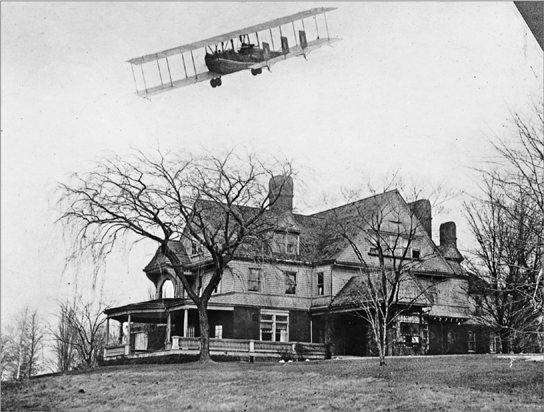
“THE WIND FROM THEIR PROPELLERS SHOOK THE BARE TREES.”
The Air Corps maintains a vigil over Sagamore Hill after TR’s death. (photo credit e.1)
THE SNOW TAPERED OFF21 around noon, when Edith and Archie, wearing his captain’s dress uniform and French war medal, received relatives and close friends at home for a valedictory service in the North Room. The Colonel’s silver-handled oak coffin was set up in front of the fireplace. Before its lid was screwed down, Ethel went through for a last glimpse of her father. “He looked22 as if he were asleep—and weary,” she recorded. “But not stern.”
She had become used to the grimness that had settled increasingly upon him during the last ten months. The coffin rested on one of his lion skins, and was covered with the Stars and Stripes, with a pair of Rough Rider flags crossed at the foot. Edith had requested no floral decorations, but raised no objection to a wreath of soft yellow mimosa blossoms, contributed at great expense by some veterans of the First U.S. Volunteer Cavalry. Yellow was the regimental color, and Roosevelt had grown to love the scent of mimosa in Brazil.
At 12:30, six undertakers wearing black skullcaps transferred the coffin to a motor hearse waiting under the porte cochère. Edith did not venture outside. In the austere tradition of Puritan widows, she retired to her bedroom alone while the rest of the house party climbed into automobiles and followed the hearse down the hill. There was no military escort. A squad of mounted policemen had ridden all the way from New York to march ahead of their former commissioner. But Archie, citing Roosevelt’s disdain for23 pompe funèbre, had asked them to wait at the church.
The cortege made slow going, carving tracks in the snowy shore road. As it approached Oyster Bay village, the cloud cover broke. A shaft of sunshine irradiated Christ Church and several thousand bystanders cordoned off by the police. Shortly before one o’clock, the hearse reached the church door.
Already a silence unrelated to the weather prevailed in most cities and large towns in the northeastern, central, and western states. Not just New York’s federal buildings, but schools, courts, firehouses, exchanges, and movie palaces closed in a show of reverence for the dead Colonel. Streetcars and subway trains ground to a halt. Factory wheels stopped spinning. The downtown financial district, so long a target of his righteous wrath, was deserted. Bell ringers in Trinity Church, St. Paul’s, and City Hall waited for 2 P.M., the presumed hour of internment of the only president born in Manhattan.
The hush was even more profound inside his parish church. Melted snow could be heard dripping from the roof. Roosevelt had requested no music of any kind. Five hundred congregants watched the coffin come down the nave, through lozenges of stained-glass light. It was still carried by the six men in skullcaps. There were no official pallbearers. Archie followed with the family party, prominently including Flora Whitney. He noticed a distraught24 William Howard Taft sitting in a rear pew, settled his companions up front, then made Taft come and join them.
Thomas Marshall sat in aloof eminence, the official bearer of a floral arrangement from the President of the United States. (It consisted of the same economical carnations that had appealed to the students of Cove School.) Charles Evans Hughes showed up, impassive behind his whiskers. Warren Harding and General Wood looked prepresidential, now that they no longer had to worry about a front-runner for next year’s Republican nomination. Henry Cabot Lodge, the senior senator present, was flanked by Hiram Johnson and Philander Chase Knox. The House was represented by the outgoing Speaker, Champ Clark, and his aged predecessor, “Uncle Joe” Cannon. Governor Al Smith of New York attended as an unwelcome envoy from Tammany Hall, and Elihu Root and Joe Murray as Roosevelt’s oldest political patrons. A democratic variety of attendees crowded the other rows, most so strange to one another that only the Colonel could have embraced them all in his vast bear hug of acquaintance.
The service was almost cruelly short and spartan. Roosevelt’s favorite hymn, “How Firm a Foundation, Ye Saints of the Lord,” was recited, rather than sung, by the Reverend George F. Talmage:
When through fiery trials25 Thy pathway shall lie,
My grace, all sufficient, shall be Thy supply.
At no time until the benediction did Father Talmage mention the name of the deceased. When he did, it evoked tears. “Theodore,” he said26, “the Lord bless thee and keep thee. The Lord make his face to shine upon thee, and be gracious to thee.”
A single pull27 of the church’s bell alerted Edith, across the bay, that her husband was beginning his final journey. Outside, the mounted police waited in formation. They were no longer to be dissuaded from forming an honor guard. Spectators sobbed as the cortege, now lengthened enormously with other automobiles, wound back toward the bend of Cove Neck.
There was no room in the tiny parking lot of Youngs Cemetery for any vehicle except the hearse. Roosevelt’s grave awaited him at the top of a steep knoll. He had always enjoyed the birdsong in that fir-forested corner, and had long ago decided he wanted to be buried there. Typically, his chosen site involved a long hard climb. Slippery snow made it even harder for the six undertakers. They bent forward at an angle of nearly forty-five degrees as they labored under their burden. Father Talmage led the way in his surplice. He had as much difficulty in avoiding a soaked front hemline as Alice, Ethel, and Flora. Big men like Taft and Wood puffed in the rear. Only a party of fifty children from Cove School trotted up the path with ease.
The graveside view made the ascent worthwhile. There was a cutting breeze, bringing with it stray whiffs of wood smoke, but the sun was now fully out, and the bay glistened half white and half bright blue. Small spirals of mist rose from the frozen reeds. Already the snow between the surrounding trees was dotted with the spoor of rabbits and squirrels.
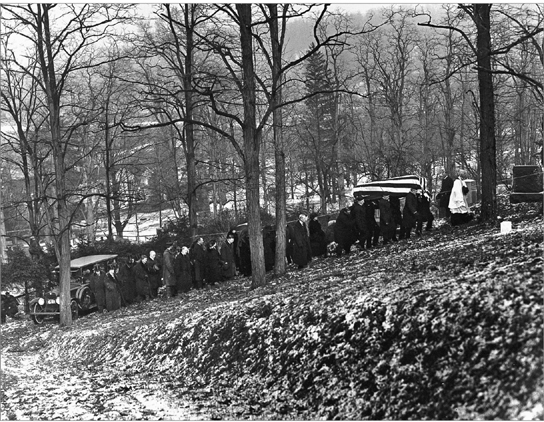
“THEY BENT FORWARD … AS THEY LABORED UNDER THEIR BURDEN.”
TR’s coffin is carried to his grave overlooking Oyster Bay, 8 January 1919. (photo credit e.2)
A laurel lining and berm of flowers camouflaged the fresh hole in the ground. Standing over it, a police bugler blew taps. Then the flag was unfolded from the coffin, revealing a rectangle of silver that read:
THEODORE ROOSEVELT
OCTOBER 27, 1858–JANUARY 6, 1919
As the engraved words28 sank out of sight, Father Talmage read the litany of committal. Lieutenant Otto Raphael29, Roosevelt’s favorite Jewish policeman, muttered his own burial prayer in Hebrew. A flight of white geese wheeled and settled in the cove.
One of the last30 mourners to remain behind, while the rest of the company straggled downhill, was Taft. He stood by the grave for a long time, crying.
IN SUBSEQUENT DAYS and weeks, commentators and orators made up for the lack of a eulogy at the Colonel’s funeral. He had died so suddenly, and the glory of America’s late but decisive role in ending the world war had so plainly been earned at his urging, that he was at once invested with a godlike glow. The acolytes who had venerated him for so long—the Lawrence Abbotts, the Gifford Pinchots, the Julian Streets—resorted to levels of hyperbole not heard since the assassination of Lincoln. Given the poignancy of his sufferings over the last year, a considerable minority of Roosevelt-haters elected to keep their opinions private for the time being. Even H. L. Mencken reserved fire. “The man was31 a liar, a braggart, a bully, and a fraud,” he wrote a friend. “But let us not speak evil of the dead.”
Among the superlatives32 granted Roosevelt by those who belonged to neither extreme camp, simple words came nearest to sincerity. “He was the most encouraging person that ever breathed,” Edna Ferber declared, on behalf of all the writers and artists he had befriended. “The strongest character in the world has died,” Will H. Hays said to a reporter. “I have never known another person so vital,” wrote William Allen White, “nor another man so dear.”
Woodrow Wilson’s sentiments33, conveyed in his proclamation of national mourning and a cable to Edith Roosevelt, were pro forma. This was to be expected from a head of state engaged in complex negotiations abroad. But two of his closest aides, Edward M. House and William G. McAdoo, verged on indiscretion in proclaiming Theodore Roosevelt one of the greatest of presidents. Newspapers that had savaged Roosevelt consistently throughout his career ran eloquent editorials. The New York Sun predicted that he would endure as a colossus in American history. “There are personalities so vivid, there is vitality so intense, so magnetically alert, as Motley said of Henry of Navarre, that ‘at the very mention of the name, the figure seems to leap from the mists of the past, instinct with ruddy, vigorous life.’ ” The New York Evening Post agreed:
Something like a superman34 in the political sphere has passed away. He saw the nation steadily and he saw it whole. Where other politicians dealt with individuals, Mr. Roosevelt reached out for vast groups.… He boldly thrust out his hand and captured the hearts and the suffrages of a whole race, an entire church, a block of states. Never have we had a politician who, with such an appearance of effortless ease, drew after him great masses and moulded them to his will.
From flag-bedecked platforms and pulpits in London (where for the first time in history a memorial service displaced evensong at Westminster Abbey), Paris, Rome, and throughout the Allied zone of occupancy in Germany, foreign speakers vied with American ones in celebrating the man who was commonly seen as instrumental in awakening his country to its social and strategic responsibilities. He was hailed35 as a liberator by Cubans and Serbs. Representatives of a nation only three months old announced that “Theodore Roosevelt was always a great friend of the Czechoslovaks.” In Tokyo, he was remembered as the peacemaker of the Russo-Japanese War and “perhaps the only great American who understood us.” Long biographies and appreciations were published in the major European newspapers. Jules Jusserand, who of all diplomats knew the Colonel best, had to be discreet in praising him at President Wilson’s elbow in Paris, but in private he was panegyrical. “I met in him a man of such extraordinary power that to find a second at the same time on this globe would have been an impossibility; a man whom to associate with was a liberal education, and who could be in every way likened to radium, for warmth, force and light emanated from him and no spending of it could ever diminish his store.”
The tribute most awaited in Washington was that of Senator Henry Cabot Lodge. He addressed a joint memorial session of Congress on 9 February in the presence of two thousand rapt listeners, including Taft, members of the Supreme Court, and officers of the cabinet, armed services, and diplomatic corps. His survey of36 the life and accomplishments of his oldest friend lasted almost two hours. With characteristic erudition, he began with an Arab lament, A tower is fallen, a star is set! Alas! Alas!, and ended with a quotation from John Bunyan, describing the passage of Mr. Valiant-for-Truth across the river of death: “So he passed over, and all the trumpets sounded for him on the other side.” By then Lodge was so overcome he half-fell back into his seat, and silence filled the House chamber.
THE EULOGIES AND POEMS and memorial proceedings had hardly been printed and bound before the worshipful biographies began to appear. William Draper Lewis’s The Life of Theodore Roosevelt and William Roscoe Thayer’s Theodore Roosevelt: An Intimate Biographywere substantial studies, reflecting some personal acquaintance with the great man, but their incense content was only a few degrees less fragrant than that of Lawrence Abbott’s Impressions of Theodore Roosevelt, Niel MacIntyre’s Great-heart, and William Hard’sTheodore Roosevelt: A Tribute.
Expectations were high that the authorized biography by Joseph Bucklin Bishop would be a scholarly and unbiased corrective. But Bishop was not yet ready to publish. Then in November 1919 Stuart Sherman, who had savaged Roosevelt in The Nation two years before, published a review of the hagiographies. Entitled “Roosevelt and the National Psychology,” it amounted to the first effective attack on the Colonel’s posthumous reputation.
“Mr. Roosevelt’s great37 and fascinating personality,” he began, “is part of the national wealth, and should, so far as possible, be preserved undiminished.” But those who insisted in canonizing a man so lustily, imperfectly, and on occasion tragically human offered posterity nothing more than “a whitewashed plaster bust.” Noting that the Colonel was always clear-eyed about himself, Sherman quoted his negative response in 1918 to a friend who told him he would be President again: “No, not I.… I made too many enemies, and the people are tired of my candidacy.” Roosevelt had understood then what his worshippers refused to allow—that both he and the American people had changed since his glory days at the turn of the century. And in changing, it was the people, not he, who had moved ahead.
Sherman looked back at the life of Theodore Roosevelt and found it to be a three-act drama, ultimately tragic because the protagonist had been brought down by his own gifts. First there was the young reformer, alone among the money-grubbing or inheritance-squandering materialists who dominated American society in the eighties and nineties, preaching and personifying his famous gospel of the Strenuous Life. “Under the influence of this masterful force, the unimaginative plutocratic psychology was steadily metamorphosed into the psychology of efficient, militant, imperialistic nationalism.” So long as the United States had no army to speak of, and no empire to fatten on, the energies Roosevelt had inspired had pushed toward a more perfect Union. But then, with amazing swiftness, both he and the nation had been elevated to supreme power.
As president, Roosevelt had been even more strenuous, establishing an ideal in the popular mind of a federal government as virile, incorruptible, and morally driven as himself. Panama should have been a warning to his supporters that the reformer at home was an imperialist abroad, but then and now, the American people had little understanding of foreign affairs.
It was not until Roosevelt visited Germany in 1910 that the imperial strain had begun to overmaster him. His address to the University of Berlin had shown the degenerative process at work, even as he spoke. Sherman quoted a “beautiful” passage from that speech, It is only by working along the lines laid down by philanthropists, by lovers of mankind, that we can be more sure of lifting our civilization to a higher and more permanent plane of well-being, and asked if any reader, nine years later, heard in them the authentic note of the Colonel’s voice. He then quoted the sentences immediately following: But woe to the nation that does not make ready to hold its own in time of need against all who would harm it. And woe thrice over to the nation in which the average man loses his fighting edge. Time and again thereafter, and compulsively during the war years, Roosevelt had indulged this rhetorical tic: always, first, the salute to men of benign instinct, then the harsh warning that if they did not fight and breed, they were doomed. In doing so, the former straight talker had become “the greatest concocter of ‘weasel’ paragraphs on record.” His misfortune was that when Americans found out that he was less interested in fighting for social justice than fighting for fighting’s sake, they had shown themselves unwilling to be either patronized or cajoled.
Summarizing, Sherman felt that Roosevelt had been more of an autocrat than a democrat, a warrior, not a peacemaker, a man of action who scoffed at philosophical scruples. His end had been tragic, Yet there was something undeniably epic about him:
Mr. Roosevelt has attained38 satisfactions which he thought should console fallen empires: he has left heirs and a glorious memory. How much more glorious it might have been if in his great personality there had been planted a spark of magnanimity. If, after he had drunk of personal glory like a Scandinavian giant, he had lent his giant strength to a cause of the plain people not of his contriving nor under his leadership. If in addition to helping win the war he had identified himself with the attainment of its one grand popular object. From performing this supreme service he was prevented by defects of temper which he condemned in Cromwell, a hero who he admired and in some respects strikingly resembled.
THESE EXCHANGES BETWEEN the wholeheartedly adoring and the ambivalently disparaging set the tone for seventy years of retrospective controversy. But for the postwar decade and beyond, it was Roosevelt the hero, “Theodore Rex” the masterful president, “Teddy” the lovable39 who loomed in popular perception. A powerful stimulant to nostalgia for him was the publication in late 1919 of Theodore Roosevelt’s Letters to His Children, the book of all his books40 he had most wanted to see in print. An instant bestseller, it revealed the Colonel to have been, behind his often grim public face, the most delightful of private correspondents, able to express adult feelings in language (and hilarious pictograms) that enchanted the young.
By the end of that year, as Roosevelt’s historical stock surged, that of Woodrow Wilson—outmaneuvered by Clemenceau and Lloyd George at the Paris Peace Conference, thwarted by Henry Cabot Lodge and other senatorial opponents of his cherished League of Nations treaty—fell precipitously. He collapsed of a stroke and became a peevish recluse for the rest of his presidency. Scholars wondered whether any head of state since Napoleon had ever suffered such a loss of power. The concurrent rise of Warren Gamaliel Harding as the Republican Party’s challenge to everything Wilson had ever stood for led to a rout of Democratic candidates in the presidential election of 1920. Most of the sixteen million men and women who voted for Harding, in a landslide victory, did so to honor the memory of the candidate they would unquestionably have preferred, had Roosevelt lived to run again.
Joseph Bucklin Bishop’s official life of the Colonel came out that fall: two dignified volumes entitled Theodore Roosevelt and His Time: Shown in His Own Letters. There were the requisite iconic frontispieces, protected with flaps of tissue paper. The scholarship was dogged, the coverage ample (if selective), and the index beyond reproach. But the overall tone was so reverential that only the occasional “scoop” document, such as Roosevelt’s mammoth 1911 letter41 describing his European tour, infused the dryasdust pages with the breath of life.
Even more monumental, in its clothbound, gold-stamped breadth and bulk, was Hermann Hagedorn’s Memorial Edition of The Works of Theodore Roosevelt, issued between 1923 and 1926 in twenty-four volumes. Merely to divide that number into the years of Roosevelt’s adult life, allowing for the fact that he had spent nearly eight years as president, was to be persuaded by William Allen White’s remark: “The man was42 gigantic.”
A Women’s Roosevelt Memorial Association was formed to reconstruct the Colonel’s vanished birthplace, at 28 East Twentieth Street in Manhattan, as a museum and educational center. Designed by a Lusitania survivor, Theodate Pope Riddle, in consultation with the two surviving Roosevelt sisters, it was dedicated to the public as “Roosevelt House” in 1923. Four female trumpeters43 in Grecian robes blew a voluntary over the entryway where Teedie Roosevelt and Edie Carow had sat reading over half a century before.
Simultaneously, a rival, masculine Roosevelt Memorial Association launched a campaign to create shrines in Washington, D.C., and downtown Oyster Bay, Long Island. (Sagamore Hill was obviously destined to become another such site one day, but for as long as Edith survived, it would remain her private property.) The group, dominated by Hermann Hagedorn as executive director and backed by such dignitaries as Elihu Root and Leonard Wood, took advantage of Roosevelt’s posthumous reputation to accumulate an impressive fund for the Washington memorial. In 1925, Hagedorn44 unveiled a design for it, by John Russell Pope, which was so grandiloquent—a two-hundred-foot ejaculation of Potomac water from a white granite island in Tidal Bay, triangulated between the Lincoln and Washington monuments—that even President Coolidge wondered if more time should not pass before Theodore Roosevelt was accorded his proper place in history. Southern lobbyists planning a Jefferson memorial for the site successfully held the RMA off.
Meanwhile the sculptor Gutzon Borglum, who had been among the Progressive delegates nominating Roosevelt for president in 1912, conceived of a bas-relief in the Black Hills of South Dakota that would proclaim the Rough Rider unequivocally, and for all time, as the co-equal of Washington, Jefferson, and Lincoln. Not for him Pope’s fragile fountain, subject to winds, ice, and drought. He meant to carve his quartet out of imperishable rock, each face sixty feet high. Coolidge agreed to write an appropriate entablature, identifying them in English, Latin, and Sanskrit. In October 1927, the first contours of Washington’s face began to emerge from Mount Rushmore. The other three colossi would have to wait their turn.
By the end of the decade, Theodore Roosevelt was commonly regarded as the third greatest American president, after Washington and Lincoln. Then, in 1931, Henry F. Pringle, a political journalist whose only previous book was a study of the government of Al Smith, published Theodore Roosevelt: A Biography. Soundly researched and brilliantly written, it coincided not only with the onset of the Great Depression—that apparent proof of the vanity of American ideals—but with a postwar revulsion against military values, and a consensus among those making policy never again to attempt the kind of democratic imperialism that Roosevelt (and for that matter Woodrow Wilson) had wished upon the world.
More damaging still was the fact that Pringle was the first major biographer who declined to take Roosevelt seriously. He mocked the Rough Rider’s fake humility and, with documentary evidence and authoritative anecdote, demolished many legends that Hagedorn and others had so long taken as gospel. He made full use of the Roosevelt presidential papers on deposit in the Library of Congress, and was clever enough to conceal the fact that he knew little about the final decade of his subject’s life. If he was often unfair, his prejudice was excusable as a reaction against too much myth. When the time came to award that year’s Pulitzer Prize for biography, Pringle was the obvious recipient.
Undeterred in 1931, the Roosevelt Memorial Association purchased Analostan Island in the Potomac as a new site for their shrine. But by then, the Colonel had already become such a caricature in some circles that cynics predicted the island would never be more than a base for a bridge.
THE FOLLOWING NOVEMBER, Roosevelt’s self-proclaimed “fifth cousin by blood45 and nephew by law” was elected President of the United States. For most of Franklin’s life, he had had to contend with the fact that his surname famously denoted someone else. Now the reverse began to apply.
Franklin was generous enough, and sincere, in insisting that Cousin Theodore was “the greatest man I ever knew.”46 He had managed, despite the crippling misfortune of polio, to get where he was by emulating the Colonel’s career path: from Harvard via the New York legislature to the Navy Department, and then on to Albany as governor of New York. He had even run unsuccessfully for vice president. But it was clear from the moment of his inauguration in 1933 that the new “Roosevelt” would henceforth make his own imperious way.
Theodore Roosevelt, Jr47., had less luck in trying to emulate the late Colonel. Retiring from the army with a chestful of decorations—the Distinguished Service Cross, the Silver Star, the Purple Heart, and the Croix de Guerre—he entered politics and successively became a New York State assemblyman, assistant secretary of the navy, and Republican nominee for the governorship of New York in 1924. But innocent involvement in the Harding administration’s “Teapot Dome” oil-field-leasing scandal compromised his campaign against the incumbent governor, Al Smith. Ted’s diminutive stature, face-dividing grin, and harsh cries of “Bully” did not evoke enough memories of his father to beguile the electorate, and Cousin Eleanor made things48 worse by barnstorming the state in an automobile reconfigured as a teapot. He was badly defeated, in a presidential election year that otherwise went well for the GOP.
President Hoover appointed Ted governor of Puerto Rico, and then of the Philippines. He was a popular and able administrator, but Franklin’s election ended his political career, and he became an executive of the publishing house of Doubleday, Doran & Co. In further imitation of his father, he built a mansion on the grounds of Sagamore Hill, and became notoriously bookish, given to loud recitations of Kipling and Omar Khayyám. It was a question49 whether Ted or Alice—the sibling he felt closest to—was the more vituperative in criticizing the New Deal as a perversion of the Square.
Brother and sister were both “American Firsters” in the early days of World War II. But Ted’s Plattsburg conscience soon prompted him to switch from isolationism to principled support of the administration’s preparedness program. A week after Pearl Harbor, he was appointed a brigadier general on active duty, and from June 1942 through 1943 fought with wild courage in North Africa and Italy. Although he was fifty-six on the countdown to D-Day, and wizened and lame with arthritis, he persuaded General Omar Bradley that his presence in Normandy would be inspirational to the assaulting forces. On 6 June 1944, Ted hobbled ashore from the first boat to hit Utah beach, and at once took command of a landing operation that threatened to degenerate into bloody chaos. His all-day heroism under constant fire won him the Medal of Honor. General Roosevelt was chosen to lead the Ninetieth Division into further battle, but on the eve of his appointment on 12 July, he died of a heart attack. He was buried in Normandy two days later, on the twenty-sixth anniversary of Quentin’s death. General George Patton, an honorary pallbearer at the funeral, described Ted as “one of the bravest50 men I have ever known.”
Kermit Roosevelt never recovered from the sensation, on hearing of the death of his father, that he had nothing left to stand on51. A proficient but not a natural soldier, he wrote a book about his service in Mesopotamia, War in the Garden of Eden52, and spent the immediate postwar years building up a mercantile business, the Roosevelt Steamship Company. He remained a shipping executive with various lines throughout the 1930s. Commerce satisfied Kermit no more than banking. His nomadic nature53 and marvelous talent for languages fought against the confinements of marriage and work. Depression steadily claimed him. He became a philanderer and insatiable drinker and, as his body thickened, developed a startling resemblance to his father. Dour and bloated, he rejoined the British army as soon as Hitler invaded Poland in 1939. He drove himself to fight well at the Battle of Narvik, but the condition of his heart—that vulnerable organ of so many Roosevelts—alarmed regimental medics, and he was declared unfit for further service. Returning stateside in 1941, he drank himself to the point of collapse and had to be institutionalized. The President, who had a soft spot for Kermit as a Democrat malgré lui, heard about his dereliction and appointed him a major in the U.S. Army in Alaska, far from the fleshpots of New York. There, on 4 June 1943, Kermit killed himself with a bullet to his head.
Archie went to work54 in 1920 for the oil company that was to embarrass his eldest brother. He resigned with belated outrage when the Teapot Dome scandal broke. Never one to dissemble his moral opinions, Archie testified against Sinclair Oil before a Senate investigative committee in 1924. After that he went into investment banking and spent the rest of his civilian career as a municipal bond salesman. He prospered enough to survive the Great Depression, living a quiet family life with his beloved “Gracie.” Like Ted, Archie was an isolationist at the beginning of World War II. But the waters of Pearl Harbor had hardly resettled in December 1941 before he was back in uniform as a lieutenant colonel. Fighting on Biak Island, New Guinea, in May 1944 he was wounded in the same arm and leg that had been so severely shattered a quarter-century before. In a further replay of the events of 1918, he was awarded another Purple Heart and Silver Star and sent home to convalesce. On VJ-Day, he was the last of Theodore Roosevelt’s sons still alive.
He did not age well, turning to Scotch and Communist-bashing as antidotes to the constant pain of his war wounds. During the McCarthy era, his conservatism deteriorated into political paranoia. His only attempt at a book, apart from an unfinished, conspiracist memoir, was a selection of55 some of his father’s worst speeches, published in 1968 as Theodore Roosevelt on Race, Riots, Reds, Crime. According to Archie, President Roosevelt had railed in 1903 against the civic threat posed by “Beatniks.”56 Family members hurriedly bought up as much of the print run as could be found in bookstores and let the old warrior go into retirement. As he lay dying in 1979, a confused recluse in Florida, he kept repeating, “I’m going to57 Sagamore Hill.”
Each of Theodore Roosevelt’s sons except Quentin fathered four children. Ethel and Richard Derby also contributed four, although little Richard died prematurely at age eight. Ethel survived until 1977, outliving Dr. Derby by fourteen years. In most respects private and shy, a Republican supporter of the civil rights movement, she retained in old age a startling ability to bellow the word “Americanism”58 at dinner parties.
Flora Whitney died59 in 1986, inevitably written off as “a wealthy socialite.” Having become, at age twenty-one, almost a widow and almost a daughter to Quentin’s parents, she spent a year trying to recover from his death—not to mention the Colonel’s. A statue of Flora carved by her mother early in 1919 shows her hollow-eyed beneath a bandeau, trying to force herself into the depths of a small armchair. In 1920 she married one of Quentin’s Harvard friends, but found him an inadequate substitute. Her second marriage, to the artist George Macculloch Miller III, was successful. Flora fulfilled herself further by becoming the rescuer, dominant executive, and lifetime patron of the Whitney Museum of American Art.
The last person anyone would have expected to add to the number of Roosevelt grandchildren was Alice, who in 1925 scandalized le tout Georgetown by producing an unmistakable, female miniature of Senator Borah. Alice was then forty-one years old, and delighted at her achievement. “Hell, yes60, isn’t it wonderful?” She never confirmed or denied Paulina Longworth’s paternity. Nick loved Paulina on sight and for the rest of his life treated her as his legitimate daughter. He became Speaker of the House of Representatives that same year, and remained in that office until a few weeks before his death in 1931.
Alice, first of Theodore Roosevelt’s children to be born, was the final one to die, in 1980. By then she had been for at least six decades the acidulous, eccentric doyenne of Washington society, fawned over by presidents of every political stamp. Invitations to her famous dinners, at which she would convulse guests with imitations of Cousin Eleanor, were as prized as passes to the White House. Her attempts at writing—a family memoir and an aborted newspaper column—had nothing of the charm of her talk, which made something like poetry out of the non sequitur. Some of it was captured and distilled by an Englishman, Michael Teague, whose Mrs. L: Conversations with Alice Roosevelt Longworth was published in 1981. It amounted to a transcribed recording of the kind of erudite wit that used to be prized in the days when the well-born were also, by definition, the well-read.
Edith Kermit Roosevelt died in 1948 at the age of eighty-seven, still living in Sagamore Hill and surrounded with the Colonel’s books, guns, hides, horns, and glittering prizes, as if he were still liable to burst through the door with reporters in tow. By then she had adjusted, if not to bereavement of him, to the deaths in war of Quentin, Kermit, and Ted, comforting herself with grandchildren and her lifelong passion for reading61. Her memories in her final, bedridden days extended back from the present, disagreeably dominated by Harry Truman, through seventeen administrations to that of Abraham Lincoln. Perhaps the earliest62 of these impressions (confirmed to her amazement by a visitor with a photograph) was of standing with six-year-old “Teedie” Roosevelt in a window overlooking Broadway, on the day that the Emancipator’s funeral procession came uptown, to a thump of drums.
AFTER THE OLD WOMAN had been buried beside her husband in Youngs Cemetery, the Roosevelt Memorial Association moved to execute its long-postponed plan to buy and restore Sagamore Hill as a museum. The purchase was announced in 1949, with a certain amount of weariness on the part of Hermann Hagedorn, who had yet to see his idol’s image recover from the desecration inflicted on it by Henry Pringle. Indeed, the RMA would soon have to rename itself the Theodore Roosevelt Association, to make clear to donors which president it wished to celebrate.
The enduring influence of Pringle’s book, however, was salutary, in that it compelled scholars to assess the Colonel as a man, and not a god or monster. Between 1951 and 1954, Harvard University published The Letters of Theodore Roosevelt in eight massive volumes. Edited and annotated with impeccable scholarship by Elting E. Morison, John M. Blum, and others, the series effectively filled a lacuna63 left by the Memorial Edition of The Works of Theodore Roosevelt thirty years before. It was perhaps even more impressive in its totality than the Hagedorn set—and not just because Morison admitted that his team had eliminated ten letters for every one of the fifteen thousand he printed. Excepting those frankly addressed to “posterity,” most were written only to be read by the recipients, and revealed a more personal Roosevelt than books and speeches he had meant for print. And the Colonel in his self-revelation proved to be, in Julian Street’s updatable phrase, arguably “the most interesting American” who ever lived.
In 1958, the year of the centennial of his birth, Carleton Putnam published Theodore Roosevelt: The Formative Years, a superb piece of scholarship that was intended to be the first part of a four-volume biography. Only one small, significant omission marred the book’s narrative flow: the fact that the young Roosevelt, attending his first Republican convention in 1884, had sought to put a black man in the chair. Putnam proved to be a retired airline executive living in Virginia, whose racial views distracted him to such an extent that his book was not followed by any sequel.
Edward Wagenknecht’s The Seven Worlds of Theodore Roosevelt also came out in 1958. It was a revelatory character study that avoided psychobiography and presented only facts, culled from what seemed to be a reading of every book and manuscript in the Theodore Roosevelt Collection64 at Harvard. Viewing “T.R.” as a sort of solar system of linked but separate worlds (those of Action, Thought, Human Relations, Family, Spiritual Values, Public Affairs, and War and Peace), it compressed in fewer than three hundred pages the fundamentals of a polygonal personality.
Three years later, a major one-volume biography appeared. It was William Henry Harbaugh’s The Life and Times of Theodore Roosevelt, a determinedly objective book that exposed the work of Henry Pringle as superficial. The ponderousness of Harbaugh’s prose lent weight to his concluding observation:
Whatever the Colonel’s65 ultimate place in the hearts of his countrymen—and it yearly grows warmer and warmer—there is no discounting those incisive perceptions and momentous actions that made him such a dynamic historical force.… Long after the rationalizations, the compromises, the infights, the intolerance and the rest have been forgotten, Theodore Roosevelt will be remembered as the first great President-reformer of the modern industrial era.
Signs of the warming trend that Harbaugh spoke of proliferated after Sagamore Hill was declared a National Historic Site in 1962. President Kennedy signed the act of acquisition. On 22 November 196366 he flew to Texas with a speech he intended to deliver at the Dallas Trade Mart, extensively quoting Theodore Roosevelt on foreign policy. The speech was not given, but subsequent presidents showed an increasing willingness to admire, and even identify with, the Republican Roosevelt.
Richard Nixon invoked67 the image of “the man in the arena” so often, and with such relish in its details of dust and sweat and blood, as to suggest that he found them masochistically agreeable. After resigning his office on 9 August 1974 he bade farewell to White House staffers with a moving, if irrelevant, quotation from In Memory of My Darling Wife, the eulogy Roosevelt had written for Alice Hathaway Lee ninety years before. Weeping, Nixon observed, “That was TR in his twenties. He thought the light had gone out of his life forever—but he went on.”
The Vietnam War era climaxing with Nixon’s debasement saw the rise of a presentist subculture among historians who, rejecting Harbaugh, continued to see Theodore Roosevelt as a bully, warmonger, and racist. He was castigated for being unaware of the civil rights movement, free sex, meditation, and mutually assured destruction. This revisionism nevertheless drew useful parallels, such as that between the massacres of My Lai in 1968 and Moro Crater in 1906—the latter inflicted on Filipino rebels by General Leonard Wood with no dissenting word from his commander in chief.
Although doubts on the New Left about Roosevelt’s imperialistic “Americanism” persisted through the decade, two biographies at the end of it marked the beginning of a more objective reassessment that steadily gathered force. This writer’s The Rise of Theodore Roosevelt (1979) and David McCullough’s Mornings on Horseback (1981) won literary prizes, and reassured post-Watergate readers that whatever Roosevelt “went on” to, after his twenties, had not been an abuse of presidential power. They coincided with the appearance of Sylvia Jukes Morris’s Edith Kermit Roosevelt: Portrait of a First Lady (1980), which documented one of the great marriages in American history.
Three decades later68, the shifting sands of historiography seem to have allowed the monolith of Theodore Roosevelt to settle. Sand being sand, nothing of his future reputation can be predicted. He is still buffeted by revisionist storms, some emanating from academe and obsessing on the latest idée fixe in that quarter, “masculinity.” But the prevailing breeze of popular opinion is favorable. A C-SPAN survey in 2009, rating the leadership of American presidents, placed “T. Roosevelt” at number four, after Washington, Lincoln, and Franklin Roosevelt. Substantial books on him continue to appear and are eagerly read. Three recent69 examples, by Kathleen Dalton, Candice Millard, and Patricia O’Toole, demonstrate that for all the Rough Rider’s machismo, fair-minded women feel no need to condescend to him. Douglas Brinkley’s study of the Rooseveltian conservation record, The Wilderness Warrior: Theodore Roosevelt and the Crusade for America (2009) became a national bestseller even though it was over nine hundred pages long.
THE EMPLACEMENT of Theodore Roosevelt Bridge across the Potomac River in Washington gives many commuters the impression that it, and not the forested island beneath, is the twenty-sixth President’s official memorial. Somewhere among those trees, however, he stands eighteen feet tall, one bronze fist upraised, eternally lecturing the doves and mockingbirds.
Solemn words are carved on granite tablets nearby. But they, and all the millions of others that have been published about him, come no closer to the truth than those of a small boy in Cove School, Oyster Bay, on June 16, 1922. As part of a class exercise paying tribute to the late Colonel, Thomas Maher wrote: “He was a fulfiller70 of good intentions.”