

Ye gods that have a home beyond the world,
Ye that have eyes for all man’s agony,
Ye that have seen this woe that we have seen,—
Look with a just regard,
And with an even grace,
Here on the shattered corpse of a shattered king,
Here on a suffering world where men grow old,
And wander like sad shadows till, at last,
Out of the flare of life,
Out of the whirl of years,
Into the mist they go,
Into the mist of death.
WHEN AMERICAN FORCES2 ADVANCED through the tiny village of Chamery, in the Marne province of France, they came upon a cross-shaped fragment of a Nieuport fighter sticking out of a field just east of the road to Coulonges. Some German soldier had taken a knife and scratched on it the word ROOSEVELT. It marked Quentin’s grave, and a few yards away the rest of his plane lay wrecked. By the time the last troops passed on toward Reims, nothing was left except the cross. All other bits of the Nieuport had been reverently stolen.
The autopsy3 performed by the Germans before Quentin’s burial indicated that he had been killed before he crashed. Two bullets had passed through his brain. He had been thrown out on impact, and photographed where he fell.

WOODROW WILSON’S TELEGRAM4 of Saturday, 20 July 1918 (“Am greatly distressed that your son’s death is confirmed. I had hoped for other news”), was not the last blow to strike the Roosevelts that weekend. It was followed within hours by a cable from Eleanor stating that Ted had been hurt in action. She said his wound was not serious. But she had also been reassuring about Quentin.
Ted was a casualty of the counteroffensive headlined in forty-two-point type across the top of Sunday morning’s front page of The New York Times: ALL GERMANS PUSHED BACK OVER THE MARNE; ALLIES GAIN THREE MILES SOUTH OF SOISSONS; NOW HOLD 20,000 PRISONERS AND 400 GUNS. Under such a banner, the story about him (“Oldest Roosevelt Son Is Wounded: News of Theodore’s Injury Comes on Heels of Confirmation of Quentin’s Death”) drew the eye much more than another given exactly the same columnar weight: “Ex-Tsar of Russia5 Killed by Order of Ural Soviet.”
Theodore and Edith therefore had an added reason to attend early mass and adjust, or try to adjust, to the enormity of the void that had opened so suddenly in their landscape. But they had to brace for a special order of service. That Sunday happened6 to be the third of the month, when the names of all parish members serving the country were read out. Quentin’s was not included. He was the first citizen of Oyster Bay to be killed in the war.
They returned home7 in luxurious sunshine to receive what promised to be an unendurable number of condolence calls. One, late in the afternoon, was from Flora. She was, in Ethel’s words, “perfectly wonderful … calm and controlled.” A less sentimental person might have perceived that the girl was in a state of near catatonia, so stiff with shock that she could neither think nor feel. Flora wanted to be alone, but irrationally wanted to share her solitude with those equally bereft—the Colonel above all. As he received mourners and endured their attempts at comfort, he gave no sign of desolation, emanating only what Corinne called an “ineffable gentleness.”
Quentin had died so young, without building an adult life away from home, that Sagamore Hill was still infused with his personality. Edith, better equipped to handle the catastrophe than her husband, saw that what was needed for them all was to get away from the house. She said to Ethel, “Why not come8 to Islesboro to see you?” Theodore had never visited that part of Maine, where the Derby family had summered for decades. Its strangeness alone would be a distraction. Little Richard and tiny “Edie” would be there to administer innocent therapy, and Flora could come too, if she felt like it.
Ethel went north at once to prepare to receive them. Behind her she left details of the itinerary they were to follow on Thursday. They must take an overnight Pullman from New York to Rockland, then transfer to a small steamer that would deposit them on the south end of Islesboro, at a place called Dark Harbor.
THE LANDING DID NOT at first sight justify its depressing name, being an inlet full of morning light. But the gray and brown-shingled “cottages”9 of New England patriarchs looming through stands of pine, hump-roofed and dormered above their rubblestone terraces, did their best to uglify the shoreline and camouflage the fortunes that secluded Dark Harbor from poorer parts of Islesboro. If Ethel had hesitated to marry, she had at least married well. This year she was staying not in the big Derby house, with its black timbers and prisonlike Norman tower, but in a smaller cottage owned by a Wall Street accountant. It surveyed Penobscot Bay from the top of a knoll and had the virtue of a breezy piazza sheltered from the afternoon sun. Importantly for Roosevelt, who liked to keep mobile even when reading, there was a rocking chair on the porch, and a rowboat at the foot of some granite steps cut down to the sea.
He and Edith arrived10 on Friday unannounced, but an islander at the dock recognized them and called out, “Three cheers for the man who ought to be in France.” Ethel was waiting to greet her parents. As they rode off in a buggy—Islesboro permitted no automobiles—the Colonel was seen to be already deep in conversation with Richard and Edie.
“In time11 of trouble, the unconsciousness of children is often a great comfort,” he wrote Belle later.
That was even12 more so for Edith than for himself. Although she had to be, in her own expression, the central card upon which the rest of the Roosevelt pack leaned, her pain was unassuageable. She could not indulge, as Theodore did, in conventional pieties about Quentin dying “as the heroes of old died, as brave and fearless men must die when a great cause calls”—words that betrayed his inability, so far, to grasp his own responsibility in the matter. For Archie, born to fight and be wounded and fight again, Edith was capable of smashing a triumphal glass to the floor; for Quentin, constituted differently, she made a gesture more womanly than melodramatic. She said she would not wear black for him. White summer linen better expressed his obliteration.
There was blackness enough, in and around Dark Harbor, to reflect her husband’s grief and guilt over the next two weeks. He often rowed out alone, past coal-black rocks and pebble beaches blackening as the tide washed in. Great piles of blue-black clamshells along the shore memorialized the island’s vanished Indians. Black-headed loons yodeled. He wrote Kermit that from out in the bay, “I can see13 the moose, caribou and black bear in the glades or by the pools—ghosts all!”
Nevertheless, the place14 was purifying, with its salt- and balsam-scented breezes and lack of mainland noise. Pious Ethel conducted household prayers every night. Except for a patriotic address that Roosevelt felt he had to give one Sunday at the Islesboro Inn, he and Edith were left undisturbed. An almost mute Flora came north on 6 August to be with them for their last four days. She confided to Ethel that she seemed incapable of feeling anything “except occasionally a great overpowering hurt.”
“It is no use15 pretending that Quentin’s death is not very terrible,” Roosevelt wrote Belle on the eve of their departure from the island. “There is nothing to comfort Flora at the moment; but she is young.… As for Mother, her heart will ache for Quentin until she dies.”
THEY WERE ALL BRACING for the delivery of a trunk of personal effects that Ham Coolidge had promised Quentin he would send to Sagamore Hill, in the event of it becoming surplus equipment.
It arrived, packed by Ham but also reflecting, in the orderliness of its contents (such as a sheaf of Flora’s letters, neatly numbered and tied) Quentin’s integrated personality. The mechanic in him had enjoyed fitting things together, in sequences that made for power or taut structure. Even his poems16 were balanced, their meter meticulous, their rhyme schemes sometimes complex—abcccb, adcccd—but logical.
As Edith and Flora undertook the task of going through these leavings of a life, Roosevelt and Miss Stricker tried to extract, from an inpouring of condolence letters and newspaper tributes, some sense of the man Quentin had become during the year he had spent in France. The most informative testimony came from fellow aviators, who wrote that he was a reincarnation of his father—specifically, the young “Teedie” who had so enlivened the Harvard class of 1880. Emerging from their reminiscences was a jovial, toothy, myopic, often wildly exuberant youth, garrulous and gregarious, courtly toward women, with a habit of bursting into rooms and attracting instant attention.
There was little evidence, however, of the personal momentum that had always characterized the Colonel. Quentin’s energy had been explosive rather than propulsive17. And often he had suffered the drag of depression—a “black gloom”18 that he could not hide from Ham Coolidge, and freely confessed to Flora. It was more chronic than the rare attacks of melancholy that Roosevelt had no trouble surmounting. As Edith had19 long ago remarked, Quentin was “a complex sort of person,” with a tendency to “smoulder.”
Only in two20 respects had he ever approached fulfillment: as a boy born to fly, and as Flora’s lover. Test-piloting21 a French Spad, he wrote that he had felt “part of the machine,” as if it were an extension of his own body. “It asks you for what it wants.… If it gets a puff under a wing and wants an aileron to take care of it, you can feel it in the pressure of the stick.… Same with the flippers.” His last 120 h.p. Nieuport had been just as responsive: “You can climb at the most astonishing rate,—& do perfectly wickedchandelles.”*
So Quentin had written Flora, confident she would share his delight, even if she wondered what candles had to do with it. As he was part of his plane, she was part of him. “The months that22 have gone, instead of blurring, have etched you deeper and deeper into my heart.”
The most consolation she could give herself was to say, numbly, “His back will23 never hurt him now.”
IN HIS OXFORD LECTURE on biological analogies in history, Roosevelt had spoken of the tertiary period, wherein “form succeeds form24, type succeeds type, in obedience to laws of evolution, of progress and retrogression, of development and death.” He was now in his own such transition, moving into a precipitous decline that was as much disillusionment as grief. Only twice before had he suffered as much—at nineteen, when his father died, and at twenty-four, when the loss of his first wife and mother, in the same house on the same night, had almost unhinged him. But then he had been young and full of growth. Neither catastrophe had taught him anything about himself except that he was strong enough to survive.
The death of Quentin, in contrast, hit him after a spring in which he had himself nearly died, and toward the end of a decade that he had always said would be his last. Archie’s narrow escape and Ted’s gassing had prepared him for worse news from the Front, but the tension inherent in such anticipation had, paradoxically, weakened him, the longer he braced himself. Roosevelt had little physical resilience any more. Cuban and Amazonian pathogens were rampant in his system, which had been further battered by erysipelas and a recent attack of ptomaine poisoning25.
But what made this loss so devastating to him was the truth it conveyed: that death in battle was no more glamorous than death in an abattoir. Under some much-trodden turf in France, Quentin lay as cold as a steer fallen off a hook. Look now26, in your ignorance, on the face of death, the boy had written in one of his attempts at fiction. The words seemed to admonish a father who had always romanticized war.
“There is no27 use writing about Quentin,” Roosevelt told Edith Wharton, “for I should break down if I tried.” But by the end of August he had steeled himself enough to write a generalized eulogy for all the Quentins fallen and still falling in Europe:
Only those are fit28 to live who do not fear to die; and none are fit to die who have shrunk from the joy of life and the duty of life. Both life and death are parts of the same Great Adventure.… Never yet was a country worth dying for unless its sons and daughters thought of life as something concerned only with the selfish evanescence of the individual, but as a link in the great chain of creation and causation, so that each person is seen in his true relations as an essential part of the whole, whose life must be made to serve the larger and continuing life of the whole.
After this magnificent beginning, his tribute degenerated29 into an embarrassing argument that the bed and battleground were equal fields of honor. Prowess on each was necessary to militate against race suicide. Straining for eloquence, Roosevelt sank to a level of bathos more suited to the death of Little Nell. He went on at length about dark drinks proffered by the Death Angel, and girls whose boy-lovers were struck down in their golden mornings. But the hackneyed images did not work. Theodore Roosevelt was just another bereaved father unable to say what he felt. Much more expressive30 were the words he was heard sobbing in the stable at Sagamore Hill, with his face buried in the mane of his son’s pony: “Poor Quentyquee!”
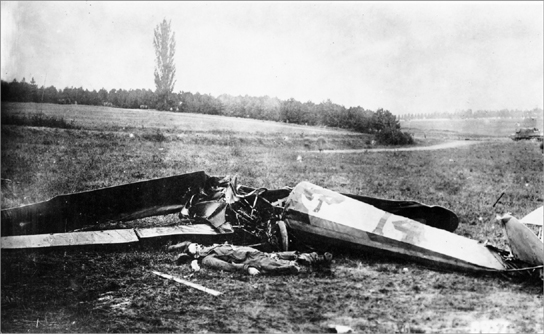
“LOOK NOW, IN YOUR IGNORANCE, ON THE FACE OF DEATH.”
Quentin photographed by the Germans in front of his crashed plane. (photo credit i28.1)
WHEN THE ARMY offered to exhume and repatriate Quentin’s body, the Roosevelts declined31. “We greatly prefer that Quentin shall continue to lie on the spot where he fell in battle, and where the foemen buried him,” the Colonel wrote. He had heard from Pershing that the crash site had become a shrine for passing troops. “After the war is over, Mrs. Roosevelt and I intend to visit the grave, and then to have a small stone put up … not disturbing what has already been erected in his memory by his French and American comrades in arms.”
In another gesture of sympathy, a Congressional commission released the Nobel Peace Prize money—$45,483 in cash and liquidated securities—that Roosevelt had been trying to get back for years. He was perversely pleased that the fund’s trustees had never been able to agree how to spend it, because he now had his own ideas for its disbursal. Every cent would go32 to war-related charities, or individuals and organizations planning to improve social conditions in the postwar world. His list of major recipients included the American, Japanese, and Italian Red Cross, the Salvation Army, the Jewish Welfare Board, “Mrs. Theodore Roosevelt, Jr., now working in the Y.M.C.A. in France,” Herbert Hoover, for use in Belgian war relief, a hospitality council for “colored troops [and] colored women and girls in and about the camps and cantonments,” and Maria Bochkareva of the Women’s Death Battalion, “as a token of my respect for those Russians who have refused to follow the Bolshevists in their betrayal to Germany of Russia, of the Allies, and of the cause of liberty through the world.” He allocated small, but attention-getting amounts to ethnic groups persecuted or fighting for freedom against autocracies—Czechs, Serbs, Armenians, and Assyrian Christians. In something of a first for a former president, he promised to allocate “further sums of money from my royalties on certain scenarios of motion pictures.”
One of the movies33 he had in mind was to be a McClure Productions six-reeler entitled The Fighting Roosevelts, starring three different actors as himself in boyhood, youth, and maturity. The draft script called for a dramatic final climax, with one of his sons dying on the Western Front—an ending that could obviously be reshot, should any more of them fall.
On 4 September34, Archie, transferred back to the United States for advanced therapy on his paralyzed left arm, returned limping to Sagamore Hill. The splendor of his blue and gold sleeve stripes, denoting a year’s service at the Front, in no way impressed Archibald Roosevelt, Jr., whom Grace had rushed down from Boston to show to him. Little Archie was only five months old, so both father and son were strangers. They eyed each other with a mutual lack of interest, while the rest of the family party tried to adjust to “Big” Archie’s worryingly limp arm. Two operations in Paris had failed to reconnect the severed main nerve well enough to restore full mobility.
Archie had become35 skeletal during his long convalescence. His hollow cheeks drew back from protruding teeth, and he wore a new, habitual frown. He admitted to be suffering from a “bad case of nerves.” Even if doctors at the Columbia Base Hospital in the Bronx—who had granted him only temporary home leave—were successful in fixing his arm and digging the shrapnel out of his leg, they had warned him he might not be able to rejoin Ted’s regiment for another eight months. Which was all Archie wanted to do. Like many soldiers who had seen the worst of the war, he had become addicted36 to it.
“FALL HAS COME,”37 Roosevelt wrote Kermit on 13 September. “The dogwood berries are reddening, the maple leaves blush, the goldenrod and asters flaunt their beauty; and log fires burn and crumble in the north room in the evenings.”
Very slowly, he was recovering his joy in the natural world, after a summer of finding himself unable to think of much but mortality. Hearing that Ted had been nearly blinded and killed, Dick Derby thrown into the air by a shell, and seeing how “crippled” Archie was had compounded his grief over Quentin’s fate. However, all were safe for the moment, as well as Kermit, detached to an artillery school in Saumur. General Pershing had written to say that Ted was about to be promoted to a colonelcy. Two Colonel Roosevelts in one family, plus two decorated captains and one dead hero, added up to plenty of honor38.
That did not help him feel any less sidelined, or any less beaten down physically and emotionally. The “gentleness” Corinne discerned in her brother struck others as exhaustion, if not desuetude: the Rooseveltian vigor di vita was gone. One day his literary colleague Mary Roberts Rinehart drove from New York out to Oyster Bay with him and Edith. “The Colonel sat39 with his chauffeur, saying nothing. Most of the time his head was bent on his breast, and I can still see his sturdy broad-shouldered figure, stooped and tired. For the first time he seemed old to me, old and weary.”
Roosevelt was loath to divide what was left of his energy between politics and war work, saying that he would tour40 in the fall only on behalf of Secretary McAdoo’s fourth “Liberty Loan” appeal. Extra military funds were urgently needed: the number of soldiers, sailors, and marines in service was now approaching three million, and the latest registration had increased the pool of potential draftees to an almost incredible twenty-four million—one and a half times as much as the total manpower of Britain and France. Roosevelt’s still-smoldering anger toward Woodrow Wilson was fueled by this evidence of how the nation could have armed itself after the sinking of the Lusitania, shortening the war and saving countless lives. Quentin’s included, perhaps.
The most he would do to help the GOP in its campaign to win back the Senate in November was volunteer a major address at Carnegie Hall, one week before the election, and write supportive letters and articles. On the twenty-eighth41 he set off on his fund-raising tour, regretfully leaving behind the sight of beach rosemary in pale, late bloom along Lloyd’s Neck.
AS HE TRAVELED42 WEST via Ohio to Missouri and Nebraska, he edited a selection of his recent journalism for book publication by Scribners. Charles Scribner was emboldened to invest in him yet again, on the strength of widespread sympathy engendered by newspaper syndication of “The Great Adventure.” Inevitably, that phrase became the title of the hardback release.
“It’s pretty poor43 business to be writing little books in these times of terrible action,” Roosevelt apologized in a letter to Belle, “but it’s all I can do, or at least all I am allowed to do by the people in power in Washington.”
Scribbling on dutifully, he used up the last of the triple-carbon notebooks that had served him so well in Africa and Brazil.
His speeches attracted large, affectionate crowds, but after nearly forty years of shouting at people he was no longer capable of saying anything new. It was enough for these tens of thousands of regular folks to say that they had “seen” the great Teddy. He still felt a kinship with them: it was they and their kind who had helped him become, in his own words, “at heart, as much a Westerner as an Easterner.” On his way home44 in early October, he spent the night in Billings, Montana, where once, as a dude ranchman from New York, he had knocked out a barroom bully. George Myers, his old cattleman, was on hand to visit with him at his hotel.
“Have you got45 a room, George?”
Myers shook his head.
“Share mine with me,” Roosevelt said, “and we’ll talk about old times.”
HE ARRIVED BACK46 EAST complaining of acute inflammatory pain in his left leg and both feet. Rheumatism was a disease he had long been afraid of, since it had racked his sister Bamie for most of her life, and made a hopeless invalid of his favorite presidential appointee, William Henry Moody. He had himself been bothered by it, on and off, since his last years in the White House, but never as sharply as now. If the two physicians47 he consulted—Drs. Walton Martin in Manhattan and George W. Faller in Oyster Bay—detected symptoms of rheumatic fever, a life-threatening pathology that often struck patients in October, they kept their concern from him. He was given conventional anti-inflammatory medicine and told to rest as much as possible.
Returning to Oyster Bay, he put himself in Dr. Faller’s care, and adjusted to the irony that he was once again prostrated, just when the presidency of Woodrow Wilson was nearing the zenith of its achievement. On the night he and George Myers had sat talking “about old times” in a hick town in Montana, the new Chancellor of Germany, Prince Maximilian of Baden, had asked the President to begin negotiations for a “restoration of peace,”48 along the lines of his “Fourteen Points” agenda of last January.
Roosevelt’s tour had coincided, moreover, with the greatest combined offensive of the war: nine armies, including Pershing’s, assailing the Central Powers from Flanders all the way south to Palestine. The giant operation was still continuing, and Pershing was making a bloody mess49 of it in the Argonne, but an armistice on the Western Front was obviously imminent.
Britain and France did not want the President to negotiate anything less triumphant than unconditional surrender by each enemy in turn. Wilson declined to do what any belligerent wanted. Sure that he, alone and at last, held the fate of the world in his hands, he had responded with a “note of inquiry” asking Prince Maximilian to confirm whether Germany accepted all of the Fourteen Points—thereby endorsing the idea of a League of Nations—and to attest that a prince had constitutional authority to end a war waged by generals.
This sounded to Roosevelt like the prelude to another drawn-out period of “elocution” while more and more poilus, tommies, and doughboys died. “I regret greatly,”50 he said in a dictated statement, “that President Wilson has entered into these negotiations, and I trust that they will be stopped.” The Fourteen Points were “couched in such vague language that many of them may mean anything or nothing … while others are absolutely mischievous.” Freedom of the seas, for example, could be construed as permission to go on deploying U-boats. Disarmament could force America to give up the defense system it had so belatedly and expensively created. Giving autonomy instead of independence to oppressed subject races would be “a base betrayal of the Czechoslovaks, the Armenians, and our other smaller allies, and the cynical repudiation of the idea that we meant what we said when we spoke of making the world safe for democracy.”
He earnestly hoped, he said, that Wilson would “refuse to compound a felony by discussing terms with felons.”
These words showed that, ailing or not, the Colonel still packed a rhetorical punch. Similar statements51 by Henry Cabot Lodge and a nearly insubordinate General Pershing enraged the administration. Political strategists fantasizing another run by Roosevelt for the presidency in 1920 had a fair idea who he would choose as his secretary of state and secretary of war. Following up, Roosevelt52 sent an open telegram to Lodge, and carbon-copied it to Senators Poindexter and Hiram Johnson for promulgation “from one ocean to the other.” It expressed his fervent hope that the Senate would disavow the Fourteen Points “in their entirety,” and take independent action to ensure Germany’s unconditional surrender.
“Let us dictate peace by the hammering of guns,” he wrote, “and not chat about peace to the accompaniment of the clicking of typewriters.”
The President, goaded53, issued a personal appeal to the nation the next day, 25 October. It was egotistical enough to make Roosevelt seem bashful: “My fellow countrymen, the congressional elections are at hand.… If you have approved of my leadership and wish me to continue to be your unembarrassed spokesman in affairs at home and abroad, I earnestly beg that you express yourselves unmistakably to that effect by returning a Democratic majority to both the Senate and the House of Representatives.”
Wilson made things worse by saying it was “imperatively necessary,” with peace negotiations impending, that the Senate remain loyal to him. A loss by his party of either house would “certainly be interpreted on the other side of the water as a repudiation of my leadership.” The respect that America’s allies entertained for him would be seriously undermined if they saw voters in the United States electing a legislature that was “not in fact in sympathy with the attitude and action of the administration.”
The folly of this statement, implying that Republicans put party above patriotism, and that only Democrats were idealistic enough to impose pax Americana on the world, admitted of no rational explanation. Wilson was neither tired nor sick nor inclined to be bothered by anything Roosevelt said about him. But he was bothered, to a degree that made him lose his famous calm, by the addressee of Roosevelt’s telegram. He had hated54 Henry Cabot Lodge ever since he heard that the senator had accused him of turning white and “womanish” after Vera Cruz. The prospect of Lodge, an outspoken opponent of Wilson’s League of Nations idea, becoming chairman of the Senate Foreign Relations Committee was more than the President could bear. He had had to be dissuaded from directly naming Lodge in his appeal.
Roosevelt sniffed55 a vote-getting issue and threw away the political address he had promised to give at Carnegie Hall. He composed a new one, passing the sheets to Alice Longworth as he wrote them.
TWO DAYS LATER the Colonel turned sixty. Archie and Ethel and their three children joined Alice and Edith in a celebration tinged with worry about his condition. He looked well, and somewhat thinner than he had been a year before, but his joints were burning with rheumatism. Ethel noticed that he still became dizzy if he moved too fast. He told her that ever since his abscess operation he had had “queer feelings”56 in his head.
She was encouraged to find him optimistic for a victorious end to the war, and philosophical about his birthday. Jokingly, he57 referred to himself as “Methuselah’s understudy” and “an elderly literary gentleman of quiet tastes and an interesting group of grandchildren.”
He pretended to have recovered from Quentin’s death, but Edith knew better. “I can see58 how constantly he thinks of him,” she wrote Kermit, “… sad thoughts of what Quentin would have counted for in the future.”
A well-wisher59 the following afternoon made sure Roosevelt kept brooding, by delivering part of the seat of Quentin’s crashed plane.
Carnegie Hall was crammed60 beyond its legal capacity when he arrived there that night. Women composed at least half of the audience, and practically every prominent Republican in New York State sat on the podium. No sooner had the Colonel walked onstage than a voice yelled, “Unconditional surrender.” He grinned and waved his speech script in reply. As he prepared to speak, another shout came, “Rub it in, Teddy!”
He spoke for more61 than two hours, excoriating Wilson for turning the war from a moral to a partisan issue. “If the President of the United States is right in the appeal he has just made to the voters, then you and I, my hearers, have no right to vote in this election or to discuss public questions while the war lasts.”
Over the next62 few days, his condition deteriorated sharply, to the point that on the evening of 2 November, when he returned home after attending a Negro War Relief benefit with Archie, he had difficulty walking for the pain in his legs. Next morning he tried to get up for breakfast, and found that he could not get one shoe on. At various times he was told he was suffering from multiple rheumatism, lumbago, sciatica, or gout. All he knew for certain was that he felt steadily worse. He remained bedridden, learning from newspapers63 that Turkey and Austria-Hungary were both out of the war. Moreover, Pershing had launched an offensive across the Meuse so ferocious that the First American Army was now recognized to be a force equal to any in the world. The papers did not report that Black Jack was encouraging the German Third and Fifth armies to retreat with liberal quantities of mustard gas. The British had simultaneously swept clear through to Ghent, and Marshal Ferdinand Foch’s forces were elsewhere engaged in driving every last “Boche” off French soil. In a magnanimous gesture, Wilhelm II had offered sixty of his personal palaces as treatment centers for victims of the Allied onslaught. Nevertheless, the German war cabinet was insisting that he abdicate.
On election day64, 5 November, Roosevelt hobbled into the blacksmith’s shop that served as Oyster Bay’s polling place and cast his ballot. Edith accompanied him. For all his support of universal suffrage, she was not herself inclined to vote. They had the satisfaction of hearing next morning that the Democrats had lost both houses of Congress, in a Republican triumph devastating to Wilson’s hope of dominating the postwar international scene. Speaker Champ Clark was dethroned. Political analysts put most of the blame on the President for demanding a vote of confidence. Roosevelt congratulated himself as “probably the chief factor” in preventing Wilson from doing “what he fully intended to do, namely, double-cross the Allies, appear as an umpire between them and the Central Powers and get a negotiated peace which would put him personally on a pinnacle of glory in the sight of every sinister pro-German and every vapid and fatuous doctrinaire sentimentalist throughout the world.”
He was equally contemptuous of the Kaiser, after reading on 10 November that Wilhelm II had resigned in the face of mass desertions and mutinies in all German services. The Red Flag was now flying in eleven German cities—even over the imperial harbor at Kiel—and the Reichstag was in danger of being taken over by a combination of socialist soviets. An armistice delegation representing its centrist majority was suing for peace in the Forest of Compiègne.
“If I had been65 the Kaiser,” Roosevelt snorted, “when my generals told me that the war was lost, I would have surrounded myself with my six healthy and unharmed sons, and would have charged up the strongest part of the Allied lines in the hope that God in his infinite goodness and mercy would give me a speedy and painless death.”
Flat on his back66 that same day, he heard that Lieutenant Colonel Theodore Roosevelt, Jr., had gone AWOL from military convalescence and reassumed command of the Twenty-sixth Infantry Regiment, just in time to participate in Pershing’s final offensive. Kermit had gotten to the Front too, and fought in the same division. Quentin was avenged. Family honor was satisfied.
AROUND THREE O’CLOCK67 the following morning, floodlights illuminated the Statue of Liberty in New York Harbor. Newspaper presses throughout the city thumped out an announcement by the State Department: “The Armistice has been signed.” At 6 A.M., local time, hostilities would cease on the Western Front.
Steam whistles68 began to blow long before dawn, in a continuous wail punctuated by motor horns and church chimes. By seven all Manhattan was throbbing, as fire crackers, cap pistols, brass bands, air-raid sirens, and even cow bells added to the cacophony. Impromptu parades joined together and marched up Fifth Avenue. Soldiers and sailors grabbed girls off the sidewalks and kissed them with a promiscuity unimaginable in prewar days. Airplanes roared overhead at dangerously low altitudes. There was a crescendo of noise through the day, approaching its climax in the late afternoon, just as Roosevelt was driven into town and returned to the hospital room he had occupied in February. It had windows facing toward Broadway, only one block distant. For as long as he remained awake, he could hear roaring and music in Columbus Circle.
Dr. John H. Richards69 announced overnight that the Colonel was back in Roosevelt Hospital because he needed to be “near his physician.” His ailment, diagnosed as “lumbago,” was not considered serious. “His blood pressure and heart action are those of a man of forty years.”
Subsequent bulletins, issued every few days by Richards and others, were equally positive, but vague enough to confuse reporters as to what, exactly, was wrong with Roosevelt. If he was in no danger, why had his wife moved into an adjoining room? And why was his treatment taking so long? On 21 November70, a rumor that he was facing an operation impelled his old literary friend Hamlin Garland to come and see him.
“I found him in bed propped up against a mound of pillows,” Garland wrote in a diary entry. “He looked heavier than was natural to him and his mustache was almost white. There was something ominous in the immobility of his body.”
After some chat71 about their youthful experiences out West, Garland said that he and a few friends would like permission to buy the field in France where Quentin was buried and turn it into a memorial park, “so that when you and Mrs. Roosevelt go there next summer, you will find it cared for and secure.”
Roosevelt’s eyes misted over. “That’s perfectly lovely of you, Garland.” But he needed to consult Edith before coming to a decision.
Corinne Roosevelt came in with a cake, and Garland rose to go. The Colonel would not let him. “Sit down!”
For half an hour the three of them talked about books and poetry. Roosevelt mentioned politics only once. “I wanted to see this war put through and I wanted to beat Wilson. Wilson is beaten and the war is ended. I can now say Nunc dimittis, without regret.”
Garland came back72 four days later to ask again about the memorial. Roosevelt seemed stronger: his operation had been merely a dental procedure, to remove two formerly abscessed teeth. Yet he emanated sadness, and his voice had a moribund sound. The stillness of his body, mummified in thick blankets, again struck Garland. It contrasted strangely with the movement of his arm as he reached out to shake hands. He was evidently in worse condition than the hospital would admit.
Edith, Roosevelt said73, was opposed to the idea of a park around Quentin’s grave. She felt that her son had been “only an ordinary airman,” doing his duty. Many others had fallen: “Quentin was no more hero than they, and should not be honored above his merits because he was our son.”
Other visitors came. All paid affectionate respects. Some sought the Colonel’s counsel, as if they feared they might soon be deprived of it. William Howard Taft, Henry Cabot Lodge, Elihu Root, and Henry White wanted to discuss the League of Nations issue, which Wilson was determined to press. Messianic as ever, the President had announced that he would personally represent the United States at a postwar peace conference scheduled to begin in Paris in the new year of 1919. White was the single Republican on his negotiating team— and a weak choice74, in Lodge’s opinion, altogether too obsequious to men of power. Wilson had not chosen a senator of either party to accompany him. He appeared to think that his foreign prestige would be enough to enshrine the Fourteen Points in a treaty so perfect, it could not fail to be endorsed.
Roosevelt was mostly75 silent as he listened to these senior statesmen of the GOP debating peace policy. White got the impression that he was not averse to the League, leaning more to Root’s cautious approval than to Lodge’s harsh opposition. But in letters and articles dictated to Miss Stricker and a new personal assistant, Miss Flora Whitney, the Colonel made clear that he liked best Sir Edward Grey’s old idea of a League that would not require great powers to scale down their defenses. He scoffed76 at the hypocrisy of Wilson’s grand-sounding phrase self-determination for all peoples, noting that the President was in no hurry to grant liberty to Haiti or Santo Domingo.
Two of his future77 biographers stopped by with honey on their lips, looking for last-chapter material. Lawrence Abbott told him that his speeches at the Sorbonne and London’s Guildhall in 1910 had “contributed directly” to the success of France and Britain in winning the war. Joseph Bucklin Bishop showed him the typescript of an epistolary volume that Scribners wanted to put out, under the title Theodore Roosevelt’s Letters to His Children. The Colonel read it entranced. “I would rather have that book published than anything that has ever been written about me.”
November gave way to December. By now Roosevelt was walking again, but only for short painful periods. Even sitting in a chair hurt. He was in his fourth week of hospitalization, on top of the week he had spent bedridden at Sagamore Hill. Unable to write anything but brief notes, he allowed Flora to think she was helping him with her laborious stenography. She was learning78 shorthand as part of her recovery process. Their relationship was quasi-familial, tender and sorrowful on both sides.
He did what79 he could to hinder Wilson’s diplomacy, after the President set sail for France in a confiscated German liner renamed the George Washington. In letters addressed to Clemenceau, Lloyd George, and Balfour, as well as such other foreign opinion-makers as Lord Bryce and Rudyard Kipling, Roosevelt argued that the Democratic Party’s defeat in the recent Congressional election amounted to a vote of no confidence in the administration. In any other free political system, he told Balfour, the chief executive would have had to resign. Speaking for the Republican Party, he declared that a majority of American opinion stood for “absolute loyalty to France and England in the peace negotiations.” That meant a retreat from the Fourteen Points, which he thought were susceptible to interpretation in Germany’s favor, and an abandonment of any presumption by the United States to act “as an umpire between our allies and our enemies.”
Except for80 describing himself as “one of the leaders” of this new majority, Roosevelt did not say what was now acknowledged by political strategists: the 1920 GOP presidential nomination would be his if he wanted it. A number of Republicans and former Progressives called to sound him out about running. He declined to encourage them.
“I am indifferent to the subject,” he said, lying back on his pillows. “Since Quentin’s death81, the world seems to have shut down upon me.” But when William Allen White reported that Leonard Wood was a candidate, he said with studied casualness, “Well, probably I shall have to get in this thing in June.” Then he produced an article he had dictated that amounted to an advance campaign platform.
“I tell you82 no secret when I say that the cards are arranged for the nomination of T.R.,” Hiram Johnson wrote a journalist on 14 December. “He has gained immeasurably in public esteem, I think.”
If so, the gain was registered at home, not abroad. That evening’s newspapers broadcast the story that Woodrow Wilson was being received in Paris with a hysteria that far eclipsed the welcome given Roosevelt in 1910. A crowd of two million had greeted the President as the savior of Western civilization, showering him with roses as he rode up the Champs-Élysées to the Arc de Triomphe.
ROOSEVELT WOKE83 THE following day with his left wrist in such agony it had to be splinted. Much more alarmingly, he showed symptoms of a pulmonary embolism. The hospital kept this secret from the press. His temperature shot up84 to 104°F, then subsided. Dr. Richards had been talking of sending him home, but it was obvious now that he should be watched day and night. Edith could do nothing but sit at his bedside while he slept, reading Shakespeare in an effort to stay calm. “Poor dear85, I wish I could take the pain.… There are so many things which he wants to do and cannot.”
He was buoyed86 by the appearance of Eleanor, back from France, except that she brought news that her husband had been left with a permanent limp. Roosevelt wished Ted could have been sent home on sick leave, like Archie. But he and Kermit were stuck in Europe, pending discharge from service.
Stuck too, the Colonel resigned himself to the prospect of Christmas in hospital. He would have to87 forgo his thirty-year ritual of playing Santa Claus at the Cove School in Oyster Bay. Archie was appointed to substitute for him.
Margaret Chanler paid a visit, and was disconcerted by her old friend’s listlessness. “I am pretty low88 now,” he admitted, taking her by the hand, “but I shall get better. I cannot go without having done something to that old gray skunk in the White House.”
He did get better89, enough that Edith got permission to take him home for Christmas. They agreed that it would be best to leave early on the holiday itself, when no press photographers would be around. Corinne came in90 on Christmas Eve and found Roosevelt in his bathrobe, bandaged but bright-eyed. He told her that there seemed to be “a strong desire” among Republicans to nominate him for the presidency in 1920. His health, however, might prevent him ever again entering public life.
“Well, anyway91, no matter what comes, I have kept the promise that I made to myself when I was twenty-one.”
“What promise, Theodore?”
“I promised myself that I would work up to the hilt until I was sixty, and I have done it.”
Vertigo assailed him on Christmas morning as the hospital elevator dropped to the ground floor. Dr. Richards reached to steady him, but he flinched.
“Don’t do that92, doctor. I am not sick and it will give the wrong impression.”
Bracing himself when the door opened, he walked firmly down the corridor to his waiting car.
ALICE, ETHEL, ARCHIE93, AND GRACE were waiting at Sagamore Hill when Edith brought him home. Lunch was going to be late, and the grandchildren were napping upstairs. Roosevelt looked white and battered, but clearly happy, after seven weeks away, to be back among his books and trophies. He gazed with rapture at the snow-whitened landscape around the house.
94 There was a great turkey on the table, and mince pie and plum pudding and ice cream. The Colonel’s frailty, however, cast a pall upon the feast. He reveled in the excitement of the boys and girls as they opened their presents, heaped around the tree in the North Room. Before going to bed early, he noticed sympathetically that little Richard Derby had asthma, like himself as a child.
ROOSEVELT LAY NOT in the bedroom he and his wife customarily shared, but in an adjacent chamber with corner windows facing south and west. It had been Ethel’s95 bedroom prior to her marriage, and back in days that Alice could scarcely remember, a gated nursery. It was said to be “the warmest room in the house” (so far as the phrase had any meaning at Sagamore Hill), because of its high, sunny exposure on winter afternoons. Edith wanted him there for that reason, and also because she could have quick access to him during the night.
A coal fire burned in the corner hearth. Servants kept it going around the clock. Propped up in96 a mahogany sleigh bed, Roosevelt saw faded blue curtains, a blue plush armchair, a tufted sofa, a chest of drawers with swing mirror, a lift-top desk, and an Italian walnut nightstand, a souvenir of his second honeymoon. No bearskin rugs snarled on the carpeted floor, but there were carved heads and masks on the wall to comfort him.
Every morning97 he breakfasted in bed, then got up and painfully dressed himself. Shaving, however, was impossible, so a barber came daily to freshen him up. Later he would limp downstairs to his study, where there was a log fire and a chaise longue. He could recline there, reading or dictating. Anemia enfeebled him. His inflammation traveled mysteriously from joint to joint, ending up on the last day of the month in just one finger. At the same time his temperature shot up to 103°F. It may have been98 precipitated by a surge of mixed emotions: an envelope from France had come, enclosing Marshal Pétain’s posthumous citation of Lieutenant Quentin Roosevelt for a Croix de Guerre.
Compared to such news, foreign dispatches reporting that Woodrow Wilson had been welcomed in London as rapturously as in Paris, and was now en route to Rome by royal train, were but the rattling of distant drums.
ON NEW YEAR’S DAY99, 1919, rheumatism flared afresh in Roosevelt’s right wrist. He gave up dressing and kept to the sofa in his bedroom, weakly trying to acknowledge at least some of the letters that still came up the hill in sacks, six days a week. Looking back over the past two years, he calculated that he had answered twenty-five thousand of them, and rejected well over two thousand speaking invitations. Now there was talk of him being president again, the sacks were sure to bulk larger.
Despite worsening pain, he dictated a Kansas City Star editorial on Friday, 3 January. The article—his thirteenth for that paper since the Armistice—was a final statement of his views on the League of Nations issue, before the Paris Peace Conference opened in the middle of the month.
“We all of us100 desire such a league,” Roosevelt said, “only we wish to be sure that it will help and not hinder the cause of world peace and justice.” Speaking as “an old man who has seen those dear to him fight,” he said that Americans did not wish to send any more of their sons to die in wars provoked by obscure foreign quarrels.
He also dictated a new article for the Metropolitan, putting himself on record in favor of a constitutional amendment awarding equal voting rights to women. In a letter101 sent that same day to Senator George H. Moses of New Hampshire, he said it was “a misfortune” that his old friend Henry Cabot Lodge and some other New England senators were “so very bitter about woman suffrage.” He begged Moses not to oppose the amendment. “It is coming anyhow, and it ought to come.”
The effort of102 this literary work exhausted him, and he told Edith that he felt as miserable as at any time during his hospitalization. Alarmed, she summoned Dr. Faller, who could do little but prescribe a course of arsenic injections to reduce the swelling in his patient’s wrist.
Roosevelt suffered so much general pain overnight that on Saturday morning Edith engaged a full-time nurse. Since none of their103 children were around for extra help (Alice, Ethel, and Archie had gone their various ways after the holidays), she placed a desperate call to James Amos. The Colonel’s former valet was now working for the William J. Burns International Detective Agency in New York, but he agreed to come back temporarily into the family service.
When Amos arrived104 that afternoon, he was shocked to see how ravaged Roosevelt looked. He bathed him with extreme care and coaxed him into a fresh pair of pajamas. “By George,” Roosevelt said gratefully, “you never hurt me a bit.” Amos turned his armchair so he could sit looking out over Oyster Bay, then put him to bed and monitored him through the night.
Roosevelt was in too much discomfort to sleep well, but when Dr. Faller stopped by on Sunday morning, he seemed somewhat better. He stayed in his room all day, dictating two or three letters105 to Edith, and correcting the typescript106 of hisMetropolitanarticle. She was touched by his exceptionally gentle mood, and whenever she passed the sofa she could not help kissing him107 and stroking his short, little-boy’s hair. “As it got dusk,”108 she wrote Ted later, “he watched the dancing flames and spoke of the happiness of being home, and made little plans for me. I think he had made up his mind he would have to suffer for some time & with his high courage had adjusted himself to bear it.”
They were still together109 when, at around ten o’clock, he asked her to help him sit up. He said he felt as if his lungs or heart were about to give in. “I know it is not going to happen, but it is such a strange feeling.” She gave him a sniff of sal volatile and sent at once for Dr. Faller, who found Roosevelt’s bronchi clear and his pulse beating steadily and calmly.
Leaving the nurse110 in charge, Edith accompanied Faller downstairs for a discreet conversation in the library. She said that her husband was insomniac, and asked permission to give him morphine. Faller assented111, saying that he himself would rest easier if he knew the Colonel was comfortable.
Edith watched while the nurse administered the shot shortly before midnight. James Amos took over, and the two women retired to their bedrooms. Roosevelt lay on the sofa for a while, saying little. Amos noticed a look of great weariness on his face.
“James, don’t you112 think I might go to bed now?” He had to be113 half-lifted onto the mattress, then asked to be turned on his side. For a while he lay staring at the fire.
Then he said, “James, will you114 please put out the light?”
A SMALL LAMP115 on the dresser filled the room with a dim yellow glow. Amos switched it off and sat where he could see Roosevelt, or at least hear him breathing in the darkness. It was a calm, moonless night, and the big house was still. Edith came in at twelve-thirty to check on her husband. She found him sleeping peacefully, and did not kiss him for fear of waking him. When she visited again at two o’clock, he was still asleep. Amos had moved closer to what was left of the fire.
About an hour later the valet was startled by a new note in Roosevelt’s respiration—“roughling”116 was the only word he could think of. He touched his master’s forehead. It felt dry and warm. Then Roosevelt began to breathe irregularly, with intermittent periods of silence. Each time he started117 again, his respiration sounded weaker. Eventually Amos had to lean close to hear any sound at all.
AT FOUR O’CLOCK118, Edith woke to find the nurse standing over her. She hurried through and called, “Theodore, darling!” But there was no response from the sleigh bed.
* Tight, smooth, climbing turns that reverse direction by 180 degrees.