

He’ll break out some day like a keg of ale
With too much independent frenzy in it.
ROOSEVELT RETURNED HOME2 on the evening of 1 July to news that despite his advocacy, Hughes’s direct-primary bill had been defeated by a combination of machine Republicans and Tammany Hall Democrats.
This was exactly the kind of political “trust” he had battled as a young assemblyman in Albany. But then, legislative disappointments were to be expected. Nearly three decades later, a former president and toast of foreign monarchs could ill afford such a rebuff. Senator Gore had to be laughing. Roosevelt’s ancient scourge, the New York Sun, printed a one-line wisecrack: “And the ‘Hundred3 Days’ lasted just thirteen.”
The question now was whether he should nurse the bruise William Barnes, Jr., had inflicted on him, and wait for sympathetic critics to point out that he had merely tried to help out his governor and his President. Or, seek revenge on Barnes for humbling all three of them?
Lloyd Griscom came to see him in a funk. At all costs, the triumphant boss must be stopped from bulldozing the New York Republican convention at Saratoga Springs in September. If Barnes prevailed, his machine would write the platform, nominate whom it pleased to local, state, and federal offices, and advertise to the world that the Old Guard was back in control of Party affairs. The result was bound to be a Democratic sweep in November. Griscom suggested that Roosevelt run, with White House support, for chairman of the convention4. Barnes doubtless had a conservative candidate in mind, so the contest would pit the forces of moderation against those of reaction, and maybe compensate for the primary-bill debacle.
Roosevelt listened without committing himself. He was not fooled that Griscom—a Taft man—wanted to do anything other than serve the administration. But here was a chance to influence the nomination of a decent man for governor, and push for a moderately progressive state delegation to the national convention in 1912. At the very least, cooperation with Griscom would signal that Roosevelt and Taft were not drifting apart.
The trouble was that they were, and both of them knew it.
“Archie, I am5 very greatly distressed,” Taft told Captain Butt on 6 July. “I do not see how I am going to get out of having a fight with President Roosevelt.”
He was still inclined to use the last two words when preoccupied or flustered. A rumor was going around that Roosevelt wanted to prevent Interior Secretary Richard Ballinger from running for the the U.S. Senate. True or not, the rumor reminded people that the Colonel had always been close to Ballinger’s enemy, Gifford Pinchot.
“I confess it wounds me very deeply,” Taft said. “I hardly think the prophet of the Square Deal is playing it exactly square with me now.” His wife was taunting him with the possibility that Roosevelt might beat him for renomination in 1912.
Butt asked if he believed Roosevelt really wanted to challenge him.
“I do not know. I have thought sometimes that he did, and then I don’t see how he can. In his mind, however, it may be the only logical way of reaching a third term. Then, too, his tour of Europe, his reception there, and the fact that every crowned head seemed to take it for granted that he would be elected …”
The President spent the rest of the morning soothing his soul with golf.
Later that same day at Sagamore Hill, Roosevelt put both hands on the shoulders of two old friends, the civil-service reformers Lucius Burrie Swift and William Dudley Foulke, and said, “I could cry6 over Taft.” He escorted them upstairs to a private room, complaining that the President had been a good lieutenant, but was unfit for higher command. Then, closing the door, he said, “I will talk to you with perfect frankness. I would not consider another nomination unless it was practically universally demanded.”
It was a classic Rooseveltian recruitment ploy: the physical embrace, the melodramatic confidentiality, the denial of personal ambition. Swift and Foulke left convinced that he was already running. A trio of Kansas insurgents, Senator Joseph L. Bristow, Congressmen Victor Murdock, and Edmond H. Madison, got the same impression.
“Are you aware,”7 Bristow asked the others as they walked back to Oyster Bay, “that we have been participants in a historic occasion where a former President definitely broke with the man he had made his successor?”
Madison expressed awe, but Murdock was skeptical. A former newspaperman, he noted the vehemence of Roosevelt’s private denunciations of Taft and the coyness with which he declined to be quoted.
Actually Roosevelt was struggling8, as throughout his life, between the desire for power and the ethics of responsibility. It was a struggle he had never been able wholly to resolve: indeed, its contrary tensions held him together. He wanted to destroy Taft because Taft had failed. He wanted Taft to succeed because Taft was an extension of himself. He knew he was no longer President, yet he was seen as presidential—the emperors of the Old World had made that clear, not to mention Taft in conversation. Although not running, he was running. Even as he maintained his vow of silence, he was shouting from the hustings.

“THE GREATEST SERVICE9 I can render to Taft,” Roosevelt wrote Lodge, “the service which beyond all others will tend to secure his renomination … is to try and help the Republican Party to win at the polls this Fall, and that I am trying to do.”
That meant10 resisting, on the one hand, pressure from GOP leaders to come out with a “flaming endorsement” of the President, and on the other, appeals from insurgents to proclaim himself in opposition. Either course, he felt, would cost him friends, and split the Party. The fault line ran right through his own family. Alice shared his reformist philosophy, while Nicholas Longworth was a regular, albeit moderate, Republican.
Roosevelt felt sorry for them both. If any single person symbolized the urgency of holding the Party together, it was Nick: son-in-law to the most eminent progressive in America, yet a former law student of William Howard Taft, hailing from the same district in Cincinnati, even representing Taft in Congress.
In response to a letter from Nick, saying it was essential that the President keep control of his own home state, Roosevelt wrote to say he agreed. “Of course you must11 stand straight by Taft.… He is your constituent.” He urged the same spirit of cooperation on Gifford Pinchot. “I do hope you won’t take any position which would make it impossible, or even merely exceedingly difficult, for you to support him if necessary.” The President had started off badly, he felt, through having no real qualities of leadership. “He is evidently12 a man who takes color from his surroundings. He was an excellent man under me, and close to me. For eighteen months after his election he was a rather pitiful failure, because he had no real strong man on whom to lean, and yielded to the advice of his wife, his brother Charley, the different corporation lawyers who have his ear, and various similar men.” With a midterm review coming his way, however, Taft must surely start considering the interests of the people. “He may and probably will turn out to be a perfectly respectable President, whose achievements will be disheartening compared with what we had expected, but who nevertheless will have done well enough for us to justify us in renominating him—for you must remember that not to renominate him would be a very serious thing, only to be justified by really strong reasons.”
The Colonel was putting the case as favorably for Taft as he could. “Otherwise I could see very ugly times ahead for me, as I should certainly not be nominated unless everybody believed that the ship was sinking and thought it a good thing to have me aboard her when she went down.”
ROOSEVELT PONDERED WHAT to say about the state of the nation when his two-month vow of silence was up. His every word would be listened to as if megaphoned. Plainly, he would have to make a major address, or Americans would ask why he was willing to orate to Europeans, but not them. A poll conducted13 by World’s Work magazine showed that more than three out of every four of its readers wanted him back in the White House. Progressive Democrats were likely to defect to him in large numbers. “I have just returned from a trip across Wisconsin and Minnesota,” one respondent wrote, “and in talking with men on the train [about] Roosevelt and the presidency, the answer in every instance was that he could not help being President again.”
He was in receipt14 of almost two thousand speaking invitations. Most were from committees or candidates desperate for help in endangered GOP constituencies. It did him little good to protest that the prospect of a return to the hustings filled him with “unalloyed horror.” So he yielded to pressure from the Republican Congressional Campaign Committee to make a sixteen-state campaign trip, beginning in late August. The foray would take him west of Ohio into the heartland of insurgency. His itinerary would advertise his progressivism, no matter what dutiful words he uttered in behalf of the Party leadership.
To his annoyance, he heard that the Committee was raising money with the specific purpose of destroying every insurgent running for election or reelection in the fall—Senator Beveridge of Indiana, for one. Even Taft had contributed funds. The more Roosevelt thought about it, the more he convinced himself that his big speech on tour—most likely at Osawatomie, Kansas—must be a restatement of his Special Message of 1908, updated and expanded to embrace the aspirations of the anticorporate middle class.
“My proper task,”15 he wrote an insurgent editor, “is clearly to announce myself on the vital questions of the day … and take a position that cannot be misunderstood.”
For the rest of July, he chopped wood and swam, rowed, and camped with Archie and Quentin, when his huge volume of mail allowed him. He passed what were to him the most precious minutes of any day reading with Edith—either back and forth aloud, or sitting silently together with their books, as they had when they were children. Once or twice a week he was driven into Manhattan to attend meetings at the Outlook offices16, traveling in a new automobile, a Haynes-Apperson17 Model 19. He quickly learned to drive himself, and became, in Edith’s word, “addicted” to it.
At either end of his commute, the political pilgrims kept coming: more and more insurgents, Old Guard “mossbacks,” fund-raisers, former appointees, emissaries of the New York Republican Party. All wanted something, if only the pleasure of having a former president listen to their “advice,” on the presumption that he wanted it.
Those begging him to make personal appearances were particularly bothersome. Roosevelt had long ago discovered that the more provincial the supplicants, the less able they were to understand that their particular need was not unique: that he was not yearning to travel two thousand miles on bad trains to support the reelection campaign of a county sheriff, or to address the congregation of a new chapel in a landscape with no trees. His refusal, however elaborately apologetic, was received more often in puzzlement than anger. Imaginatively challenged folks, for whom crossing a state line amounted to foreign travel, could not conceive that the gray-blue eyes inspecting them had, over the past year, similarly scrutinized Nandi warriors, Arab mullahs, Magyar landowners, French marshals, Prussian academics, and practically every monarch or minister of consequence in Europe—not to mention the maquettes in Rodin’s studio, and whatever dark truths flickered in the gaze of dying lions.
ON A VISIT18 to the summer White House, Lloyd Griscom encountered at first hand the President’s desire to evade any contretemps not occurring on the golf course or poker table. Taft indicated that he might not support Roosevelt for chairman of the New York State convention in September. His explanation was simple: a gratified Boss Barnes would deliver a pro-Taft delegation to the national convention in 1912.
Then Barnes announced19 on 16 August that the machine had endorsed Vice President James Schoolcraft Sherman as its candidate for chairman of the convention. The Colonel was aghast at the news. Sherman was an archconservative who, he felt, could not have been nominated without Taft’s approval. But he kept20 to his vow of silence, which had a few more days to run.
Taft could not refrain from chortling. “Have you seen21 the newspapers this afternoon?” he asked Archie Butt. “They have defeated Theodore.”
Butt was so angry he had to go outside and stare at the sea to calm down. “It makes me ill,”22 he wrote his sister-in-law that night, “to see the President lessen his own character by lending himself and his great office to these petty devices to humiliate his predecessor.”
A news flash23 from Oyster Bay next day reported that the Colonel had told friends that he might have to oppose Taft in 1912 to preserve his progressive legacy. He neither confirmed nor denied that rumor, contenting himself with an announcement that he would go to Saratoga as a delegate from Nassau County, and would run against Sherman for the chairmanship. Barnes warned that there would be dead bodies in his way. “So they want24 a fight, do they?” Roosevelt responded. “By George, they shall have it.” With that, he left New York on his western tour.
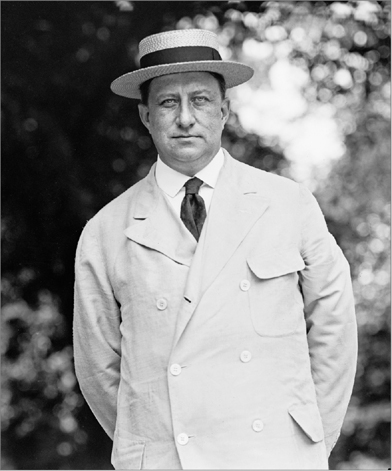
“BARNES WARNED THAT THERE WOULD BE DEAD BODIES IN HIS WAY.”
William Barnes, Jr. (photo credit i5.1)
ROOSEVELT WAS GLOOMY about embarking on a “Teddysee,”25 closely watched by the press, which might well leave the Party more fragmented than it was already. He had lost his former zest for whistle-stop speeches and—though he would not admit it—much of his love for crowds. He worried that his throat, sandpapered by dusty drought conditions on Long Island, would not stand the strain of nearly three weeks of shouting at people. “Ugh! I do dread26 … having to plunge into this cauldron of politics.”
The truth was27, he was not well. Earlier in the month, he had visited the anthracite country of Pennsylvania, and been struck by a recurrence of the same ailment that had immobilized him during the Coal Strike of 1902: an inflammation of the left shinbone, complicated by an attack of Cuban fever. He was also regaining the weight he had lost in Africa. He vowed that after this tour, and a lecture trip he was committed to the following spring, he would never again go on the road for any length of time.
Without much hope that anyone would believe him, Roosevelt insisted that he was traveling as an independent commentator, in behalf of The Outlook. This did not deter representatives of other magazines and newspapers from attaching a special car to his train. “It is incredible28 that there should remain a single American citizen,” declared the New York Sun, “who does not see that Theodore Roosevelt has undertaken a campaign for the presidential nomination in 1912.”
Rolling north on 23 August through Albany (stronghold of William Barnes, Jr.) and Utica (hometown of Vice President Sherman), he tried at first not to talk about politics at all. His provincial audiences reacted with dismay, and he realized that they wanted him to behave like a candidate for the presidency.
“I don’t care29 that for it,” he said, snapping his fingers, to O. K. Davis of The New York Times. “I’ve had all the work and all the fun and all the glory of it.”
Davis waited for the inevitable follow-on. “Of course, if there were a big job to be done which the people wanted me to handle, that would be a different thing.”
Proceeding via Buffalo into Ohio, Roosevelt began to address current issues—conservation, corporation control, labor and welfare reform—but carefully pitched his rhetoric so as not to offend conservative opinion. He praised the administration in the blandest possible language, refraining from any direct endorsement of Taft. As Ohio gave way to Indiana and the plains states, where insurgent candidates were registering30 dramatic gains in primary elections and conventions, he began to sound more progressive. But he said little that the President might not have said, to please the same audiences. He wanted to give maximum impact to what he called his “credo”31 at Osawatomie.
FOR A FEW RECREATIONAL HOURS, in Wyoming on the twenty-eighth, he was Roosevelt the Rough Rider again, happily participating in the Frontier Days celebration outside Cheyenne. The constant thunder of hooves, the band music, and the fluttering of myriad Stars and Stripes triggered a longing within him that went deeper than politics, deeper than patriotism, to some dark core of desire unsatisfied since his “crowded hour” in Cuba. Riding across the prairie32 with Robert D. Carey, a local rancher, he said that it was the ambition of his life “to go to war at the head of a brigade of cavalry.”
With no war immediately at hand, Carey thought little of this strange remark. He had no inkling, and Roosevelt’s subconscious may not have acknowledged, any connection between their current trot and the charge of the Twenty-first Lancers at Omdurman. Yet it had been there33, some five months before, that Roosevelt had committed to come to Cheyenne.
ADDRESSING BOTH HOUSES of the Colorado legislature in Denver the next day, Roosevelt gave Eastern conservatives the first hint of radical oratory to come. He accused the Supreme Court of favoring big corporations and creating a judicial no-man’s-land around them, into which neither state nor federal government could trespass. A notorious case in point, he said, was Lochner v. New York. By striking down as unconstitutional a state law against excessive workplace hours, the Court had shown itself to be “against popular rights.”34
The word popular sounded, to conservative ears, like populist, and the idea that the Court was capable of hostile acts in defense of liberty of contract showed how far Roosevelt had come from his Social-Darwinist youth. President Taft, who venerated appellate justice as something superior to vox populi, thought his remark smacked of anarchy. But Roosevelt was only warming up.
At 2:1535 P.M. on the thirty-first, he climbed onto a kitchen table in a grove outside Osawatomie, Kansas, where John Brown had fought the Missouri raiders in 1856. A crowd of thirty thousand Kansans waited to hear him declaim his “credo.” The prairie sun was strong, but there had been a cloudburst earlier in the day, and many stood ankle deep in mud.
Addressing himself36 repeatedly toward the Civil War veterans who sat in a special place on the battleground, Roosevelt roared over the calls of food vendors, “There have been two great crises in our country’s history: first, when it was formed, and then, again, when it was perpetuated.” The name of John Brown, he declared, would “be forever associated” with the second of these national crises. Having said that, he avoided any further tribute to the bloody old fanatic.
It was a looming third crisis he wished to discuss—one utterly modern, yet still subject to the wisdom of Abraham Lincoln. The Emancipator had advocated harnessing a universal dynamic, whose power derived from the struggle between those who produced, and those who profited. Roosevelt quoted Lincoln’s famous maxim, Labor is the superior of capital, and joked, “If that remark was original with me, I should be even more strongly denounced as a communist agitator than I shall be anyhow.”
Nevertheless, he was willing to go further in insisting that property rights must henceforth be secondary to those of the common welfare. A maturing civilization should work to destroy unmerited social status. “The essence of any struggle37 for healthy liberty has always been … to take from some one man or class of men the right to enjoy power, or wealth, or position, or immunity, which has not been earned by service to his or their fellows.”
America’s corporate elite, Roosevelt said, was fortifying itself with the compliance of political bosses. He revived one of his favorite catchphrases: “I stand for the square deal.” Granting that even monopolistic corporations were entitled to justice, he denied them any right to influence it, or to assume that they could buy votes in Congress.
The Constitution guarantees protections to property, and we must make that promise good. But it does not give the right of suffrage to any corporation. The true friend of property, the true conservative, is he who insists that property shall be the servant and not the master of the commonwealth; who insists that the creature of man’s making shall be the servant and not the master of the man who made it. The citizens of the United States must effectively control the mighty commercial forces which they have themselves called into being.
Gifford Pinchot sat38 listening with collaborative satisfaction. He, James Garfield, and William Allen White, the progressive editor of the Emporia Gazette, had drafted significant sections of the Colonel’s speech.
Roosevelt explained that there could be no check to the growth of special interests so long as channels of collusion flowed back and forth between secretive boardrooms and secretive halls of government. To that end, the people must insist on “complete and effective publicity of corporate affairs,”* and a law prohibiting “the use of corporate funds directly or indirectly for political purposes.”
There should be federal regulation, and physical valuation, of the stock flotations of all industrial combinations doing an interstate business: not only railroads and steamship lines, but those dealing in meat, oil, coal, and other necessities. Executives and “especially” the board members of such corporations should be held responsible for breaches of antitrust law. Roosevelt cited one of the proudest creations of his own administration, the Federal Bureau of Corporations, and said that it and the Interstate Commerce Commission should be handed greater powers. He further advocated “the great central task” of conservation of natural resources, second only to national security on his agenda; graduated income and inheritance taxes on big fortunes; a judiciary accountable to changing social and economic conditions; comprehensive workmen’s compensation acts; national laws to regulate the labor of children and women; higher safety and sanitary standards in the workplace; and public scrutiny of all political campaign spending, both before and after elections.
Throughout his address39, the food vendors had loudly continued to advertise peanuts, popcorn, hot dogs, and pink lemonade, and a merry-go-round whistled not far away. But Kansans stood rapt as the Colonel, acknowledging that there could be such a thing as too much federal power, called for a compensatory spirit of democratic redress, as strong in the extremities of the country as at its center.
Three times, he defined this spirit as “New Nationalism.” One of its principal features would be a judiciary that favored individual over property rights. “I rank dividends below human character,” Roosevelt shouted, and swung into his peroration:
If our political institutions were perfect, they would absolutely prevent the political domination of money in any part of our affairs. We need to make our political representatives more quickly and sensitively responsive to the people whose servants they are.… It is particularly important that all moneys received or expended for campaign purposes should be publicly accounted for, not only after election, but before election as well.…
No matter how honest and decent we are in our private lives, if we do not have the right kind of law and the right kind of administration of the law, we cannot go forward as a nation. That is imperative; but it must be an addition to, and not a substitution for, the qualities that make us good citizens.… The prime problem of our nation is to get the right type of good citizenship, and, to get it, we must have progress, and our public men must be genuinely progressive.
ROOSEVELT’S “NEW NATIONALISM”40 speech made front-page headlines all over the country. Newspapers printed the text in full. Progressive editors reacted with understandable warmth, forgiving the Colonel for his reluctance—still—to condemn the administration outright. “The dominant note of the whole address was its humanity,” remarked the Fort Wayne Sentinel, “its demand for the square deal, and its placing of the rights of man above the rights of property.” Conservative organs of both major parties condemned him as a “neo-Populist,” a “peripatetic revolutionist,” and “a virtual traitor to American institutions.” Criticism was particularly shrill in New York, center of the American financial industry. “The character of his addresses in the West during the last few days,” remarked The New York Times, “has startled all thoughtful men and impressed them with the frightful danger which lies in his political ascendancy.” The New York Commercial described New Nationalism as “more and worse than rank socialism—it is communism at the limit.” TheTribune noted that Roosevelt had traveled to Osawatomie by way of the state lunatic asylum.
Perhaps the most trenchant commentary was that of the New York Evening Post, focusing on what he had not said:
He never once41 mentioned the party to which he is supposed to belong … nor referred in the remotest way to the President.… What are we to make of this? Are we to infer that Mr. Roosevelt proposes to found and head a new party, made up of elements from both the old ones? Is this speech to be taken as a bold bid for the Presidency in 1912?
Even taken at its face value, the Post went on, “his speech yesterday outstrips not only the most extreme utterance that he himself ever made previously, but that of any of the most radical men of our time.”
Roosevelt himself granted42 that he had probably gone too far at Osawatomie—at least, voiced his “deepest convictions” on the subject of radical reform too soon. “I had no business to take the position in the fashion that I did,” he wrote Henry Cabot Lodge. “A public man is to be condemned if he fails to make his point clear … and it is a blunder of some gravity to do it.” He would have difficulty, now, in pretending that he was a regular Republican. Progressive had been the final word he threw at his Kansas audience, before jumping down off that kitchen table to roars of applause.
He tried to sound43 as conciliatory as possible toward the administration in stump speeches on the way back east, arguing that Republicans had to remain unified in the face of the threat they faced in November. But the damage was done. In future, nothing he said about Party policy could be interpreted as constructive. As Taft scoffed privately, the program Roosevelt had advanced at Osawatomie “could never be gotten through without a revolution or revisions to the Constitution.”
James Bryce, currently British ambassador to Washington and a lifelong observer of the American scene, was reminded of Disraeli’s remark “that when a majority44 in the House of Commons is too large and the opposition too weak, part of the majority becomes detached and begins to fill the function of an opposition.” Republicans had simply been too strong too long, in all three branches of government. Since the Democrats had failed to mount an effective challenge to them, in seven successive election seasons, the GOP’s own “progressive and so-called radical section” had begun, almost without realizing it, to think and campaign like another party. Chief among the apostates was Theodore Roosevelt. Their transformation was his transformation. Except that, having changed so much as President, he had continued to change during more than a year of removal from domestic politics. The “enlarged personality” immediately obvious to four intimates on his first day home, the new capability of “greater good or greater evil,” was now an inescapable challenge to the leadership of both major parties.
“A break between45 the President and the Colonel might not be altogether regrettable,” Harper’s Weekly remarked. “Like the removal of Mr. Pinchot last winter, it might clear the atmosphere, lessen the need for pretence and hypocrisy, and greatly simplify the task of the average Republican in making up his mind where he stands.”
In no way did Roosevelt seem more radically threatening than in his moralistic attitude toward justice. If constructionists could believe their ears and eyes, he proposed to subject the Constitution itself to moral review. “When I see you46,” Henry Cabot Lodge wrote on 5 September, “I shall want to have a full talk in regard to this matter of court decisions, about which I admit I am very conservative.… The courts are charged with the duty of saying what the law is, not what it ought to be, and I think that to encourage resistance to the decisions of the courts tends to lead to a disregard of the law.”
Roosevelt answered that47 his attack on the Supreme Court’s pro-corporate bias had been prompted by none other than Justice William Henry Moody, whom he had met with the day after seeing Taft in June. Not only that, he had “most carefully” consulted with another constitutional expert, Professor Arthur D. Hill of Harvard. Moody believed “that the courts … sometimes erred in deciding against the national government,” and Hill had even compared the Court to “an irresponsible House of Lords.”
Since both consultants hailed from Massachusetts, the center of Lodge’s universe, no further dissent was heard in Nahant. But the damage to Roosevelt’s reputation as a regular Republican was a perceived fact when he got back home, hoarse and depressed, on 11 September.
To Edith48, the debilitating effect campaign travel now seemed to have on him was worrying. “He comes home in the saddest frame of mind that can be imagined,” she wrote Jules Jusserand, “and requires much cheering from his family.” On the trail, Roosevelt was as conscientious and energetic as he had always been, stopping his train up to thirty times a day whenever he saw a crowd, large or small, waiting for a glimpse of “Teddy.” He shouted or rasped or squeaked with all his old fervor, repeating the bromides that delighted them, glowing with charm, humor, and goodwill, leaving behind an image that never faded. (“His tour through the West has been one continuous ovation,” Taft marveled, with a touch of envy.) But Edith could see that her husband had changed in some fundamental way. He had lost his compulsion for electoral favor. No matter how passionately he believed in the New Nationalism, the statesman in him cringed at the prospect of having to go back to selling it.
THERE WAS ONE49 pleasant development, however, to cheer Roosevelt on his return: the popular and critical success of his safari book, just released by Scribners. African Game Trails: An Account of the African Wanderings of an American Hunter-Naturalist was selling strongly. Thanks to first serial and foreign rights, it promised to be the most profitable title he had ever published. Five hundred signed copies of the two-volume first edition, boxed and printed on Dutch handmade paper, had been followed by a one-volume trade issue, hardly less luxurious in three-quarter pigskin with uncut pages, and a subscription edition for the mass market. Lavishly illustrated, African Game Trails was irresistible to readers who could stomach the meticulous descriptions of bullets drilling hearts and brains. Even those who could not (Cecil Spring Rice found it sickening, “rather like the diary50 of a butcher”) had to concede that Roosevelt was scientific in his scrutiny of every aspect of the African wilderness, and often movingly lyrical. The density of recorded details, whether ornithological, paleontological, botanical, or anthropological, was almost overwhelming. Most came not from notes, but from the author’s movie-camera memory51, which in advance of any system yet available in nickelodeons, registered both sight and sound.
Over and above its documentary appeal, the book exuded a kind of savage romance new to American readers. Roosevelt’s authenticity of voice made the Western novels of Zane Grey and Owen Wister seem pallid: “So, with the lion-skin52 swinging behind two porters, a moribund puff-adder in my saddle pocket, and three rhinos threatening us in the darkness, we marched campward through the African night.”
Reviewers acknowledged the occasional overripeness of his prose style, but excused it in view of the curiosity and courage with which he had traversed lands hitherto seen as hostile to foreign exploration and settlement. The Nation53 noted that what he wrote was of secondary importance to what he had done to place the African section of the Smithsonian Museum “in the front rank of zoological collections.”
Roosevelt felt he had not done enough. As soon as he had extricated himself from his current political embroilment, he intended to54 collaborate with Edmund Heller on a volume of life histories of African game animals that would last in libraries long after the New Nationalism had become old.
ROOSEVELT AND TAFT were so clearly on divergent roads by mid-September (the former calling for authority to be centered in the executive, the latter for its enshrinement in the judiciary) that Party intermediaries felt it was crucial for them to meet again, in a show of Republican unity. Lloyd Griscom arranged55 a lunch rendezvous at Henry White’s summer house in New Haven, Connecticut, on 19 September. Roosevelt crossed Long Island Sound by motorboat. It was a stormy voyage, into which the press did not fail to read portents, but he received a pleasant reception from Taft and a small group of friends and aides.
Covers were laid56 for six. By prearrangement, the President and the Colonel were left alone at the end of the meal, and the dining room door was locked. “I suppose it is the New York situation you want to discuss,” Taft said. He allowed that he was willing, after all, to support Roosevelt’s bid for the chairmanship of the Saratoga convention, now only one week away. But the White House would not oppose any gubernatorial candidate or policy initiative that might result if he lost. Roosevelt, for his part, was unwilling to beg any further favor. When after a considerable time they emerged, it was evident that their polite estrangement continued. They parted with strained joviality, and contrary impressions as to why they met and what they each had said.
To Roosevelt’s annoyance57, Charles D. Norton, the President’s devious young secretary, authorized a wire report stating that the Colonel had come to New Haven hat in hand. Taft, genuinely concerned about Barnes manipulating the convention, had agreed to support Roosevelt’s candidacy over that of his own vice president, James S. Sherman.
Roosevelt indignantly denied Norton’s wire, annoying Taft in turn. The President complained to Archie Butt that Roosevelt had been “offish” during their meeting, while lecturing him on the need to keep the GOP intact. “If you were58 to remove Roosevelt’s skull now, you would find written on his brain ‘1912.’ ”
Yet the owner of the skull in question recoiled from the prospect of a petty political battle in Saratoga. “Twenty years ago59 I should not have minded it in the least,” Roosevelt wrote Henry Cabot Lodge. “It would have been entirely suitable for my age and standing. But it is not the kind of fight into which an ex-President should be required to go.”
NOW HERE HE WAS60, in his thirtieth year as a practicing Republican, positioning himself, as he had in 1880, against the lowliest type of machine politicians. He climbed aboard a train full of convention delegates heading up the Hudson Valley, and confessed to a sense ofdéjà vu. “It reminds me of the old days when I was first elected to the Assembly.” He introduced Lawrence Abbott to a red-faced old ward heeler from the Twenty-first District of Manhattan. “I want you to know my friend, Joe Murray. He started me in politics. Take him into the smoking room and get him to tell you the story.”
Saratoga’s pink, High Victorian town hall overbore the modest resort as much as the State Capitol dominated Albany. Its chandelier-hung auditorium and thirty-foot stage looked more appropriate for plays than politics, and indeed functioned as a theater for much of the year. On the opening day of the convention, 27 September, the thespian in Roosevelt rose to the challenge of impressing a thousand fellow Republicans that he, not Sherman, was best qualified to chair the proceedings.
He did it by exuding61 such jovial, uninhibited charisma that all eyes were drawn to him when the list of candidates was announced. William Barnes, Jr.—pale, long-fingered, weary-looking—made the mistake of asking the smallest politician present, Abe Gruber of New York, to make a speech opposing Roosevelt’s nomination. Gruber tried to make up in stridency what he lacked in height. But he came up short in both respects, and succeeded only in evoking hilarity. When he tried to portray the returned hunter as a trigger-happy revolutionary (“Looking for other fields of shooting practice, this man is now shooting at the courts”), Roosevelt rocked in his seat with laughter, slapping the thigh of a fellow delegate.
The subsequent vote, however, was a solemn affair. No previous state convention had ever been required to choose between a former president and sitting vice president. It decided in Roosevelt’s favor, 567 to 445. Sherman had to escort him onstage and listen to his keynote address.
As a forum for oratory, Saratoga Town Hall did not compare with the Sorbonne or Oxford University. Roosevelt’s audience that hot afternoon was unlikely to be receptive to any biological analogies in history, nor, for that matter, to much New Nationalism. He soothed it62 with an opening list of laws creditable to Republicans in Congress, “and to our able, upright, and distinguished President, William Howard Taft.”
Except for his conspicuous avoidance of any other reference to the administration, this sounded like the endorsement Taft had been craving all summer. The word upright had a sycophantic ring to progressives still chafing over the Ballinger-Pinchot affair. But Roosevelt wanted to strike a moral note early. “We are against63 the degrading alliance which adds strength to the already powerful corrupt boss and to the already powerful corrupt head of big business,” he shouted.
He was trying to galvanize the convention into a wholesale revolt against Barnes. In fact (as Democratic observers were pleasedly aware), no boss could worsen, no reform ticket could improve the GOP’s appalling fortunes in New York. Not to mention other parts of the country: Taft and his tariff were simply too unpopular, and the Party too divided to inspire voter confidence. Already Maine, that most rock-ribbed of Republican states, had just elected a Democratic governor and legislature, and, for the first time in half a century, returned two Democrats to the House of Representatives.
For the moment in Saratoga, Roosevelt gave the Party an illusion of unity. He paced the stage64 with such jut-jawed force that O. K. Davis, in the press box, was reminded of a caveman on the prowl. The audience sat stunned as words flew out of him in spasms, punctuated by loud palm punches: “The rule of the boss is the negation of democracy.”
At least one delegate was able, by virtue of long friendship, to distinguish the performer from the performance. “Theodore,” said Elihu Root65, putting a hand on his shoulder, “you are still the same great, overgrown boy as ever.”
By far the most distinguished man to have served him, as political patron, legal adviser, secretary of war, and secretary of state, Root now represented New York in the U.S. Senate. He might even have done so in the White House, if the “overgrown boy” had not regretfully decided, in 1908, to choose a successor with fewer ties to Wall Street. It was ironic that Taft had turned out to be a much more divisive figure. For all Root’s conservatism, he was capable, at sixty-five, of liberal attitudes—toward strategic autonomy for Latin America, for example, or the ideal of a permanent international court of justice at The Hague. Almost alone among orthodox Republicans, he declined to be fazed by New Nationalism. “If it means66 having the federal government do the things which it can do better than the states and which are within the limits of its present constitutional power, I am for it. If it means more than that, I am against it.”
Root opposed, by reflex, any challenge to legal authority. He had been instrumental in persuading Taft to fire Gifford Pinchot for insubordination. He did not admire the President, but accepted him as someone sanctioned by the people, by the Party, and by Theodore Roosevelt. Behind that gibe at Saratoga flashed an admonition, as from father to son: Behave yourself.
THE CONVENTION’S MOST important business on its second day was to name a successor to Governor Hughes, now about to take his seat on the Supreme Court. Roosevelt had his candidate: Henry Lewis Stimson, the unimpeachably correct U.S. attorney for the Southern District of New York. Barnes put forward a tame congressman, William S. Bennet. Stimson was chosen, 684 votes to 242. Roosevelt then forced the adoption of a progressive platform that pledged to introduce the direct primary. By now, his control of the convention was so absolute that he even got delegates to stop smoking. “It shows an utter67 lack of consideration for the rest of those present,” he scolded, as they meekly crushed out their cigars.
Less than three months after his reluctant reentry into politics, he had become the architect of the Party’s fall campaign. But by so personalizing a local struggle widely seen as hopeless (Stimson was an unpromising candidate, with all the charm of a bluefish), the Colonel was once again risking his reputation.
“I do not think68 we can win,” Roosevelt told O. K. Davis after the convention adjourned. “However, the fight was worth the making. We have beaten the reactionary machine, and the progressives are in charge of the party organization.”
Democrats assembling in Rochester for their own convention acknowledged this by nominating John A. Dix, a wealthy, boss-beholden industrialist, to oppose Stimson. They made clear that their long-term purpose was to defeat Roosevelt so badly that he would never again run for president. “We have got69 a bitter fight ahead of us—a fight against a marvelous man,” one orator declared. “Let us take it out of him!”
HOME AT SAGAMORE HILL70, Roosevelt consented to an off-the-record interview with Ray Stannard Baker, one of the progressive journalists he had accused of “muckraking” back in 1906. Now he merely teased the younger man for being “a reasonable exponent of the extreme left of the Party,” and said, “Ask me anything you like.”
He sat relaxed in his library, still perspiring from an early morning ride, and talked exultantly about his victory at Saratoga. Sooner or later, Republican reactionaries were going to have to adjust to changing times. “Root is all right, but he needs me to direct him. Taft is the same sort of man. He needs direction.”
Baker had gotten used, over the years, to Roosevelt’s amazing self-confidence, but this imperious note, not unmixed with contempt for former allies, was something new.
“Are you a candidate for the presidency in 1912?”
“I will answer your question as plainly as you have asked it.” Roosevelt leaned forward, as he always did for emphasis.
“I don’t know.”
THE GROWING SUSPICION that the Colonel was running for a third term caused his old enemies on Wall Street to look with disfavor on the Saratoga ticket. Their newspaper of choice, the New York Sun, kept printing an editorial leitmotif, “The time to beat71 Roosevelt in 1912 is on November 8, 1910.” Even stalwart Republicans solicited funds for Dix and other Democratic candidates. They knew they were embarrassing President Taft, but their corporate consciences were clear: the vital thing was to keep government weak, and business strong.
Roosevelt spent72 the next forty days trying to save the GOP inside and outside his own state. He traveled wherever he felt needed—south through Georgia and Mississippi to Hot Springs, Arkansas; west to St. Louis and back through Illinois and Indiana (where Albert J. Beveridge’s Senate seat was under siege); northeast in aid of the similarly threatened Henry Cabot Lodge; up, down, and around New York State, making twelve to fifteen speeches a day, hoping to convince voters that reform and Republicanism were not incompatible. “He is trying to be both radical and conservative,” Baker observed. “It will not work.”
Occasionally Roosevelt’s passion for social reform got the better of him. On 22 October73 he attacked Simeon E. Baldwin, the retired chief justice of Connecticut, for ruling in Hoxie v. the New Haven Railroad (1909) that a brakeman was not entitled to compensation for the loss of a leg in a collision of two trains. Judge Baldwin had held that the Federal Employers’ Liability Act of 1906 denied liberty of labor contract within states. Because such liberty was, in the judge’s view, a form of property protected by the Constitution, Congress had no power to override the personnel policies of a private railroad.
The liability law was one of the most progressive achievements of Roosevelt’s presidency. He had seen it strengthened just before he went out of office, and was furious to find that a provincial judge had thrown it out of court. Railroad lobbyists were now seizing on the Hoxie decision as an argument in favor of deregulation, and sending copies of it to conservative candidates across the country. Baldwin himself was running for governor of Connecticut on the Democratic ticket, and suggesting that the New Nationalism was an authoritarian plan for the dismantling of states’ rights. Back of it, he warned, lay the desire of a dangerous man to radicalize the Supreme Court. “So far as I am aware74, ex-President Roosevelt has had no special training for undertaking such a task.”
The judge was clearly spoiling for a fight, and Roosevelt was quick to oblige. As he explained to Elihu Root, “When I’m mad at a man75 I want to climb right up his chest.” Speaking extempore in Concord, Massachusetts, to a supportive crowd, he accused Baldwin of holding that the Constitution gave industrial employees the right to sign contracts that later prevented them suing for loss of life and limb.
Baldwin, incensed at newspaper reports of the speech, denied that personal feelings had influenced his Hoxie decision. In an open letter76 addressed to Roosevelt, he insisted that he had ruled according to legal precedent—specifically, the “fellow-servant” defense77 hallowed by common law—and pointed out that his own campaign in Connecticut touted workmen’s compensation. “I trust that your remarks at Concord were misinterpreted; if not, you certainly were misinformed. If you did, in fact, make the charge against me, or one substantially of that character, I write to request that you would retract it.”
In a return78 open letter of his own, Roosevelt stood by the substance of what he had said. “I feel that it is in the highest degree retrogressive (or, if you prefer the term, Bourbon and reactionary), to take the view that the fellow-servant rule … rests … ‘upon consideration of right and justice.’ ”
The exchange was an obvious first skirmish in an ideological battle whose repercussions would probably extend far beyond the current campaign. At stake was the classical, or “mechanical” jurisprudence of Baldwin and his constructionist counterparts on the Supreme Court versus the “sociological” jurisprudence of William H. Moody and other progressive legal thinkers. The common law itself needed to be redefined, either as the unchanging thing it had seemed to be through most of the nineteenth century, or as Justice Oliver Wendell Holmes, Jr. (another Roosevelt appointee), had famously proposed, as a codification of “the felt necessities79 of the time.”
Nobody “felt” the changing demands of American society more viscerally than Theodore Roosevelt in the fall of 1910. Herbert Croly intellectualized them; Moody and Holmes gave them constitutional sanction; La Follette and Pinchot formulated them as dogma; writers as various as Upton Sinclair, Theodore Dreiser, and William Allen White gave them literary expression. But Roosevelt was unique in the force of his conviction that these “necessities” must be translated from desire into political reform—unique, too, in his ability to persuade voters of the possibility of such reform. He “felt” so strongly that he was prepared to temporize, pleading for Republican unity, as progressivism burgeoned into the fundamental issue of the next presidential election. “One thing always80 to remember in politics,” he told White, “is that it takes a long time to overcome inertia, and that, when it has been overcome, it takes an equally long time to stop momentum.”
Judge Baldwin, by contrast, amounted almost to a caricature of the old paternalist neurosis, on the wane everywhere except on Wall Street and in Brahmin Boston. He believed not only in states’ rights over federal power, but in trusts as always trustworthy, and the rich as “stewards for the public good,”81 not to mention flogging, castration, and other methods of social control. As such, he was clearly a candidate, not only for governor of Connecticut, but for one of the most devastating weapons in Roosevelt’s arsenal: a no-holds-barred, public “posterity letter.”
Nothing in their previous correspondence could have prepared Baldwin for the missive he received on 2 November: two thousand words long82, specific, and packed with argument. Readers of the newspaper transcript had no need to consult African Game Trailsfor further evidence that the Colonel, in full hunting cry, was a formidable adversary.
He brushed aside Baldwin’s legalistic self-defense (“My criticism of you as a reactionary was based, not upon what you may have said as a law writer, but upon what you did as a judge”) and said that Section Five of the Federal Employers’ Liability Act voided any contract that enabled a common carrier to exempt itself from liability for accidents due to negligence. In indemnifying the New Haven Railroad against any claim from employees mutilated on the job, Baldwin had flouted that structure and in effect decided that “the right to get killed” was a property right sanctioned by the Constitution. “Congress aimed at giving the railroad employee a substance. You construed the act as giving him a shadow by solemnly declaring that to give him substance is to take away his property in the shadow.”
Shadows over substance, words rather than deeds, precedents hampering change, technical injustice precluding practical justice: Roosevelt had been attacking statutory pedantry since his days as a law student at Columbia University. Even in 188183, he had stood out among his classmates, arguing “for justice against legalism,” and complaining about the “sharp practice” of corporate lawyers. As President, he insisted that courts, no less than churches, were places where plain morals had to be expounded. Judges should no more sanction an abusive policy, in the name of the Fourteenth Amendment, than priests should cite the Old Testament in favor of child sacrifice. He had gone so far as to suggest, in his eighth annual message to Congress, that the judicial branch of government was actually a branchlet of the legislative. Now out of office, he was as righteously didactic as ever:
In this opinion of yours … not a line appears which can be distorted into the slightest recognition of the right to life and limb of the employee, into the slightest recognition of the grave perils of the men engaged in railway work; not a word appears in the whole opinion as to the grave importance of the question from the point of view of the thousands of railway men annually killed, and hundreds of thousands annually injured in their dangerous calling.
Roosevelt followed up on 4 November with a near-libelous attack on Baldwin in Des Moines. The judge was too busy with his own gubernatorial race to respond. “I shall waste84 no more words on him,” he announced, “but intend, when I have leisure … to bring a suit.”
RETURNING TO NEW YORK, Roosevelt found that Stimson was boring audiences into somnolence. “Darn it, Henry85, a campaign speech is a poster, not an etching.” His own last speeches, delivered in Manhattan on election eve, were little more than weary croaks.
By the following evening, 8 November, it was clear that the GOP had suffered one of the worst defeats in its history. It had lost control of the House for the first time since 1894, and of the Senate too, unless a small swing group of progressives could be counted as faithful Party members. Even they were chagrined by the defection of many Eastern progressive voters to the Democrats. Beveridge crashed. Ninety-eight Republican congressmen lost their seats. More than half the states chose Democratic governors. As Maine went, so went Massachusetts, Connecticut, New York, New Jersey, Maryland, Ohio, Indiana, Kentucky, Missouri, and Oregon. The first Socialist86 representative in American history was elected in Milwaukee, Wisconsin.
For the Republican87 National Committee, the results were particularly upsetting. Despite all the money Aldrich, Crane, and others had raised to suppress insurgent candidates, conservatives prevailed in only three out of nine reform-minded states. Nick Longworth barely survived the anti-Taft turnaround in Ohio. Nationwide as at home, the voting pattern amounted to a rejection of everything Taft had stood for so far. He was shocked into a rare burst of metaphorical excess. “I should say, it was not only a landslide, but a tidal wave and a holocaust all rolled into one general cataclysm.”
The President was still, however, head of the Party, with immense reserves of patronage to help him rebuild his devastated landscape. Roosevelt, in contrast88, was swept into political exile with a force that had analysts doubting he would ever again figure in national affairs. He had been humiliated in his own state, where Stimson lost to Dix by a plurality of 67,410 votes. Democrats won other key offices and both houses of the legislature. Young Franklin D. Roosevelt of Hyde Park became a Democratic state senator. Only fourteen Republicans were elected to New York’s thirty-seven-man Congressional delegation. Even Oyster Bay sent a Democrat to the House of Representatives.
Elsewhere, the results looked even worse for Roosevelt. Every candidate he had campaigned for had been defeated, while all those he opposed had won. Perhaps his worst humiliation was in Connecticut, where Judge Baldwin had been triumphantly elected governor. Less than five months89 after being welcomed home by a million New Yorkers, the Colonel was seen as human, vain, and fallible.
HE SECLUDED HIMSELF from reporters at Sagamore Hill, pleading that he needed a rest. This was true: since coming down the Nile he had been almost continually onstage. He was exhausted, sick of posturing and orating. “I am glad90 to think that I have Father safely caged at Sagamore,” Edith wrote Kermit.
Only one journalist91 was permitted to visit, on Sunday, 13 November. Mark Sullivan, the editor of Collier’s Weekly, was a good friend, and could be relied on to respect Roosevelt’s desire for privacy. More sympathetically than most, Sullivan understood the complex feelings of duty and desire that had reinvolved Roosevelt in politics. He had been at Harvard, observing, on that fateful day when Governor Hughes asked the returning hunter for help.
The big brick house was quiet, with double windows blocking more sound than cold, and all its children’s rooms empty, except the one Ethel still occupied, keeping her parents company.
“Don’t go,” Roosevelt said, when Sullivan made a move to return to Oyster Bay station. “The time will come when only a few friends like you will come out to see me here.”
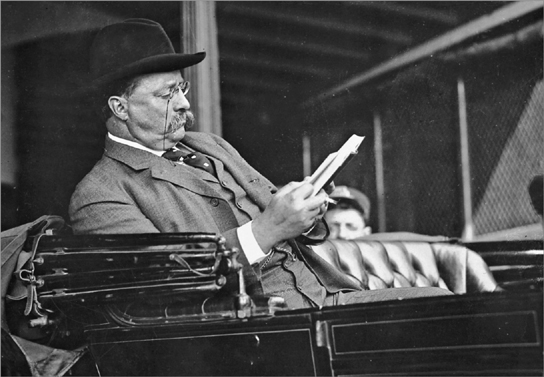
“HE WAS EXHAUSTED, SICK OF POSTURING AND ORATING.”
Roosevelt reading on the North River ferry, New York, fall 1910. (photo credit i5.2)
Sullivan stayed on for some time, then again tried to leave. Roosevelt clung to him.
He suggested92 that I should not take the train from Oyster Bay but that the two of us should walk four miles across Long Island fields to another station on the main line, at Syosset. At the station, as we parted, he made me a present of the cane he carried, as if he wished to make some enduring seal of what he regarded as probably a diminishing number of his future friends. As I looked out the window of the car and Roosevelt waved a final good-by and turned back toward Sagamore Hill, I felt sorry for the thoughts I knew would accompany him through the four miles of winter dusk.
ROOSEVELT’S MOOD WAS not as melancholy as Sullivan imagined. For a few weeks, he alternated between bravado (“The fight for progressive government has merely begun”) and relief that a repugnant campaign was over (“I have never had a more unpleasant summer”).
One piece of good news93 was that Simeon Baldwin might not, after all, sue him for libel. The governor-elect felt94 there was little political capital to be gained by dragging a still beloved former president into court, and suggested arbitrating their differences. Roosevelt declined to arbitrate and insisted, once again, on the primacy of national law over states’ rights. Baldwin replied that in view of the Colonel’s obvious sincerity, he would not proceed against him.
Gradually Roosevelt95 began to feel more cheerful about his disastrous decision to reenter politics. He gave thanks that there would be no more talk of him challenging the President for renomination. “It looks to me as if, ultimately, the best thing that could happen to us now would be to do what we can with Taft, face probable defeat in 1912, and then endeavor to reorganize under really capable and sanely progressive leadership.”
He thought that he had behaved responsibly at Saratoga, fighting against machine politics with the approval of the administration. And he was pleased96 that, although his too-big personality seemed to have hurt some progressive candidates, his promulgation of the New Nationalism had helped others to win big in the West and Midwest. The swing vote that Republican insurgents now wielded in the Senate was encouraging. If Democrats had been shameless in cottoning on to the progressive cause, at least their imitation was a sincere form of flattery. One of them, Woodrow Wilson, the former president of Princeton University, had been elected governor of New Jersey on a campaign platform of corporate control, railroad taxation, humane labor policies, and primary reform that the Colonel himself could have written.
AS THE END of the year approached, Roosevelt and Taft began—half-shyly, half-warily—to reconcile. They had mutual bruises to nurse, as well as memories of an era when they had been on happier terms, forever roaring with laughter.
On 19 November97, the Colonel put in a surprise appearance at the White House. He pretended not to know that Taft was away on a Caribbean cruise, and said only that he had time to kill before engagements at the Smithsonian and National Geographic Society. Munching corn bread from the kitchen and trailed by an excited group of former servants and clerks, he marched over to the West Wing to look at the new Oval Office that Taft had built over his former tennis court.
Without a trace of self-consciousness, he sat behind the President’s desk and said how “natural” it felt to be there. He praised everything he saw, and remembered the names of all around him, including scullery maids. Then he was off, leaving behind a calling card for Mrs. Taft. Ike Hoover, the White House usher, wept when describing the event to Archie Butt. “It is the only happy day we have had in two years, and not one of us would exchange it for a hundred-dollar bill.”
When Taft returned to reclaim his chair, he wrote Roosevelt to say he was sorry to have missed him, and insisted that he stay at the White House next time he came to the capital. “I think you are a trump98 to ask me,” Roosevelt replied, but was vague about future visits. A political instinct sharper than the President’s warned him to keep his distance. That did not stop99 him lobbying Taft to appoint Edward Douglass White, a Southern Democrat and a Catholic, as Chief Justice of the United States, instead of Charles Evans Hughes, who had shown no gratitude for services rendered earlier in the year. Taft was happy100 to oblige, and in return asked the Colonel to review a draft of his annual message to Congress. “There is nothing for me to say,” Roosevelt replied, “save in the way of agreement and commendation.”
Notwithstanding their politesse101 on paper, a residue of personal disapproval remained. Taft used the phrase deeply wounded so often, in complaining about Roosevelt’s post-Africa attitude, as to sound almost masochistic. It was clear to aides that the President was mentally and physically ailing. Over the summer his weight had ballooned to 330 pounds, and he kept falling asleep during the day. A doctor advised that his heart was under serious strain. He lived for play rather than duty, procrastinating endlessly—“I would give anything in the world if I had the ability to clear away work as Roosevelt did.” Tabulatory games obsessed him: when his golf score was low, or his bridge and poker winnings high, he was unconscious of time passing, and the resentment of companions wanting to go home.
Roosevelt was more healthy in mind and body, although he had trouble shaking his travel fatigue. He claimed to be reconciled to life on the sidelines, and wrote Eleanor, now settled with Ted in San Francisco:
What I now102 most want is just what is forced on me: to stay here in my own home with your mother-in-law, to walk and ride with her, and in the evening sit with her before the great wood fire in the north room and hear the wind shrieking outside; to chop trees and read books, and feel that I am justified in not working. I don’t want to be in Africa, or on the ranch, or in the army, or in the White House; I like to think of them all, now and then, but the place I wish to be is just where I am.
* In 1910, the word publicity was understood to mean exposure of something generally hidden.