
CHAPTER 1
How does one prepare a preteen for the task of ruling the world?
That question confronted imperial Rome at the midpoint of the first century A.D., as the reigning emperor, Claudius, grew increasingly infirm. It seemed likely then that supreme power would pass, for the first time, to an heir who was not fully grown. The most likely candidate was then twelve years old: Claudius’ stepson, Domitius, whom he had recently adopted and given the name Nero. A natural son, Britannicus, was also waiting in the wings, but he was three years younger.
Given that the entire Roman empire, stretching from southern Britain to the Euphrates, a world-state of fantastic power and complexity, would rest on the shoulders of whichever boy succeeded, those three years might make a huge difference. At least, that was the hope of Nero’s mother, Agrippina, the most powerful woman of her times, now Claudius’ newly wedded wife.
Rome had no handbooks, no courses of study, to prepare a young man to be princeps—the executive office founded eight decades earlier by Augustus Caesar and still poorly defined. Four successive “first men” had imposed their own stamps on the job, with varying degrees of success. Young Nero, in line to become the fifth princeps, would need to learn from their examples—and that task required no ordinary teacher.

Nero as a young boy.
Agrippina, doting mother of the new heir apparent, was awake to the demands of the situation—and the opportunities. Not only must her son—her only child—receive the best instruction on offer, but official Rome must see him receive it. The quality of Nero’s tutor would reflect, as did every staffing change in the imperial household, the odds of his succeeding his adoptive father. Many Romans still hoped that Britannicus, the natural son of Claudius, would take his father’s place; but Agrippina had dismissed her stepson’s tutors and replaced them with nonentities, to discourage such expectations.
With a deft instinct for image making, Agrippina knew where to turn. A master speaker and writer, a man whose high repute as a moralist would shed its glow on her son, was then in exile on the island of Corsica, longing to return to Rome. This man would be forever in Agrippina’s debt—or so she hoped—if she arranged his pardon and return; he would do whatever she required to elevate young Nero. Claudius had banished this man from Rome eight years earlier, but the charge—adultery—was pardonable. Claudius, worked on by Agrippina, could be persuaded to change his mind.
Thus was arranged the recall of Lucius Annaeus Seneca, the man known to us simply as Seneca or as Seneca the Younger. (His father, a literary figure of some repute, had the same name.) From his rocky island home on Corsica, where he had passed his time observing comets, stars, and planets, Seneca made his way to the imperial palace at Rome—an observatory of the dark recesses of the human heart.
I was better off hidden away, far from the crimes wrought by envy,
shunted off from it all, on the cliffs of the Corsican sea.…
How glad I was there, my eyes on Nature’s masterwork—
the sky, and the sacred paths of the sun,
the cosmos’ motions, the allotments of night and day,
the sphere of the Moon, that glory of upper air,
spreading its light to a ring of unanchored stars.
With these words, the author of Octavia, a Roman play written by one of Seneca’s admirers, introduces the character “Seneca” onto his stage. This unknown author has left us a mythicized, but nonetheless fascinating, account of Nero’s inner circle, a self-enclosed group whose twisted relationships and psychic torments were already legendary in their own day. Tragic drama, this author felt, was the best way to understand these people, even if historical facts had to be bent. Many modern playwrights and operatic composers, including Racine, Monteverdi, and Handel, have concurred.
Seneca never commented, in any of his extant works, on whether he regretted his departure from Corsica, by far the most consequential of the many turns his life took. Some later claimed that he hoped to go to Athens, not Rome, when he left, to study the works of great Greek thinkers in the city where they had lived. But the claim might well have arisen as an effort at image repair. There were many supporters of Seneca, including Octavia’s author, who portrayed him as what he strove to be—a moral philosopher of the Stoic school—and sought to counter the charges, brought by others, that he was a politician, a greedy businessman, and a corrupt power-monger who used philosophy to cloak his motives. The divide between these views continues to this day.
By his own account, Seneca had been won over to Stoicism in boyhood, at the feet of Attalus, a Greek who taught at Rome around the turn of the millennium.
Seneca, with his father and brothers, had moved to Rome from Corduba, in what is now Spain, at a time when Greek sages were thronging to the world’s new imperial city. Attalus impressed young Seneca with his abstemious way of life, an asceticism that, he said, made him a king; by needing nothing—neither wealth, nor position, nor fine dress and food—he gained as much power and freedom as any monarch. “To me, he seemed even greater than a king, in that he was entitled to pass judgment on kings,” wrote Seneca many decades later—after he himself had tasted the same privilege.
Attalus was only one of several whose wares young Seneca sampled in Rome’s bustling marketplace of ideas. Cynics preached an even sterner ascetic code than the Stoics, ranting against wealth and power while wearing threadbare cloaks and gnawing crusts of bread. Pythagoreans taught the mystical doctrine of transmigration of souls and avoided the eating of meat, which they regarded as cannibalism. Seneca briefly adopted their practice, but his father made him desist. In that year, A.D. 19, a surge of xenophobia had gotten Jewish rites banned from Rome, and a vegetarian diet looked uncomfortably similar to a kosher one.
Most of the philosophers whom young Seneca heard were imports from Greece, but a native Roman school had also sprung up, and Seneca took a strong interest in it. Its founder, Quintus Sextius, had famously declined appointment to the Senate, a high privilege that had been offered to him by Julius Caesar. Sextius preferred to devote himself full-time to philosophy, though he at first found the work so difficult that he almost hurled himself out a window in frustration.
Seneca liked the way Sextius, in his writings, used tough, vigorous Roman language to express Greek moral ideas, which in their native tongue often felt flaccid and effeminate. A passage from Sextius that he admired contained a military analogy, comparing a virtuous man’s resistance to evil to an infantry hollow square—a defensive formation that brought spearpoints to bear in four directions at once. The muscular image held for Seneca the appeal of the unattainable, for he suffered from respiratory ailments and never saw a day’s military service. In his own later writings, of the countless metaphors he employed, among his favorite and most frequent would be that of moral effort, or human life itself, as armed combat.
In his writings, Seneca praised Sextius’ choice, to practice philosophy and forsake politics, but in his own career, he did not follow it. Somehow, by a thought process he never revealed to his readers, Seneca decided, in his thirties, to pursue both paths. Still practicing ascetic habits that he learned from Attalus—sleeping only on hard pillows, and avoiding mushrooms and oysters, Rome’s favorite delicacies—and studying natural phenomena, he nonetheless embarked on the cursus honorum that led, ladderlike, to ever higher offices. In his late thirties, after a sojourn in Egypt with a powerful uncle, Seneca, along with his older brother Novatus, entered the Senate—the very move Sextius had disdained.
By family status, Seneca had no right to a seat in the Senate house. His clan, the Annaei, were equites, “knights,” well off but neither rich nor noble, and under Rome’s class-stratified constitution, they were excluded from high office. Seneca’s father—a tough-minded, rock-ribbed man of letters, still sharp as a tack in his late eighties—had once hoped for adlection, the magical process by which the princeps could elevate a knight to the Senate, if only so that he might hear Cicero declaim. His two elder sons would finally gain the rank that eluded him.
As he neared the end of a long life, back in the family seat of Corduba, the elder Seneca gave a qualified blessing to the path on which these two had set out, while praising his cherished third son—young Mela, the quiet and studious brother—for avoiding it. “I see your soul shrinks back from public office and disdains all ambition, and desires only one thing: to desire nothing,” the crusty old man of letters wrote, urging Mela toward his own specialty, the study of rhetoric. “You were always more intelligent than your brothers.… They are all about ambition and are now preparing themselves for the Forum and for political office. In those pursuits,” he remarked, as though issuing a warning, “the things one hopes for are also the things one must fear.”
At around the time those words were written, just after Seneca had made his start in the Senate, Agrippina the Younger (so known because her mother was also named Agrippina) gave birth to a son. The event had political meaning, for this Agrippina was great-granddaughter of Augustus and sister to the reigning princeps, Caligula, who was as yet childless himself. Official Rome marked the arrival of a promising heir—for every male who shared Augustus’ blood had promise, and young Domitius had a greater share than most.
If Seneca joined his colleagues in hailing the birth, as he must have done, he could have little guessed how much his own fate hung on this boy’s future. There was as yet no clue that their two lives would, for almost two decades, be intertwined in a strange and tortuous partnership on which much of Rome’s destiny hung. Nor could Agrippina have divined from the portent she saw at her son’s birth—the rays of the rising sun falling full on the baby’s face—that someday he would seek to have her murdered, and seekSeneca’s help.
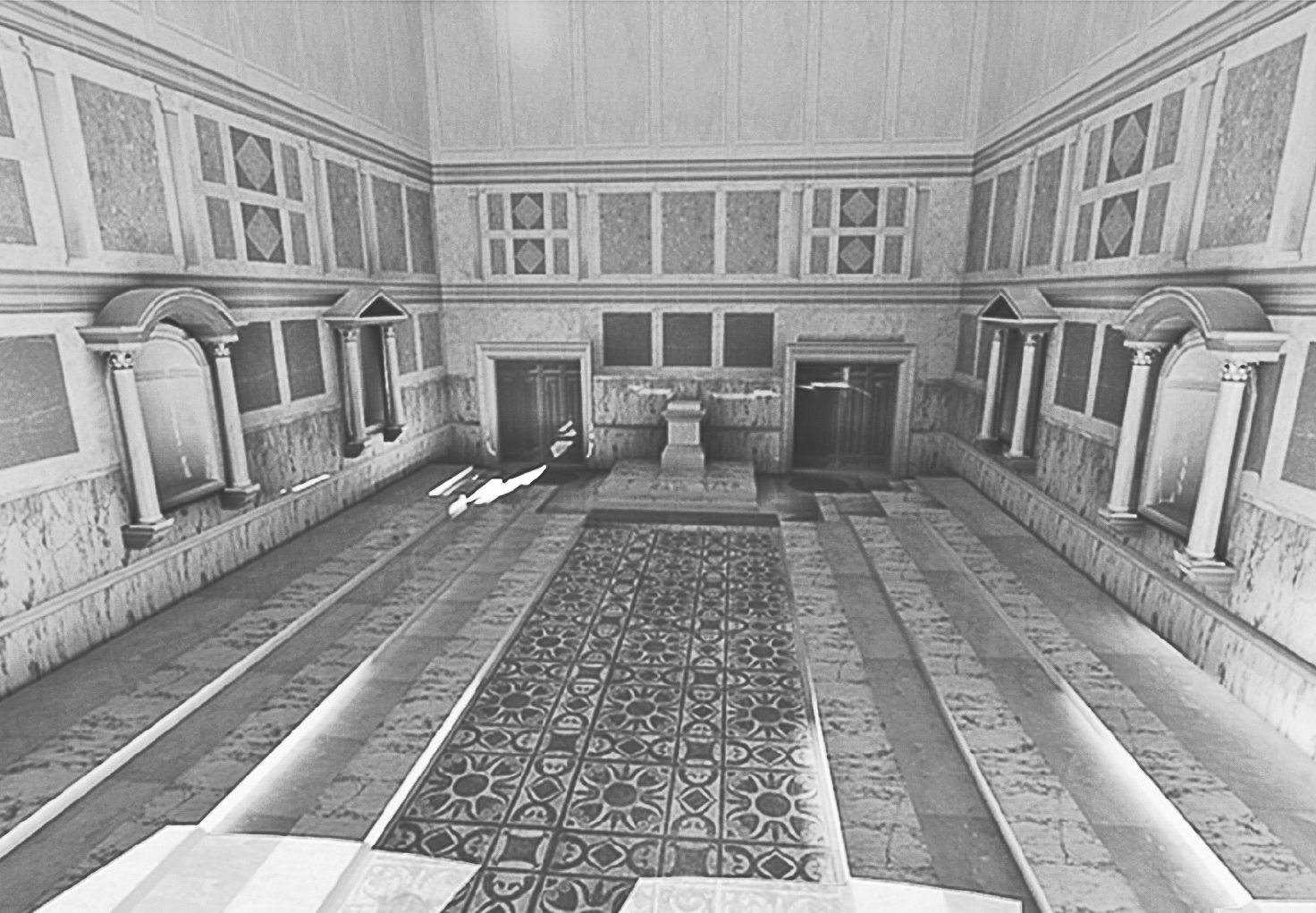
A digital reconstruction of the interior of the Roman Senate, with benches on which senators sat.
Agrippina was a spirited, beautiful twenty-two-year-old when her son was born, already well versed in the perils of dynastic politics. Her father, Germanicus, an adored war hero whom many had hoped would be princeps, died under mysterious circumstances in her childhood; his ashes, escorted home from abroad by her mother, had produced a national outpouring of grief. Over the next fifteen years, she lost that mother, and two of her three brothers, to political murders. The reigning princeps, Tiberius, resented the cultlike reverence the public felt for Germanicus, and looked with suspicion on the orphaned children who shared in it. But he nonetheless spared Agrippina and her sisters, as well as Germanicus’ last surviving son, Gaius—known to us by his nickname, Caligula—whom in the end he adopted.
Tiberius had just died, and the four siblings had just come into their own, when Agrippina became a mother. Caligula was officially coruler, along with Tiberius’ grandson, but he quickly eliminated his partner and assumed sole rule. A dashing twenty-five-year-old, sound of body and—for the moment—of mind, Caligula was hailed as the bringer of a new golden age, and his three charming sisters added to his luster. Caligula even made his sisters sharers of his power, adding their names to the oath of loyalty swornannually to the princeps. Agrippina, one of the cherished children of Germanicus, had gained stature unprecedented for a Roman woman; and she had wealth as well, thanks to her marriage, since age thirteen, to a rich aristocrat, Domitius Ahenobarbus, Nero’s father.
Agrippina could not attend meetings of the Senate (though one day she would try to fix that), but she heard much about what went on in that fervid chamber, the Curia. An orator who had recently arrived there, Lucius Annaeus Seneca, was attracting notice for his unique verbal style—seductive prose with short, punchy clauses and pithy epigrams. Agrippina formed a bond of friendship with Seneca, a man almost two decades older but, as an eques, well below her (and his fellow senators) in rank. So too did Agrippina’s sister Livilla—and that bond was said, by some, to go beyond friendship.
Agrippina’s brother did not care for Seneca, nor for the epigrammatic style in which he spoke. “Sand without lime,” Caligula called those words, drawing an analogy from the building trade, where sand and lime were mixed to make mortar. Seneca’s speeches, to Caligula, seemed to lack solidity—ear-catching phrases strung together without binder to firm them up. (That critique has been repeated, in various forms, ever since. Lord Macaulay echoed it in the 1830s when he wrote: “There is hardly a sentence [in Seneca] which might not be quoted; but to read him straightforward is like dining on nothing but anchovy sauce.”) Or else they were “nothing but commissiones,” showy declamations like those put on for prizes at the start of public games.
Senators like Seneca were, at the outset of Caligula’s reign, welcome visitors in the imperial household, for the Senate had cheered the new princeps and rushed to grant him supreme power. But the lessons of Roman history suggested that amity would not last. The Senate, still cherishing memories of its central role under the republic, had never reconciled itself to the principate, even though the attempt to prevent it—the killing of Julius Caesar—had failed. A bloody civil war had decided the question, and Augustus had taken over. But both he and his successor, Tiberius, had struggled to find a modus vivendi with stiff-necked senators. When that effort failed, those necks often went under the sword.
Over seven decades, the Senate had tried to assert its ancient prerogatives. But the princeps always had the final say, thanks to his personal army corps, the Praetorian Guard. These elite soldiers, encamped at the northeastern edge of the city, alone had the right to bear arms within Rome’s boundaries. Each emperor had been careful to ensure that these troops, and in particular their prefects or commanding officers, were well fed, well paid, and loyal to his cause. Though it was bad taste for a princeps to deploy Praetorians against the Senate, all parties were certain that, if so ordered, the troops would obey.
The Praetorians were thus the ultimate weapon of a princeps. Caligula, as his sanity deteriorated and his hostility to the Senate grew, would test that weapon’s limits—and finally exceed them.

The Praetorian Guard, depicted in a relief of the first century A.D.
No one quite knows how the downturn began, but Seneca, an eyewitness, attests to the terrifying depths it reached. Caligula stalks through Seneca’s later writings like a monster in recurring nightmares, arresting, torturing, and killing senators, or raping their wives for sport and then taunting them with salacious descriptions of the encounters. “It seems that Nature produced him as an experiment, to show what absolute vice could accomplish when paired with absolute power,” Seneca said of Caligula’s madness.
Among the first whom Caligula victimized, after his mind began to turn, were his sisters, Agrippina and Livilla. They had been his closest companions, along with a third sister, Drusilla, who was thought by some to have been his lover. Drusilla died of illness inA.D. 38, plunging Caligula into deep grief; he emerged from the catastrophe a changed man. Without warning, while passing time with his surviving sisters at a posh estate, he accused them of having affairs—both at once—with their widowed brother-in-law,Lepidus, and conspiring to put him on the throne.
The Senate, asked to pass judgment, acceded to what the princeps desired. Agrippina and Livilla were branded state enemies and banished to the Pontine Islands, tiny patches of volcanic rock in the Tyrrhenian Sea. Probably Caligula meant for them never to return.
At age twenty-three, leaving her infant son in the care of her husband and sister-in-law, Agrippina went into exile. Before she left, Caligula added degradation (his signature touch) to her sentence. He forced Agrippina to carry the ashes of her alleged lover Lepidus, now executed, in a public burial procession. It was a cruel parody of their mother’s heroic march, two decades earlier, with the ashes of their father, Germanicus. Ingenious in his sadism, Caligula had found a way to debase his sister, his dead brother-in-law, and the memory of his parents, all in a single spectacle. Then he auctioned off Agrippina’s property to bearded Germans, leaving his sister destitute.
Exile to the Pontines had spelled death for most descendants of Augustus, and in this case, too, it seemed to be only a prelude. “I have swords as well as islands,” Caligula quipped as he sent his sisters away. But somehow, as the weary months wore on, noPraetorians arrived at the prison of either Agrippina or Livilla, and the food allotments were not stopped. For whatever reason, Caligula, for the moment anyway, let his sisters live on.
Many Romans fell in the wake of the Lepidus conspiracy, among them aristocrats who had backed a different coup a generation earlier—that of a Praetorian prefect named Sejanus. Caligula had been but a boy when his adoptive father, Tiberius, put that plot down. But Caligula somehow grew suspicious that the remaining Seianiani, the supporters of Sejanus, were against him; the two plots, separated by fifteen years, seemed linked in his disordered mind. And that suspicion fell also on Seneca, whose family was linked to the Seianiani in ways that could not have escaped notice.
Perhaps Seneca feared that the odor of the Sejanus conspiracy still clung to him, fifteen years later, and that Caligula would scent it out. That, at least, is one conclusion that has been drawn from a treatise he published at this time, his first extant philosophic work.
Consolation to Marcia, written about A.D. 40, takes the form of a letter addressed to a mother grieving for a dead son, but it was meant to be read widely. Seneca would play the same rhetorical trick his entire life, allowing his readers to listen in on what seemed to be an intimate exchange. His addressee was often a family member—his elder brother Novatus on several occasions—or a close friend. In this case, Marcia, a middle-aged woman of senatorial rank, was not connected with Seneca in any recoverable way. She was, however, the daughter of a man who had been persecuted by Sejanus, Cremutius Cordus.
In A.D. 25, Sejanus had deemed that Cordus, a senator and part-time historian, had committed treason by portraying Brutus and Cassius, Julius Caesar’s assassins, as valiant men. Cordus defended himself in the Senate, claiming that freedom of speech had never before been so harshly repressed. But the mood in the Senate chamber, and the frowning countenance of the princeps as he sat in on the trial, foretold what the sentence would be. Cordus went home, shuttered himself in his room, and began fasting to death.
The sequel is related by Seneca in Consolation to Marcia. After her father had been locked away for four days, Marcia entered his room and discovered he was starving himself. He begged her not to prevent him. Meanwhile, in the Senate, word had gotten out that Cordus was trying to cheat Sejanus of his prey. Sejanus’ partisans argued that a defendant on trial could not evade judgment in this way and pressed for an arrest and execution. While the debate proceeded, Cordus managed to achieve the death he sought. Angry officials ordered the burning of his histories, but a copy survived, and Marcia helped bring the work back into circulation twelve years later, after both Tiberius and Sejanus were dead.
It is an odd ploy Seneca uses—reminding Marcia of these painful details of her father’s arrest and suicide, in a letter meant to offer her consolation. Perhaps he was merely maladroit. But perhaps, as one modern scholar suggests, he was pointedly putting himself on the right side of a political fault line. If to be friends with the friends of Sejanus was dangerous, then safety lay in being friends with his enemies—and in displaying that friendship to the world. On this reading, Seneca chose to console Marcia out of savvy self-interest.
Nothing can be proven, but the theory fits with a pattern of opportunism in much of Seneca’s work. His command of the written word was so deft, his rhetorical skills so subtle, that it was easy for him to help himself while also helping others. The challenge for modern readers is deciding which motive is foremost in any given work. Perhaps Seneca himself often did not know.
In its larger goals, Consolation to Marcia uses Stoic ideas and methods to deal with the greatest of human griefs, the loss of a child. Seneca portrays himself as a doctor cleansing a patient’s wounds. Those wounds have begun to fester: Marcia is still grieving more than two years after the death of her son Metistius. In Stoic terms, she has dangerously lost touch with Reason, the element that makes her fully a person. The Divine enthroned this element within the human soul, just as surely as it put a thinking brain atop the human body. If Reason cannot be restored to its proper primacy, Marcia will lose her personhood and any hope of happiness.
Seneca does not deny Marcia the right to grieve, for that would be cold—and coldness was often charged against the Stoics, as he was well aware. Seneca’s version of Stoicism was softer, more adaptable to human frailties. Mourning is natural for a bereft parent, Seneca allows, but Marcia’s grief has surpassed the bounds of Nature. Nature, for him as for all Stoics, was the master guide and template; it was allied with Reason and with God. Indeed these three terms, for Stoics, were close to synonymous.
Marcia’s grief, for Seneca, exemplifies a universal human blindness. We assume that we own things—family, wealth, position—whereas we have only borrowed them from Fortune. We take for granted that they will be with us forever, and we grieve at their loss; but loss is the more normal event—it is what we should have expected all along. Our condition, could we see it aright, is that of an army assaulting a well-defended town: every moment might bring the bite of a barbed arrow. Then, shifting metaphors, Seneca compares our lot to that of a condemned criminal: “If you lament a dead son, his crime belongs to the hour in which he was born. A death sentence was passed on him then.”
Is life on a battlefield, or on death row, worth living? Seneca seems to be of two minds. At one point, he extols the beauty of the world, the joys that outweigh all suffering. At another, he reckons up the pains of mortal life and claims that, were we offered it as a gift instead of being thrust into it, we would decline. In either case, life, properly regarded, is only a journey toward death. We wrongly say that the old and sick are “dying,” when infants and youths are doing so just as certainly. We are dying every day, all of us. To finish the job early on, as Marcia’s son did, is a fate to be envied.
Some of Seneca’s comforts ring hollow or seem in dubious taste. When he tells Marcia to be grateful that she had joy of rearing her son, just as a breeder has joy of raising a puppy but then parts with the adult dog, we hear him reaching too far for analogies. Throughout his career, Seneca would struggle with the curse of the facile writer—not knowing when to stop. But his Consolation to Marcia is on the whole an inspiring work, impassioned in its tone and grand in the scope of its goals. Seneca aims, as he would do throughout the next quarter-century, to change the way humanity thinks about our greatest crisis, death.
Consolation to Marcia ends with a bizarre flourish, Stoic in origin but crafted into something all Seneca’s own. Greek Stoicism held that the world would be burned away, then created afresh, in a recurring cycle. The doctrine was largely obsolete by Roman times, but Seneca gave it new life, in this work and others. He asks Marcia to picture her father, the heroic suicide Cordus, now dwelling in a place very much like Heaven (though Christianity had just begun at this time, half a world away in Jerusalem, and had only barely reached Roman ears). From his all-seeing seat in the sky, Cordus foresees what is to come:
Nothing will remain where it now stands. The old age of the world will level all, carry all away with itself. Not just mankind, but places, regions, continents—all these will be its sport. It will push down the mountains and toss new peaks to the sky. It will suck up the seas, turn rivers aside, and dissolve the congress of peoples that binds the social order of man. Cities will it drag down into deep chasms, shatter with earthquakes, infect with plague-bearing winds summoned up from its depths. It will swallow up with floods every inhabited place; it will kill every living thing on the submerged earth; it will burn and destroy mortal life with immense tongues of flame. And when the time comes for the earth to snuff itself out, in order to make itself new, all this will destroy itself by its own power; stars will crash into stars, and whatever now shines in an ordered array will burn up in a single flame in which all matter is consumed.
He offers all this to comfort Marcia, showing her that individual losses—like the death of Metistius—will soon be insignificant. But the ecstatic intensity of the passage goes well beyond this goal. It appears that Seneca, as he endured the horrors of Caligula, found something deeply stirring in the nearness of the world’s end.
It was not apocalypse but redemption that arrived, soon after Seneca published his Consolation.
One day in early 41, when he was in his fourth year as princeps, Caligula awoke from a strange dream. He had been sitting at the feet of Jupiter on Mount Olympus, when the god pushed him with his big toe and sent him hurtling downward. It was a prophetic image, for before the next day ended, Caligula was dead.
His mad behavior had gone so far as to turn even his Praetorians against him. If they let him continue in power, he would destroy the principate itself, the institution that was their sinecure and raison d’être. They made common cause with the senators, his principal victims. A squad of soldiers cut him off in a tunnel leading out of a theater and stabbed him to death. His body was cremated unceremoniously, and his ashes were buried beneath a low mound of earth.
As the fatal strokes fell, they changed forever the unwritten definition of the principate. Caligula’s experiment in absolute power had proved that there was, finally, a check. The Praetorians had imposed it. And in the hours that followed the murder, they also seized a central role in the question of succession. While the Senate dithered vaguely over a hoped-for return of the republic, soldiers collected Caligula’s sickly paternal uncle, Claudius—found trembling behind a curtain, according to legend, though more likely well briefed on what was to happen—and brought him to the Praetorian camp, where he was hailed with cries of “Imperator!”
Claudius, in turn, thanked the guard with a huge bequest of five years’ salary per man. Setting a precedent that was to endure for centuries, the Praetorians had dispatched one emperor and installed another—and got rich for their efforts. They had transformed themselves from honor guard and security force to Rome’s behind-the-scenes kingmakers. Except that Claudius was not a king, but something vaguer and less substantial. Rome had abjured hereditary monarchy centuries before and could not admit to itself that arex—even the word was considered toxic—was once again head of state.
The Senate, which had formally acclaimed three previous emperors, took no part in this transfer of power. The swiftness with which Caligula had imploded had allowed them no time to align behind the new ruler. Claudius, aware that the Senate mistrusted him, did not enter the Curia for a solid month—and then only with a bodyguard. He was a creature of the Praetorians, selected by none but them. He acknowledged it candidly on his coins, some of which depicted the gates to the Praetorian barracks or a soldier taking Claudius by the hand.
Seneca watched the bloody fall of Caligula from near at hand but seems to have taken no part. In his writings, at least, he kept a cool distance from the conspiracy. Regicide was a sensitive matter to discuss in print, for every princeps was threatened by it, and none could allow it to be praised. In one hypothetical discussion, Seneca advocated a final solution for a princeps who was incurably insane, but then went on to say—prudently, for a minister of state—that such freaks of nature were as rare as chasms gaping in the solid earth, or underwater volcanoes. Not even the case of Caligula, perhaps, would qualify under such strict guidelines.

An early coin of Claudius, showing his own image on one side and the Praetorian camp on the other. The abbreviated words Imperatore recepto, “The commander received,” recall the moment of Claudius’ accession.
Though he could not write openly about Caligula’s fall, Seneca could at least survey the wreckage of the Roman political class. Victims of torture and rape stirred his pity, but also, perhaps more so, onlookers forced to accept those crimes without protest—the regime’s moral casualties. The harrowing stories of De Ira (“On Anger”), probably written soon after Caligula’s fall, show the young senator reckoning up the spiritual cost of despotism: the psychic wounds suffered by those forced to capitulate. It was the defining problem of Seneca’s age, and he was to grapple with it as no one else did, both in his writings and in his own life.
De Ira is Seneca’s first in a string of treatises, each dealing with a single ethical topic announced in the title (De Clementia or “On Mercy,” De Brevitate Vitae or “On the Shortness of Life,” and so on). Anger leads the series of topics because anger poses such an immense threat to Reason. Seneca shows first why ira must be avoided, then how it can be. If we exert strenuous effort—Seneca uses the analogy of a sponge diver learning to hold his breath for ever-longer intervals—we can master anger and prevent it from infecting our souls. Along the way, Seneca discusses some disturbing cases in point.
De Ira, for instance, tells of Pastor, a wealthy eques, whose son Caligula had marked as an enemy merely because he had nice hair. (The princeps himself was going bald.) Pastor begged the princeps to spare his son, prompting the peeved Caligula to immediately have the boy killed. After the murder, Caligula brought Pastor to the palace and ordered him to drink wine and put on festive garlands; a soldier stood nearby, watching for signs of discontent. Pastor steeled himself and cheerfully drank the health of his son’s killer. How could he bring himself to do it? asks Seneca, then gives the answer: Pastor had another son (and Caligula knew it).
Not only in Rome, but everywhere and in all times, good men have knuckled under to despots. Elsewhere in De Ira Seneca calls to mind the sufferings of Asian viziers in old Greek legends. Harpagus served as chief minister to a Persian king but offended his master by disregarding an order. The king took a gory revenge: he served Harpagus a stew of his own children’s flesh, then showed him the severed heads to reveal what he had eaten. How did Harpagus like his dinner? the king asked, with Caligulan cruelty. Harpagus’ choking reply was “At a king’s table, every meal is pleasant.” The flattery at least gained him this, Seneca says grimly: he did not have to finish his meal.
De Ira teaches its readers to avoid anger by disregarding injuries. But the cases of Harpagus and Pastor test the limits of this doctrine. It is one thing for a great Stoic to ignore a man who jostled him in the public bath, or even one who spat in his face (two other tales told in De Ira). To accept the murder of one’s children goes beyond anger management, into the realm of moral self-annihilation. Yet Seneca suggests, initially, that this is indeed what his teaching requires. “That’s how one eats and drinks at the tables of kings, and that’s how one replies,” he comments on the tale of Harpagus. “One must smile at the slaughter of one’s kin.”
Then abruptly, as though shocked at where his own argument has led him, he changes track:
But is life really worth so much? Let us examine this; it’s a different inquiry. We will offer no solace for so desolate a prison house; we will encourage no one to endure the overlordship of butchers. We shall rather show that in every kind of slavery, the road of freedom lies open. I will say to the man whom it befell to have a king shoot arrows at his dear ones, and to him whose master makes fathers banquet on their sons’ guts: “What are you groaning for, fool? … Everywhere you look you find an end to your sufferings. You see that steep drop-off? It leads down to freedom. You see that ocean, that river, that well? Freedom lies at its bottom. You see that short, shriveled, bare tree? Freedom hangs from it.… You ask, what is the path to freedom? Any vein in your body.”
This rhapsodic hymn to suicide stands as a second landmark in Seneca’s thought, like the equally fervent apocalypse scene in Consolation to Marcia. Stoics had long considered suicide to be a remedy for inescapable ills, including abuse by a cruel despot. But what had been a minor topic among the Greek Stoics became all too central in Rome in the age of the Caesars. Indeed, for Seneca, it became a kind of fixation. In writings throughout his career, he recurs again and again to agonizing questions of how, why, whether, and when to take one’s own life. Later ages decided he had been aptly named, deriving Seneca from the Latin phrase se necare, “to kill oneself.”
The template for Roman political suicide had been set in the previous century, by a man named Marcus Porcius Cato. The last in a long line of famous Catos, an ascetic who trained himself to endure hunger and cold, Cato found himself ranged against Julius Caesar in a civil war of the 40s B.C. The city he governed, Utica in North Africa, was one of the last anti-Caesar strongholds, and after it fell, no hope was left. Cato and a small band of followers fled and took refuge in a friend’s villa, where Cato—who had been reading a serene account of Socrates’ death, Plato’s Phaedo—retired to a private room and fell upon his sword. His companions heard his struggles and rushed to help him; a doctor among them tried to reinsert his viscera and sew up the wound. But Cato, briefly regaining consciousness, ripped out stitches and organs with his own hands and expired.

Bronze portrait bust of Marcus Cato, the legendary Stoic suicide.
The gruesome self-disemboweling came to be seen as an exemplary act of lived philosophy. It showed a heroic devotion to autonomy—the personal freedom that Caesar’s victory had threatened—and a superhuman defiance of pain and fear. As the Caesarean system took hold, Cato’s suicide took on new meaning to those who mourned loss of liberty, shining ever brighter as a moral exemplum. In Seneca’s works, it glows incandescent—as does nearly everything Cato did or said.
But political suicide in Seneca’s day was a different gesture than it was in Cato’s. Often it signaled acquiescence to autocracy rather than defiance. A bizarre compact had been struck between aristocracy and ruler: the princeps would allow his victims to pass on their wealth to their heirs, rather than forfeiting it to the state, if they executed themselves rather than force him to use his Praetorians. They could save self-respect, and avoid the horror of decapitation, if they took their own lives. Their bodies would be accorded due rites of burial. The princeps could then present their death to the public as evidence of guilt, or at least of surrender.
The system had become formalized by the time of Caligula, who kept two notebooks of enemies’ names, titled “Sword” and “Dagger.” The first listed those whom the soldiers would behead; those on the second would open their own veins (an operation requiring a much shorter blade). The state had a vital interest in keeping these categories distinct. In at least one case, a man attempting suicide and on the point of succeeding was rushed as he expired to a place of execution. He managed to die en route, cheating the princeps of an estate.
Even as their lifeblood ebbed away, political suicides knew that the princeps held the power to harm their wives and children. Their last words and gestures were carefully restrained. Wills were altered to give the princeps a sizable share of the property, lest he concoct a pretext to seize it all. The prudent might even insert flattery of the emperor into their suicide notes.
Seneca’s hymn to suicide is thus very much of its time. By his day, suicide had come to signify, for aristocratic victims of the emperors, an inability to fight back; the best one could hope for was to embarrass the princeps by a highly public exit. In De Ira, accordingly, Seneca portrays suicide as an escape route, a way to gain release from the power of kings. What he doesn’t acknowledge, or isn’t aware of, is that suicide can also be a means of fighting back—even though an example was right before his eyes.
Prexaspes was another vizier like Harpagus, a right-hand man to a Persian monarch. His master, Cambyses, a notorious drunk, set out one day to prove to his court that wine did not affect him. He set up an archery course, with Prexaspes’ son as the target; then, good as his word, he shot the boy through the heart. The story is related in De Ira just before the hymn to suicide above (in which Prexaspes is recalled as “the man whom it befell to have a king shoot arrows at his dear ones”). But Seneca leaves the sequel to the story curiously untold.
Years later Prexaspes found himself in possession of dangerous information. He knew that a group of plotters had murdered Cambyses’ heir and put an impostor on the throne. He had colluded with the plot’s leaders, who valued his high standing among the Persian people. When the people became uneasy about their king’s legitimacy, the plotters asked Prexaspes to reassure them.
Prexaspes climbed a high tower in a central square of the capital. From a window at the top, he called out to the populace below—but not as instructed. He denounced the impostor and revealed the plot, confessing that he himself had killed the true heir to the throne, on Cambyses’ orders. Then he launched himself off the tower and fell to his death. Inspired by his deed, the Persians rallied against the conspirators and soon overthrew them and their false king.
Prexaspes’ model was one Seneca never contemplated, though he examined suicide in many forms. In De Ira, he configures the act as something private, passive, nonpolitical. He takes as implicit that regime change cannot happen at Rome, even if good men are willing to die.
That premise would govern the choices Seneca made in his own life and his own political career—which was soon to follow that of Prexaspes all too closely.
The fall of Caligula meant that Agrippina and Livilla, the two exiled sisters of the princeps, could return to Rome. Both now in their twenties, adored by the public as children of Germanicus and victims of their hated brother, these women enjoyed a stature that had never been higher. For some, it was too high.
Both women were beautiful, and one—Agrippina—was known to be fertile. Both were therefore suspected of using sex to gain power. Caligula, when getting them exiled, had accused them not just of backing the usurper Lepidus but of sleeping with him—a charge that played on the entrenched fears of Roman men. For decades, the women of the Caesars had held them in a cathectic spell, appearing to their mind’s eyes as sexual sirens, manipulators, incestuous monsters, or some mixture of these frightening roles.
The sexuality of this sisterly pair was the special worry of Valeria Messalina, the sixteen-year-old wife of the newly installed Claudius (soon to become herself a huge source of male anxiety). From the moment they returned, she regarded the daughters of Germanicus as rivals, even though they were her husband’s nieces. She had already borne Claudius two children, including a son, Britannicus, but she feared the lineage of these two trophy women. Either one could solve a grave problem facing Claudius’ regime, a problem that could be traced back decades earlier to Augustus, the principate’s founder.

Messalina holding her infant son, Britannicus.
Rome’s first princeps had been unlucky in the engendering of sons. Augustus’ line had been carried forward through his sister Octavia, and through his only natural child, his daughter Julia. Claudius, and Messalina as well—she was his cousin, for the family was narrowly inbred—were descended from Augustus’ sister, as they emphasized by naming their firstborn child Octavia. But Agrippina and Livilla were descended from his daughter. Their direct lineage trumped that of all collaterals.
The principate was not a monarchy—Rome had rejected that institution five centuries earlier and still officially reviled it—and so had no guidelines for succession. Nonetheless, a blood link to the holy figure of Augustus conferred innate legitimacy. The reign of Augustus’ successor, his stepson Tiberius, had taken the throne outside that bloodline, while that of Caligula had restored it. With the accession of Claudius—who had not even been adopted by his predecessor, as Tiberius was adopted by Augustus—the office of princeps and the “royal” line had again parted ways, a situation that made all Rome uneasy.
Messalina had wed Claudius before he became princeps, when it seemed there was no chance he would be one. She had acceptable dynastic stature, but Claudius, significantly, had not allowed her to take the title Augusta, the ultimate mark of female dominion. Her lack of that title meant that Messalina was dispensable. In the imperial family, as she well knew, inconvenient marriages were easily broken so that new ones could be contracted. And the children of such broken unions, especially the males, had a peculiar habit of dying young.
Messalina had two assets with which to defend her place in the palace. The first was her youth, beauty, and warmth, which had a powerful hold on her husband (even if they did not enslave him as our sources represent). The second was her alliance with a cannyGreek ex-slave, Narcissus, Claudius’ private secretary. This highly placed staffer knew every trick in the political playbook. Messalina and Narcissus had discovered that if they worked on Claudius in tandem, she in the bedroom and he in offices of state, they could accomplish almost any goal. Their primary goal, in A.D. 41, was to get Livilla and Agrippina off the scene.
Livilla was married, so it was an easy matter to charge her with adultery, a criminal offense. No hard evidence was needed, only a demonstrably close tie to a man other than her spouse. Livilla had such a tie—to Seneca. She was charged, tried, convicted, and sent back to the Pontine Islands, less than a year after leaving them. She had survived most of Caligula’s reign on those obscure rocks, but this time her persecutors were more diligent. Within a few months, she was dead.
As her alleged partner in crime, Seneca was tried in the Senate, and one would give a lot to read the speech he made there. Perhaps Tacitus, that great chronicler of noble futility, recorded it in the now-lost portion of the Annals; he recorded many other speeches made by senators forced to defend themselves before colleagues forced to convict them. Seneca’s case was particularly hopeless. The Senate not only condemned him but voted a death sentence, a harsh measure showing that someone, perhaps Messalina, considered him a threat. Claudius, however, wary of going too far, stepped in and commuted the sentence to exile, on Corsica.
Agrippina somehow escaped Messalina’s wrath. It perhaps helped her cause that she was related to the empress; her sister-in-law Domitia was Messalina’s mother. But aid from that quarter ended in 42, when Domitia’s rich husband, Passienus Crispus, divorced her to marry Agrippina instead.
Probably Agrippina survived because her sister had died before her. She was now the last of a revered line, and she had borne a son. Domitius, now five years old, was a precious dynastic asset, the only male alive descended from both Germanicus and Augustus. Claudius and Messalina, sprung from a collateral line, thrust into power without support of the Senate or the people, reliant on the Guard and on Greek freedmen staffers whose loyalty was born of total dependence, were too weak to kill this mother and son—much though Messalina might have wished to.
Stripped of half his property, drummed out of the Senate, and having just buried an infant son—the only child he and his wife would ever have—Seneca made his weary way to Corsica.
The island on which he landed was no barren Pontine crag. Corsica had two Roman towns and many smaller settlements; among its diverse population, which included Ligurians, Spaniards, and Greeks, Seneca could find cultured countrymen. But in his first essay written there, a consolatory letter to his mother Helvia, Seneca transformed the place into an island fit for a Crusoe. He gloried in the role of unaccommodated man, living happily on what Nature provided.
“It is the mind that makes us rich,” he told his mother, to dissuade her from mourning his fate. “The mind enjoys a wealth of its own goods, even in the harshest wilderness, so long as it finds what is enough to keep the body alive.” These words might have been written by Thoreau at Walden Pond, although the terms of Seneca’s exile, which allowed him to keep half his estate, gave him access to ready cash.
Corsica, as Seneca conjured it in Consolation to Helvia, was an ideal proving ground for the main Stoic tenet: true happiness comes from Reason, a force allied with Nature and with God. All that Seneca had left behind—senatorial rank, half his property, and what he called gratia, the public esteem he had won as a writer, a thinker, and a decent, fair-minded man—were “indifferents” in Stoic terms, inconsequential to the search for a good life. Of far greater consequence were the beauties that now surrounded him, especially the clear sky above—the sacred source from which, for the Stoics, the reasoning mind was sprung.
In his open letter to his mother, Seneca described in rapturous terms his observations of that sky, especially at night. He tracked carefully the phases of the moon and the motions of stars and planets. “So long as I can dwell with these, and lose myself—to the degree allowed to humans—in celestial things, what does it matter where I set my feet?” Closeness to the night sky was a kind of union with the Divine.
Rome, the city that had blocked the sky with walls and ceilings, appears in this letter as a monster of arrogance, ransacking the world to satisfy its gluttony. Edunt ut vomant, vomunt ut edant (“They eat to vomit, and vomit to eat”), writes Seneca in Consolation to Helvia. He describes the case of Apicius, Rome’s greatest gourmand, who squandered a fortune on exotic shellfish, game birds, and delicacies. When his money began to run out, Apicius drank poison and killed himself. “His last draught was the most healthful he ever took,” Seneca says, combining one favorite theme, overconsumption, with a second, suicide.
Why would any devoted Stoic, having found a paradise of Reason beneath a benign firmament, ever return to the cesspool called Rome?
The question goes to the heart of the enigma of Seneca’s life. Seneca’s friends and supporters recognized its importance, for they suggested, in the play Octavia and elsewhere, that his return to Rome from Corsica, eight years after leaving the city, was not voluntary. But Seneca gives them the lie in his own writings. In a second open letter from exile, probably written a year or two after the first, Seneca showed, obliquely but urgently, that he was desperate to be recalled by the emperor Claudius.
Claudius had firmed up his rule in those years, especially with an important military victory, the conquest of southern Britain. The princeps himself had symbolically led the final assault on Camulodunum, the center of resistance, though he spent only sixteen days on the other side of the Channel. It was enough for the Senate to grant him a triumphal parade in 44 and to dub him Britannicus, a title he humbly handed down to his son. As the date of his celebration approached, Claudius felt strong enough to pardon a few of his enemies. Seneca, who was no doubt following events from Corsica, hoped to be one of them.
The poet Ovid, banished from Rome decades earlier, had tried to win recall by barraging Augustus with groveling, flattering poems. Seneca took a different route. He addressed not the princeps himself but one of his highly placed staffers, a freedman namedPolybius. Polybius had recently lost a brother, and Seneca seized the opportunity to send him a consolation, as he had earlier done with Marcia. His Consolation to Polybius survives nearly intact—though Seneca might wish it had not.
The shining Arcadia of the soul that Seneca had described in his first letter from Corsica has collapsed into dust in the second. His island is no longer a healthful bounty of Nature but a brutal, sterile rock. Seneca suggests, without saying so directly, that a man of refined mind must not be left to rot in such a place. Borrowing a trick from Ovid, he apologizes for the clumsiness of his style, claiming that hearing only the rude clamor of barbarian speech has damaged his ear for Latin.
Seneca’s letter to Polybius repeats Stoic remedies for grief that he earlier preached to Marcia. But he has added a new one, tailored to the needs of a courtier. “When you wish to forget all your cares, think of Caesar,” he wrote, referring to Claudius. “So long as he is safe, your family is well and you are in no way harmed.… He is your everything.” A courtier’s joy flows from the princeps he serves; and this particular princeps, Seneca goes on to say, brings joy supreme. “Whenever tears well up in your eyes, turn them toward Caesar; they will be dried by the sight of his greatest, most glorious godhead. His radiance will dull them so that they can behold nothing else, but will keep them fixed on himself.”
Repugnant though this flattery might be, one can still be impressed by the ingenious way it is framed. Seneca could have fawned like Ovid, but instead he cleverly wove his plea into a high-minded work of philosophy. He measured out his obsequies with an expert eye. The right amount might do the trick yet not destroy his image or his self-esteem, should Claudius turn a deaf ear. Literary art, that supremely supple tool of which he was a supremely subtle master, could advance him in two ways at once, both as a political player and as a moral thinker.
But in this case, he failed on both scores. The effusions of Consolation to Polybius proved such an embarrassment that later, according to Dio, Seneca sought to have them suppressed. Nor was the work effective in winning him favor at court. Whatever Polybius made of it, Claudius passed Seneca by when inviting back other exiles to share his British triumph. For the next five years, he showed no concern for the Stoic languishing on Corsica. Seneca, to our knowledge, did not try again to beseech him.
Thus things might have remained, except that impotens Fortuna—Fortune that cannot be resisted, in the phrasing of the play Octavia—played its hand. A bizarre series of events in the year 48 put Agrippina into Messalina’s place as empress and gave her the means to return Seneca, her old friend and ally, to Rome.
For almost seven years, Messalina continued as Claudius’ wife but without the title Augusta that would have sealed her dynastic position. During those seven years, Agrippina, an attractive woman with a better lineage, had haunted the palace, and at some point she became a widow for a second time, inheriting a second fortune. Perhaps because of Agrippina’s availability, or her own mental instability, Messalina felt her position deteriorating. In 48 she elected to try a new tack.
In a strangely unconcealed ritual, Messalina “married” a handsome, aristocratic lover, Gaius Silius, while her real husband, Claudius, was away from Rome. Silius had vowed to adopt Britannicus, son and heir of Claudius, as his own son. It was a kind of marital coup d’état. But without strong military backing, which Messalina seems not to have secured, it was doomed to fail. Soldiers confined Messalina in her private estate, the Lucullan gardens—today the grounds of the Villa Borghese—and, on orders issued by the palace, forced her to take her own life.
For the first time in eight decades of the principate, a widower with young children occupied the throne. The question of remarriage was a thorny one. Claudius wanted a new wife, but did he want a new heir? The public and the army had hailed Britannicus, but all were aware of his lack of Julian blood, and perhaps some also knew he had epilepsy. Descended through a collateral line going back only to Augustus’ sister, he fell short of full legitimacy. Would not Britannicus forever struggle, as Claudius himself had struggled, with rivals who could claim descent from Augustus himself?
At some point, Claudius decided to scrap all previous dynastic assumptions and start his family over. He would marry Agrippina, daughter of Germanicus and great-granddaughter of Augustus. And even more significantly, he would betroth his daughter Octavia to Agrippina’s son, Domitius. His own son Britannicus might thereby lose his chance at succession. But the chance that he himself could hold on to rule, and that his future grandsons would enjoy it, would be greatly enhanced. As had often been true in the Julian clan, what the male side lacked in legitimacy could be made up by the female.
Obstacles, however, stood in the way of this scheme. First, Agrippina, though widowed, available, and wealthy to boot, was, inopportunely, Claudius’ niece. A decree had to be obtained from the Senate to allow the incestuous union. Second, Octavia, the emperor’s daughter, now perhaps eight years old, was not free to marry Domitius. For years, she had been promised to Lucius Junius Silanus, who was, like Domitius himself, a direct descendant of the mighty Augustus.
Claudius had already built up high expectations for Silanus’ future. He had put on a set of gladiatorial games in the man’s honor and allowed him to wear a gold coronet and the toga picta, a purple-dyed garment suggesting royalty. Getting such an esteemed man dismissed from the imperial family would not be easy. Claudius and Agrippina called on Vitellius, their most trusted senatorial lackey, for help in blackening Silanus’ name. Vitellius was father-in-law to Silanus’ sister, giving him access to inside information—or at least, the right to pretend so.
Vitellius told the Senate that Silanus had been sexually intimate with his sister Junia. The allegation of incest must have struck many as ironic, under a regime headed by an uncle who was going to marry his niece. But the charge was nonetheless scandalous and damning. Silanus was thrown out of the Senate, and his sister was banished. His engagement with Octavia was null and void.
Rome watched the disbanding of one union and the forging of another—and registered the new course that the palace had set out on. To highlight this fresh start, Claudius set his wedding for New Year’s Day, of the year we know as A.D. 49. For Romans, January 1 was inauguration day, when high officials began their term of office. Agrippina made ready to take the highest office available to a Roman woman, that of Augusta—the title that was long withheld from Messalina but that Claudius would confer on her soon after their marriage.
On December 29, Lucius Junius Silanus was removed from his praetorship by senatorial decree. He had but two days left in his term, but Claudius meant to make a point. A man polluted by incest could not be left in office even a moment longer than necessary, lest he contaminate the state.
Lucius had joined what would be a long line of victims from the doomed clan of the Junii Silani. Another Junius Silanus, Appius, had preceded him. Afraid of Appius’ popularity, Claudius had had him executed on no more pretext than a bad dream reported by Messalina and one of his freedmen. When justifying his act to the Senate, Claudius, apparently without irony, thanked these two for keeping watch over the state even while asleep.
Was life under such arbitrary power worth living? It was the question Seneca had posed in De Ira and, in a different way, in Consolation to Marcia. For Lucius Junius Silanus, the answer—no—was clear enough. Three days after his dismissal, on the same day Claudius wed Agrippina, he took his own life.
It was about this time that Agrippina brought about Seneca’s recall from Corsica. The Stoic sage returned to a Rome that had been shaken by yet another high-level suicide of a political victim. Some things had changed while he had been away, notably the regime’s attitude toward him. But the powerlessness of those oppressed by the princeps, leaving only one avenue of escape, had not.