
CHAPTER 2
Some said the world would end in fire; some said, in water.
Seneca’s Stoic masters had taught that fire would bring to a close the present age of the world. Tongues of flame arising from the outer cosmos would rise in intensity until they scorched away all living things and all traces of humanity. Then, like a phoenix rising from its predecessor’s ashes, life, and civilization, would begin again. Seneca adapted the cyclical scheme in Consolation to Marcia by making water, not fire, the agent of destruction. This made the apocalypse more imminent, for the fatal waters could arise from beneath our very feet, at any moment.
The Stoic cycle of death and rebirth was a purely natural event; it was not caused by an angry or punishing god. Yet because it always set human development back to zero, it raised the implicit question of how far that development could go. As in the biblical tale of the Tower of Babel, the very complexity of civilization seemed to carry the seeds of its own destruction—or at least to have a fixed terminus, reached at a regular point every few thousand years.
To Seneca, who lived in a city that had reached unimagined levels of sophistication, that terminus seemed not far off. Wealthy Romans could not only obtain snow and ice from mountain summits to cool their drinks and bathing pools—a practice Seneca deplored—they could dine on rare birds and shellfish and watch the combats of wild animals brought from all corners of the world. The reach and scope of the empire in the mid-first century A.D., its ability even to cross the English Channel and seize territory beyond, struck Seneca’s mind not merely as a triumph of power and technology but as a sign that apocalypse was near.
That, at least, seems to be the message of his play Medea, written perhaps not long after Claudius conquered southern Britain in A.D. 43.
The story of Medea, as told by Seneca—retooling the more famous Greek drama by Euripides—was a parable about the perils of progress. Before Jason’s voyage to Colchis (modern Armenia), there had been no ships and no seafaring. Earth’s peoples had simply stayed in the lands where they were born. Then the Argo was built, a ship with supernatural powers. Jason crossed the Black Sea, seeking the golden fleece, and brought Medea home to Corinth along with that treasure. A fiery barbarian princess landed in a Greek city, and years later, when Jason’s affections turned, a royal line was destroyed in a savage killing spree.
The breakthrough wrought by Jason’s voyage had since increased a thousandfold, Seneca observes in his play’s most famous passage. Where once a single ship had disturbed the natural order, Rome had now filled the seas with traffic, scrambling the races and dissolving global boundaries. Because of Rome, the Persians, dwellers on the river Euphrates, now drank the Rhine instead, while the sun-baked Indian sipped the frozen streams of Siberia. “The all-traveled earth leaves nothing in the place it once was,” laments the chorus of Corinthians, speaking, as their obvious anachronisms reveal, with Seneca’s own voice.
At the climax of this rush toward chaos, Seneca places the Roman invasion of Britain, an event he refers to obliquely by invoking the legendary island of Thule. Thule was thought to lie in the icy waters west of Britain—some have identified it with Ireland, the Hebrides, or even Iceland—and to form a natural limit to human travel. Attempts to reach it by Roman fleets had been blocked, according to one writer, by the slushiness of northern seas. Vergil, in the epic poem Aeneid, completed about 19 B.C., had given Thule its famous epithet ultima, implying it could never be surpassed.
But in Medea, Seneca imagined that it would be:
An age will come, in later years,
when Ocean will loose the bonds of things,
and earth’s great breadth will stand revealed;
Tethys will disclose new worlds,
and Thule no longer be last among lands.
These lines close the ode in which Seneca charts the parabolic progress of seafaring. That arc will end with Ocean and his wife Tethys—gods who represent the waters surrounding the world—bringing an epoch of history to a close. The smashing of the barrier formed by Thule, Seneca predicts, will bring a revelation of novos orbes, “new worlds,” a phrase that has rung with unintended meaning since 1492. (Renaissance scholars quoted these lines as a prophecy of the discovery of America, and Columbus’ own son scrawled a memo to that effect in the family copy of Seneca’s plays.)
But the story of human progress does not end there. In the next ode of Medea, the chorus resumes its ruminations on seafaring, this time in a gloomier register. By now it is clear that Medea will kill her children and destroy her husband, undoing Corinth’s political order. This horror is traced straight back to the primal sin of the voyage of Argo. An angry Neptune, god of the sea, has already destroyed most of the ship’s crewmen, as the chorus reveals, and will soon finish off those few who remain. The ocean will exact a terrible vengeance on those who have penetrated its secrets.
It is not known when Seneca wrote Medea or any of his tragedies for that matter. But it’s a fair guess that Claudius’ invasion of Britain was much on his mind at the time. Romans celebrated the feat, and Claudius himself led a triumphal procession of conquered Britons through the capital’s streets. In Seneca’s view, however—a view that perhaps anticipates the thinking of modern environmentalists—the ceaseless advance of empire would turn the cosmos itself into an enemy. When everyone could go everywhere, when no boundaries remained intact, total collapse might not be far off.
For Seneca to express such dour views, even from exile on Corsica, would no doubt have been risky. Tragic dramas, which tended to center around arrogant or deluded monarchs, were always risky under the principate; Tiberius had once ordered a playwright executed for a single line about the blind folly of kings. It is not clear that Seneca ever had his plays performed or even allowed them out of his house. There is no evidence they were known in his day, and Seneca himself says nothing about them elsewhere in his writings. Perhaps they were private documents, shared with a trusted few—a way to vent worries that a ruling princeps would not have welcomed.
After 49, Medea would have been risky for another reason. It portrayed a powerful wife wreaking havoc on an imperial house. Agrippina, Seneca’s friend and patroness, could not have relished such a plot, in the wake of her marriage to Claudius. And she would have been even less pleased by Phaedra, Seneca’s other great portrayal of a destructive queen.
Adapted (as was Medea) from a more famous play by Euripides, Phaedra tells of the second wife of Theseus, a mythic Athenian king. Phaedra conceives an irresistible passion for Theseus’ grown son, Hippolytus, and tries to seduce him, but he recoils. Rejected, Phaedra becomes a monster of vengeance. She kills herself but leaves behind a note accusing her stepson of rape, knowing it will prompt Theseus to destroy him. The play evokes that familiar folktale type, the wicked stepmother, made more monstrous here by incestuous lust.
To Roman readers in A.D. 49, Phaedra would have raised uncomfortable associations. They saw Agrippina as a tempestuous, controlling, and highly sexual woman, not unlike Seneca’s heroine. She had already been accused of incest with both Caligula and her brother-in-law Lepidus; she was now incestuously married to her uncle Claudius. And she had become a stepmother. The chances that she would be a wicked one, given that she had a son of her own to protect, seemed high. Seneca’s Phaedra would have been perilous for its author indeed, if released against this backdrop.
Was palace life imitating Seneca’s art, or were things the other way around? Could we determine the date that Medea or Phaedra were written, we would know the answer. For lack of any chronology, we can only muse on this tantalizing circumstance: Rome’s greatest tragic playwright had landed at the court of a queen plucked straight from tragedy. The curtain was going up on the drama of Agrippina’s reign.
Concern over how Agrippina would treat Claudius’ children, Britannicus and Octavia, had already been raised before the wedding. Vitellius, chief flack and spin doctor of the Claudian regime, had addressed this concern in the Senate: “To her”—Agrippina—“Claudius can entrust his innermost counsels, and his young children,” he declared with studied confidence. But nothing in Agrippina’s background gave grounds for this assertion. She had been a bitter enemy of Messalina, Claudius’ prior wife, and could be expected to hate the children on their mother’s account, or they her. More troubling was her obvious devotion to Domitius, whose odds in a succession struggle were certainly, by this time, better than even.
Claudius could not have been blind to the risks of his new marriage, but he did little to protect his children. He stood aside as Agrippina began to promote her son’s interests over those of Britannicus. Our sources depict Claudius as passive and manipulable, Agrippina as ruthless and clever, but it seems more likely that, in the matter of succession, the two were in cahoots: both recognized the need to merge the bloodlines of the imperial house. Their own marriage had been one step in this direction; the betrothal of Domitius to Octavia had been another. The logical third step was not long in coming: Claudius prepared to adopt Domitius, the great-great-grandson of Augustus, as his son.
It was contrary to Roman law for a man with a living son to adopt another. Such an arrangement would clearly threaten the rights of his natural offspring. But Nature had already been superseded by Law when the Senate voted that Claudius could marry his niece. On February 25, A.D. 50, the senators passed a special act of adoption requested by the princeps himself. Claudius gained a new son and gave him a new name: Nero Claudius Caesar Drusus Germanicus, or as he soon became known, Nero.
A rivalry for succession had begun, and it soon held all Rome in suspense. Not since the legendary days of Romulus and Remus had two boys who were brothers, in legal terms at least, been so much at odds. Every public appearance by the imperial family was scrutinized for clues as to which boy was the presumed heir. Coins struck at state mints, usually vehicles for glorifying the reigning emperor, became for the first time an indicator of who would replace him. Those struck at Rome increasingly featured Nero, while those in the provinces continued to favor Britannicus, or else they put the profiles of both boys together in an overlapping arrangement called jugate. One issue minted in the Greek city of Pergamon hedged its bets: it featured Nero’s portrait on one side and that of Britannicus on the other, as though the outcome of the rivalry rested on the toss of a coin.
Nero had not only purity of blood but seniority in his corner. He would reach all the stages of political maturity more than three years before Britannicus: at fourteen, the donning of the toga virilis, the wool tunic signifying adulthood and responsibility; at twenty, the minimum age for officeholding; at twenty-five, the right to sit in the Senate. It was not clear how many of these milestones a youth had to pass to qualify for the principate. But Nero was almost sure to pass more of them, during Claudius’ lifetime, than his stepbrother.
Nero’s partisans were evidently eager to increase his lead, for they rushed him to the first milestone a year ahead of schedule. At age thirteen, in early 51, Nero received his adult’s toga and was escorted into the Forum, the arena of public affairs. He was as yet too young to hold office, but the Senate reserved a consulship—the annual magistracy carrying the state’s highest authority—for him in the year he would turn twenty. Similar measures had been taken under Augustus in order to hurry young heirs toward the throne. Nero was quite clearly being groomed for rule.
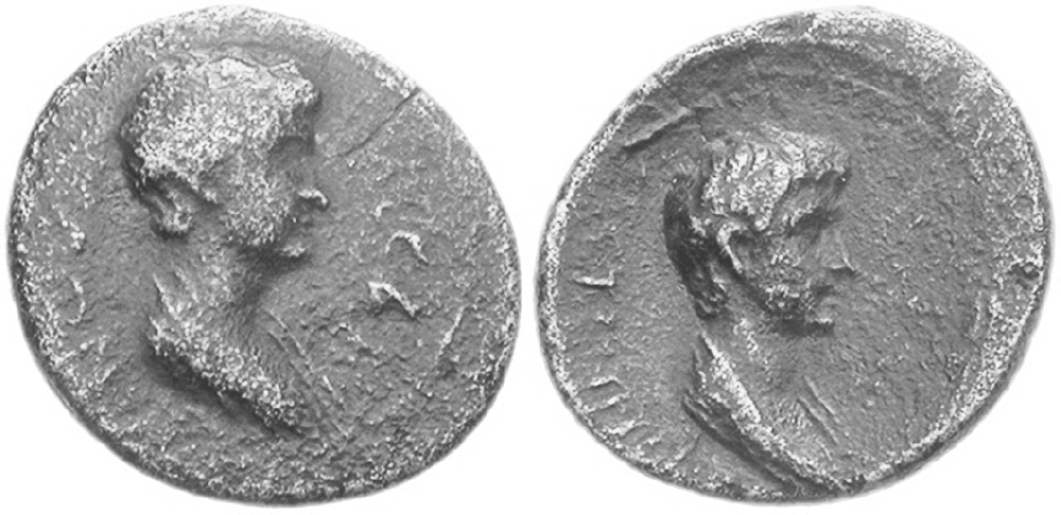
Pergamon coin issue showing Britannicus and Nero on flip sides.
As a consul-to-be, Nero was entitled to exercise proconsular power—like a modern teenager driving with a learner’s permit—and to wear special clothing and insignia. His new stature was therefore highly visible in the streets of Rome. At a special round of games put on to mark his elevation, he was presented to the crowds wearing his new markers of high office, while Britannicus appeared beside him in the simple cloak of a boy. The contrast was a humiliation for Britannicus and a clear indication of the new order of things.
He had the heart to lift the seed of alien blood above his own son, says a character in Octavia with disgust, looking back at Claudius’ elevation of Nero in 50 and 51. The sidelining of Britannicus shocked and puzzled many observers. Could a father be so unfeeling toward his own flesh and blood? Some thought the preferment of Nero was an accident of timing. Claudius, they guessed, would advance Britannicus in the same way three years later and would make the two youths joint heirs—a strategy that previous emperors had used. Others thought Agrippina, with her rumored sexual wiles, had addled Claudius’ brain.
In back rooms of the palace, factions jockeyed for influence, one supporting Britannicus’ right of succession, the other championing Nero. Claudius’ two most powerful Greek freedmen—ex-slaves on whom he increasingly relied as chiefs of staff—were divided.Narcissus had feared Agrippina from the start and had tried to persuade Claudius to remarry Aelia Paetina, his own ex-wife, instead. His rival Pallas, with a better eye for picking winners, had all along backed Agrippina as Claudius’ spouse and now backed Nero as his heir.
Seneca had no choice but to take Nero’s side, despite the fact that in Consolation to Polybius, sent from Corsica, he had effused over the young Britannicus. “Let Claudius confirm his son, with lasting faith, as steersman of the Roman empire,” he had written. But that was before a second son had appeared on the scene, and before that boy’s mother had become his patroness. Now Rome needed clarity and decisiveness about the way forward.
Seneca never commented, in any extant work, on the palace rivalry, but a line he quoted from Vergil seems to address it indirectly. In A.D. 54, when Nero was already on the throne but Britannicus’ claim was still supported by many, Seneca imagined one of the Fates saying:
Death to the worse; let the better one rule in the empty throne room.
The verse comes from Vergil’s Georgics, and gives instructions for managing a hive that has two “king” bees (Romans thought hive leaders were male, not female). Seneca quoted it in another context, but he must have been aware, given the tension surrounding the succession question, of its grim relevance.
While the fortunes of Britannicus declined, those of his sister Octavia, perhaps a year or two older, were on the rise. By betrothing her to Nero, Claudius had raised her chances of becoming empress and, eventually, queen mother, but he first had to cease being her father. Since Nero was now, in law, Claudius’ son, Octavia had to become some other man’s daughter; even a regime founded on a union of uncle and niece could not sanction that of brother and sister. Octavia was adopted by a patrician family so that she might marry insitivus Nero, “grafted-on Nero,” the sneering title she gives her husband in the play Octavia.
By the start of 53, the reengineering of the imperial family was complete. Claudius had a new wife and a new son; Nero had a new name and a new father; Octavia had a new father and a new fiancé. Britannicus alone remained unreconstructed. He had been the great loser in all these transactions, and he simmered with impotent anger. One day he let that resentment show, perhaps involuntarily, as he passed his “brother” in the palace halls. Though Nero had been adopted many months earlier, Britannicus saluted him as Domitius, the name he had held before joining the imperial family.
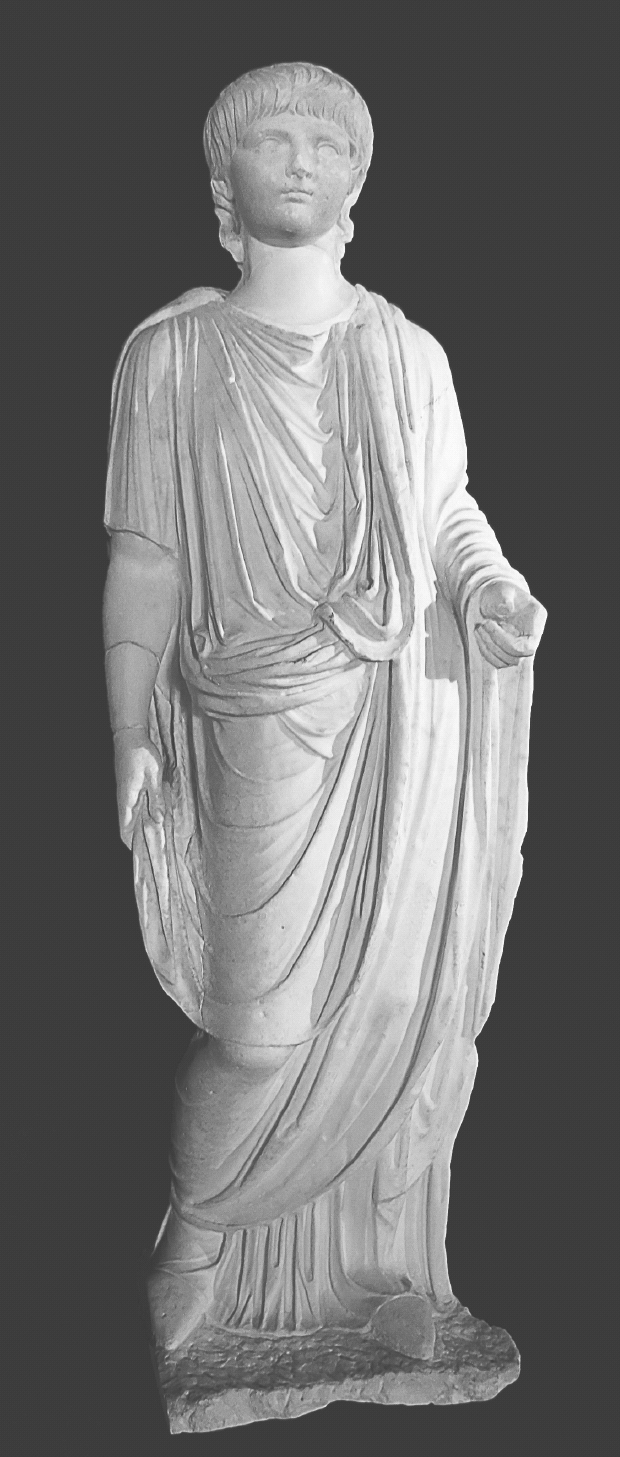
A statue from Claudius’ era, thought to depict his daughter Octavia.
Agrippina seized on this greeting as evidence of ill will, even of a conspiracy to overthrow the regime. She denounced Britannicus, now perhaps nine years old, to Claudius and demanded that he take action.
Whatever his feelings may have been for his sidelined son, Claudius acceded to his wife’s wishes. Britannicus was stripped of the tutors who had helped raise him, his closest confidants and supporters; one of them, Sosibius, was put to death as an insurgent. A new staff of minders was called in, whose loyalty to the new order was firm and who could be counted on to isolate the boy.
Britannicus had been fenced off from all he held dear, perhaps even from his father. He had landed exactly where his partisans feared he would land: in the grasp of a stepmother.
Agrippina had gotten all that she sought. She had elevated Nero to presumptive heir and greatly diminished Britannicus. Her own stature had risen along with her son’s. Shortly after his transformation from Domitius to Nero, she had received a new name of her own, the honorific title Augusta. Only the most revered imperial women had borne this title before her, and only as widows or mothers of emperors. Agrippina was the first to claim it as wife, and the shift betokened a new definition of the role. An Augusta was now—or so Agrippina hoped—the female counterpart of a Caesar, entitled to sit beside him in the halls of state, to take part in his privy councils, to appear on the backs of his coins, or even to share the front face with him in jugate profile.
But Agrippina’s self-assertions did not stop there. In her second year as empress, she boldly intruded into the most sacred preserve of male power: the military.
A British resistance leader, Caratacus, son of Cynobelinus (Shakespeare’s Cymbeline), had been brought to Rome in chains that year. Claudius arranged to receive his submission in a grand ceremony: Caratacus and his family were marched up to an imperial dais behind a procession of spoils, with the whole Praetorian Guard, clad in full armor, lining their route. Beside Claudius on that dais, surrounded by the standards that symbolized command of the legions, sat Agrippina, claiming her right as Germanicus’ daughter to occupy such a place. When Caratacus delivered his plea for clemency, he addressed both members of the royal couple, and when clemency was granted, it was granted by both. “This was a new thing, unknown to the ways of our ancestors—a woman sitting before the Roman standards,” comments Tacitus, no friend of powerful women.

Agrippina, wife of Claudius after A.D. 49.
Agrippina’s paternity gave her enormous credit with the army. So did her name—a feminine refashioning of that of her grandfather, Marcus Vipsanius Agrippa, the general responsible for Augustus’ greatest victories. Alert to the value of these assets, Agrippina found an ingenious way to advertise them to the world.
Agrippa had founded a town in Germany as a haven for the Ubii, a tribe he had brought under Roman dominion. His son, Germanicus, later made it his base of operations. Agrippina herself had been born there, during her father’s glorious campaigns. This place, as yet only a regional outpost called Ara Ubiorum, was the focal point of her family’s heroic legacy, and Agrippina knew it. She persuaded Claudius to upgrade it to a colonia, a high-ranking Roman town with full legal status, and to name it after her. Never before had a Roman foundation commemorated a woman. Its full name, Colonia Agrippinensis, “Agrippina’s colonia,” proved too cumbersome for many Roman tongues, and so over time a shortened version, Colonia, gave rise to the modern name, Cologne (or Köln).
Agrippina had gained power unprecedented for her gender, greater even than Messalina’s, and she was even better than her predecessor at putting it to use. A familiar pattern emerged, in which enemies of the empress—in particular, attractive, marriageable women—suddenly found themselves labeled enemies of the state. Lollia Paulina was one of these—a fabulously rich widow whom Claudius had looked at as a possible bride, before deciding to marry Agrippina. Agrippina accused her of treason, on the grounds she had consulted astrologers in an attempt to win the marital contest. Lollia was stripped of her wealth and sent into exile, presumably to the Pontine Islands. When she was safely out of the public eye, a Praetorian was dispatched to kill her and, according to Dio, bring back her severed head.
Not only female rivals but rivals for palace influence troubled Agrippina. Among them was the man who had long enjoyed Claudius’ confidence, the Greek freedman and palace staffer Narcissus. This sharp operator had himself brought down many enemies in the days of Messalina. He might have been a helpful henchman to Agrippina, but the two instead were at odds. Narcissus was leaning increasingly toward Britannicus in the rivalry over succession.
Agrippina wanted Narcissus humbled. When a huge public works project that Narcissus headed came a cropper, her opportunity arrived.
Under Narcissus’ oversight, a crew of 30,000 had worked for eleven years to dig a drain for the Fucine Lake, about fifty miles east of Rome. Claudius meant to shrink the lake and reclaim arable land from its shores. It was an enormous undertaking: a tunnel had been chiseled through the rock, much of it hard limestone, for a distance of three miles, so that the lake’s waters would flow into the nearby river Liris. The rubble had to be hauled out laboriously by winches through shafts in what is today Monte Salviano. Vast amounts of cash had been spent on the project, and Narcissus had a huge stake in its success—a point that did not go unnoticed by Agrippina.
Claudius staged an elaborate celebration for the tunnel’s opening. Crowds came from Rome and all the surrounding towns to watch the festivities, with the emperor presiding in full battle garb, and Agrippina beside him in a chlamys, a military cloak, adorned with threads of gold. As a prelude, Claudius assembled thousands of condemned prisoners and put them on warships for a battle to the death. The start of the ceremony was signaled by a trumpet blast from a mechanical statue that arose automatically from the center of the lake.
But at the tunnel’s moment of truth, the flow issuing from its mouth was only a trickle. Narcissus’ engineers had erred. The crowds went back to Rome, and the crews went back to work. In due course, a second opening ceremony was arranged, again with elaborate entertainment, including a dignitaries’ banquet held at the tunnel’s mouth; this time the tunnel worked too well. A jet of water erupted from it with a roar, tearing away chunks of the dining platform and sending the banqueters fleeing in panic.
Agrippina saw a chance to take Narcissus down, and she pounced. The freedman’s great wealth—he was reputed to be the richest man of his time—made charges of fiscal malfeasance all too credible. Of course, graft could explain only the first tunnel debacle, not the second; but an ingenious rumor was spread that Narcissus had contrived the banquet cataclysm as a way to divert attention from his juggled books.
Narcissus survived the Fucine Lake disasters, but they weakened him. Meanwhile Agrippina advanced Pallas, her own freedman partisan, to the lead position in the palace hierarchy. With the support of Agrippina, his patroness and—so the public believed—his lover, Pallas rose to heights never before reached at Rome by a foreigner or a former slave.
In 52, the Senate, at Agrippina’s behest, awarded Pallas the insignia and powers of a praetor—one-upping Narcissus, who had received only those of a quaestor. Pallas was also offered a vast sum of 15 million sesterces from public funds. When he graciously refused the money—he was already wealthy beyond measure—the Senate ordered that fulsome praises be inscribed on a brass plaque and displayed in the loftiest of places, affixed to a statue of Julius Caesar in the Forum.
To heap such honors on an ex-slave was an embarrassing show of the Senate’s servility. But one clever senator, Cornelius Scipio, devised a way to save face. An Etruscan prince, also named Pallas, had lived near Rome in mythic times, according to Vergil’sAeneid, and had died in battle while fighting on the side of Aeneas. Speaking before the Senate, Cornelius addressed the freedman Pallas as “one sprung from the kings of Arcadia,” implying that the shared name indicated lineal descent. The man whom the Senate had just anointed was no mere freedman, but the progeny of an ancient hero.
Elevating the lowborn or fallen, thereby making them dependent and loyal, was a time-honored strategy for Roman rulers, as it has been for autocrats everywhere. Agrippina had already used it to great effect with her recruitment of Seneca, whom, like Pallas, she had gotten appointed praetor. Their shared reliance on Agrippina gave Seneca and Pallas, the Roman moral philosopher and the Greek palace lackey, something in common. Both men, moreover, had seen their brothers promoted to coveted positions—another tactic by which Agrippina bound supporters to herself. For a man who had a brother in high office had two lives at stake, should the empress become displeased.
By a curious coincidence, the careers of these two brothers—Seneca’s older brother Novatus, and Pallas’ brother Antonius Felix—are bound together by an unlikely thread: the travels of the apostle Paul.
Paul was among the followers of a man whom the Romans knew as Christus or Chrestus, if any at Rome had yet even heard his name. In the 50s the movement begun by this man was still a minor and foreign disturbance, a doctrinal dispute among Jews in the East, especially in the territories that the Romans called Judaea (Israel, Palestine, and neighboring regions) and Achaea (Greece). As things turned out, Seneca’s brother Novatus—by this time he had taken the name of a wealthy aristocrat who had adopted him, and was called Gallio—was serving as proconsul, or governor, of Achaea in the early 50s, just when Paul arrived there.
Felix, brother of Pallas, had taken up a parallel post in Judaea at the same time. Judaea was then a nominally independent kingdom, governed by its own monarchy, but Roman agents like Felix, called procurators, nonetheless helped keep the peace there.
Paul’s travels through Greece resulted in his famous epistles to the Corinthians, in which he explained his new doctrines to skeptical Jews. The head rabbi of Corinth, Sosthenes, was in fact sympathetic to Paul and allowed him to teach in the city’s synagogue. But the congregants were angered by what they regarded as heresy. They brought Paul before Gallio, Seneca’s brother, and demanded punishment.
Gallio had no desire to meddle in the doctrinal disputes of zealous monotheists. Since no crime had been committed, Gallio declared, a Roman proconsul had no role to play in Paul’s fate. Like Pontius Pilate, who had faced a similar situation decades earlier inJerusalem, Gallio washed his hands of the matter. He even refused to intervene when the Jewish plaintiffs vented their frustration on Sosthenes and beat him to death outside Gallio’s chambers.
The episode has earned Gallio a small, undistinguished place in the Bible, in chapter 18 of Acts of the Apostles. Meanwhile in Judaea, Felix, brother of Pallas, was having his own difficulties with the Jews. These too would be recorded in Acts of the Apostles, at greater length than Gallio’s because they had far greater repercussions.
Felix was a violent and selfish man. He provoked Jewish ire from the moment he landed in Caesarea, Judaea’s administrative capital. When the Jews’ head rabbi, Jonathan, began carping at him, Felix hired thugs to stab the man to death with the short daggers they carried under their cloaks. These coldhearted assassins had a ruthlessly effective technique: they struck stealthily, then hid their daggers and, rather than run away, melded into the crowd surrounding their victim. The Sicarii, “dagger men,” became Felix’s personal hit squad and began terrorizing the province.
Tensions in Judaea rose to alarming levels. An insurrectionist known as “the Egyptian” gathered thousands of followers for an attack on the Roman garrison in Jerusalem. Felix countered by unleashing his troops on the crowd. The walls of the holy city were drenched in gore. A man who did not belong in a sensitive post, put there because his brother had friends in high places, was trying to hold on to power by the brutal use of force.
In the midst of this violent upheaval, the apostle Paul sailed from Greece to Judaea, continuing his mission to the Jews of the East. Despite numerous prophecies that he would meet disaster in Jerusalem, he made his way to the holy city, just as the Roman search for the insurgent “Egyptian” was in full force.
One day a Roman officer in Jerusalem learned that someone was causing an uproar inside the Jews’ holiest shrine, the Temple. He thought it must be the Egyptian and had the man arrested and hauled away for torture. But then he heard his prisoner speaking in civilized Greek. It was Paul he had captured. The uproar had been caused by Jews outraged at Paul’s teachings, just as the Jews of Corinth had been outraged. Paul was thrown into prison by authorities who had no idea what to do with him, a pattern that was to prevail for the rest of his life.
Eventually Paul was taken to Caesarea and brought before Felix and his wife Drusilla, daughter of the Jewish royal family. Felix was impressed by what he heard about universal love and salvation through faith. Over the next two years, Felix had Paul fetched from his cell on several occasions, and he and Drusilla listened raptly to his preachings. It was a strange confluence that brought a Jewish princess, a Christian apostle, and the brother of Claudius’ most powerful freedman together in the same room, but such were the complexities of the Roman world in the first century A.D. Stranger still was the fact that Paul, the only person in that room with no freedom, wealth, or power, was also the only Roman citizen.
Felix was finally recalled from his procuratorial post in A.D. 60. His abuses of power would surely have incurred punishment, except that his connection to Pallas placed him beyond the law. He left Paul to rot in jail in Caesarea, but Paul invoked his legal right to an appeal before the emperor himself. Paul was shipped off to Rome, still a prisoner, but on arrival he was allowed enough freedom of movement that he was able to proselytize, crossing paths perhaps with his fellow apostle Peter.
Almost nothing is known of Paul’s life in Rome. But a curious legend holds that while there, he struck up a warm friendship with Seneca.
A collection of letters survives that purports to be a correspondence between Seneca and Paul, each expressing admiration of the other’s teachings and even arranging meetings to learn more. Almost certainly these letters are spurious, but the idea that the two great moralists of their age were in some kind of dialogue is hard to resist. Their two ethical systems, Stoicism and Christianity, had much in common, and early Church fathers would one day consider Seneca a kind of proto-Christian, based partly on the “evidence” of his correspondence with Paul.
Felix’s departure from Judaea did not bring the troubles there to an end. Subsequent Roman procurators continued to use the Sicarii as hit men and squeezed the province badly with tax levies. Late in Nero’s reign, a second revolt would break out there, far more serious than that of the Egyptian. Rome would finally crush Jerusalem in A.D. 70 and destroy its Temple, leaving only one wall—today’s Western Wall—standing in place.
But by that time, Paul would be dead—as would Seneca, Pallas, Gallio, and the entire imperial family. Felix alone, of all those who came to prominence in this treacherous era, would ride out its turbulent currents and survive into the next.
While Felix was being taught by Paul in Judaea, Seneca was conducting lessons in a different classroom, in Rome. His student, heir apparent to rule the Roman Empire, was in dire need (as time would prove) of his teachings. But Seneca did not have a free hand in setting the curriculum, or in anything he did for that matter.
Agrippina did not think much of philosophy and did not want her son exposed to it. Intellectual musings, she felt, were not what a future emperor needed. She wanted her son taught the more practical arts he would need as princeps, above all rhetoric and declamation. The emphasis that these subjects got is attested by Tacitus, who imagined Nero giving credit to Seneca, later in life, for his eloquence. “You taught me not only how to express myself with prepared remarks, but how to improvise,” the princeps tells his tutor, a remark no doubt invented by Tacitus but based on primary research.
Eloquence was still an essential concomitant of power in Rome, even under the autocracy. A princeps was expected to deliver speeches, in both Latin and Greek, before the Senate, the army, and the populace. His security might depend on how well he handled these situations and whether he could show confidence and control. The style of the speech mattered, too, for verbal elegance helped carry conviction and project power.
At some point, possibly as early as Nero’s first public declamation at age thirteen, Seneca began serving not only as a speaking coach but as speechwriter. This was a new thing in the history of the principate. Earlier emperors had written their own public addresses, each in his own distinctive style. But Nero’s literary interests ran to poetry, especially plangent odes set to the music of the Greek lyre. He had little inclination toward the more sober medium of Latin prose. Beyond that, he was a passionate fan of thechariot races, a far more exciting diversion than could be found in forensic rhetoric.
Early in his career, Seneca himself had had ambitions as an orator and had spoken well enough to draw the envy of Caligula. But chronic respiratory illness made public speaking hard for him. Looking back on this early period, he wrote that he had stopped wanting to speak in public and that he had stopped being able—presumably because of his weak chest. Now he had the chance to get his words heard across much of the globe. His partnership with Nero, in this arena at least, was highly complementary.
There was another way in which Nero and Seneca complemented each other: the teenage boy lacked a father, and the fifty-year-old man lacked a son. Indeed, the infant son that Seneca had lost to illness, on the eve of his exile to Corsica, would have been just a few years younger than Nero, had he lived. Seneca had never had another child and never would. Nero, for his part, had lost his father at age three and had spent his life in the care of powerful women: his paternal aunt Domitia Lepida and the formidable Agrippina. For a boy just entering adolescence, the presence of a mature male teacher—even one whose temperament differed radically from his own—must have been a source of comfort.
Tacitus, who knew far more about this relationship than we do, attests that it included bonds of affection. Imagining how Nero might have looked back on these years, the historian has the princeps say to Seneca: “You nurtured my boyhood, then my youth, with your wisdom, advice, and teachings. As long as my life lasts, the gifts you have given me will be eternal.” He goes on to call Seneca praecipuus caritate, foremost in the ranks of those he holds dear. The phrase is ironic, given that the two men had by this time come to hate each other. But Tacitus regarded them as words Nero might plausibly have used.
Seneca never described what went on in these palace tutorials or discussed his in loco parentis role. He once wrote disdainfully, in general terms, about students who sought out teachers “for the sake of improving their talents but not their souls.” Perhaps he had the young Nero in mind.
Seneca’s own education had been very different. At Nero’s age, he had “laid siege” to Attalus’ classroom, arriving early and staying late by the side of his great Stoic model. Now he was limited to practical instruction. But he had a chance, if only by way of his presence, to change the future princeps for the better. And by changing a princeps, he might change the world.
In A.D. 53, under a bloodred sky that seemed to onlookers to be on fire, Nero was married to Octavia, daughter of Claudius. He was then sixteen years old, she a few years younger. The celebrations at Rome must have been intense, though no descriptions have survived. By the union of this pair, the two sides of the imperial family would be fused, and a half-century-old problem resolved. The principate’s future would be on a much sounder footing—provided the couple could have children.
But Nero was not eager to impregnate his wife. Marriage to Octavia was an unwelcome prospect. He had known her for years as his adoptive sister, long enough to know she was not at all his type. Reserved and decorous, high-minded and proper, she was the last partner he would have chosen for himself, to judge by his later selections.
According to Suetonius, some members of the court suggested to Nero, no doubt delicately, that he ought to show his wife more affection. Nero’s reply was imperious. “She should be content with uxoria ornamenta—the trappings of a wife,” he said, punning on the ornamenta consularia, the consular regalia sometimes awarded as a hollow show to men who were not in fact consuls.
Octavia could not have cared much for Nero either. The author of Octavia thought the union broke down thanks to her dislike of him, not the other way around. “The soul of my wife was never joined to mine,” he imagines Nero complaining to Seneca, almost petulantly, some eight years down the road.
It did not matter much how the young couple felt about each other, for imperial unions were hardly love matches. Their function was to produce an heir and to win Roman hearts by showing them a model of virtuous womanhood. From this second perspective, Octavia made an ideal empress. The Romans liked what they had seen thus far of her sobriety and self-possession. As time went on, Octavia’s popularity would rise ever higher, and Nero’s mistreatment of her, as will be seen, would provoke riots in the city’s streets.
Seneca’s marriage was very different—a true partnership, if we judge by his rare mentions of it in his extant works. In one of them, he describes his wife’s tender fretting when he insists making a journey while ill. “Her life’s breath depends on mine,” Seneca wrote to his friend, a man named Lucilius. “I can’t ask her to be any braver in her love for me, so she asks me to love myself more carefully” (that is, to take better care of himself). It’s one of few candid glimpses we have of Seneca’s family life—if even this one can be taken as authentic.
The woman who was so anxious over Seneca’s safety was Pompeia Paulina, the daughter of an eques from Gaul. Seneca had been married to her since at least 49 but possibly a good deal earlier. We don’t know whether it was Paulina, or an anonymous first wife, who bore him a short-lived son in 41 or who sat beside him later in the 40s, as pictured in De Ira, while he reckoned up his moral failings each night. He does not name the spouse with whom he shared those moments. If it was indeed Paulina, she must have been less than twenty years old when he married her, for he makes clear in the letter to Lucilius that Paulina was a good deal younger than he.
For Paulina and her family, marital connection to a palace insider brought swift political advancement. Pompeius Paulinus, Seneca’s father-in-law, attained the high office of praefectus annonae, superintendent of Rome’s grain supply, at around the time Seneca became Nero’s tutor. Seneca’s rising fortunes were lifting those of his entire family—but the effect could be reversed if those fortunes fell. In fact, Paulinus seems to have suffered just such a reversal in 55, in an episode reflected in one of Seneca’s moral treatises.
In 55, Seneca suffered a setback at court at the hands of Agrippina, who by then had become his determined rival. Agrippina flaunted her victory by installing one of her partisans, Faenius Rufus, as praefectus annonae—which meant that Paulinus, Seneca’s father-in-law, had to step down. Demotion would embarrass both Seneca and Paulinus, unless it could be portrayed as something voluntary and noble: a philosophic retreat. Such, it seems, was in part the purpose of Seneca’s De Brevitate Vitae, “On the Shortness of Life,” a treatise addressed to Paulinus and urging him toward just such a retreat.
“Withdraw yourself into calmer, safer, and greater things,” Seneca told his wife’s father. “Do you think these tasks are comparable: to see that grain is transferred to storehouses without being pilfered or neglected in transit, that it’s not damaged by moisture or exposed to heat, that it tallies up by weight and measure; or to approach these holy and lofty matters: to learn what substance God is made of, what experience awaits your soul, what it is that holds the heavy matter of this earth in the middle of the cosmos, raises lighter things above it, and drives the fiery stars to its highest point?”
De Brevitate Vitae is much more than a call to one man to retire. It roams over a wide turf and addresses a wide audience. Seneca here expounds some of his central ideas about time, mortality, and the quest for a good life. Only philosophic contemplation, he argues, can fulfill that quest. Only those who study philosophy are truly alive, in that they move outside the prison of time into the realm of eternals. All others, those who follow worldly pursuits, are squandering their time, merely running out the ever-ticking clock of mortality.
The final address to Paulinus stands out from the treatise, and from Seneca’s other works, by its pointedness and detail. Nowhere else did Seneca deal with the unique circumstances of his addressee. The anomaly has struck many readers, including Miriam Griffin, a leading Seneca scholar. It was Griffin who first proposed that De Brevitate Vitae—which cannot on other grounds be dated—was written soon after Paulinus’ dismissal from office. On this theory, the work’s final segment is an ingenious face-saving device, a loftier version of the modern cliché about wanting to spend more time with family.
The interpretation detracts somewhat from De Brevitate Vitae, a beautifully written and stirring exhortation toward the examined life. But it fits all too well with the pattern of Seneca’s earlier works, in particular the Consolations addressed to Marcia and to Polybius. There his deft control of language and argument allowed him to do two things at once: expound his Stoic ideals and improve his political image. It seems he continued that double game into his early years in the palace—and perhaps, as will be seen, to the last moments of his life.
The marriage of Nero and Octavia spelled triumph for Agrippina. By 53, she had succeeded in making Nero’s succession likely, though not inevitable. And she had taken other steps to shore up her ability to control events. She was proving herself to be, by any account, one of the all-time master strategists of the game of dynastic politics.
By the fourth year of her marriage to Claudius, Agrippina had reshuffled the imperial hierarchy in her own favor. She had overhauled the palace staff, raising up Pallas, the Greek freedman who had loyally supported her cause, while thrusting aside Narcissus, who had not. Narcissus was a dangerous adversary whom Agrippina watched carefully. His great wealth, obtained by years of grafting, made him able to do her harm, as did his control of the emperor Claudius’ private papers and correspondence.
Agrippina had also done much work on the Praetorian Guard, the army unit that would, when the time came, acclaim the new emperor. She spent years winnowing out those she mistrusted and promoting her own partisans. And she made a crucial change in the guard’s leadership. She removed its two coprefects, holdovers from the days of Messalina, and replaced them with her own selection. The guard henceforth would have a single commander, a man named Afranius Burrus.
Burrus was an undistinguished officer from the middle ranks of society, like Seneca an import from the provinces (Gaul in this case). His family belonged to the equestrian, not senatorial, ranks. Burrus had a maimed hand, perhaps from a war injury, which made his future as a career soldier uncertain. His appointment as head of the Praetorians greatly increased his fortunes and his social status. Burrus, like Seneca, would feel enough gratitude to do whatever his patroness wished, or so Agrippina might hope.
Month by month the foundations of Agrippina’s power, and of Nero’s succession, were becoming firmer. But Britannicus was also growing up.
Early in 53 Britannicus turned twelve, one year younger than Nero had been when he received his adult toga and an array of titles and honors. His supporters, Narcissus among them, watched anxiously for signs that Britannicus, too, would “graduate early.” Perhaps, this faction believed, Claudius had advanced Nero only to cover the three-and-a-half-year gap until his own son came of age. He might still intend to give the empire joint heirs, or a sequential succession in which the older boy would rule first but pass on power to the younger. Such arrangements had been made by emperors before, though not carried out after their deaths.
Claudius was growing older as well, which added to the urgency of the question. Now in his early sixties, suffering from tremors and digestive ailments, the emperor did not seem likely to reach his seventies. Astrologers had predicted his death nearly every month since he came to power—or so said a wisecracking character in a farce written by Seneca. Whoever was to be heir might be called upon very soon.
At around this time, Claudius did fall seriously ill, and Rome went into a deathwatch. Agrippina seized the opportunity to further spotlight her son, arranging for Nero to sponsor public games in honor of Claudius’ recovery. Nero provided horse and chariot races out of his own pocket, a public show of filial piety. His real feelings, though, must have run in the opposite direction. Plainly there was no better moment, from Nero’s perspective, for Claudius to die, than during the interval between his own attainment of manhood and that of his brother.
Claudius wrote to the Senate from his sickbed, proclaiming Nero qualified to take the reins in the event of his death. But then, to everyone’s surprise, he recovered. And as his health revived—what little he had ever had—so did the hopes of Britannicus’ supporters.
Narcissus now went on the offensive against Agrippina, denouncing her openly and claiming that “the palace is being torn apart by the schemes of a stepmother.” His own fate was sealed no matter who succeeded, he said—evidently feeling that his betrayal ofMessalina had made him an enemy to one heir, his enmity with Agrippina, to the other—but he could at least hope to safeguard his master, Claudius. His clear implication was that Claudius, if Nero was designated successor, would soon fall victim to Agrippina—and to Pallas as well, who had now, as Narcissus claimed, become the empress’s lover.
Charges of low-life, adulterous, or incestuous sex were a highly effective tactic in Roman politics. Such charges had been brought against every imperial wife and daughter; they had already been flung at Agrippina for most of her life and would continue up to her death. Judging their truth content is almost impossible today. (Imagine assessing tabloid accounts of modern celebrity sex lives from a distance of two millennia.) All we know for certain is that such charges were guaranteed to stick and to leave a nasty smear.
Also hard to assess are behind-the-scenes tales about what now took place in the palace. Our sources report that the emperor’s favor began to shift, away from Nero and toward his natural son. Suetonius says Claudius would hug Britannicus and urge him to grow up quickly, suggestively quoting an old Greek proverb: “The one who wounded you”—meaning himself—“will heal you.” Tacitus attributes such gestures only to Narcissus, not to Claudius. But he does give some support to the idea, prominent in other sources, that Claudius was growing mistrustful of Agrippina’s conduct, especially her sexual comportment. (When he was congratulated for having presided over the conviction of an adulteress, Claudius allegedly punned that his own wives were likewise impudica sed non impunita, “sleazy, but they won’t get off easy.”)
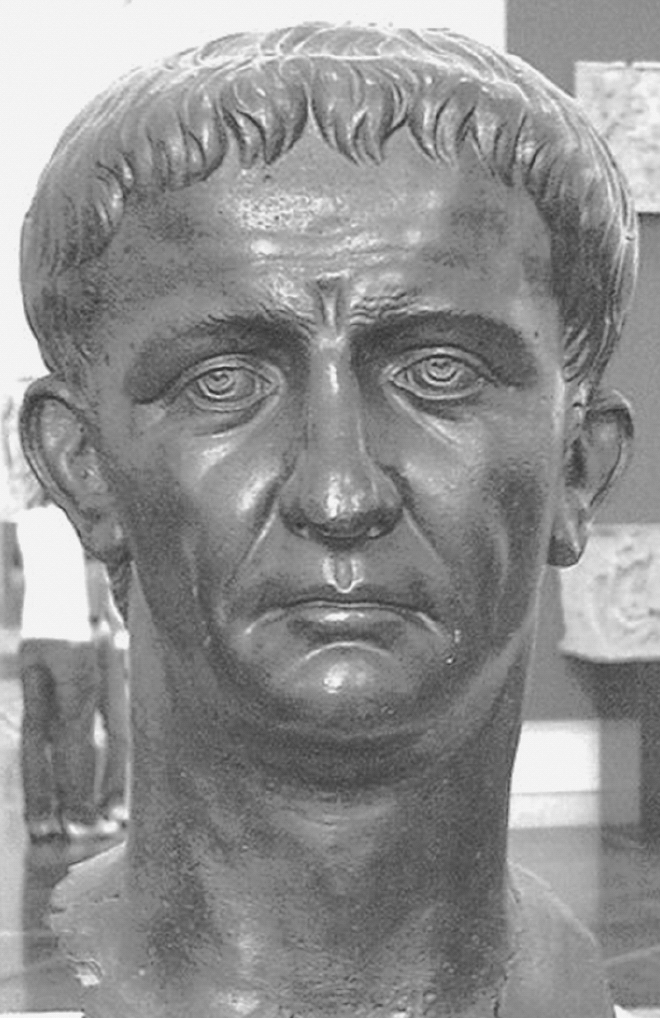
A weary-looking Claudius, in a bronze portrait probably made from life.
Claudius drew up his will at this time and had it put under official seal. He could not simply pass on control of the empire as if it were a family heirloom, but bequeathing his personal wealth, an essential resource for anyone running the government, would amount to the same thing.
What was in that document, or in Claudius’ mind, concerning his sons? The will was later suppressed, leaving historians both ancient and modern to argue about its contents. Perhaps, as Tacitus, and some modern scholars, believe, it confirmed the selection ofNero; but why then would Nero suppress it? The motive Tacitus gives—that the will would have upset the populace by preferring a stepson over a son—sounds specious, given that entirely scuttling the will risked inflaming them even more.
Barbara Levick, the leading modern biographer of Claudius, reasons that no logical man would derail the standing order, which for years had favored Nero, at this late stage. But moves made by aging emperors do not always accord with logic. Tiberius, who had faced a similar dilemma to that of Claudius—whether to prefer a grandnephew, Gaius, over his own grandson, based on age and purity of blood—avoided making a decision as long as he could, then designated both boys joint heirs. Even at the doorway of death, Tiberius seemed unable or unwilling to make the fateful choice. According to a report by Seneca, in his final moments Tiberius removed the signet ring from his hand as though to pass it to a successor. But instead he held on to it, and then, just before collapsing, put it back on his own finger.
Was Claudius in a similar quandary in October 54? Or was he still convinced, as he had been for four years, that Nero was the best way forward? Did Agrippina perceive a growing change of heart in him? Did she then take steps, as most sources agree she did, to stop that heart, before it could change further?
Poisoning stories bedevil the modern historian even more than scandalous sex tales. No autopsies were held after the death of an emperor. The Romans, like all peoples everywhere, enjoyed skullduggery and conspiracy theories. These were vastly more entertaining than reports of sick old men slowly declining toward death. The truth of whether Claudius was murdered can never be known for certain, and some scholars do not believe he was.
That said, the timing of Claudius’ death is highly suspicious. It fell some three months before Britannicus’ majority, during the last stretch of Nero’s three-year edge. If Claudius had indeed expressed to anyone, or written in his will, any doubts about Nero’s succession, this would have been the perfect time to strike.
According to Tacitus, Agrippina plotted Claudius’ murder carefully. She first sent away Narcissus, the emperor’s most watchful partisan, to Sinuessa, a spa town where he could take the cure for his gout. Then she commissioned Locusta—“the Crayfish”—a Gallic woman convicted of poisoning but sprung out of jail on condition she work for the palace. Agrippina wanted a carefully calibrated drug, one that would not kill Claudius quickly—a sudden, violent death would be too obvious—but rather would destroy his mind, so that he could neither protect himself nor elevate Britannicus.
This custom-made toxin was passed to a eunuch named Halotus, the emperor’s server and food taster, who introduced it into a plate of mushrooms, one of Claudius’ favorite foods. Dio concurs with Tacitus’ account and adds a memorable detail: Agrippina had only one mushroom poisoned, the biggest and most succulent on the plate. She shared the dish with her husband to put him off guard, but then insisted, as loving spouses do, that he help himself to the best one.
Claudius quickly fell into a stupor and was carried from the banquet hall; but then—again following Tacitus’ account—the plan went awry. After emptying his bowels of the toxic meal, Claudius began to recover. Agrippina panicked, recognizing that her husband must now suspect her intentions and would act swiftly against her.
Luckily she had other palace lackeys ready to do her will. Xenophon, a Greek physician who attended on the imperial family, was called in and prescribed a therapeutic purge. He produced a feather to induce vomiting; it had been coated with a fast-acting poison. This second drug finished Claudius off, during the night of October 12.
Such is the tale of Claudius’ demise as told by Tacitus. It is contradicted on details by other ancient historians and mistrusted by some modern ones. But many of those who today deny that Claudius was murdered nonetheless agree that a dish of mushrooms was the cause of death. If such was the case, the lethal fungus seems far more likely to have been poisoned than merely poisonous, given the timing of its appearance on the emperor’s table.
The moment for Nero’s accession was at hand, a moment Agrippina had long anticipated and that she now choreographed with consummate skill. Before news of Claudius’ death could leak out, she made use of the Praetorian Guard, the corps of soldiers she had carefully groomed over preceding years, to seal off the palace. No one was to learn of Claudius’ death until the time was right. Meanwhile she detained Britannicus in his chambers and kept his sister Octavia close by her side.
When morning came, and a troupe of comedians arrived to entertain the emperor, the soldiers admitted them. It was important to convey a sense of routine to those passing by. Finally, at around noon—an hour of good omen, according to superstitions of the day—Agrippina launched into action.
The palace doors were thrown open, and Nero came grandly forth, accompanied by Burrus, prefect of the Praetorian Guard. A brief announcement was made of Claudius’ death to the soldiers on duty outside, who took their cue from Burrus and saluted Nero as leader. Or at least, most did. Tacitus reports that a few looked around anxiously and asked one another why Britannicus had not appeared. But as critical seconds ticked away, Britannicus stayed off the scene.
Rome had as yet no rituals for the acclamation of a princeps. Only twice before had there been an orderly transfer of power. For lack of a longer tradition, the soldiers adopted the procedure used for Claudius the last time around. Nero was taken in a covered litter to the Praetorian camp outside the city walls. There he delivered a speech—Dio specifies that Seneca had written it for him—to the assembled soldiery. He accompanied his grand words with a grand gift: as much as 20,000 sesterces, or two decades’ worth of pay at the centurion salary level, per man. The soldiers hailed him as imperator, as they had done for Claudius.
Nero proceeded to the Senate house and spent several hours there. The senators, too, greeted Nero adoringly. They immediately voted him the rights and powers accruing to his new status. This outdid Claudius, and Caligula as well, both of whom had waited weeks to receive these honors.
By the end of the day on October 13, as her son made his way back to the palace, Agrippina could look with immense satisfaction on what she had wrought. Nero was princeps, and Britannicus was disinherited. The Praetorians had dutifully played their part. The machinery she had set in place had worked.
Narcissus, in Campania, got word of Claudius’ death and hurried back to Rome. Perhaps he still hoped to rouse support for Britannicus, but he was too late. As soon as he entered the city, he was arrested and thrown into prison. The new regime, only a day or two old, had committed its first abuse of judicial procedure.
Meanwhile, in the skies above Rome, Claudius’ spirit made its limping way toward heaven, to join the company of the gods. As the Senate would shortly decree, Claudius had become a god, Divus Claudius, at the moment of his death.
The upward progress of Claudius’ ghost would soon be described by a most unlikely “witness”—the former senator who was now the close adviser, speechwriter, and moral conscience of the new regime, the philosopher Seneca.