
CHAPTER 4
“Have I, out of all mortals, found favor, and have I been chosen to take the role of gods here on earth? Am I the judge who marks out nations for life or for death?” Such are the awestruck words of eighteen-year-old Nero looking out upon his realm, as Seneca imagines them. Seneca opens De Clementia, “On Mercy,” by giving voice to Nero’s thoughts, a new device for allowing Rome once again to hear his words issuing from the emperor’s mouth.
Seneca depicts Nero as an omnipotent but morally serious adolescent. Like a modern teenage superhero, the princeps knows that great powers confer great responsibilities. Principles of justice, mercy, and restraint guide his every move. Whether dealing with foreign foes or the troublesome mob of his fellow citizens, he keeps “harshness sheathed, but mercy battle-ready,” an instance of Seneca’s favorite metaphor, moral effort as hand-to-hand combat. “If the gods today ask me for an accounting, I stand ready to tally up the whole human race,” Seneca/Nero concludes—meaning that, as shepherd, he has not allowed his flock to diminish by even a single head.
Of course, the flock had been diminished, and recently, by one very important head, and those reading Seneca’s treatise knew it. The death of Britannicus casts a long shadow over De Clementia, especially since Seneca goes on to proclaim, in his own voice this time, the spotlessness of Nero’s record. He affirms Nero’s boast of “never having shed a drop of human blood anywhere on earth”—a claim that rings all the more hollow for being literally true; Britannicus had been poisoned rather than put to the sword. Seneca willfully wipes the slate clean, as though allowing the year-old regime a do-over. If Nero could be given a pass for that one life, Seneca must have reasoned, many more might be spared.
By his own account, Seneca was moved to write De Clementia after witnessing a behind-the-scenes moment of palace life. Burrus, the Praetorian prefect and Seneca’s own staunch ally, needed the emperor to make out warrants for the execution of two robbers. Nero kept postponing the unpleasant task, until Burrus finally drew up the papers and presented them for signing. “If only I were illiterate!” Nero reportedly sighed, as he validated the warrants. Seneca effuses that this should be the quip heard around the world, that it bespeaks the guiltlessness of a golden age when all men are brothers. It shows Nero already in possession of perfect clementia, Seneca claims, ingeniously concealing instruction behind a screen of flattery.
The essay claims not to teach Nero anything but to show him his own moral brilliance, as if in a mirror. Its real goals, of course, are more complex.
Seneca’s target audience in De Clementia was not so much the emperor but the senatorial class, the Roman political elite. The treatise sought to reassure these aristocrats that Nero’s character, on which much of their own safety depended, was in good hands. Despite the red flag that Britannicus’ murder had raised, Seneca showed that he was still restraining the young emperor, keeping him off Caligula’s path. It would be Seneca’s humane principles, here superimposed onto Nero by rhetorical sleight of hand, that would guide the regime.
Seneca expounded those principles more fully in De Clementia than he had in De Ira. (The two treatises are in a sense complementary, since ira seeks to impose punishment while clementia remits it.) Both essays take the position that all humankind is prone to err and therefore all deserve mercy. But De Clementia is more emphatic on this point. “We have all of us done wrong,” Seneca intones here, in words that would not be out of place in a modern Christian sermon, “some seriously, some lightly, some intentionally, some pushed into it by accident or carried away by the wrongdoing of others; some have stood by our good designs not firmly enough and have lost our guiltlessness, unwillingly, while trying to keep our grasp on it.” That last case sounds strikingly like Seneca’s own.
Everyone should be merciful, given the universal guilt of humankind; but, Seneca claims, emperors—and kings—have even greater reason to do so. Remarkably, he does not blush to dust off the old, vilified word rex as a virtual synonym for princeps. For more than five centuries, Rome had held reges in contempt, which meant that emperors had to conceal their true status. The Roman state was, in theory, still a republic, with the Senate gently guided by a “first citizen.”
In De Clementia, Seneca drops the veil of pretense. Rome has become an autocracy, he grants—and a good thing, too, for the alternative is chaos. Should the mob ever throw off its “yoke,” he asserts in the essay’s opening words, it would harm itself and everyone else—an assessment that had propped up the Caesars for a century but that no one had yet dared admit.
Seneca begins De Clementia, then, by ceding Nero absolute power; but then he shows why his power should be restrained. Kindness from rulers wins adoration from subjects and results in a long, secure reign; severity breeds fear, and from fear springs conspiracy. The divine Augustus is brought forward, as in other Senecan works, to exemplify the former approach. Augustus, Nero’s great-great-grandfather, found out that a trusted subordinate, Lucius Cinna, was plotting against his life. After a long, tense parley with Cinna, Augustus, far from imposing punishment, awarded him an appointment as consul—the highest political honor. “He was never again the target of anyone’s conspiracies,” Seneca concludes.
Nero’s role, as defined by De Clementia, is absolute monarch in law but pious servant of moral principle. He can choose—or already has chosen, under the conceit that Seneca is only showing Nero his own perfection—to rein in power voluntarily. If his fellowship with the all-fallible human race does not compel him, self-interest will.
To highlight that fellowship, Seneca uses a novel analogy to illustrate the role of the princeps. Roman writers had often portrayed their leader as a father raising his children or, in more effusive moods, as the sun shining down on the earth. Seneca introduces a new model. He compares Nero to a mind, controlling the limbs of the citizen body. The analogy virtually embodies Reason, the Stoic school’s greatest good, in the person of the emperor.
The second section of De Clementia has not survived intact, but here Seneca went in for theory: defining what clementia is, how it arises and functions. Notionally he was still addressing Nero, but readers knew that the princeps had not the slightest interest in such things. De Clementia, like most of Seneca’s writings, targets multiple audiences and strives for multiple goals. It shows that pure ethical philosophy, the source of Seneca’s high repute, was an ongoing project, though not part of his official brief.
De Clementia is a hugely ambitious effort to hold together a fragmenting life. Perhaps Seneca could accomplish what Aristotle, four centuries earlier, had attempted (in popular legend at least) with Alexander the Great: to bring enlightenment to a global ruler. Perhaps Stoic virtue could after all march hand in hand with power; perhaps the principate could in fact be built on a moral foundation. At least he, Seneca, could be seen making the attempt—a point that would be crucial, should the experiment fail.
What Nero thought of getting such instruction in public is not known. It’s unlikely he cared much for philosophy during his late teenage years, or ever afterward for that matter. Had he tried, Seneca would have had trouble finding a student who was less apt for his lessons. Nero was busy exploring the possibilities that his new powers had brought him—to commit murder, for one, but also lesser crimes, illicit pleasures, and carefree assaults on Roman society. If any philosophic text caught his attention, it was not one of Seneca’s high-minded treatises but Plato’s Republic, with its famous story of Gyges’ ring.
In the Republic, Plato portrayed Glaucon, a youth about Nero’s age, in conversation with Socrates, a man about Seneca’s. At one point, Glaucon relates to Socrates how a Lydian named Gyges found a magic ring. If twisted a certain way on the finger, the ring would make its wearer invisible. Glaucon then asks Socrates, What would prevent Gyges from donning the ring to steal from the marketplace, to rape women, and to beat or kill whomever he chooses? Surely, Glaucon says, any man would do these things if invisible, no matter how seemingly upright his nature.
Socrates’ rebuttal plays out over the remaining nine books of the Republic. Under the guidance of a master teacher, Glaucon comes to realize that justice brings far greater happiness than injustice. It was precisely the outcome Seneca might have hoped for in his tutelage of Nero. But Nero was no Glaucon, and Seneca, as time would reveal, was no Socrates.
Nero had in fact set out on exactly Gyges’ path. He regarded the principate as his ring of invisibility, a license to do what he pleased.
Nero began sallying out of his palace incognito on rapacious nighttime jaunts, helping himself to merchant goods, drinking and carousing, assaulting passersby. Caught up in the exuberance of power, he wilded in the streets of the city, sexually molesting women and boys alike. It was an early sign of the troubles that awaited Rome. The new princeps was turning out to be a lawless teen with no moral compass.
Nero feared no legal consequences, but the drubbings he might take while in disguise posed a problem. One incident did indeed end badly. A young man of senatorial rank, Julius Montanus, enraged by the rape of his wife, viciously beat a man whom he failed to recognize as the emperor. Nero went home and hid from sight until his bruises healed. He was disinclined to punish a man for an honest mistake—but Montanus somehow learned who his victim was and sent a letter of apology, which changed everything. Nero could not abide a subject who knew he had beaten up the princeps. Montanus, informed of the emperor’s displeasure, forestalled the inevitable by taking his own life. Thereafter Nero was careful to bring soldiers along on his forays, ordering them to stand at a distance but come to his aid when called.
Seneca did not interfere with Nero’s Hyde-like escapades; nor did Burrus, Seneca’s close ally. These two men might have reined in the wild energies of Nero’s youth, but, according to Cassius Dio at least, they had been cowed by the murder of Britannicus. The princeps had struck a blow for independence, not only from his mother but from his two senior advisers as well.
Nero’s young friends, companions of his wilding sprees like Marcus Otho and Claudius Senecio, egged on the princeps to defy these two father figures. “Are you afraid of them?” they asked, knowing they would score points by irreverence. “Don’t you realize that you are Caesar—that you have power over them, not they over you?” The slow unraveling of Nero’s trust in Seneca had begun—a process that would take ten years to play out and would result in disaster for both men.
Nero extended his newfound license to the commoners: he removed the armed details that kept order in Rome’s open-air theaters. Fans of various pantomime dancers—balletlike performers whose sensuality made them the sex symbols of their day—used this freedom to start factional fights in the stands. Nero went to the theaters in disguise and watched these frays with delight, or even took part, throwing stones or broken bits of bench along with the most rabid brawlers. Finally the disorder became so grave that even Nero felt it had to be stopped. He ordered all pantomimes out of Italy, to give the fevered audiences a chance to cool off, and reinstated military patrols of the theaters.
It was not a dancer but a musician who most fascinated young Nero: a Greek singer and lyre player named Terpnus (“Delight”). The emperor installed this man in the palace and had him perform after dinner, often staying up late to listen, enraptured, to his languorous, passion-filled songs. Terpnus’ art form was imported from Greece, like the pantomime dance, and Romans found it seductive and sensuous—an effect mistrusted by the elite, though the mob adored it. Nero, too, was captivated and soon undertook to learn the art himself. His voice was not naturally musical, but he took every measure taught by Terpnus to beautify it, including purgatives, enemas, special diets, and an exercise for the diaphragm done while lying under lead plates. He had taken his first steps on the path that would lead him, over the next decade, from princeps to performing artiste.
Amid Nero’s experiments in anomie and cultivations of his voice, Rome somehow had to be governed. It was becoming clear that the princeps had little interest in statecraft, and no talent for it. His one big initiative in these early years, a proposal to abolish all indirect taxes—customs duties, tolls, and the like—had to be scuttled by embarrassed advisers, on the grounds that it would cause financial ruin.
Seneca and Burrus seem to have kept Rome in order to a large degree, though just how large is a matter of debate. Our sources have little to say about governance during these years, preferring personal dramas and court intrigues—the events that, for them, defined Nero’s reign. Tacitus merely implies that the state was being run, without Nero doing much to run it. Seneca and Burrus, aided by a staff of Greek freedmen inherited from the days of Claudius, most likely had their hands full.
Then there was Agrippina, eager to do whatever she could—which was considerably more than what most Romans wanted.
Though the poisoning of Britannicus had deprived her of her ultimate weapon, Agrippina was attempting to regroup. She had begun amassing money to buy influence and cultivate support among the disaffected. Nero preemptively bribed many of his courtiers with lavish gifts—rewards for their complicity in Britannicus’ death—but Agrippina had a large estate and could hope someday to outbribe him.
More disturbing to Nero were the bonds Agrippina was forging with Octavia, his unloved bride. Concord between these two outcast women portended no good to him. Agrippina could use Octavia to play the succession card, as she had once done with Britannicus, rallying support to the Claudian banner. She could promise Octavia as a marital prize, a guarantee of legitimacy, to a usurper.
The warning shot that Nero had fired had clearly not humbled his mother, and sterner measures were needed. Nero ordered Agrippina stripped of her bodyguard, the band of German toughs who had been a visible marker of her status (only the princeps was similarly attended), and of the Praetorians who patrolled her quarters. Finally he turned her out of the palace altogether, claiming—an obvious pretext—that daily gatherings of her dependents were crowding the halls of state.
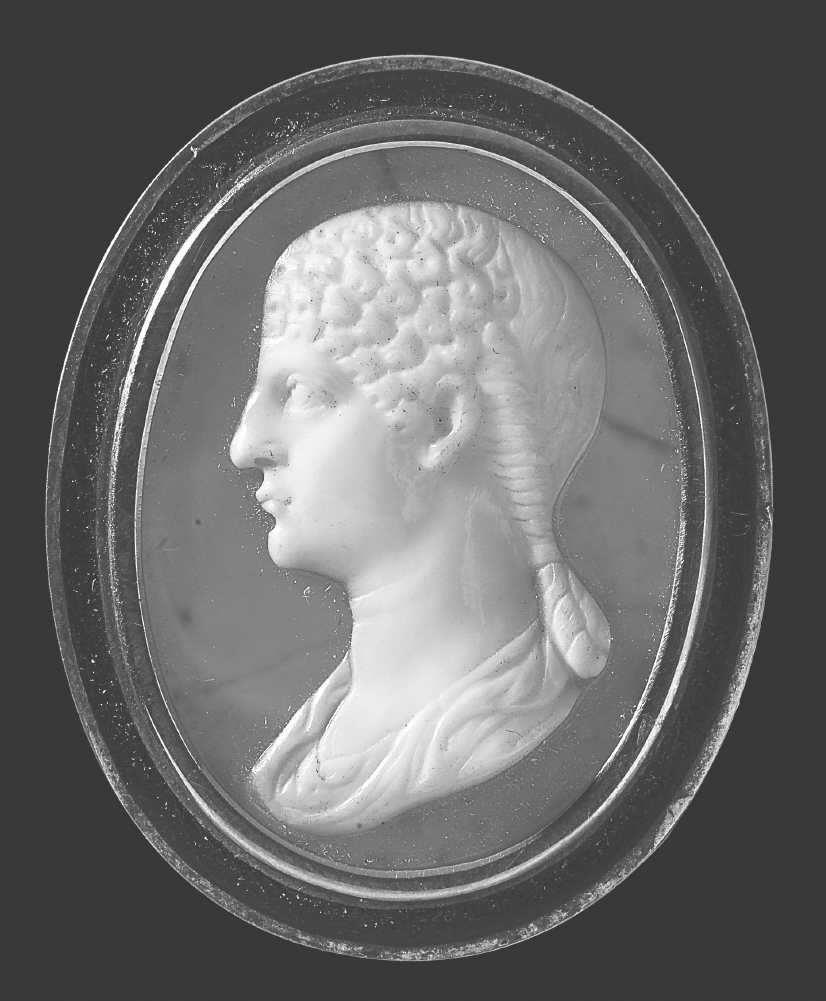
Agrippina.
Agrippina at once became marked as persona non grata in the eyes of Nero’s regime. Her friends made haste to abandon her, fearing that any association might be held against them. When Nero went to visit her new abode, he took a conspicuous armed guard with him. He wanted to convey to all observers that she was a dangerous woman.
Then one night, as Nero was relaxing over drink and song, news arrived that seemed to confirm his worst fears about his mother.
By A.D. 55, there were four men alive whose lineage made them potential rivals to Nero. Two belonged to the ill-fated Silanus family, direct descendants of Augustus as Nero was (a distinction that had already brought death to two of their kin). A third wasRubellius Plautus, the only child of Tiberius’ granddaughter and therefore connected to the line of Augustus by adoption. The last was Faustus Sulla, not descended from any emperor but a Julian nonetheless, great-grandson of Augustus’ sister Octavia.
These men could not simply challenge Nero to some Arthurian trial by combat. But they could be backed by rebellious foreign legions, as Germanicus once had been, or by a mutinous Praetorian Guard, like Claudius. Or their cause could be embraced by the third of Rome’s kingmakers, Agrippina.
In Nero’s eyes, Plautus gave the most cause for concern. He had a high reputation for strength of character; he lived a simple, unambitious life, in accord with his Stoic beliefs. His wife, Antistia Pollitta, was also well respected and had good political pedigree, being the daughter of a consul serving that very year. Sulla was almost as worrisome as Plautus, having married Antonia, Claudius’ daughter by his second wife (the predecessor of Messalina). And Sulla’s name linked him to a formidable ancestor of an earlier century, Lucius Cornelius Sulla—a military strongman whose memory could still stir restive troops.
The messenger who knocked on Nero’s door that drunken evening was a freedman named Paris, an actor, one of Nero’s favorite performers and perhaps (so Tacitus implies) a visitor to his bed. Paris carried information he had received from Julia Silana, a woman who had continued talking to Agrippina even after her fall from grace. According to Julia’s report, Agrippina was planning a coup that would put Rubellius Plautus in power. She would get him divorced from Antistia, then marry him herself and become coruler of the empire, as she had been in the days of Claudius.
There were reasons to doubt this tale, since Julia, its source, bore an old grudge against Agrippina. Nonetheless Nero went into crisis mode. The specter of his mother’s power to undo him, so recently suppressed, sprang back out with terrifying force. He wanted his mother put to death immediately, and he also, according to one of Tacitus’ sources, demanded a new Praetorian prefect—he now mistrusted Burrus as Agrippina’s appointee. Only Seneca’s intervention, according to this source, prevented the second move, but Nero seemed intent on carrying out the first.
Burrus was summoned to Nero’s chambers and ordered to kill Agrippina. Only with difficulty could the prefect persuade the princeps to wait until morning, when the wine would have worn off and the matter could be weighed in full. At dawn the next day, Burrus was sent to interrogate Agrippina, accompanied by a worried Seneca.
Neither man wanted this showdown between mother and son. Not many months had elapsed since the murder of Britannicus. The public had accepted one apparent assassination, but a second one, of a far more powerful figure—the daughter of Germanicus—would not sit well. Then too Seneca and Burrus had their own futures to consider. They had risen in Nero’s graces by opposing Agrippina, but if that great counterweight were removed, the emperor’s trust might disappear as well. Already it seemed to be slipping away: Nero had sent his own freedmen along to witness the questioning of Agrippina, as though he were suspicious of collusion.
Agrippina’s self-defense speech, as preserved by Tacitus, relied on chopped logic and feigned maternal affection. All her accusers had ulterior motives, she pointed out, and the principal one, Julia Silana, was childless; she could not know the warmth of a mother’s love. “Parents don’t switch children the way a cheap adulterer changes lovers,” Agrippina argued, ignoring the fact that, a few months earlier, she had done exactly that—threatening to advance Britannicus over her own son. Then, changing tack, Agrippina called to mind all she had done to put Nero into power. She claimed she had no hope of survival were Plautus, or anyone else, to take the throne. Only her own flesh and blood could keep her safe, she said, again ignoring patent facts: it was because of her flesh and blood that she was now fighting for her life.
The speciousness of these arguments did not matter. Seneca and Burrus knew that they must bring about a reconciliation between mother and son or face a very uncertain future. They persuaded Nero to meet his mother face-to-face, and somehow—Tacitus does not say what took place in their closed-door meeting—the crisis was defused.
The price of reconciliation was steep. Knowing he must find a modus vivendi if he was not going to kill Agrippina, Nero had to make highly visible concessions. The court hierarchy had to be rebalanced so that Agrippina’s accusers were banished and her partisans promoted. Recent appointees had to be deappointed, and not even Seneca’s family was spared: his wife’s father, Pompeius Paulinus, now lost his post as prefect of Rome’s grain supply, to make room for Faenius Rufus, a protégé of Agrippina. This may have been the occasion, as seen earlier, for Seneca’s plea to Paulinus to retire into philosophy—the essay De Brevitate Vitae, “On the Shortness of Life.”
Whatever ground Seneca had lost in l’affaire Plautus, Burrus had lost more. On the panicky night when the rumor first broke, Burrus had perhaps narrowly escaped dismissal; then he had been forced to decline a direct order from Nero. In the wake of the crisis, an opportunist named Paetus, a man who made a disreputable living buying and selling bad debt, tried to curry favor by tying Burrus to a new conspiracy, this one centered on Faustus Sulla. To make the charge more convincing, and a conviction more appealing, Paetus accused Agrippina’s former lackey, the freedman Pallas, of being Burrus’ accomplice.
It was a probe of the new rifts in the palace, but Nero, perhaps at Seneca’s urging, stood by Burrus. As though to belittle Paetus’ charges, Nero empaneled Burrus as one of the judges deciding the case, thereby ensuring acquittals all around. The tempests passed, and court hierarchy was restored.
Nero went on with his nighttime diversions: mayhem in the city streets, singing lessons with Terpnus, the warm embraces of Acte. But his mind was more troubled than before by Rubellius Plautus and Faustus Sulla. No evidence had been found against either, but loose talk alone gave grounds on which to mistrust them. By the twisted logic of autocracy, a man cast as usurper in a fictional conspiracy became an enemy in reality. Whomever rumor settled on, this logic ran, was the man the public would turn to if they ever demanded a change of princeps.
Rumor had also cast Agrippina as a foe of the regime, ascribing to her a plan to marry Plautus. Though there may have been no substance to the accusation, its plausibility gnawed at Nero’s mind. Nero had already watched his mother remake the imperial family from top to bottom, after marrying Claudius. She might pull off the same trick a second time. She might even—she was just now reaching forty—bear a second son to some new Julian husband, an heir to displace Nero from his throne and from her affections.
A mother who could seduce and control powerful men, who hated her son for not bending to her will, who had threatened in a heated moment to advance Britannicus—such a woman seemed capable of anything. There would be a reckoning between Nero andAgrippina someday, though none could tell as yet what form it might take.
In 55 or (more likely) 56, Seneca attained the highest constitutional office in the Roman state, that of consul. The post carried less power than his unofficial role as amicus principis, friend of the princeps, but it was a towering achievement nonetheless. Seneca’s elder brother Gallio, returned to Rome from his proconsular post in Greece, attained the same honor at about the same time. The two boys from Corduba, provincials born into the equestrian class, sons of a crusty rhetorician who had never made it to the Senate, had come far indeed—a mark of what the emperor’s favor might bring, in Rome’s winner-take-all political system.
High office was not the only way Seneca’s fortunes had changed. During the six or seven years since his return from Corsica, he had gotten rich.
Exile to Corsica had stripped Seneca of half his estate, but Agrippina’s recall had restored it, and thereafter his closeness to Nero had made good the loss many times over. Some gifts came from the emperor himself; others were from those who sought favors or access. By the late 50s Seneca owned estates in Egypt, Spain, and Campania, the fertile and fashionable region centered around Neapolis (Naples), as well as others in unspecified locales, along with plenty of cash. His gardens were famed for their size and magnificence. In the early 60s he would add another property, a choice vineyard, to his holdings, at Nomentum, north of Rome. Both Tacitus and the satirist Juvenal called him praedives, a milder term than our filthy rich but certainly not an epithet Seneca would have been proud of.
These estates brought in a modest income from the sale of produce, especially wine. Seneca counted himself an expert vintner and was said to have gotten more than 180 gallons of wine to the acre. But better profits could be gained from lending money at interest, and Seneca pursued this revenue stream as well.
Provinces newly added to the empire were hungry for capital—the wherewithal to develop trade and begin tapping Roman markets—and willing to pay high rates. Seneca invested in Britain, the newest and hungriest province. This was good foreign policy, for Roman funds helped to make British warlords tractable, but it was also good business. Cassius Dio’s estimate of Seneca’s British stake, 40 million sesterces, is perhaps an exaggeration. But whatever the amount involved, it is clear that Seneca’s portfolio was targeting aggressive growth.
The paradox of a moral philosopher who was rich and getting richer raised concern in Seneca’s time, as it has in ours. Other sages had enjoyed royal subsidies—Aristotle, for one, had profited handsomely from his friendship with Philip of Macedon, Alexander the Great’s father—but none had been quite so intent on building a fortune. Indeed, the two Greek thinkers most admired for their lifestyles, Socrates and Diogenes, were famous for their disregard of wealth. Socrates had been poor by birth and remained so through inattention to his trade; Diogenes the Cynic was an ascetic by choice. He rejected his family’s bourgeois status, got himself exiled from his native city, and went about in a threadbare cloak with only the barest possessions, a bag for his crust of bread and a cup for scooping water from fountains. When one day he saw a boy drinking from his hands, he smashed the cup, disgusted by his own love of luxury.
Seneca was a Stoic, not a Cynic like Diogenes, and for the Stoics wealth did not present so grave a problem. They counted it as one of several “indifferents” that contributed neither to happiness nor to unhappiness. Moderate Stoics even conceded that wealth could add to happiness, not least because it made possible virtuous deeds. But Seneca had been attracted, from his earliest writings, by a harder, tougher regimen, bordering on Cynicism in its disdain for wealth.
In his letters from exile, Seneca had celebrated life as an unaccommodated man, his view of the open sky unblocked by mansions and banquet halls. He had praised a member of Claudius’ court who “pushed riches away, and sought no better profit from his ease in acquiring them than contempt of having them.” He had sworn, in De Ira, that all the world’s gold mines, heaped up into a single pile, “would not be worth the frown on the face of a good man”—the frown that owning them would surely cause. “No one excelled this millionaire in singing the praises of poverty,” writes his biographer Miriam Griffin.
Seeming contradictions between word and deed emboldened Seneca’s enemies. By now he had plenty of them, and not only in Agrippina’s circle. A principal foe was Suillius Rufus, who had himself gotten rich as a delator under Claudius and Messalina—a lackey who prosecuted those whom the princeps disliked, in exchange for reward. Suillius was not faring well under Nero; a move by the Senate threatened to fine or even punish those who took pay for legal services. His back against the wall, Suillius tried to deflect blame onto a new target. If the senators wanted to punish ill-gotten gains, he said, they need look no further than Seneca.
“By what kind of wisdom, by what teachings of the philosophers has Seneca heaped up 300 million sesterces in four years as a palace insider?” Suillius ranted in the Senate. “The childless and their estates are being scooped up in his net; Italy and the provinces are being drained away by his outrageous moneylending. I will endure anything—any accusation or trial—rather than rank my long-standing honor, won by my own efforts, below his windfall profits!”
The brazenness of this attack was breathtaking. The idea that Suillius had earned his money, albeit by slandering the innocent, whereas Seneca had merely got his handed to him, or that Claudian fortunes were more honorable than Neronian ones, relied on tortured moral logic. So too did a comparison that Suillius drew between his own courtroom rhetoric—which he described as “vigorous and blameless”—and the “indolent” discourse Seneca practiced on innocent youth. Suillius compounded the outrage by resurrecting the old charge of adultery with Livilla, Caligula’s sister, for which Seneca had once been exiled. After eight years in Corsica paying for a crime he may well have been innocent of, Seneca now had to suffer this from Suillius: “Should we deem mine a weightier offense—getting a reward for decent labor, paid by a willing defendant—than sullying the bedrooms of royal women?”
Suillius’ charges went nowhere; Nero’s regime was not about to see its senior minister defamed. Instead, Suillius’ dirty deeds under Claudius were dredged up and used to discredit him. When he claimed he had merely followed orders, Nero dutifully checked his father’s papers and reported he could find no such orders. Suillius ended up exiled to the Balearic Islands with the loss of half his estate. But the caricature he had drawn of Seneca—a portrait of a venal upstart, an outsider conniving his way into power, money, and the beds of princesses—could not be so easily banished.
Others besides Suillius attacked Seneca during these years. Some said he seduced the young men he pretended to teach, others that he had been seduced—by Agrippina. Some claimed he kept five hundred citrus-wood dining tables in his home for lavish dinner parties. The most damning charge of all, because it could not be refuted, stemmed from his close collaboration with Nero. “Even after denouncing tyranny, he had become a tyrannodidaskalos—a tyrant-teacher,” Dio quotes Seneca’s critics as saying, using a rare and potent Greek word. That charge has shadowed Seneca for two millennia.
Seneca prided himself on his self-restraint, especially restraint of anger. In De Ira, he held up the model of Cato, who kept his cool even when a man publicly spat in his face. But the carping of those who took issue with his wealth got to him. In a portion of his treatise De Vita Beata, “On the Happy Life,” he hit back.
In the main, De Vita Beata gives an exposition of Stoic values, enshrining Reason and Virtue as the sources of happiness. A sapiens or wise man—the perfect master of the Stoic creed—will require nothing more than these. But, Seneca concedes, those less perfect, those still making their way toward wisdom, can use some help from Fortune. That leads him to consider a philosopher’s relationship to money, and his essay takes a surprising turn.
Seneca suddenly replies directly to his attackers, first restating their charges in scathing detail: “Why do you speak better than you live? … Why are your country estates farmed beyond what natural use requires? Why do you not dine as your own writings dictate? Why does your furniture gleam? Why is the wine drunk at your house older than you are? Why is gold on display there? Why are trees planted that will supply nothing but shade? … Why do you have land overseas? Why more land than you can even keep track of?” The questions go on and on, with Seneca mocking his accusers by exaggerating their taunts.
Seneca’s line of defense relies on his earlier distinction between the sapiens, complete in Stoic wisdom, and others still striving. “I am not a sapiens, nor—let me give you food for your malice!—will I ever be,” he replies to his accusers. “Demand from me not that I be equal to the best, but better than the bad.… I have not attained good health, nor will I; I mix only pain-killers, not cures, for my gout.” Riches do not befit a wise man, Seneca concedes, but since he is not one, the rule doesn’t apply. He argues, in effect, that he need not practice virtue until he has attained it—even if, as his critics would no doubt counter, such practice might advance him toward his goal.
Seneca asks his critics to see the glass of his character as half full, not half empty, and to pardon his moral failings. More arguments follow. Seneca says he has less interest in money than his accusers. He does not depend on riches for happiness; why should he not then possess them, since he is immune to their toxins? Finally he channels Socrates, imagining, in a long speech, what his great forerunner would say in a similar position. It is not the first time, nor the last, that he fuses himself with this most exalted of models, though it is strange that he does so in a discussion of wealth—an area in which he and Socrates had little in common.
The last sentences of the treatise as we have it—spoken by either Seneca or the ventriloquized Socrates, or both at once—contain a disturbingly dark message to Seneca’s accusers: “Looking down from on high, I see the storms that are looming, ready to break on you with their black clouds, or even drawing near, right next to you, about to whisk away you and all you possess.” Seneca seems, inescapably, to be issuing threats—referring obliquely to his ability to pull imperial strings.
After one more fist-shaking sentence, De Vita Beata breaks off. An accident of transmission—a leak or infestation of worms that destroyed part of an early manuscript—created the break. But the resulting text gives the impression of an author suddenly realizing he has gone too far.
Seneca had allowed his critics to get under his skin. His outrage at being attacked by lesser men made him zealous in his rebuttal. Though he invoked Socrates as his spokesman, he seems not to have learned from his great forerunner about staying above the fray. The rough and tumble of politics, and the intoxicant of proximity to power, were taking their toll on his Stoic serenity.
While Seneca was battling his critics and adding to his huge estate, Nero was occupied with a different distraction. He had fallen in love.
The princeps had continued sleeping with Acte during his four years in power, while also maintaining his sham marriage to Octavia. But recently a woman eight years his senior, the wife of his best friend, had roiled his emotions. She was among the most beautiful, desirable, and sexual women of her day, and above all, she was fertile—an important point for Nero who, though only twenty, had much to gain by siring an heir. Her advent would provoke the third and greatest mother-son crisis to rock the imperial household, destroying the uneasy concord of the past three years. Her name was Poppaea Sabina.
A haughty whore, bedecked with what she despoiled from my house—so Octavia, portrayed as the virtuous wife par excellence, characterizes Poppaea in the play Octavia. Ancient historians concurred, painting Poppaea as a ruthless, scheming seductress—the perfect match, it would seem, for a boy raised by Agrippina. No doubt the Roman dread of female impotentia, the same dread that colored male views of Agrippina, was at work again here, distorting Poppaea into a caricature. But Poppaea and Agrippina didhave much in common. As might be expected, each quickly formed a deep-seated hatred of the other.

Poppaea Sabina.
Poppaea was already married, divorced, and remarried when Nero fell for her, and she had a young son from her first marriage. It seems that Otho, her second husband and Nero’s close friend, first brought Poppaea and the emperor together, though just how is unclear. Tacitus gives two different reports, one making Otho the instigator of the affair—he boasted of Poppaea’s beauty so ardently that Nero had to see for himself—the other suggesting that Nero wanted Poppaea all along and got Otho to marry her as a cover. Whatever the circumstances, Otho ended up far from Rome, dispatched to a provincial post in Lusitania, while Poppaea, now his ex-wife, stayed behind.
Nero seems to have intended from the start to marry Poppaea and make her empress—an outcome Poppaea must have demanded, if ancient reports of her ambitiousness have any bearing on truth. To accomplish this, however, Nero would need to divorce Octavia, against the express and urgent wishes of his mother. Fidelity to Octavia had already been a flashpoint in Nero’s incendiary relations with Agrippina, years earlier when Acte first came on the scene. The prospects of a fresh blowup, now that Nero was contemplating not just a new lover but a new wife, were very real.
Poppaea dared Nero to stand up to his mother and reject Octavia, playing on his male pride. She sneeringly called him a pupillum, a helpless dependent, lacking both power and freedom. Or perhaps, she taunted, he was afraid to marry a woman who would show him what Agrippina really was: a greedy, arrogant shrew despised by the public. Poppaea threatened to abandon Nero and return to Otho, her previous husband. Above all she worked on him with her erotic charms, which by all accounts were considerable.
Agrippina recognized the threat from Poppaea and took countermeasures. In the days of the Acte crisis, when faced with a similar challenge, she had at first cozied up to her son, offering him money, gifts, and affection. It seems she tried this ploy again now in more extreme form, offering him herself. According to most ancient accounts, Agrippina, fighting Poppaea’s sexual fire with fire, tempted Nero toward incest, visiting him in alluring outfits after he had gotten drunk at his midday banquets. Tacitus, quoting his sources, does not say that consummation occurred—if it did, could anyone have witnessed?—but he does speak in lurid tones of “erotic kisses and endearments that are forerunners of sin.”
Incest rumors were a powerful smear tactic in Rome, but this one came, according to Tacitus, from Cluvius Rufus, a court insider with no ax to grind. Tacitus claimed that it was well supported and contradicted by just one dissenter—who took issue only by claiming that Nero, not Agrippina, initiated the affair. Suetonius endorsed this alternate version, while Cassius Dio preserved a bizarre third variant in which Nero made love to a prostitute dressed to look like Agrippina, then boasted in jest that he had slept with his mother. The truth lies beyond our grasp, as with many turning points in this strange mother-son saga. But Cluvius’ story cannot be dismissed.
Cluvius also made an interesting claim about Seneca’s part in the drama. He reported that Seneca used Acte, Nero’s ever-adoring bedmate, as a counterweight to Agrippina, who was herself trying to counter Poppaea. Sending Acte in to visit the princeps at opportune moments, Seneca tried to divert the young man’s lust to a more appropriate object. Seneca reportedly asked Acte to bear a message on her seductive missions: the Praetorian Guard, Nero’s guarantors of rule, would never stand for an incestuous affair within the royal household.
Cluvius gives us a painful picture of Seneca’s role at court, five years into the reign of Nero. The high-minded Stoic, who had begun by setting Augustan goals and guidelines for the regime, had been sucked ever deeper into the mire of family intrigue. He was struggling to hold on to his influence over Nero, believing he could still do some good. But the methods he now had to use were expedient in the extreme. To act as imperial panderer, dispatching an ex-slave to the princeps to stop him from sleeping with his mother, brandishing Burrus and the guard as an implicit threat—these were hardly roles he had envisioned when he returned to Rome from Corsica, his trunk full of ethical treatises.
Seneca and Nero had been together for ten years now. Nero had grown up, and Seneca had grown old. The princeps had found new allies, among them another former tutor, a Greek freedman named Anicetus (“Invincible”). Nero had elevated this man to admiral of the Misenum fleet, a naval force he was grooming to be his own corps d’élite—the Praetorians being more devoted to his mother. Other freedmen, slaves, and foreigners had begun to rise at court, men whose complete dependence and subservience gratified Nero. The voices that whispered against Seneca and Burrus had grown in number and stridency, and Nero had shown more willingness to listen.
It was to Anicetus, not to Seneca or Burrus, that Nero turned as he approached the great crisis of his reign, in the summer of 59. By that time, the young man’s love for Poppaea had brought him to a pitch of dire resolve. He had decided on a crime that the future will believe with difficulty, and ages to come, with reluctance, as the play Octavia forecast—correctly. He had decided to kill his mother.
· · ·
It was what he had wanted to do years before but was prevented by Seneca and Burrus. Now, abetted by Anicetus, Nero found the courage to act. Perhaps Poppaea goaded him on, as Tacitus claims, by insisting she could never be his wife as long as Agrippina lived. But Nero needed no Lady Macbeth to harangue him into crime. He had already killed his adoptive brother on his own initiative; his mother posed a greater threat and caused him greater psychic torment.
Did Seneca take part in Nero’s matricidal plan? Tacitus wondered but didn’t know. Dio made Seneca chief instigator, though like much of his testimony on Seneca, this seems little more than slander. The question of collaboration is indeed hard to resolve. A princeps could not have easily hid such a plot from a high-ranked counselor, but perhaps Seneca no longer ranked very high. If Nero kept him in the dark, declining to consult his old ally against Agrippina, then relations between teacher and pupil had truly gone downhill. If Seneca was consulted, he may have seen he could not prevent Nero from acting but could at least help him succeed. Under that scenario, he may have consented to murder if it could be done cunningly, so as to look like an accident.
Cunning was indeed what was needed, for a daughter of Germanicus could not be attacked either with blades or legal writs. Poison too was out of the question; Agrippina, having long suspected Nero’s intentions, had taken precautions, perhaps even fortifying herself with antidotes. A technologically savvy method was called for, and Nero was a great lover of technology. One day he saw in the theater, according to Dio, a collapsible boat that fell apart when a lever was worked, simulating a shipwreck. The idea took root in his obsessed mind. With a move as clean and remote as the proverbial push of a button, Nero could crush his mother, or drown her, or both, far out in the water and away from the public’s eyes. He delegated the mission to Anicetus.
Constructing the trick ship in secret was no simple task. Anicetus no doubt recruited his best shipwrights at Misenum and also trained loyal sailors who would crew on the fateful voyage. Meanwhile Nero set about making up with his mother. The two had become estranged of late—some breakup had followed their overly intimate union—but Nero hastened to repair the breach. He had to regain Agrippina’s trust enough to get her on that boat.
Writing in jocular tones, admitting to having lost his temper, Nero cajoled his mother into joining him at Baiae, the sumptuous resort surrounded by lakes and a quiet bay, for the celebration of that year’s Quinquatria, a rite of Minerva held at the spring equinox.
Both Nero and his mother had villas at Baiae, as did many of the Roman elite. The place was famous for high living, loose morals, and easy pleasures, a den of vice that good men should shun, in the eyes of Seneca—though he did sometimes go there. In his disdain, Seneca painted a vivid picture: “Why do we need to see drunken men wandering the beach and boaters on riotous pleasure cruises, and the lakes resounding with songs of musicians? … Do you think Cato would ever have lived there, to count the adulteresses as they sail past, the many kinds of boats painted with vivid colors, the roses bobbing everywhere on the lake’s surface?” No was of course his answer, though he perhaps made the high season at Baiae sound more appealing than he meant to.
Boating was the great thing at Baiae. Because most of the villas stood along a curving shore, or across a small bay at Puteoli, partiers could get from house to house by boat, putting in at small private docks. In her grander days, Agrippina had plied these waters in a state warship rowed by picked sailors. Just down the coast from her villa, an estate called Bauli, was the naval station at Misenum, where such ships and crews stood ready. Now, though, it was a different boat that arrived from Misenum for her use, a luxury yacht fitted out with regal ornaments, manned by a special crew—many of them Anicetus’ trained assassins.
Nero had this boat moored at a Baiae villa, where he had arranged a grand dinner party in Agrippina’s honor. He presented the boat to his mother after dinner as a gift. It was only one of the many filial gestures he made that night, in an effort to overcome her distrust. Agrippina had her guard up, for she had long suspected her son might seek her life. But the splendidly arrayed ship appealed to her vanity, and Nero’s kisses, as he put her on board, seemed sincere.
It was a cloudless, windless night, “with a calm that seemed sent by the gods to reveal the crime,” as Tacitus says in one of his most memorable sentences. The ship slipped along through shallow water, on its coasting voyage from Baiae to Bauli. Agrippina reclined with a friend, Acerronia, on a special couch on the vessel’s rear deck. The two women talked warmly of the evening’s entertainment and of the fond attentions of Nero. Nearby stood another of Agrippina’s entourage, her procurator—manager of her estates—Crepereius Gallus.
Without warning, a section of roofing above these three collapsed, slamming onto Gallus with the full force of its lead-reinforced weight. The man was immediately crushed to death.
Had Agrippina not been reclining on her couch, or had Acerronia not been sitting lower still as she bent over her friend’s feet, both would have died with Gallus. But the couch saved them. Its back and arms extended high enough to block the force of the falling lead. The two women got out from under the lethal weight and emerged into a frantic scene.
Anicetus’ agents among the crew were trying to complete their mission. They had expected the ship to break apart and pitch Agrippina into the sea, but this had failed to happen. Confused and seemingly lacking a backup plan, they rushed about on the boat’s splintered deck. Some had the idea of capsizing the craft by putting all their weight on one side. But other crewmen who were not part of the plot, perhaps surmising what their comrades were up to, countered them by running to the opposite side. Shouts echoed across the bay’s still surface, barely heard, if at all, by those on shore.
As the boat gradually tipped, Agrippina and Acerronia slid into the water. Acerronia, perhaps failing to see the design behind the calamity, called out that she was Agrippina and asked for rescue. Her cries drew a hail of blows from oars and other naval gear, as nearby assassins saw a chance to finish their job. Acerronia was clubbed to death in the water, while Agrippina, who had kept a prudent silence, took only a hit on the shoulder. Glimpsing the lanterns of some fishing smacks nearby, she swam off unnoticed. Indefatigable to the last, she had escaped Nero’s deathtrap.
Safely returned to Bauli, Agrippina reflected on her position. Nero clearly meant to kill her but had gone to extreme lengths to keep the crime secret. Her high stature as daughter of Germanicus, and her son’s timidity, had prevented an open attack, and these might now be enough to save her. She sent a messenger to Nero to inform him of the night’s events, pretending it had all been a freak accident. If she could feign trust in her son, prevent him from striking a second blow, she could somehow rally support and strengthen her position. Already crowds of well-wishers, festival-goers who had heard about the collapse of the ship, were gathered outside her villa. She had a fighting chance, if she could only survive this night.
Meanwhile at Baiae, Nero, accompanied by Anicetus, had fretted for hours awaiting word of the plot’s outcome. The news that it had failed sent him into a tailspin. He knew that his mother would now spot his intentions. Wounded but not killed, Agrippina would become more dangerous than ever. She might march on his villa that very night with a band of armed slaves, or make her way back to Rome to denounce him before the Senate. Nero was determined that his mother must die before the next day dawned, but he had no idea how to proceed. In despair, he sent for his two senior counselors to be roused from their chambers—Seneca and Burrus.
None of Seneca’s meditations on morality, Virtue, Reason, and the good life could have prepared him for this. Before him, as he entered Nero’s room, stood a frightened and enraged youth of twenty-three, his student and protégé for the past ten years. For the past five, he had allied with the princeps against his dangerous mother. Now the path he had first opened for Nero, by supporting his dalliance with Acte, had led to a botched murder and a political debacle of the first magnitude. It was too late for Seneca to detach himself. The path had to be followed to its end.
Every word Seneca wrote, every treatise he published, must be read against his presence in this room at this moment. He stood in silence for a long time, as though contemplating the choices before him. There were no good ones. When he finally spoke, it was to pass the buck to Burrus. Seneca asked whether Burrus could dispatch his Praetorians to take Agrippina’s life.
Now it was Burrus’ turn to face the awful choices that came with collaboration. He too declined to do what the situation, and what full loyalty to Nero, demanded. The Praetorians, he said, had too strong an allegiance to Agrippina, and to the memory of her father. He suggested that Anicetus and the sailors at Misenum finish what they had started.
Nero’s old guard had temporized at a critical pass and thus ceded power to the new. Anicetus eagerly took on the task that Seneca and Burrus had cast off, and Nero instantly affirmed how highly he rated this boon. “Only today did I get control of the empire,” he declared, “and it was a mere freedman who conferred such a great gift.” This barb was aimed at Seneca who, despite having worked for a decade to firm up Nero’s power, had now been found wanting. The sage’s influence over the princeps, long in decline, had taken another lurch downward.
With opportune timing, the messenger sent earlier by Agrippina, Agerinus, now arrived with news of his mistress’s “accident.” Nero was grateful for a pretext, however slim, to move openly against his mother. As Agerinus delivered his message, Nero dropped a sword by the man’s feet and ordered him seized as an assassin. Then he dispatched Anicetus to Bauli.
It was well past midnight when Anicetus’ hit squad arrived at Agrippina’s villa. In spite of the hour, the grounds and beach were thronged with Agrippina’s well-wishers. Anicetus ordered them to disperse, then broke down the door and began removing household slaves.
Agrippina was in her bedroom with a lone servant, but even this last companion disappeared when armed men were heard in the house. The queen mother was alone when Anicetus and two other officers burst into her room. She had been hoping it was her messenger Agerinus arriving; his long delay meant she was still in grave danger.
Agrippina’s only chance was to shame her attackers out of completing their mission, to remind them of the glory of her line. But she was exhausted, shaken from the night’s ordeal, and wounded. The best she could manage, according to Tacitus, was to protest that Anicetus must have made some terrible mistake. Surely Nero would never order her death.
The captain accompanying Anicetus, a man named Herculeius, answered by hitting her on the head with a club. The other officer standing by, Obaritus, drew his sword. Agrippina was all out of stratagems. There was little left for her but to die.
Agrippina had been betrayed by those she had put in power, by Nero above all, but also by Burrus, Anicetus, and not least, Seneca. The sage she had rescued from Corsica, who owed all he had to her, had declined to raise his voice against her murder. Politics had first made bedfellows of her and Seneca—in the literal sense, some claimed. But politics, and her son’s disordered mind, had arranged things such that only one of them could survive.
The foremost woman of her age—sister of one emperor, wife of a second, mother of a third, the last of Germanicus’ children—was about to die, friendless, abandoned, alone. One last, bold gesture remained to her, a gesture reported by three ancient sources. The author of Octavia describes it best:
Dying and wretched, she makes one last request of her assassin:
to sink his lethal sword in her womb.
“Here’s where to bury your sword, right here—
The place from which such a monster came.…”
After those words, she lets her sad soul
seep out through savage wounds
together with a final groan.