
CHAPTER 3
“That which transpired in heaven, on the third day before the ides of October, Year One—the beginning of a most blessed age—I wish to commit to record,” begins a text with the curious title Apocolocyntosis Divi Claudii—“Pumpkinification of the DeifiedClaudius.” The narrator, an unidentified political insider with a snarky tone and a habit of suddenly breaking into verse, promises to relate the events of October 13, the day after Claudius’ death. The author, improbably enough, was Seneca.
Nearly everything about this work is a mystery, including the meaning of its title, for the text as we have it nowhere refers to pumpkins. The invented Greek word apocolocyntosis, coined by analogy with apotheosis, may simply be intended to convey the spirit of the ludicrous. For Rome had witnessed a truly ludicrous event by late 54: the official deification, sponsored by Nero and Agrippina, of Claudius.
It was the first time in almost two decades that such an honor had been granted, and only the second time a princeps had received it. Augustus, of course, had been the first. The notion that Claudius ranked with his most sanctified predecessor was patently absurd. Seneca’s older brother Gallio, formerly called Novatus, quipped to his cronies that Claudius had been hauled up to heaven with a hook—meaning the hook the Romans used to haul the corpses of criminals through the Forum, before they were dumped into the Tiber.
Laughable or not, the move held advantages for Nero. He could now be called divi filius, son of a god, as he soon was on coins and in inscriptions. By a twist of irony, the same rise in stature accrued to Britannicus, Claudius’ natural son, the new emperor’s chief rival and foremost threat.
Agrippina too had much at stake in Claudius’ divinization. She could now hope to follow the example of Livia, the wife of Augustus, and exploit the power that belonged to a god’s widow. Livia had become priestess of Augustus’ cult and was thereafter accompanied by a lictor—a bearer of bundled rods, symbolizing the right to use force as an instrument of control. Agrippina, in fact, saw to it that she would outstrip her predecessor. The senatorial acts that deified Claudius awarded her two lictors to Livia’s one. They also set aside funds for a colossal new temple in central Rome, to be superintended by Agrippina as flamen or head priestess.
It was this solemn act of deification, this prop to the authority of both Nero and Agrippina, that Seneca mocked in Apocolocyntosis. Abandoning the reserved, high-minded tone of the moral treatises, he here writes in such an uncharacteristically funny, irreverent voice that, were it not for a chance comment by Cassius Dio, no one would ever think the work was his.
The day described in Apocolocyntosis begins with the death of Claudius. After the Fates snip the thread of the emperor’s life, Claudius farts loudly and pronounces his last words: “Oh Lord, I think I’ve shit myself” (to which the narrator adds, “Whether he did or not, I can’t say, but he certainly shit all over everything else”). The palsied, limping emperor appears at heaven’s gates and is greeted as a deformed monster. An assembly of gods is convoked—a parodic version of the Roman Senate—to debate Claudius’ request for admission, and stern voices are raised in opposition. The deified Augustus rises to condemn Claudius’ abuses, recounting with outrage the murders that have thinned out the imperial family.
Rebuffed from heaven, Claudius is sent down to the underworld. There he is greeted by throngs of his victims—thirty-five senators and 321 knights, together with countless commoners, according to the exacting records of Aeacus, judger of souls. Sentence is passed in the work’s last lines. Claudius will have an eternal low-rank post on the staff of Caligula, shuffling legal papers for one of the mad emperor’s freedmen.
Seneca’s motives in writing this work are extremely hard to discern. Editors of a recent translation suggest he wanted revenge, since Claudius, at the behest of Messalina, had sent him to exile on Corsica thirteen years earlier. Other readers have suggested it was written during the Saturnalia, a winter solstice holiday that granted license to servants to make fun of their masters. But if so, Seneca took that license to a risky extreme, ridiculing one of the first, and most sober, undertakings of Nero’s administration.
In fact, there is more than satire and holiday fun in Apocolocyntosis. Even in its first sentence, the work employs a complex mixture of serious and comic tones. The dateline includes the phrase anno novo, “in the first year,” as though Nero’s accession has begun the world anew, ushering in “a most blessed age.” In these phrases Seneca appears to be playing it straight; even while lampooning the recently deceased princeps, he lavishes praise on the current one. It’s a tricky balancing act—and it gets even trickier as the praise becomes more elaborate.
Seneca describes the snipping of Claudius’ thread in lines of tragic verse, parodically grandiose in style. But the tone turns suddenly rapturous when the author’s attention turns to Nero. The Fates are seen spinning a new life, using an endless, and golden, thread. The god Apollo appears to proclaim that this golden life will bring a new golden age. He compares the man it represents to the sun rising up after long night. “That’s the kind of Caesar who’s come,” Apollo effuses; “that’s the Nero Rome will soon gaze upon.”
The lines ring out like a martial anthem in the midst of an opera buffa. Seneca wrapped this flattery inside a comic, satiric package, just as he had wrapped praise of Claudius inside his philosophic Consolation to Polybius. That work of ten years earlier was patently out of date, now that Claudius was down and Nero was up, and Seneca, according to Cassius Dio, tried to have it suppressed. In another decade, he would have cause to regret these verses of Apocolocyntosis as well.
With this weird combination of back-slapping levity and solemn fanfare, Seneca enacted for the public his close bond with the princeps. Together they could have a laugh kicking dirt on Claudius’ corpse. The work has the feel of an inside joke, shared in the clubby atmosphere of a palace back room. One theory holds that it was composed for a single Saturnalian banquet, with Nero himself enjoying the fun—and flattery—between goblets of Falernian wine.
Rome now had the youngest ruler the Western world had ever seen. Even Alexander the Great, the paragon of precocity, had entered his third decade before assuming rule over Macedon and starting his conquest of the East. Nero was still sixteen, yet reigned over an empire larger than Alexander’s had ever been. And his talent for leadership, his inclinations toward command and rule, were nothing like Alexander’s. Lacking in self-assurance, easily seduced by fantasies and whims, Nero was going to be vulnerable to intimidation and control. So at least his mother might hope, for it was she who planned to control him.
Nero’s youth, idealized for public consumption in the vigorous portrait statues of the day, posed a welcome contrast to the decrepitude of Claudius. Rome’s hopes for a bold new beginning were high. Poems and pamphlets—among them Seneca’sApocolocyntosis—proclaimed the dawn of a new golden age. Such sentiments were by now de rigueur at the accession of an emperor, but they seemed more convincing when addressed to a trim, athletic, moderately handsome teenager.
Beneath the celebratory mood lurked painful memories of the last youthful princeps, Caligula, installed at age twenty-five amid equally bright expectations. Within two years the energies of that youth had turned to sadistic caprice. No outward signs had forewarned of Caligula’s madness; just so, there was no way to know, at Nero’s accession, what weaknesses were lurking in the boy’s nature. The principate, that great magnifier of mental flaws, would bring them out in time—but few could have guessed how soon.
Other than Agrippina, Seneca was closest to Nero and best able to gauge his fitness to rule. If the sage harbored fears for the future, he never expressed them—or at least, never more pointedly than his fervid depictions of a coming apocalypse. He must have harbored doubts, having seen in Caligula’s case that youthful arrogance and absolute power made an explosive combination. If we can trust a report by Suetonius, Seneca had had a dream, on the night after his appointment as Nero’s tutor, that he was in fact teaching Caligula. The story, perhaps spurious, supplies our only clue that Seneca, after one brief look into Nero’s soul, might have dreaded the path before him.
Caligula was not the only nightmare that the Roman elite were trying to escape. Claudius, too, had murdered large numbers of them (or in a more generous mood, had forced them to commit suicide). He had used the vague charge of maiestas, treason, to arrest his enemies, then tried them in secret proceedings within closed chambers of the palace. Messalina and palace freedmen often joined him on these tribunals, sitting in judgment over men indicted on their say-so. Acting in concert with high courtiers, playing on Claudius’ fears and superstitions, his wife and her allies had often goaded the emperor into a guilty verdict.
Claudius’ regime was widely disliked by the Senate for these abuses. But Claudius was also the source of Nero’s legitimacy, since it was he who had adopted and promoted the boy. The first challenge facing the new princeps was what posture to take toward his predecessor. A balance had to be struck between the reverence befitting a son and protégé, and the reckoning up of past abuses.
The task of navigating between these poles fell to Seneca, who now took up his official duties as speechwriter. In his first big assignment, however, Seneca stumbled.
Claudius’ funeral was an elaborate ceremony held six days after the emperor’s death. Nero delivered the eulogy, before the assembled Roman elite. Seneca framed the speech in heroic language, seeking to reaffirm the power of the principate and the close bonds between Claudius and Nero. But he miscalculated and overshot his target. As Nero read out fulsome praises of Claudius, snickers could be heard in the crowd. Seneca had crossed the line—unintentionally this time—into satire.
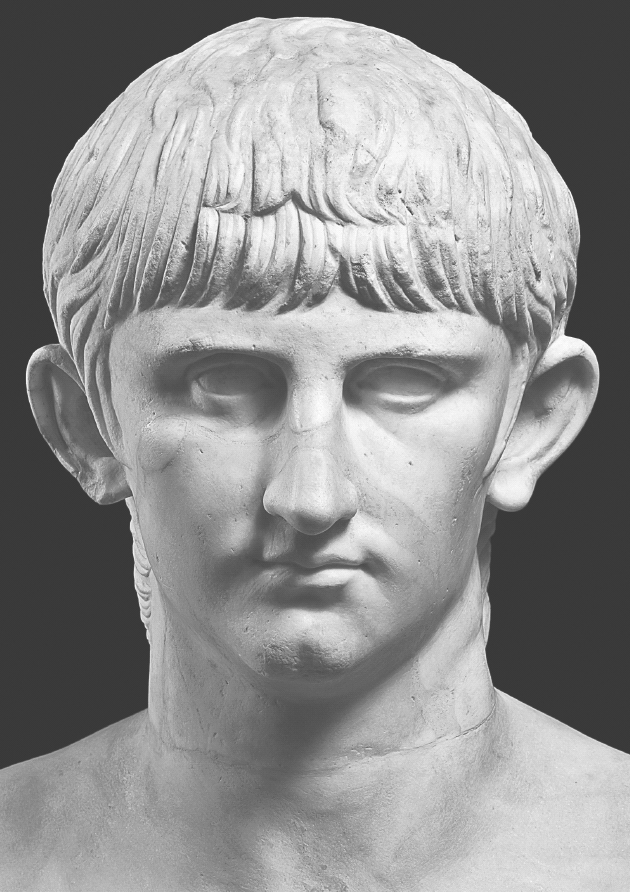
Nero in his late teens.
The historian Tacitus, writing many years later, notes the sophistication of the funeral speech and remarks on Seneca’s “pleasing talent, well suited to the ears of that time.” Given the patent fictions the speech contained, this praise is ambiguous, one of Tacitus’ many multilayered comments on Seneca’s career. “The ears of that time,” after all, were accustomed to hearing doublespeak and empty flattery. Tacitus was himself both a writer and a courtier, who had survived the reign of the despotic Domitian only by carefully adapting his words. He had sympathy for Seneca’s plight—but a certain contempt as well.
Whatever ground the new regime lost in this first address was quickly made up in the second. Nero’s inaugural speech to the Senate, again composed by Seneca, struck all the notes that the beleaguered senators longed to hear. The practice of holding closed-door trials would stop. The new princeps would not act as sole judge, nor delegate power to freedmen lackeys, as his predecessor had done. The Senate would have its ancient dignity, and many of its lost jurisdictions, back again. “My youth was not troubled by civil wars and family feuds,” Nero proclaimed, distinguishing himself from previous palace-raised emperors. “I bring with me no hatreds, no scars, no lust for vengeance.”
The promise of a clean slate, a return to amity between ruler and aristocracy, coming from one so young and so seemingly sincere, stirred the senators deeply. They voted to have this speech inscribed on a column covered with silver plate and read aloud every year in the Senate house when incoming consuls took office. It was an unprecedented honor for a public address. A compact of mutual respect had been struck between Senate and princeps, as in the days of Augustus. The nightmare of Caligula seemed to be gone, the policies summed up in a slogan that Seneca quoted on three occasions, always with revulsion: Oderint dum metuant—“Let them hate, as long as they fear.”
In framing this compact for Nero, Seneca was addressing his own former colleagues. A senator himself, though now working for the palace, he had a unique role to play, well suited to his diplomatic mien. He had been a victim of Claudian injustice, at first sentenced to death, then exiled to Corsica after the sentence was commuted. He knew abuse of power at first hand. No one had better credibility as an advocate of restraint.
The ideas Seneca put into the inaugural speech share a common outlook with De Ira, which by now was certainly in circulation. That work taught the powerful and proud that it was better to ignore a wrong than stoop to anger. “To fight against an equal is risky; against a higher-up, insane; against someone beneath you, degrading,” Seneca wrote in De Ira. He gave the example of Cato, that Stoic nonpareil who, when spat upon in public by an adversary, merely wiped his face and returned a good-natured quip. If one could not turn a blind eye, one could at least forgive, knowing that all human beings are prone to do wrong.
In both the inaugural speech and De Ira, Seneca was eager to banish discord and vengefulness, but he knew this took constant effort. He himself practiced a Zen-like exercise to restrain his own anger, if we can trust the self-portrait he paints in De Ira. Every night before bed, Seneca confides to his readers, he sat quietly beside his wife and took stock of his day, reviewing moments when he gave in to his passions. Perhaps he grew too hot during a dispute, or spoke more sharply to an underling than the man could handle. In each case, he tells himself: “See that you don’t do that again, but now I forgive you.”
Seneca then broadens the scenario and writes as though all Romans are performing the same exercise. Perhaps one is offended by drunken jesting at a dinner party. Perhaps another is jostled at a rich man’s door by a self-important doorkeeper. A third is seated at a banquet table in a spot lower than he feels he deserves. Seneca urges his readers to forgive such slights and take themselves less seriously: “Pull further back, and laugh!”
With an unerring eye for detail, De Ira caricatures the self-regard and self-importance of the Roman nobility. The work even explains these traits in a way that might look familiar to a modern psychologist. The wealthy and powerful indulge their children and give them no training in overcoming indignities. “The one to whom nothing was refused,” Seneca writes, “whose tears were always wiped away by an anxious mother, will not abide being offended.” The ability to laugh, he suggests, is an antidote to the petulance that comes with privilege.
But not everyone was able to take the laughter cure. Seneca was about to confront a woman who, as far as evidence reveals, had not the slightest trace of a sense of humor. He had poked fun at her, indirectly, in Apocolocyntosis, for she considered herself the widow, and priestess, of a god. To her, apotheosis was no laughing matter.
That woman was, of course, the imperious Agrippina, once Seneca’s greatest patron, but now looming as his greatest problem.
While Claudius lived, the task of getting Nero onto the throne had kept Agrippina, her son, and her son’s tutor in close alignment. Now that this goal had been achieved, their relations had become far less stable. Much would depend for Seneca on how he negotiated the change in the troika. Stoicism had taught him much about managing emotion and keeping the rational mind in control. But how rational could he remain amid the wrath of a possessive, domineering woman, still vigorous in her late thirties, and the rebellious, impetuous urges of a seventeen-year-old boy?
Nero started off by paying public tributes to Agrippina. When the captain of the guard asked the princeps, on the very first night of his reign, for the watchword that would give security clearance, Nero made it optima mater, “best of mothers.” It was a phrase from epic poetry, found once in Vergil’s Aeneid, and thus a gift of heroic stature for Agrippina. It was more than mere whimsy, for Nero knew that she had carefully cultivated the allegiance of the Praetorians for years. They were loyal more to her than to him. He had much to gain from seeming, in their eyes, a devoted son.
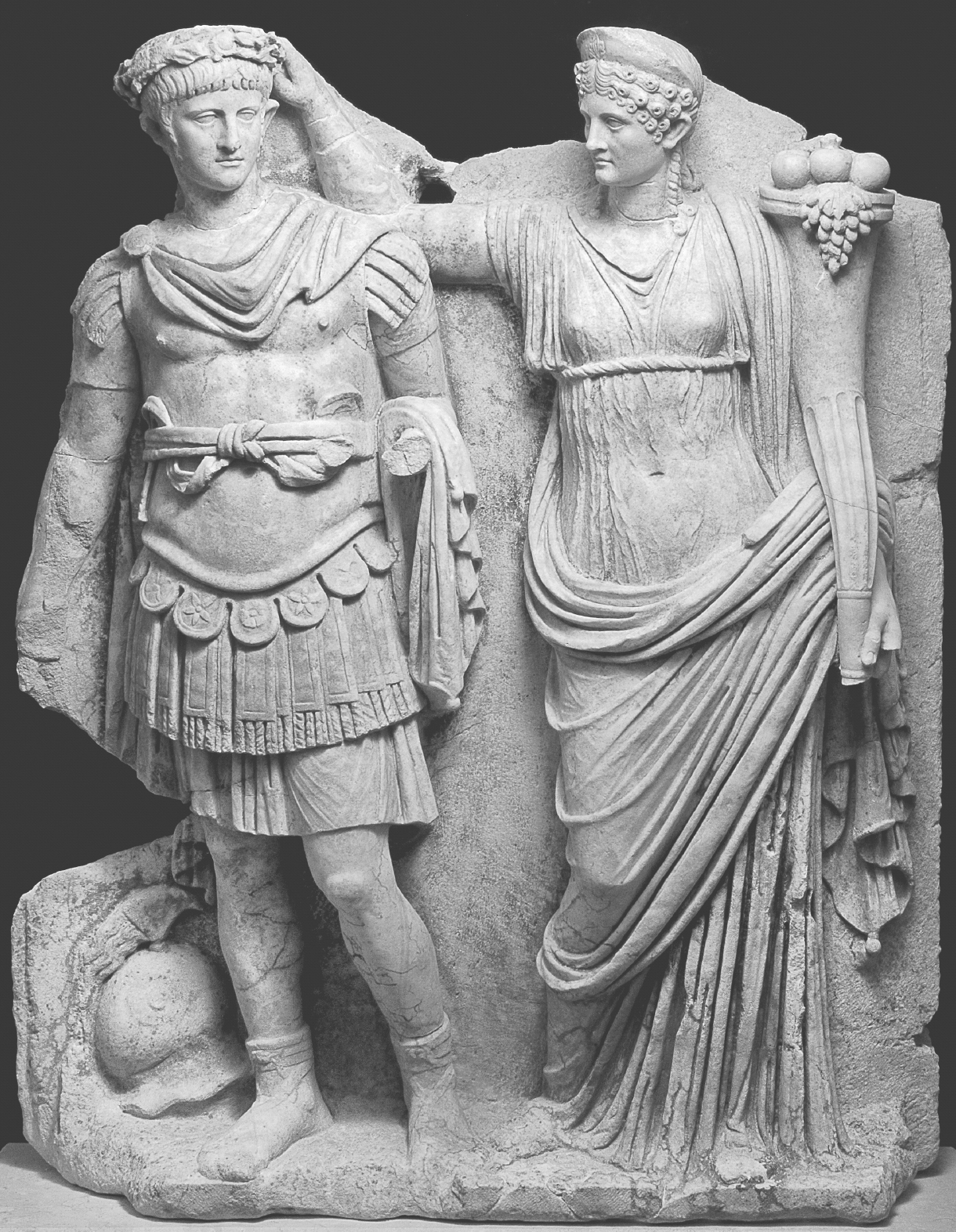
Relief from Aphrodisias in modern Turkey showing Agrippina crowning her son.
The reliance of the son on his mother was underscored in statuary, especially in a bas-relief sculpture found in Aphrodisias (a Romanized town in what is now Turkey). Uncovered only in 1979, this relief, part of a gallery of imperial portraits, depicts Agrippina gazing at Nero with maternal adoration as she places a laurel wreath on his head. Nero, dressed as a soldier, does not return her gaze but looks outward, coolly, impassively, at the tasks before him. The scene clearly configures Agrippina as the source of her son’s power. The image seems to have derived from an original displayed at Rome.
In his first coin issues—always an emperor’s most far-reaching medium of communication—Nero gave his mother a prominent, virtually coregnant, role. Under Claudius, Agrippina had appeared in jugate arrangements, her husband’s profile stamped over hers, or else she was relegated to the reverse—“tails”—side. Now a new format appeared, never before seen at Rome: Nero and Agrippina were shown in symmetrical profiles, gazing at one another on the “heads” side. Neither profile was larger than the other. The image suggests an intimate conversation, a moment of perfect concord, with each partner unafraid to hold the other’s gaze.
The message sent through these media was clear: Nero meant the public to see Agrippina as a sharer in rule. It was an obvious move for a youth who had been promoted to the principate in his teens, but it posed considerable risks. Romans who had witnessed the depredations of Messalina, or the machinations of Livia, Augustus’ wife, before her, were not eager to see another woman grasping the levers of power. The specter of impotentia, the will to power that Roman men demonized in Roman women, was again rearing its head. It did not help that Agrippina had already raised that specter in the reigns of Caligula and Claudius, seducing (so it was thought) the men from whom she could gain, and destroying those who opposed her.
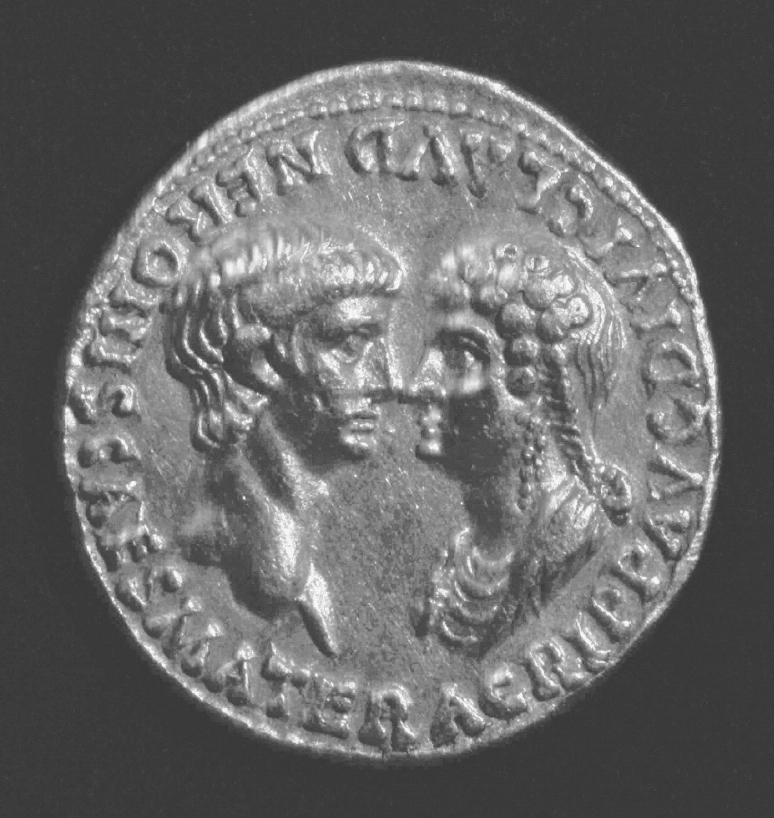
Coin issue of 54 showing Nero and Agrippina. Significantly, her name and titles are seen on the “heads” side of the coin, his on the reverse.
It was not long before Agrippina began playing her folktale role all too close to type. She used her new power to order two assassinations, eliminating one potential threat and one long-standing enemy. According to Tacitus, Nero was not involved in either move.
Marcus Junius Silanus, brother of the suicide who had spoiled Agrippina’s wedding day, now forty years old, was serving as governor of western Turkey and doing no one any harm. But his blood made him dangerous. His descent from Augustus marked him as a likely alternative, should the Romans decide someday to oust Nero. Agrippina dispatched two envoys who gave him the same poison used on Claudius—“too openly to be missed,” according to Tacitus. Apparently she wanted other Julian males to know whom they were dealing with.
Next Agrippina did away with Narcissus, Claudius’ devoted freedman, who had remained in custody since the death of his master. Not only did Agrippina bear him an old grudge, but the man knew too much. She ordered Narcissus to commit suicide, a more benign fate than execution since he could still pass on property to his heirs. Before his death, perhaps in exchange for this privilege, he burned the private papers he had amassed—documents that could have done Agrippina much harm.
Agrippina’s purge might have gone further, but Seneca moved to curb it. He could not stand by and watch as these Claudian tactics resumed, tactics that Nero, speaking Seneca’s words, had promised the Senate were over. Tacitus, who otherwise loved to dramatize scenes involving either Seneca or Agrippina, does not show us how this confrontation played out. But he does say that Seneca’s policy of restraint was seconded by a crucial ally at court: the new prefect of the Praetorian Guard, Afranius Burrus.
Burrus and Seneca made an odd pair, one a career soldier, the other a moralist and writer who had never borne arms. But they had by now built a bond of mutual trust. Together they worked to guide the young Nero and counter the sway of his mother. “They exercised different but equal influence [on Nero],” Tacitus comments admiringly, “Burrus by his soldierly sense of duty and his gravity of character, Seneca by his instruction in eloquence and his upright civility.” It was a rare instance when men who might have been rivals became collaborators, aided by shared goals and, increasingly, a common enemy.
Seneca explained his philosophy of executive restraint in De Ira. There he compared a leader’s handling of the state to a physician’s care of the body, an analogy he would often return to. Just as a good doctor seeks the least aggressive cure, a leader should use the gentlest methods of correction. He should chastise with only words if possible, then proceed to the mildest of blows. Execution should be only a last, desperate resort, for those who are so morally “ill” that death is, in effect, euthanasia.
Had Agrippina been permitted her own turn on this medical metaphor, she might have argued the benefits of prophylaxis. Sometimes tumors had to be excised before they turned malignant. Or she might have fired back at Seneca the line he had recently quoted himself, from Vergil’s guide to beekeeping: “Death to the weaker; leave the stronger to reign in the empty throne room.”
· · ·
For the moment Agrippina did not proceed with her purge. But she soon created a new problem when she claimed a role in privy councils of state.
As Claudius’ wife, Agrippina had once appeared on the emperor’s dais, dressed in military garb, to receive the surrender of British insurgents. Now she wanted to be present at even more important occasions. The Senate’s chambers were barred to all outsiders, but Agrippina contrived to move its meetings to a room in the palace and to listen in on deliberations from behind a curtain. Everyone knew she was there, taking note of every word that was said.
Another defining moment in the palace power struggle came early in 55, when Nero’s reign was a few months old. A foreign policy crisis had presented itself. On the empire’s eastern frontier, Rome’s ancient enemy, the Parthians, had decided to test the new emperor’s mettle. An uprising in Armenia had pushed a Roman puppet off the throne there, and the Parthian king seized the opportunity. He installed his brother, Tiridates, as ruler of Armenia, in effect claiming this crucial buffer state as his own.
The provocation demanded a riposte—but who would deliver it? Some Romans fretted that a youth just turning seventeen, governed by his mother and his teachers, was not up to the task of waging war in the East. Others reasoned that Seneca and Burrus were experienced men who would help the young emperor get through. Everyone waited to see who would be put in command, a real soldier or a mediocrity who could be counted on not to outshine Nero.
Agrippina, daughter of the greatest soldier of the century, expected to help manage the crisis. This was a red line for the male leaders of the regime. An Amazon could not lead Rome into war, even if she was the last living child of Germanicus. A court audience for the Armenian ambassadors was chosen as the place to make a stand.
Seneca and Burrus sat beside Nero on the high platform that denoted imperial power. Agrippina entered the room and made clear she intended to join them on that platform. The idea struck horror into the minds of the onlookers, but the three men had devised a countermeasure. At Seneca’s cue, Nero stepped down off the dais and met his mother at ground level, pretending to greet her but blocking her progress. The episode appeared to outsiders to be merely a tender exchange between mother and son, not a determined test of wills. The proceedings were then adjourned or moved to a new location. An open clash might have ensued had Nero reascended the dais, and foreign eyes might have glimpsed the rift in the regime.
Nero, prompted by Seneca, had stood up to his mother with a small but strong gesture. He soon followed it with equally confident moves to counter the eastern threat. Troop strength was boosted, and plans were laid to bridge the Euphrates and invade Parthia. Nero gave Domitius Corbulo, an iron-hard disciplinarian who had beaten the Germans under Claudius, command of the invasion forces. That move was hailed as a sign that Nero, advised by Seneca and Burrus, did indeed have the strength to face a barbarian foe.
The Parthians quickly backed down. Their surrogate in Armenia relinquished power and turned over hostages to Corbulo as guarantees of nonaggression. A grateful Rome showered honors on Nero, erecting a statue in the temple of Mars as large as that of the war god himself.
Agrippina accepted her second check but nursed her wounded pride. She was far from ready to cede the role of chief regent to Seneca, still less to Burrus. She was determined to show who had more influence over her son, she or they. As it happened, her next opportunity was not long in coming, and her efforts to exploit it would forever destroy what concord remained in the palace.
Like most Romans, Seneca mistrusted ambitious women, especially mothers who sought power through their sons. In a letter to his own mother, Helvia, from his exile on Corsica, Seneca had praised her for keeping out of politics even with two sons in the Senate: “You did not make use of our influence as though it were family property.… The only things that touched you from our elections to office were the pleasure they gave you and the costs they imposed.” Helvia’s passivity posed a stark contrast, Seneca wrote, to “those mothers who wield the potentia of their sons, with the impotentia of women.” His wordplay contrasts political governance—normally the province of men—with female inability to “govern” desire and emotion.
Seneca never mentions Agrippina in any of his surviving writings. Indeed his moral treatises deal only infrequently with women in general. De Ira characterizes anger as a “womanly and childish vice,” but its cases in point come from the realm of adult males. Even in Apocolocyntosis, his scathing satire on the abuses of Claudius, Seneca mentions Messalina—the moving force behind numerous executions, and his own exile—only as a victim, not as a perpetrator, of crimes.
By contrast, Seneca’s tragedies are dominated by women. Two of his best plays, Phaedra and Medea, revolve around powerful women and their passions, love in the first case, anger in the second. Phaedra conceives a desperate passion for her stepson, Hippolytus, then destroys him after he spurns her. Medea, barbarian wife of the Greek hero Jason, murders her children to get revenge on her adulterous husband. It is tempting to think that Seneca wrote the first in the era of Messalina, the second in that of Agrippina, women whose prevailing passions sort well with the heroines he portrayed. But there are no clues, either within the plays themselves or in other sources, that allow us to establish their dates.
Few today would think to read De Ira together with Medea, though the two works might well have been composed concurrently. Indeed, among dozens of modern editions of Seneca, a huge array of anthologies that organize his works for modern readers, only a single volume dares to package tragedies and prose works together. For why would any reader—still less, any writer—choose to inhabit two nearly opposite moral universes at the same time? Medea shows anger run amok, mushrooming into gigantic and hideous forms. “Ira, I follow wherever you lead,” Medea says as she stabs her sons to death, one after the other. But in De Ira, Seneca argues that anger can and must be subdued so that the rational mind can prevail. Our exemplar is Seneca himself, sitting with his wife as evening falls, calmly chastising himself for raising his voice that day.
Interpreters have struggled, and will struggle forever, to understand how one mind could have produced both bodies of work. It is as though Emerson had taken time off from writing his essays to compose the opera Faust. Some have described Seneca’s tragedies as inversions of his prose works—instruction by negative example—but that is too pat an explanation. The author of the plays expresses thoughts that the author of the treatises seems unable even to entertain. The last couplet of Medea, spoken by Jason as he watches his murderous wife escaping in a dragon-drawn flying chariot, resounds with nihilistic horror:
Make your way up, through the high expanses of heaven;
Proclaim, wherever you go, that there are no gods.
The tragedies feature many such moments. One would guess that their author was well acquainted with despair, even madness. But the prose treatises are optimistic and pious. They proclaim everywhere that there are gods, or God—as proved by the divine power of Reason within every soul.
In which body of work do we hear the real Seneca? Or are they two equally authentic expressions of what has been called his “compartmentalized mind”? Did he write his tragedies as a covert cri de coeur, a release of moral revulsion he could not otherwise express? That certainly seems the case, as will be seen, with his most ambitious, most harrowing drama, Thyestes—perhaps the last play he completed and the only one that can be securely dated to his years under Nero.
In Medea and Phaedra, Seneca plumbed the depths of what he saw as a typically female affliction, impotentia—an inability to master lust, restrain envy, or tamp down the need for control and power. It was a condition he, and other Roman males, feared in all contexts but particularly when it entered the political realm. The passions of unbridled women could destroy that realm and rush the world headlong toward apocalypse.
It was these fears of female impotentia that Rome, and Seneca, confronted as they watched Agrippina suddenly come unglued in early 55. What prompted the tempest was not an issue of statecraft but an affair of the heart.
· · ·
Nero had married Octavia a year or two before his accession, but the union was a cold one. The young emperor did not much care for the high-minded princess his mother had chosen for him. Octavia was central to Agrippina’s plan to knit together the Julian and Claudian lines and secure the future of the dynasty. The birth of a son would have sealed that future and cemented Nero’s position, but Octavia had not yet conceived. Perhaps she was not able, but it is likely that her disdainful husband did not give her many chances.
Nero’s interest in sex was as strong as any adolescent boy’s, but like many smothered sons of the elite, he craved the exotic and outré. He had not been in the palace long when an Asian freedwoman named Acte, a member of the foreign-born staff assembled by Claudius, caught his eye and came into his bed. She was everything Octavia was not—above all, she was not his mother’s choice.
Emperors felt entitled to any woman they desired, regardless of either party’s marital status. Nero’s passion for Acte was not in itself worrisome. Indeed, it brought relief to many, who had seen Caligula debauch himself with the wives of senators and consuls, humiliating the elite with rape and degradation. The affair with Acte harmed no one—but it sent Agrippina into a rage. She regarded it as a betrayal by her son and a challenge to her authority. “A handmaid for a daughter-in-law!” she exclaimed to her partisans, and demanded of Nero that he end the liaison. “I made you emperor,” she reminded him, implying that she might undo what she had done.
Nero had had enough. His mother’s carping and bullying had annoyed him before, so much that he had threatened to abdicate and run off to Rhodes, far from her influence. Now he was ready to risk a true breach, and he turned to his best natural ally, Seneca.
Seneca had aided Nero early on in the affair with Acte, directing his close friend Annaeus Serenus, newly appointed as head of Rome’s vigiles (a combined police and fire-fighting corps), to help conceal it. Serenus pretended to be Acte’s lover, passing along Nero’s gifts to the girl as though they came from him. It was a sneaky and passive form of support—given no doubt in hope the affair would soon run its course—but it showed plainly where Seneca’s sympathies lay. If mother and son were going to war, he would side with the son.
The choice could not have been an easy one. Agrippina was his patroness, the woman who had brought him back from exile and given him the power he now enjoyed. He would lose that power, and perhaps his life, if he fell on the wrong side of the rift. Agrippina might even go over the edge if she was pushed too far, a dangerous outcome that Seneca could not have hoped for. Even if Nero must triumph in the end, Seneca had nothing to gain—and indeed had much to lose—from the total estrangement of his two masters.
The contretemps took a seemingly benign turn. Unable to bully her son, Agrippina suddenly turned cloying. Outpandering Seneca and Serenus, she offered Nero her own palace rooms for his trysts with Acte, and the use of her wealth to subsidize his pleasures. It was a transparent attempt at manipulation, and Nero’s friends urged him not to take the bait. The emperor nonetheless had pangs of regret. Knowing well his mother’s taste for feminine finery, he picked out some clothes and gems from the palace treasury and sent them to her as a peace offering. Agrippina only bridled when she got them, claiming that the crown jewels she had given her son were being returned to her in niggardly dribs and drabs. The attempt at reconciliation ended up widening the breach.
Nero decided to neutralize one of Agrippina’s chief supporters, the freedman Pallas. Officially minister of the exchequer, but party to all backroom schemes, Pallas had amassed enormous influence and more wealth than anyone in Rome—except his deceased former rival, Narcissus. For seven years, he had used his sway on behalf of Agrippina, but now Nero wanted his mother disarmed. He cut a deal with Pallas, allowing the freedman to take his loot with him, no questions asked, if he would leave without making trouble. Pallas exited grandly, accompanied by crowds of attendants and bearers—a rare political gambler who had beaten the house and, for the moment at least, got out with his winnings intact.
The loss of her principal ally turned Agrippina apoplectic. A few weeks earlier, she had touted her role in securing the throne for Nero; now she spoke openly of her power to take it away. Britannicus was about to reach manhood, she pointed out to her son, and could easily reclaim his patrimony. In an inversion of her former line, she portrayed Nero as an interloper and a usurper of Britannicus’ rights. It was by the grace of the gods, she said, that Britannicus still lived. She would take him to the Praetorians’ camp and present him for acclamation; the soldiers would take her part against her rivals at court.
“It’ll be a daughter of Germanicus on one side, and on the other Burrus the cripple and Seneca the exile—one with his maimed hand, the other with his schoolmaster’s tongue, yet they seek rule over the whole human race!” she cried, gesturing wildly and invoking the shades of her victims, the two Silanus brothers and the now-deified Claudius.
A young man’s dalliance with a servant was spiraling into a crisis. Agrippina was lashing out viciously at her son, with her uncanny instinct for what would threaten him politically and terrorize him psychologically. There was no doubt of her standing with the Praetorian Guard, the keystone to control of the throne. The guard had always been fiercely loyal to the house of Germanicus, whose memory they deeply revered. With the guard behind her, Agrippina could, if it came to that, destroy Seneca, Burrus, and Nero together, as easily as she had created all three ex nihilo.
The triumvirate forged at the end of Claudius’ regime—the strange triangle of Agrippina, Nero, and Seneca—had collapsed. It was now a game of two against one, with Agrippina desperate not to end up on the losing side. She had shown her willingness to use any weapon, to escalate to the highest pitch of emotion, in order to hold Nero’s allegiance. For Seneca, adherent of Reason, advocate of moderation and the suppression of anger, it was not clear whether, or how, to fight back.
Britannicus was approaching his fourteenth birthday. With it would come an adult toga, a ceremonial entry into the Forum, and implicitly, eligibility for rule. The seniority advantage that Nero had enjoyed would soon be at an end, forever.
Though sidelined from power, Britannicus had made plain that his hopes were not extinguished. In December 54, when Nero had been two months on the throne, the imperial family had one night relaxed with a role-playing game, and Nero had been made king-for-a-night. The new princeps imperiously commanded his adoptive brother to stand and sing before all. Britannicus, unbowed by the bullying, sang a tragic lament about the loss of patrimony and rule. It was the same sort of pluck the boy had shown years earlier, if he indeed had ignored Nero’s adoption and deliberately called him Domitius.
Had Claudius wanted his natural son to inherit the throne on coming of age? Some believed his will had made such provisions, but Agrippina and Nero had suppressed it. In any case, what mattered to Nero now was not his adoptive father’s intentions but those of his mother. Even if the will had not named Britannicus heir, Agrippina could claim that it had—and who would gainsay a grieving widow, daughter of Germanicus, and priestess of her deified husband’s cult?
Agrippina had shown, in the Acte crisis, that she would use Britannicus at any opportunity to gain leverage. She had the supreme weapon that could be held over a princeps, a viable replacement. Only when this weapon was defused could Nero hope to control his mother—though she would still have in her arsenal the support of the Praetorians, the heroic legacy of Germanicus, and a remarkable ability to lavish or deny maternal love.
The date of Britannicus’ upcoming birthday grew more threatening as it drew closer. Nero decided he must make that date a deadline in the literal sense—the date by which Britannicus would be dead.
It was as much his mother as his adoptive brother that Nero was striking at. He was not strong enough to order violence against Agrippina, though soon the wish to do so would consume him. For now, he could murder her by proxy.
Nero used his mother’s own hired poisoner to accomplish the deed, the Gaul Locusta, “the Crayfish.” Unlike his mother when she killed Claudius, though, Nero did not care about acting in stealth. Locusta at first concocted a slow-acting poison that only made Britannicus vomit; Nero became so agitated that he struck her. The woman explained that she had only been trying to help keep the crime concealed. “So I’m afraid of the Julian law, am I?” Nero asked, mocking the idea he could be tried under standing statutes.
Locusta obliged by providing a stronger dose, testing it on a goat and a pig to make certain. Speed and openness were desirable now. Nero wanted Agrippina to see that he had the courage to act.
Did Seneca help Nero carry out his first assassination? Was he at least informed of the plot? None of our sources imply either proposition, but the logic of the court demands that they be considered. Seneca had been Nero’s ally against Agrippina from the start, as well as his chief adviser and guide. It is hard to know whether Nero could, or would, have pulled off the crime without him.
By custom, the imperial family dined together, but with younger members sitting upright (as only children did in Rome) at their own table. Britannicus took his meals here, alongside his close friend Titus, son of the general Vespasian—both of whom would one day become emperors themselves. Nero and his wife Octavia sat apart, reclining on dining couches in adult fashion. Hierarchies of place, posture, and diet thus separated Octavia from her younger brother. The paths of the two orphans had diverged widely sinceinsitivus Nero, “grafted-on Nero,” had arrived in their midst.
Tasters routinely sampled all drinks and dishes to guard the family against poisons. But every system has its loopholes, and Nero exploited one of them. Since it was winter, wine was drunk warm, mixed beforehand with hot water. Britannicus’ cup was duly tasted and passed to him. But the drink had been made too hot for the young man’s liking. He pushed it away, and an obliging servant added melted snow to temper it. The drink, now containing the poison, was not tested a second time. Britannicus sipped it and fell stone dead.
There followed a stunned silence in the dining hall, during which all present felt, as one historian has put it, “the need of seeing into the minds of others while concealing one’s own.” Some made a hasty exit from the room. Agrippina and Octavia, who were among those taken by surprise, stood transfixed, striving (according to Tacitus) to keep their faces expressionless. All eyes turned toward Nero. The emperor reminded those present that Britannicus had suffered epileptic attacks since childhood; the boy would no doubt soon recover his health. No one contradicted him, and the meal grimly resumed.
Rome had seen dynastic murders before, but never such a brazen one at a large gathering. The openness of the deed sent a clear message, intended for Agrippina above all. She would not be allowed to bully or blackmail her son. Nero would stand on his own, or rather with Seneca and Burrus, not his mother, to aid him.
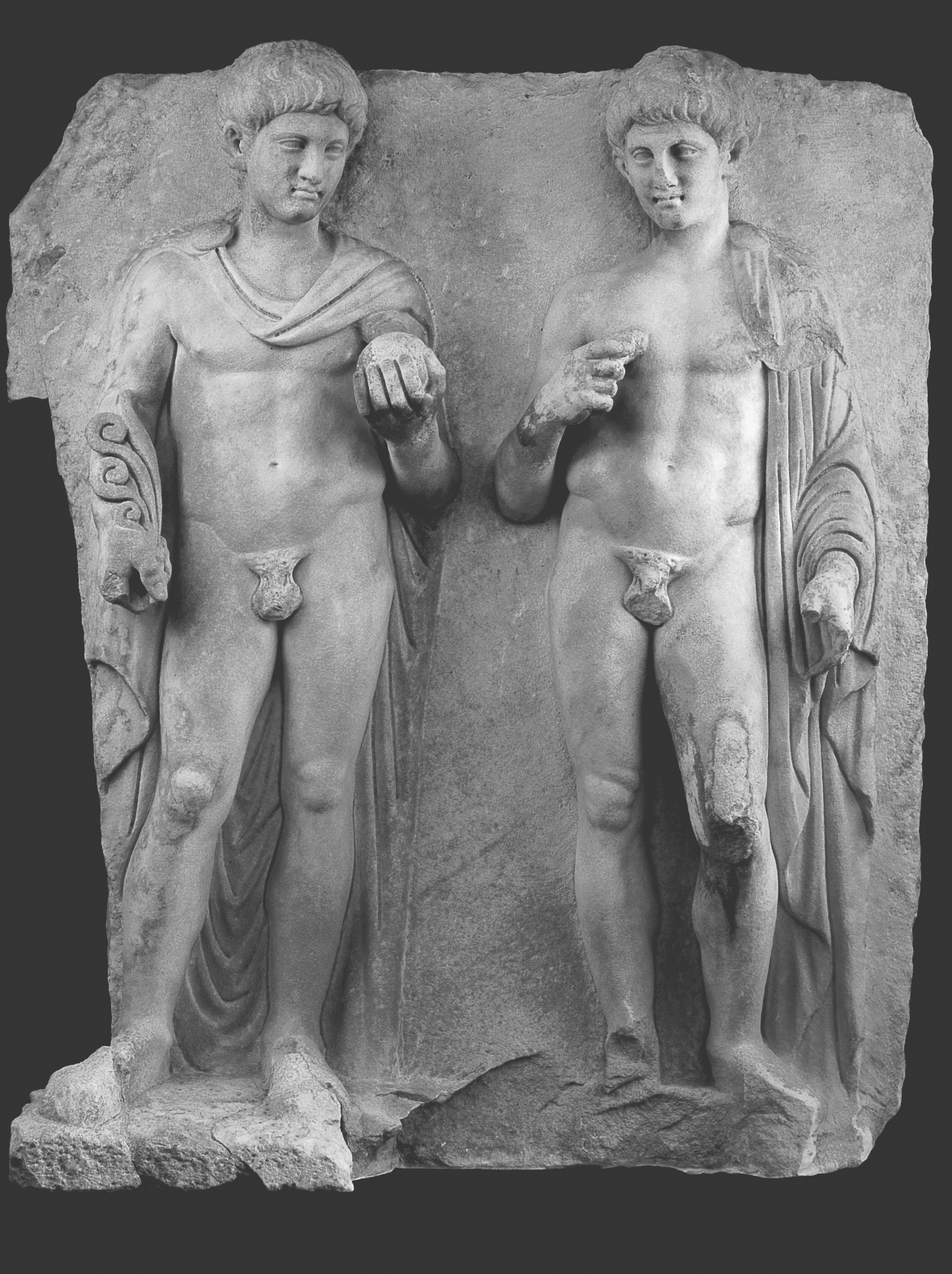
Nero (left) and Britannicus, in a relief dating from before Nero’s accession.
Locusta had done her job well. She received an imperial pardon for her prior crimes and an award of rich lands outside Rome. On these estates, according to Suetonius, she founded a kind of poisoning academy in the service of the princeps. Her drugs had so far carried off two of three surviving Claudians, slowly in the first instance, in the second with terrifying speed. Nero would have cause to call on her one more time, in the years to come.
Somehow the poison given to Britannicus also got into the system of Titus, his best friend and dining companion, and made the young man ill for weeks (or so Suetonius reports). Titus would, after becoming emperor a quarter-century later, portray himself as Britannicus’ posthumous champion. In the short time he occupied the principate, from A.D. 79 to 81, he issued coins bearing Britannicus’ image and commissioned two costly statues: a gilded one that stood in the palace, and an equestrian portrait, plated with ivory, that was carried, alongside images of gods and heroes, into the Circus Maximus at the start of a yearly sports festival.
By that time, a link to the Claudians had become an asset for reigning emperors, since Nero had trashed the reputation of the Julians. Britannicus came to stand as a shining symbol of what might have been.
Postmortem rites for Britannicus had to be carefully stage-managed, just as they had been for Claudius. The young man’s death had to seem like a natural event, even if the palace knew otherwise. When it was discovered that Locusta’s toxin had darkened Britannicus’ skin, Nero reportedly had the body painted over with chalk to whiten it again. A cremation ceremony was held either that very night or the next, despite heavy rain. Later it was rumored that the rain washed away the makeup from Britannicus’ face, as though the gods themselves sought to reveal the truth.
Britannicus’ ashes were interred, quickly and quietly, in the mausoleum of Augustus, formerly reserved for emperors and members of the Julian line. But despite the honorary resting place, haste and lack of ceremony aroused public resentment. Nero was forced to publish an edict the day after the interment. It was good Roman custom, Nero asserted, to forgo rites for those who had died in youth, lest the lingering presence of a young corpse bring bad luck to the family. This thin pretext was the best the regime could manage, even with Seneca’s ingenuity.
Agrippina, according to two sources, went into open mourning for the young man whose cause she had espoused so recently and with such fatal consequences. Perhaps her tears were political theater, designed to arouse opposition to Nero, but she also had grounds for remorse. Her best means of restoring her waning power at court was gone. She had used Britannicus as a pawn in a high-stakes showdown, and her son had bested her with a lightning blow.
Agrippina’s fortunes went into a steep decline, clearly signaled by imperial coinage. Her image was no longer shown facing that of Nero. For a brief time, she appeared in jugate, the profile of the princeps overlaying hers, as she had been portrayed under Claudius. Then she disappeared from state coinage entirely within the year. The “best of mothers” had been thrust from her son’s favor. Spurned, she gravitated toward another outcast at court, her stepdaughter Octavia, orphaned daughter of Claudius and Messalina, now Nero’s unloved teenage wife.
Octavia’s plight, in the aftermath of Britannicus’ death, was truly piteous. In seven years, she had watched as her father killed her mother, her stepmother killed her father, and her husband killed her brother. She had somehow survived, along with her half-sisterAntonia, in a regime run by strangers and enemies. Her husband rejected her and sought the embraces of an ex-slave instead. The loss of her brother Britannicus left her utterly alone, perhaps afraid even to grieve, as the author of Octavia imagined:
My fear forbids me to weep for a brother,
He in whom my last hope was lodged,
He who gave a short respite from pains.
Living only to mourn my kin
I linger on, the shade of a once-great name.
The historian Tacitus confirms the tragedian’s portrait: “Despite her youth, Octavia had already learned to conceal her sorrow, her love—all her emotions.”
Britannicus had other partisans at court, and in the Senate and the street, but Rome stayed quiet. Though an earlier princeps, Tiberius, had once endured widespread outrage at the suspicious death of Germanicus, in this case no protests arose to trouble the new regime. The public was not even provoked by a disturbing report, of uncertain credibility, that Nero had raped Britannicus some days before the fatal dinner, to demoralize his enemy before striking him down.
Many suspected foul play, but they bowed to the logic of history, according to Tacitus: in royal families, brother had ever been at war with brother; the principate could not be shared. “Death to the weaker; leave the stronger to reign in the empty throne room,”Seneca had written, probably only a few weeks earlier, in Apocolocyntosis, quoting Vergil’s advice on ending strife in a beehive with two “kings.”
But in Apocolocyntosis, Seneca had also depicted Augustus, among the company of the gods, thundering disdain at Claudius for killing members of his family. And in De Ira, he had compared a princeps to a gentle physician, administering death only as a form of mercy when a patient was beyond cure. For the author of those two works, the murder of Britannicus raised disquieting questions.
Was a moral principate, an administration compatible with Stoic precepts, going to be possible? Seneca had based his vision of good governance on the regime of Augustus; but the regime to which he belonged, dominated by an insecure, spoiled teenager and his unstable mother, seemed a long way off from that shining ideal. He stood closer to the moral universe of his tragedies, works like Medea and Phaedra, than to De Ira and his other prose works.
Seneca had to consider not only his own principles but his reputation among the elite. He had crafted Nero’s inaugural speech to the Senate, an address that promised an end to abuses of power. That historic speech had been inscribed on silver tablets and hung on a column for all to see. But those tablets were now badly tarnished. The fresh start that the regime had enjoyed months earlier, its repudiation of Claudian paranoia and subterfuge, had been given the lie.
Even if Seneca had played only a passive role in the murder—and some surely suspected it was more than that—he was nonetheless tainted by it. “Not stopping a wrong is the same as spurring it on,” Seneca had written in one of his plays, a line that, if any among the elite had heard it, might now have been spat back in his face. It did not help that in all likelihood, Seneca was among those to whom Nero gave shares of Britannicus’ property. This distribution caused revulsion in official Rome, according to Tacitus: “There was no lack of those who took issue with this: that men who affected moral seriousness were splitting up houses and estates like booty.”
Not least of Seneca’s concerns, in the days after Britannicus’ death, was his own safety. Any illusion that partnership with Burrus, who controlled the Praetorians, would protect him had now been dispelled. In the balance-of-fear calculations that governed palace relationships, poison was a great trump card. Nero now had an expert poisoner in his service and, more important, the courage to deploy her weapons. The threat that Nero’s power posed must have been present to Seneca’s mind at every state dinner thereafter.
In the tragedy Seneca wrote near the end of his life, Thyestes, the climactic scene shows a king destroying his brother by feeding him a toxic meal. On one level, the scene evokes the murder of Britannicus, for the victimized brother had been just on the verge of assuming joint rule. On another, the victim is Seneca himself, for the play portrays this man as a mild-mannered sage returning from exile. By the time he wrote Thyestes or soon afterward, Seneca’s life had also been threatened by poison, as we will see. In the play, he seems to recall Britannicus’ deadly last dinner but also to put a version of himself in the boy’s place at table.
The dilemmas Seneca now faced—ethical, political, and deeply personal—would grow more complex and pressing through the decade he was to spend at Nero’s side. To judge by his few oblique references to them, he was never to find resolution. He would describe himself, near the end of that decade, as suffering from an incurable moral illness, able to gain partial relief but no cure. Perhaps that was the necessary outcome of his decision, long before, to enter politics even while pursuing his Stoic moral pilgrimage. He had attained both the wisdom of a sage and the power of a palace insider—but could the two selves coexist?
Seneca was not ready to give up on the ideal of a moral principate. His greatest assets, virtuosic eloquence and literary ingenuity, were still as potent as ever. Twice before, he had used these gifts to accomplish feats of dexterity: preaching acceptance of death while also begging for recall from exile, in Consolation to Polybius; viciously lampooning a dead princeps while exalting a living one, in Apocolocyntosis. His command of words was such as to make any goal seem possible. Perhaps it could even hold together his swiftly diverging paths.
In the wake of Britannicus’ death, Seneca set out to write his most eloquent, most audacious, most ingenious prose work yet. This time he would not only ventriloquize Nero, he would preach to him, asserting the privilege of a teacher to lecture his pupil. He would erase the recent assassination and start the regime over again, on a firmer ethical footing this time. He would show that if Nero went down the road of Claudius or, worse, of Caligula—banishments, executions, rigged trials held in the emperor’s bedroom—he, Seneca, would not stand by idly, or at least could not be held to blame.
Such thinking, at any rate, is one way to explain the genesis of De Clementia (“On Mercy”), the most inspiring political treatise produced under the Roman principate—or, perhaps, the cleverest piece of propaganda.