Chapter 10
In This Chapter
 Envisioning Einstein’s ideas on simultaneous events
Seeing how relativity impacts space and time
Linking space and time together
S witch your brain to science fiction mode for a minute. Consider a universe where clocks keep different time depending on how fast they’re moving. (A clock in a spaceship might run at a different pace than a clock on land, for example.) Or a universe where people age faster if they’re standing still than they do if they’re moving. (See all those Hollywood stars running for dear life?) Or a universe where distances and shapes change depending on how fast you’re moving when you observe them.
Sound like a fascinating place? It is, and it just so happens to be the universe you’re living in.
In this chapter, I show you how Einstein’s special theory of relativity changed the way we think about space and time.
Your Time Is Not My Time
As I explain in Chapter 9, Einstein developed his special theory of relativity from one simple but powerful idea: The laws of physics are the same for all observers in uniform motion (without acceleration). This statement is Galileo’s principle of relativity, which Einstein extended to apply to all of physics rather than just to Newton’s mechanics. When Einstein adopted this principle, the need for an ether disappeared, along with the idea of absolute motion. All uniform motion is relative. Einstein’s principle of relativity also required him to make the speed of light a fundamental constant.
Casting doubt on simultaneity
Einstein’s beautiful special relativity paper was the fourth paper that he published in 1905, his year of miracles (see Chapter 3). In that paper, Einstein discussed the implications of his theory on simultaneous events. “We see that we cannot ascribe absolutemeaning to the concept of simultaneity,” he wrote.
He explained that two events that are simultaneous in some particular moving frame aren’t simultaneous when observed from a reference frame that is moving relative to the first one. Einstein’s conclusions regarding the simultaneity of events led to unexpected situations.
Conducting a thought experiment
Consider the following thought experiment involving two spaceships.
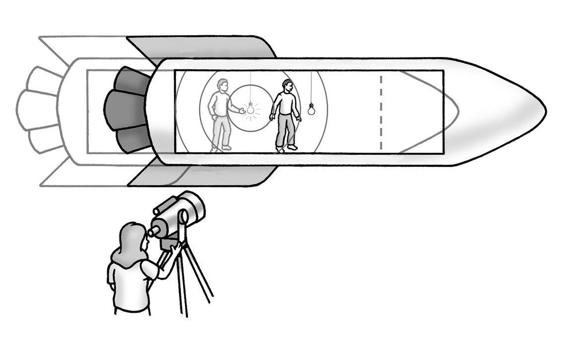
You’re traveling on a spaceship on an interstellar expedition. A crew member turns on a light bulb in the middle of the crew quarters (see Figure 10-1). You notice that the light reaches the front and back of the cabin at the same time (as it should, because the speed of light is the same whether you are moving or not, and the distance from the light bulb to each wall is the same). The two events are simultaneous. Or are they?
An astronomer named Ellie is watching your transparent spaceship through a powerful telescope from her own spaceship, and her version of events is different. Ellie sees that your ship is heading toward the star Sirius at half c. She then sees the crew member turning on the light bulb in the middle of the spaceship. From Ellie’s perspective, the light going toward the front of the spaceship, traveling at c, has a slightly larger distance to cover than the one going to the back of the spaceship. That’s because the front wall has moved a bit farther away from the light bulb since it emitted the light. The back wall, however, has moved a little closer and meets the light going there a little sooner, as shown in Figure 10-2.
|
Figure 10-1: You see that the light from the light bulb reaches the front and back of the spaceship at the same time. |
|
|
Figure 10-2: Astronomer Ellie sees that the light reaching the back wall arrives first. |
|
To Ellie, the light doesn’t reach the front and back of the ship at the same time. These two events are not simultaneous.

Who is right? Ellie is right. And you are right. Both are right at the same time. As Einstein said,
Events that are simultaneous in one moving frame are not simultaneous in another.
Dilating Time
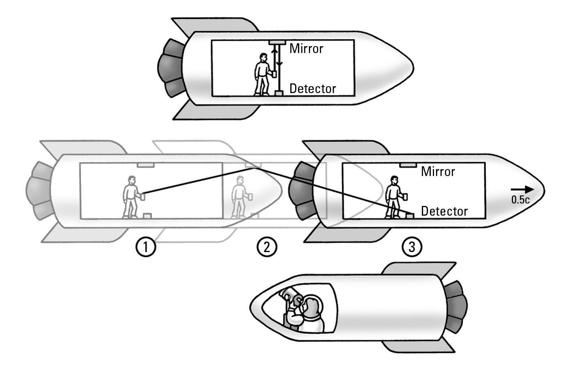
According to Einstein, you and Ellie disagree on the timing of what you both see because you are moving relative to each other. Suppose now that for a second experiment, you send one laser pulse straight up to a mirror in the ceiling of the spaceship’s cabin. From the spaceship, you see the pulse go up, bounce off the mirror, and come straight back down (as shown at the top of Figure 10-3).
Ellie sees the pulse travel up along a diagonal, because the light travels up and then across with the moving spaceship. She then sees the pulse bounce off and head down along another diagonal, because now the pulse travels down and also across with the ship (as shown at the bottom of Figure 10-3).
According to Einstein, both you and Ellie, in motion relative to each other, measure the same speed for the light pulse. However, Ellie sees the pulse traveling through a longer path than you do. The same event, the light pulse going up and down, takes longer to happen from her perspective than from yours.
|
Figure 10-3: (Top) You see the light beam go up, bounce off, and come straight back down. (Bottom) Ellie sees the beam go up along a diagonal, bounce off, and move down along another diagonal. |
|
You could arrange for this experiment to repeat over and over, with the light pulse going up and down in your spaceship. That would be a kind of clock. You could count the number of return trips for the light pulse in a day, and from there on you could say that when you count so many of these returns, a day has passed. To make it easier, you could adjust the height of the mirror so that 50 million return trips equals a second on your regular watch. Your device could tick every time it counts 50 million, so you know it ticks every second, like your regular clock.
Ellie is still on her spaceship as well, and she also builds the same kind of clock to keep track of the time on your ship. Will her clock and your clock keep the same time? No. Ellie finds out that her light clock takes longer to tick than the regular clock on the wall. Remember, her new clock is keeping the time on your ship, and it’s taking longer to count up to a second than her regular clock. She concludes that time on your ship flows more slowly than on hers.
You disagree. From your perspective, your ship isn’t the one moving. To you, Ellie’s ship is moving at half c. If you ask her to set up the same experiment with the laser pulse and the mirror on her ship, you’ll be able to monitor the flow of time on her ship. And when you do, you’ll observe that time on her ship is running more slowly than on yours.
From your ship, it appears that Ellie’s ship is moving, and time in her frame runs more slowly than in yours. From Ellie’s ship, your ship seems to be moving, and your time flows more slowly than hers. How do you explain the differences? All you can say is that, according to Einstein,
Time in the moving frame always runs more slowly.
Shortening Space
According to Einstein, time is relative. It changes depending on how the person measuring it moves. But time isn’t the only thing that changes with the motion of the observer. Space also changes.
Conducting a repair mission
Ready for another thought experiment? Imagine that you are on a spaceship that has docked at a large space station for maintenance. While you are there, you receive news that a sister ship was disabled at a point 360 million kilometers (km) from the space station. A service runabout out on a short trip is rerouted to assist the ship. While on its way, the pilot of the runabout realizes that he has fuel for only 320 million km, at the most, and radios back to the station that he is returning to base. The station commander does a quick calculation and orders the runabout to continue on its service mission to the disabled ship.
Reluctantly, the pilot obeys orders and keeps his course. Thirty-four minutes later, he arrives at the disabled ship, and he still has enough fuel left to go another 10 million km. His instruments tell him that he’s traveled only 310 million km. How can that be?
The station commander had calculated the shortened distance, which is why he sent the pilot ahead with the mission. The commander used Einstein’s equation for the shortening of space from the perspective of the moving runabout. At the one-half c that the runabout could travel, Einstein’s special theory of relativity says that the distance is shortened by 13 percent — enough for the runabout to make it to the disabled ship. (Once fixed, the ship can carry the runabout back to the station.)
According to Einstein’s special theory of relativity,
Space is shortened in the moving frame.
Having more time than you thought
Another way to look at why the runabout makes it with the fuel it has is to consider the lengthening of time for the runabout. Einstein said that time flows more slowly in the moving frame. If you’re in the station comparing the clock on the wall with the clock in the runabout, you’ll see that the runabout’s clock moves more slowly. Using the clock on your wall, you’ll measure a longer time for the trip than if you used the pilot’s clock.
Because the clock in the moving runabout runs more slowly (as it’s viewed from the frame of the station), the pilot’s time is expanded or dilated, and his fuel lasts longer. The longer distance that you measure in your frame is shortened in his. There is an interplay between space and time here, which I discuss more later in the chapter.
Understanding length contraction
The runabout made it to the disabled ship with the fuel it had because it was moving relative to the station, and space in the moving frame is shortened or contracted. However, you could say that the space station was moving relative to the runabout, and its space is the one that should’ve been shortened. According to relativity, both statements are equally valid.
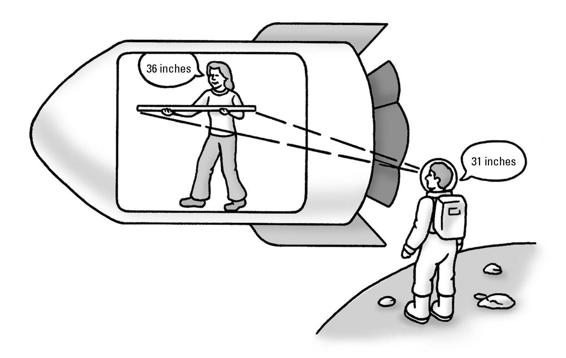
If you’re moving relative to me, I see your space contracted, and anything that you’re carrying, including yourself, will be shortened in the direction of motion (see Figure 10-4). If your ship measures 300 meters and is moving at half c, I measure it as being only 260 meters long — a 13-percent contraction. I see a yard stick laying down in the direction of motion in your moving ship to be 31 inches long instead of 36. You look 13 percent thinner, but your height hasn’t changed (see Figure 10-4).
From your perspective, everything is normal: The yardstick is still 36 inches long, and you don’t look any skinnier than normal. For you, however, I am the one moving at half c, and when you observe my surroundings, everything is shortened by 13 percent in the direction of motion. Remember: According to Einstein, space is relative.
|
Figure 10-4: If you move relative to me, I see your space shortened in the direction of your motion. |
|
This shortening of space is linked to the lengthening of time for the moving observer. Both space and time are relative. Einstein was forced to reach this conclusion after he decided that the speed of light is a universal constant. This way of thinking was completely opposite to what Newton had done. For Newton, both space and time were fixed, absolutes, but the speed of light could change depending on how fast you were moving.
Deciding If It’s All Real
How can it be possible that I see your space contracted and, at the same time, you see mine contracted? I see your time running slow, and when you measure my time, you see it running slow. Are these effects real, or are they simply illusions? Does your time appear to me to be running slow when you and I are in relative motion, or is your time actually running slow?
You’re a muon!
The effects are real and have been measured many times with modern instruments. The first observation was with muons, elementary particles that are created in cosmic rays at an altitude of 6,000 meters (20,000 feet) and that reach the ground in abundance.
The average lifetime of a muon is 2.2 microseconds. Physicists measure this lifetime with precision instruments in their laboratories. Cosmic ray muons travel at 0.998c, very close to the speed of light. At this speed, they could travel only 660 meters (2,200 feet) in the atmosphere. Because they start their journeys 6,000 meters above the Earth, you should never detect one.
However, because they are moving relative to us, their lifetimes are extended in our frame of reference from 2.2 microseconds to 34.8 microseconds. Because they last longer, they can cover a distance of 10,000 meters (33,000 feet), more than enough to reach the ground (see Figure 10-5). A muon passes each square centimeter of the Earth’s surface about every minute.
If you are a muon, you know that you will live only 2.2 microseconds. In your reference frame, you aren’t moving, and that’s what your life expectancy is. Yet you make it to the ground below. And most of your neighbors do, too. The reason is that the distance from your birthplace to the ground isn’t 6,000 meters, as the Earthlings say, but 380 meters (1,200 feet), and you know you have time to travel that far.
|
Figure 10-5: Muons move close to the speed of light, so their lifetimes are extended enough to reach the ground. |
|
Slowing it down
Biological processes are also slowed down as you move faster and faster. Your heartbeat and the rate of cell division in your body, for example, are slowed down when you move relative to the Earth. How does this happen?
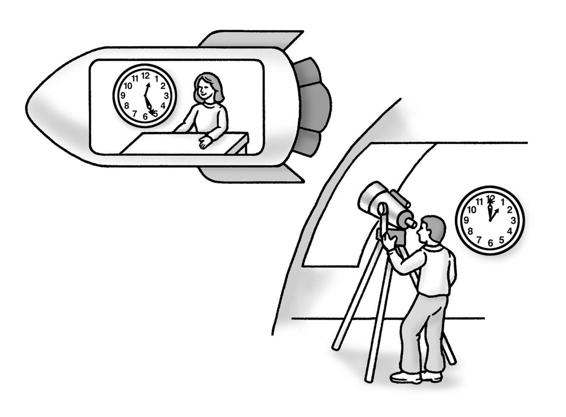
If you take off on a spaceship and eventually reach a speed of 0.9c relative to the Earth, your heart will continue to beat normally, and the cells in your body will continue splitting at their normal rate. But to me, here on Earth, your ship’s clock runs more slowly than mine (because you’re moving at 0.9c relative to the Earth). For every hour that passes on my clock, your clock marks only 26 minutes (see Figure 10-6). When a day passes for me, it’s only been ten and a half hours for you. A year later, you’ll be seven months younger than me. In ten years, you’ll age only four years and four months. I’m talking about real age here, not an illusion, because all your biological processes have slowed down. You will honestly age more slowly than the rest of us here on Earth.
Speeding it up
But wait. Didn’t I say that this type of motion is relative? Couldn’t you just as well describe the situation by saying that when you are on your spaceship, the Earth and the entire solar system are traveling at 0.9c while you are at rest? This is true.
|
Figure 10-6: When my clock registers an hour, only 26 minutes have passed for you on the spaceship. |
|
For you, then, all of us staying here on Earth are aging more slowly, and when you return in ten years, you should find that everyone has aged almost six years less than you.
Uh oh, our usual drill won’t work. We can’t say that both situations are equivalent because you can clearly see who’s younger. What went wrong here?

Don’t worry, relativity hasn’t failed. If you look at the situation more closely, you’ll see that the two frames of reference are not equivalent. Relativity applies to uniform motion — motion that you can’t distinguish. For example, if two spaceships are moving in interstellar space, either one can say that the other is moving. Or both can agree that they’re both moving. You can even say that while you are around the solar system, the solar system is moving past you, and you’re standing still. As long as you don’t accelerate, you’re fine.
However, when you take off in your spaceship, you must accelerate for some time to reach the constant speed that you’ll be traveling at. When you get to your destination, you have to slow down, stop, turn around, and then accelerate to reach the speed that’s going to bring you back home. And when you get here, you need to slow down and finally stop to meet your younger old friends.
All those accelerations are not uniform motion where special relativity is valid. You can certainly feel accelerations. You don’t have to look outside to know that you’re moving. When you are accelerating and you meet another spaceship, you won’t doubt that you are moving.
Back on Earth, we can clearly say that you’re the one accelerating away from us, and you won’t disagree. The two situations are not interchangeable, so special relativity doesn’t apply.
Einstein was bothered by the fact that his special theory wasn’t general enough and spent many years extending it. The result was the general theory of relativity, which I discuss in Part IV.
Mixing Space and Time
Einstein derived his theory of relativity from one simple idea: that the speed of light is the same everywhere in the universe, regardless of where you are or how you move. But the implications of this idea are anything but simple.
If you think the information in this chapter has been heady so far, hang on!
If you and I are not moving relative to each other, your clock and mine keep the same time. Both of us are moving through time at the same rate. Our clocks tell us how fast the minutes, the hours, and the days go by. We both wake up the next morning and agree that a day has passed. So far, so good.
But here’s where Einstein’s theory takes us for an exciting mental ride. As soon as you start moving relative to me, part of your motion through time changes into motion through space. If I don’t move, I keep all of my motion through time. The faster you move, the more part of your motion through time gets converted into motion in space. You give up moving through time so that you can move in space, and so your motion through time is not as fast as mine. That’s why your time flows more slowly than mine.

The mathematical origins of spacetime
Einstein’s professor of mathematics at the Polytechnic, Hermann Minkowski, didn’t like Einstein when he was his student. Minkowski once said that he thought Einstein was “a lazy dog.” In 1907, Minkowski was planning a seminar on the electrodynamics of moving bodies with the famous mathematician David Hilbert in Göttingen, and he inevitably came across Einstein’s special relativity paper. The two men were very impressed with the paper, but Minkowski couldn’t believe that Einstein was the author. He told a colleague that he wouldn’t have thought Einstein was capable of that.
Minkowski went on to develop an elegant mathematical formulation of special relativity in which the three dimensions of space and the one dimension of time were joined into what he called spacetime. “From here on,” he wrote, “space by itself and time by itself are doomed to fade away into mere shadows, and only a kind of union of the two will preserve an independent reality.”

If you could convert all of your motion through time into motion through space, you’ll be moving at the speed of light. Time would stand still for you. This is one way of seeing why Einstein said that nothing, except light, can move at the speed of light. The reason is that you can’t completely stop the flow of time. But you can come very close, when you move close to the speed of light. For light, time stands still.
According to relativity, the combination of your motion through time and your motion through space equals exactly the speed of light. This combination of the three dimensions of space and the one of time became what was later called spacetime, a four-dimensional entity that shows that space and time are not separate, like Newton thought, but intermixed.
No one had noticed this connection before Einstein because these effects can be observed only at speeds close to the speed of light. Even today, the highest speeds that we can achieve are a tiny fraction of the speed of light. NASA’s New Horizons spacecraft to study Pluto and its moon, Charon, moves at 80,000 kilometers per hour (kph), or 50,000 mph. This speed is only one ten-thousandth of the speed of light. At this speed, New Horizons will take ten years to reach Pluto.
And at these slower speeds, only a tiny amount of motion though time is converted into motion through space. This small amount exists but is hard to detect.
Making Interstellar Travel Possible
For those of us who keep our eyes fixed to the heavens, Einstein’s theory of special relativity has thrilling implications. Namely, the relativity of time and space allows for the possibility of human interstellar travel.
The nearest stars to Earth, the binary stars Proxima and Alpha Centauri, are about four light-years away. In other words, light from these stars, traveling at 300,000 km (186,000 mi) per second, takes four years to reach us. And there are other interesting stars for us to visit beyond our closest neighbors. Over the past ten years, astronomers have discovered more than 125 planets orbiting around stars similar to our sun. They’ve been able to “see” them by studying the tiny motions that these planets cause on their suns as they move around them.
Among these newly discovered planets, there is a very young one — a planet in orbit around the star CoKu Tau 4, about 420 light-years from Earth. There is even one that astronomers have actually seen directly with the European Southern Observatory Very Large Telescope in Chile. It orbits its sun at some 230 light-years from us.
We may also want to visit the center of our galaxy, which is hidden from our eyes by interstellar dust but visible to our x-ray, infrared, and radio telescopes. Scientists have discovered a super massive black hole there. In the future, human beings may also want to tour our entire galaxy and even visit other galaxies.
However, even if we design a spaceship that can travel at 0.99c, interstellar travel beyond the nearest stars seems impossible for the foreseeable future. Crossing our own galaxy will take more than 100,000 years, and a trip to Andromeda, the nearest galaxy, will take more than 2 million years.
That timeline is accurate for those of us staying behind. But, on the moving ship, time will be dilated. A future spacecraft, using technologies that we haven’t even dreamed of, may use an engine that could sustain a constant acceleration of 1 g until the ship reaches relativistic speeds. With such an engine, a trip even to Andromeda may be possible within a human lifetime. For those astronauts, however, returning back home is out of the question. Back on Earth, entire civilizations would’ve come and gone, while the astronauts who left in their 20s would be only in their 80s.
Table 10-1 shows several possible trips on a ship constantly accelerating at 1 g. The figure for “Distance in Light-Years” is also the time that would pass on Earth while the ship traveled to its destination.
|
Table 10-1 Ship Time for Interstellar Travel at 1 g |
||
|
Destination |
Distance in Light-Years |
Ship Time in Years |
|
Alpha Centauri |
4 |
3 |
|
Sirius |
9 |
5 |
|
Epsilon Eridani |
10 |
5 |
|
2M1207: Star with |
230 |
11 |
|
first visible planet |
||
|
CoKu Tau 4 |
420 |
12 |
|
Galactic center |
30,000 |
20 |
|
Andromeda galaxy |
2,000,000 |
28 |