Part IV
In this part . . .
The general theory of relativity is Einstein’s crowning achievement. It was the successful result of his incredible four-year effort to extend his special theory of relativity. In this part, I tell you what this theory means and what it does to our conception of the universe.
The general theory shows that light can be trapped in a black hole. I describe what these strange objects are and what a trip into one of them might be like.
Speaking of strange objects, I discuss the possibility of tunnels or wormholes into another universe. Can these wormholes be used for time travel? I tell you what Einstein’s theories have to say about that.
But, have all these strange ideas been checked? Was Einstein right? You’ll see the many efforts to check on Einstein that scientists at universities around the world and at NASA have undertaken, as well as what the results say.
Chapter 12
In This Chapter
 Wanting to expand special relativity
Connecting gravity and accelerated motion
Developing the general theory of relativity
Understanding the theory’s implications
Gaining international acclaim
E instein realized from the start that the special theory of relativity was restricted to a special kind of motion: uniform motion, which is nonaccelerating motion. He searched for more than a decade for a more general theory of relativity and finally achieved his goal in 1917.
In this chapter, I explain the process Einstein went through to expand his theory of relativity. I present Einstein’s amazing understanding of how gravity bends light, which led him to refine our understanding of spacetime. And I show you that the general theory of relativity, as he called it, made Einstein the most famous scientist of the 20th century.
“The Happiest Thought of My Life”
In September of 1907, Einstein was working at the Bern patent office and waiting for news on the application that he’d submitted to the University of Bern for a position as an unpaid instructor. (See Chapter 11 for details.) He received a request from Johannes Stark, the editor of the Annual Review of Radioactivity and Electronics. Stark wanted Einstein to write a comprehensive article on relativity for the journal.
Einstein gladly agreed to the assignment. Under a tight deadline, he produced an article titled “On the principle of relativity and the conclusions drawn from it.”
Recognizing the limitations of special relativity
In the article, Einstein reviewed very clearly the two principles on which he built his theory: the principle of relativity and the constant nature of the speed of light. Einstein’s principle of relativity says that the laws of physics are the same for anyone in uniform motion (moving along a straight line at a constant speed). Because everything behaves the same whether you’re at rest or in uniform motion, you cannot detect uniform motion.
While writing the article, Einstein began to think about the limitations of special relativity. Clearly, the theory was limited because it didn’t include accelerated motion.

You can easily detect acceleration. You will never doubt that your airplane is moving during takeoff or landing. On the other hand, if you go to sleep listening to music on your headphones before takeoff and wake up sometime later, you may not be sure that you’ve left the gate until you look out the window. Accelerated motion is not relative; only uniform motion is relative.
Having a revolutionary thought
Einstein wanted to extend the theory. But how?
In a lecture that Einstein gave in Kyoto in December of 1922, he told the audience that one day he was sitting in a chair at the patent office in Bern when, suddenly, a thought came to his mind. If someone fell from the roof of a house, he wouldn’t feel his weight. He wouldn’t feel gravity. That was “the happiest thought of my life,” he said.
This thought put Einstein on the road to the general theory of relativity, the extension of his special theory to include all motion, not just uniform motion. In doing that, he came up with a theory of gravity that replaced Isaac Newton’s universal law of gravitation.
Experiencing weightlessness
While you’re falling, you don’t feel gravity. Seems trivial. Why did Einstein think that this thought was so important?
While you’re falling, you’re weightless. If you’re weightless, you may be falling. Or you may be in an interplanetary ship, far away from the sun and any of the outer planets, where the gravitational attraction is so weak that it’s insignificant. You could also be at the point between the Earth and the moon where the two forces of attraction cancel each other.
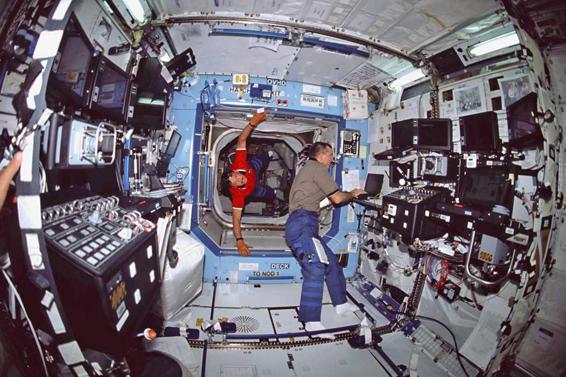
Or you could be an astronaut in the International Space Station (see Figure 12-1). The Space Station orbits the Earth at an altitude of 386 kilometers (240 miles). The Earth’s diameter is about 12,000 km (7,500 mi), which means the Space Station is essentially just skimming the surface. The astronauts are in the gravitational field of the Earth. At their altitude, the strength of the field is about 88 percent of the strength on the ground. Why don’t they weigh 88 percent of what they weigh on the ground? Why are they weightless?
Because they are falling. Just like the moon is falling toward the Earth.
|
Figure 12-1: The astronauts on the International Space Station are weightless. |
|
Courtesy NASA
Launching your own satellite
I discuss the idea of the moon falling while in orbit in Chapter 4, when I describe Newton’s discovery of his universal law of gravitation. Newton realized that the moon is falling toward the Earth, attracted to it by the Earth’s gravity. In his Principia, Newton’s monumental book on his work, he illustrated with a thought experiment the idea of the moon falling and never actually hitting the Earth.

In a similar thought experiment, imagine that you are atop Mount Everest and decide to throw stones horizontally to see where they fall. The faster you throw them, the farther out they fall. If you had the strength, you could throw one that would hit the ground at the foot of the mountain. If you were stronger still, you could throw one that would land near Bhimsen Tower in Kathmandu, Nepal. If you had superpowers, you could throw stones farther out still, hitting the Indian Ocean and even beyond (see Figure 12-2).
Eventually, if you kept increasing the speed, you’d throw one that would go all the way around the Earth and (unless you ducked) hit you in the back of the head. The stone would begin to fall the moment you threw it, bending down toward the ground, but it would be going so fast that it would run out of time and not have a chance to hit the Earth. At that point, you would’ve launched your own satellite into orbit. Your satellite would keep orbiting the Earth, constantly falling but never hitting it.
Of course, you can’t really launch a satellite by throwing a stone, because air drag will slow the stone down. However, this is the process that NASA used to launch the International Space Station into orbit. But NASA launched it 386 kilometers above the ground, where there is no atmosphere.
|
Figure 12-2: Throwing stones from the peak of Mount Everest. |
|
Linking Acceleration in Space and on Earth
Today, we can easily visualize what it means to experience weightlessness. We see footage on TV of astronauts floating in the Space Shuttle or the Space Station, and we can imagine how that sensation relates to the sensation of falling off a roof. But picturing weightlessness wasn’t as easy 100 years ago, when Einstein had his happiest thought.

Astronaut training
NASA’s Reduced Gravity Research program uses a C-9 airplane that flies to an altitude of 33,000 feet and nosedives to 24,000 feet in 25 seconds. During those 25 seconds, the plane and its passengers are in freefall and feel no gravity. They are in 0 g. After this fall, the plane curves up, increasing the acceleration to one-sixth g (lunar gravity) for 40 seconds and one-third g (Martian gravity) for 30 seconds, before returning to level flight and 1 g. NASA uses the airplane for tests and for astronaut training.
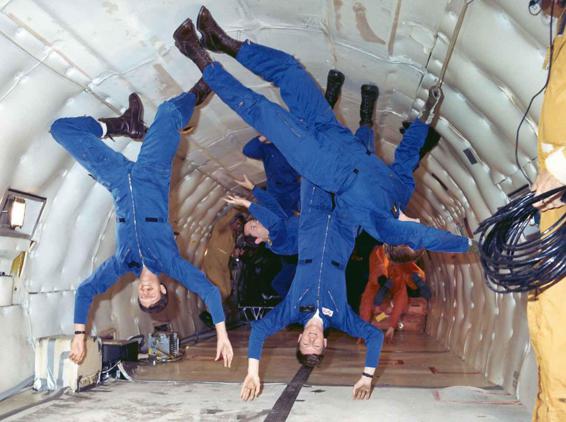

Courtesy NASA
In the Annual Review article, Einstein used a thought experiment — one of his favorite methods — to show how he was thinking about the extension of relativity to include accelerated motion.
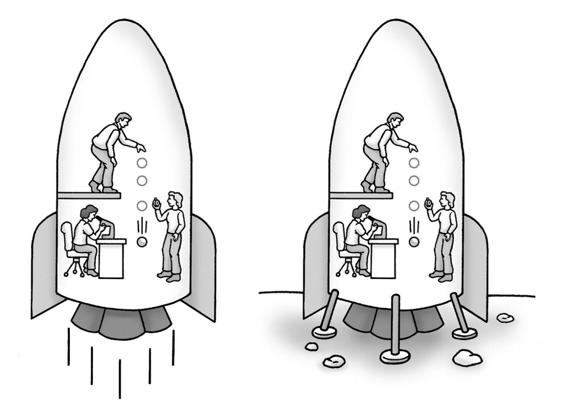
Imagine a laboratory in space. However, unlike the International Space Station labs, this lab is in a spaceship traveling far from the solar system or from any other star. The spaceship is accelerating at 1 g (which is equivalent to the force of gravity on Earth). The scientists in the laboratory feel the sensation of weight, as if they were back on the ground on Earth.
One of the scientists is holding a ball in her hands. If she lets go of it, the ball becomes a free object, not being pushed by the accelerating ship (see the left side of Figure 12-3). Because the spaceship continues accelerating, the “floor” of the spaceship rushes up to meet the ball. From the point of view of the scientists, the ball “falls” to the ground at 1 g. The scientists decide to perform more sophisticated experiments to measure their acceleration with accuracy, and they conclude that they are accelerating exactly at 1 g.
The scientists go back to the research projects that they’ve been working on and spend several weeks inside their lab and in their quarters, none of which has portholes. Some time later, they decide to check the ship’s acceleration again. When they drop the ball, it falls to the ground at exactly 1 g. (Or the spaceship runs up at 1 g to meet the free ball.) All the other experiments, with accurate measuring devices, tell them that they are still accelerating at 1 g.
|
Figure 12-3: (Left) Scientists in a laboratory inside an accelerating spaceship on an interstellar voyage. (Right) After the ship lands back on Earth. |
|
Soon, however, the scientists look outside, and they are surprised to find that the spaceship actually landed back on Earth while they slept and is on the ground (see the right side of Figure 12-3). The acceleration that they measured for the ship was actually the acceleration due to Earth’s gravity.
Equating gravity with accelerated motion

In his Annual Review paper, Einstein explained with his thought experiment that it is impossible to distinguish a constant acceleration from the effects of gravity. He called this idea the principle of equivalence, because it showed the equivalence between acceleration and gravity.
According to Einstein, gravity is relative. Gravity exists only while the acceleration exists. When the scientist lets go of the ball in the accelerating spaceship, the ball is free and no longer accelerates. The ball is in uniform motion, and the ship accelerates toward it. The scientists feel the ship’s acceleration. If one of the astronauts jumps off the ship, he’ll be free of the ship’s acceleration and will feel no acceleration. He won’t feel any motion, either, because motion without acceleration (uniform motion) cannot be identified.
The same principle is true when the ship is back on Earth. When the astronaut drops the ball, it feels no acceleration. Because the ball’s acceleration is the one due to the gravitational attraction of the Earth, the ball feels no gravity. The ball that the astronaut released from her hand is now floating in space, like the Shuttle astronauts. It’s the ground, the Earth, that rushes up to meet the ball and collide with it.
How can that be? The Earth is in complete synchrony with the other planets, rotating along with its moon around the sun following a precise orbit. The Earth can’t move up to collide with the floating ball. It would have to take the entire solar system along with it.
That’s exactly what Einstein says really happens. If you dive off a spring board, you’ll be weightless, floating in space, while the Earth and the entire solar system accelerate in your direction. You are not accelerating. The Earth is. You feel no gravity because for you, there isn’t any gravity.
According to Einstein, gravity is equivalent to accelerated motion. The astronauts on the accelerating spaceship away from the solar system feel real gravity — not a simulation of gravity, but the real thing. And the astronaut who jumps off the ship and sees it accelerate away from him is in the same situation as you when you jump off the diving board and see the Earth accelerate in your direction.
Here’s Einstein’s principle of equivalence:
Gravity is equivalent to accelerated motion. It is not possible to distinguish a constant acceleration from the effects of gravity.
Measuring gravitational mass
When an astronaut in orbit on the Space Shuttle gently lets go of the computer he is working with, both the computer and the astronaut continue orbiting the Earth with the same orbital speed. The computer doesn’t get ahead of or stay behind the astronaut. The computer and the astronaut are floating inside the Shuttle as it moves in its orbit.
The Earth pulls on the astronaut with just enough force to keep him in orbit, and it pulls on the laptop computer with a smaller force (because it has a smaller mass) to keep it in the same orbit as the astronaut. It always pulls in exactly the right proportion to keep both moving together.
Galileo Galilei was the first person to notice this effect. He said that all objects, regardless of their mass, when dropped at the same time and from the same height, hit the ground together. The reason why we see a stone fall faster than a piece of paper is because of air drag. Take the air out, and they fall together. The Earth pulls on the rock and the sheet of paper with the right force to bring them down simultaneously.
In Chapter 11, I explain that inertial mass is the measure of the resistance that you feel when you try to move an object. But mass is also related to weight — the gravitational attraction that the Earth wields on an object. This mass is called the gravitational mass.What Galileo discovered is that the gravitational mass is the same as the inertial mass.

In 1922, the Hungarian Baron Roland von Eötvös set up a delicate experiment to show that the Earth pulls on different objects in exactly the right proportions to their inertial masses. In other words, his experiment showed that the gravitational mass and the inertial mass are the same. In the 1960s, Robert Dicke at Princeton University did similar experiments and showed that the two masses are the same within one part in a hundred billion.
Like Galileo, Einstein also believed that the gravitational and inertial masses are the same. Einstein didn’t perform any lab experiments to show that this is the case. Instead, he performed one of his famous thought experiments.
Einstein used an elevator for his thought experiment, but I return to the spaceship in interstellar space for my explanation. Suppose that one of the scientists on board lets go of several objects of different masses at the same time. These objects stop accelerating and become free. The spaceship continues accelerating, and soon the floor of the lab catches up with the free objects, hitting them all at the same time.
From the point of view of the scientists, the objects all fall to the ground at the same time. Because there is no difference between the effects of the ship’s acceleration and the effects of the Earth’s gravity, when the scientists perform the same simple experiment back on the ground, they see that all the objects fall together. What does this mean? Gravitational and inertial mass are the same.
With his principle of equivalence, Einstein made Galileo’s observation the foundation of his new extended theory, the general theory of relativity. Another way to state Einstein’s principle of equivalence is by saying that
The gravitational mass and the inertial mass are the same, and no experiment can ever distinguish one from the other.
The Earth knows what to do
Because all objects fall to the ground with the same acceleration, the force with which the Earth pulls on objects of different masses must be different. The gravitational force of the Earth acts in exactly the right proportions on objects of different masses. If the mass is doubled, the gravitational force doubles. Because the inertial mass doubles, the resistance to this double gravitational force also doubles, producing the same acceleration as before.
How does the Earth know what force to apply? Take two rocks, one with twice the mass of the other, and imagine dividing them into many small pieces, the size of sugar cubes. The Earth pulls on all the cubes with the same force. When you put together the cubes that belong to the smaller rock, the Earth pulls all the cubes. The same goes for the larger rock, but the larger rock has twice as many cubes, so the total force on this rock is twice as large.
Bending light
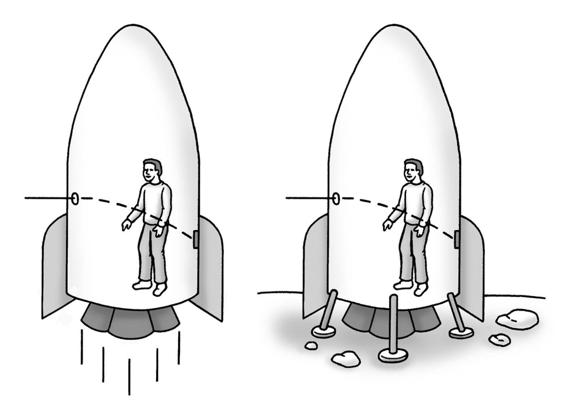
Imagine now that one of the labs in the interstellar spaceship is an optics lab that has a very small window in one of the walls. A light beam comes in through the hole, crosses the lab, and shines on the opposite wall (see Figure 12-4). Because the spaceship continues accelerating at 1 g, the ship speeds up while the light beam is still crossing the lab. The scientists take very precise measurements of the light beam while it crosses the lab and see that, because of their accelerated motion, the path of the beam appears bent toward the floor.
|
Figure 12-4: A light beam appears bent to the scientists in the accelerating spaceship. |
|
Einstein’s principle of equivalence says that gravity and accelerated motion are equivalent — you can’t distinguish one from the other. When the spaceship is back on the ground on Earth, the scientists should measure the same bending of the light beam, this time due to the Earth’s gravity. If Einstein followed his principle of equivalence to the letter, gravity should bend light.
Einstein stuck to his principle and predicted that this bending of the light could eventually be measured. He pointed out that this phenomenon was a direct consequence of the mass-energy equivalence of his E = mc2. In 1907, Einstein didn’t have a way to calculate what this bending of light by a gravitational field would be, but he knew that the effect was small.
Taking a Quantum Break
Einstein discovered his principle of equivalence in 1907 and discussed its implications in his Annual Review article that same year. From December of 1907 (when the Annual Review article was published) until June of 1911, Einstein let his great discovery lie dormant. He went back to work on the development of the ideas that led to quantum physics.
It’s puzzling to think about this three-year interruption in Einstein’s work on relativity. With the introduction of E = mc2, his beautiful special theory was complete. But he also realized that his special theory was limited and wanted to extend it. He came up with his principle of equivalence, which gave him the key to the puzzle, his happiest thought. “It impelled me toward a theory of gravitation,” he said later.
Yet, he stopped working on relativity for three years while he worked on the quantum physics papers.
When he came back to the relativity theory, however, it became an obsession. It took him four years to get it right. At the end, it became what most physicists consider the most elegant physics theory ever developed.
Trying to Extend the Theory of Relativity
In 1911, when Einstein finally returned to the problem of extending relativity, he had moved from the University of Zurich to the Karl-Ferdinand University in Prague. Einstein liked his new position and his nice office. However, he was seen as a big celebrity, which made him uncomfortable. He had more time for research at this point, and he went back to his principle of equivalence and the extension of relativity to include accelerated motion. His prediction about the bending of light by gravity led him to discover that he couldn’t use the familiar Euclidian geometry (the kind we all learn in school). He needed a different geometry, one that would describe a curved spacetime.
To find a different geometry, Einstein needed to expand his knowledge of mathematics. He went downstairs to the Mathematics Institute to talk to the experts there. However, he soon got the support he needed in advanced math — in an unexpected way.
Going back to Zurich
In the summer of 1911, Einstein traveled briefly to Zurich and met with his old friend Marcel Grossmann, who was the dean of math and physics at the Polytechnic, their alma mater. Grossmann wanted to lure Einstein to the Polytechnic, and Einstein was interested in considering an offer.
At the time, Einstein was receiving offers from several prestigious universities. One of the first came from Hendrik Lorentz at the University of Utrecht, and later he also heard from the University of Leyden, the University of Vienna, and Columbia University. But Einstein’s heart was still with the Polytechnic.
After receiving strong recommendations from French mathematician Jules Henri Poincaré and famous scientist Marie Curie, the Swiss Federal Department of Interior made Einstein an offer on January 31, 1912, for a ten-year appointment at the Polytechnic. Einstein accepted and was elated. He and his family moved back to Zurich in August.
Collaborating with an old friend
Soon after arriving in Zurich, Einstein realized that the correct geometry to use in his extension of relativity was one called Riemannian geometry. This geometry, developed by the German mathematician Behrhard Riemann in 1854, works on curved surfaces rather than on planes, like Euclidian geometry. One specific example of these curved surfaces is the surface of a sphere. To be able to work with Riemannian geometry, Einstein had to write his equations to describe motion on curved spaces rather than on flat spaces.
Einstein knew that he had his work cut out for him. In October of 1912, he wrote to the physicist Arnold Sommerfeld that he was working exclusively on the extension to the special theory and that he had never worked so hard in his life. He also said that compared to this problem, special relativity was child’s play.
At about this time, Einstein asked Grossmann to help him with the complicated mathematics. Grossmann had a doctorate in math and had been a professor for several years. He was a year older than Einstein and had been his trusted friend and classmate in college. His beautifully organized class notes had served Einstein very well in studying for his exams.
Grossmann was happy to collaborate with Einstein. He warned him, however, that he wasn’t going to take responsibility for any of the physics. That, of course, was going to be Einstein’s job.
The following three years were the most challenging of Einstein’s life. At the end, Einstein had a new theory of gravity that replaced and contained Newton’s. He called it the general theory of relativity. Today, scientists agree that this beautiful theory is not only Einstein’s masterpiece; it’s also the most perfect theory ever proposed in physics and, some even think, in all of science.
Meeting a friend in the fourth dimension
Let’s backtrack for a moment: In 1907, the year that Einstein came up with his principle of equivalence, his former math college professor, Hermann Minkowski, developed an elegant and powerful formulation of the special theory of relativity in four dimensions: the three dimensions of space and one of time.
At first, Einstein found the formulation a bit pedantic and unnecessary, but when he later looked into it in more detail, he came to like it. He ended up using it in the development of his general theory.
The basic idea of a four-dimensional spacetime is not that difficult to visualize. In fact, you use it all the time. Suppose that you’ve agreed to have dinner with a friend on Friday, July 29th, at 7 p.m. at a restaurant downtown. The restaurant is on the 44th floor of the Central Bank building at the corner of Main and 7th Street.
For you and your friend to meet at this restaurant on Friday, you’d need to agree on four numbers: the three that describe the special location of the restaurant (Main Street, 7th Street, and 44th floor), and a fourth one for the time. If you show up on Thursday the 28th at 8 p.m., you won’t find your friend there.
In Newton’s mechanics, the three numbers that describe a location in space are usually kept separate from the number describing the time. In practical terms, there’s no need to lump these four numbers together all the time. If you need to find your parked car after you’ve had dinner with your friend, you can wait until dinner is over, take the elevator down, walk to 8th and Riverside where you left it, and find it there.
But there is a need for using all four dimensions at once in special relativity, because space and time are interlocked. If your friend is traveling at a good fraction of the speed of light relative to you, next Friday for her may be in February of 2027 for you.
Treating space and time the same
The general theory is highly mathematical. Like Einstein’s special theory, the general theory is also based on two principles. The first one is the principle of equivalence, which states that gravity and acceleration are equivalent and that you can’t distinguish between the two.
The second principle assures that space and time are treated the same. If you and your relativistic dinner date arrive at the restaurant at the same time, it doesn’t matter that she was traveling at near the speed of light to get there and that she will not have aged as much as you. From your perspective, while your friend was traveling, her space was shortened and her time lengthened (meaning time flowed at a slower rate). But from her perspective, your space and your time changed.
Because your friend was much farther away from the restaurant, she had to move at near the speed of light to get there at the same time as you. But you were closer, and you didn’t have to move as fast. Special relativity tells you that your space doesn’t change as much as your friend’s, but your time changes more. Your space and your time change differently from hers, but both change so that you meet at the same place and at the same time. Your spacetime and her spacetime are the same.
However complicated the equations that describe both of your motions are, when you are at the restaurant, your location in spacetime is the same. For Einstein, these equations are there to label the details of the motion. In the end, physics is about the events that coincide in space and time.
Describing the coincidence of an event
In searching for the right mathematical description of spacetime, Einstein found that of the many possible sets of equations, the right ones are the ones that describe the coincidence of the event: the ones that correctly put you both at the restaurant at the same time. He called that his principle of covariance, and it reads as follows:
Physics is described by equations that put all spacetime coordinates on an equal footing.
With his two principles in place, Einstein developed his general theory of relativity. After four years of extremely intense work, with many wrong leads and dead ends, Einstein finally succeeded. The final theory is highly mathematical and its details are difficult to understand, even today. The implications are revolutionary.
Creating a New System of the World
Einstein published his final version of the theory early in 1916 in the Annalen der Physik, the same prestigious journal where he’d published his special theory of relativity, his E = mc 2, and all the other major papers. He titled his new paper “The Formulation of the General Theory of Relativity.”
His paper starts with the statement that all the laws of physics must be valid in any reference frame in any kind of motion. No longer is relativity restricted to uniform motion; accelerated motion is now included. In making that statement, Einstein created a theory of gravity, a system of the world, with a set of basic equations that, when solved, provides the rules that the universe follows.
In the next sections, I show you several important implications that came out of his theory.
Envisioning warped spacetime
In general relativity, an object stretches the spacetime around it, which affects the motion of any other body that enters this spacetime. Einstein had actually thought about this possibility back in 1907, when he developed his principle of equivalence. But he needed the complicated math that Marcel Grossmann was helping with for the full development of a theory of gravity.
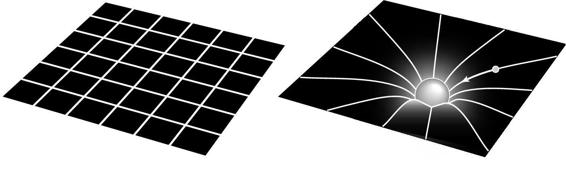
Although this stretching of spacetime takes place in four dimensions, here’s how it works in two. Imagine a flexible plastic sheet stretched out from all four edges and held in place by some clamps, like the one in Figure 12-5. This is our four-dimensional spacetime in two dimensions. Now place a billiard ball somewhere in the middle of the sheet. The weight of the ball stretches the plastic and makes a dip. If you place a marble on the plastic sheet, it rolls toward the billiard ball. If you push the marble sideways, it curves around the dip and spirals down until it hits the billiard ball.
|
Figure 12-5: Envisioning spacetime in two dimensions. |
|
The billiard ball isn’t pulling the marble in. The marble rolls toward the billiard ball because of the dip in the plastic sheet, the distortion in its space. Similarly, the sun creates a dip in the fabric of spacetime. The Earth and all the other planets and comets in the solar system move in this distorted spacetime. It’s not that the sun attracts the Earth to it; the dip that the sun creates in spacetime makes the Earth move around it. The sun changes the geometry of spacetime.
In general relativity, there is no gravitational force. Gravity is geometry.
Measuring the deflection of light
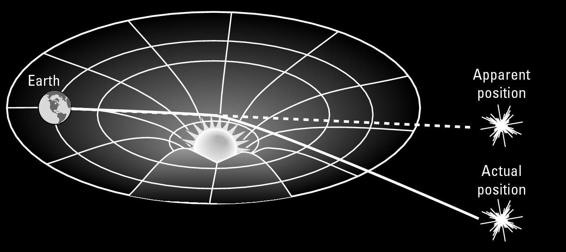
Consider how light travels in curved spacetime. When light passes near the sun, where the spacetime has been curved, the light ray gets deflected (see Figure 12-6). Einstein proposed this idea in 1907, but at the time he didn’t have the equations that would give him the value of this deflection. In 1911, he had the equations, although they weren’t quite correct yet.
|
Figure 12-6: Light from a star is deflected as it passes near the sun, where spacetime is curved. |
|
Einstein knew that the effect of curved spacetime on light is very small and difficult to detect. You need a massive body, like the sun, to cause any appreciable deflection of light. Einstein calculated that a light beam from a star grazing the sun would be deflected by a tiny angle, about the size of a penny seen 21/2 kilometers (11/2 miles) away. The size of that angle could be easily measured — if you could see the star in plain daylight, right next to the sun, that is.
Luckily for Einstein, you can see exactly that — during a solar eclipse.
Going to war for the wrong values
In 1914, the German astronomer Erwin Finley-Freundlich organized an expedition to Russia to check Einstein’s prediction of the bending of light during a solar eclipse that was going to be visible there. The expedition ended with the astronomers caught in the middle of the war. They were captured as prisoners of war, and although they were released a few weeks later, their equipment was confiscated. They weren’t able to make any observations to check Einstein’s prediction.
Although the astronomers would surely disagree, this turn of events was just as well for Einstein, because the results wouldn’t have confirmed his predictions. In 1911, when Einstein first calculated the value for the deflection of starlight by the sun, he was not quite right. He hadn’t yet found the right equations, and his calculations gave the wrong value.
Taking pictures from an expedition
After he published his final version of the general theory in 1916, Einstein once again calculated the value of light’s deflection as it passes the sun. In 1919, the respected British astronomer Arthur Eddington organized a second expedition, this time to the island of Principe in West Africa, to check Einstein’s prediction and the new value.
For the 19 days prior to the eclipse, no rain fell in Principe. But the day of the eclipse, the sky was cloudy. When the eclipse began, no stars could be seen; only the disc of the moon could be seen through the clouds. Eddington and his assistant took photographs anyway. They knew they would have only five minutes and two seconds to succeed at their mission. As soon as the disc of the sun began to peek from behind the moon, it would be over. The sky would be too bright to see any stars.
For brief moments, a few stars could be seen through the clouds. Of the 16 photographs that Eddington and his assistant took, 5 showed stars. That was enough. Back in England, Eddington took careful measurements and made his calculations. The results showed that light from the stars had been deflected by exactly the amount that Einstein had calculated from his equations.
Einstein was right. The sun distorted the spacetime around it, deflecting light from its straight path toward the Earth.
Explaining the orbit of Mercury
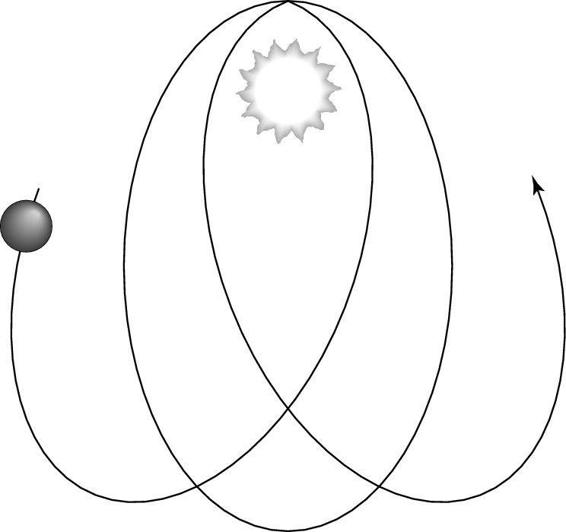
Among the calculations that Einstein performed to make sure that he had the right equations for his theory were some related to the orbit of Mercury. Sixty years earlier, the French astronomer Urbain Jean Joseph Le Verrier had discovered that the orbit of Mercury didn’t close into an ellipse, like Johannes Kepler’s laws said it should (see Chapter 4). All the other planets obeyed Kepler’s laws. Not Mercury. Its orbit was open and moved around, like a spinning top (see Figure 12-7).
|
Figure 12-7: The orbit of Mercury isn’t closed, like all the other planets. |
|
Mercury is a small planet that orbits closer to the sun than any others, and it has a very elongated orbit. It is surrounded by Venus, the Earth, and Mars. These planets pull on Mercury from different directions, modifying its orbit. Even Jupiter, which is farther away, causes a slight change in Mercury’s orbit (because of its size).
Le Verrier took into account all the modifications to Mercury’s orbit that could be caused by the pull of all these planets and came up short. The shortage was a very small amount, just 43 seconds of arc (there are 3,600 seconds of arc in 1 degree). The modern value of the shortage ranges from 42.91 to 43.33; astronomers give a range rather than a single value, to account for the small errors in the measurements.
For many years, astronomers thought that another undiscovered planet was the cause of this difference, and they began to look for it. They even gave the planet a name: Vulcan. And soon someone claimed to have found it. But when other astronomers went looking for it, Vulcan wasn’t really there. Eventually, astronomers realized that there weren’t any other undiscovered planets near the sun.
When Einstein published his general theory, this problem of the orbit of Mercury hadn’t been solved. No one understood its behavior; it didn’t fit with Newtonian physics. Einstein thought that the orbit of Mercury was a good test for his theory. He calculated the impact that the warp of spacetime near the sun would have on Mercury’s orbit. His equations gave him a value of 42.98 seconds of arc, precisely what the astronomers had measured.
Einstein said that after that calculation, he was “beside himself with excitement” for a few days. Einstein’s new theory had passed the first test. As a bonus, it finally explained a long unresolved problem in astronomy.
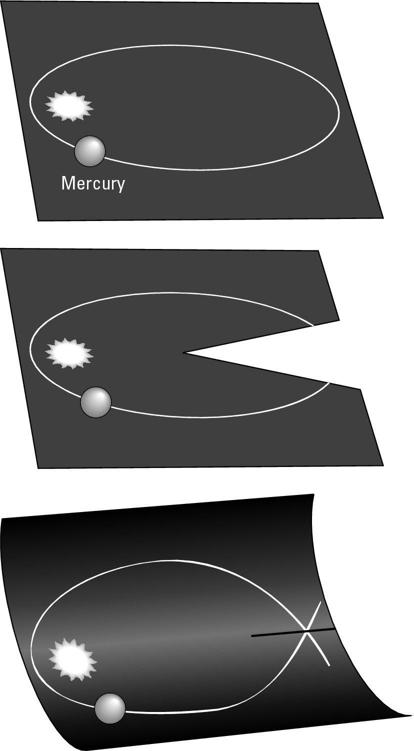
Einstein’s general theory of relativity explained why Mercury’s orbit behaves how it does. In Newtonian mechanics, space is flat and the planets orbit the sun in elliptical orbits (see Chapter 4). In general relativity, spacetime is curved, and when you fit this elliptical orbit into this curved space, the orbit becomes deformed and the planet doesn’t move along the same path every time.
Imagine that flat Newtonian space is a flat sheet. You can draw a closed ellipse on this sheet where the planet is supposed to move, according the Kepler’s laws (see the top of Figure 12-8).
Next, cut a small wedge out of the paper and rejoin the edges, as shown in the middle and bottom illustrations of Figure 12-8. You now have a curved sheet. Your ellipse is deformed and open, and the planet is moving along a slightly shifted ellipse.
|
Figure 12-8: The orbit of Mercury in flat, Newtonian space and in curved spacetime. |
|
Aging more slowly
As I explain in Chapter 10, according to the theory of special relativity, if you’re moving relative to me, from my perspective, your time flows more slowly. If you’re moving at a speed close to the speed of light for four years according to your clock and your calendar, it could be ten years according to my clock and calendar. Time flows more slowly in the moving frame.
However, the moving frame depends on who is observing. From your perspective, I am moving at a speed close to the speed of light, and you measure my time as flowing more slowly.
Speeding clocks
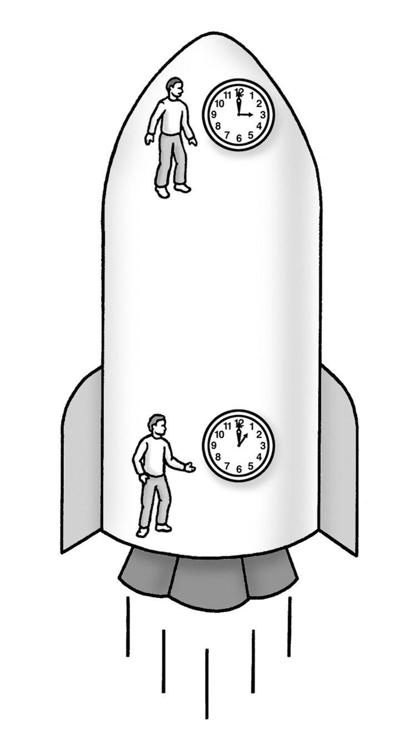
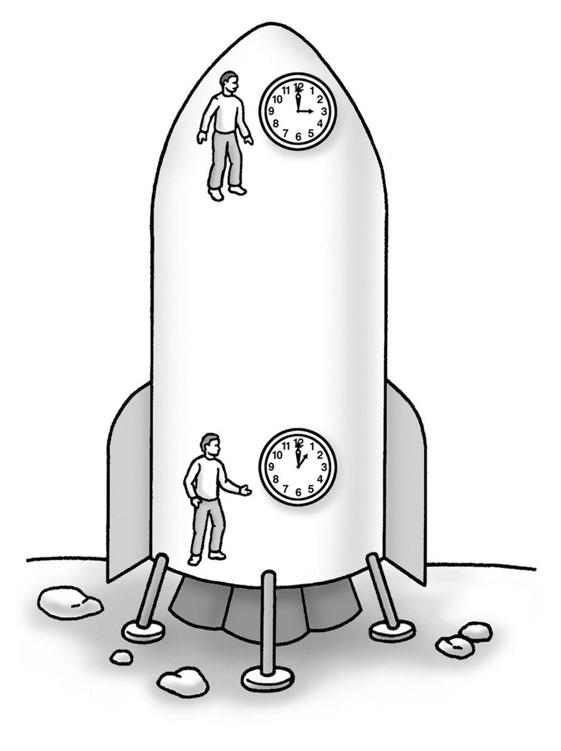
According to general relativity, time runs more slowly in an accelerating frame. Imagine that you’re in a laboratory on board an accelerating spaceship. Your fellow scientists have placed two clocks far apart in the spaceship. One is near the nose of the ship, and the other one is near the back (see Figure 12-9). They use an electromagnetic signal to compare the two clocks.
These clocks are atomic clocks that keep very precise time by counting the oscillations of light emitted by a cesium atom. The group of scientists by the clock near the front of the ship can also detect the light emitted by the clock at the back of the ship and are able to see the time that it registers. However, by the time the signal gets to them, they’ve moved (by a tiny distance) away from where they were when the signal was emitted.
|
Figure 12-9: Comparing clocks in the accelerating laboratory. |
|
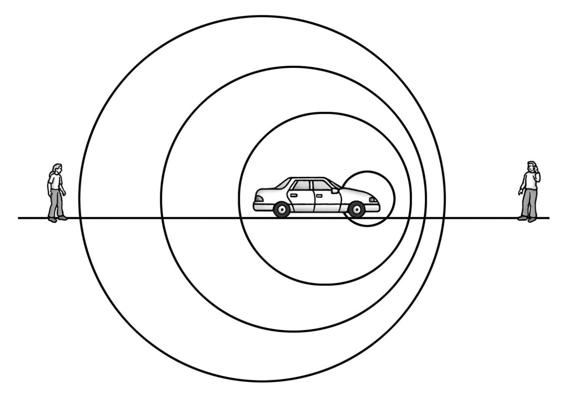
The signal from the back — when detected by the group at the front — changes because of the group’s motion. This phenomenon is due to the Doppler effect, the same principle behind the Doppler radar used by your local television station to track the weather.
You experience the Doppler effect in highway traffic when you hear the drop in pitch from a car horn as it speeds past you. The pitch doesn’t change for the driver, but it changes for you. The reason for the change in pitch is that the wave fronts get pushed closer together when the car blowing the horn is coming at you, and they get spread out more when it moves away from you (see Figure 12-10). The compressed wave fronts have a higher pitch, and the stretched waves have a lower pitch.
It’s similar for the clocks in the spaceship. The signal that the group at the front receives is “Doppler-shifted” to stretched waves because these scientists are moving away. Their detector counts fewer of these stretched waves per second, and the scientists conclude that the clock in the back of the ship runs more slowly than the clock at the front.
To confirm, the group of scientists at the back of the ship detects the light from the front clock. Because this group is accelerating toward the place where the signal was emitted, they detect a compressed wave, and their detector counts more of these waves per second. For them, the clock at the front runs faster than theirs. The two groups are in agreement about the clocks.
|
Figure 12-10: The Doppler effect, or change in the wavelengths, of the moving signal. |
|
Gravity slows time
According to Einstein’s principle of equivalence, there isn’t any difference between gravity and accelerated motion. When the spaceship lands on Earth, the clocks must behave in the same way.
When the spaceships lands, the clock in the back runs more slowly than the clock at the front (see Figure 12-11). The clock in the back is closer to the surface of the Earth, where gravity is slightly stronger. The clock at front of the ship is farther away, and gravity is slightly weaker. This phenomenon was one of Einstein’s first predictions. We can state it as follows:
In a gravitational field, time runs more slowly.
Einstein’s prediction has been tested successfully many times. The first direct test was done in 1960 in the physics building at Harvard University. For the 24-meter (79-foot) tall tower, the difference in the clocks was extremely small — only one in a quadrillion (1 followed by 15 zeros). But it’s a real difference, nonetheless.
|
Figure 12-11: The clock at the back of the ship runs more slowly than the one at the front. |
|
The younger traveler
General relativity alleviates the apparent confusion regarding how a space traveler ages compared to the people who stay behind.
According to the theory of special relativity, time runs more slowly in the moving frame. If you take off in a spaceship and accelerate to 0.9c relative to the Earth and I stay behind, I measure your time as running more slowly. Because motion is relative, you could say that I am the one moving, along with the Earth and the whole solar system, at 0.9c away from you. For you, my time runs more slowly.
However, when you return ten Earth years later, only one of us is younger than expected: you.
Einstein’s general theory of relativity provides the explanation. To reach 0.9c, you need to accelerate, continue at that speed for some time, then decelerate to a stop, turn around, accelerate back to 0.9c, head back, and finally slow down and stop to land back on Earth. While accelerating, your clock runs more slowly than mine, because I am not accelerating. Granted, I am on the Earth, which has gravity (which is equivalent to acceleration). But your acceleration must be much larger than Earth’s acceleration of gravity for you to reach 0.9c twice in the four years that your trip lasts for you.
When you return ten Earth years later, you’ll be six years younger than you would’ve been if you never left Earth.
Becoming a Mainstream Celebrity
Arthur Eddington’s results from his expedition to Principe became headline news in most major newspapers in Europe and the United States. The New York Times ran an article under the headline: “Revolution in Science. New Theory of the Universe. Newtonian Ideas Overthrown.” European newspapers soon recruited renowned scientists to write articles explaining Einstein’s theories to their readers. In Germany, the Frankfurter Zeitung asked the physicist Max Born for an article. The London Times asked Einstein himself to write an account in simple language for its readers.
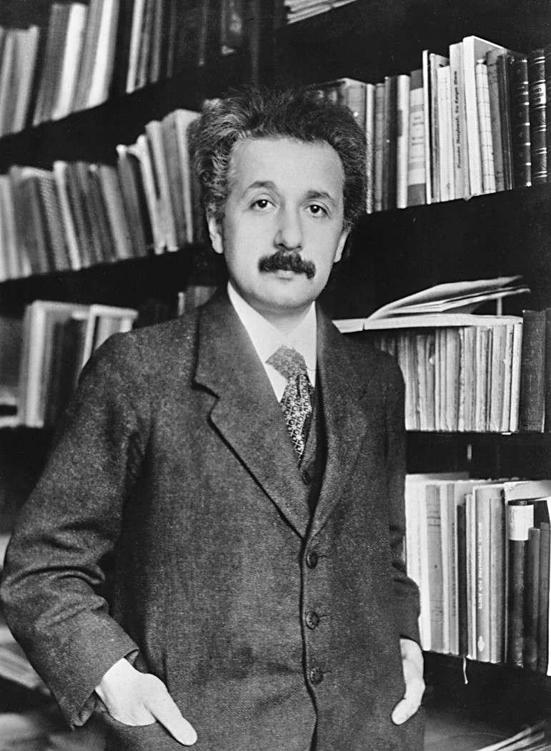
On December 14, 1919, the Berliner Illustrirte Zeitung carried a photo of Einstein on its front page, along with the caption “A New Giant in World History: Albert Einstein, whose researches mean a complete overthrow of our views of nature, and which rank as equal with the discoveries of Copernicus, Kepler, and Newton.” Einstein was suddenly famous all over the world (see Figure 12-12).
|
Figure 12-12: Einstein, shown here in 1916, became world famous because of the general theory. |
|
Some of the predictions of general relativity have been corroborated experimentally. A few others are still waiting for technology to catch up with the theory so that they can be measured. In Chapter 14, I show you what’s been confirmed so far.
Courtesy NASA