Part II

In this part . . .
To appreciate Einstein’s greatness, you need to understand the state of physics at the time he developed his revolutionary theories. This part offers an overview of what Einstein learned from his college professors and from his own studies.
The science that Einstein learned in school began with the ancient Greeks’ ideas about the universe. But most of the Greek thinkers weren’t scientists; they were philosophers. Some of their ideas were crucial to the development of modern physics, but they didn’t have the means to conduct experiments to test an idea’s merit.
Galileo Galilei was actually the first scientist; in the late 16th century, he invented the method that today’s scientists still use (more or less). In this part, I show you what Galileo did and how Isaac Newton was able to expand Galileo’s ideas into the first complete view of the universe. Newton’s theory explains how the planets move around the sun and how a cannonball flies across a field. It includes the laws that objects in motion follow.
Not long before Einstein’s time, James Clerk Maxwell developed his theory of electrical and magnetic effects — what he called electromagnetism. Maxwell’s theory not only explained the behavior of electricity and magnets but showed us how light behaves as well.
Galileo, Newton, and Maxwell all set the stage for Einstein’s great leaps forward. In this part, I show you how.
Chapter 4
In This Chapter
 Getting to know the first astronomers
Exploring Greek science
Understanding contributions from later astronomers
Creating the scientific method
Developing Newtonian physics
B y the time Einstein graduated from college, he had mastered the physics of his time. While in college, he took the standard rigorous program of study required for a physics major. But he also studied on his own, especially the new physics being developed at the time.
The physics that Einstein studied was based on the work of Galileo Galilei, Isaac Newton, James Clerk Maxwell, and many others. Their theories were in turn based on the advancement of science that started with the early civilizations. Einstein was familiar with the main ideas of science and used them as the basis of his own work.
In this chapter, I start at the beginning (almost) and look at the ideas of the ancient Greeks about matter, motion, and the universe that formed the foundation of the knowledge passed down to Einstein. I discuss Nicolaus Copernicus’s revolution and Johannes Kepler’s laws of planetary motion. I explain Galileo’s development of the scientific method. These ideas made possible Newton’s view of the universe “running like clockwork,” with which Einstein was fully familiar. And finally, I show you how all these ideas set the stage for Einstein to turn Newton’s clockwork universe into the “space and time are in the eye of the beholder” universe we know today.
Introducing the First Astronomers
In 1900, when Einstein graduated from the Polytechnic, physics was based on the work of Isaac Newton (mechanics) and James Clerk Maxwell (electromagnetism). But the ideas that led to the development of the science of physics had started with the ancient Greeks, 2,000 years earlier. What the Greeks discovered about matter, motion, and the universe formed the foundation of the scientific knowledge passed down to Einstein.
Inventing science
The ancient Greeks didn’t invent science. That honor belongs to the Babylonians, some 5,000 years ago. The Babylonians, who lived in the region occupied today by Iraq, started a study of the sky motivated by their need to know the best harvesting times.
The Babylonians made gods out of the sun, the moon, and the five visible planets: Mercury, Venus, Mars, Jupiter, and Saturn. Their worship drove the Babylonians to follow closely their motions across the sky. They used their knowledge of the paths of the sun and moon to set up a calendar. They also observed that the planets, unlike the sun and moon, did not follow simple paths across the sky; the planets stopped their eastward motion now and again, retracing part of their paths, then stopping once more before resuming their eastward motions.
Getting it right: The ancient Greeks
Some of the knowledge acquired by the Babylonians was passed on to the Greeks who, in turn, made amazing advances in their understanding of the world. Through the study of the heavens, the Greeks were able to start on the long path toward the development of the ideas of physics.
For example, in the sixth century B.C., Pythagoras came up with the idea that the Earth was spherical and located at the center of the universe. Aristotle developed Pythagoras’s view into a more complete theory, saying that the Earth was immovable and fixed at the center of the whirling heavens.
In the second century A.D., Claudius Ptolemy (who I discuss more in the section “Identifying ‘The Greatest’ patterns”) expanded Aristotle’s geocentric, or Earth-centered, model into an extremely complicated system that was accepted by nearly everybody for 18 centuries.

There were dissenters, like Aristarchus, who said that the sun was fixed at the center of the universe and that the Earth revolved around the sun in a circular orbit. He also said that the Earth rotated on its axis as it revolved and that this axis was inclined with respect to the plane of the orbit.
Aristarchus got it right. Today, we know that the sun is the center of our solar system, that Earth rotates around the sun and on its own axis, and that its axis is tilted.
Shifting their position, unfortunately
In spite of being correct, Aristarchus’s view of the universe didn’t prevail. The main reason was that the Earth seemed motionless. How could the Earth rotate around the sun if you couldn’t detect any motion? What’s more, if the Earth rotated around the sun, there should have been an apparent shift in the position of the stars as the Earth moved.
Consider an example closer to home. When you drive down a highway, the trees close to the road pass by quickly, while the ones far back seem to stay with you a little longer. (The moon, being much farther away than any trees, seems to move with you.) The shift in the position of the trees tells you that you are moving. With some measuring equipment, you could use the shift in position to figure out how far the trees are from you and how fast you are going. This apparent shift in position is called parallax.

At the time of the Greeks, nobody had yet observed or measured the apparent shift in the position of the stars relative to the Earth. As a result, the Greeks abandoned the sun-centered, or heliocentric, model of Aristarchus.
Aristarchus stayed with his theory, believing that he was correct. But the proof had to wait for western civilization to go through the long hiatus of the Dark and Middle Ages. We know today that the stars are so far away that none has a parallax that can be seen with the naked eye. During the Renaissance, instruments like the telescope were invented. By 1838, using a telescope, the German astronomer Friedrich Bessel was able to make the first observation of the parallax of a star.
Identifying “The Greatest” patterns
With the Earth appearing to be stationary in the middle of the universe, the ancient Greeks developed more sophisticated models to explain their astronomical observations. During the second century A.D., Claudius Ptolemy developed the definitive geocentric model, with the planets, the moon, and the sun moving about the Earth in circular orbits. The complicated motion of the planets in the sky required an elaborate model. (As we know today, this motion is the result of the combination of the Earth’s motion around the sun and the planets’ own motions.)
To explain the known planetary motions, Ptolemy had the planets moving in small circles that he called epicycles. The epicycles themselves moved around the Earth in circular orbits (see Figure 4-1). The combination of the motion of both these circles reproduced the observed pattern of the planets’ motion.
|
Figure 4-1: The original system of Ptolemy, with the planets moving in small circles and orbiting the Earth. |
|
The model grew in complication when newer and more accurate observations came in. Ptolemy added more circles that moved in circular orbits around other circles, with the planet moving on the last circle. He ended up with a system of 40 circles that reproduced very accurately the astronomical observations of his time.
Ptolemy published his model in The Mathematical Collection, a monumental work in 13 volumes. The Arabs took possession of Ptolemy’s work after it survived the destruction of the library of Alexandria. They saved it for posterity, calling it al Magiste, meaning “The Greatest” in Arabic.
During their long occupation of Spain, the Arabs introduced the book in Europe where, known as the Almagest, it was studied for more than 1,000 years.
Sowing the Seeds of Physics
Besides astronomy, the ancient Greeks made advances in what we now call physics. In the following sections, I present two key examples.
Discovering buoyancy
The ancient Greeks’ most important discoveries about physics were made by Archimedes, perhaps the greatest Greek scientist.
Born into a royal family in the third century B.C., Archimedes became a famous inventor, scientist, and mathematician. When the Romans laid siege to Syracuse, he invented machines that threw heavy stones at any Roman soldier attempting to climb up the walls. He also built powerful cranes that overturned the ships landing at the bottom of the cliffs around the city.
Archimedes didn’t think that his accomplishments on behalf of the war were worthy of publication and wrote only about his numerous scientific achievements. The most important, and the one for which we remember him today, is the discovery of the principle of buoyancy (also called Archimedes’ Principle). This principle says that a body submerged in water is buoyed up by a force equal to the weight of the water displaced by the object.
Imagining the atom
Living in the 21st century, we know that matter is made up of atoms. But 100 years ago, not even the physicists and chemists agreed that atoms existed. (The young Einstein began his scientific career with three important papers demonstrating that atoms existed.)
The development of our modern theories of matter began with John Dalton in the 19th century. However, the Greeks introduced the idea of the atom 23 centuries earlier. The Greek philosopher Democritus, who lived in the fifth century B.C., introduced the idea that all things are made up of small, indivisible particles called atoms, meaning “indivisible.” In his writings, he credited his teacher Leucippus with the idea. (However, it isn’t clear whether Leucippus really existed.)
According to Democritus, the atoms that make up matter have different sizes, masses, and even colors, and they combine to form all the substances that we see in the world. Democritus wasn’t really a scientist, but a philosopher. He didn’t know mathematics and couldn’t make any calculations to show how the atoms might combine to make the different substances. In addition, laboratory experimentation didn’t exist in ancient Greece. (That had to wait for Galileo to invent in the early 17th century.)
Without any mathematical model or laboratory measurements to show how viable atoms were, Democritus’s idea remained just that — an idea.
Battling with Mars: Later Astronomers
Not long after Ptolemy died in the year 170 A.D., most of what the Greeks had discovered began to be forgotten. Western civilization took a different path during the Dark and Middle Ages. The sciences and the arts did not again reach the Greek standard until the 17th century, during the Renaissance.
Committing heresy: Copernicus
The long road back to a rational world started in the 15th century with Nicolaus Copernicus. Along with many astronomers of his time, Copernicus became dissatisfied with Ptolemy’s model of the universe because it could not explain recent astronomical observations. Like Aristarchus 17 centuries before, Copernicus realized that astronomy could be more easily explained if the sun were at the center of the universe and the Earth rotated around it with all the other planets. He proceeded to build a new model of the universe with the sun at the center.
In the heliocentric model of Copernicus, the Earth, along with Venus, Mars, Jupiter, and Saturn, moved around the sun in circular orbits. After hearing of this model, Church authorities went ballistic. According to Church doctrine, the Earth had to be at the center of creation. Saying otherwise was heresy.
Scared, Copernicus decided not to publish anything on his theory. Many years later, when he was in his late 60s, some of his closest friends encouraged him to publish it. Copernicus gave in, and his book On Revolutions was published the day he died at age 70. (He did get to see his work in print: His publisher brought an advance copy to him a few days before his death.)
Discovering planetary laws: Kepler
Although Copernicus’s model was much simpler and more elegant than the Ptolemaic system, the Earth still seemed motionless. Like the ancient Greeks, Copernicus’s peers couldn’t detect the motion of the Earth against the background of the distant stars. As a result, the Copernican model wasn’t accepted.
A century later, during the early 1600s, a young and promising German astronomer by the name of Johannes Kepler joined the prestigious observatory of the Danish astronomer Tycho Brahe. (Scientists usually refer to Tycho Brahe by his first name; I follow that convention here.) Tycho’s observatory was the best in the world and held the most precise astronomical data.
Tycho asked Kepler to work with a new and large set of unexplained observations of the motion of the planet Mars. Tycho believed in the Ptolemaic system. Kepler, on the other hand, had been converted to the Copernican model by one of his professors at the University of Tübingen, where he graduated in 1588.
Kepler used the precise measurements of Mars that Tycho and his assistants had made to show that the orbit of Mars was not a circle but a stretched-out circle, or oval, called an ellipse.
You can draw an ellipse by loosely threading a string around two tacks placed side-by-side on a board (see Figure 4-2). If you move a pencil around the two tacks while you keep the string taut, you can draw the ellipse. The location of each tack is called a focusof the ellipse. Kepler discovered that for Mars, the sun is located at one of these foci. (Note that in Figure 4-2, the ellipse representing the orbit of Mars is exaggerated; its actual orbit is a bit more circular.)
|
Figure 4-2: (Left) Drawing an ellipse. (Right) The orbit of Mars. |
|
During the 16 years of his “battle with Mars,” as he called it, Kepler discovered that in this elliptical orbit, the planet would move faster when it was closer to the sun and move at a slower speed when it was farther from the sun. He also found that the line joining the planet to the sun swept out the same area with equal intervals of time.
Kepler realized that he was actually discovering something bigger than how Mars orbits the sun; he was identifying the laws of motion of all the planets. After many years of complicated and tedious calculations, he found a mathematical relationship between each planet’s own year or period (the time it takes for a planet to orbit the sun) and its distance to the sun.
With his discoveries, Kepler knew he had succeeded in discovering the planetary laws. He was immensely proud of his work, but especially so of the last law, called harmonic law, which identifies the relationship between the periods of revolution around the sun and the time that a planet is at a specific distance from the sun. He wrote a book describing this discovery, which he entitled Harmony of the World.
Here’s a quick overview of Kepler’s laws:
 Law of orbits: Each planet moves around the sun in an elliptical orbit, with the sun at one focus.
Law of areas: A planet moves around the sun so that the line from the sun to the planet sweeps out equal areas in equal intervals of time. Take a look at Figure 4-3 to see this in graphic form; the planet moves faster from 1 to 2 than from 3 to 4, so that the line joining it to the sun sweeps out the same area in both cases.
Harmonic law: The squares of the periods (or years) of any two planets are proportional to the cubes of their average distances from the sun.
|
Figure 4-3: Kepler’s law of areas. |
|
With the three laws in place, the motion of the moon and the planets became predictable. The universe followed these laws. People could now understand why Venus’s year was 225 days while a year on Mars was 687 days. These years or periods were known at the time, but no one had any idea why they were all different. Kepler demonstrated that the planets move around the sun in precise mathematical orbits and times, blindly following his laws.
Inventing Modern Science: Galileo
Kepler’s approach to science was very close to that of a modern scientist. He started with the data that had been taken by astronomers in Tycho Brahe’s observatory and used it to come up with a model. However, it was his contemporary, Galileo Galilei, who invented the methods followed by modern scientists.
Galileo was born in Pisa in 1564 to an old and distinguished Florentine family. He entered the University of Pisa at the age of 17 to study medicine, a career path he chose to please his father, who wanted his son to have a profession that would guarantee him financial security. Galileo switched to math and science after he started studying the work of Archimedes in one of his courses. (His father wasn’t particularly happy with the decision.)

Playing the lute
Like Einstein 300 years later, Galileo enjoyed music. His father, Vincenzio, inspired in him this love for music, teaching him to play the organ and the lute. This interest lasted throughout Galileo’s life. He often relaxed by playing the lute, an instrument that became his comfort later in life during his frustrating encounters with the Church.
Vincenzio also taught his son some music theory, introducing him to the musical ratios of the Pythagoreans. Pythagoras, in the sixth century B.C., had discovered that a set of strings vibrating together would produce a pleasant sound if their lengths, compared to the longest string, were in the ratio of one-half, one-third, one-fourth, and so on.

Using the tools at his disposal
A few years after graduating from university, Galileo started doing research in math and physics, giving papers at the Florentine Academy. His extraordinary abilities were soon noticed, and at the age of 26, he was offered a position as professor of mathematics at the University of Pisa.
Here, Galileo started his work in mechanics, clashing with Aristotle’s simple and clear ideas about motion. Aristotle had taught that everything fell into its natural place, and the natural place of everything was determined by what the thing was made of. For example:
A rock falls to the ground.
Fire falls upward.
A heavier rock, which contains more earth than a lighter one, falls to the ground faster because it has a greater tendency to fall to its natural place.
Things turned out to be even simpler than that, as Galileo proved. He published his work on mechanics in his book titled Discourses and Mathematical Demonstrations Concerning Two New Sciences Pertaining to Mechanics and Local Motion, which appeared in 1638. We know it today as The Two New Sciences.
Because Galileo was working in Pisa when he made his discoveries about the nature of motion and of falling bodies, it’s not far-fetched to think that he dropped objects from the famous Tower of Pisa to prove his ideas. But he didn’t. A stone falling to the ground from several floors high does so at a fairly high speed, so Galileo couldn’t time it. He didn’t have clocks that were accurate enough.
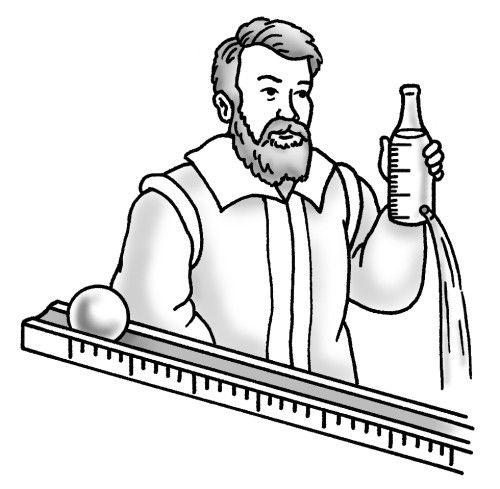
Galileo’s “clocks” were rudimentary: wine bottles filled with water that each had a hole in the bottom and marks to show the water level as it emptied through the hole (see Figure 4-4). His tools weren’t terrific, but Galileo was clever. He slowed down the motion of his falling bodies so that his clocks could time it. To slow down the motion, Galileo built a long, smooth, inclined track where he rolled down smooth wooden balls (see Figure 4-5).
|
Figure 4-4: Galileo’s wine bottle clock. |
|
|
Figure 4-5: Galileo with his inclined track. |
|
Creating the modern scientific method
Galileo performed hundreds of experiments on his inclined plane, changing the inclination of the plane and using balls of different masses. All the balls rolled down at the same time, regardless of mass. Using steeper and steeper angles, he was able to show that in the extreme case of vertical fall, which he couldn’t time, the balls should all fall to the ground at the same time, with the same acceleration. He is the first person in history to carefully set up experiments with the sole purpose of testing his theory of motion. He actually proved mathematically that all objects, regardless of mass, should accelerate to the ground with the same rate and, if dropped simultaneously, should hit the ground at the same time. With his experiments, he showed that his conclusions were correct.
With these experiments, Galileo created the modern scientific method. If you examine the way science is done today, you’ll find that scientists use the method invented by Galileo:
Modern scientists come up with theories or models of what they are observing in nature.
They draw some conclusions about the behavior of the phenomenon that they are studying.
Experiments are designed and performed to check the conclusions.
It sounds simple, but until Galileo came along, no one had thought of trying to explain the universe that way. His method made possible modern science.
Freeing his mind
Einstein used thought experiments (see Chapter 2) to seek answers to many of the questions that came up in the course of constructing his theories. Galileo invented the technique and also used it with great success.
One of Galileo’s thought experiments had to do with his inclined tracks. First, he put together two tracks in such a way as to make a letter V (see Figure 4-6). A ball rolling down one incline speeds up until it reaches the bottom and then starts rolling up the second track. As it goes up, the ball slows down until it finally stops, reaching a height slightly lower than its original position on the first track.
|
Figure 4-6: Galileo’s inclined tracks to study motion at a steady speed. |
|
Galileo then lowered the second incline but made it longer, so that the two ends of the more open V were leveled. This way, the ball had enough path to reach the same height as before. He kept lowering the incline while making it longer. Finally, when the second track was horizontal, the length had to extend an infinite length, because, in theory, the second ball should roll on, trying to reach the original height forever.
Galileo realized that, in reality, friction between the ball and the track slows the ball down and makes it stop. But he could do this experiment in his mind. In his thought experiment, he made the ball and the tracks perfectly smooth, with no friction whatsoever. In this case, with a perfectly smooth horizontal track, the perfectly smooth ball is free of any outside forces and rolls on forever.
This seemingly simple idea was not easy to come up with. The teachings of Aristotle, as well as our own perceptions, tell us that objects don’t move forever. You must supply some force to keep them going. Horses pull on wagons to keep them going, and in still winds, sailing ships don’t maintain their speeds. Everywhere you look, a force seems to be needed to keep an object in motion.
Galileo realized that real-life situations are complicated. Friction is everywhere, and that is why objects in motion, when left on their own, always slow down and stop. He invented the thought experiment so he could rid himself of distractions and simplify the problem.
Moonlighting as an astronomer
Galileo’s first important contribution to science was in astronomy, even though technically he wasn’t an astronomer. News of the invention of the telescope in Holland reached Galileo, and he knew the physics principles on which it was based, so he was be able to make himself one. With it, Galileo studied the theory of refraction (the bending of light as it passes from air to glass that makes possible the images formed by a lens). More importantly from a practical point of view, he showed his telescope to the Venetian Senate and told them how useful it would be in spotting and counting enemy ships from the top of the Campanile before they could be seen with the naked eye.
Galileo also turned the telescope to the sky and discovered mountains on the moon and spots on the surface of the sun. When he observed the motion of the sunspots over many days, he discovered that the sun rotated on its axis once every 27 days.
He then turned his telescope to the planets, discovering that Jupiter has four moons (we call them Galilean satellites today) and measuring their periods of revolution around the planet. He also discovered that, like the moon, Venus has phases, which are formed by reflected sunlight as the planet rotates around the sun. With this discovery, Galileo obtained the first proof of the Copernican model. Not bad for someone who wasn’t an astronomer.
Galileo quickly wrote a small book about his discovery and had it printed in a couple of weeks. The little book, which he called The Starry Messenger, was a bestseller all over Europe. (Like all learned books, it was written in Latin.) A Chinese translation of the book quickly appeared. Galileo became famous overnight, and he didn’t dislike it at all.
Marveling at Newton’s Miracle Year
Kepler thought that the sun exerted some kind of influence or force on the planets to keep them in their orbits. Galileo, on the other hand, discovered that a force wasn’t needed to keep an object in motion, as long as the object was moving at a constant speed along a straight line. In 1666, these two ideas were put together by Isaac Newton into a comprehensive model of the universe. In that year, known today as Newton’s year of miracles, Newton created what is now called classical physics, the physics that Einstein changed in 1905 during his own year of miracles (see Chapter 3).
Failing as a farmer
When he was just 11 years old, Newton’s twice-widowed mother, Hannah, wanted her son to help run the properties she owned. Newton tried and failed. He didn’t get along with the workers and wasn’t interested in agricultural matters.
Fortunately for Newton, one of Hannah’s brothers saved his nephew from life as a farmer. He talked Hannah into sending the boy to school so that he could eventually go to college. The world owes much to this smart uncle.
Although he didn’t do well at first, Newton eventually became the best student. When he was ready to graduate, the school principal encouraged him to apply to college. But his mother had other plans. She was determined that her 16-year-old son take over the Woolsthorpe estate. Again, her brother (this time with some help from the school principal) convinced Hannah that her son was gifted and should go to college. Reluctantly, Hannah agreed.
Revealing his genius
Newton entered Trinity College in Cambridge in 1660. Five years later, he graduated with a B.A. degree. He wanted to go on and work on his master’s degree, but the great plague broke out and the university was closed. Newton returned home in June of 1665. The university didn’t reopen until April of 1667.
During that one year and 10 months, Newton’s mind revealed its full power. He set up experiments at home to investigate the nature of light, and he developed his theory of colors (see Chapter 7). He began his astronomical observations, tracking comets late into the night for many nights in a row. He also developed the main ideas of his law of universal gravitation, which became the basis for his celestial mechanics.
Newton found out that he needed a mathematical tool to be able to complete his calculations for his law of gravity. The mathematical tool didn’t exist, so he invented it. Today, we call it calculus. All of this from a 22-year-old recent college graduate during his miracle year of 1666.
A mediocre college student
You may be surprised to know that Newton was not a good student in college. He was more interested in studying the works of Copernicus, Kepler, and Galileo than studying what was being taught in the regular courses. (The university taught the writings of Aristotle and Ptolemy.)
As I discuss in Chapter 2, over two centuries later, Einstein would also pay little attention to some of his college courses — showing much more interest in studying Maxwell’s theories, which weren’t taught in school.
Developing Newtonian Physics
Newton took Galileo’s revolutionary discoveries about the motion of bodies and expanded them to form a complete theory of the universe. Galileo had shown that an object moving at a constant speed along a straight line will continue moving forever, unless a force acts on it. Newton considered the effects of applying a force to an object. He soon realized that the only way to change the motion of an object is to apply an unbalanced force (the net force that’s left after taking into account all the other forces acting on the object). To keep a planet moving in circles around the sun, you need to apply a force to the planet — precisely what Kepler had found in his observations of Mars.
Obeying the laws (of motion, that is)
Newton’s analysis showed him that if he applied a force to an object, the object changed its state of motion. If the object wasn’t moving, the force made it move. If the object was moving already, the force made it speed up, slow down, or change its direction, depending on how he applied the force.
These two situations became Newton’s first two laws of the motion of objects. Simply put, Newton’s first law of motion says that with no forces acting, an object in motion stays in motion and an object at rest remains at rest. His second law of motion says that applying a force to an object changes its motion.
Newton and the apple
Most people have heard the story of how Newton discovered the law of gravitation when an apple fell from a tree, perhaps hitting him on the head. But did it happen? Newton’s friend William Stuckey writes that during one warm evening while drinking tea in the garden at Newton’s house, under the shade of an apple tree, Newton said that the situation reminded him of “when the notion of gravitation came into his mind.” He said that it was triggered by the fall of an apple, as he sat thinking.
The apple didn’t fall on his head, but, unlike many such legends, the rest of the story is probably true. The fall of an apple from a tree started Newton thinking about gravity.
Here’s how to visualize Newton’s second law of motion. If you step on the gas pedal while driving, the car’s engine supplies the force that accelerates the car, increasing the speed. If you step on the brakes, they provide the force to decrease the speed. Friction with the pavement provides the force that allows you to steer the car in a different direction. (And if friction isn’t there, you get into accidents, as happens often when driving on icy or wet roads.)
The second law also says that you would need a larger force to move a more massive object. The two aspects of the second law combine into Newton’s F = ma equation (using F for force, m for mass, and a for acceleration), which is famous among scientists and engineers. It’s not known as widely as Einstein’s E = mc2, but it’s equally important. Newton’s second law is the equation of motion of an object, and it’s the starting point for any scientific analysis of the complicated motion of bodies.
Newton also came up with a third law of motion, the law of action and reaction. It says that forces always come in pairs and that applying a single force to an object is not possible. When you step on the gas pedal to accelerate your car, the engine makes the wheels turn. But if your car is on very slick ice, the wheels will spin and you won’t go anywhere. When you are on dry pavement, the ground provides the frictional force that makes the car go. The car’s wheels apply a force on the pavement, and the dry pavement applies an equal and opposite force (a reaction force) to the car that makes it accelerate.
Newton’s three laws of motion read like this:
1. An object remains in its current state of motion (at rest or moving at a constant speed along a straight path) until a force is applied to it.
2. A force applied to an object changes its state of motion. If the object is at rest, it will start moving. If it is moving, it will speed up, slow down, or change direction. The change in motion depends on the mass of the object.
3. Forces always come in pairs. If you apply a force to an object, the object pushes back at you with an equal and opposite force.
It took Newton decades to actually write down the results of his research about the laws of motion. He finally did so only because his discoveries were being questioned by another scientist.
Revealing Newton’s masterpiece
Newton’s second law of motion told him that the motion of a planet in orbit around the sun requires a force that acts on the planet in the direction of the sun. Where does this force come from? He knew it had to be from the sun itself. But what keeps the moon in orbit around the Earth? In this case the force had to come from the Earth. And the Galilean satellites? Jupiter must be the culprit.
If the Earth pulls on the moon to keep it in its orbit, is that the same pull that makes an apple fall from a tree? Is the force of gravity responsible for keeping the moon in its orbit?
Newton remembered Kepler’s third law, the relationship between the time it takes a planet to orbit the sun and its distance to the sun. He started trying to calculate the force the sun exerts on planets, and he came up with an equation showing that this force is inversely proportional to the square of the distance between the planet and the sun.
The moon is falling
If the moon is held in its orbit around the Earth by the gravitational force of attraction between the two bodies, the moon should fall toward the Earth. (Actually, they both fall toward each other, but since the Earth is much more massive, it doesn’t fall as much.) Should you panic? I don’t recommend it.
Think of it this way: If we could turn off the gravitational force on the Earth and the moon, the moon would move off in a straight line. A similar thing would happen if the string holding a ball that you’re twirling around were to suddenly break — the ball would take off in a straight line. (It would soon curve down toward the ground due to its weight, but if you performed the experiment in space, that wouldn’t happen.) Like the string holding the twirling ball, the gravitational force of the Earth on the moon makes it fall from the straight line into its circular orbit.

Trying to show that this force is the same force that makes an apple fall to the ground was another matter. Newton was a superb mathematician, but the mathematical tools to prove this correlation just didn’t exist. He needed a new tool and set out to develop it. And he succeeded. He called his new tool the theory of fluxions. Today, we call it calculus.
With this new tool, Newton was able to show that the force that brings down an apple from the tree is the same force that keeps the moon in its orbit around the Earth. What’s even more astonishing is that Newton was able to generalize his discovery from a force of attraction between a planet and the sun to that between the Earth and the moon, the Earth and an apple, or the Earth and you. He made it a universal law. That’s the mark of genius.
Newton’s universal law of gravitation, as we now call his greatest discovery, says that there is a force of attraction between all objects in the universe that is related to their masses and the distances of separation. It’s the force that explains the workings of the universe. It shows how the planets move around the sun or how far and how fast each one of the moons of Jupiter must orbit the planet. It shows how the millions of small rocks and dust that make up the rings of Saturn must move and how fast you fall when you slip on a wet floor.
Newton’s universal law of gravitation explains how the universe moves, like clockwork, in very predictable ways. Today, we use Newton’s physics to calculate the orbits of the Earth, the moon, Venus, Jupiter, and Saturn. With Newtonian physics, we send out spacecraft that loop around Venus, come back, and allow the Earth to catapult them toward an empty spot in space where we know Saturn will be several years later when the spacecraft arrives with an array of instruments to show us how it looks up close (see Figure 4-7).
|
Figure 4-7: With Newtonian mechanics, NASA’s scientists and engineers calculate the orbits of the planets to send spacecraft on their missions. |
|
Courtesy NASA JPL
Sharing Genius: Newton and Einstein
Galileo, Newton, and Einstein are perhaps the greatest scientists that the world has ever seen. Galileo invented the modern scientific method and was an outstanding experimentalist. His studies on motion laid the foundation for the development of Newton’s mechanics.
But Newton and Einstein changed science at its roots. Both Newton and Einstein laid the groundwork for their work right out of college and did so in a very short length of time, each during his own miracle year: 1666 for Newton and 1905 for Einstein.
In 1666, Newton came up with his theory of colors, discovered the law of gravity that laid the basis for his celestial mechanics (essentially explaining how the universe works), began his astronomical studies of comets, and developed the main ideas for calculus.
In 1905, Einstein developed his special theory of relativity, came up with his equivalence of mass and energy equation (E = mc2), created a new method to measure the sizes of molecules, explained the zigzag motion of a speck (helping to establish the existence of atoms), and introduced the idea of the quantum of light, which started quantum theory. His explanation of how the universe at large works, essentially a complete rewrite of Newton’s theory of gravity, had to wait a decade.
Both Newton and Einstein were theoretical physicists, which means that their work was done with calculations rather than by doing experiments, although they both dabbled in experiments. Actually, Newton’s experimental work was a bit more than just dabbling. His landmark experiments with light alone, which I describe in Chapter 7, were enough to guarantee his appearance in the history books. But his theoretical work is so monumental, it dwarfs everything else he did.
A pair of loners
Newton and Einstein typically worked alone. During the development of his general theory of relativity, Einstein did work with a couple of physicists who helped him with the tedious and complicated mathematics. But Newton never worked with anyone.
Although Einstein twice married and enjoyed the company of women (getting into trouble with his wives for that reason), he really never committed himself to them or to his children. Newton never married and never even went near a woman. He remained celibate by choice, thinking that a relationship would distract him from his work.
Two views of the universe
In the system of the world that Newton developed, the universe runs like clockwork. The mathematical equations of motion in Newton’s mechanics can tell us everything we would ever need to know about the universe. Given enough time and calculating power, you could take the present state of the universe, input all the variables you’d need into his equations, and run the clock backwards to unfold the entire history of the universe, all the way back to the beginning. You could also run the clock ahead and predict what would happen in the next second, year, or century. You could predict the future. You could discover the ultimate fate of the universe.
Einstein’s universe is very different. The theory of relativity tells us that time and space aren’t fixed. They change depending on how the observer moves. And the quantum that Einstein introduced to physics tells us that the world we observe is intimately linked to the observer — that even if we had all the computing power needed, we couldn’t run the clock backwards to see the past history of the universe or run it forward and calculate its future state.
With these two revolutions, Einstein completely rewrote Newton’s theories. Einstein’s universe doesn’t run like clockwork. The clocks depend on the motion of the observer.
Who was the greater genius? I don’t think anyone can tell. Their revolutions in science were probably the greatest ever made. And each one was made by one human being alone. Einstein’s genius can perhaps be remotely attributed to his family, his upbringing, and the time in which he lived. Newton’s genius can’t be explained. He came out of nowhere. In the history of the world, no one has equaled the genius of these two men.