
10.

FROMM HAD PURCHASED THE PROPERTY at Rolandstrasse 4 for 95,000 Reichsmarks in 1919, then had it lavishly renovated and furnished. In 1933 the German Credit Bureau assessed its value “at 300,000 to 400,000 Reichsmarks.”66 When Fromm and his wife left Germany in October 1938, he did not sell the house, but instead arranged for Elvira Fromm (the wife of his brother Salomon), his sister Else, and her husband, Willy Brandenburg, to reside there.
Shortly before emigrating, Fromm also granted an official lifetime right of residence to Anna Frieda Schefler, who had been the family’s housekeeper for many years. When Frau Schefler died on February 19, 1943, Karl Kühne, who was still the asset administrator, promptly reported her death to Herr Kühn, the assessor at the office of the Chief Finance Authority. By return mail, Kühn appealed to the district court to revoke the right of residence and at the same time to “transfer the entire property to the German Reich, represented by the Berlin-Brandenburg Chief Finance Authority, Berlin.”
However, the Chief Finance Authority had already “entered into sales negotiations” at the end of 1942—ignoring Frau Scheffler’s legally binding right of residence and the Jewish tenants, and disregarding the fact that the property was still being held in trust as an enemy asset. On November 20, 1942, the Asset Valuation Office accepted an offer from the Berlin-Charlottenburg city councilman Karl Sommer. On December 20, the property was assessed, and on January 18, 1943, it was inspected “to determine its adaptability for Reich purposes.”
On February 13, the Chief Finance Authority notified the Reich finance minister that the house was well suited “to provide housing for civil servants,” and that Sommer had offered the full asking price of 46,000 Reichsmarks “by telephone.” Compared with the actual market value of the villa, it was a pittance. The chief councilman, Willy Bötcher, was handling this matter at the Asset Valuation Office. Bötcher and his boss, a senior government official named Hans Thulcke, indicated that party comrade Sommer was their first choice, and Sommer was eager to finalize the purchase. There were two compelling factors in his favor. For one thing, he had suffered an injury while serving the Third Reich—an unspecified injury that impaired 50 percent of the functioning of one of his limbs or other body part—and for another, the “report on his political activities,” which he was happy to enclose with his application, gave him a glowing recommendation.
The deal fell apart when the Reich finance minister registered his fundamental objections to it. “I ask that the sale of the property be refused,” instructed Walter Maedel, who was in charge of the Asset Valuation Office, and referred to a memorandum he had just issued on February 16, 1943.67 About a year earlier, the minister had imposed a block on sales of nationalized properties from Jews, as Thulcke was well aware. That is precisely why he had focused on the loophole offered in “paragraph 3a, clause 1 of the decree of April 22, 1942—O 5300—443 IV,” which permitted exceptions to be made for prospective buyers if they were disabled or had distinguished political service.
This case, and many others like it, made the Reich finance minister realize that he had to draw attention to the purpose of the restrictive regulation issued in April 1942, and to tighten it up.68 Although both decrees ostensibly ensured that frontline soldiers could not be placed at a disadvantage as purchasers of formerly Jewish real estate, the Reich finance minister had a different motive for forbidding the sales: he wanted to force financially solid Germans to invest their money in life insurance or savings accounts, thus blocking any diversion into tangible assets. This was a deviously clever way to reinvest money entrusted to the banks or life insurance companies as war loans. In this way, the money flowed into the war chest “silently” (to use the financial parlance of the day). In addition, the Reich collected rent from the houses of those who had fled or been deported.
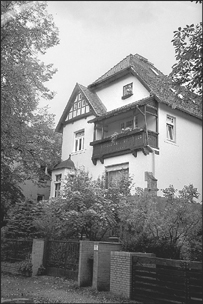
The former Fromm villa,
Rolandstrasse 4, 2006

On March 15, 1943, District Court Judge Heinrich Feussner certified in the land registry division of the district court of Berlin-Lichterfelde that the property formerly listed in the name of Julius Fromm had been transferred to the German Reich. The section of the land registry marked “owner” now contained the following information: “German Reich, represented by the Berlin-Brandenburg Chief Finance Authority, Berlin.” The court officials explained the basis for this entry as follows: “By virtue of expiration, in accordance with paragraph 3 of the 11th Ordinance of the Reich Civil Code dated November 25 and entered on March 15, 1943.”69 The process was not regarded as a transfer in the legal sense, but rather as an emendation of inaccurate wording. Paragraph 9.1 of the Eleventh Ordinance provided a justification for this practice: “When entries in land registries expire and are thus rendered inaccurate, they are to be rectified free of charge at the request of the Chief Finance Authority of Berlin.”
Once the sale of the villa to the Nazi official Sommer had fallen through, the Chief Finance Authority looked to Colonel Wolf Hagemann as a possible tenant, at the request of the urban planning office in Berlin. Hagemann, a professional soldier, was living in Berlin-Mitte, at Königstrasse 41. In 1919 he had served in the volunteer corps in Silesia. He was awarded the Knight’s Cross of the Iron Cross in 1940 as a lieutenant colonel in the mountain infantry at Narvik, and in 1944 the further distinction of Oak Leaves was added to his Knight’s Cross. To give this hero an attractive residence, the Chief Finance Authority approved disbursement of 5,500 Reichsmarks for “work on renovations and additions” to the Fromm villa despite the wartime building embargo then in effect. Throughout the summer, the property was redesigned under the management of Reich Building Bureau II. Hagemann had an air-raid shelter built, and put in an additional bathroom, an extra kitchen on the upper floor, and other luxuries. Hans Lüders, a senior official at the Asset Valuation Office, had to transfer a total of 8,500 Reichsmarks “from the expatriate’s liquid assets” to cover these expenses. The building inspection department of the Berlin-Zehlendorf district office duly approved the renovations for Colonel Hagemann—on August 14, 1945.70
Before the Chief Finance Authority could begin upgrading the Fromm villa to conform to the wishes of the bearer of the Knight’s Cross, a construction permit had to be secured, and the bureaucrats in this office had to be persuaded to expedite this predatory process. The Chief Finance Authority pressured Bailiff Curt Brückenstein to assess the inventory left behind after the deportation with notes marked “Special Assignment!” and “Extremely Urgent!” By this point, Gärtner had already called upon his colleague, Herr Korge, the civil servant in charge of furniture appraisal, to arrange for the sale of Julius Fromm’s furniture on January 13, 1943.
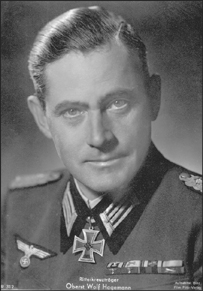
Wolf Hagemann, awarded the
Knight’s Cross, ca. 1940
The Evaluation Office disposed of the basic furnishings for a two-person household on March 20, 1943, for the price of 2,473 Reichsmarks. The purchaser was Colonel Max Bork, a member of the Wehrmacht general staff residing at Pfalzburger Strasse 15/1. Shortly thereafter he was promoted to general. Bork’s wife, Else, selected the furniture and other items, which included two beds with night tables, a vanity, various freestanding closets, a leather sofa, a leather easy chair, dishes, a cabinet with glasses, fifteen coffee cups, and so on.
“The remaining items,” Kühn, the assessor in charge of this matter, noted, “were brought to Korge and auctioned off there on May 17, 1943.” We can infer from this note that the Chief Finance Authority had taken charge of the auction, instead of following the standard protocol of working with a private auction house. The auction at Korge’s had been announced on the previous day in an advertisement in both the Völkischer Beobachter and the Berliner Lokalanzeiger. The advertisement made special mention of “1 lge. corner sofa with 12 wooden easy chairs (leather).” The seating was from Julius Fromm’s household. The advertisement also enticed buyers of all social classes with “oil paintings, books, light fixtures, glass, fine china, household items, and many other pieces” for this “public” auction. It began at 9:15 a.m., and the items for sale could be inspected one hour beforehand: “Entrance only with photo identification and as long as seating is available. The Chief Finance Authority of Berlin-Brandenburg, Asset Valuation Office.”
A man named Liebert, who lived at Chausseestrasse 59, purchased the elaborate corner seating unit for nine hundred Reichsmarks. Two pictures and a wall plate went to the family of Gustav Adolf Bächle at Prinzregentenstrasse 4 in Wilmersdorf. There must have been a good number of bids on the grandfather clock, because its price doubled. In the end it went to Otto Sander, a merchant who lived at Adalbertstrasse 14 in Kreuzberg, for the price of two hundred Reichsmarks. Small pieces of furniture and box springs proved to be hard sells, and went to a bidder named Gartz at Werder 96 for a price far below the appraised value. The family of Richard Piebus, an elevator operator who lived at Kottbuser Ufer, bought just a single round table. Friedrich Schilling, a painter residing at Motzstrasse 17, was out for antique liqueur glasses; he dealt in paintings and antiques. The sewing machine was auctioned to the Hofschulzes from Lüderitz (in the subdivision of Greater Poland the Germans referred to as Warthegau). Four lamps, a chair, and crystal and vases were acquired by Max Fischer, from the same town.
After a fierce bidding war, Franz Knabe carried off a round table, a sofa, a desk chair, and a batch of framed family pictures. The pictures were especially important to him. Knabe had a picture framing and molding business at Oranienstrasse 36 in Kreuzberg. Most likely he threw away the photographs of the Fromm family, polished the frames, and placed them in his showcase for purchase by newlyweds, young widows, and others who were delighted to discover that such nice things still existed.
A bargain-hunter named Hagen from Reichshof (Rzeszów) in occupied Poland bought glasses and a silver-rimmed carafe. Fine china went to the Schumann family at Kottbusser Strasse 6. Paul Gallisch, a postman who lived at Artilleriestrasse 13, paid a hundred Reichsmarks for Julius Fromm’s marble desk set and a few small items. Two cardboard boxes and a basket filled with an assortment of household goods went to F. Marschall on Wassmannstrasse for ten marks. Borokowski, residing on Kirchstrasse, paid fifteen marks for similar items, as did M. Worieki of Lausitzer Strasse 21. The bidders whose identities could not be established in the 1943 Berlin address book (most of whom were evidently women) must have been lodgers, and thus of a lower social status.
The auction of the remainder of the Fromm household on May 17 yielded 2,255 Reichsmarks gross. The purchasers paid cash and hurried off with their loot. The end of the auction log contains the following comment: “The signatures of the highest bidders could not be obtained because they were no longer present at the end of the auction.” The diary of Victor Klemperer gives us some indication of how the day must have “gone wild” in Klemperer’s description of the “auction of the Jacoby possessions” in Dresden on December 7 and 9, 1942, in the “Jew house” in which Klemperer was living: “We have to keep our rooms locked because the place is crowded with people inspecting the goods. On the first day the auction was held in the hall—I looked on (from the gallery), never having seen one. Involved were small household effects, and the bidders were menu peuple [common people]. After that more expensive objects and a somewhat better-off crowd.” On September 7, 1942, Jenny Jacoby, the octogenarian widow whose possessions would be sold off three months later, had been forced to leave her villa “with a cane, bent, but intellectually alert,” and was sent to Theresienstadt.71
To return to the auction of Fromm’s goods: the moving company Adolf Göritz issued a bill in the amount of 207.20 Reichsmarks for transporting the items from the villa in Berlin-Schlachtensee to the auction site at Kottbusser Ufer 39/40 in the Kreuzberg section of Berlin. The antiques dealer Georg Hinsche confirmed in an official statement that there were no “objects of high cultural value or precious art treasures” in the “auction lots of items formerly belonging to the Jew Fromm, Julius” that would be of special interest to the state. In the end there was a net profit of 2,047.80 Reichsmarks.
On this same morning, in this same location, the furniture and the household effects of sixteen other Jewish families that were listed by name were auctioned off, as was the remaining property of an unspecified number of deportees, collectively designated as “O 5205—General,” who were evidently so impoverished that the bureaucrats in the finance department did not deem them worthy of individual mention. The yield from the morning’s transactions in this single auction house was 25,594.57 Reichsmarks; this money was deposited into the central treasury in Berlin-Brandenburg. From there, the money was transferred to the Reich budget for the 1943 fiscal year, and recorded as “General Administrative Revenues” in Itemized Plan XVII, chapter 7.
These kinds of transactions were the order of the day. For May 21, 1943, the auctioneer Fritz Roth announced in the Völkischer Beobachter “on official instructions” that he was selling to the highest bidder—in the same auction rooms that were used for the sale of the Fromms’ furniture—“individual pieces of furniture, grand pianos, linens, china, crystal for immediate cash payment.” Bernhard Schlüter, a “certified auctioneer for the Greater Berlin area” who resided on Leipziger Strasse, was one of many who catered to discriminating tastes. Also citing “official instructions” that dictated sales to the highest authorized bidder, he was offering “on Tuesday, May 18, at 10 a.m., in his auction rooms at Panoramastr. 1, for immediate cash payment: 1 living room set, 1 bedroom set, 1 child’s room set, Biedermeier furniture, corner glass cabinet, rococo suites, individual pieces of furniture, 1 iron fireplace grate, 3 golf bags with clubs, china, crystal, pictures, household effects, etc.”
Nowhere near all the loot from the Jewish households was auctioned off, however. A substantial portion was bought up by secondhand and antiques dealers and then offered for sale on the retail market. Other items were sold to privileged individuals with high-priority identification cards, as well as to large families. Victims of bombing raids received preferential treatment from the state, including cash compensation for their losses, which enabled them to stock up on necessities.72
In the case of Julius Fromm, fifteen Volksgenossen (German national comrades) enjoyed a nice little spending spree. Because the auction on the morning of May 17, 1943, comprised the inventory of additional Jewish households, the proceeds totaled eleven times the amount Fromm’s estate yielded. We can therefore infer that on this morning, about eleven times as many Germans, a total of 165, cheerfully and cheaply enhanced their households to the detriment of exiled, deported, and often already murdered Jews. During the war, about five hundred of these kinds of auctions took place in Berlin, so roughly eighty thousand Berliners must have taken part in them. If the proceeds of May 17, 1943, represent an average yield, the auctions of household goods in Berlin alone would have generated additional revenues of 13.5 million Reichsmarks for the state treasury—the equivalent in today’s currency of 130 million euros.
Since quite a few of the Fromm household effects were sold in advance directly to Frau Else Bork, and Colonel Hagemann was given the villa, the government revenues and the number of profiteers need to be set significantly higher. But any upward adjustment of the assessment to compensate for these omissions still understates the dimensions of the massive theft, because the truly valuable items do not appear in any sales lists: the Bechstein grand piano in the parlor, the Blüthner piano for the children, the silver dinner set, the holiday china, the large library, the oriental rugs, the crystal chandeliers, the oil paintings, the film projector, the refrigerator, and the cameras. Fromm had had to leave all that behind in Berlin.73 Evidently there were still others who had lined their pockets handsomely before the official auctions took place, or the objects were appropriated to benefit Nazi luminaries, young artists, officers’ clubs, music schools, and the like.
Yet another way to pilfer the property of Jews was to auction off the furniture and clothing that came from the households of the Western European and Czech Jews that had been plundered every which way by the German state. From the occupied western territories alone—France, Belgium, Luxembourg, and the Netherlands—more than 1,300 freight cars transported the household goods of the deported Jews to Berlin. The number of inland ships unloading this kind of freight cannot be determined with any accuracy.74 Moreover, the clothing of the people who were deported or murdered wound up in secondhand stores or was distributed to the needy by the National Socialist Public Welfare office. If these transactions are factored in, the number of Berliners who profited from the auctions of Jewish property clearly exceeded 200,000. Since most of the profiteers from the deportations at that time were not single households, but rather families of four and five, the number of Berliners whose comfort level increased at the expense of the persecuted and the murdered Jews quickly jumps to a million.
There was something to suit everyone’s taste. Even Germans who arrived late or came with an empty wallet and left empty-handed still stood to profit in the end, because the proceeds flowed into the Reich coffers and reduced the tax burden across the board.
The documentation clearly indicates that the Fromms’ furniture sold to Colonel Bork and auctioned off to various other buyers had enriched the German state by a total of 4,520.80 Reichsmarks. Despite this evidence, on October 9, 1962, the compensation bureau in Berlin refused once and for all—at least in this case—to make restitution of a single penny for what the civil servants had the audacity to mislabel the “abandonment of furniture.”
In contrast to the petitioners, these officials had full access to the original files from the years of Aryanization, which they took advantage of to the detriment of those entitled to restitution. In 1955, a senior tax collector demanded that the renovations in the Fromms’ villa that the tenant, Colonel Hagemann, had insisted on and that had been paid from Fromm’s liquid assets “be deducted from the reimbursed sum for the property in the restitution process.” Hagemann’s air-raid shelter alone must have cost a fortune!
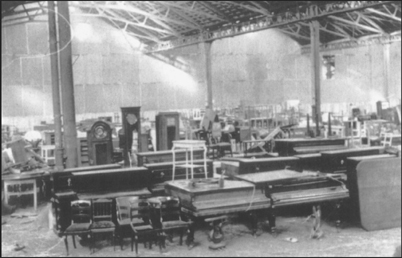
Storage facility for “property from Jews” in Oberhausen, ca. 1943
The files also indicate that restitution officials in Berlin were aware of specified assets about which the petitioners had no knowledge. No compensation was made for these assets. For example, Salomon Fromm had taken out a small life insurance policy for his daughter Ruth in 1926, which was to be paid out on February 1, 1944. Payment on maturity had indeed been made—but to the Reich treasury. When in 1958 Ruth Fromm applied for compensation for the losses she and her family had sustained, she did not know about the life insurance policy in her name, and was thus unable to claim restitution, although the administrators knew full well of its existence. They pored through the 1944 correspondence between the life insurance company and the Berlin tax authorities, then added it to their office files—and kept their findings to themselves.
At the time of Julius Fromm’s formal denaturalization, his personal assets totaled about 1.6 million Reichsmarks, all of which he had to leave behind in the Reich, as we learn from the balance sheet his lawyer, Loebinger, drew up in February 1939.75A portion of the proceeds from the sale of his company, in the amount of 300,000 Reichsmarks, should be added to this sum, as should the package of gold and jewelry in the safe deposit box at the Reichs-Kredit-Gesellschaft that Loebinger had not reported as “enemy assets;” this package was easily worth an additional 200,000 Reichsmarks.
The Berlin-Zehlendorf tax office collected 25 percent off the top of the total amount as a “Reich Flight Tax.” The cynically named “Jewish atonement payment” of a billion Reichsmarks, which Göring imposed in consultation with the Reich Finance Minister after the November 9 pogrom (Kristallnacht), required every German Jew whose assets exceeded five thousand Reichsmarks to hand over 20 percent of these holdings as a contribution to the German state. Julius Fromm was forced to pay this money, and in addition a “Count Helldorf Donation,” named after the Berlin chief of police. This “donation” was extorted from every well-to-do Jewish emigrant from Berlin to augment the municipal treasury. No receipt was issued. Yet another compulsory payment, this one to the Jewish Community in Berlin, was earmarked as poverty aid for Jews of lesser means, who were denied the benefits to which they were entitled as qualifying members of the German social security system, so this money went straight to the German treasury and social security funding as well.
If we add up all these amounts, we find that the government had helped itself to about 50 percent of Fromm’s assets by 1939. The second half was appropriated by the end of 1944. An itemized list of the state’s profit from its Aryanization of Fromm’s holdings is as follows:
|
Reich Flight Tax |
515,972.00 RM |
|
Jewish Asset Tax |
457,770.88 RM |
|
Count Helldorf Donation |
50,000.00 RM |
|
Emigration Tax |
7,790.00 RM |
|
Reich Railroad Bonds |
37,380.00 RM |
|
Account at the Reichs-Kredit-Gesellschaft |
14,917.00 RM |
|
Account at the Deutsche Bank |
6,181.05 RM |
|
Indemnity for Fromm’s sister Else Brandenburg (who was later murdered) |
11,456.48 RM |
|
Balance at the Conversion Fund for German Foreign Debts |
726.22 RM |
|
Debt Repayment Barth-Probst |
4,870.83 RM |
|
Debtor K. Lewis (Mortgage, Impounded) |
20,000.00 RM |
|
Debtor K. Lewis (Köpenick), Interest |
1,100.00 RM |
|
Debtor Daubitz |
30,000.00 RM |
|
Debtor Daubitz, Interest |
1,875.00 RM |
|
Debtor Baumann (Coburg) |
15,000.00 RM |
|
Debtor Berger (Stralsund) |
20,000.00 RM |
|
Debtor Herzka (Dresden) |
8,000.00 RM |
|
Debtor Tuphorn |
3,466.25 RM |
|
Debtor Tuphorn, Interest |
43.12 RM |
|
Debtor Schultz |
10,000.00 RM |
|
Remaining Rental Income, Rolandstr. |
4,215.01 RM |
|
Sale of Furniture |
4,520.80 RM |
|
Sale of Patents |
8,802.05 RM |
|
Commerzbank Account |
21,361.00 RM |
|
Dresdner Bank Account |
123,403.55 RM |
|
Liquid Assets Converted into Reich Treasury Notes, Plus Interest |
202,268.20 RM |
|
Additional Interest Payments on the Reich Treasury Notes, Paid on June 16, 1943 |
3,421.25 RM |
|
Residence at Rolandstr. 4 (1919 Purchase Price: 95,000 RM; Minimum Value as of 1933) |
300,000.00 RM |
|
Gold and Jewelry Safe Deposit Box at the Reichs-Kredit-Gesellschaft |
202,320.00 RM |
|
TOTAL |
2,086,860.69 |
The preceding balance sheet appears to count the sum of the Reich railroad bonds twice (item 5). The restitution process that Ruth Fromm initiated for her father Salomon’s expropriated assets indicates the kinds of ploys associated with these bonds. As the Commerzbank advised on May 27, 1955—for a fee of “4 marks for expenses”—it had sold Salomon Fromm’s Reich railroad bonds (worth 20,500 Reichsmarks) “in several small units” on the stock exchange. “The final sale of the remaining stocks in the amount of 500 Reichsmarks occurred on November 11, 1940.” The proceeds from this sale were immediately converted into war loans and later confiscated.76 Aside from this item, the nationalization of Julius Fromm’s personal assets can be clearly documented.
The above-mentioned sum, which comes close to representing the total figure, should be increased by at least the inheritance tax that Otto Metz-Randa had to pay for Fromms Act in 1941 as the heir of Elisabeth Epenstein, the Aryanizer of the business. The tax office assessed the company’s value at 1.9 million Reichsmarks and set the inheritance tax of Metz-Randa, who was not related to the deceased, at 935,000 Reichsmarks.77 Metz-Randa paid this tax out of the Fromms Act assets.
Factoring in this amount, we discover that a total of about three million Reichsmarks flowed into the Reich treasury and thus to the German Volksgemeinschaft (people’s community) as a result of the expropriation of Fromm’s assets. In today’s purchasing power, that would equal about 30 million euros. Elisabeth Epenstein and her heir secured a large portion of the loot for themselves. Others swooped in to profit from the Aryanization on a small or a large scale, notably two high-ranking Wehrmacht officers, who were given manifestly preferential treatment. There was also a covert deal involved in this lucrative transaction for Frau von Epenstein, whereby Göring would get two castles “as gifts” in return for his largesse, and his sisters and a woman identified as “Frau Göring” would receive an allowance for life from the profits of Fromms Act—and did in fact receive this allowance until 1945. Thus the family of a leading Nazi also made money hand over fist.
Julius Fromm had fallen prey to the robbers. These were not a bunch of bandits in the bushes, however, but a state and its citizens. Millions of Germans—Nazis and others—seized the opportunity to profit. According to the principles of social participation, helping the Nazis meant helping themselves. The National Socialist movement may have sprung from an ideological foundation, but it was now fully fused with material interests, thus uniting the Görings, Hagemanns, and Metz-Randas, the men who ran the elevators and the men who ran the country, the tenants in the modest back units and stately front buildings, lower-ranking and top-level officers. Instead of going to a carnival or a sale, everyone happily trotted off to the Jew Auction.