
13.

THE MACHINES THAT PRODUCE CONDOMS TODAY are called chains. Three of these production chains, each over a hundred feet long, turn out condoms bearing the brand name Fromms FF in a factory in the industrial zone of Zeven, situated between Hamburg and Bremen. The MAPA manufacturing company is part of Total, a multinational energy company based in France. With a market share of over 13 percent in 2005, Fromms ranks as the brand with the second-highest sales of condoms in Germany.
A pungent odor of ammonia suffuses the production area. Adding ammonia to the latex prevents curdling during shipping from Malaysia to Germany. For about ten days, the latex, enhanced with all kinds of undisclosed additives, undergoes a swelling process in Zeven, and is then ready to be placed on one of the chains, each of which holds approximately one thousand glass molds, commonly called mandrels, mounted at intervals of 2.75 inches. In 1995 a European norm (EN 600) was introduced to standardize condom sizes at 6.69 inches in length and 1.8 to 2.2 inches in diameter.
The glass mandrels are cleaned in a tank, then dried and drawn—one by one—through a small basin filled with milky latex. A thin (0.0011-inch), virtually transparent coating adheres to the mandrels. Then the chain runs through a drying chamber, and a second round of dipping and drying follows, after which brushes roll up the open ends of the raw condoms to form a rim. Once the condoms have been sprayed off the mandrels with high-pressure jets of water, they are placed in large washing machines, where denatured cornstarch is added. Then the condoms dry at 140 to 194 degrees Fahrenheit, and undergo quality testing. Only two condoms are inflated per hour. They have to be able to hold at least 4.75 gallons of air before bursting; many can take in more than 13 gallons. Individual testing with air has now been replaced by quality control using electrical current. Each condom is mounted onto a metal form and rotates between two rods charged at two thousand volts. If the condom has a hole or a thin area, the current passes through, and the defective item falls into a container for rejects.
Like so many twenty-first-century factories, the hall is eerily devoid of a human presence. One worker monitors the computers that control the chain, and loads the washing machines and dryers. A second worker places the condoms on the testing equipment, which has yet to be fully automated. In the course of three shifts, six workers produce about a hundred thousand condoms. A staff of twenty-eight manufactures an annual total of about 80 million units.
In the 1960s, the benzene process Julius Fromm had employed was discontinued and replaced by a new latex-manufacturing process. Apart from that innovation, and an increasing degree of automation, the technology has remained unchanged.

Condom production in Zeven began in the summer of 1947. At that time, Hannes Bachmann, a businessman in Bremen, and Bruno Engelhardt, a former chief executive at a rubber factory in Hildesheim, decided to form a company to produce rubber products. Bachmann and Engelhardt intended to center their business on manufacturing waterproof aprons. They applied to the British military administration in Hanover for permission, but were turned down for this product. The occupying forces were troubled by the steadily rising number of cases of venereal disease after the end of the war, and by the fact that both the Fromms Act factories (in East Berlin) and the Blausiegel factories (in Erfurt and Leipzig) were part of the Soviet zone. The British wanted an independent condom factory to provide this necessary product for the three Western zones.
The two businessmen lacked any experience in condom production, but a lucky coincidence brought them in contact with a former production manager at Fromms Act when they attended the first postwar Leipzig Trade Fair. This production manager was looking for work, and had the expertise and professional experience they were seeking.
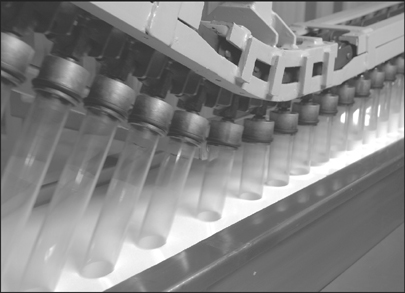
Production of the FF Fromm brand of condoms in Zeven, 2006
Bachmann and Co. Hanseatic Rubber Factory, Inc., was granted an operating license by the British military government on October 1, 1947. The industrial site near Zeven, where a large army munitions factory had just been dismantled, was well suited for use as a production plant. This factory, referred to as the Muna, had been making artillery shells and mortar bombs for the Wehrmacht since 1940—increasingly by Soviet prisoners of war.
Since the factory lay well-camouflaged in a dense forest, the buildings as well as the electrical and water supplies had remained intact during the war. A workforce could be assembled readily from the refugees from Germany’s eastern territories. The bigger challenge was to acquire the requisite machinery. As luck would have it, Engelhardt, the cofounder of the company, had run a large rubber factory in Lodz during the war, and as the Soviet troops were advancing, he dismantled a rolling mill for rubber and brought it to the West. This looted machine would come in quite handy.
Production in Zeven began in December 1948, with male workers’ wages set at seventy-eight pfennigs an hour. Women were paid hourly wages of fifty-two pfennigs. In 1991 Gummilinse (Rubber Lens), the company newsletter, ran a piece recalling the “enormous and now-unthinkable” benzene fumes that plagued the workers, and the “horrid, back-breaking work … of setting up the dipping frames” on which the glass mandrels were mounted. Many workers developed tendinitis.
The quality of the product was also erratic. Reject rates approached 8 percent, and a trade show for hairdressers in Bremen turned out disastrously for the inexperienced condom manufacturers. A chronicle of the company’s history tells the story of a prospective buyer who suddenly showed up at the booth, “filled a condom with water right in front of everyone, and the water poured out in a steady stream, making the condom look like a watering can.”88
At this point, the former plant manager from Fromms Act tracked down Herbert and Edgar Fromm in London, who had also opened a small condom factory there, and proposed a license agreement. The old familiar trademark, they reasoned, could help them on the road to glory. Herbert and Edgar Fromm gave their consent, since they were facing overwhelming competition from London Rubber’s Durex condoms in Great Britain. In January 1949, they signed a mutually beneficial twenty-five-year license agreement with the Hanseatic Rubber Company.
The only problem was that the sons and heirs of Julius Fromm no longer owned the trademark. Fromms Act in Berlin, which, since the death of Elisabeth Epenstein, had belonged to her heir, Otto Metz-Randa, now held the rights to this brand name. Metz-Randa, using the fact that he was from Vienna to his advantage, quickly transformed himself from a pan-German profiteer of Aryanization into a persecuted Austrian, a paragon of innocence. He even tried to pass himself off as a victim of National Socialist tyranny.
Bachmann, the founder of the postwar incarnation of the company, traveled to Vienna with Sally Jaffa, Julius Fromm’s old attorney in Berlin, who had survived the war in London, to meet with Metz-Randa. Edgar Fromm recalled that Metz-Randa “was fully expecting to hear from us.” The Demographics Division of the Municipal Administration of Vienna now listed Metz-Randa as a retiree, but he saw—and seized—his chance yet again to reap a handsome profit from his shady inheritance.
Metz-Randa refused to hand over the company and the trademark. He contacted the “Trustees of the American, British, and French Military Government for Assets Transferred Under Duress” to contest the Fromm brothers’ demands. Metz-Randa argued that “because the sales contract at that time was not in the nature of a ‘forced contract,’” the claim was “not defensible.” This was the brazen argument of a Viennese businessman in 1951, whose role in Elisabeth Epenstein’s life, first as her consultant and then as her heir, had enabled him to take over at least three formerly Jewish companies (Fromms Act, Fromms Cosmetics, and a castle hotel plus estate in Gösing in Lower Austria).
Otto Metz-Randa instructed Walter Fuhrmann, an attorney and notary public in Berlin, to put a stop to any possible return of the company to the Fromm family. Fuhrmann characterized the sale of Fromms Act to Elisabeth Epenstein as “a transaction completed for purely financial reasons [and] unrelated to the Nazi regime.” He claimed that Fromm had “already decided in 1933” to emigrate, and he sold his company “so that he could enhance the new life he had already begun to build abroad, that is, in England.” The attorney also reported that there had been other offers to buy the company, including an offer by a “German Briton named Koch.” He alleged that “of all these bids [Fromm] favored the one from … Frau v. Epenstein.”
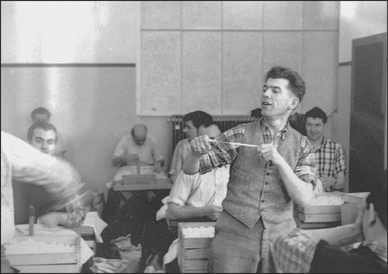
Testing Fromms condoms in Zeven, 1965
The attorney representing Fromm’s sons in Bremen vehemently denied this allegation. Fuhrmann fired back by speculating that “it appears absolutely out of the question that the seller—if he were still alive—would have made claims for restitution.” On top of that, he explained that “special directives from the Reich Marshal’s chief of staff had granted extraordinary currency and transfer relief far exceeding those in any other case.”
In the summer of 1951, after several months of this wrangling, Fromm’s sons realized that they would be forced to agree to a settlement, and signed the papers with Metz-Randa after driving a hard bargain at the forty-fourth restitution tribunal of the district court in Berlin. The settlement stipulated that Metz-Randa, the consultant to and heir of the Aryanizer Elisabeth Epenstein, would transfer his share of the business to them. In return, the heirs of Julius Fromm, who had been stripped of his company, would remit the “sum total of 174,300 West German Marks” to Metz-Randa.89 At the time of this settlement, which came so soon after the war and the currency reform, this was an astronomical sum of money.
When the Hanseatic Rubber Company set about advertising its condoms, the emphasis was on their protective function. The first advertising brochure, “Sun of Life, Health of the People,” cited statistics on the increase in gonorrhea and syphilis, and provided this explanation: “An uncertain past” that posed “obscure perils” had made “many people go the way of folly” and “become reckless,” making them “a danger to people today in the truest sense of the word.”
The product line also included “tried and true” Fromms rubber sponges and hot-water bottles. The following pointer was intended to reassure buyers of condoms: “Fromms has come to stand for this kind of prophylactic, and its name is a guarantee that you are getting the very best. You should insist on Fromms, and make it clear that you will accept only genuine Fromms products from the Western occupation zones.”90 The key message here is “Western,” with its suggestion of quality inherently superior to products manufactured in East Berlin.
The Fromms factory in Köpenick was nearly obliterated by bombs on December 24, 1943, and on January 17, 1945, days on which the Allied air force launched strategic and highly effective attacks on the entire German rubber industry.91 On April 23, 1945, the Red Army marched into Köpenick. One day later, Berthold Viert and Karl Lewis, the two long-term directors of Fromms Act, committed suicide. The motives behind their decision to end their lives remain a mystery. However, their despicable treatment of the three Fromm family members who were forced to work in the factory would seem to suggest that they had less to fear from the Soviet soldiers than from the return of their former boss.
The machines that had remained intact through the air strikes were immediately dismantled and shipped to the Soviet Union.92By contrast, the older factory in Friedrichshagen, which had survived essentially undamaged, was readied for operation to supply the Red Army soldiers with condoms immediately needed. On orders from the Soviet military commander of the city, Fromms Act’s head chemist, Dr. Wilfried Genth, got the factory up and running again just seven weeks after the capitulation of the German Reich. Raw materials were on hand, and, according to a report submitted by the industrial union Chemicals, Paper, Stones, and Earth on July 15, 1946, “the Russians bought our products without delay.”
The author of this text was Reinhold Schobert, the head of the staff association at Fromms Act, who had been appointed by the Friedrichshagen employment office. In this report he expressed his views about Dr. Genth and Genth’s girlfriend Elisabeth Lipova. “Genth,” Schobert wrote, “and his assistant, Fräulein Lipova, a Polish woman, [acted] as though the company belonged to them, and as though nothing whatsoever had happened in Germany.” Unfortunately, Schobert explained, Genth’s position was unassailable, “because the Russians have opened a testing division with us … and the Polish woman, Lipova, is assisting him.” This “Polish woman” was actually a Czech woman who had been deported to Germany in 1941 as a forced laborer. Schobert, an unelected proletarian functionary who had not been active in the company since he was fired in 1933, until his appointment as head of the staff association, vented his frustration in this report: “I cannot get it through my thick worker’s skull how something like this is possible in a free Germany; it is as though a person were irreplaceable.” Not so very long ago, this same worker’s skull had belonged to a Nazi Party official. In this regard, he was not so very different from Genth, who had become a member of the Nazi Party in 1933.
According to the regulations of the Potsdam Agreement, Julius Fromm or his heirs, as victims of the Nazi dictatorship, should have had the factories in Berlin-Köpenick and Friedrichshagen returned to them. In September 1945, the district court judge in charge of the Berlin company register confirmed that “in view of the political constellation … Herr Julius Fromm is to be reinstated as the true owner.” But the German communists in the Soviet zone (and then in the German Democratic Republic) prevented this from happening.
The district office in Berlin-Köpenick began by putting the Köpenick factory premises and buildings under trustee administration. It then registered the real estate with the Soviet Military Administration (SMAD) as “unclaimed property” and delegated it to the Köpenick district authority. The SMAD handed over both the company and the factory in Friedrichshagen to the district office for trustee administration. Siegmund Fromm fought in vain to “reinstate” Julius Fromm’s previous “rights as the sole proprietor of Fromms Act Rubber Company, Inc.”
Late in March 1946, the company was placed into forced administration, and, three years later, nationalized by the German Trustee Administration for the benefit of the German Democratic Republic in accordance with Edict 124. The bureaucrats did not follow the letter of the law, however, as the ukase issued in October 1945 by Marshal Zhukov of the Red Army provided only for the takeover of property from “chief officers” and “leading members and supporters” of the Nazi Party. The Fromm family plainly did not fall into this category.93
The East Berlin officials were well aware of this. To be on the safe side, they made out Julius Fromm, the inventor and founder of the company, to be a capitalist villain. A 1948 document describing this case contains the following remarks, under the heading “Incriminating Evidence”:
I. Jewish proprietor, capitalist exploiter, antisocial, anti-labor, and pro-Nazi views… Although a Jew himself, J. Fromm—and all parties concur on this point—was one of those capitalist exploiters who used all means and methods at his disposal, in the most unscrupulous manner, to maximize his profit at the expense of others. The primitive production facilities and antiquated or in some cases nonexistent hygienic and other requisite amenities at the plant in Friedrichshagen took a heavy toll on the workforce as a whole, and on the health of the workers employed there. The “savings” he hoped to achieve were coupled with the worst possible piecework wages, which bore no relation to the prices they commanded, and in just a few short years gave him the financial foundation he needed to construct the factory in Köpenick (1930—turn key price, ca. 6 million marks).
There was no denying that Julius Fromm had “developed and expanded the various amenities in the company.” These changes were now being used against him as “incriminating evidence” of his “active support of National Socialist propaganda.” To add insult to injury, the report also claimed that Fromm had sold his company of his own free will and that he had gone so far as to target the sale to “a reactionary buyer [Göring’s godmother] to make a lucrative foreign currency transaction.”
Sworn statements by four men corroborated this “incriminating evidence.” One of them, Schobert, had written the vitriolic attack against the chemist Genth and the supposedly Polish woman Elisabeth Lipova two years earlier. The four men characterized themselves as antifascists. However, they had been defeated in the workers’ council elections in October 1946, “because,” they explained, “the elections came too early for a company of this kind.” On January 17, 1948, the activists gave more evidence to boost their claim: “The Fromm family brought a large portion of their assets and merchandise to England even before 1933, and when they boarded a plane and flew to England, they weren’t bothered in the least about what was happening to their workers.” In July 1948, Schobert’s brother-in-law Herzog added: “The Jewish owner, Julius Fromm, was an exploiter of the worst sort, utterly lacking in any understanding of social responsibility.” All four regarded their former boss as “nothing but a capitalist,” and they declared: “We cannot stand this sort of person, which is why these companies belong in the hands of the people.”
An administrative report about the Fromms company that Nazi officials had drawn up in 1934 while preparing to strip Julius Fromm of his citizenship told a very different story: “Most of the workers are paid more than the standard rate” and “the staff facilities are impeccable; all the workrooms are equipped with adequate ventilation, and with heating in the winter and cooling in the summer. Washrooms and showering facilities are available to the workers.” This report also noted that Fromm provided for the physical well-being of his employees by making lunch—“soup, meat dish, and stewed fruit”—available at a bargain price.94
However, the German trusteeship was not receptive to these points when considering the case in October 1948. Instead, it incorporated the distinctly anti-Semitic tirades of the workers’ representatives nearly verbatim into its “recommendation for transfer to state ownership.” The “incriminating evidence” evolved into “incriminating facts” that emphasized Fromm’s “anti-humanitarian and anti-labor attitude.” The explanation ran as follows: “After 1933, the attack on the staff was stepped up, in an evident attempt by the Jewish company to ingratiate itself with the Nazi regime.”
One year later, on December 2, 1949, officials in the newly established German Democratic Republic completed the final steps in the nationalization process. The journal of administrative orders for Greater Berlin announced: “In light of the law of February 8, 1949, confiscating property assets of war criminals and Nazi activists, the city council of Greater Berlin has resolved to confiscate without compensation the property assets of the individuals and companies noted in List 3 below as assets of war criminals and Nazi activists and to transfer them to ownership by the people.” The text for reference no. 133 read: “Fromms Act Rubber Company, Inc., Berlin-Friedrichshagen, Rahnsdorfer Str. 153.”
The notice was signed by Friedrich Ebert, the son of the late president of the Weimar Republic. Ebert, a former member of the Social Democratic Party, was now serving on the Central Committee of the Socialist Unity Party of Germany, and was the mayor of Greater Berlin. On June 24, 1951, the factory was formally entered in the land registry as “property of the people.” KAUTAS (United People’s Factories for Rubber and Asbestos) manufactured condoms there until the end of the 1950s.
Later on, “Fromms Act—made of pure natural rubber—luxury” was produced by People’s Enterprise Plastina in Erfurt, at the nationalized Richter and Käufer Rubber Factories (formerly Blausiegel). The cost of a three-pack was 1.25 East German marks. Just as in the old days, a coupon printed on the packets that could be slid unobtrusively over the drugstore counter came with these instructions: “Please use this slip of paper for discreet purchases at your specialty store.” Eventually the Fromms brand was renamed Mondos, and this name became synonymous with condoms in the German Democratic Republic.
Condemned to idleness during World War II, Julius Fromm wavered between depression and hope. On good days in his exile in London, he dreamed of rebuilding the company that had been stolen from him. Shortly before the defeat of Hitler’s Germany, he drew up a will “in regard to my assets in Germany and Danzig,” which sketched out two possible outcomes, one entailing reacquisition of the factories, and the other financial restitution. In any case, he made his sons promise to do everything in their power to save the business, and to entrust an “impartial arbitrator” to resolve any disputes about the inheritance that might arise.
The extent to which Julius Fromm retained his faith in the German people and their respect for justice and for upstanding citizens like himself is revealed in a clause that established how the impartial arbitrator was to be appointed, should his sons disagree even on this point. Fromm wrote in his will in December 1944 that the arbitrator “should be chosen by the president of the Berlin chamber of commerce.” And of course it was Berlin that he had in mind when he wrote to his son Max in liberated France on February 6, 1945: “As soon as the war is over, I will begin again.”95
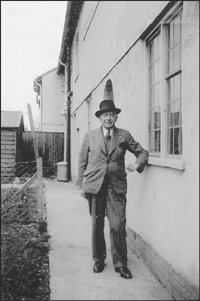
Julius Fromm shortly before
his death in England
That is not how things turned out. On May 12, 1945, three days after hundreds of thousands of people had exuberantly celebrated victory on London’s Trafalgar Square and in front of Buckingham Palace, Julius Fromm got up in the morning, and when he tried to open the curtains, he collapsed. The doctor was hurriedly summoned, but by the time he arrived, the patient had died.
Julius Fromm’s heart had given out, his family said, because he had been so overjoyed about the demise of the Nazis and the prospect of his imminent return to Germany.