
12.

WHEN FRANCE DECLARED WAR on the German Reich on September 3, 1939, Max Fromm, Julius’s eldest son, was interned in Paris as an enemy alien. The actor wound up in a camp named Villerbon, not far from Blois, and lived in fear that in the event of a Wehrmacht attack on France he would fall into the hands of the Gestapo. He therefore volunteered for the Foreign Legion of the French army, which sent him to Morocco. His wife, Paulette, and her mother fled Paris in the chaotic weeks that followed the German invasion in June 1940. They reached Bagnères-de-Bigorre in the Pyrenees, a place that attracted many Jewish refugees because of its proximity to the Spanish border.
In March 1941, Max was discharged from the French army and given enough money to tide him over for two days. The Moroccan authorities, who were under Vichy France control, were now beginning to arrest Jews and hand them over to the Germans. Max and Paulette figured it would be best to flee to Algeria. But Paulette and her mother did not make it over the “green border” (the favored illegal crossing point) to Spain, so Max returned to France. In an attempt to ensure their safety, Paulette forged papers for herself and her husband. She changed their family name Fromm, which was doubly problematic because it sounded both German and Jewish, to Fromin. Supported by wealthy Jews, they lived in a small house in Bagnères-de-Bigorre and were active in the French Resistance, hiding partisans—although they were themselves essentially in hiding. They built a secret trapdoor to enable Resistance fighters to disappear into the cellar.
As the situation in Vichy France became increasingly dangerous for the Jews, Max Fromm decided to try crossing the border into Spain on his own and continuing on to England, where he would then arrange for Paulette and her mother to join him. On his first attempt, Spanish soldiers caught him and sent him back. For his second attempt, he paid a professional escape agent to bring him over the border on a secure secret route. However, the agent turned out to be cooperating with the Gestapo. Max was arrested and imprisoned in Noé, a camp in Haute-Garonne.
After a few months, he was transferred to a Todt Organization work camp near Marseilles. Along with other forced laborers, he had to build bunkers for the Wehrmacht, to protect the Mediterranean coast from a possible Allied invasion. Luckily, his German guards did not discover that there was a Jewish compatriot in the group. Max could not count on keeping his identity secret for long, however. Roll calls to single out circumcised men could occur at any moment. Paulette did everything in her power to save him, and persuaded a group of Resistance fighters to attempt a risky operation. One foggy night, they were able to sneak up to the small camp, knock down the guard, and free Max.
Max, Paulette, and Paulette’s mother fled to Tulle, Dordogne, in central France, where Max worked as a charcoal maker in the forest until German units combed through the area in the summer of 1944. Again he wound up in Gestapo custody. His captors were unaware that he was Jewish, and that he spoke German. The prisoners were asked to line up in a row and the Gestapo chief shouted: “Jews, step forward.” Max stayed put, understanding full well what his German tormentors were saying about him: “That guy is sure to be a criminal. Let’s let him go, and see where he takes off to.” They did so, but they soon lost track of him.
At this time, Paulette, who was nearing the end of her first pregnancy, was an inpatient at the local hospital. On June 7, 1944, Resistance partisans, emboldened by the Allied invasion in Normandy, attacked the German occupiers in the town, locked up most of the security regiment in a munitions factory, and liberated Tulle, albeit for just a few short hours. Units of the Second SS Panzer Division Das Reich intervened at once. After they had trounced the Resistance fighters and taken back the city, Brigadier General Heinrich Lammerding ordered ten Frenchmen to be killed for every fallen German.
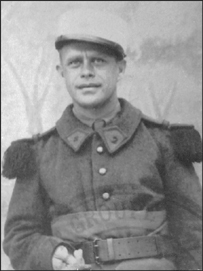
Max Fromm with the French
Foreign Legion in Morocco, 1940
The SS men rounded up the residents on the market square and forced them to witness the massacre. They hanged ninety-nine prisoners, aged seventeen to forty-five, from balcony lattices, lampposts, and trees. Paulette Fromm later told her son Henri, “On that day, the Germans made widows out of quite a few of the patients in my hospital. They were weeping over their husbands; they were screaming.” Paulette feared for Max’s safety, but he had found a hiding place in time.
The farther the Allies advanced through northern France, the more the German occupiers’ control of the country slipped from their grasp. Max, Paulette, and her mother managed to get to Paris with little Henri, who was born just a few weeks after the massacre at Tulle.
Henri, who is now a psychoanalyst in Paris, gives this sober account of his father: “He was a melancholy man. After the war he never spoke German again, and he was often depressed.” Max Fromm traveled to the Federal Republic of Germany a total of three times, and panicked whenever he saw a German in uniform. Friedrich Hollaender, who returned to Munich from Hollywood after the war and performed in a cabaret, offered him a job there. But Paulette and their two sons were French. Max Fromm neither could nor would leave France.
He waited for major film roles to come his way, but he was assigned only bit parts. His main source of income was film dubbing, which he found tedious. In 1949 he was offered a role in Le Silence de la Mer, directed by Jean-Pierre Melville, and he later appeared onscreen with Peter Ustinov in Henri-Georges Clouzot’s Les Espions. Max Fromm played the Gestapo officer in the internationally acclaimed war film Le Train. Since he was blond, spoke German, and looked quite Germanic, he was soon typecast as a Nazi, playing Gestapo agents and SS officers. At one point he came close to getting a plum role opposite Brigitte Bardot, but he was considered too short to be cast with this new star of the French cinema. In 1950 he wrote to a friend from his earlier years in Berlin: “When all is said and done, I have accomplished very little.”86
Max Fromm never truly considered himself French. German culture remained his spiritual homeland—not Germany per se, his son Henri recalls, but rather the Berlin of the 1920s: “He had achieved a certain degree of fame as an actor there. That was his life, and then it was over.”

Edgar Fromm, Julius’s youngest son, had to report for military duty with the British Pioneers in December 1941. Right from the start, he was asked to adopt a British name—in case he was taken prisoner by the Germans. He refused. The basic military service consisted of digging trenches: “One day, we were digging away as usual when a brigadier general from the War Office and our colonel came by. The brigadier general asked me: “You’re not an Englishman, are you?” I said: “No.” “What are you then?” “German.” He stepped back, and I said, “Sir, you needn’t be upset. I am on your side, otherwise I wouldn’t be here.” He laughed and asked me: “So you speak German?” “Yes, sir. And French, too.” Then he turned to our colonel and asked him “Why is this man digging here?” The colonel replied, “He didn’t tell me anything about this.”
Three weeks later, Edgar Fromm was summoned to the War Office in London. “Two men from the Special Air Service were waiting for me there, dressed in casual clothing; they were smoking cigarettes and looking me over. They figured I could parachute down for espionage missions in France or Germany. I replied: ‘I have just gotten married. I’m willing to do anything but that.’ They accepted my demurral, and soon I was trained as an interpreter.”
Ten days after Allied troops landed in Normandy, Edgar’s unit crossed the English Channel, and was caught up in heavy fighting. The unit traveled from Belleville to Brussels. Toward the end of 1944 he first set foot in Germany again, near Aachen, as a sergeant in the military secret service.
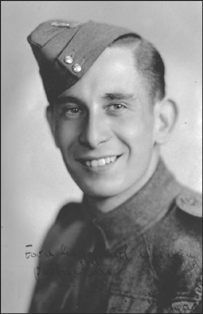
Sergeant Edgar Fromm in
the British Army military
intelligence, 1945
Thinking back to his time with the occupying forces, he had especially vivid memories of a visit to Baroness Thyssen, the wife of a famous steel magnate. “She wasted no time in declaring: ‘I was never a Nazi.’” “Listen, madam,” Edgar Fromm replied, “it is not my job to determine that. I just need to draw up an inventory of your possessions.” When he returned from this mission, a fellow British officer asked him, “Did you bring home a nice souvenir?” The otherwise amiable Edgar Fromm seethed with indignation as he replied, “The Nazis did that to us, and that is exactly why I will not do so!”
Edgar Fromm never felt hatred for the Germans—perhaps because most members of his family survived the Holocaust. In contrast to many of his Jewish refugee friends in London, he travelled to his native country on a regular basis. He even toyed with the idea of moving back to Germany, but his wife, whose parents had been murdered in German death camps, balked at the thought of doing so. “I felt rather sorry for most Germans after the war,” Edgar Fromm said. “They went along with their holy Führer and paid such a heavy price for having done so.”
Ruth Fromm likewise insists: “I do not hate the Germans. Even so, I no longer think of myself as German, although I did grow up in Berlin.” Just after the war ended, she signed on with the United States Army, which needed a large number of bilingual staff members. On the way from England to Germany, she sought and found her cousin Max, his wife Paulette, and their son Henri, who had just turned one. The family was living in Paris “in appalling conditions.” Her next stop was Munich, where, she recalls, “They fired shots at us. The people of Munich did not like the Americans at all, and thought the British had started the war.”
In Nuremberg she translated documents, including descriptions of experiments on humans that had been conducted in Auschwitz on behalf of I.G. Farben, for use in the criminal trials. She had the impression, though, that the investigative and prosecutorial zeal demonstrated in the first spectacular trial took a nosedive in subsequent efforts to prosecute Nazi criminals. The case of Göring, one of the men sentenced to death, wound up casting suspicion on her and her American coworkers. When Hermann Göring poisoned himself, they were accused of having helped him get hold of the cyanide. American soldiers had taken Göring into custody on May 9, 1945, at his castle, Mauterndorf. Before they led him away, this man, who had profited most from the Aryanization of Fromms Act, summed up his feelings about National Socialism in this matter-of-fact statement: “At least I lived a decent life for twelve years.”
After working with National Socialist files in Nuremberg for six months, Ruth Fromm had had quite enough, and applied for a transfer to Berlin. In the demolished city of her birth, she tracked down her uncle Siegmund and her cousin Gerhard, the son of Alex, who had fled to London. She brought Siegmund and his family food from PX stores, which were restricted to U.S. military personnel. Gerhard, who had just been liberated from years of racial persecution, could not accept the fact that Ruth was working for the American occupiers. He and his wife, who had lived in the Fromm villa at one point, now returned to the house, and discovered that old family photographs were still in the basement. A concierge in a neighboring building recalled the day that Ruth’s mother, her aunt, and her aunt’s husband had been taken away. Ruth’s father, Salomon, was shattered by this news.
Salomon Fromm died on February 19, 1947, in London. He lies buried in a northwestern suburb of the city. His tombstone carries the English-language inscription: “Also in memory of his wife and son Ella Fromm and Berthold Fromm, who both suffered death in German concentration camps.”
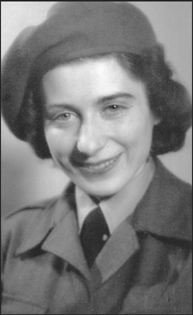
Ruth Fromm in the U.S. Army, 1947
Siegmund was the only one of Julius Fromm’s brothers and sisters to have survived National Socialism and the war while remaining in Berlin. A joint owner of Fromms Cosmetics, Siegmund had spent a long time weighing the pros and cons of fleeing to England, but he was quite attached to his charming apartment in Berlin. By the time Germany started the war, it was too late. His wife, Elsbeth, was “of German blood,” but had converted to Judaism before the wedding. In 1932 she gave birth to Alfred. A year later, she converted back to Christianity, and was classified as an Aryan. She also had Alfred baptized in May 1943. Even so, the authorities in Berlin labeled him a Geltungsjude (legal equivalent of a Jew), because of his Jewish religious instruction, and forced him to wear a yellow star.
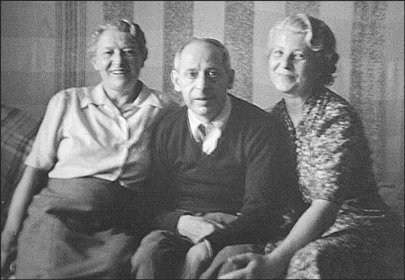
Helene, Siegmund, and Elsbeth Fromm in Berlin, 1947
The four weeks Siegmund spent in the Sachsenhausen concentration camp took a severe toll on his health. After his release in late 1938 he was required to report to the police daily for a full year. “Only someone who has experienced this,” he wrote in November 1945, “can appreciate what it means.” After the attacks on Poland and the Soviet Union, he was imprisoned in the police headquarters at Alexanderplatz, and suffered a mild “tension-induced stroke.” In March 1943, he was again taken into temporary custody, this time on Rosenstrasse. “This is why I often stayed away from my apartment for days or even weeks on end.”
His wife, Elsbeth, was “put to work as a washerwoman at Bergmann Company laundering soldiers’ coats, on orders from the Gestapo.” She contracted jaundice. Siegmund was no better suited for a prolonged period of hard labor, and he suffered “a complete physical and mental breakdown.” Beginning in 1942, he was forced to work as a packer for a printing press. “We watched him wither away with each passing day,” Elsbeth recalls.
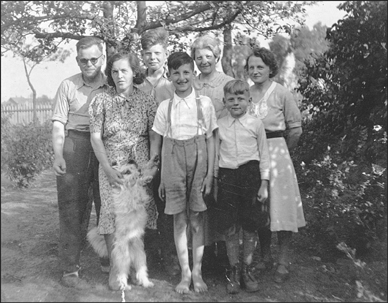
Alfred Fromm, foreground center, with the Schmidts, who hid him,
summer 1944; his mother, Elsbeth Fromm, is behind him to the right
Sunniva Graefe, a Finnish woman who had moved into Paulsborner Strasse 8 in Berlin-Wilmersdorf in 1941, struck up a friendship with the couple. To “declare [her] solidarity” with them and their son, Alfred, she accompanied them “into the special air-raid shelter for Jews.” She, too, watched “Herr Fromm grow more nervous by the day.” He had “crying fits,” and “later [gave] the impression of a man who was deeply tormented, both physically and mentally.” He died in 1952 at the age of fifty-nine.
Alfred often played with the two sons of Max Schmidt, a shoemaker who lived nearby on Paulsborner Strasse. As the air strikes grew ever more intense, the Schmidts decided in early 1943 to move to their house near Balz-Süd, in the vicinity of Landsberg on the Warta River. Gertrud Schmidt, a warmhearted working-class woman from Berlin, liked Alfred and understood the danger he faced in having to wear a yellow star, so she passed him off as her son, and took him with her to the country. He had to hide in the barn whenever there were visitors. However, he was quite a bit safer there than in Berlin. The eleven-year-old boy wrote to his mother in the spring of 1943: “I wish you a happy birthday and hope you are not bothered by any air-raid sirens. Too bad I wasn’t able to come.”87
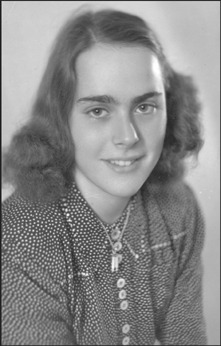
Alfred Fromm’s future wife,
Ilse Haacke, ca. 1945
Only once, in the summer of 1944, did Elsbeth Fromm dare to visit her son. Late in January 1945, Alfred set off alone for Berlin. The roar of gunfire on the front could be heard on the night that the boy, who had just turned thirteen, joined the refugees heading west. He and two German soldiers crossed the Oder River, which had frozen over. After stealing a uniform jacket from a boy in the Hitler Youth and discovering valid papers in it, he managed to find his way to his parents in Berlin. Alfred Fromm wrote an autobiographical account of this experience in 1996, and recalled the moment of liberation: “On May 1, 1945, at about 8 p.m., Red Army soldiers liberated us. When they came into our cellar, I hugged and kissed them, one after the other.”
He later married Ilse Haacke, a Jewish woman from Berlin. Before being deported to Theresienstadt, her mother had brought Ilse to stay with the Christian adoptive parents of her husband’s second wife in southern Germany. They passed her off as an “Aryan,” and in this way she was able to survive the Holocaust. Today she is a widow living in Munich. She shudders at the memory of having to make coffee for SS men in Bavaria: “We were both traumatized as children,” Ilse Fromm recalls, “and we were plagued by complexes. We always had the feeling that we were worthless. Alfred suffered from anxiety his whole life. It would have been better if our parents had not brought us into this world.”