
8.

JULIUS FROMM WAS FIFTY-FIVE YEARS OLD when, in October 1938, he had to leave the country that had become his homeland. He and his wife traveled to Paris to visit their son Max, and a few weeks later they went on to London, where Herbert and his wife, Ellen (née Friedländer), were already living. Back in Berlin, Ellen’s father had owned Friedländer & Grunwald, a company that made feather dusters; the factory was located in the same industrial complex on Elisabethstrasse where Fromm had for a time manufactured his condoms. Fromm had established excellent business contacts in the British Empire, which made London a logical choice for his forced relocation. He aimed to build on his past success and set up a new factory.
The British did not welcome the German Jews with open arms. For one thing, resentment of Jews ran deep in all social classes. “No doubt,” Neville Chamberlain, Conservative Party prime minister, wrote to his sister Hilda in 1938, “Jews arent [sic] a lovable people.”51 For another, politicians were united in their belief that Great Britain was not a country of immigration. The Conservatives aimed at achieving an ethnically and culturally homogeneous nation; Labour politicians and trade unionists did not wish to put their members in the position of having to compete with immigrants for the few available jobs.
The Aliens Act of 1905 had been put in place decades earlier to exercise greater control over the immigration of Eastern European Jews. Just a few days after the National Socialists came to power in Germany, officials noted a rapid increase in Jewish refugees. Since the visa requirement had been abolished for Germans and Austrians in 1927, the British border police had to stand by and watch as more and more newcomers masquerading as tourists or business travelers soon asked to be recognized as victims of religious and racial persecution so that they could apply for residence permits.
The officials in the Home Office Aliens Department quickly hit upon a pragmatic solution that would not cost the British taxpayers a single penny. The refugees would be permitted to extend their stay “provided that the Jewish community in Great Britain was prepared to guarantee, so far as might be necessary, adequate means of maintenance for the refugees concerned.”
Apart from this, the British considered England a temporary stopping point for Jews, who needed to move on as soon as possible to the United States, or at least to a remote part of the extensive British Empire. However, Lord Bledisloe, the governor-general of New Zealand, was one of many who were concerned that “immigrants from Germany might be at heart, if not openly, Communists, and spread revolutionary propaganda to the social unsettlement of the local community.” The Australian government chimed in with blatantly anti-Semitic arguments.
Julius Fromm entered the United Kingdom just as the political situation was coming to a head. After the Anschluss (annexation) of Austria and the ensuing smear campaigns against the Jews, thousands sought to escape to England, where the Jewish organizations were unable to meet the full financial needs of all the destitute refugees—many of them rendered destitute by the Germans. On May 2, 1938, the Home Office therefore reintroduced a visa requirement for Austrians; nineteen days later, this requirement was extended to Germans as well.
Julius and Selma Fromm had no difficulty obtaining visas. They could easily prove to the British Aliens Department that they were able to support themselves. At first the couple stayed at the Hotel Esplanade in London near Paddington Station. Sigmund Freud had also lived in this hotel, which was run by Austrian émigrés, after fleeing Vienna in June 1938. Later the Fromms rented a luxury apartment near Regent’s Park.
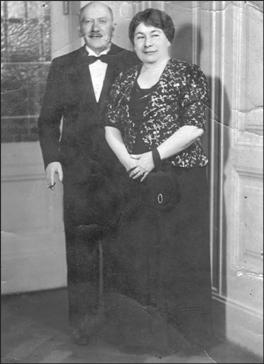
Julius and Selma Fromm in their apartment
in London, ca. 1940
No matter how comfortable their situation was, the Fromms were aware right from the time of their arrival in England that they were more tolerated than welcome. Like everyone else who had sought refuge in the British Isles, they were handed a card in German that read: “You are guests of Great Britain. Politeness and good behavior will ensure a kind reception and sympathy for you everywhere. Do not speak loudly in the streets, particularly at night. Be considerate about the comfort of other people, and avoid damaging the property and furniture of others. Never forget that England’s opinion of German refugees depends upon your behavior.”
The reverse side of this “welcome” card reminded them that “German refugees are urgently advised to exercise the utmost caution when speaking to others. For your own good, you are urgently advised not to accept any offers of employment without prior permission from the English government.”
Julius Fromm tried to obtain permission to build a condom factory, but the plan went up in smoke when the war began, so he had to bide his time. The resulting forced idleness was very hard on this indefatigable man of action. In Berlin he had been in charge of more than five hundred employees and a worldwide sales network. Now he was reduced to ruling a small household with the same iron fist that had brought him success in Germany. Soup was set out on the table for lunch at precisely 12:30. Anyone who came late went away hungry.

Possessions tie you down. The more the German Jews had worked their way up and gained recognition, the harder it was for them to relinquish what they had earned and leave their homeland. Although Julius and Selma Fromm had fled Berlin, Julius’s brothers and sisters hesitated to do the same.
Alexander had obtained a pro forma divorce from his non-Jewish wife and transferred ownership of the optician’s shop to her. Even so, he was required to designate his big, beautifully equipped shop at Memhardstrasse 4, designed by Korn and Weitzmann, a Jewish place of business. The exterior had black marble and bronze panels with two curved cut-glass display windows leading to the entrance. Two film vending machines were installed outside. Glass sliding doors, built-in leather sofas, mirrored walls, and recessed ceiling lighting made for an inviting atmosphere for customers.
Alexander Fromm wrote up a report of the events surrounding Kristallnacht and the damage to his store: “As it was marked as a Jewish business in 1938, it was subject to the night of pogroms against Jews on November 9.” All the store windows were broken, the inside décor—“optical instruments, all mirrors, glass cases, and cabinets”—destroyed, and “a large part of the goods” smashed or looted. In the later restitution proceeding, he estimated that the “damage during the expulsion of the Jews on November 9” had amounted to twenty thousand Reichsmarks. “Right after Kristallnacht, the Gestapo came to the shop to take me into custody; I was saved only because I had already gone into hiding.”52
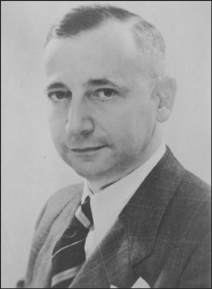
Alexander Fromm, ca. 1950
Salomon Fromm’s optician’s shop was also ransacked and demolished on that infamous night. Siegmund, who, like Alexander, was married to an “Aryan,” was taken away for a month to the Sachsenhausen concentration camp on the outskirts of Oranienburg, after which he was released, and required to report to the police on a daily basis for a full year.
By now, it must have been quite clear to Julius Fromm’s brothers and sisters that they had to get out of Germany as quickly as possible. The now-Aryanized Fromms Act was interested in acquiring Fromms Cosmetics Associates, which belonged in equal parts to Siegmund, Bernhard, and Else’s husband, Willy Brandenburg. On January 17, 1939, the three owners of Fromms Cosmetics had to appear before the notary Dr. Carl vom Berg on Bendlerstrasse, where Julius had been forced to sell his company. Fromms Act, owned by Göring’s godmother Elisabeth Epenstein, and represented by Julius Fromm’s longstanding directors, Berthold Viert and Karl Lewis, took over Fromms Cosmetics for a pittance: 16,700 Reichsmarks. The company’s estimated market value was 100,000 Reichsmarks. The annual sales, as a former employee later attested, amounted to approximately 300,000 Reichsmarks, and the annual profit was 35,000 Reichsmarks.
The purchase price was to be paid out by the notary once the sellers had initiated the new owners into the production process. To this end, the three of them had to “make their workforce available to the buyer.” The “sellers are obligated,” the contract further stated, to dismiss without severance pay “the remaining two non-Aryan members at the earliest possible time.” Since the cosmetics company was not deemed “strategically important for the war effort,” it closed down in October 1942.
In early 1940—one year after the sale—the time for Siegmund Fromm and Willy Brandenburg to receive their money had finally arrived. (Because Bernhard had been expelled, he was deemed ineligible for any payment.) They were each given 5,075 Reichsmarks, but did not have unrestricted use of this money. The chief of police had issued an order for the purchase price to be reduced from 16,700 to 15,225 Reichsmarks, and the buyers were told to send an “equalization payment” of 1,035 Reichsmarks to the state treasury. Although the chief of police had dragged his feet on enforcing the payment of this reduced sum of money, he was much speedier when it came to enforcing punitive measures against the family. Since Bernhard, his wife, Lucie, and their son Frank did not have German citizenship, a “prohibition on residence in the territory of the German Reich” was placed on the family a mere seven days after the compulsory sale, and their bank accounts were frozen.53 Fortunately for Bernhard and his family, Julius Fromm, who had arrived in London three months earlier, could vouch for them, and their visas were expedited. They lost all their possessions, however. “We had to leave behind even our clothing and linens,” Bernhard Fromm recalled after the war. “We could bring only a toothbrush and the clothes on our backs.”
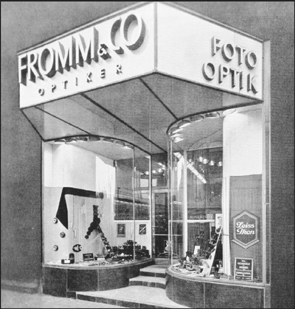
Alexander Fromm’s shop in Berlin-Mitte, 1927
Soon Alexander and his family and Ruth also left for London. Friends had found Ruth a job as a domestic servant with a Jewish family. On April 19, 1939, she boarded an airplane in Berlin’s Tempelhof airport. During the first week of September, her father, Sally, and his sister Helene flew out of Berlin. Julius had already financed Rudi Fromm’s escape to South Africa as well. Rudi was the son of his brother Max, who had died in 1930.
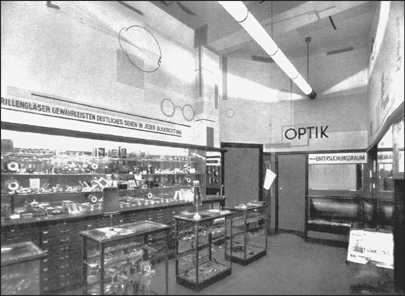
Interior view of Alexander Fromm’s shop, 1927
Julius rented a house at Canons Park in Stanmore, at the extreme northwestern end of London, for his relatives, but remarked in a rather businesslike manner a year later, “Unfortunately, I have provided a house for the whole family in order to keep the costs down. But because only Helene and Sally have moved in, it is now costing me a great deal of money.”54
When World War II began, the already precarious situation of most Jewish refugees in Great Britain deteriorated still further. After the Wehrmacht invaded Poland on September 1, 1939, and both France and Great Britain declared war on the German Reich two days later, the British resorted to a security measure that had been widely implemented during World War I, the internment of enemy aliens. They were not alone in doing so. In France, all Germans were arrested indiscriminately; in the United Kingdom, however, it took several weeks for the Home, Foreign, and War Offices to agree on a course of action.
Soon 120 tribunals throughout the country were classifying enemy aliens from Germany and Austria (and then from Italy as well) into three groups. Class A was made up of people about whom there were serious doubts regarding their loyalty; they were interned immediately. Class C comprised refugees who did not arouse suspicions. Those who were neither overtly suspicious nor above suspicion were placed in Class B.55 Their freedom of movement was restricted; for example, they were not allowed to go farther than five miles from their place of residence without police permission, and were barred from owning automobiles, cameras, binoculars, or weapons.
Nearly all of the 62,244 registered Germans and 11,989 Austrians, roughly 90 percent of them Jewish refugees, were summoned to the tribunals, which began their work in September 1939. Only 569 people were put into Class A, and 6,782 into B. The great majority, about 66,000, were classified as nonsuspicious and placed into Class C. Of those, 55,000 were granted the status of political refugees persecuted by the National Socialists.
Since the large majority of the tribunal staff members had no legal training, mistakes were bound to be made. Raimund Pretzel, who later became a renowned journalist under the name Sebastian Haffner, was assigned to Class A because he was not Jewish and thus could not prove that he had suffered persecution in Germany. In February 1940, he was interned in the county of Devon on the southern coast of England. There he met Jürgen Kuczynski, a Marxist historian, and Peter Jacobsohn, whose father, Siegfried, had founded the magazine Die Weltbühne. They had to spend the winter in unheated huts in a vacation complex patching up fishing nets.56
Most of the Fromm family members were deemed nonsuspicious and were placed in Class C, aside from Sally and his daughter Ruth. “The chairman of the tribunal,” Ruth Fromm explained, “accused my father of having started out as an Englishman, then letting his citizenship lapse and eventually becoming German.” He was therefore placed in Class B, and so was Ruth, in what amounted to guilt by familial association.
After German troops invaded Poland, they went on to occupy Denmark and Norway, and then overran Luxembourg, the Netherlands, Belgium, and France. The British faced a disaster in Dunkirk. Fortunately, 226,000 soldiers—nearly the entire British professional army—were able to escape across the English Channel to their homeland, but most of their equipment fell into the hands of the aggressors. Now the fear took hold of the otherwise stoic Britons that for the first time since 1066, invaders could occupy their island.
The fear of the “enemy from within,” or of a “fifth column” of Nazi spies, assumed panic proportions. The Daily Mail, a mass-circulation conservative newspaper, ran a headline on April 20, 1940, declaring: “Act, Act, Act—Do It Now.” The text read, in part, “All refugees from Austria, Germany, and Czechoslovakia, men or women alike, should be drafted without delay to a remote part of the country and kept under strict supervision.” Other newspapers followed suit, and once Winston Churchill had succeeded Neville Chamberlain in the aftermath of Chamberlain’s disastrous policy of appeasement, mass internments began—at first only along the English Channel and the North Sea, but soon throughout the country.
Early one morning, three policemen came to take Edgar Fromm from his parents’ apartment. They brought him to barracks outside London. His cousin Ruth ended up in strict solitary confinement in the infamous Holloway Prison in North London. Only after six weeks and a hunger strike were she and her fellow sufferers allowed a few hours’ daily recreation. Helene, Alex, and Bernhard Fromm were brought to an improvised camp; Herbert was deemed unable to withstand the rigors of detention and sent home to London after seven weeks. Fortunately for Julius, his wife, Selma, and Salomon, their doctor certified that at their age they could not be detained.
Edgar, who had just turned twenty and had recently fallen in love, was taken to Huyton, a transit camp near Liverpool.57 Many of the internees were still teenagers; most were unmarried. Word soon got around that they would be sent overseas. Most volunteered to do so in hopes of escaping life in the camp. Edgar actually wanted to join the British army to fight against Nazi Germany, but the camp commander was adamant: “If you do not get on board of your own free will, we will force you to do so.” Edgar later recalled, “They never let on where ‘overseas’ we would be heading.”
After ten days in the transit camp, about eight hundred camp inmates, of whom about two hundred were German prisoners of war, were brought to the Port of Liverpool, where they boarded the troop transport ship HMT Dunera. The guards made it quite clear from the outset that this would be no pleasure cruise. With calls like “Move, you bastards!” and prods with rifle butts, they were herded onto the ship. The prisoners had to hand over their possessions, then submit to a body search. Whatever the guards considered worthless was thrown overboard. Edgar Fromm asked whether he could at least keep a picture of his fiancée. “In reply,” he wrote in a 1957 report about his deportation, “a sergeant tore it out of my hand and pushed me down a spiral staircase.”
No sooner had the Dunera pushed off to sea than a rumor that was as gruesome as it was true began to circulate. The first contingent of enemy aliens had sailed ten days earlier, at dawn on July 1, 1940, on the Arandora Star, a passenger steamer that had been turned into a troop transporter. After only twenty-seven hours at sea, the ship was hit by a torpedo fired by Günther Prien (who was later hailed as a submarine hero in Germany), and it sank off the west coast of Ireland. It took just a half hour for it to vanish in the waves of the Atlantic. Over six hundred Italians and Germans drowned, among them a former communist Reichstag representative, Karl Olbrich, who had fled to Great Britain by way of Czechoslovakia after spending three years in German prisons and concentration camps.
One of the 229 German survivors (most of whom were sent off a second time on the Dunera) was Peter Jacobsohn. Edgar Fromm was now on the Dunera, one of 2,646 prisoners cooped up behind barbed wire on a ship built for eight hundred passengers and bound for parts unknown. Two-thirds of the prisoners were Jews, but 200 Italian fascists and 250 German National Socialists and prisoners of war were also on board.
The internees slept in hammocks, on tables, in overcrowded cabins, or on the floor. There were no blankets. Soon a mixture of vomit and urine was dripping from the overflowing latrine buckets onto the decks below. Food and drink were limited to tea and bread in the morning and afternoon, and there was cold soup for lunch. Two internees succumbed to disease en route, and another, overwhelmed with desperation, leaped overboard to his death. “At first we thought we were headed for Canada,” Edgar Fromm recalled. “But when it kept getting hotter, and then we passed Sierra Leone, it dawned on us that they were bringing us to Australia.”
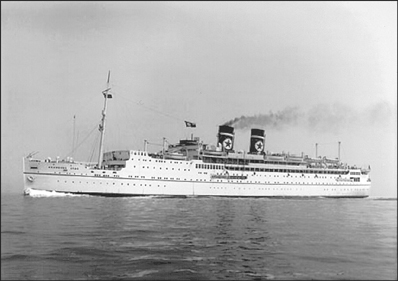
The Arandora Star, sunk by a German submarine
Most of the guards on the Dunera were convicts released on parole. They looted the internees’ luggage, and during a stopover in Cape Town, quite a few of them made off with their loot. Some were sadists who made the prisoners walk barefoot over broken glass. The officer in charge, Lieutenant Colonel William Scott, was unperturbed by this abuse, as documented in a message he telegraphed shortly before arrival to the Australian army department responsible for the prisoners of war. “The German Nazis,” in his “personal view,” had “exemplary” behavior, the message read. They are “of a fine type, honest and straightforward, and extremely well disciplined.” By contrast, the Italians, Scott contended, “are filthy in their habits, without a vestige of discipline, and are cowards to a degree.” The Austrian and German Jews, he declared, “can only be described as subversive liars, demanding and arrogant.”
An impressive aspect of British democracy is that even in times of war it allows for criticism. Once the details of the “hell ship” voyage had come to light, journalists and politicians were heated about what was now being called the “Dunera affair,” and about discrimination against Jewish refugees in general. The distinguished economist John Maynard Keynes spoke out on behalf of interned colleagues and declared that he had “not met a single soul, inside or outside government departments, who is not furious at what is going on.” Victor Alexander Cazalet addressed the House of Commons on August 22, 1940, to condemn the “tragedies” on the Dunera, which he deemed both “unnecessary and undeserved”: “No ordinary excuse, such as that there is a war on and that officials are overworked, is sufficient to explain what has happened,” he fumed. One year after the Dunera affair, William Scott and several guards stood trial. Scott was court-martialed and his deputy sentenced to a year’s detention.
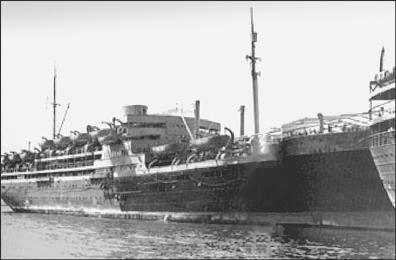
The British troop transport ship Dunera
After fifty-seven days at sea, the Dunera reached Sydney. Then Edgar Fromm and the majority of his fellow sufferers, about 2,600 in all, had to endure a nineteen-hour train ride before pulling into the town of Hay in New South Wales. Just outside the town, two internment camps—enclosed behind electric barbed-wire fences—had been set up so hastily that they seemed to have materialized out of thin air. Edgar was one of about a thousand Jewish deportees (some of whom had already spent time in German concentration camps) assigned to the spot in the desert designated as Camp 7.
During the day the temperature soared as high as 113 degrees Fahrenheit, and it was bitterly cold at night. Still, the food was good, and the Australians allowed the inmates to run the camp themselves. A former director of the Bavarian Mortgage and Exchange Bank helped them introduce their own currency. Doctors saw patients, an orchestra performed music, and young people completed their high school examinations. The prisoners put together a theater troupe and soccer teams. There was also kosher food for the Orthodox.58
Even before the British government publicly declared the indiscriminate internment and deportation a political blunder, the Home Office sent an envoy to the prisoners in Camp 7. This envoy was Major J. D. Layton, a Jew who in civilian life had worked as a London stockbroker. He offered the internees an alternative to remaining in Australia: anyone who volunteered to join the Pioneer Corps of the British Army could return to Europe.
Julius Fromm wrote to his son recommending that he stay in Australia and await the end of the war; at least he would be safe there. Edgar wanted to get back to England, however, come what may, so that he could marry his fiancée, Jolanthe Wolff. Jolanthe had been permitted entry into England in March 1939 because she had a household job lined up with the Fromms. Before long, Edgar and Jolanthe fell in love, but his father Julius was adamantly opposed to the match. For one thing, the woman Edgar had chosen was eight years older than he; for another, the factory owner considered a penniless servant not in keeping with their social standing—a strange sort of condescension, considering that Jolanthe’s father had been a judge in Hamburg and her mother was a member of the Weill family, a distant relative of the composer Kurt Weill. Her forefathers had lived in Germany for a good eight centuries; the family’s earliest known ancestors had emigrated from Spain in the thirteenth century, settling in Weil der Stadt near Stuttgart, from which they took their surname.
While Edgar was stranded in the Australian desert, he sent daily letters to Jolanthe. On December 23, 1941, after one and a half years overseas, Edgar Fromm came back to London and soon enlisted in the army. One year later, on New Year’s Eve 1942, he and Jolanthe were married. His parents pointedly avoided the wedding.
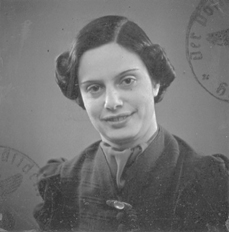
Jolanthe Wolff’s passport
photograph, 1939