
7.

SHORTLY BEFORE HERMANN GÖRING ESCAPED the hangman’s noose in October 1946 by swallowing a potassium cyanide capsule, he fantasized, “In fifty or sixty years’ time there will be statues of Hermann Göring all over Germany. Little statues maybe, but one in every German home.”48 A self-image this overinflated fits the impression of Göring as a robust, good-natured, and popular man. Unlike the ascetic and fanatic Hitler, or Joseph Goebbels, who was consumed by ambition, Göring had a crude barroom humor that people found appealing.
According to the British historian Richard Overy, Göring, the corrupt hedonist, embodied “the restless and violent nature of the National Socialist movement as a whole.” He spurred on economic preparations for war and, in conjunction with this, the theft of Jewish property. In the authoritarian anarchy of the Third Reich, he moved through a total of twenty-eight top positions and titles, from Reich Hunting Master to Reich Marshal, from Reich Minister of Aviation to Prussian Prime Minister to Reichstag President to Commissioner for the Four Year Plan.
If there had been a title of Reich Lord of the Castle, it would have gone to Göring as well. No other leading National Socialist took more pleasure in amassing grand manors or reveling in historical kitsch, which explains his eagerness to get the successful and highly profitable Fromms Act into the hands of his godmother, Elisabeth Epenstein von Mauternburg, knowing that in return she would make him a gift of two medieval castles. To understand his interest in trading a condom factory for a citadel setting steeped in a sovereign past, it helps to have a look at the Göring family history.
In contrast to most prominent Nazi Party members, the second-in-command could trace a lineage of ancestors who were high-level Prussian civil servants. His forefathers included a military adviser to Frederick the Great and a district chief executive. His father, Heinrich Göring, who was born in Emmerich in 1839, earned a law degree, served as cavalry officer in the Prussian army in the wars of 1866 and 1870/71, and, after the foundation of the German Reich, became a district court judge. Heinrich Göring attracted Bismarck’s attention with an 1884 memorandum urging the development of a colonial policy, whereupon Bismarck sent him to London to have a look at the efficient way the British ruled and exploited their colonies, and thus acquire the basic knowledge that the Germans lacked. Göring was a widower with five children. While in London, he married for a second time. His new wife was Franziska Tiefenbrunn, a Bavarian peasant girl and beer garden waitress who was a good twenty years his junior. Shortly thereafter, he was sent as governor general to the “protectorate” of German South-West Africa (present-day Namibia).
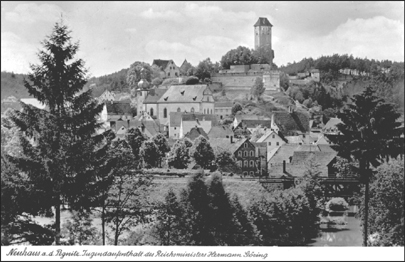
Postcard view of Neuhaus an der Pegnitz with Castle Veldenstein, ca. 1938
Once in the protectorate (through which he was driven in the same travel coach that Bismarck had used during the war against France), he and his wife got to know and enjoy the company of Hermann Epenstein, a doctor from Berlin and a former medical officer in the Prussian army who owned quite a bit of real estate and pursued his passion for hunting in Africa. He became Frau Göring’s doctor, and delivered her first son.
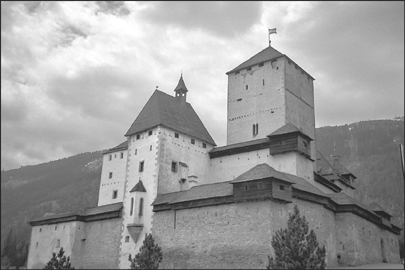
Castle Mauterndorf, 2006
Epenstein became a close friend and benefactor of the Görings. As the years went by, the childless bachelor became the godfather of the couple’s three sons and two daughters. There is much significance in the fact that the Görings’ second son, Hermann, who was born in 1893 in the Marienbad sanatorium near Rosenheim, was named after his godfather.
The elder Göring returned to Berlin after five years in Africa and six years as consul general and minister resident in Haiti. He and his family were now enjoying a lavish lifestyle in Berlin-Friedenau. The house belonged to their friend Epenstein. By this time, an intimate relationship had developed between Dr. Epenstein and Franziska Göring. This arrangement was quite beneficial for her family, which depended on her husband’s rather modest civil service pension. Epenstein later allowed the Görings to live rent-free in one of his two castles.
Werner Maser’s biography of Hermann Göring characterizes Epenstein as a “rich, cultivated, and artistically inclined Jew … whose penchant for luxury knew no bounds.” Actually, it was Epenstein’s father who had been Jewish, but he had converted to Christianity before marrying the daughter of a Catholic banker, and he had his son baptized as well.
In 1894 Epenstein purchased the rather dilapidated Mauterndorf Castle in Lungau, Austria, on the southern slope of the Hohe Tauern mountains, and had it restored at great expense. As a result, Emperor Franz Joseph I of Austria bestowed a title of nobility on the generous developer on August 8, 1910 and thenceforth he was known as Hermann Ritter Epenstein von Mauternburg. He had bought a second rundown castle in 1897 for twenty thousand gold marks: Castle Veldenstein, thirty miles northeast of Nuremberg. Sparing no expense, he commissioned a stonemason to restore it. This project took ten years to complete, and ran up a bill for the then-exorbitant sum of one million Reichsmarks.
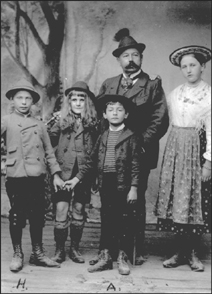
Left to right: Hermann, Paula,
Albert, and Olga Göring with
their godfather Hermann
Epenstein, ca. 1902
Once the renovations of Castle Veldenstein were complete in 1901, the Göring family moved in with Epenstein. According to the official Göring biography written in 1938, eight-year-old Hermann would have preferred to stay in Berlin at first, but he quickly changed his mind: “When he arrived in a horse-drawn carriage at the side of his father, and the road took them higher and higher, through the big castle gate and then through a second one, whose battlements and crenels struck him as even more beautiful; when he finally stood in the uppermost bailey, the castle tower, the deep well, and the vine-covered castle walls before him, the young Hermann’s heart soared.” “You really must come to Castle Veldenstein,” Göring’s sister Olga later told the friends of her now-famous brother. “This is where he spent his romantic youth, reading legends and dressing up as a knight, day in and day out. There you will be able to understand him.”
Göring’s father, who had become an alcoholic, spent his nights on the ground floor of the castle; his wife’s bedroom was one floor above, adjacent to Epenstein’s ornate chamber. The ménage à trois of the two Görings and their benefactor went on for fifteen years, until early in 1913, when Epenstein announced to Franziska that he had fallen deeply in love with another woman and would be marrying her soon. The woman’s name was Elisabeth Schandrovich Edle von Kriegstreu. She was thirty-six years younger than the wealthy knight. Born in Temesvar, which was then part of Hungary (and is now in Romania), she was the daughter of a Prague aristocrat and a Bohemian officer, and had grown up in Budweis (today Bude’jovice in the Czech Republic) and Aussig (in the Sudetenland). Epenstein’s niece recalled that “Aunt Lili” was “a radiant beauty.” When she was seventeen, she had married and quickly divorced. Now, at the age of thirty-three, she met Ritter Epenstein von Mauternburg, who was fatherly and immensely wealthy. A few short weeks after the new lady of the manor moved in, the Görings were asked to vacate the castle grounds after having spent twelve pleasant years there. They moved to Munich. Heinrich Göring died a few months later, in December 1913.
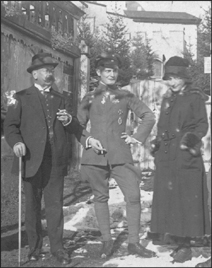
Left to right: Hermann
Epenstein von Mauternburg,
Hermann Göring,
Elisabeth Epenstein
von Mauternburg in
Mauterndorf, 1916
The close relationship between Hermann Göring and his godfather, whom he regarded as a second father, remained intact. When Göring was severely wounded in 1916 as a fighter pilot, he stayed with the Epensteins at Mauterndorf Castle. At the end of his convalescence, he traveled to Castle Veldenstein with Elisabeth Epenstein, whom he called Lili, and who saw herself as the godmother of the Göring children and friend of their widowed mother. Göring’s mother awaited them there. Göring later married Carin von Kantzow, a Swedish woman from a poor family with an aristocratic heritage. He also joined the National Socialist Party and had to flee the country in the aftermath of the failed Nazi putsch in 1923. Through it all, he continued his friendship with the Epensteins.
Immediately following the annexation of Austria in March 1938, he and his second wife, Emmy—Carin Göring had died in 1931—visited Mauterndorf Castle. He arrived with a large military escort and enjoyed an enthusiastic welcome. The lady of the manor was in a gloomy frame of mind, however. Her husband had died in 1934, at the age of eighty-four, and she was anxious about her godchild Albert (Göring’s younger brother), who was working in film studios in Vienna and made no secret of his antipathy for the Nazis. She also feared that the National Socialists would start a war.
It is not known whether Göring and his godmother took this occasion to discuss the swap of Fromms Act for castles that took place shortly thereafter, but it seems likely. After the death of her husband, Elisabeth Epenstein had found a new partner, a retired Viennese lieutenant colonel and merchant named Otto Metz-Randa. “He was not handsome, but he was charming,” Frau Epenstein’s niece recalled, “and he knew something about finances.” Metz-Randa saw little reason to own castles, since they just ate up money and yielded no profits. In his view, the more attractive option was to use the capital from Elisabeth Epenstein’s historical real estate to make lucrative investments.
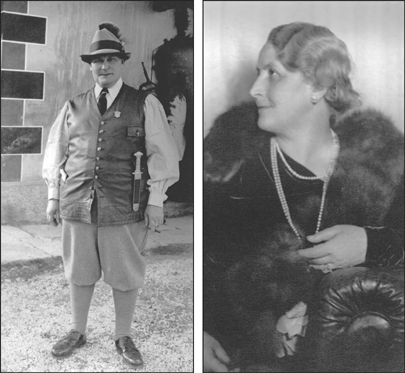
On left: Hermann Göring in Mauterndorf, March 1938
On right: Aryanizer Elisabeth Epenstein, 1938
Whatever plan Göring and Frau Epenstein may have hatched in March 1938, Göring was finally in a position to reciprocate for the decades of his godfather’s benevolence, and about four months later, Elisabeth Epenstein bought Fromms Act. She was also given a large piece of property—about 2,500 acres—in Gösing (Lower Austria), which had a horse and chicken farm as well as a luxury hotel with a staff of about a hundred workers and administrators. It had belonged to the Jewish timber industrialist Sigmund Glesinger of Vienna. Before he was able to emigrate to the United States, he had to Aryanize his possessions. This transaction was surreptitiously overseen by Göring, and his godmother reaped the rewards. On December 16, 1938, Fritz Langthaler, the provisional manager, informed the district authorities: “The Aryanization of [Glesinger’s] companies has been implemented with the authorized bill of sale, and I ask you to see to it that these companies are no longer listed in the directory of ‘Jewish Businesses.’ Heil Hitler.”
The anti-Semitic novel In the Shadow of the Ötscher (1943), by an Austrian regional writer named Lorenz Peter Herzog, gives a fictional account of this case. Glesinger (called Schlesinger in the novel) is here the imperious “company president from Frankfurt … who buys up everything” and recklessly modernizes it: “Tear down the portal, remove bearing walls, a couple of crossbeams, concrete floor, done!” His plans are thwarted by “an alliance between Berlin and Vienna,” which makes people like Glesinger “disappear at very short notice” and ensures that “an end is put to the bankers of the other race who are worth millions.” In Gösing (called Hinterburg in the novel) “something was actually being done for the good of the community.”49

February 1939 was the last time Elisabeth Epenstein visited the man who had helped her acquire the rubber factories and the country estate. He proudly showed her around Carinhall, his hunting lodge in Schorfheide, a vast forest north of Berlin. She then instructed her lawyer to transfer the ownership of Castle Veldenstein to Göring and his younger sister Edda as her gift to them.
Shortly thereafter she traveled to Chicago to visit her stepbrother. Before her departure, her lover, Otto Metz-Randa, persuaded her to draw up her will. The will named him executor of her estate. This document, which contained twenty-seven clauses, stated that Mauterndorf Castle was also to go to Hermann Göring. Clause 14 read: “I bequeath my factory (Fromms Act Rubber Works), that is, the property and business as well as the property and business of the Fromms Act Rubber Works, Inc. in Danzig, to Colonel Otto Metz-Randa, Vienna V, Schönbrunnerstrasse 12.” The country estate in Gösing also went to Metz-Randa.
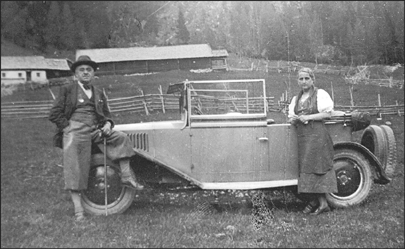
Elisabeth Epenstein with her lover and adviser Otto Metz-Randa, 1937
He was not the only one slated to profit from the condom business. Elisabeth Epenstein directed that even if “the factories lacked the raw materials to continue operations, Frau Olga Rigele would be paid 1,000 Reichsmarks a month; Frau Göring, Berlin, 500 Reichsmarks a month; and Frau Paula Hueber 500 Reichsmarks a month” from the “rubber works” profits. These three beneficiaries were Göring’s two married sisters and an unspecified “Frau Göring.”
During the war, Hermann Göring spent most of his time at the grandiose hunting lodge of Carinhall. He rarely visited Mauterndorf, but he did have a swimming pool built there. He lavished more attention on Castle Veldenstein, and in 1942 had an air-raid shelter constructed under the manor, with its own air, water, and electric supply. He also had the driveway paved with asphalt. On Easter 1945—with the Red Army already at the outskirts of Berlin—he paid a visit to Veldenstein in his Schienenzeppelin (a Zeppelin-shaped railcar). “Here he dressed down the contractors busy with the renovations,” Eitel Lange, his personal photographer, later reported. “He said to the supervisor: ‘I demand the fastest possible work from you and from every man in the contracting firm—now! If I return to find anything not in order, right down to the last nail, I will get nasty.’”50
No sooner had Elisabeth Epenstein returned to Mauterndorf from America on September 4, 1939, than she was found dead in her bed. Her niece, who still resides in Mauterndorf, attributes this sudden death at the age of fifty-three to her “chain smoking and constant coffee drinking to keep from getting fat.”