
[XIII]
Galileo threw himself into the work on the new book with all the force that his science, his religion, his life experience, and his flair for the dramatic allowed. The topic deserved nothing less:
“The constitution of the universe,” Galileo said in dedicating his Dialogue to the grand duke of Tuscany, “may be set in first place among all natural things that can be known. For coming before all others in grandeur by reason of its universal content, it must also stand above them all in nobility as their rule and standard. Therefore if any men might claim extreme distinction in intellect above all mankind, Ptolemy and Copernicus were such men, whose gaze was thus raised on high and who philosophized about the constitution of the world. These dialogues of mine . . . set forth the teaching of these two men whom I consider the greatest minds ever to have left us such contemplations in their works.”
The writing of the Dialogue occupied him intermittently for a period of six years following his 1624 meetings with Pope Urban. Since Galileo had actually begun thinking about the subject matter long before that, however, and even previously written the backbones of certain sections in nondialogue form, such as his “Treatise on the Tides,” he personally considered the book the product of a decade’s gestation.
Galileo had experimented with the dialogue style in his humorous exposition on the nova of 1604, as well as in actual playwriting for his family and friends, and his father had employed dialogue to write about ancient and modern music. Aside from the dialogue’s popularity for presenting scientific issues, the format offered Galileo a measure of protection: By putting the shortcomings of Ptolemy— and the merits of Copernicus—into the mouths of dramatis personae, the author could distance himself from their sensitive discussions as though he were an impartial bystander. In addition, the dialogue form allowed the characters occasionally to veer off the main theme to treat other topics—magnetism,* for example— that Galileo deemed “no less interesting than the principal argument.”
His book took the form of an animated encounter, spread over four days’ time, like a play in four acts, among three acquaintances who breathed their own personalities into the theories they entertained. The character he called Salviati, a thinly disguised alter ego, spoke Galileo’s own mind; Sagredo, an intelligent and receptive man of means, typically took Salviati’s side. Simplicio, on the other hand, a pompous Aristotelian philosopher who loved to drop Latin phrases, would often wax prolix on a topic before being played for a fool. Galileo also inserted himself as a minor character in the work by having the men cite the authority of “the Lyncean Academician” from time to time, or allude to the discoveries and ideas of “our mutual friend.”
Galileo, over sixty now, had reached the stage in life at which many of his own dearest friends had already died. But in the Dialogue, he brought two of the departed back to life for all time: Filippo Salviati, the gracious host at whose Florentine Villa delle Selve Galileo had resided for long periods, writing while recuperating from illnesses, and Giovanfrancesco Sagredo, who had been a private student of Galileo’s at Padua and kept in close touch with him till his death in Venice in 1620. The name Simplicio recalled no particular colleague of Galileo’s, but rather the sixth-century Greek philosopher Simplicius, a renowned commentator on Aristotle. Behind that ancient identity hid some unspecified pedant— thought to be Cesare Cremonini, University of Padua philosopher— who had frequently opposed Galileo in debate. Of course, the name Simplicio also sounded something like sempliciotto, or simpleton, which could hardly have escaped Galileo’s notice and might well have been his intention.
“Many years ago in the marvelous city of Venice,” Galileo recounted in the Dialogue’s preface, “I had several occasions to engage in conversation with Giovanfrancesco Sagredo, a man of most illustrious family and of sharpest mind. From Florence we were visited by Filippo Salviati, whose least glory was purity of blood and magnificence of riches; his sublime intellect fed on no delight more avidly than on refined speculations.” Galileo had often drawn these two out on the three main topics to be considered in the Dialogue, namely, the question of the Earth’s motion, the organization of the heavenly bodies, and the ebb and flow of the sea.
“Now, since bitter death has deprived Venice and Florence of those two great luminaries in the very meridian of their years, I have decided to prolong their existence, so far as my poor abilities will permit, by reviving them in these pages of mine and using them as interlocutors in the present controversy. . . . May it please those two great souls, ever venerable in my heart, to receive with favor this public monument of my undying friendship. And may they assist me, through my memory of their eloquence, to explain to posterity the promised reflections.”
The action of the Dialogue unfolds at Sagredo’s palazzo in Venice, where his guests, Salviati and Simplicio, arrive each day by gondola. The three have earmarked these four days, according to the conceit of the book, for their mutual enlightenment—to isolate themselves for an intellectual retreat so as to “discuss as clearly and in as much detail as possible” the two chief systems of the world (as the universe was then commonly called).
Writing in Italian for a mass audience, Galileo laced the five-hundred-page Dialogue with grand, gorgeous language, by turns poetic, didactic, reverent, combative, and funny. He illustrated the text, too, but only sparsely, by having his characters create simple line drawings for each other as need arose. “Just seeing the diagram has cleared the whole matter up,” Sagredo says gratefully to the more learned Salviati at one such juncture, “so go on.”
In the margins of almost every page, where Galileo normally penned notes to himself in the books he read, he put postils—short phrases that described the content of the paragraphs or reiterated their main points. A few densely numerical tables of observational data also entered the Dialogue, but not until the morning of Day Three, by which time the lay reader had been prepared either to absorb them or skip over them without losing the gist.
As for the central dilemma of the Dialogue—the challenge of championing Copernicus without alienating the Church—Galileo faced it on the very first page of his preface. Here he took pains to explain the delicate situation in Italy, where a scientist (he, Galileo) had made vital discoveries pertaining to the Copernican doctrine, but where the doctrine itself ran afoul of the reigning religious authorities. He had intimated as much in his “Reply to Ingoli.” Now he stated his position for the record, addressing “the discerning reader” as follows: “Some years ago there was published in Rome a salutary edict which, in order to obviate the dangerous tendencies of our present age, imposed a seasonable silence upon the Pythagorean opinion that the Earth moves. There were those who impudently asserted that this decree had its origin not in judicious inquiry, but in passion none too well informed. Complaints were to be heard that advisers who were totally unskilled at astronomical observations ought not to clip the wings of reflective intellects by means of rash prohibitions.” Indeed, Galileo himself had expressed exactly these sentiments in his Letter to Grand Duchess Cristina. But he wrote that plea before the edict was issued. After the fact of the edict, he did not gainsay the Holy Fathers. The Dialogue resumed his importuning that truths about Nature be allowed to emerge through science. Such truths, he still believed, could only glorify the Word and deeds of God.
“Upon hearing such carping insolence,” he continued in the preface,
my zeal could not be contained. Being thoroughly informed about that prudent determination, I decided to appear openly in the theater of the world as a witness of the sober truth. I was at that time in Rome; I was not only received by the most eminent prelates of that Court, but had their applause; indeed, this decree was not published without some previous notice of it having been given to me. Therefore I propose in the present work to show to foreign nations that as much is understood of this matter in Italy, and particularly in Rome, as trans-Alpine diligence can ever have imagined. Collecting all the reflections that properly concern the Copernican system, I shall make it known that everything was brought before the attention of the Roman censorship, and that there proceed from this clime not only dogmas for the welfare of the soul, but ingenious discoveries for the delight of the mind as well.
Then Day One opens like a curtain rising, with the characters already assembled and their conversation coming immediately to the point. The day’s discussions draw the dividing lines between the Aristotelian/Ptolemaic and the Copernican worldviews. To that end, Simplicio propounds Aristotle’s view of the Earth as fundamentally different from all celestial bodies—in that it comprises elements instead of aether. Salviati, à la Galileo, seeks to find the Earth a place in Heaven. And Sagredo good-naturedly grants the Earth— “the dregs of the universe, the sink of all uncleanness"—a unique strength born of its characteristic susceptibility to change: “For my part I consider the Earth very noble and admirable precisely because of the diverse alterations, changes, generations, etc. that occur in it incessantly. If, not being subject to any changes, it were a vast desert of sand or a mountain of jasper, or if at the time of the flood the waters which covered it had frozen, and it had remained an enormous globe of ice where nothing was ever born or ever altered or changed, I should deem it a useless lump in the universe, devoid of activity and, in a word, superfluous and essentially nonexistent.”
Salviati backs him up with the evidence from their “friend’s” telescope about how the Sun also changes, via spots erupting and receding round and round its girth. He suggests that the Moon, too, may be changing, and all the stars as well, fixed or wandering, but that the changes have thus far escaped detection. Immutability, which Aristotle had deemed a defining quality of perfect orbs, here dissolves into a simple lack of information.
“The deeper I go in considering the vanities of popular reasoning,” the host Sagredo resumes his musing,
the lighter and more foolish I find them. What greater stupidity can be imagined than that of calling jewels, silver, and gold “precious,” and earth and soil “base"? People who do this ought to remember that if there were as great a scarcity of soil as of jewels or precious metals, there would not be a prince who would not spend a bushel of diamonds and rubies and a cartload of gold just to have enough earth to plant a jasmine in a little pot, or to sow an orange seed and watch it sprout, grow, and produce its handsome leaves, its fragrant flowers, and fine fruit. It is scarcity and plenty that make the vulgar take things to be precious or worthless; they call a diamond very beautiful because it is like pure water, and then would not exchange one for ten barrels of water. Those who so greatly exalt incorruptibility, inalterability, etc. are reduced to talking this way, I believe, by their great desire to go on living, and by the terror they have of death. These individuals do not reflect that if men were immortal, they themselves would never have come into the world. Such men really deserve to encounter a Medusa’s head which would transmute them into statues of jasper or of diamond, and thus make them more perfect than they are.
Illness interrupted Galileo’s progress on the Dialogue in March of 1625. Though he recovered relatively quickly, he did not return to the book right away. Guiducci, his former live-in student and coauthor in the comet controversy, wrote to him from Rome that some unnamed “pious person” had lodged complaints with the Holy Office of the Inquisition about The Assayer, on the grounds that it undermined the Sacrament of the Eucharist. Galileo had commented in The Assayer on the nature of matter—how it breaks down into even smaller parts that lose all resemblance to familiar objects. This philosophy seemed to question the integrity of the bread offered in the mass as the body of Christ, and the wine that was His blood. As a precaution, Guiducci advised Galileo to muffle his “Reply to Ingoli” for the time being, since its praise of Copernicus was unabashed. And Galileo took the further prudent measure of suspending work on the Dialogue.
He occupied himself with other interests of his own and his official duties as philosopher to the grand duke, who called on Galileo to evaluate the schemes and machines that enterprising inventors tried to sell the Tuscan government. One such offering purported to pump water with miraculous efficiency, and another to revolutionize the milling of grain. After attending model demonstrations, Galileo would write polite but often daunting letters to the inventors, explaining the hopelessness of their ideas on the basis of the principles of simple machines.
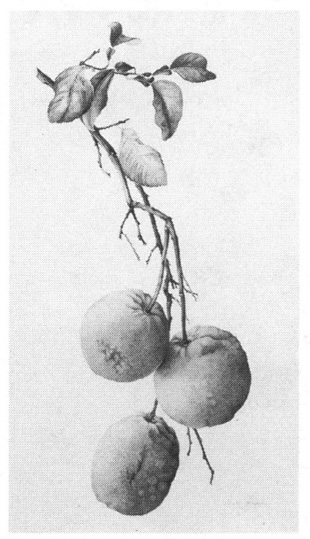
Branch of an orange tree
“I cannot deny that I was admiring and confused when, in the presence of the Grand Duke and other princes and gentlemen, you exhibited the model of your machine, of truly subtle invention,” Galileo began his critique of the would-be water pump. “And since I long ago formed the idea, confirmed by many experiments, that Nature cannot be overcome and defrauded by art,” he added soon after, “I have made an accumulation of thoughts and have decided to put them on paper and communicate them to you in order that if the success of your truly acute invention is seen in practice, and in very large machines, I may be excused by you, and through you excused by others.”
At the same juncture in 1625, Galileo also gave mathematical critiques on papers he received from his correspondents in Pisa, Milan, Genoa, Rome, and Bologna concerning their thoughts on the dynamics of river flow, the refraction of light, the acceleration of bodies in fall, and the nature of indivisible points.
In his spare time Galileo repaired to his garden, where he indulged the pleasure he had described of planting orange seeds— and lemons and chartreuse-colored citrons—in large terracotta pots. Galileo regularly sent the best of the citrons to Suor Maria Celeste, who would seed, soak, dry, and sweeten them over a period of several days to prepare his favorite confection. Having fared poorly with the fruits he consigned to her just before Christmas 1625, however, she sought a few other tokens she hoped would please him.
 MOST ILLUSTRIOUS AND BELOVED LORD FATHER
AS FOR THE CITRON, which you commanded me, Sire, to make into candy, I have come up with only this little bit that I send you now, because I am afraid the fruit was not fresh enough for the confection to reach the state of perfection I would have liked, and indeed it did not turn out very well after all. Along with this I am sending you two baked pears for these festive days. But to present you with an even more special gift, I enclose a rose, which, as an extraordinary thing in this cold season, must be warmly welcomed by you. And all the more so since, together with the rose, you will be able to accept the thorns that represent the bitter suffering of our Lord; and also its green leaves, symbolizing the hope that we nurture (by virtue of this holy passion), of the reward that awaits us, after the brevity and darkness of the winter of the present life, when at last we will enter the clarity and happiness of the eternal spring of Heaven, which blessed God grants us by His mercy.
And ending here, I give you loving greetings, together with Suor Arcangela, and remind you, Sire, that both of us are all eagerness to hear the current state of your health.
FROM SAN MATTEO, THE 19TH DAY OF DECEMBER 1625.
Most affectionate daughter,
S. M. Colost
I am returning the tablecloth in which you wrapped the lamb you sent; and you, Sire, have a pillowcase of ours, which we put over the shirts in the basket with the lid.

The garden at the Convent of San Matteo in Arcetri, where a rose could bloom at Christmastime, devoted much of its earthly paradise to herbs and medicinal plants the likes of rosemary (good for treating nausea) and rue (applied directly to the nostrils to stanch a bloody nose, or drunk with wine for headache). These grew among the pine, plum, and pear trees ranged around a central well in back of the church. Even the decorative rosebushes served an apothecary’s purpose, for the syrup of cooked, compressed rosebuds made an excellent purgative (prepared from several hundred roses, picked when the buds were half open, then steeped a full day and night in sugar and hot water). Just beyond the garden, the fragrant almond trees and evergreen olive trees cascaded down the slope behind the convent, where walkways led the nuns easily into Franciscan communion with Nature.
The convent’s walled perimeter, not to mention the rule of enclosure, detained Suor Maria Celeste in an anteroom of the afterlife. Rather than resent this separation from worldly affairs, cloistered monks and nuns at that time typically developed fierce attachments to their self-contained communities, where some spent long lifetimes (like the aunt of Pope Urban VIII who lived eighty-one years at her convent), and where, according to contemporary record books, miracles occurred as matters of course. A statue of the Blessed Virgin might weep or bow her head above the blue-flowered rosemary shrubs. Bones of saints buried in the on-site cemetery could be heard rattling to herald the death of a nun.
Florentine monasteries also guarded an abundance of holy relics, including fifty-one authentic thorns from the crown of Jesus and the tunic worn by Saint Francis of Assisi when the stigmata first appeared on his body.
The difference Suor Maria Celeste discerned between this vale of tears and the harmony of Paradise precisely echoed Aristotle’s distinction between corruptible Earthly matter and the immutable perfection of the heavens. This consonance was no coincidence, but the fruit of the labors of the prolific Italian theologian Saint Thomas Aquinas, who grafted the third-century-B.C. writings of Aristotle onto thirteenth-century Christian doctrine. The compelling works of Saint Thomas Aquinas had reverberated through the Church and the nascent universities of Europe for hundreds of years, helping the word of Aristotle gain the authority of holy writ, long before Galileo began his book about the architecture of the heavens.