
[XIV]
By 1626, Galileo had neglected his Dialogue for so long that his friends feared he might never return to it. And if not Galileo, then who would step forward to correct humanity’s self-centered view of the cosmos? Who better than Galileo to propound the most stunning reversal in perception ever to have jarred intelligent thought: We are not the center of the universe. The immobility of our world is an illusion. We spin. We speed through space. We circle the Sun. We live on a wandering star.
The apparent steadiness of the Earth lulls the mind into a false stability. The body’s footing feels so secure that the mind naturally interprets the daily bobbing up and down of the Sun, the Moon, the planets, and the stars as motions entirely external to the Earth. Even at night, under the open sky, assaulted by the intimations of infinity scintillating through the cope of heaven, the mind would rather cede revolution to the universe than relinquish the solace of solid ground.
This incontrovertible perception of Earthly rest gains support on every hand. The halting drop of each autumn leaf adds weight to the case for stillness. Indeed, if the Earth really turned toward the east at high velocity, falling leaves would all scatter to the west of the trees. Wouldn’t they?
Wouldn’t a cannon fired to the west carry farther than a salvo to the east?
Wouldn’t birds lose their bearings in midair?
These questions doubting the Earth’s diurnal motion consumed the participants in the Dialogue throughout Day Two of their deliberations.
Here Galileo demonstrated that the moving Earth—if it did indeed move—would impart its global motion to all Earthly objects. Instead of having to fight this movement in one direction and be abetted by it in the other, they would own it themselves, just as the passengers aboard a ship may saunter up or down the decks as their bodies travel—with more rapid motion, through no effort of their own—the two thousand miles from Venice to Aleppo.
As he built up the evidence for the Copernican thesis, Galileo interjected protective reminders regarding his own neutrality. “I act the part of Copernicus in our arguments and wear his mask,” Salviati explains to his two companions. “As to the internal effects upon me of the arguments which I produce in his favor, I want you to be guided not by what I say when we are in the heat of acting out our play, but after I have put off the costume, for perhaps then you shall find me different from what you saw of me on the stage.”
Thus freed to debate all the more forcefully, Salviati shows how a cannon pointed east moves east along with the Earth, as does the cannonball loaded inside it. After firing, therefore, the eastward shot has no trouble flying as far as a westward one. Nor do birds, though they fly slower than the Earth turns, find their flight adversely affected by the diurnal rotation. “The air itself through which they wander,” notes Salviati, “following naturally the whirling of the Earth, takes along the birds and everything else that is suspended in it, just as it carries the clouds. So the birds do not have to worry about following the Earth, and so far as that is concerned they could remain forever asleep.”
As participants in the Earth’s activity, people cannot observe their own rotation, which is so deeply embedded in terrestrial existence as to have become insensible.
“Shut yourself up with some friend in the main cabin below decks on some large ship,” Salviati suggests later on the second day,
and have with you there some flies, butterflies, and other small flying animals. Have a large bowl of water with some fish in it; hang up a bottle that empties drop by drop into a wide vessel beneath it. With the ship standing still, observe carefully how the little animals fly with equal speed to all sides of the cabin. The fish swim indifferently in all directions; the drops fall into the vessel beneath; and, in throwing something to your friend, you need throw it no more strongly in one direction than another, the distances being equal; jumping with your feet together, you pass equal spaces in every direction. When you have observed all these things carefully (though there is no doubt that when the ship is standing still everything must happen in this way), have the ship proceed with any speed you like, so long as the motion is uniform and not fluctuating this way and that. You will discover not the least change in all the effects named, nor could you tell from any of them whether the ship was moving or standing still.
Remarkably, Galileo conceded through this early demonstration in relativity, no experiment performed with ordinary objects on the surface of the Earth could prove whether or not the world was actually turning. Only astronomical evidence and reasoning from simplicity could carry the argument. Thus the daily rotation of the Earth streamlined the hubbub of the universe and recognized the cosmic balance of power. For if the heavens really revolved with enough force to propel the vast bodies of the innumerable stars, how could the puny Earth resist the tide of all that turning?
“We encounter no such objections,” Salviati replies to his own rhetorical question, “if we give the motion to the Earth, a small and trifling body in comparison with the universe, and hence unable to do it any violence.”
When evening falls on the long second day of the Dialogue, and the three friends exchange their good-byes, Simplicio leaves promising to review the modern Aristotelian arguments against the Earth’s annual motion, in preparation for the next day’s discussion. Salviati, too, stays up late to study an anti-Copernican text about comets and novas that Simplicio has lent him, and Sagredo lies awake, his thoughts flitting from one cosmological order to the other, eager for a resolution. But somewhere in that second day’s night of reflection, Galileo stopped writing, so that the conversation among the Dialogues three characters hung suspended for several years while their author continued thinking through the intricate proofs to be presented, and also tended to other pressing affairs.
The long-promised pension for Galileo’s son at last became real in 1627 through a bull issued by Pope Urban VIII. Vincenzio was to receive a canonry up north at Brescia, along with an annual income of sixty scudi—except that he refused the offer. Still attending school at Pisa, twenty-one-year-old Vincenzio admitted that he felt a “bitter hatred of the clerical state.” This confession drove a new wedge between him and his father, and also compelled Galileo to find another recipient for the pension itself. A candidate soon emerged from the ranks of his extended family.
In May of 1627, Galileo received a letter from his brother, Michelangelo, who now carried on their father’s unremunerative musical profession in Munich. Michelangelo proposed to send his wife, Anna Chiara, along with a few of their eight children, to stay with Galileo in Florence for an unspecified length of time, where the family would be safe from the German turmoil of what eventually came to be called the Thirty Years’ War. This conflict had begun in 1618, when enraged Protestant noblemen threw two Catholic governors out the windows of the royal castle in Prague. The “Defenestration of Prague” renewed long-dormant religious bloodshed between Protestant and Roman Catholic states in Germany. In no time the conflict drew in neighboring countries warring for the political prize at stake: control of the Holy Roman Empire of the German nation. By 1627, the fighting, almost entirely confined to German soil, embroiled Dutch, Spanish, English, Polish, and Danish armies. If impoverished Michelangelo needed a good excuse to export his family to Italy, the war certainly added substance to his personal reasons.
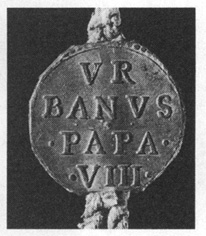
Papal seal of Urban VIII
“This arrangement would be good for both of us,” Michelangelo wheedled. “Your house will be well and faithfully governed, and I should be partly lightened of an expense which I do not know how to meet; for Chiara would take some of the children with her, who would be an amusement for you and a comfort to her. I do not suppose that you would feel the expense of one or two mouths more. At any rate, they will not cost you more than those you have about you now, who are not so near akin, and probably not so much in need of help as I am.”
Anna Chiara arrived in July, with all her children in tow, not to mention their German nurse, for a total of ten additional mouths to feed. Thus Galileo, at age sixty-three, suddenly found himself the head of a noisy household that included his infant niece, Maria Fulvia, two-year-old Anna Maria, Elisabetta, three unruly boys— Alberto, Cosimo, and little Michelangelo—and Mechilde, the dutiful older daughter. Galileo arranged for his eldest visiting nephew, the twenty-year-old Vincenzio, to study music in Rome. He further accommodated the youth by granting to him the papal pension he had secured for his own Vincenzio.
Although Michelangelo’s Vincenzio evinced genuine musical talent, he disdained to work at his lessons. The Benedictine monk Benedetto Castelli, who had taken Galileo’s son in hand in Pisa, had recently been transferred to Rome, where he now tried vainly to keep Galileo’s nephew in line. But this Vincenzio stayed out all night with rapscallions, ran up debts, and flouted religious decorum so flagrantly that his Roman landlord threatened to have him denounced to the Holy Office of the Inquisition.
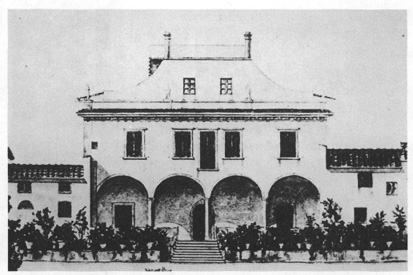
Galileo’s house at Bellosguardo, where he lived from 1617 to 1631
In Brescia, meanwhile, resident clerics ignored Galileo’s transfer of the pension from one Vincenzio Galilei to another: They elected a citizen of their own town to serve as canon. (Galileo waited a few years for the popular Brescian to die and create a new vacancy before he tried to install another family member in that post.)
With his house filled to the rafters, Galileo abandoned Bellosguardo when he next fell ill in mid-March of 1628, taking refuge at the home of acquaintances in Florence.
“Something in the peaceful air today,” Suor Maria Celeste wrote him when he had recovered and returned to his own quarters,
gave me half a hope of seeing you again, Sire. Since you did not come, we were most pleased with the arrival of adorable little Albertino, along with our Aunt, giving us news that you are well and that you will soon be here to see us; yet my delight was all but destroyed when I learned that you have already returned to your usual labors in the garden, leaving me considerably disturbed; since the air is still quite raw, and you, Sire, still weak from your recent illness, I fear this activity will do you harm. Please do not forget so quickly the grave condition you were in, and have a little more love for yourself than for the garden; although I suppose it is not for love of the garden per se, but rather the joy you draw from it, that you put yourself at such risk. But in this season of Lent, when one is expected to make certain sacrifices, make this one, Sire: deprive yourself for a time of the pleasure of the garden.
Galileo had considered undertaking a second pilgrimage to Loreto in 1628, marking the decade since his last call at the Casa Santa. He mentioned the possibility in a letter to his brother, and even suggested taking his sister-in-law, Anna Chiara, along with him on the long trek, but his illness prevented him from making such a trip. Instead, Anna Chiara and her children, whom Suor Maria Celeste now referred to as “the little rabblerousers,” took their leave. Catholic forces in Germany seemed virtually assured of victory at this point, and in any case, after nearly a year, it was time to go home.
Soon after his long-visiting relatives returned to Germany in the spring of 1628, Galileo fell into a tenure wrangle with the University of Pisa. His original appointment to the Tuscan court in 1610 had included a lifetime chair on the university faculty, conferred by Cosimo II. Galileo occupied the honorary position in absentia, with no obligation even to visit Pisa, and no mandatory teaching duties to derail him from his more important mission of discovering novelties and announcing them to the world at large for the greater glory of the grand duke. But the university administration, tired of honoring the old contract, suddenly moved to dissolve it. Galileo fought back with vigor, and with the full support of Ferdinando II, for although his professorial appointment had come through the court, the university paid Galileo’s salary of one thousand scudi annually.
By April, Galileo told Suor Maria Celeste of his plans to go to Pisa. In addition to the legal proceedings with the university (which wore on, with and without his presence, for nearly two years before Galileo emerged victorious), he meant to attend Vincenzio’s graduation. Suor Maria Celeste pressed him to do a favor en route for two poor nuns at the convent by purchasing several yards of cheap Pisan wool cloth, for which they had pooled together eight scudi.
At the Pisan academic ceremonies, Vincenzio collected his doctoral degree in law as the culmination of six years of study. (Galileo himself had never experienced this rite of passage, having left school without completing his required courses.) A more mature Vincenzio now returned home to his father’s house at Bellosguardo, where he turned twenty-two in August. He took to paying regular visits to his sisters at San Matteo. And the following December he delighted Galileo with his decision to marry young Sestilia Bocchineri, whose family held prestigious appointments in the Tuscan court.
 MOST BELOVED LORD FATHER
THE UNEXPECTED NEWS delivered here by our Vincenzio regarding the finalization of his wedding plans, and marrying into that esteemed family, has brought me such happiness that I would not know how better to express it, save to say that, as great as is the love I bear you, Sire, equally great is the delight I derive from your every joy, which I imagine in this instance to be immense; and therefore I come now to rejoice with you, and pray our Lord to protect you for a very long time, so that you can savor those satisfactions that seem guaranteed to you by the good qualities of your son and my brother, for whom my affection grows stronger every day, as he appears to me to be a calm and wise young man.
I would much rather have celebrated with you in person, Sire, but if you would be so kind, I implore you to at least tell me by letter how you plan to arrange your visit with Vincenzio’s betrothed: meaning whether it may be well to meet in Prato when Vincenzio goes there, or better to wait until she is in Florence, since this is the usual formality among us sisters, and surely, given her experience of having been in a convent, she will know these customs. I await your resolution. And in the meanwhile I bid you adieu from my heart.
Your most affectionate daughter,
S. M. Coloste 