
[XXXI]
The wednesday before the start of Advent, when Suor Maria Celeste went searching for the pears Galileo had requested, she briefly imagined saving them to present to him in person—before her doubts dispelled these pleasant thoughts. “Because I hear that this year the fruits do not last long, I wonder if it might be better, once I have them, to send them to you right away and not wait for your return, which could be delayed for several more weeks, or so my desire leads me to fear.”
By Church tradition, the hopeful time of Advent commenced with the Sunday closest to the feast day of Saint Andrew the Apostle, November 30. In 1633, the nearest Sunday happened to fall on November 27—the earliest possible date for Advent to begin, and this stretched the period to its maximum duration of twenty-eight days. Everything that had anything to do with waiting dilated during the dark season Suor Maria Celeste spent anticipating her father’s return. In her Breviary she read the Advent Liturgy regarding “the Lord the King that is to come,” “the Lord already near,” and “Him Whose glory will be seen on the morrow.”
Inside the tiny Church of San Matteo, Suor Barbera prepared the violet-colored candles, the seasonal violet altar hangings, and the special violet and rose vestments for the priest.
“It does me good to hope, and also to believe firmly,” Suor Maria Celeste wrote to Galileo on December 3, “that His Lordship the Ambassador, when he departs from Rome, will be bringing you the news of your dispatch, and also word that he personally will conduct you here in his company. I do not believe that I will live to see that day. May it please the Lord to grant me this grace, if it be for the best.”
Suor Maria Celeste’s fear of not living to see Galileo’s return might have stemmed from some morbid presentiment regarding her indifferent health, but more likely it arose from her frustration at the innumerable delays and rumors bearing false hope. "I understand everyone in Florence is saying you will soon be here,” she wrote the following week, “but until I have this from your lips, all I will believe is that your dear friends are allowing their affections and desires to give themselves voice.”
This time, however, the hearsay held true. Urban had condescended at last to change Galileo’s place of imprisonment to Arcetri— not so much to commute his sentence as to make it harsher, since the ambience at Siena approached that of an exclusive salon. The pope’s recommendation to the Holy Office stipulated that Galileo be limited in his social contacts henceforward, and that he refrain everafter from all teaching activities. Under these conditions, he now would be allowed to go home.
 MOST BELOVED LORD FATHER
ONLY A MOMENT before the news of your dispatch reached me, Sire, I had taken my pen in hand to write to Her Ladyship the Ambassadress to beg her once more to intercede in this affair; for having watched it wear on so long, I feared that it might not be resolved even by the end of this year, and thus my sudden joy was as great as it was unexpected: nor are your daughters alone in our rejoicing, but all these nuns, by their grace, give signs of true happiness, just as so many of them have sympathized with me in my suffering.
We are awaiting your arrival with great longing, and we cheer ourselves to see how the weather has cleared for your journey.
Signor Geri was leaving this morning with the Court [for the annual winter session at Pisa], and I made sure to have him notified before daybreak of your return, Sire; seeing as he had already learned something of the decision, and came here last evening to tell me what he knew.
I also explained to him the reason you have not written to him, Sire, and I bemoaned the fact that he will not be here when you arrive to share in our celebration, since he is truly a perfect gentleman, honest and loyal.
I set aside the container of verdea wine, which Signor Francesco could not bring along because his litter was too overloaded. You will be able to send it to the Archbishop later, when the litter makes a return trip: the citron candy morsels I have already consigned to him. The casks for the white wine are all in order.
More I cannot say for the dearth of time, except that all of us send you our loving regards.
FROM SAN MATTEO, THE 10TH DAY OF DECEMBER 1633.
Your most affectionate daughter,

Here she was rushing to get her last letter to her father into the hands of Signor Francesco Lupi, Suor Maria Vincenzia’s brother-in-law, before his litter rumbled off to Rome by way of Siena. Although the Niccolinis could not accompany Galileo back to Arcetri as they had intended, Galileo indeed returned by the end of the week. Grand Duke Ferdinando came in person to II Gioiello to welcome him back and stayed to visit for two hours. They spoke of life and honor, and how Galileo had preserved his against formidable odds, to become even more esteemed in his patron’s eyes. If Ferdinando’s fidelity to Galileo had fluttered briefly during the trial in response to Urban’s threats, the future would find him a more steadfast friend.
On December 17, Galileo wrote a formal letter of thanks to his most highly placed supporter in Rome, Francesco Cardinal Barberini:
I have always taken special note of how affectionately Your Eminence has empathized with me in the events that befell me, and I especially recognize the value of your intercession in ultimately securing for me the grace of my being allowed to return to the quiet of my villa, precisely as I wanted to do. This and a thousand other kindnesses, all originating from your benign hand, confirm in me the wish, no less than the obligation, to always serve and revere Your Eminence, whenever it may please you to honor me with your command: not having such an order from you at the moment, I render the requisite thanks for the favor received, which I so fervently desired; and with the most respectful love I bow to you and kiss your robe, wishing you every happiness this most holy Christmas.
In truth Galileo was not so much home now as under perpetual house arrest. Later he would dateline his letters, “From my prison in Arcetri.” He was forbidden to receive any visitors who might discuss scientific ideas with him. Nor could he go anywhere except to the neighboring convent, where the private reunion with his daughters revealed the true emotional cost to Suor Maria Celeste of the long, anxious separation. She had been frequently ill, he discovered, but had paid too little attention to herself.
Galileo might have expected her to regain her stamina now in the relief of his repatriation and the sudden respite from responsibility for his affairs. But instead she grew weaker.
“Most of all I am distressed by the news of Suor Maria Celeste,” Niccolo Aggiunti wrote from Pisa when Galileo told him of her condition. “I know the fatherly and daughterly affection which exists between you; I know the lofty intellect, and the wisdom, prudence, and goodness with which your daughter is endowed, and I know of no one who in the same way as she remained your unique and gentle comforter in your tribulations.”
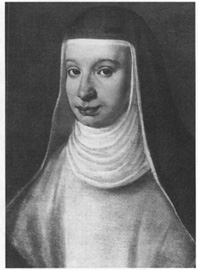
Unsigned, undated portrait thought to be of Suor Maria Celeste
For months she had dropped all talk of entering the other life, to focus only on having her father return to his home and their life together. But now it seemed that both those prayers might be answered simultaneously.
In the weakened state she had described so often, Suor Maria Celeste easily succumbed to one of the many contaminants in the food or water supply. Toward the end of March 1634, she fell gravely ill with dysentery. From the moment she took sick, Galileo walked from II Gioiello to San Matteo every day, trying to hold on to her with love and prayer. The disease cursed her with intense, unremitting abdominal pain. Her inflamed intestines evacuated fluids indiscriminately, some blood along with the vital water, until she became dehydrated. The tiny amounts of broth she could swallow would not revive her, and finally the whole balance of her body tipped against her heart. Despite the best efforts of Doctor Ronconi and Suor Luisa to save her, she died during their vigil on the second night of April.
Galileo’s grief felled him. For months he sought his only solace in reading religious poems and dialogues.
“The death of Suor Maria Celeste still tears at my heart,” the ambassadress Caterina Niccolini said in condolences sent from Rome on April 22, “like the love I bore her on account of her most virtuous nature, as well as those traits she inherited from Your Lordship, with whom I sympathize completely in this torment and in all else you have suffered.”
The archbishop of Siena apologized that he could find no words to console his friend on the loss of such a daughter, but he tried to nevertheless, and he counseled Galileo to summon all his forbearance and strength for this current trial. “I have known for a long time that she was the greatest good Your Lordship had in this world,” the archbishop wrote, “and of such towering personal importance as to merit more than paternal love. But her having employed her spirit in the service of the next life now grants her the privilege of that singular charity, enabling her to transcend our human plight, so that she deserves to be envied rather than pitied.”
Geri Bocchineri rued the irony that Suor Maria Celeste, truly worthy of living for centuries, had followed the all too human course of dying young. “A father who turns his tender love toward a most virtuous, most reverent daughter,” Signor Geri wrote Galileo, “cannot deny himself the full expression of his loss at her departure; of necessity, his tears must fall. But Your Lordship can cherish the hope that a maiden so good and holy will make her way straight to the Lord God, and pray for you there before Him, and so you may reconcile yourself to that encounter, and be consoled, rather than rail against the death that has placed her in Heaven, for I believe we will need to entreat her far more than she will ever need our prayers. Always have I admired and esteemed her, and never once did I leave her presence without feeling edified, moved, contrite. Surely blessed God has already gathered her into His arms.”
As Galileo received the comfort of these words, he still suffered the effects of his physical frailties, including the aggravation of his hernia. These problems mixed with his unhappiness to produce an irregular pulse and heart palpitations.
“I feel immense sadness and melancholy,” Galileo confided to Signor Geri at the end of April, “together with extreme inappetite; I am hateful to myself, and continually hear my beloved daughter calling to me.”
Galileo’s son, Vincenzio, chose this difficult moment to make his own pilgrimage to the Casa Santa in Loreto, and from there to assume a series of law clerkships outside Florence, against his father’s objections.
“I do not think it proper that Vincenzio should leave me for his travels,” the bereft father complained to Signor Geri, “since from one hour to the other something might happen which would make his presence useful, because in addition to all this [mourning and sickness] a perpetual sleeplessness makes me afraid.”
In July, in a letter to Elia Diodati in Paris, Galileo explained Suor Maria Celeste’s death in the context of his punishment and limited future:
I stayed five months at Siena in the house of the archbishop; after which my prison was changed to confinement to my own house, that little villa a mile from Florence, with strict injunctions that I was not to entertain friends, nor to allow the assembling of many at a time. Here I lived on very quietly, frequently paying visits to the neighboring convent, where I had two daughters who were nuns and whom I loved dearly, but the eldest in particular, who was a woman of exquisite mind, singular goodness, and most tenderly attached to me. She had suffered much from ill health during my absence, but had not paid much attention to herself. At length dysentery came on, and she died after six days’ illness, leaving me in deep affliction. And by a sinister coincidence, on returning home from the convent, in company with the doctor who had just told me her condition was hopeless and she would not survive the next day, as indeed came to pass, I found the Inquisitor’s Vicar here, who informed me of a mandate of the Holy Office at Rome that I must desist from asking for grace or they would take me back to the actual prison of the Holy Office. From which I can infer that my present confinement is to be terminated only by that other one which is common to all, most narrow, and enduring forever.
Into Galileo’s morbid house at this juncture, his widowed sister-in-law, Anna Chiara Galilei, brought three daughters and her youngest son, Michelangelo, only to perish there with them during a brief reprise of the plague in 1634. Then Galileo, in his loneliness, invited another son of Anna Chiara’s to stay with him—Alberto, Suor Maria Celeste’s “adorable little Albertino,” who now worked as violinist and lutenist to the elector in Germany. The two men comforted each other for a time at II Gioiello until Alberto went back to Munich to marry.
Now there was nothing for Galileo to do but lose himself in his work. In August he resumed active correspondence with fellow mathematicians, and in the autumn he reopened the unfinished manuscript for Two New Sciences.