
Diane de Poitiers — Her childhood — Her marriage with Louis de Brézé, Grand Sénéchal of Normandy — Arrest of her father, M. de Saint-Vallier, for complicity in the conspiracy of the Connétable de Bourbon — He is condemned to death, but his sentence is commuted when actually on the scaffold — Accusation of the Huguenot historian, Regnier de la Planche, that Diane redeemed her father's life by the sacrifice of her honour to François I — Anecdote of Brantôme — Opinions of various historians on this point — Conclusions of Georges Guiffrey — Assertion of Lorenzo Contarini, Venetian Ambassador to the French Court, that Diane became François's mistress at a later period — Arguments of Ludovic Lalanne as to the authorship of a packet of love-letters addressed to the King — Opinions of Champollion, Sainte-Beuve, and Guiffrey — Question of the relations between Diane and the poet Clément Marot considered — Extraordinary respect shown by the Grande Sénéchale for the memory of her husband — Date of the beginning of her liaison with the Dauphin — Verses of Clément Marot — Methods adopted by the lady in the subjugation of the young prince — Politic attitude of Catherine de' Medici towards her husband's inamorata — Antagonism of Madame d'Étampes to Diane — Vouté's epigrams against the Sénéchale — The enmity between the two ladies divides the Court into rival factions
THE year 1536 was a very eventful one in the life of Henri de Valois, for not only did he become, by the death of his elder brother, heir to the throne of France and receive his first lessons in the art of war, but it was now that he fell under the influence of the woman who was to mould him into what he subsequently became, and to exercise over his heart and mind an ascendency which was to endure until the day of his death.01
Diane de Poitiers, whose remarkable astuteness and strength of will, far more than the charms of her person, which, in point of fact, tradition has a good deal exaggerated, were to make her for twelve years the uncrowned Queen of France, was the eldest of the three daughters of Jean de Poitiers, Sieur de Saint-Vallier, who traced his descent from Guillaume de Poitiers, last Duke of Aquitaine, and was born, according to the calculation of Dreux du Radier,02 on September 3, 1499, probably at the Château of Saint-Vallier, since it was here that she is known to have passed her childhood. She appears to have received a better education than most young girls of that period, while, as we are told that she went hunting and hawking with her father at the age of six, her physical training was evidently not neglected. She also acquired something which was to prove of infinite service to her in her career as a Court beauty, namely, habits of personal cleanliness, but too unusual in the early part of the sixteenth century; and there can be little doubt that it was to the regular use of cold water, and not, as certain of her contemporaries affirmed, to the possession of some wonderful elixir, that she was indebted for the preservation of her naturally brilliant complexion long after the bloom of other ladies of her age had become merely a memory.
After serving for a short time as fille d'honneur to Marguerite d'Angoulême, Diane married, on March 29, 1514, Louis de Brézé, Comte de Maulevrier, Grand Sénéchal of Normandy, son of that Jacques de Brézé whose name recalls one of the most tragic episodes of the reign of Louis XI. Married, somewhat against his will, to Charlotte de France, natural daughter of Charles VII and Agnes Sorel, he had by her six children, but having, on the night of May 13-14, 1476, surprised her in flagrante delicto with her lover, Louis de la Vergne, he poniarded them both on the spot. For this crime he was condemned to death, and only escaped the block by the surrender of all his property, which, however, was restored to him after the King's death.
A middle-aged widower who bore the reputation of being one of the ugliest men of his time was scarcely the kind of husband to appeal to a girl of fifteen, but he was wealthy, high in favour with the King, generous, and even-tempered, and Diane, who was a sensible young lady, would appear to have been well content with her lot. With the exception of the birth of two daughters, her married life was uneventful until 1523, the time of the conspiracy of the Connétable de Bourbon. The Constable succeeded in making his escape to Italy, but the majority of his accomplices were not so fortunate, and Diane learned to her dismay that among those who had been apprehended was her father, M. de Saint-Vallier, concerning whose treasonable dealings she had, of course, been in entire ignorance.
Saint-Vallier had been arrested at Lyons, on the evening of September 5, and conducted to the Château of Loches, whence he hastened to acquaint his daughter and son-in-law with the calamity which had befallen him. "Monsieur mon fils," he writes to Louis de Brézé, "the King has ordered me to be arrested without any reason . . . and has caused me to be conveyed to the Château of Loches, as a false traitor, which occasions me such horrible grief that I am dying of it." And to Diane: "Madame la Grande Sénéchale, I have arrived at the Château of Loches, as badly treated as poor prisoner could be. . . . I beg you to have sufficient pity upon your poor father as to be willing to come to see him."03
From which it will be gathered that the Sieur de Saint- Vallier was very far from being of the stuff whereof heroes are made.
The misguided old gentleman was kept in a darksome dungeon at Loches until the beginning of the following year, when he was brought to Paris for trial, and on January 17, 1524, found guilty of high treason and condemned to death. A month later, he stood, more dead than alive, upon the scaffold on the Place de Grève, and his head was on the point of parting company from his body, when an archer of the King's Guard arrived, bringing an order from his Majesty which commuted the capital sentence to "perpetual imprisonment between four stone walls, with only a small window, through which his food and drink will be administered to him."
How long M. de Saint-Vallier remained in this extremely unpleasant situation is uncertain. Any way, he was at large again in 1532, for in that year we learn that he took unto himself a third wife, who, we may presume, was careful to see that his energies were employed in some less dangerous occupation than politics.
By whose influence and at what price was the condemned conspirator's very modified pardon obtained? This is a question upon which the imagination of historians has been freely exercised, at the expense of the future mistress of Henri II and of that monarch's predecessor on the throne.
"She [Diane]," says Brantôme, "was above all things a very good Catholic and hated bitterly those of the Religion, which is the reason why they have very much hated and slandered her."04 Diane, indeed, showed herself pitiless towards the Protestants, and they, in their turn, were pitiless towards her, after her empire was at an end. Not only did they reproach her with the shame and scandal of her recent influence, and declare her to have been a blight upon the land, but, to avenge more fully the persecutions which she had inspired, they accused her of having led a life of infamy even in her youth.
In 1576, the Huguenot historian Regnier de la Planche, a man of undoubted integrity, but implacable in his hatred, published his Histoire de l'Estat de France, tant de la république tant de la religion, sous François II, in which, after describing in lurid terms the baneful results of her ascendency, he added:
"In her youth, Diane redeemed by her virginity the life of the Sieur de Saint-Vallier, her father."
"It was to strike with the same arrow three persons at once," observes Niel, "it was to chain to the same pillory, by the fetters of debauchery, adultery, and incest, the father, the son, and the favourite."05
The accusation was subsequently repeated by Brantôme in his Discours sur les dames qui font l'amour, etc.:
"I have heard people speak of a great nobleman also, who, having been condemned to lose his head, was already on the scaffold, when his pardon arrived, which his daughter, who was one of the most beautiful, had obtained. And, on descending from the scaffold, the only remark that he made was: 'Dieu sauve le bon c . . . de ma fille, qui m'a si bien sauvé!'"
It is true that Brantôme writes in this instance from hearsay and without naming the persons concerned, so that his narrative only proves that such a rumour was in circulation. But what was merely a malicious anecdote was eagerly seized upon by writers with a weakness for the picturesque, and, transmitted from generation to generation, it at length came to be regarded almost as history.06
Several authorities on the Valois period, however, such as Gaillard and Dreux du Radier, in the eighteenth century, and Niel and Lescure (les Maîtresses de François I), in later times, have represented the extreme improbability of such a story; and its falsity has, in our opinion, been finally established by M. Georges Guiffrey, in his able and scholarly introduction to les Lettres inédites de Dianne de Poytiers.
The writer shows that neither in the official documents connected with the Saint-Vallier affair, nor in the testimony of contemporary historians of repute, is any argument to be found in support of this accusation. The lettres de rémission signed by the King state that it was at the entreaty of the Grand Sénéchal of Normandy and other friends of Saint-Vallier that the latter's sentence had been commuted,07 while Belleforest and Le Ferron assert that Queen Claude, to whom, in her official capacity as dame d'honneur, Diane enjoyed constant access, joined her entreaties to those of Louis de Brézé and his wife.
He further points out that the King had the strongest possible reason for showing mercy to Saint-Vallier, since it was Louis de Brézé, who had given the Government the first warning of the conspiracy of Bourbon. The great service rendered by his son-in-law is surely a sufficient explanation of the royal clemency towards the condemned, without having recourse to other motives!08
Again, debauched as François was, it is difficult to believe that a king who had been knighted by Bayard, and who prided himself on being "le Premier Gentilhomme de France," could ever have stooped so low as to make an infamous bargain with a daughter for her father's life. "His chivalrous spirit, his traditional generosity," observes M. Guiffrey, "vie with with each other in repudiating such an imputation."
Finally, there is a circumstance which scandal-loving historians have not taken sufficiently into account. Louis de Brézé appears to have been an honourable man, and not at all the kind of person to accommodate himself to the rôle of complaisant husband, or to maintain silence concerning an affair which so nearly affected his honour. If he in the least resembled his passionate sire, his wife's infidelity would certainly have been followed by a terrible scandal, if not by something worse, and, in view of the tragedy of fifty years earlier, we should have need of positive proofs to establish his conjugal abnegation. Such, very briefly summarised, are the conclusions of M. Guiffrey, which may be considered to dispose once and for all of a calumny which had held its ground for three centuries.
But we are not yet quit of this tradition of gallantries, according to which the father preceded the son in the favours of Diane. There is another version of the supposed liaison between François I and Madame la Grande Sénéchale, which places it in the early years of the lady's widowhood, that is to say, some time between September 1531, when she lost her husband, and the end of 1536, when she became the mistress of the future Henri II.
In 1552, Lorenzo Contarini, the Venetian Ambassador to the Court of France, sent to the Senate an interesting account of Diane, in which the following passage occurred:
"Having been left a widow, young and beautiful, she was loved and tasted by the King François and by others also, according to what every one says. Then she passed into the hands of the present King, when he was only Dauphin."09
Now the diplomatists of the Queen of the Adriatic enjoy a deservedly high reputation as indefatigable collectors of Court gossip, which their official functions gave them unique opportunities of obtaining. Nothing in the remotest degree connected with the sovereigns to whom they were accredited seems to have been too trivial for their flowing pens to record, until one is almost tempted to believe that some of their despatches were composed as much for the diversion of the Senate as for its political enlightenment. As they wrote without prejudice, their assertions are not to be lightly disregarded, and that it was the opinion of many persons at the French Court that tender relations had at one time existed between the reigning favourite and the late King is therefore certain. But were there any real grounds for such a belief? If there were, it is certainly very singular not only that the despatches of Venieri, Marino, Giustiniani, and Bassadonna, the Venetian Ambassadors in France between 1531 and 1537 — the period during which the supposed liaison must have been in progress — contain no mention of any such affair, but that the chroniclers of the time are also silent about it.
M. Guiffrey is, however, wrong in affirming that there is absolutely no confirmation by contemporary writers of Contarini's allegation. A curious work, entitled le Fort inexpugnable de l'honneur du sexe feminin, by François de Billon, published in 1555, contains the following passage:
"A king could not be more effectually persuaded to show clemency than by the sweet and opportune intervention of a wise princess or of some other lady . . . a thing which might easily be proved by several examples in every Court; and particularly in that of France, where the noble and very prudent Duchesse de Valentinois10 has clearly given evidence of this in the case of two kings, . . . with whom she had enjoyed so much honour and favour, that not only has she several times saved life by means of her grace and sweetness, but has also several times caused great benefits to be accorded."
After all, such testimony proves nothing more than that a rumour was current during the reign of Henri II that his father had preceded him in the favour of Diane, as well as upon the throne. But in 1854 a learned French archivist, Ludovic Lalanne, announced that he had discovered unmistakable evidence of the amours of Diane and François, in a packet of seventeen letters of a very tender nature addressed to that gallant monarch by an anonymous mistress, and preserved in the Bibliothèque Impériale.11 These epistles had already been published by Aimé Champollion, in his Poésies de François Ier et de Louise de Savoie, which appeared in 1847; but neither that writer nor Sainte-Beuve, who had carefully examined the letters before reviewing Champollion's book in theJournal des Savants, considered that there was sufficient evidence to attribute their authorship to Diane, although a note by an unknown hand in the margin of one of them stated that she was the writer. Lalanne, however, had no doubts at all about the matter, basing his conclusion chiefly on the similarity between the handwriting of François's unknown correspondent and that of the letters of the Grand Sénéchale with which he had compared them; and both Michelet and Haureau, who had already discovered the germ of the supposed liaison in the Saint-Vallier affair, were of the same opinion.
Twelve years after Lalanne wrote, Guiffrey published his Lettres inédites de Dianne de Poytiers, in which he pointed out that not only the handwriting of the fair inconnue, but the style and the orthography also, bore a much closer resemblance to those of Madame de Chateaubriand than to Diane's, and that one of them, moreover, contained a passage in which there is an allusion to the father-in-law of the writer, who is spoken of as if he were still alive.12 Well, the father of Louis de Brézé died in 1494, five years before Diane was born, so that the letters could not possibly have been written by her. Madame de Chateaubriand's father-in-law, on the other hand, however, lived until 1530.
Quite apart, however, from the lack of evidence to support Contarini's allegation, there is a very excellent reason for believing it to be merely an idle rumour, or a deliberate calumny manufactured by the enemies of the favourite.
At the date of the supposed liaison, Madame d'Étampes was in possession of the royal heart, and, from what we are told of this lady, we may be very sure that she would not have failed to resent in the most vigorous fashion any encroachment upon her privileges. On the other hand, Diane was a woman who would not have condescended to accept a secondary position or rest content with secret favours. From the clashing of these two ambitious natures some scandal would have been bound to result, which would have been recorded in the memoirs and correspondence of the time, whereas we hear nothing of any open rivalry between them until after the Grande Sénéchale became the Dauphin's mistress.
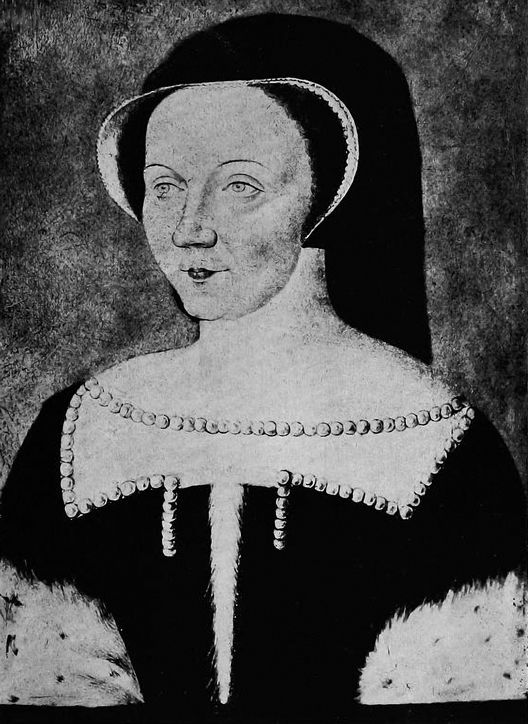
DIANE DE POITIERS DUCHESS DE VALENTINOIS
FROM THE PAINTING IN ENAMEL BY LÉONARD LIMOSIN IN THE MUSÉE CONDÉ, CHANTILLY
Diane, then, may fairly be acquitted of any tender relations with François I. But Contarini, it will be remembered, accuses her of having had other lovers; "she was loved and tasted," he writes, "by the King François I and by others also."
No confirmation of this charge is to be found in the writings of her contemporaries, nor, indeed, until more than a century and a half after her death, when the Abbé Lenglet-Dufresnoy published his edition of the works of Clément Marot.13 This personage, we may observe, who, before becoming a man of letters, had been successively a diplomatist and a government spy, was a writer of really remarkable erudition and of great independence — he probably holds the record for sojourns in the Bastille, having been sent there on at least ten occasions — but he was very little scrupulous as to the use he made of the knowledge which he garnered, and "fell into gross errors, which certain critics attribute to interested bad faith rather than to ignorance."14 In the preface and notes to the work in question, he exhausts himself in subtle arguments to prove that romantic relations had existed between Diane and Marot. If we are to believe him, the affair took place between 1523 and 1525, and it was the lady who made the first advances. The poet was far from insensible to the Sénéchale's charms, but, "instead of coming to the point which she regarded as the most essential, the only decisive, one in love," was so maladroit as to confine his responses to vain elegies and useless madrigals. Diane, angered by his timidity, which she mistook for indifference, changed from love to hatred, and denounced the unfortunate Gascon to the Sorbonne "for having eaten bacon in Lent," with the result that he was promptly arrested and imprisoned in the Châtelet. And the proofs of his story Dufresnoy claims to have found in five epigrams, which in most of the early editions of Marot's poems bear the title of les Amours de Diane, in the reproaches addressed by the poet to an unfaithful mistress, whom he calls Isabeau, and in the rancour which he displays against a mysterious personage named Luna, who appears to have been his evil genius.
Well, these so-called proofs are no proofs at all. Marot was certainly arrested and imprisoned in February 1526, but on a more serious charge than that of having contravened the dietary laws of the Church; and the Sorbonne had been keeping a watchful eye on him for some time past. As for the Diane of the epigrams, there is no reason to identify her with the Grande Sénéchale, for Diane was a common name enough; and, even supposing that they are identical, was it not the bounden duty of a Court poet to profess himself in love with all the high-born beauties about him, or might they not have been written at the order of the Dauphin to express the feelings to which he was himself unable to give poetic utterance, just as, in later times, Henri IV employed Malherbe to address verses to his inamoratas? There is still less reason for believing that by the perfidious Isabeau he intended to indicate Diane — while Dreux du Radier is of opinion that Luna is not a woman at all, but the Sorbonne. In short, Dufresnoy's ingenious conjectures will no more stand the test of examination than the calumny of Regnier de la Planche, the anecdote of Brantôme, or the gossip of Contarini.15
There is, indeed, no proof of any kind that Diane's conduct during her husband's lifetime, and for the first five years of her widowhood, was not entirely beyond reproach. That she was a faithful wife scarcely admits of a doubt. Notwithstanding the disparity in age, she appears to have been sincerely attached to Louis de Brézé. When he died in July 1531, she erected a magnificent tomb to his memory in Rouen Cathedral, with an epitaph which breathes undying affection;16 in August 1534, she arranged for the payment of an annual sum to the Chapter, in consideration of a high and low Mass being said every day for the repose of her husband's soul; in 1541 — several years after she had become the mistress of the future Henri II — we read of her writing to the clergy to remind them of their obligation; in 1558, she had a memorial service celebrated for him; and, at a date which is uncertain, but which was undoubtedly during the period of her favour, she had a marble plaque placed on the facade of the Château of Anet, "which attests," observes Niel, "a more durable regret than widows, even the most inconsolable, are accustomed to display":
"Bresæo hæc statuit pergrata Diana marito
Ut diuturna sui sint monumenta viri."
Finally, she wore mourning for the rest of her life, and black and white became her colours.
But, if during the first five years of her widowhood the Grande Sénéchale continued the irreproachable conduct which had marked her married life, we are inclined to believe that, greedy as she subsequently showed herself for both money and power, she would have been willing enough to accept the exalted post of maîtresse en titre to François I, had it been offered her. But it happened to be already filled, and its occupant, Madame d'Étampes, had secured so firm a hold upon his Majesty's affections, that to attempt to supplant her would have been to court failure and humiliation. If, therefore, the conquest of the King was ever contemplated by Diane, the project must have been soon abandoned for one which presented a less remote chance of success.
The beginning of the long liaison between Diane and the Dauphin, as we have already said, almost certainly dates from the last months of 1536, when the prince was seventeen and the lady thirty-seven. Some historians are disposed to place it a year or two earlier, but to this there is a very serious objection. Up to the late summer of 1536 Henri was only second in the line of succession, and, as there was every probability that the then Dauphin would soon marry and have children, his position and prospects were scarcely such as to appeal to so haughty and ambitious a lady as the Grande Sénéchale. But when, in August of that year, his elder brother died and he became heir to the throne, the situation was altogether different, and it did not take Diane long to decide that he had now become an object worthy of her attention. It was true that François was only forty-two, and that, in the ordinary course of Nature, many years must elapse ere she could realize more than a very small part of her ambitions; but she knew, or at least suspected, that the King's health was already undermined by the excesses of his youth, and that it might not be so very long before the sceptre passed to another. And, in the meantime, if her position as the Dauphin's mistress would bring her few of the material advantages which Madame d'Étampes enjoyed, it would, at any rate, assure her a consideration which would be very gratifying to her vanity. For which reasons, she dressed her batteries and brought them to bear upon the young prince.
It is related, and the anecdote has been accepted by such authorities as Niel and Bouchot, that, annoyed at the melancholy humour and uncouth manners of his heir, François had, so to speak, thrown the lady into the Dauphin's arms, with instructions to polish him a little. "They say," writes Le Laboureur, "that, one day after the death of the Dauphin François, the King having expressed to her [Diane] his displeasure at the little animation which he saw in this Prince Henri, she told him that he must be made to fall in love, and that she would make him her gallant."17
If this anecdote be true, it confirms the supposition that the affair could not have begun until Henri had become heir to the throne; and some verses of Clément Marot seem to establish the fact that the date was the last months of 1536. On New Year's Day, 1537, Marot, according to his custom, presented poetic étrennes to a number of the Court ladies, the only kind of coin of which he was never short. Diane's, which was not without a spice of malice, though, at the same time, it constitutes an additional testimony to the lady's previous good conduct, was as follows:
"Que voulez-vous, Diane bonne,
Que vous donne?18
Vous n'eustes, comme j'entends,
Jamais tant d'heur au printems
Qu'en automne."
The conquest of the Dauphin once resolved upon, Diane pursued it with inflexible determination and with marvellous adroitness. To assure a greater and more durable ascendency, she was in no hurry to complete his subjugation, but posed before every one as the mentor of youth and inexperience, the guide of the future King of France towards noble thoughts and generous actions; encouraging the taciturn, reserved lad to converse freely with her — a thing which it is doubtful if he had ever done before with any human being — to express opinions to which he had never yet dared to give utterance, to open his mind to her and make her the confidante of his hopes and fears.
Henri was completely fascinated. His had been a dreary, almost friendless, existence. He had lost his mother when he was a child; he was perhaps the least loved of all François's children; he disliked his younger brother, who presumed on the King's indulgence to give himself intolerable airs, and he did not understand his wife, for which we can scarcely blame him. Craving companionship and sympathy, it is not surprising that he should have abandoned himself unreservedly to the counsels of the new Egeria.
For a time, the Court appears to have been altogether deceived as to the lady's intentions, and so shrewd an observer as the Venetian Ambassador, Marino Cavalli, wrote that many persons believed that her affection for her royal pupil was "like that of a mother for a son." But the situation was full of perils for the Dauphin. If Diane was no longer young, she was still eminently seductive: tall and splendidly proportioned, with jet black hair, fine eyes, regular features, and a dazzling complexion; and, to the senses of very young men, the charms of maturity often appeal far more strongly than the grace and freshness of youth. And, while awakening Henri's intellectual powers, she had not failed to awaken his dormant passions as well, for "she knew what Catherine was absolutely ignorant of, and she had studied her prince with the pitiless penetration of an anatomist."19 Soon he was completely in her toils, and his initiation into the mysteries of love was proceeding simultaneously with his instruction in courtly manners and the duties of his exalted position.
The results of the gallant side of this education were not slow in revealing themselves. During the campaign in Piedmont, in the autumn of 1537, the Dauphin met a young Italian girl, who is supposed to have been of humble condition, and whom historians call Filippa Duc, and laid siege to her heart so effectively that in the following year she gave birth to a daughter, of whom we shall have something to say hereafter.
This infidelity, which seems to have been a mere passade, does not appear to have aroused any resentment in the Grande Sénéchale, and when, some years later, the little girl, who had been named after her, was brought to the French Court, she herself superintended her education.20
And what of the Dauphine? How did she regard the subjugation of her husband by this mature siren?
Henri's infidelity wounded his young wife to the quick. Not that she entertained for him any great affection, her temperament, indeed, being far too cold to permit her to bestow her love where it was unlikely to meet with any response. But, in common with the rest of her family, she was intensely proud, and she felt bitterly humiliated at his open preference for another woman. Her talent for dissimulation, however, came to her aid, and not only did she refrain from reproaching him, but she treated the Sénéchale with the same courtesy as before; and the curious sought in vain for any indication of the jealousy and hatred which consumed her, and which the necessity for repression served only to aggravate.
But, if Catherine placed no obstacle in her rival's path, the latter was not permitted to triumph with impunity. For some years past Madame d'Étampes had regarded the Sénéchale, who was one of the few women at the Court who declined to acknowledge her ascendency, with far from friendly feelings, and Diane's conquest of the Dauphin roused her slumbering hatred to malignant activity. Great as was the influence she exercised, she knew that it must terminate with the King's life, and she feared the moment when the favourite of the Dauphin would reign in her place and be in a position to mete out to her the same treatment which she had received at her hands. She accordingly determined to employ every means in her power to expel her enemy from the citadel she had captured before that moment arrived.
In the hope of making the Dauphin ashamed of his choice, she summoned the poets to her aid, and soon there began to appear against the Sénéchale numerous epigrams ridiculing her unmercifully upon her age, her coquetry, her rouge, her powder, her artificial teeth, her false hair, and her wrinkled skin. The most bitter of these were the composition of one Jean Vouté, who in 1537 published, under the name of Vulteius, a collection of Latin verses, in which he assailed the favourite of the Dauphin with a license worthy of Martial:
"Empto quæ faciem colore pinguis,
Quæ ornas dentibus os tuum paratis,
Quæ celas capitis nives redempto
Crine. ..."
And elsewhere —
"Rugosa est facies et tibi laxa cutis."21
All this was, of course, entirely false; Diane had no need to summon Art to the assistance of Nature, having the most beautiful complexion in the world, excellent teeth, and abundant tresses. Nevertheless, it made very unpleasant reading, and, if the verses were written in a language not understanded of the people, there were many persons at the Court sufficiently well acquainted with Latin to translate them for the benefit of the unlettered.
As for Madame d'Étampes, far from being content to leave the attack to the scribes whom she protected, she lost no opportunity of expressing her astonishment at the bad taste shown by the Dauphin in choosing for his mistress a "toothless, wrinkled hag," who, she asserted, had been married on the same day on which she herself was born. There was, as a matter of fact, only nine years' difference between the two ladies.
Diane was not the kind of woman meekly to endure such assaults, and she retaliated by assailing the reputation of Madame d'Étampes, whom she accused of infidelity to her royal lover;22 and the antagonism between the two women became a veritable war, which divided the Court into two hostile camps. Madame d'Étampes favoured those who viewed the Reformation with approval; Diane declared openly for the suppression of heresy. The duchess had for allies the Admiral Chabot de Brion, who was regarded as the King's rival in her affections; her uncle, Antoine Sanguin, Archbishop of Orléans, who, after his elevation to the purple, was known as the Cardinal de Melun; the ladies of the Petite Bande, most of the men of letters, and the majority of the courtiers, who naturally preferred to worship the risen planet rather than one which might be many years before it reached its zenith. The Sénéchale was assured of the support of Montmorency and of the Cardinal de Lorraine, both of whom shared her hatred of the new doctrines, the former from sincere religious conviction, the latter from fear of losing his benefices and episcopates, while the Grand-Master's friendship with the Dauphin naturally inclined him to take the side of that prince's mistress. The Cardinal de Lorraine's nephews, the threeelder sons of the Duc de Guise, likewise paid court to the lady,23 though their father held aloof from both parties and prudently declined to compromise himself. Diane could also count upon the discontented and ambitious women excluded from the royal circle, and those courtiers who had sufficient foresight to sacrifice present to future advantages. The forces of the two favourites were thus very evenly balanced, and every day the strife became more bitter.
Notes
(1) Georges Guiffrey (les Lettres inédites de Dianne de Poytiers) places the beginning of this romance "towards the end of 1536 or in the first months of 1537"; But, as we shall presently show, it was certainly in progress before January 1, 1537.
(2) Récréations historiques.
(3) Guiffrey, Introduction to les Lettres inédites de Dianne de Poytiers, in which the full text of the letters will be found; T. A. Cook, "Old Touraine."
(4) Dames galantes.
(5) Portraits des personnages français les plus illustres du XVIe siécle.
(6) Among the historians who have assisted to propagate the calumny are Mézeray (Abrégé chronologique), who, like its father, Regnier de la Planche, makes Diane a young girl at the time of the sacrifice of her honour, Sauval (Amours des Rois de France), Hauréau (François Ier et sa Cour), Michelet (Histoire de France), with whom no scandal was too gross to find acceptance, and Ludovic Lalanne, the editor of the Journal d'un Bourgeois de Paris; while it was made use of by Victor Hugo in his celebrated tragedy, le Roi s'amuse.
(7) Louis de Brézé's active intervention on his father-in-law's behalf is proved by a letter written by him to Anne de Montmorency: "If you had been here, you would have aided me up to the end with all your influence. I have been compelled to speak myself, since I have found no one to help me; but I have so much confidence in his Majesty's goodness that I hope all will be well." — La Ferriere, Grandes Chasses du XVIe siècle.
(8) M. Guiffrey does not mention a fact which would have greatly strengthened his case, namely, that Brézé was one of the King's most intimate personal friends, and that François, on several occasions, visited him at his Château of Anet.
(9) Armand Baschet, la Diplomatie Vénitienne.
(10) Diane de Poitiers was created Duchesse de Valentinois, by Henri II, in 1549.
(11) Journal d'un Bourgeois de Paris sous le Règne de François Premier, publie par Ludovic Lalanne (Paris, 1854).
(12) "Après avoyr entandu les propos que l'on m'a terms estant cheus mon beaupère."
(13) Œuvres de Clément Marot, accompagnées d'une préface historique, par l'Abbé Lenglet-Dufresnoy (Paris, 1731).
(14) Article Lenglet-Dufresnoy, Nouvelle Biographie générale.
(15) Niel, Portraits des personnages français les plus illustres du XVIe siècle; Dreux du Radier, Récréations historiques.
(16)
"Hoc, Lodoïce, tibi posuit Brisæe sepulchrum,
Pictonis amisso mœsta Diana viro.
Indivulsa tibi quondam et fidissima conjux,
Ut fuit in thalamo sic erit in tumulo."
(17) Le Laboureur, Additions aux Mémoires de Castelnau, vol. i. "Gallant" must be here understood in the Platonic sense.
(18) Que je vous donne.
(19) Bouchot, Catherine de Médicis.
(20) This has led some historians to believe that Filippa Duc was a myth, and that the child was the daughter of the Grande Sénéchale. The best-informed authorities on the period, however, follow contemporary opinion in accepting the Piedmontese origin of Diane de France.
(21) Desgardins, la Duchesse d'Étampes.
(22) If we are to believe the reports industriously circulated by Diane and her friends and repeated by the more picturesque chroniclers of the time, Madame d'Étampes was no more faithful to the King than she was to her husband, and Chabot de Brion, Clément Marot, the young Christian de Nançay, captain of the Guards, and several other gentlemen, shared in the favours which were supposed to be reserved for their Sovereign. The last-named gallant is said to have been one day surprised by François himself in the lady's chamber at the Château of Madrid. Taking advantage of his Majesty's absence at the chase, the duchess had granted M. de Nançay an assignation, having first taken the precaution of stationing a confidential attendant, Mlle, des Colliers, at one of the windows of the corridor leading to her apartments, to give her timely warning of the King's return. The day, however, was exceedingly close, and presently Mlle, des Colliers fell into a profound slumber, from which she was only awakened by the stamp of horses' hoofs and the jingling of bits in the courtyard below, which announced the return of the huntsmen. Terrified, she flew to warn the culprits; but she was too late, and the King, who was anxious to tell the duchess about his afternoon's sport, entered the boudoir almost as soon as she did. With a single glance he comprehended the situation, and, livid with anger, went to the window and shouted for his guards. Madame d'Étampes and Nançay stood with bowed heads before him, like convicted criminals awaiting sentence. But, when the guards arrived, the King affected to believe that it was the maid, and not the mistress, who was the delinquent. "Let that woman get up," he cried, pointing to Mlle, des Colliers, who, in an agony of terror for her protectress, had thrown herself at his feet. "And you, monsieur," turning furiously upon the young officer, "who dare to carry on an intrigue here with an attendant of Madame d'Étampes, go and reflect in prison on the impropriety of such conduct." And Nançay was marched off between two of his own men.
It is doubtful if there is any truth in this story, and, even if the duchess were unfaithful to her royal lover, it would not appear to have in any way affected her credit with the King. Perhaps, François felt that, if he had something to forgive, he had a great deal more to be forgiven; and, besides, the lady was so pretty, and so charming when she wished to please, that it would have been difficult for so susceptible a monarch to remain long inexorable.
(23) François, Comte d'Aumale, afterwards Duc de Guise; Charles, afterwards Archbishop of Rheims and Cardinal de Lorraine; and Claude, afterwards Marquis de Mayenne.