
Serious illness of the King — Policy of Montmorency — Charles V invited to pass through France on his way to the Netherlands — His magnificent reception — His entry into Paris — His departure for Flanders — The illusions of François I and Montmorency in regard to the cession of the Milanese rudely dispelled — The new proposals of the Emperor received with indignation by the French Court — Charles V invests his son Philip with the Milanese, and a fresh rupture between the two sovereigns becomes inevitable — Affection of the Dauphin for Montmorency — Increasing bitterness of the struggle between Madame d'Étampes and Diane de Poitiers — Diane and the Constable procure the disgrace of Chabot de Brion — Fury of Madame d'Étampes, who succeeds in alienating François from the Dauphin, and in convincing the King that Montmorency has sacrificed his interests to those of his eldest son — Disgrace of the Constable — Assassination of Rincon and Fregoso — Failure of Charles V's expedition against Algiers — François declares war against the Emperor
THE truce of Nice expired in its infancy, but not until it had done much to weaken the position of France in Europe. Soon after his interview with the Emperor at Aigues-Mortes, François I was attacked by a severe illness, which left him for a time a physical wreck,01 and affected his mind to some degree as well as his body. Affairs now fell completely into the hands of Montmorency, upon whom, in February 1539, was conferred the office of Constable, vacant since the treason of Bourbon, and the external policy of France took a fresh direction. Montmorency, giving free rein to his Catholic and Imperialist predilections, broke off the friendly relations which had existed with England, the German Protestant princes, the Duke of Cleves, and the Turks, and not only persuaded the King, dazzled by the chimerical hope of a voluntary restitution of the Milanese, to reject the offer of the rebellious Ghent burghers to acknowledge him as their suzerain, but to reveal their proposals to Charles V, and to offer him a passage through France to Flanders, when he journeyed thither to reduce his revolted subjects to obedience.
Having first taken the precaution to secure letters of invitation from the King and Queen, the Dauphin and his brother, and the Constable and the Cardinal Jean de Lorraine, and an undertaking that he should not be troubled with State affairs during his sojourn in France, the Emperor accepted, and on November 27, 1539, he crossed the Bidassoa, accompanied by a small suite of some twenty to twenty-five gentlemen, who included the Duke of Alva, of sanguinary memory.
As the state of François's health prevented him from undertaking so long a journey, the duty of welcoming the illustrious guest devolved upon his two sons and Montmorency. The Duc d'Orléans met the Emperor half an hour before he crossed the frontier; while the Dauphin and the Constable, with nearly the whole of the King's Household, awaited him about a league from Bayonne.
Charles was suffering from a chill which he had caught while crossing the Pyrenees, and was therefore anxious to complete his journey as speedily as possible; but François had given orders that he was to be received "like the Kings of France on their joyous accession," and the fêtes which were given in his honour greatly retarded his progress. In every town through which he passed magnificent receptions awaited him, and the luxury displayed by both nobles and citizens caused the parsimonious Spaniards the most unbounded astonishment. At Poitiers, his Majesty was met by the governor, the Duc de la Trémoille, and the whole nobility of the province, and escorted into the town by between four and five thousand gentlemen superbly habited, and by two thousand citizens dressed in velvet and satin, laced with gold and silver. At Orléans, his escort was composed not only of all the local noblesse and militia, but also of "a guard of ninety-two young merchants of the town, well mounted on fine horses, all wearing black- velvet surcoats, with doublets of white satin fastened with gold buttons, velvet caps covered with gold embroidery and precious stones, white morocco buskins, all pinked, and spurs of gold. The value of a single cap was estimated at two thousand crowns, and there was not one among them who did not carry upon his person the value of more than two thousand francs in jewellery."02
At Loches, which was reached on December 10, the august traveller found the King and Queen awaiting him. The interview was cordial, the reception magnificent. Thenceforward François did not quit his guest, and they journeyed together towards Paris by way of Amboise, Blois, and Orléans. On December 31 they reached Vincennes, where the Emperor was acquainted with the arrangements for his solemn entry into the capital. This took place in the afternoon of New Year's Day 1540, with great ceremony. Early in the morning, Charles, accompanied by the Dauphin, the Duc d'Orléans, and the Constable, proceeded to Saint-Antoine-des-Champs, where a sumptuous pavilion had been erected for his accommodation. Here De Thou, the Provost of the Merchants, came to offer him the keys of the town, while, shortly afterwards, the Parlement, with the First President at its head, arrived to present him with an address of welcome. Then the state procession was formed, headed by the Parlement, and, amid the ringing of church bells and the firing of cannon, the Emperor made his entry into the city.
On his right hand rode the Dauphin, on his left, the Duc d'Orléans; while the Constable, dressed in a robe of cloth of gold and mounted on a magnificently-caparisoned charger, preceded them with his sword of office unsheathed, as though he were escorting his own sovereign. François himself, accompanied by the Queen, watched the procession from the windows of the Hotel de Montmorency, in the Rue Saint-Antoine.
As the Emperor passed through the city, the keys of the several prisons were delivered to him, as they had previously been in the provinces, and he declared the freedom of all captives detained therein. At the Hotel de Ville, he was harangued by the sheriffs, who presented him, on behalf of the municipality, with "a Hercules of massive silver, draped with a lion's skin of gold, the said statue being of the height of a tall man." From the Hôtel de Ville he proceeded to Notre-Dame, where a Te Deum was sung, after which he was conducted to the Louvre, where a suite of apartments had been newly decorated for his reception.
A week of magnificent fêtes followed, during which the Emperor sought to confirm Montmorency in his good dispositions by overwhelming him with condescension, and to conciliate Madame d'Étampes by flattery and presents; and on January 7 his Majesty, accompanied by the King and the Court, quitted Paris and proceeded to Saint-Denis, and thence to Chantilly, where he was splendidly entertained by the Constable. At Chantilly, François took leave of his brother-in-law,03 and Charles continued his journey under the escort of the two princes and Montmorency, who did not quit him until he reached Valenciennes, the first town in his Flemish dominions (January 24). At parting, the Emperor presented them with costly souvenirs of his visit; diamonds to each of the princes, and a splendid emerald to Montmorency.
During the past twelve months the old bait of the Milanese had been dangled very assiduously before the covetous eyes of François; and at the beginning of February 1539 a provisional agreement had been arrived at between the King and the Emperor in regard to a marriage between the Duc d'Orléans and the daughter of Ferdinand of Austria, Charles promising that he would "dispose of the duchy and state of Milan, in virtue and contemplation of the said marriage, in such a manner that the said lord king would have reason to be well contented with it."
Apart from some allusions by members of the Court to the prospective cession of the Milanese, the question had not been raised during the Imperial visit, and, in their conversations, the King and the Constable had treated only of the general affairs of Europe.04It had been arranged, however, that after Charles had reduced the Gantois to submission and had seen his brother Ferdinand, who was to join him in Flanders, Montmorency and the Cardinal de Lorraine should proceed to Brussels, when his Majesty would make a definite pronouncement with regard to the Milanese. By the end of February, Ghent had made its submission and the King of the Romans had arrived at Brussels; but Montmorency waited in vain for the Imperial summons. None came, and when the French Ambassador at Brussels reminded Charles of his promises with regard to the Milanese, he answered that he had never made any which could be considered binding upon him. Finally, at the beginning of April, he submitted, through his Ambassador at the French Court, Saint-Vincent, an entirely new proposition, which showed that, while anxious to avoid a breach with France, he was resolved not to share Italy with a rival. François was to renounce all claims on the Milanese, to abandon all rights of suzerainty over Flanders, to restore the States of the Duke of Savoy, and to evacuate Hesdin; while the Emperor would renounce all pretensions to Burgundy and give his eldest daughter in marriage to the Duc d'Orléans, with the Netherlands, Franche-Comté, and the Charolais for her dowry. The Netherlands and Franche-Comté were to be erected into a kingdom, of which the young couple would enter into full possession after the death of the Emperor, and the King of France would accord his younger son an appanage worthy of so great an alliance, in proximity to the territory ceded to the bride. To bind yet closer Hapsburg and Valois by ties of common interest, Charles's son, Philip, was to wed Jeanne d'Albret, only daughter of Marguerite d'Angoulême, and purchase her rights over Lower Navarre and Béarn.
This project, which, if accepted, would have created a new House of Burgundy under the protection of Spain and the Empire, and inevitably have caused a feud between the Duc d'Orléans and his elder brother, already on sufficiently bad terms, was very ill received by the French Court. François was profoundly mortified to find that he had once more sacrificed the substance for the shadow and permitted Charles to subdue his Flemish subjects, come to an understanding with the German Protestant princes, and re-establish his authority in the whole Empire, while deluding him with promises which he had not the remotest intention of fulfilling. Montmorency, indignant at having allowed himself to be made the dupe of the Emperor, was as strongly opposed as the King to the new proposals, and urged his master to continue to insist on the cession of Lombardy. The negotiations dragged on for several months, but the favourable moment had been lost, and on October 11, 1540 the Emperor dissipated the last lingering hopes of François and the Constable by formally investing his son Philip with the duchy of Milan. From that moment, a fresh rupture between the two sovereigns was plainly inevitable, though both announced their intention of respecting the truce of Nice.05
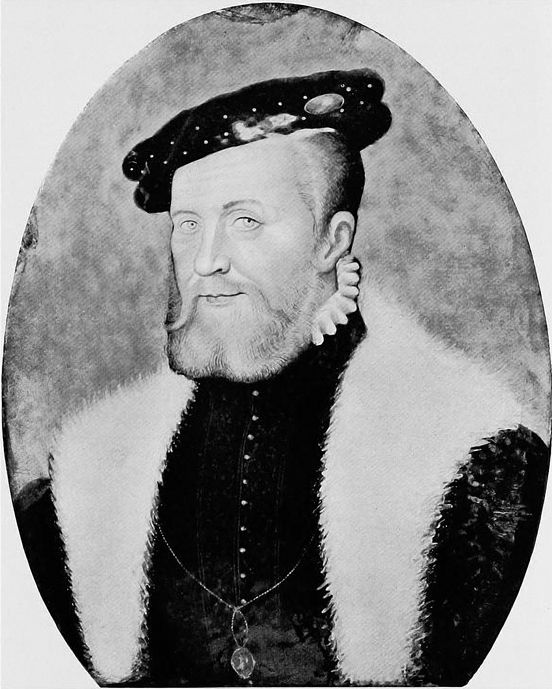
ANNE, DUC DE MONTMORENCY, CONSTABLE OF FRANCE
FROM THE PAINTING IN ENAMEL IN LÉONARD LIMOSIN IN THE LOUVRE
The bestowal of the Milanese upon Philip of Spain proclaimed to Europe the total failure of Montmorency's policy, and was the signal for his disgrace, though the intrigues of the palace rather than the humiliation into which the Constable's almost pathetic trust in the Imperial justice and friendship had led his sovereign seem to have been the principal cause of his fall.
Ever since the campaigns of 1536 and 1537, the affection of the Dauphin for Montmorency had continued to increase, and the close friendship between the prince and the Constable, combined with the latter's strong Catholic convictions, had, as we have seen, caused the Constable to become one of the staunchest supporters of Diane de Poitiers in the unceasing struggle which she waged with the King's mistress, Madame d'Étampes. As time passed, this struggle became more and more envenomed, and both François and his elder son found themselves involved in it.
The two ladies began active hostilities in the person of their partisans, "seeming to regard one another as kings upon a chessboard, who are not attacked until the principal pieces have been taken."06 The Admiral, Chabot de Brion, Madame d'Étampes's principal champion and long Montmorency's sworn enemy, was accused of enriching himself in various ways at the expense of the State. The King, already irritated against the Admiral by the friendship a little too tender which Madame d'Étampes testified for him, orderedhim to be arrested and imprisoned in the Château of Melun (February 1539), and in November 1540 he was tried by a commission presided over by the Chancellor, Poyet, a creature of Diane and the Constable. Poyet, notwithstanding the reluctance of some of the judges, succeeded in securing the condemnation of the accused, who was deprived of all his dignities, banished from the Court, and mulcted in a fine of 1,500,000 livres.
Montmorency was not allowed much time to rejoice over the downfall of his rival. The arrest of Chabot had greatly infuriated Madame d'Étampes, who became from that moment the implacable enemy of the Constable, and left no means untried to destroy his credit with the King. While the rapprochement with the Emperor lasted, she appears to have made but little impression on Montmorency's position, for François naturally looked to its author to secure the cession of the Milanese. But when, at the beginning of April 1540, the King's eyes were suddenly and rudely opened to the real value of the Imperial promises, her task was, of course, immensely facilitated. Already she had succeeded in alienating father from son, and in persuading his Majesty to express to the Dauphin in very plain language his disapproval of his infatuation for the Sénéchale;07 and it was not difficult for her to awaken the King's suspicions in regard to the intimacy between Henri and Montmorency, declaring her conviction that the Constable had sacrificed the interests of the King to those of his heir, and secretly connived at the Emperor's duplicity, from a desire to prevent the aggrandizement of the Duc d'Orléans, of whom his elder brother was jealous. "The Constable is a great villain," she exclaimed one day. "He has deceived the King, telling him that the Emperor would immediately surrender to him the Milanese, when he knew the contrary."
The change in François's attitude towards the Constable was soon apparent to the Argus-eyed courtiers. "It is said," wrote one of Montmorency's friends to him, "that the King is displeased with you, on account of some conversations and understandings which you have had with the Dauphin."08 The King now no longer left the absolute direction of affairs in the Constable's hands, and he was compelled to share a power which for nearly two years he had possessed in its entirety with the Cardinals de Lorraine and de Tournon and Annebaut. After the Emperor's bestowal of the Milanese on Don Philip had destroyed all hope of an accommodation, the King's secretaries received orders from his Majesty to discontinue the use of the diplomatic cypher which Montmorency had given them, and the Ambassadors to address their despatches to François himself; while, some weeks later, the Chancellor took over the direction of the Foreign Office.
Finally, in the following summer, the disgrace so long expected arrived. It was indicated to the Constable in a singular manner at the marriage of the little Jeanne d'Albret to the Emperor's rebellious subject, Guillaume de la Marck, Duke of Clèves, which was François's reply to the bestowal of the Milanese on Don Philip. The future mother of Henri IV, although she was at this time but twelve years old, already possessed that haughty character and strength of will which were to make her, in years to come, so redoubtable a party leader. She had evinced the strongest repugnance to the marriage arranged for her, and had "very humbly besought the King that she might not be obliged to marry M. de Clèves." Finding her objections disregarded by François and her parents, she adopted the singular expedient of making a formal protest against her compulsory nuptials in a document which she herself drew up and caused to be witnessed by three officers of her Household, wherein she declared that she "had never consented to it, and never would consent, and that all that she might say and do hereafter, by which it might be attempted to prove that she had given her consent, would be forcibly extorted from her against her wish and desire, from her dread of the King, of the King her father, and of the Queen her mother, who had threatened to have her whipped by her gouvernante, the baillive of Caen."09
At the marriage ceremony, at Châtellerault, the child-bride appeared attired in a robe of cloth of gold, heavily embroidered with jewels, and an enormous ermine train. When her royal uncle approached to conduct her to the altar, she suddenly complained of feeling unwell, and declared that it was perfectly impossible for her to walk, on account of the weight of her gilded and bejewelled gown. François, greatly annoyed, turned brusquely to the Constable and ordered him to carry the princess. Montmorency, bitterly mortified that he, the first personage in the realm after the King, should be called upon to undertake such a duty, obeyed; but, as he returned to his place in the bridal procession, after depositing his burden at the altar, he observed: "C'est fait désormais de faveur. Adieu luy dit."10 Next day, he quitted the Court and retired to Chantilly, and afterwards to Écouen, where he had begun the construction of a magnificent Château. Unable, however, to believe that the King intended his disgrace to be permanent, he solicited, towards the end of the summer, permission to return, to which his Majesty replied by a curt refusal and an intimation that, if he came without his permission, he would have reason to regret it. Several persons ventured to expostulate with François on his treatment of the Constable, reminding him of the services which the object of his displeasure had rendered during the last war, and pointing out the need which France had of so experienced a captain at a moment when she was about to measure swords once more with her redoubtable enemy. But, thanks to the efforts of Madame d'Étampes, the King remained inexorable.
Although François's refusal to avail himself of the services of his ablest general was a grave error, he had certainly good reason for his irritation against the Constable, since he was now experiencing the difficulty of renewing the alliances which had been broken during the administration of Montmorency. However, thanks to the untiring efforts of the French diplomatists, the suspension of the persecution against the Huguenots, and the marriage of Jeanne d'Albret to the Protestant Duke of Clèves, with whom François formed an offensive and defensive alliance, some of the German Protestants were wooed back, and Soliman was persuaded by the enterprising Paulin de la Garde11 to promise the Most Christian King the assistance of his fleet.
Paulin had not been François's original envoy to the Sultan, and the fate of his predecessor, Antonio Rincon, a Spanish refugee, had nearly provoked immediate war. As Rincon was passing, without a safe-conduct, down the Po, in company with another agent of the French Government, named Cesare Fregoso, who had been despatched on a mission to Venice, the barge in which they were travelling was attacked, near Pavia, by a party of Spanish soldiers, sent by the Marquis del Guasto, the Milanese Viceroy, and both the diplomatists were killed (July 2, 1541). The seizure of their papers was the object of the crime, but, as the most compromising of these had been entrusted to Guillaume du Bellay, the Governor of Piedmont, to be forwarded to Venice, it was not attained. Del Guasto, when accused of having instigated the assassination, declared that the culprits were merely brigands, but it was soon proved beyond all reasonable doubt that they were soldiers from the garrison of Pavia; and François filled all Europe with denunciations of the outrage perpetrated on the sacred persons of his agents, and demanded reparation from the Empire and the Diet. However, as the chain of alliances which he hoped to form was not yet complete, and the Pope besought him not to attack Charles until the latter's return from his approaching expedition against Algiers, he decided to postpone hostilities until the following year.
The expedition against Algiers ended in a lamentable fiasco, and the Emperor returned to Spain with prestige and power both seriously diminished. François had, of course, no scruple in turning the common misfortune of Christendom to his own advantage; his deliberate exaggeration of Charles's losses encouraged both Christian III of Denmark and Gustavus Wasa of Sweden to join the anti-Imperial alliance; the co-operation of the Porte was tacitly acknowledged, and on July 12, 1542 war was formally declared.
Notes
(1) "Une recrudescence du mal aigu et honteux qui l'avait frappé dès sa jeunesse," says Henri Martin, which is likely enough; but there appears to be no truth in the legend of "la belle Feronnière" accepted by so many historians. See, on this anecdote, Lescure, les Maîtresses de François Ier.
(2) Paradin, Histoire de notre temps. It must not be supposed that all this extravagance was wholly spontaneous. Montmorency, indeed, to whom the supervision of the arrangements for the Emperor's reception had been entrusted, seems to have experienced considerable difficulty in whipping up the necessary enthusiasm, and the municipality of Paris protested loudly against the expenditure required of it.
(3) Several historians state that the King accompanied Charles as far as Saint-Quentin, but this is incorrect.
(4) In the course of his interviews with the Emperor, Montmorency had pushed his complaisance so far as actually to reveal to Charles the nature of the correspondence of the Lutheran princes with the King of France.
(5) Henri Martin says that the Emperor's investiture of his son was in retaliation for the bestowal of the hand of Jeanne d'Albret upon Guillaume de la Marck, Duke of Clèves; but this marriage did not take place until the following June, and was, in point of fact, François's reply to Charles's move, Guillaume de la Marck being in arms against his sovereign.
(6) Forneron, les Ducs de Guise et leur époque.
(7) "I did not fear in days gone by," wrote Henri, many years later, to Diane, "to lose the good graces of my father in order to remain near you. I have known only one God and one friend." — Guiffrey, Lettres inédites de Dianne de Poytiers.
(8) Decrue, Anne de Montmorency, grand maître et connétable de France, a la cour, aux armées et au conseil du roi François Ier.
(9) Martha Freer, "Jeanne d'Albret, Queen of Navarre," in which the full text of the document is given.
(10) Brantôme, Grandes capitaines français.
(11) Antoine Escalin des Aimars, Baron de la Garde, Marquis de Briançon, celebrated under the name of Captain Paulin. Born in 1498 at the village of la Garde, in Dauphiné, his parents being poor peasants, he began life as a "goujat," or soldier's servant, and rose to be captain of a company of men-at-arms. His courage and abilities having attracted the attention of Guillaume du Bellay, he was presented to François I, who, in 1541, sent him on a mission to Venice, which he carried out successfully. After his mission to the Porte he was created Baron de la Garde and appointed general of the galleys. He had a distinguished naval career, being, in fact, the best sailor France possessed in the sixteenth century, but the horrible atrocities which he perpetrated on the hapless Vaudois in 1545 have left an indelible stain on his memory. He died at his native village in 1578, at the age of eighty.