
Claude de France, first wife of François I — Conduct of the King towards her — Hostility of his mother, Louise of Savoy — Her retired life — Her children — Her vow to Saint-François de Paule — Birth of a Dauphin — Birth of Henri, Duc d'Orléans, afterwards Henri II — Death of the Queen— She is accounted a saint, and miracles are reported to have been performed at her tomb
FEW queens have left so little mark upon history as Claude de France, eldest daughter of Louis XII and Anne de Bretagne, and first wife of François I. One of the greatest heiresses of her time, she brought her husband the province of Brittany — which, if her mother had been allowed to have her way, would have gone, with the princess's hand, to young Charles of Austria, the future Charles V — and the counties of Asti, Coucy, Vertus, Étampes, Montfort, and Amaury; "and a dowry more precious still, an inexhaustible fund of kindness, sweetness, chastity and patience, in a word, all the virtues of her father."01
But alas! neither her great possessions, nor her many virtues, nor yet the pathetic devotion which she entertained for him, sufficed to win her more than a half-contemptuous tolerance from "le roi chevalier," who, though, in accordance with custom, he made it an invariable rule to pass the night with his consort, did not attempt to conceal his preference for the society of more attractive, if less estimable, ladies, of whom the too-celebrated Madame de Chateaubriand was the most favoured.02 Nor were the neglect and infidelity of François the only trials which she had to endure. Often she found herself exposed to the imperious humour of the vindictive Louise of Savoy, Duchesse d'Angoulême,03 who appears to have been resolved to avenge upon the innocent Claude all that she had suffered from the hatred of Anne de Bretagne, and to make her life as unhappy as possible.04
Neglected by her husband, slighted by her mother-in-law, and towards the end of her life a martyr to ill-health, the poor Queen took but little part in the amusements of the Court. Most of her time was passed in tapestry-work, in the embroidering of altar-cloths, in devotional exercises, and in works of charity. The only joys she appears to have known were those of maternity, which were not spared her, since, in her ten years of married life, she gave birth to seven children: three sons and four daughters.05
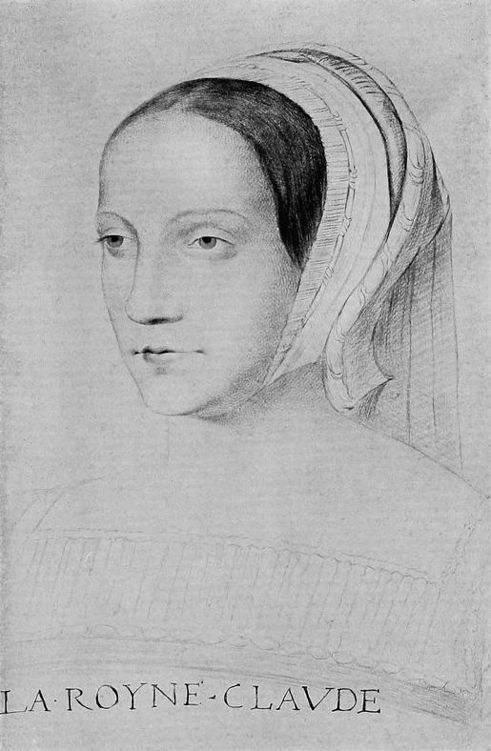
CLAUDE DE VALOIS, QUEEN OF FRANCE
FROM AN ENGRAVING AFTER THE DRAWING IN THE LOUVRE
Her first two children, to her intense disappointment, were both daughters, whereupon, we are told, having learned that Louise of Savoy had obtained the King through the prayers of Saint-François de Paule, she made a vow, in the presence of Père Binet, general of the Minims, and of several other persons of quality, that, if it should please God to grant her a son, she would give him the name of François, and cause François de Paule, who had already been beatified by Leo X, on the petition of Louis XII and Anne de Bretagne, to be canonised.
Her desire was accomplished, and "on the last day of February 1517,06 the good, virtuous, and very perfect Queen of France gave birth to her first son, Dauphin of Viennois, in the town of Amboise, which was the occasion for great rejoicings throughout all the realm."07
This happy event was followed, thirteen months later, by the birth of a second son, who came into the world at Saint-Germain-en-Laye, "on the thirty-first and last day of March [1519], about six o'clock in the morning,"08 and we learn, on the authority of the courtly Ronsard, that the Queen —
"Sitôt qu'elle se vit voisine d'accoucher,
Et que jà la douleur son coeur venoit toucher,
S'en vint à Saint-Germain où la bonne Lucine
Luz osta la douleur que l'on sent en gésine.
Adonc toy, fils semblable à ton père, nasquis,
Et sans armes naissant, un royaume conquis;
Lors les nymphes des bois, des taillis et des prées,
Des plaines et des monts et des forests sacrées,
Les naides de Seine et le bon saint Germain
Te couchant au berceau, te branloient en leur main
Et disoient: crois, enfant; enfant, prends accroissance
Pour l'ornement de nous et de toute la France."
This demi-god was the future Henri II, the subject of the present volume, the name Henri being given him out of compliment to Henry VIII of England, who stood godfather by procuration.
Of the childhood of Henri, upon whom the title of Duc d'Orléans was conferred, the chroniclers tell us nothing, save that it was chiefly passed in the company of his brothers and sisters at the Château of Amboise. When he was six years old he lost his mother, who died, at Blois, on July 20, 1524, unregretted, we fear, by her volatile husband, but mourned by the people, who had styled her "la bonne reine," and many of whom now accounted her a saint. Her body lay for some time in the chapel of Saint-Calais at Blois, before being conveyed to Saint-Denis, during which contemporary chroniclers assure us that several sick persons who had visited her tomb, "bearing offerings and candles," were cured of their ailments.09
Eighteen months after the death of their mother, Henri and his elder brother, the Dauphin François, found themselves called upon to play a part which, happily, has fallen to the lot of few princes of such tender years — nothing less than to leave their peaceful home on the banks of the Loire and to cross the Pyrenees into Spain, there to remain for four weary years as hostages in the hands of the Emperor Charles V, for the fulfilment of their father's engagements to that monarch. But, to understand how this came about, as well as the external difficulties which will confront Henri on his accession to the throne, we must go back to the beginning of the reign of François I.
Notes
(1) Gaillard, Histoire de François Ier.
(2) Françoise de Foix, daughter of Phébus de Foix, Vicomte de Lautrec, and of Jeanne d'Aydie, eldest daughter of Odet d'Aydie, Comte de Comminges. She was born about 1495, and married in 1509 Jean de Montmorency-Laval, Seigneur de Chateaubriand. If we are to believe Brantôme, François I, whose curiosity had been aroused by the fame of the lady's charms, had recourse to a stratagem to bring her to his Court, despite the desire of her husband to keep her beyond his Majesty's reach — namely, by having a facsimile made and forwarded to her of a ring which M. de Chateaubriand had arranged to send his wife, should he wish her to join him. Any way, the King fell in love with her, and in 1518 she became his mistress, and wore in public the jewels which he had given her, engraved with amorous devices, which the complaisant Marguerite d'Angoulême had composed, at her brother's request. Her influence was considerable and most unfortunate, for she brought about the disgrace of several old and faithful servants of the Crown, and obtained for her three brothers, Thomas, Seigneur de Lescun, Odet, Seigneur de Lautrec, and André, Seigneur de Lesparre, not only the highest dignities, but important military commands, for which they were quite unfitted. She appears to have had little affection for her royal lover, and was suspected of having bestowed her favours upon the King's favourite Bonnivet and the Connétable de Bourbon.
(3) Daughter of Philippe, Comte de Bresse, afterwards Duke of Savoy, and of Marguerite de Bourbon; born September 14, 1476; married in 1490 Charles d'Orléans, Comte d'Angoulême, and became the mother of François I and Marguerite, Queen of Navarre.
(4) Louise of Savoy, in her Journal, calls the universe to witness that she had always treated her daughter-in-law with affection and respect. "Every one knows it," she writes; "truth recognises it, experience proves it; moreover, common report proclaims it." Her indignant protestations, however, have been disregarded by historians, and there can be no doubt that her imperious airs severely tried the patience of the unfortunate Queen.
(5) Here is the list:
1. Louise, born in 1515; died in 1517.
2. Charlotte, born in 1516; died in 1524.
3. François, born in 1518; died in 1536.
4. Henri, born in 1519; succeeded to the throne as Henri II in 1547; died in 1559.
5. Madeleine, born in 1520; married in 1536 James V of Scotland; died in 1537.
6. Charles, born in 1522; died in 1545.
7. Marguerite, born in 1523; married in 1559 Emmanuel Philibert X, Duke of Savoy; died in 1574.
(6) 1518, according to modern chronology. At this period, the year began at Easter.
(7) Chronique de Bayard. The joyful mother did not forget her vow to Saint-François de Paule, whose canonisation took place in 1519, as the result of the representations made by the King and Queen of France to the Holy See, "their Majesties, with a liberality worthy of our Kings, defraying all the expenses."
(8) Journal d'un bourgeois de Paris sous la règne de François Ier (1515-1536), edited by Ludovic Lalanne (Paris, 1854).
(9) "And by reason of the great opinion which they held of her sanctity, several persons carried to her offerings and candles, and attest that they were cured and saved from some malady by her merits and intercessions. And likewise a notable lady, who affirmed that she had obtained, owing to her merits, the cure of a fever which had long time tormented her." — Chronique du roi François Ier.
"It was said that, after her death, the gentle lady performed miracles, her body being at Blois in the chapel of Saint-Calais, and that vows and candles of wax were offered to her. The good lady was very greatly beloved while alive and after her death, for she was all goodness and kindness and virtue." — Journal d'un bourgeois de Paris.