
First Italian campaign of François I — Battle of Marignano and recovery of the Milanese — The Concordat — Treaties of Noyon and Cambrai — Character of the King — Disastrous consequences of the government of Louise of Savoy and her favourite Du Prat — Beginning of the rivalry of François I and Charles of Austria — Charles elected Emperor — Negotiations with England: the Field of the Cloth of Gold— War between François and Charles V begins — Early successes of the French — Reverses in Italy — League formed against France — The Connétable de Bourbon — A woman scorned — Conspiracy of Bourbon — His flight — The French compelled to evacuate Italy: death of Bayard — Invasion of Provence by the Imperialists — Siege of Marseilles — Retreat of the Imperialists — François again invades the Milanese — He occupies Milan and lays siege to Pavia — The Imperialists advance to the relief of the town — Battle of Pavia, in which the French army is destroyed, and the King is taken prisoner
THE reign of François I had opened in a blaze of glory. The temptation to embark upon those Italian enterprises for which France had paid so dearly during the two previous reigns proved too strong for the restless ambition of the new King, and, undeterred by the sad experiences of his predecessors, he at once resolved upon the recovery of the Milanese, the inheritance of which he claimed through his great-grandmother, Valentina Visconti, daughter of Gian Galeazzo, Duke of Milan. In order to dissolve the Holy League which had driven Louis XII from Italy and secure himself against external attack, he renewed with Henry VIII the treaty concluded by Louis XII in 1514, won over the Republic of Genoa, which commanded the communications between Milan and the sea, secured the co-operation of the Venetians, and negotiated with his future redoubtable rival the young Charles of Austria, sovereign of the Netherlands, a treaty of alliance, in which he promised him his sister-in-law Renée de France, younger daughter of the late King, in marriage, and engaged to assist him, when the time arrived, to secure the vast heritage of his two grandfathers, the Emperor Maximilian and Ferdinand the Catholic.
These negotiations completed, he assembled at Lyons a composite army of Gascons, French, and landsknechts, the strength of which is variously estimated at from 20,000 to 40,000 men, though the lesser total is probably nearer the mark, and placed himself at its head. In great alarm, Leo X, Maximilian Sforza, Duke of Milan, and the Spaniards renewed their former alliance, and the Swiss mercenaries of Maximilian promptly occupied the Alpine passes from Mont-Cenis to Mont-Genèvre. But François, guided by friendly peasants, succeeded in leading his army over the mountains by a pass to the south of Mont-Genèvre which had hitherto been deemed impracticable; and his great victory over the Swiss at Marignano (September 13-14, 1515) was speedily followed by the surrender of Milan.
After despatching Maximilian Sforza to Paris, where he lived in a kind of honourable captivity until his death in 1530,01 François, with the object of securing his position in Italy, entered into negotiations with the Pope and the Swiss. With the latter he made a treaty which subsequently took the form of a perpetual peace and was destined to endure as long as the French monarchy. With Leo X, with whom he had several interviews at Bologna, he concluded, in February 1516, a "Concordat," which swept away that great charter of Gallican liberties the Pragmatic Sanction,02 by recognising the superiority of the Holy See over all ecclesiastical councils, and restoring to it the annates and other rich sources of revenue, while giving the King of France the right of nominating to practically all vacant benefices. The Parlement of Paris and the University subsequently protested vehemently against this cynical bargain, which deprived the Gallican Church both of its wealth and its independence; but the only result of their remonstrances was that François ordered the imprisonment of several members of the University and took away from the Parlement all cognisance of ecclesiastical affairs.
Having disbanded the greater part of his victorious army and left the remainder, under the command of the Connétable de Bourbon, to occupy the newly-conquered territory, the King returned to France. On January 23, Ferdinand V had died, leaving the crowns of Spain and Naples to Charles of Austria. The latter, whose accession was encountering grave difficulties, seemed disposed towards peace and even an alliance with France; and in the following August a treaty was signed at Noyon, whereby Charles was pledged to marriage with the infant French princess, Louise, or, in the event of her death, to a younger sister yet unborn, or, failing such a birth, to Louis XII's second daughter, Renée, and to accept by way of dowry the rights of the Kings of France to the Crown of Naples. This was succeeded, thanks to Charles's good offices, by a reconciliation between the Emperor Maximilian and François, and in May 1517, a treaty of alliance between the three sovereigns was concluded at Cambrai, by which they mutually agreed to guarantee their dominions and to act in concert against the Turk, whose power was daily growing more threatening. To complete the pacification, François renewed his alliance with Venice (October 1517), and a year later came to an arrangement with Henry VIII, by which France recovered Tournai.
These successful negotiations, following the brilliant victory of Marignano, placed the crown upon the power and reputation of François. Enjoying, thanks to the absorption of the great fiefs, the Concordat, and the subserviency of the Parlements, an authority which no French monarch had ever before exercised, he seemed called to the first place among the princes of Europe. But for such a position he was eminently unfitted. His qualities, indeed, were superficial rather than solid. Brave, open-handed, magnificent, capable of generous and even lofty impulses, he was, at the same time, thanks to the deplorable training of his adoring mother, Louise of Savoy, vain, selfish, indolent, and easily led, without self-restraint, perseverance, or sense of duty. He had no taste for the stern business of government; he cared nothing for justice, nothing for economy. So long as he had money to squander on his incessant wars and his licentious pleasures, he was content to leave the management of affairs in the hands of Louise and her despicable favourite the Chancellor du Prat, "one of the most pernicious men who ever existed,"03 both of whom showed a cynical indifference for law and justice which has seldom been surpassed, alienated many of the great nobles, ground down the people by aggravated taxation, and diverted immense sums into their own coffers. "Ce gros garçon nous gâtera tout," Louis XII had remarked sadly of his heir. His prediction came only too true.
Meantime, a rival had appeared upon the scene. It was the heir of the four dynasties — Burgundy, Austria, Castile, and Aragon — that sickly son of an insane mother,04 who a little while before had seemed almost to court the friendship and protection of the all-conquering King of France.
In January 1519, the Emperor Maximilian died, and Charles offered himself to the suffrages of the Electors. The union of Spain, Naples, the Netherlands, and the Empire under one head was a contingency which it was impossible for François to contemplate without alarm, and one which he was determined to avert. Had he used his influence to secure the election of one of the other German princes, he would probably have succeeded in keeping Charles out; but dazzled by the brilliant prospect of becoming the lay head of Christendom, and the defender of the Faith against the Moslem, he entered the lists in person,05 vowing that "he would have the Empire if it cost him three million crowns, and that three years after his election he would be in Constantinople or his grave." But neither the glamour of his military triumphs, nor the favour of the Pope, nor the mules laden with gold which he sent to support his pretentions, proved sufficient to balance the claims of a competitor whose House had already furnished six wearers of the Imperial purple, and whose hereditary dominions, bordering as they did on Turkey, enabled him to present himself as the natural defender of Germany. On July 5, 1519, the young King of Spain was elected without a single dissentient voice, and is henceforth known to history as Charles V.
The irritation of François at his defeat undoubtedly embittered his personal relations with his successful rival, and precipitated the outbreak of that long and sanguinary struggle, which, with an occasional breathing-space, was to continue until the Treaty of Cateau-Cambrésis in 1557, and which inherited disputes in regard to Navarre, Naples, Milan, Burgundy, and Flanders would in any case have rendered inevitable. Both sovereigns were sworn to remain at peace whatever the issue of the election, but in those days such engagements were but lightly regarded, and pretexts for violating them were seldom wanting. In view of the approaching conflict, the great aim of both was now to secure the alliance of England, and here again Fortune ultimately smiled on Charles. François invited Henry VIII to an interview, and in the month of June 1520, the two Courts, "bearing their mills, their forests and their meadows on their shoulders,"06 met between Guines and Ardres, on a spot which received the name of the "Field of the Cloth of Gold."
Nothing came of this ruinous pageant, for, though François parted from his brother of England under the illusion that he was assured of his support, the latter had been merely acting a part. Wolsey, indeed, who guided Henry's policy, had been already gained over by Charles V, and a few days before the English King sailed for France the Emperor had landed at Dover, and an interview had taken place between the two monarchs. On taking leave of François, Henry journeyed to Gravelines to return his nephew's visit, and Charles escorted him back to Calais. The second interview effectually destroyed any impressions in favour of François which might have been left by the Field of the Cloth of Gold, and the King subsequently announced that he intended to adopt an attitude of strict neutrality towards the two rivals, and to declare against the aggressor.
The aggressor, as Henry VIII had doubtless foreseen, proved to be François, who, in April 1521,06b after several ineffectual efforts to gall his astute adversary into taking the offensive, struck the first blow, by sending an army under Bonnivet07 into Navarre, to aid Henri d'Albret to recover his kingdom, and another under the Duc d'Alencon, first husband of his sister, Marguerite d'Angoulême, to assist Charles's rebellious vassal, Robert de la Marck, who from his little principality of Bouillon was devastating the southern borders of the Netherlands. Charles, on his side, retaliated by invading France and laying siege to Tournai, and concluded (May 8, 1521) a treaty with Leo X for the expulsion of the French from Italy, that Machiavellian pontiff having been induced to change sides, partly by the promise of territorial aggrandizement, and partly by the hope of inducing Charles to check the Reformation in Germany, by procuring the Diet's condemnation of Luther.
At first, the fortune of war inclined to François's side. The Swiss in the Papal service were reluctant to fight against their brethren in French pay, and little impression was made on the defences of the Milanese; Bonnivet surprised Fontarabia, the key of North-Western Spain; and the Count of Nassau, who commanded the army which had invaded France, was compelled by the advance of a superior force under the King in person to raise the siege of Mezières and fall back hurriedly across the frontier, leaving the French to ravage Hainaut and Western Flanders. François was strongly advised to pursue and fall upon the retreating Imperialists, but he hesitated and allowed them to escape him. "If he had attacked them," writes Guillaume Du Bellay, "the Emperor would that day have lost both honour and fortune. . . . He was at Valenciennes in such despair that during the night he fled to Flanders with a hundred horse. That day, God had delivered our enemies into our hands; but we would not accept the gift, a refusal which afterwards cost us dear."08
So hopeless, however, seemed Charles's position in the autumn of 1521, that Wolsey, who on August 2 had concluded on behalf of Henry VIII a secret agreement with the Emperor at Bruges, implored him to accept a truce, and his aunt Margaret of Austria09used her influence in the same direction. But Charles refused to consent to such a step, and his obstinacy was quickly justified, for on November 25, the day after Wolsey, with many misgivings, had signed the treaty confirming the Bruges agreement and pledging England to an offensive alliance with the Emperor, came the news that the Imperialists and the Papal forces, aided by a popular rising, had occupied Milan.
The tide now turned strongly against France: Tournai at once capitulated; the incapable Lautrec,10 who commanded for François in Italy, left without money, supplies, or reinforcements, retreated towards the Swiss frontier, and all the towns of Lombardy, with the exception of a few scattered fortresses, followed the example of the capital. As the months passed, the outlook grew more and more gloomy. The death of Leo X (December 21, 1521) was followed by the election to the Pontifical chair of the Emperor's old tutor, Adrian of Utrecht; at the end of the following April, Lautrec, who, reinforced by the Venetians and 16,000 Swiss mercenaries, had re-entered the Milanese, rashly attacked the Imperialists in their almost impregnable position at La Bicocca, a country-house surrounded by a great moat near Milan, with the result that he met with a disastrous repulse and was compelled to evacuate Italy altogether, while shortly afterwards Henry VIII declared war against France, and an English force invaded Picardy, though it effected little.
The summer of 1523 witnessed the formation of a general league against France, which comprised the Pope, the Emperor, Henry VIII, Charles V's younger brother Ferdinand, Archduke of Austria, Francesco Sforza, now again Duke of Milan, Venice, Savoy, Florence, Montferrato, and Lucca; while, at the very moment when all the resources of the kingdom were being strained to the utmost to make head against this formidable coalition, came the defection of the Connétable de Bourbon.
A few words concerning Bourbon and the reasons which induced him to betray his sovereign and his country may not be without interest.
Charles de Bourbon-Montpensier, head of the younger branch of the House of Bourbon, was, thanks to his marriage with his cousin, Suzanne de Bourbon, heiress of the elder branch of that family,11 the most powerful feudal prince in France, and until the birth of sons to François I had been heir presumptive to the throne. Never had there been a more magnificent noble; in all Europe no one could vie with him in splendour or generosity. At the supper which followed the King's coronation he appeared wearing a robe of gold cloth, with a train twelve ells long lined with ermine, and a velvet cap sparkling with precious stones, which were said to be worth a hundred thousand crowns. When, in 1517, he entertained François at Moulins, where he kept almost regal state, the King was served at the banqueting-table by five hundred gentlemen in velvet costumes, each wearing a gold chain passed three times round his neck.
But Bourbon had other titles to respect besides his wealth and magnificence. He was one of the most renowned soldiers of his time, who had greatly distinguished himself in the Italian wars of Louis XII, and had had no inconsiderable share in the victory of Marignano; a just man in the highest sense of the word, ruling his people and his soldiers with equal firmness and gentleness, while, in a licentious age, his private life seems to have been comparatively pure. Unfortunately, he was also ambitious, imperious, and overweeningly proud, and this, combined with his immense power and popularity, ended by arousing the resentment of François I, who, though he had created Bourbon Constable of France on his accession to the throne, soon began to treat him with marked coldness.
The King's attitude appears to have been largely due to the malevolent insinuations of Louise of Savoy, who, notwithstanding that she was fourteen years the Constable's senior, had conceived for him a violent passion, and had never forgiven his contemptuous rejection of her advances. Any way, when war broke out in 1521, although Bourbon had raised at his own expense a force of 800 men-at-arms and 6,000 foot, François would not trust him with any command, and in the Flemish campaign even refused him the right to lead the vanguard, on the pretext that he wished to keep him near his own person. This affront deeply wounded the pride of Bourbon; but it proved to be but an earnest of what was in store for him. Towards the close of the year his wife died, and her death was soon followed by that of his three sons and his mother-in-law, Madame de Bourbon, his staunchest supporter at the Court. Thereupon Louise of Savoy claimed her cousin Suzanne's inheritance, alleging that the marriage-contract, which had assured the inheritance of the Bourbon possessions to the survivor, was null and void; while the Attorney-General, Lizet, asserted that the duchies of Auvergne and the Bourbonnais, with the county of Clermont, reverted to the Crown by inalienable right. At the same time, it was suggested to the Constable that all conflicting interests might easily be reconciled by his consenting to marry the King's mother; but he repulsed the proposal with scorn, declaring that "never would he wed a shameless woman." These words were reported to Louise, who, beside herself with indignation, determined to leave no stone unturned to compass his ruin, and, thanks to the machinations of Du Prat, in August 1523, the Parlement of Paris sequestrated all Bourbon's estates, and referred the case to the King's Council, whose decision was, of course, a foregone conclusion.
The shameful persecution to which he was subjected had already proved too great a strain on the Constable's loyalty and patriotism, and since the previous autumn he had been in communication with the agents of Charles V. The Emperor hoped much from Bourbon's defection, and, though the latter's terms were high, he resolved to accede to them; and in the spring of 1523 a secret treaty for the dismemberment of France was concluded between the Constable, Charles, and Henry VIII, by which it was agreed that, in the event of success, an independent kingdom should be given to Bourbon, composed of Aries, Dauphiné, and Provence, with his former possessions of Auvergne and the Bourbonnais, and the hand of the Emperor's eldest sister Eleanor, Queen-Dowager of Portugal;12 while the Emperor received as his share of the spoil Burgundy, Champagne, and Picardy, and Henry VIII the old English inheritance in the south and west.
Had Bourbon issued his challenge to his ungrateful sovereign from his own dominions, it might have awakened a response which would have torn the sceptre from François's grasp, for the whole country was seething with discontent under the intolerable burdens laid upon it for a war in which neither noble, citizen, nor peasant had any interest. But he delayed too long; his plans were discovered, and he was obliged to fly for his life to Italy, where he arrived with but a scanty following, and accepted a command in the Imperial Army of Italy under Lannoy, Viceroy of Naples.13
Although Bourbon's conspiracy had failed, the uneasiness which it aroused, joined to a combined invasion of the English and Imperialists, who advanced to within eleven leagues of Paris, prevented François from again leading the French across the Alps, as he had intended. He remained at Lyons, and entrusted the command of the invading army to Bonnivet, who owed his appointment to the solace for Bourbon's disdain which he had brought to Louise of Savoy's wounded heart. Less successful in the field than in the boudoir, he proved no match for the ex-Constable and the Imperialist generals Lannoy and Pescara,14 and in the spring of 1524, weakened by the desertion of the Swiss, who declared that François's failure to send the reinforcement of cavalry which he had promised15 freed them from their engagements, he was driven back across the Sesia. His retreat has been rendered memorable by the death of the celebrated Bayard — "le chevalier sans peur et sans reproche" — which occurred on April 30.
The Imperialists pressed the French hard, and the latter only escaped destruction through the gallantry with which Bayard, who commanded the rear-guard, covered the retreat. He saved the army, however, at the cost of his own life, for, after seeing many of his officers fall around him, he himself was struck by "une pierre d'arquebuse," which passed through his body and shattered his spine. When he felt himself wounded, he exclaimed, "Jésus!" and then observed, "Hélas, mon Dieu, je suis mort!" He kissed the hilt of his sword, which was in the form of a cross, and requested those about him to assist him from his horse and lay him at the foot of a tree, with his face turned towards the enemy; and then begged them to leave him and seek their own safety. A few moments later, Bourbon, who was hotly pursuing the French, in the hope of making Louise's minion, Bonnivet, a prisoner, galloped up, and expressed his pity at seeing him in this extremity. "Monsieur," replied the dying hero, "there is no need to pity me, for I die a man of honour. But I pity you, to see you in arms against your prince, your country, and your oath!" Bourbon rode away without replying; but Pescara, who came up soon afterwards, directed that everything possible should be done to alleviate the wounded man's sufferings, declaring that he would have willingly shed "the half of his blood" to have taken him unhurt; while his officers crowded round "with great mourning and lamentation," for Bayard had made war with humanity and courtesy, and they esteemed him almost as much as did the French. All their care, however, was, of course, unavailing, and in a little while the "flower of all chivalry" breathed his last. His magnanimous foes caused his body to be transported to Dauphiné; and from the foot of the Alps to Grenoble it was escorted by immense crowds. There it was laid to rest in his family vault in the Convent of the Minims; and "all fêtes, dances, banquets, and pastimes ceased for a month in the province."16
After the death of Bayard the army continued its retreat and re-entered Dauphiné by the Lower Valais; the last French garrisons of Lombardy capitulated, and not a rod of Italian soil remained to François I.
The peninsula once cleared of the French, the Pope17 and the other Italian members of the coalition wished to make peace with France and to secure the withdrawal of the Spanish and German troops, who exercised over the provinces which they had "delivered" a domination even more insolent and oppressive than the soldiers of François. But the Emperor desired to remain master of Italy and to follow up his successes against France; and when Clement appealed to Henry VIII to use his influence on behalf of a general pacification, Wolsey, who was naturally inclined to look coldly upon overtures coming from his successful rival for the tiara, and wished to reserve to himself the honour of regulating the destiny of Europe, caused the proposal to be rejected.18
The Pope, the Venetians, and the Tuscan republics then withdrew from the league and announced their intention of observing a strict neutrality; but the other members renewed their offensive alliance against France, and at the beginning of July an army of some 18,000 men, under the command of Bourbon, advanced rapidly along the Corniche road, crossed the Var, and entered Provence.
This sudden invasion was totally unexpected by François, who was quite unprepared to meet it. Bourbon, aware of this, had conceived the bold plan of marching straight upon Lyons, by way of Provence and Dauphiné, in the belief that, if he penetrated to the heart of the kingdom, the discontented nobles, particularly those of his own former dominions, would hasten to rally round him. There was undoubtedly much to be said for this course, though the ex-Constable perhaps over-estimated the strength of the rebellious faction. However, Charles V had other views. He was set upon the capture of Marseilles — the half-way house between Genoa and Barcelona — which would convert the Gulf of Lions into a Spanish lake and definitely transfer the sea-power on the Mediterranean from France to Spain;19 and Pescara, who had been associated with Bourbon, and the Spanish officers refused their consent to his project, and insisted on his undertaking the conquest of Provence.
With the exception of Aix, whose defence was protracted for over a month, most of the Provençal towns opened their gates after scarcely a show of resistance, and on August 19 the Imperialists laid siege to Marseilles. The ramparts were ill-fitted to withstand artillery; the inhabitants, in common with all the Provençals, bore no very high reputation for courage;20 and Bourbon declared that "three cannon-shots would so astonish the good citizens that they would come with halters round their necks to bring him the keys of their town." His calculations were grievously at fault, for the "good citizens" of Marseilles offered an heroic resistance,21 and when a breach had been made in the ramparts, threw up with astonishing rapidity a formidable earthwork, which was called "le rempart des dames," since all the women in the town had assisted in its construction. A Spanish squadron which was blockading the port was defeated by the French fleet under the famous naval condottiere Andrea Doria, then in the service of France, who was thus able to throw provisions into Marseilles; while the investing army, whose supplies reached them with difficulty, suffered severe privations. Finally, towards the end of September, the inactivity of the Emperor and Henry VIII — the one through lack of means, the other through lack of will — for Wolsey was already negotiating with France — enabled François to assemble at Avignon a formidable army for the relief of the town, upon which the Imperialists raised the siege and retreated into Italy.
Emboldened by the retirement of the enemy, François determined to make another descent into the Milanese and revenge in person the reverses of Lautrec and Bonnivet and the invasion to which his realm had just been exposed, by the splendour of a conquest which he believed to be certain, and which he intended should be permanent. His most experienced generals, who had begun to entertain an almost superstitious dread of Italy, and to regard it as a tomb in which successive French armies were destined to be swallowed up,22 endeavoured to dissuade him from undertaking a campaign so late in the year. But he would hear of no delay, and, early in October, having nominated his mother Regent, at the head of 40,000 men, who included the flower of the French nobility, he marched rapidly through Dauphiné and over Mont-Genèvre into Italy, with the intention of cutting off the retreating Imperialists from Lombardy.
In this he all but succeeded; indeed, he entered Milan by the western gate as Bourbon and Pescara retired through the eastern and fell back on Lodi. Here Pescara entrenched himself in a strong position, in order to defend the line of the Adda; while Bourbon hastened into Germany to raise a force of mercenaries. Pescara's troops were worn out with sickness and privation; they had received no pay for months, and were utterly discouraged; and if François had attacked the disorganised army before Bourbon could return, he would probably have broken it up beyond all hope of rally. Instead of doing so, however, he laid siege to Pavia, which blocked the road from Milan southwards, and into which Pescara in his retreat had thrown a force of some 6,000 men, under Antonio de Leyva, a brave and capable officer. The King's decision has been severely condemned by French historians; but, as Mr. Armstrong points out in his admirable monograph on Charles V, it was not unreasonable. "The garrison," he says, "was mainly German, and was thought unlikely to hold out without its pay; the occupation of Pavia would exercise pressure on Florence and the Papacy, for Clement VII, at the first sign of Imperial failure, had begun to veer towards France; Pavia would serve as a base for an advance on Naples; after all, sooner or later, it must be besieged, for its powerful garrison could not be left in the rear of a force with a long line of communications stretching from Naples back to Milan."
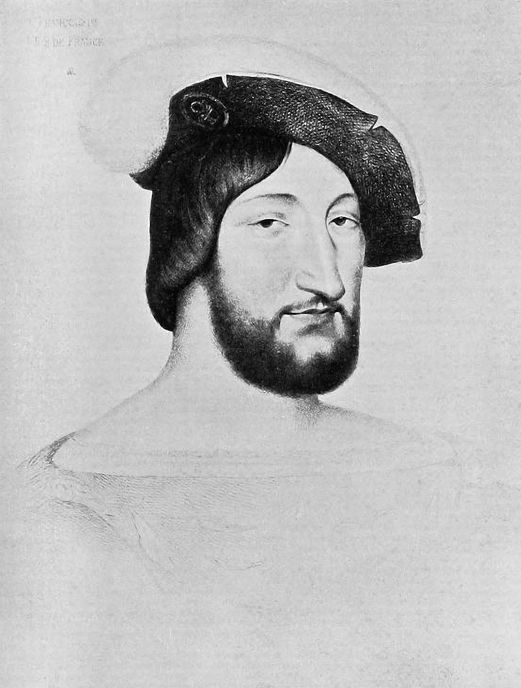
FRANÇOIS I KING OF FRANCE
FROM AN ENGRAVING AFTER THE DRAWING IN THE BIBLIOTHÈQUE NATIONALE
But François committed a fatal error when, contrary to the advice of La Palice, the new Constable,23 he proceeded to weaken his army by detaching 4,000 men to attack Genoa and sending nearly three times that number, under John Stuart, the last Duke of Albany,24 to the frontier of Naples. For Antonio de Leyva succeeded in inspiring the garrison and citizens of Pavia with his own indomitable spirit, and the stubborn defence of the town caused the siege to degenerate into a blockade and gave time to Pescara to reorganise his forces behind the shelter of the Adda; to Bourbon to return from Germany with a strong force of landsknechts, which his great name had attracted to his banner; and to Lannoy, the Viceroy of Naples, to join his colleagues at the head of a considerable body of Spaniards and Italians.
Towards the end of January, the Imperialists quitted their camp at Lodi,25 and advanced to the relief of Pavia. François's most prudent officers, La Palice, La Trémoille, and the Grand Master of the Artillery, Galiot de Génouillac, warned him of the danger of permitting himself to be shut in between the relieving army and the garrison of Pavia, and urged that they should temporarily raise the siege and retire on Milan, or occupy a strong defensive position in the environs. Bonnivet and the junior officers, however, cried out with one voice against this proposal, the former declaring that "we other Frenchmen are not accustomed to make war by military artifices, but with banners waving, particularly when we have for general a valiant king, who ought to inspire the greatest poltroons to combat bravely."26 Such advice was too much in accord with François's own inclinations not to be acceptable, and he accordingly determined to remain before Pavia.
It must be admitted that the position which he took up was one of great strength. Earthworks bristling with cannon protected his front; his right was sheltered by the Ticino; while his left lay within the high walls of the park of Mirabello, the favourite villa of the dukes of Milan, whose beauties had been so often celebrated by the poets and artists of Italy.
For three weeks the Imperialists remained in sight of the French camp without attempting any decisive movement, though they succeeded in throwing a supply of ammunition into Pavia. By that time their provisions were exhausted, and it was only with the greatest difficulty that their generals could prevent the army from disbanding. On the other hand, François's forces had been still further reduced by the withdrawal of 6,000 Swiss mercenaries, who had been recalled to the Grisons to defend their valleys against acondottiere in the pay of Charles V, who had seized Chiavenna, on Lake Como. Their departure, however, left the French still superior to the enemy, particularly in cavalry and artillery. At length, faced with the alternative of fighting or disbanding, the Imperialist generals decided to attack,27 and in the early hours of St. Matthias's Day (February 24) they advanced to the assault of the French position. During the night, several companies of soldiers and sappers had been detached to breach the Mirabello wall, which, as we have mentioned, covered the French left, and had succeeded in doing so in three places; and it was on these points that the Imperialists directed their attack.
Accounts of the battle which followed are many and unusually conflicting, but the following details seem to be well authenticated:
The flank march of the Imperialists over the open ground which lay between them and the French exposed them to so murderous an artillery fire that, according to Du Bellay, "you saw only arms and heads flying in the air." To check this havoc, Pescara issued orders for the troops to take shelter in a hollow to the northward of the French position, for which they accordingly made, the infantry at the double and the cavalry at a gallop. Observing this, François concluded that the Imperialists were in full retreat and that victory was assured, and charged furiously down from the rising ground which he occupied, at the head of his bodyguard of nobles and gentlemen and the French men-at-arms. By this movement, he not only got between his own artillery and the enemy, and obliged the gunners to cease fire,28 but cut himself off from the main body, and left his centre and right wing unsupported by cavalry. As soon as the King charged, the whole army quitted their entrenchments and pressed forwards likewise, the landsknechts, led by the attainted Duke of Suffolk29 and François de Lorraine, younger brother of Claude, Duc de Guise, being on the right, the Swiss in the centre, and the French foot on the left.
The King at first carried all before him, killed with his lance the Marchese di Civita San-Angelo, who led the Imperialist light horse,30 scattered the men-at-arms of Lannoy, and broke right through a body of pikemen. But Pescara and Bourbon rallied the fugitives; and the steady fire of the Spanish arquebusiers, which no armour could withstand, checked the triumphant progress of the French men-at-arms and drove them back upon the Swiss, whom they threw into hopeless disorder. In the meanwhile, thelandsknechts on the French right were attacked on one flank by their compatriots in the Imperial service, and on the other by some Spanish battalions, and, after a gallant struggle, were overwhelmed by numbers and perished almost to a man, both Suffolk and François de Lorraine being killed. The victorious troops then advanced against the disordered Swiss, upon whom the arquebusiers were now directing their fire, and, disheartened by the fate of their German allies, the Swiss gave way and retreated towards Milan. On the left, the Duc d'Alencon, who commanded the cavalry of that wing, lost his head on learning of the defeat of the right, and fled without striking a blow, followed by his men;31 and, though the French infantry, under La Palice, offered a stout resistance, they eventually shared the fate of the Germans, the Constable being amongst the slain.32 Finally, Antonio de Leyva sallied out from Pavia, dispersed the corps which had been left to hold him in check, destroyed the bridge over the Ticino — the principal avenue of escape — and fell upon the rear of the French cavalry whom François had so imprudently led to the charge, and who were now the only troops which still held their ground. They, comprising as they did the élite of the French nobility, and inspired by the example of their King, performed prodigies of valour, but, hemmed in on every side by overwhelming numbers, their courage was useless; François's horse fell dead under him,33 and the King, who had already been wounded in three places, was made prisoner, and almost all his followers were either killed or taken. Never, indeed, had there been so great a slaughter of nobles. Besides Suffolk, François de Lorraine, and La Palice, who had fallen earlier in the engagement, the gallant old Louis de la Tremoille, who had taken part in every war which France had waged since the accession of Charles VIII, Louis d'Ars, the kinsman and teacher of Bayard, René, the Bastard of Savoy, Grand-Master of France,34 the Grand Equerry San-Severino, chief of the French party in the kingdom of Naples, the Maréchal de Foix, and Bonnivet were either killed or mortally wounded; while Henri d'Albret, King of Navarre, the Comte de Saint-Pol, brother of the Duc de Vendôme,35 Anne de Montmorency, afterwards Constable of France, Chabot de Brion, afterwardsAdmiral, the Prince de Talmont, heir of La Trémoille, and the Sénéchal d'Armagnac were among the prisoners. In less than two hours France was deprived of her sovereign and a whole generation of paladins. Altogether, it is believed that over 10,000 of the French and their auxiliaries perished on the field of battle, or were drowned in attempting to escape across the Ticino, and at least 4,000 were taken prisoners. The loss of the victors was comparatively small, probably not more than 1,000.
Notes
(1) Thus history repeated itself in a singular manner, for Maximilian's father, Ludovico il Moro, had been dispossessed of his duchy by Louis XII and carried away captive to France, where he died, in 1510, at the Château of Loches.
(2) By the Pragmatic Sanction, which had been promulgated at Bourges in 1438, the authority of the Pope was subordinated to periodical General Councils; the free election of bishops, abbots, and priors was guaranteed to chapters and communities; and the various extortions, known as annates, réserves and expectatives, by which a great part of the ecclesiastical revenues of France went to fill the Papal coffers, were suppressed. Successive pontiffs had made great efforts to secure its revocation, but until now without success.
(3) Regnier de la Planche.
(4) Juana, second daughter of Ferdinand and Isabella — Jeanne la Folle, as the French called her.
(5) He came forward in theory as a German prince, basing his claim on his lordship of the old kingdom of Arles, a fief of the Empire.
(6) Du Bellay, Mémoires.
(6b) [Kindle note: the original here reads "1721".]
(7) Guillaume Gouffier, Seigneur de Bonnivet, born about 1488; killed at the battle of Pavia, February 24, 1524. Educated with François I, to whom his elder brother was gouverneur, he became a great favourite with that prince. He was sent on a diplomatic mission to England in 1518, and represented François at the Diet of Frankfurt the following year. He was celebrated for his gallant adventures, and carried his temerity to the point of becoming his master's rival in the affections of Madame de Chateaubriand and of laying siege to the heart of the King's sister. In the latter enterprise he was unsuccessful, and in an attempt to take by storm the fortress he had failed to reduce, he was vigorously repulsed, and bore for some time the proofs of his defeat upon his face. Marguerite has herself related the details of this affair in the fourth nouvelle of the Heptaméron.
(8) Du Bellay, Mémoires.
(9) Daughter of the Emperor Maximilian and Mary of Burgundy; born 1840; married first, in 1497, Don John, son of Ferdinand and Isabella; secondly, in 1512, Philibert le Beau, Duke of Savoy; Governess of the Netherlands; died 1530.
(10) Odet de Foix, Vicomte de Lautrec (1485-1525), was the second of the three brothers of François's mistress, Madame de Chateaubriand, and probably owed his command to his sister's influence. He had taken part in the Italian wars of Louis XII, and had been severely wounded at the battle of Ravenna in 1512, while endeavouring to save his cousin and commanding officer Gaston de Foix. He had also distinguished himself at Marignano. Lautrec was an extremely brave soldier and not without military talent; but his vanity and obstinacy rendered him unfit for the post of general-in-chief. Brantôme, however, has devoted a chapter to him in his Grands Capitaines Françoises.
(11) Grand-daughter of Pierre II de Bourbon and of Anne de Beaujeu, daughter of Louis XI.
(12) Born at Louvain in 1498. At the age of sixteen she fell desperately in love with Frederick, Prince Palatine, but her brother refused to hear of such an alliance, and married her, in 1519, to the old King of Portugal, Manoel the Great, by whom she was left a widow two years later.
(13) Charles, Marquis de Lannoy, born at Valenciennes in 1487, and brought up with the future Emperor, who was greatly attached to him. He was made a Knight of the Golden Fleece in 1515, and Viceroy of Naples in 1521.
(14) Francesco Ferrante d'Avalos, Marchese di Pescara, a member of a noble Neapolitan family of Spanish origin, and the husband of the celebrated poetess Vittoria Colonna, who consecrated many of her poems to his memory. The Italian historian Vettori describes him as arrogant, envious, avaricious, vindictive, and cruel, and "born expressly for the ruin of Italy"; but, however that may be, he was adored by his soldiers and was by far the ablest general whom Charles V possessed at this time.
(15) This reinforcement had been duly despatched by the King, but it had been delayed on the march.
(16) Du Bellay, Mémoires; la Très joyeuse, plaisante et récreative histoire du gentil Seigneur de Bayard, composée par le Loyal Serviteur, publié par J. Roman (Paris, 1878).
(17) Adrian IV had died in September 1523, and had been succeeded by Cardinal Giulio de Medici, who assumed the name of Clement VII.
(18) Henri Martin, Histoire de France.
(19) Armstrong, "The Emperor Charles V."
(20) There was a saying that, whereas in the rest of France every man could wield a sword, the Provençals could scarcely hold a knife.
(21) Du Bellay relates that one day a cannon-shot from the town passed through Pescara's tent, killing his almoner and two of his attendants. Pescara sent the deadly missile to Bourbon. "Here," wrote he ironically, "are the keys which the citizens of Marseilles bring you."
(22) Mignet, la Rivalité de François Ier et de Charles-Quint.
(23) Jacques de Chabannes, Seigneur de la Palice. He was a member of a family famous for its warriors, and one of the oldest of the French marshals, having served with distinction in the Italian wars of Charles VIII.
(24) Son of Alexander Stuart, second son of James II, and Anne de la Tour d'Auvergne. He had been brought up in France, which he looked upon as his country, and, though he was Regent of Scotland during the minority of James V, he passed but some three years there.
(25) Their army was composed of a little over 20,000 infantry, 500 light horse, and 200 men-at-arms, with a few pieces of cannon. Its strength lay in the Spanish arquebusiers, at this period the best marksmen in Europe, and the serried masses of intrepid landsknechts, under the command of Luther's friend, George Frundsberg. — Mignet.
(26) Brantôme, Vie des grands capitaines.
(27) Pescara's harangue to his starving Spaniards on the night before the battle is worthy of reproduction: "My lads, Fortune has placed you in such an extremity that on the soil of Italy you have nothing on your side except what is under your feet; all the rest is against you. The whole power of the Emperor could not provide you to-morrow morning with a single morsel of bread. We know not where to obtain it, unless in the French camp, which is before your eyes. There, there is everything in abundance — bread, wine, meat. And so, my lads, if you intend to eat to-morrow, let us march to the French camp."
(28) "Il couvrit son artillerie et lui ôta le moyen de jouer son jeu." — Du Bellay.
(29) Richard de la Pole, son of John de la Pole, second Duke of Suffolk and younger brother of John, Earl of Lincoln (killed at Stoke in 1487), and Edmund (executed in 1513). He had been attainted in 1504, and exempted from the general amnesty on the accession of Henry VIII. The French called him "Rose blanche," to distinguish him from Charles Brandon, Duke of Suffolk, the second husband of Mary Tudor.
(30) "His Majesty sent to Heaven the Marchese di S. Angelo, whom he slew with his own hand." — Letter of Marco Paolo Luzascho, cited by Ranke, "History of Germany."
(31) On his arrival at Lyons, his wife and mother-in-law overwhelmed him with such bitter reproaches that he died of grief two months later.
(32) His horse having been killed under him, he had surrendered to a Neapolitan officer named Castaldo, when a Spaniard, jealous of the Italian's good fortune, blew out the distinguished prisoner's brains with an arquebus.
(33)
"Et là je fuz longuement combattu,
Et mon cheval mort soubz moy abattu."
— Epître de François Ier, in Champollion, Captivité du roi François Ier.
(34) He was a natural son of Philip, Duke of Savoy, by Bona da Romagnano, a Piedmontese lady, and therefore half-brother of Louise of Savoy.
(35) The King of Navarre and Saint-Pol subsequently succeeded in effecting their escape.