
Refusal of François I to execute the Treaty of Madrid — His conduct severely condemned by modern historians, but generally condoned by his contemporaries — The League of Cognac formed against the Emperor — Inaction of François, who for more than a year leaves his Italian allies to shift for themselves — Fall and sack of Rome — François concludes the Treaty of Westminster with England — Lautrec invades the Milanese with an army subsidised by England, and carries all before him — Escape of Clement VII from Rome — Contemplated duel between François and Charles — Siege of Naples — The folly of François causes the withdrawal of Andrea Doria's fleet from the blockade — The French, weakened by disease, raise the siege, and are subsequently obliged to capitulate — Genoa lost to France — Battle of Landriano and defection of the Pope — Peace of Cambrai (la Paix des Dames), which contains a stipulation that the young princes are to be released on payment of a ransom of two million crowns.
CHARLES V was soon to discover that, on the day on which he had allowed the French King to cross the Bidassoa, he had let slip the chance which comes to a man but once in his life.
On François's arrival at Bayonne, Louis van Praet, the Imperial Ambassador, lost no time in calling upon him to ratify the treaty, as he had engaged to do in the first town in his dominions. The King, on some plausible pretext, deferred the ratification. At Mont-de-Marsan, whither the Court proceeded from Bayonne, Peñalosa, who had been sent by Lannoy, joined Van Praet, and François was again summoned to fulfil his promise. This time, his Majesty replied that the treaty, the terms of which had already been made public by the Emperor, was causing great indignation among his subjects; that the principal personages of the State, to whom he had applied to secure its acceptance, all implored him not to ratify it; that he had received advices from Burgundy that the cession of that province, "united and incorporated inseparably with the Crown," could not take place without the consent of the Estates, who were determined not to give it, and that he feared that the adhesion of the States-General of the kingdom and the Parlement of Paris, which was equally necessary for such an alienation, would be also impossible to obtain.
These evasive answers were communicated to Lannoy, who was at Vittoria with Queen Eleanor and the young princes, and by him transmitted to his master. Charles at once sent orders to the Viceroy of Naples to proceed in person to France and demand in the most imperative terms the immediate fulfilment of the King's engagements. Lannoy set out in all haste and found the Court at Cognac, in Saintonge — François's birthplace — the King's physicians having decided that his native air might be beneficial to his health, which was still causing some anxiety.
Two days after the Viceroy's arrival (May 10, 1526), he and Van Praet were requested to appear before the Council, when the Chancellor informed them that the King had no power to surrender a province of France, and that, though his Majesty's subjects were ready to obey him in all else, they would never consent to the dismemberment of the realm. The King himself confirmed what his Minister had said, adding that the oath which he had taken either to execute the terms of the treaty or to return to Spain was not binding, inasmuch as it had been exacted from him while in prison. At the same time, he was prepared to pay a ransom of two million crowns for Burgundy — an immense sum at this period — and to execute faithfully the rest of the treaty.
Modern historians have rightly condemned the conduct of François in severe terms; but his contemporaries appear to have regarded it in a very different light. "Our King," writes Brantôme,01 "made the treaty of a very skilful prince," and such was undoubtedly the general opinion in France. Nor was foreign opinion, outside Charles's own dominions disposed to judge the perjured monarch at all harshly. Those, indeed, to whom the growing power of the Emperor was a cause of jealousy and alarm, declared that François was justified in repudiating engagements entered into while he was not a free agent. "Treaties made under fear do not stand," wrote Baldassare Castiglione, the Papal Nuncio at Toledo, to the Vatican, so soon as he was informed of the terms of the treaty,02 and Clement VII subsequently made not the smallest difficulty about absolving the King from his oath; while Wolsey instructed the English Ambassadors at the French Court "to say of themselves soberly, and in a manner of stupefaction and marvel, that these be great and high conditions, the like whereof have not been heard of, and such as were even here [in England] thought were either never agreed to, or being agreed to, shall never be performed."03
François's reply to the demands of Lannoy and Van Praet was communicated to Charles V, who, incensed and mortified at finding himself the dupe of a rival whose political capacity he held in such contempt, rejected the proposed compromise with indignation, and called upon the King to keep his oath and return to prison, since he was either unwilling or unable to execute the articles of the Treaty of Madrid. In the interval, however, plenipotentiaries from Clement VII and the Venetians had arrived at the French Court, with proposals for a Franco-Italian alliance, which was to free the peninsula from the yoke of the Imperialists and re-establish its independence; and François's reply to the Emperor's summons was the announcement of the formation of the "Holy League" of Cognac, between the King of France, the Pope, Venice, Florence, and Francesco Sforza, Duke of Milan (May 22, 1526), at the instigation of the King of England, who was declared its protector.
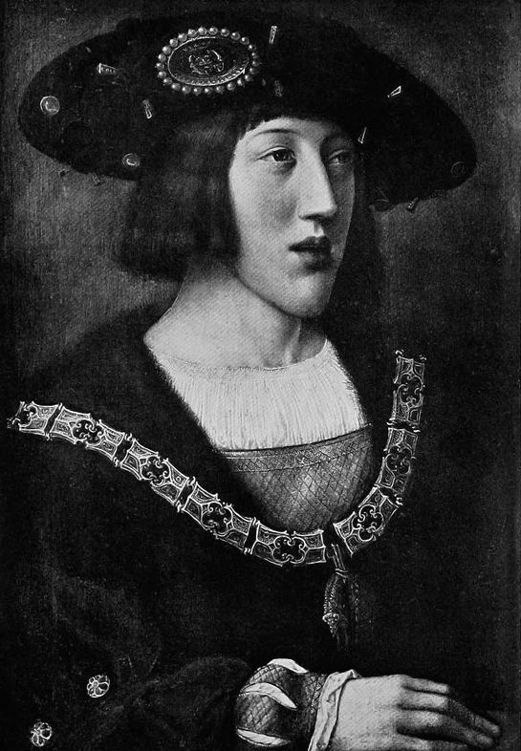
THE EMPEROR CHARLES V
FROM A PAINTING BY AN UNKNOWN FLEMISH ARTIST IN THE LOUVRE
Conceived ostensibly in the interests of universal peace, this league was in reality a challenge to a European war, for, though the preamble of the treaty stated that its object was "the safety and security of Christendom and the establishment of a true and lasting peace between Christian princes," and the Emperor was invited to join it, the conditions of his admission were that he should restore the Milanese to Sforza, place the Italian States in the position in which they stood at his accession, visit Italy for his coronation with such escort only as might be approved by the Pope and the Venetians, release the French princes for a reasonable ransom in money, and undertake to discharge within three months all his debts to the King of England. In the event of Charles refusing to subscribe to these conditions, as he would most assuredly do, the confederates bound themselves to expel the Imperialists first from Lombardy and Genoa, and afterwards from Naples. When this had been effected, François was to recover his suzerainty over Genoa; while Sforza, to whom a French princess was to be given in marriage, undertook to cede to him the county of Asti and pay an annual sum of 50,000 ducats, in return for his renunciation of his claims on the Milanese. He was also to receive an annual pension of 75,000 ducats from the new King of Naples — whose selection was left to the Pope — as compensation for the surrender of his claims in that quarter. Great efforts were made by the confederates to induce England to join the League, and, as a temptation, an article was inserted in the treaty engaging to provide Henry VIII with a rich principality in the kingdom of Naples, and reward Wolsey with a lordship producing a revenue of 10,000 ducats. But it was not the interest of England at that moment to make an enemy of the Emperor, and she decided to wait upon events.
We shall pass briefly over the events which followed the formation of the League of Cognac. Never again was France to have so favourable an opportunity of arresting the forward march of her great enemy; not for nearly three centuries was Italy to be afforded so fair a chance of shaking off the yoke of the foreigner. Charles V, as he had foreseen when the Treaty of Madrid was signed, found himself without an ally in Europe, and beset with difficulties on every side. Germany was torn by religious strife; the Turks were overrunning Hungary; Naples was seething with discontent; his coffers were all but empty. In Lombardy his army had dwindled to ten or twelve thousand disheartened and disorganised men, for Pescara was dying, there was no money to pay the troops, they were surrounded by a population which their tyranny had aroused to exasperation, and the citadels of Milan and Cremona still held out for Sforza.
But the opportunity was allowed to pass. François was no longer the man he had been before his captivity. Then, whatever his shortcomings, he had at least possessed resolution and energy where the furtherance of his own ambitious schemes was concerned. Now, however, he seemed to take but faint interest in the momentous struggle to which he found himself committed and to be quite unable to decide upon a vigorous course of action. The pleasures of the chase, the charms of a new mistress, Anne de Pisseleu, the future Duchess d'Étampes, of whom we shall have a good deal to say hereafter, occupied his mind to the exclusion of the important questions which called so urgently for his attention. "Alexander used to pay attention to women when he had no affairs of State; François attended to affairs of State when there were no more women."04
The French King had pushed his Italian allies into war by promises of the most vigorous co-operation; but for more than a year he never moved, and by that time two of the leaders of the League had fallen, and the whole situation in the peninsula had completely changed.
The Duke of Urbino, the general of the confederates, though far superior to the Imperialists in numbers, failed in his attempt to relieve the citadel of Milan, and at the end of July 1526 starvation obliged Sforza to capitulate.
After Sforza, it was the turn of Clement VII. In the following September, a force consisting partly of Imperialists and partly of troops in the service of the Pope's determined enemy, Cardinal Pompeo Colonna, swooped down upon Rome, plundered the Vatican and St. Peter's, and compelled Clement VII, who had taken refuge in the Castle of St. Angelo, to purchase their withdrawal by a four months' truce, which, however, following the example of the Most Christian King, he speedily found a pretext for violating. Nevertheless, the misguided Pontiff began to regret his share in a war in which he had embarked with such confident hopes of success,05 and on March 15, 1527, he concluded a treaty with the Viceroy of Naples, by which the Pope was to abandon the Confederation and the Imperialists were to evacuate the States of the Church.
But the solution of the Papal-Imperial problem had already passed into other hands. In July 1526, Bourbon had taken command of the Imperialists in Lombardy; towards the end of the year, 13,000 landsknechts under George Frundsberg crossed the Alps, and early in February, the ex-Constable joined them with his forces on the Trebbia. His troops, unpaid, ragged, and starving, were in full mutiny. Clamouring for their pay, they surrounded Bourbon's quarters, and assumed so threatening an attitude that their leader was obliged to take refuge with the landsknechts.06 The Germans, however, soon followed the example of the Spaniards, and Frundsberg, while endeavouring to pacify them, was struck down by apoplexy and carried away to Ferrara, where he died.
Recognising that, in order to quell the mutiny, there was but one course open to him, Bourbon now offered to lead the troops to the pillage of Florence and Rome. His decision was hailed with enthusiasm by the army, which was already preparing to march, when one of Lannoy's officers named Feramosca arrived in the camp, with the announcement of the truce which had just been concluded with the Pope. Bourbon, however, who was by this time thoroughly disgusted with the ingratitude of the Emperor, and is believed to have contemplated carving out a kingdom for himself in Southern Italy, told him sarcastically that if he wished the truce to be observed, he had better persuade the troops of the necessity of submitting to it. This Feramosca essayed to do, whereupon — to borrow his own words — the soldiers became "furious as lions," and if he had not prudently taken to flight, would certainly have killed him.07
On March 30, the army began its march, crossed the Apennines and descended into Tuscany by the Val di Bagno, "like a living avalanche," devastating every town and village through which it passed. But, finding that the Duke of Urbino had fallen back to cover Florence, it turned to the south-east and advanced rapidly on Rome, for whose defence Clement, relying on his convention with Lannoy, had made but the feeblest preparations. On May 5, the Imperialists saw the spires and domes of the Eternal City rising before them; on the following morning, they advanced to the assault. Bourbon himself planted the first scaling-ladder against the walls, and was mortally wounded by a ball from an arquebus08 with his foot on the second rung; but the assailants, roused to fury by the fall of their leader, poured over the ramparts in a resistless torrent; the terror-stricken Pope fled to the Castle of St. Angelo, and in a few hours all resistance was at an end.
The grim tragedy which followed is well known. For weeks the city was a prey to the lawless soldiery, who pillaged, murdered, and committed every act of brutal violence without respect of age or sex or dignity. "The sack of Rome," writes Brantôme, "was so terrible that neither before nor since has anything been seen like it." "Never," says another writer, "had there been such calamity, misery, damage, cruelty, and inhumanity witnessed."09
The sack of Rome and the captivity of the Pope, who, after sustaining a siege of a month in the Castle of St. Angelo, was forced to capitulate, sent a thrill of horror through Christendom, and though the Emperor made every effort to exculpate himself, his protestations fell on unheeding ears. The opportunity thus offered him was too favourable for François to lose. In the previous March, a French embassy, with Grammont, Bishop of Tarbes, at its head, had visited England, where Henry VIII and Wolsey were becoming seriously alarmed at the successes of the Imperialists; and on April 30 — a week before Rome fell — a treaty was concluded at Westminster, whereby it was arranged that either François himself or his second son, Henri, should marry Mary Tudor,10then eleven years old; that Henry VIII should renounce the pretensions to the Crown of France on payment of an annual sum of 50,000 crowns by François and of 15,000 by his successors; that, in the meanwhile, the two Kings should present an ultimatum to the Emperor calling upon him to make peace, to liberate the princes on payment of the ransom already offered, and to discharge his debts to England, and that, in the event of his refusal, they should make joint war upon him. The tragic news from Italy caused this alliance to bear speedy fruit, and at the beginning of August Lautrec, at the head of an army of over 30,000 men, entered Lombardy. It was officially called "exercitus Anglicæ et Gallicæ regum pro pontifice romano congregatus," but was English only in the money part, Henry VIII supplying 50,000 crowns a month, and, mirabile dictu, actually paying two months' subsidies in advance.11
Antonio de Leyva, who commanded the Imperialists left in Northern Italy, was quite unable to make head against such a force. Alessandria capitulated; Pavia was taken by assault and ruthlessly sacked, in revenge for the disaster of 1525, and before the end of the year practically the whole of the Milanese, with the exception of the capital, was lost to the Emperor; while Genoa, which had refused to join the League, also surrendered, after being closely blockaded, both by land and sea, and Ferrara, Florence, Savoy, and Mantua deserted the Imperial cause.
On December 9, Clement VII, after paying a portion of the 250,000 ducats demanded as his ransom, escaped from Rome, "disguised as a merchant," and fled to his palace at Orvieto, where the advance of Lautrec's army, which early in January began to march southwards, protected him from further molestation.
On the 22nd of the same month, the heralds of England and France brought to the Emperor at Burgos a formal declaration of war. Charles replied in very moderate terms to the English herald, but said to the other: "The King, your master, has done a sorry, dastard deed in breaking his plighted word to me in regard to the Treaty of Madrid; and this I am ready to maintain, my person against his." François replied by a violent cartel, in which he informed the Emperor that "if he had wished or wished to charge him with having done anything unworthy of a gentleman of honour, he lied in his throat;" and begged him to fix a time and place where they might meet in mortal combat. The Emperor thereupon sent the herald-at-arms "Burgundy," with a letter in which he ironically suggested a meeting on the Bidassoa, between Fontarabia and Andaye. This letter he was instructed to read to François before his Court. But when, on September 9, after being kept waiting seven weeks on the frontier, he reached Paris and was admitted to the royal presence, François demanded the safe-conduct he had asked for, and, as "Burgundy" refused to deliver it before he had done his office in the form prescribed, and his Majesty refused to hear him otherwise, he eventually retired with the cartel still in his hand.12Perhaps, François was reluctant to allow his Court to hear the exceedingly candid opinion which the Emperor expressed of his conduct; perhaps, he was glad of a pretext to evade the proposed meeting. Anyway, he refused to accord the herald a second audience, and Wolsey's hope that "these yong corragious passions should finally be converted into fume" was realised.
While this quarrel, which did little honour to the two rivals, was engaging the attention of their respective Courts, the fate of Italy was trembling in the balance. Lautrec advanced southwards without encountering anything but the feeblest opposition, for disease had so terribly avenged the Romans of the brigands who had despoiled them that they were now a mere wreck of an army, and, on the approach of the French, they evacuated the city and the surrounding country and fell back on Naples. If Lautrec had showed a little more activity, he might have destroyed them, in which case Naples must have fallen, but he allowed them to escape him. However, by the end of April he was besieging the town, while the French and Genoese fleets blockaded the port. The plight of the garrison was desperate, for neither supplies nor reinforcements could reach them; and when, in the last days of May, the viceroy's fleet was annihilated in a desperate attempt to break the blockade, and Moncada himself killed,13 their last hope seemed extinguished.
Had Naples fallen, the loss of Milan must have soon followed, for with Genoa, the water-gate of Italy, in the hands of the French, it was impossible for Spanish troops to reach Lombardy; and then not a foot of the peninsula would have remained to the Emperor.
However, the apathy and folly of François ruined everything. He sent scarcely any reinforcements or money to Lautrec; he alienated the Genoese by depriving them of their free constitution and converting Savona into a rival port; and, by these measures and the haughtiness and injustice with which he treated him, he mortally offended their compatriot Andrea Doria, who had long served France with a squadron organised and equipped by himself. At the beginning of July, Doria withdrew the Genoese fleet from the Bay of Naples, upon which troops and supplies from Spain and Sicily were at once thrown into the city. A few weeks later, the French, amongst whom pestilence had been making the most terrible ravages,14 Lautrec himself being amongst the victims, raised the siege and evacuated the whole kingdom of Naples; but they were followed by the Imperialists and compelled to capitulate.
The catastrophe of Naples was followed by other reverses. About the middle of September, Andrea Doria, who had now gone over with his ships to the Emperor, appeared off Genoa, incited the city to revolt, drove out the French garrison, and re-established the republic, under Imperial protection; while, in June 1529, a second French army under the Comte de Saint-Pol, which had been sent into Lombardy, was totally defeated by Antonio de Leyva at Landriano, and, almost immediately afterwards, the Pope deserted the League and made an "Eternal Peace" with Charles.
Although his Italian allies were for continuing the war, François now decided to make peace. He had already lost two armies, and to raise a third was impossible. Moreover, he was becoming alarmed about his sons, who had been now more than three years in captivity, and whose health and character, he feared, might be seriously affected if they were not soon set at liberty.
Fortunately for France, the resources of the Emperor were almost as exhausted as those of his rival; while the religious dissensions in Germany, which were threatening to develop into civil war, and the advance of the Turks made peace an urgent necessity.
Louise of Savoy and Margaret of Austria were called upon to arbitrate between the monarchs. The two princesses met at Cambrai on July 7, 1529, and in less than a month drew up a treaty, known as "la Paix des Dames," which was in the main a recapitulation of the Madrid treaty, save that Burgundy remained a French province15 and that the young princes were to be restored to their father on payment of the 2,000,000 crowns already offered. The Italian allies of France were abandoned to their fate; indeed, François even engaged to assist the Emperor to drive the Venetians from the Adriatic ports which they had occupied.
Notes
(1) Brantôme was, of course, not himself a contemporary, but he echoes the sentiments of those who were.
(2) Cited by Mignet, Rivalité de François Ier et de Charles-Quint.
(3) Instructions of March 1526, in Sharon Turner.
(4) Tavannes, Mémoires.
(5) "This war," wrote Clement's most trusted Minister, Giberto, "will decide the deliverance of the eternal slaves of Italy. . . . Posterity will envy us the times in which we live, and our share in so great a felicity." — Ranke, "The Popes of Rome."
(6) According to Brantôme, Bourbon gave up to the soldiers all his jewels, plate, and furniture, as a proof of his good intentions; but the truth is that they pillaged his quarters and also killed one of his attendants.
(7) Letter of Feramosca to the Emperor, April 5, 1527, in Mignet.
(8) Benvenuto Cellini, as is well known, claimed the honour of having fired the fatal shot [Vita di Benvenuto Cellini, scritta di sua mano propria); but the writer's weakness for self-glorification is too evident for much importance to be attached to such a statement.
(9) Guillaume Paradin, Histoire de notre temps.
(10) This was the third time Mary had been betrothed; indeed, before she had left her cradle she had become an important factor in her father's intrigues with François I and Charles V. Immediately after the birth of the Dauphin, a marriage had been arranged between them; and on October 5, 1518 [? printed 1618], the bridal ceremony had been celebrated at Greenwich, Bonnivet representing the infant prince. It was arranged that the marriage ceremony was to be repeated when the Dauphin attained the age of fourteen, and that Mary was to receive a dowry of 330,000 crowns. However, before a year had passed, England's foreign policy had changed, and in January 1522 a treaty was signed with Charles V, by which he engaged to wed the English princess when she was twelve years old. At first, there seemed every likelihood of the marriage taking place, but, later, difficulties arose, and in September 1525 Henry VIII released the Emperor from his engagement, in return for a pecuniary compensation. It is worthy of remark that the French Ambassadors in 1527 seem to have been very favourably impressed with Mary, and one of them, the Vicomte de Turenne, who had the honour of dancing with the princess at Greenwich, wrote that he considered her "very handsome, and admirable, by reason of her great and uncommon mental endowments."
(11) "When this armye was assembled, the cardinal [of York] delivered the Kyng of Englande's money, that he had brought out of England in barrels, with which money was this armye payed two moneths before hand, and the remainder was delivered to sir Robert Jarnyngham, wich was called treasorer of the warres." — "Hall's Chronicle."
(12) The Emperor, however, had foreseen the difficulty which arose, and instructed "Burgundy," if he were prevented from reading the cartel, "to give it into the King's own hands, or even to throw it at his feet, if he refused to take it." The herald, however, apparently lost his head.
(13) Lannoy had died of fever in the previous September, and Ugo de Moncada had succeeded him as Viceroy of Naples.
(14) It was probably a virulent form of typhus, engendered by the heat of an exceptionally hot summer and the insanitary condition of the camp. So appalling was the mortality that in a month more than two-thirds of the army are said to have been swept away, and of the survivors only about 4,000 were fit for service.
(15) Charles, however, did not renounce his claims on Burgundy, and in later years advised his son to maintain them, though not to make them a casus belli.