
Change effected in the characters of the Dauphin and the Duc d'Orléans by their captivity in Spain — Impatience of François I, who "does not care for dreamy, sullen, sleepy children" — Eagerness of the King to regain a footing in Italy — Charles V's Italian league — Position and policy of Clement VII — Catherine de' Medici — Her early years — Her adventures during the revolution in Florence — Her suitors — François I sends envoys to Rome to propose a marriage between her and the Duc d'Orléans — Embarrassment of the Pope, who, while anxious for the French alliance, fears to give umbrage to the Emperor — Proposed interview between François and Clement at Nice — Duplicity of the Pope — The intimacy between Catherine and her cousin, the Cardinal Ippolito de' Medici, a source of disquietude to his Holiness — Catherine is sent to Florence and Ippolito to Hungary — Interview between the Pope and Charles V at Bologna — Clement skilfully outmanoeuvres the Emperor, and the marriage between Catherine and the Duc d'Orléans is arranged
NOTWITHSTANDING the apprehensions of François and Louise of Savoy, the health of the young princes would not appear to have been much affected by their captivity. The same, however, could not be said for their characters.
The Dauphin, who was now twelve, returned to France a grave, reserved youth, speaking little, and then in slow, measured tones, drinking scarcely anything but water, wearing only the most sombre clothes, and showing a regard for the minutiæ of etiquette most unusual in so young a prince — in a word, far more of a Spaniard than a Frenchman.
In the Duc d'Orléans — his junior by a year, and of a more sensitive nature — the change was even more marked. Awkward, taciturn, morose, unsociable, he seemed an altogether different being from the bright, intelligent lad whom the English Ambassador had seen at Amboise on the eve of his departure for Spain. The boy's spirit, in fact, had been crushed by the dreary existence which, as we have seen, had been his lot for more than four years — an existence in which he had not only been deprived of the affection and sympathy so necessary for one of his age, but subjected, it is but too probable, to constant petty humiliations at the hands of his callous gaolers. So profound was the impression which his sufferings had left upon him, that in 1542 — that is to say, twelve years after his return from Spain — Matteo Dandolo, the Venetian Ambassador in France, wrote that few people at the Court could ever remember to have heard him laugh.01
François, who was not the kind of man to make allowance for the shortcomings of others, could not conceal his displeasure at the change which had taken place in his sons, and particularly in the younger. He might have endeavoured to win the boy's confidence and affection, and thus gradually to dissipate his melancholy humour and persuade him that life held joys as well as sorrows. But the task was not one which commended itself to his selfish nature; and so, observing that the mark of a true Frenchman was to be always gay and lively, and that "he did not care for dreamy, sullen, sleepy children,"02 he left both Henri and the Dauphin severely alone, and bestowed all the affection of which he was capable on his youngest son, Charles, Duc d'Angoulême, a frank, high-spirited boy — now in his ninth year — who bade fair to become a replica of his father in both appearance and character.
But, if poor Henri appeared to be lamentably deficient in princely qualities, he was, none the less, a Son of France, and as such a useful pawn in the political speculations of his ambitious sire; indeed, even before he had crossed the Bidassoa, he had already become the chief factor in a scheme by which François hoped to regain a footing in Italy.
For François's passion for Italy was the scourge of his reign; it was the passion of a lover for a beautiful and capricious mistress, and the rebuffs which he had sustained only seemed to make him the more eager to prosecute his suit. To him, the Peace of Cambrai was merely a truce to enable his exhausted kingdom to gather strength for fresh exertions; he had no thought of abiding by it a moment longer than suited his convenience. Scarcely, indeed, was the ink dry upon the parchment of the treaty than he was planning new combinations, eagerly scanning the map of Europe for fresh allies.
And his search did not seem likely to be a long one. The Turks, who had threatened Vienna in 1529, were again eager to advance into Austria; Henry VIII, whom the Emperor's attitude in the matter of the divorce of Catherine of Aragon had completely alienated, was ready for a close alliance with France; the Protestant princes of Germany were already casting their eyes in the same direction. Finally Charles V's settlement of Italy had left behind it the germs of much future trouble.
Charles had no ambition for annexation of territory for territory's sake, and, in opposition to the advice of several of his Ministers, he had restored the Milanese to Francesco Sforza, in consideration of an annual payment of 900,000 ducats, and reinstated the Pope in all his former possessions. The policy he had resolved to pursue was that of closing Italy to France by means of a federation of States, which was to comprise Naples, the Papacy, the Milanese, Ferrara, Florence, and Mantua, and the republics of Genoa, Siena, and Lucca.
It was a scheme which had much to recommend it, but there were several obstacles to its success. Sforza's subjects, ground down by the taxation which their ruler was obliged to impose in order to meet the Imperial demands, were not inclined to be exactly enthusiastic in the common cause; Siena's sympathies were with France, as were those of the democratic party in Florence; while Venice, which was still too powerful and too independent to be brought within the league, and had not forgiven Charles for having thwarted her ambition of becoming the predominant power in Italy, constituted a standing danger on the north-east.
But the chief source of disquietude to the Emperor was the attitude of the Holy See, which was the pivot of the Italian political system. Although the Papacy was not strong enough to unite Italy, it, nevertheless, wielded a great influence, and could always foment a formidable opposition to any prince who aimed at the domination of the peninsula. Recognising this, Charles had already done much to conciliate Clement and was prepared to do even more. He had given back to him all the Papal fortresses which had been occupied by the Imperialists during the war, compelled the Venetians to restore Ravenna and Cervia, and assisted him to reduce the rebellious Florentines to submission; and he had resolved to create Alessandro de' Medici Duke of Florence and bestow upon him the hand of his natural daughter Margaret. But neither thankfulness for past mercies nor the expectation of favours to come sufficed to make the scheming, shifty Pontiff more than a very unstable ally. As a temporal prince, he naturally regarded with jealousy and suspicion the Imperial predominance in Italy; as head of the Church, he positively shuddered at the prospect of the General Council which Charles was being strongly urged to convoke as the only way of securing the union of distracted Germany. For a General Council might demand Clement's deposition, on the ground that the election of a person of illegitimate birth to the Holy See was uncanonical; and, even if it spared him, it would most certainly insist on reforms in the financial machinery of the Holy See, which would result in the withdrawal of immense sums from his immediate control. To avert this disaster was now the principal object of Clement's tortuous policy, and he was quick to recognise that his chances of success would be greatly strengthened by an alliance with François. François had made a Concordat with the Papacy, and had therefore nothing to gain from the proposed Council; indeed, it was to his interest to oppose it, since the pacification of Germany would mean an alarming increase in the power of the Emperor. If his Holiness could arrive at an understanding with François, without alarming Charles and sacrificing the advantages he counted to secure from him, he would find himself in a stronger position than he had been since his accession. And the means of accomplishing this lay ready to his hand.
Clement VII had a little orphan cousin à la mode de Bretagne, whom he called his niece — Caterina Maria de' Medici, daughter of Lorenzo de' Medici, Duke of Urbino,03 and Madeleine de la Tour d'Auvergne04 — for whom he was anxious to find a suitable alliance — that is to say, one calculated to promote the Medicean interests.
Catherine — to give the girl the Gallicized form of her name, by which she is best known to history — had passed a troublous childhood. Born in the Palazzo Medici, at Florence, on April 13, 1519, she had lost her mother on the 28th of the same month, and her father a week later, victims both, say the chroniclers, of Lorenzo's promiscuous gallantries. Alfonsina Orsini, the ill-fated duke's mother, took charge of the little orphan, who towards the end of that summer was taken so ill that no one seems to have expected her to live. However, she recovered, and Leo X having summoned her to Rome, in the last days of October she set out for the Eternal City, under the care of her grandmother and Cardinal Giulio de' Medici, afterwards Pope Clement VII. "Secum fert arumnas Danaum!"(She brings all the calamities of the Greeks with her) exclaimed Leo, as this frail shoot of the line of Cosimo was carried into his presence — words which were certainly to prove prophetic with regard to the nation which Catherine was one day to be called upon to rule.
Leo X died in 1521, and Alfonsina Orsini some months earlier. The latter's daughter Clarice, wife of the banker Filippo Strozzi, succeeded her as Catherine's guardian, under the surveillance of the Cardinal de' Medici, who, after the brief reign of Adrian VI, was elected to the chair of St. Peter. Catherine's half-brother Alessandro, natural son of Lorenzo by a Moorish woman,05 and her cousin Ippolito, son of Giuliano de' Medici, Leo X's younger brother, shared her house with her. For Ippolito, a handsome, good-natured boy, some seven years her senior, the child early conceived a warm affection, but she appears to have entertained a hearty dislike for the future ruler of Florence, whose pointed nose and swarthy complexion appealed to her as little as did his ungovernable temper and cruel disposition.
In the summer of 1525, Rome being in a very unsettled state, Clement VII decided to send Catherine and Alessandro to Florence, whither Ippolito had already preceded them. Alessandro, however, did not remain there long, as he went, in charge of a tutor, to live at the beautiful villa of Poggio a Cajano, midway between Florence and Pistoja; but Catherine and Ippolito took up their residence in the Palazzo Medici, in the Via Larga, under the care of Clarice Strozzi and Cardinal Silvio Passerini, who had been appointed governor of Florence.
It was now that the little girl's character began to take definite shape. Clarice Strozzi was a conscientious woman, but she appears to have been a harsh guardian, who kept an unsleeping eye upon her charge and never failed to visit with severity her childish peccadilloes. Thus, Catherine was often driven to dissimulation and skilful cajolery as a means of securing immunity from punishment, and this habit of deception, once formed, clung to her all her life; the methods which she employed at the Palazzo Medici she will practise at the Court of France; she will meet Diane de Poitiers, Guise, and Conde with exactly the same weapons as those with which she confronted Clarice Strozzi.
And she learned other lessons, too, besides the value of dissimulation. Some indiscreet words spoken in her presence very effectually undeceived her as to the intentions of her relatives in regard to her, and she recognised that, under colour of her welfare, they sought only the furtherance of their own ambitions. The impression that the discovery made on her mind was not a pleasant one; before she was eight years old her faith in human nature was entirely shattered; she distrusted every one, and particularly persons of high rank.
Two years passed in peace and obscurity; and then came the terrors of 1527, when Rome was sacked by the brutal soldiers of Bourbon, the Pope was in turn a prisoner and a fugitive, and Florence was a prey to rival factions. For, on the news of the downfall of Clement, the populace rose against the hated Medici and proclaimed the re-establishment of the republic.
At the beginning of the Revolution, Cardinal Passerini hurried Catherine away to Poggio a Cajano; but the democratic leaders, although they wished no harm to the "duchessina," as the little girl was called, considered her too valuable a hostage to lose; and she was accordingly brought back and lodged in the Dominican convent of Santa-Lucia. On May 18, her aunt arrived and took her back to the Palazzo Medici, where, however, the girl's arrival aroused so much indignation among the populace, that the same evening Clarice returned with her to the convent.
From the Convent of Santa-Lucia, Catherine was presently transferred to another nunnery, that of Santa-Caterina. As plague had broken out in Florence with fearful virulence,06 and the convent in question was situated in one of the most unhealthy quarters of the city, the change of residence was attended by considerable danger to the unfortunate girl. But it was not until the beginning of December that, thanks to representations which the French Ambassador made on her behalf, she was removed to the Convent of Santa-Annunziata delle Murate, in the Via Ghibellina, which his Excellency had himself chosen for her.
The Murate — the name signifies the "walled-up ones" — had been originally a poor and very austere community, but, though it still clung to the custom of obliging each novice who joined it to make her entry through a hole in the outer wall, made for the occasion, and rebuilt behind her, in symbolisation of her final separation from the world,07 it was now an easy-going and eminently aristocratic sisterhood, where many daughters of noble houses were received either as nuns or pupils, and strongly Medicean in its sympathies. Catherine therefore was assured of a warm welcome, and, as the letters written by her in later years prove, she always retained the most kindly feeling towards those who had sheltered her in those stormy days.
Catherine learned much from the high-born sisters in the Via Ghibellina during the two and a half years which she spent among them. "At the Murate," observes one of her biographers, "the Catherine of the Wars of Religion was formed."08 They taught her those graceful manners, that ease in conversation, that exquisite courtesy, which fascinated the diplomatists and statesmen of her time, and disarmed even the sternest Huguenot when he was admitted to her presence. They taught her, it is to be feared, little that makes for godliness, except a certain respect for the forms and ceremonies of the Church; but, on the other hand, they encouraged and fostered that love of deception which was already ingrained in the girl's character, and taught her that expediency is the only true law and craft the natural and legitimate weapon of the weak. Thus, when, in the summer of 1530, while Florence was being closely besieged by the combined forces of Pope and Emperor, the Government, having ascertained that the sisters of the Murate were combining with their orisons a good deal of intriguing with the Medicean partisans who had remained in the city, sent commissioners to remove Catherine to the Convent of Santa-Lucia, the girl suddenly appeared among the nuns in the dress of their Order, and with her hair cut short, crying out: "Holy Mother! I am yours! Let us now see what excommunicated wretch will dare to drag a spouse of Christ from her monastery!"
Through the arguments of one of the commissioners, Silvestro Aldobrandini, the father of him who became Pope, more than sixty years later, under the title of Clement VIII, she was eventually persuaded to obey the order for her removal, though she obstinately refused to resume her ordinary dress, being determined, we are told, that all the world should see that she was a nun taken forcibly from her cloister. And so, still in conventual attire, she mounted the horse that Aldobrandini had brought and rode through the streets to Santa-Lucia, with a number of gentlemen marching on either side, to protect her from the fury of the starving populace, who had demanded that she should be suspended in a basket from the walls and exposed to the fire of the besiegers, or thrown as a prey to the soldiers.
The firmness of Aldobrandini, however, saved both her life and her honour, and she reached Santa-Lucia in safety.09 Here, on August 12th, she learned of the surrender of the city, and lost no time in returning to her friends at the Murate, with whom she remained until the middle of September, when Clement VII sent Ottaviano de' Medici to bring her to Rome.
It was a very different Catherine who returned to the Eternal City from the one who had quitted it five years before. In years and appearance she was still almost a child, "small in stature, thin, and with a countenance which possessed no interesting feature," says that close observer, the Venetian Ambassador, Antonio Soriano, "but having the large eyes peculiar to the Medici family."10 Intellectually, however, she was already a woman, shrewd, calculating, unscrupulous, with a nice appreciation of her own capabilities, and the fullest determination to profit by the experience she had acquired in so hard a school.
No sooner had his "niece" been restored to him than the question of her establishment in life began to engage very seriously the attention of the restless Pontiff. With a considerable dowry and her pretensions to the duchy of Urbino, the young lady had, of course, no lack of aspirants to her hand; indeed, during the past four years quite a number of matrimonial propositions had already been made to Clement from various quarters of Europe. Thus, as early as February 1527, we find Sir John Russell, the English Ambassador to the Vatican,11 writing to Henry VIII:
"The saying is here, that Monsieur de Vaudemont's12 commyng hither was to have the Pope's nyce, and that the Duke of Albany laboreth as much as he can, that the King of Scottes [James V] shuld have her,13 and the Duke of Ferrara in likewise laboreth for his son."
And he goes on to say that he has sounded one of the Papal Ministers on the subject of a marriage between Catherine and Henry VIII's natural son, the Duke of Richmond,14 "that might spend as much as too (sic) of the best of them," and that the Minister in question had expressed the opinion that "the Pope's Holines wold be very wel contentyd to have suche alliaunce."15
However, nothing came of these and several other proposals, for Clement, who regarded Catherine's hand as his most valuable political asset, was resolved not to bestow it except in a quarter whence he himself might derive substantial advantages; nor was it until a few weeks before the girl's return to Rome that he received a proposition which appeared to promise him all that he could reasonably hope for.
This proposition came from François I, who, having decided that a marriage between his second son and the titular Duchess of Urbino presented the best means of binding Clement to his interests — that is to say, so far as any one could ever hope to bind that shifty personage — and of regaining a footing in Italy, sent the Cardinal de Gramont and the Seigneur Francisque to Rome, to broach the subject to his Holiness. The French envoys found the Pontiff very much on his guard, but, after some difficulty, they succeeded in extracting a promise from him that he would not give his niece in marriage without the consent of the King of France.
Having been charged by his Majesty to visit his prospective daughter-in-law as soon as she arrived in Rome and communicate to him their impressions, they lost no time in doing so, and Francisque writes:
"The Duchess of Urbino, the Pope's niece, has arrived in this town. She is tall, handsome, and plump (embonpoint), and gives promise of being very intelligent. . . . The Pope loves her very much."16 And, in a subsequent letter, he adds that she is "graceful andportée à plaire, and shows a need to be caressed and loved."
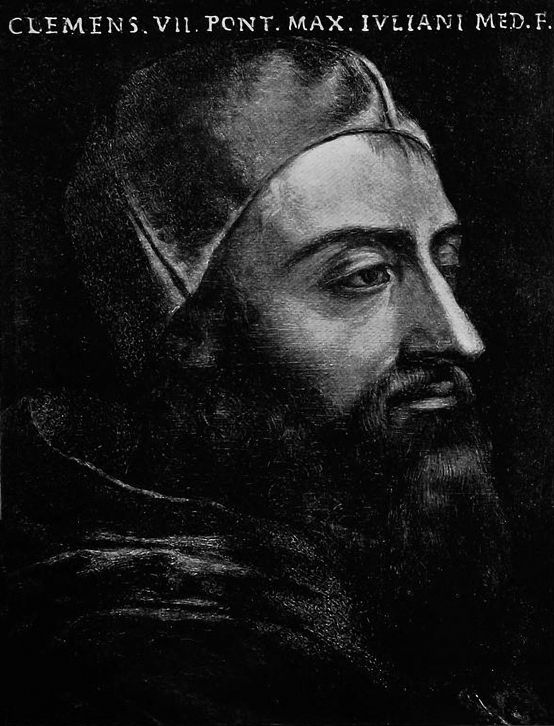
POPE CLEMENT VII (GUILIO DE MEDICI)
FROM THE PAINTING BY BRONZINO IN THE UFFIZI GALLERY, FLORENCE
Throughout the autumn of 1530 negotiations for the marriage were going on, though they made but little progress, for Clement's path in this direction was far from clear before him, it being above all things essential for him to avoid giving umbrage to the Emperor. Charles had a candidate of his own for Catherine's hand, in the person of Francesco Sforza, Duke of Milan. On every ground the French match was to be preferred to the Milanese, for Sforza, with his health so shattered that he already looked like an old man,17 with his resources hopelessly crippled by the immense sum he was compelled to raise every year from his ruined country as the price of the Imperial protection, and with no political influence worth mentioning, was a very mediocre parti, whether from Clement's or his kinswoman's point of view. But the same overwhelming dread of a General Council which had induced the Pontiff to stomach the many mortifications he had received at Charles's hands made him hesitate to take a step which might precipitate the calamity which he was seeking to escape. He was, besides, more than a little suspicious of the good faith of the Most Christian King. The first proposal had been that Catherine should proceed to France so soon as the betrothal had taken place, and that the marriage should be celebrated when she had reached a marriageable age. To this Clement refused to consent, "lest she should become, as it were, a hostage in the hands of the King of France, who, having by that means made sure of the Pope, might then invade Italy for the conquest of the duchy of Milan."18 Nor did he forget that many fiancées had been sent back, among them the Emperor's aunt, Margaret of Austria, in the time of Louis XII, and he considered that it was not improbable that, after his young kinswoman had served François's purpose, the King might find some pretext for breaking off the marriage.
It was finally arranged that Catherine's uncle, the Duke of Albany, who acted as trustee of his niece's French estates and had come to Rome to render an account of his stewardship, should return to France, lay his Holiness's views before the King, and bring back François's reply.
In the meanwhile, Clement, with the twofold purpose of stimulating the desire of the King of France to bring matters to a conclusion and of hoodwinking Charles's Ambassadors, Muscetolla and the Cardinal de Loaysa, continued to discuss with them the question of Catherine's marriage with Francesco Sforza, assuring them that, though he must await the reply with which Albany would be entrusted, he was quite of opinion that the King of France would renounce the affair, in which eventuality he would most readily give his kinswoman to the Duke of Milan.
Whatever his Ambassadors may have thought of these assurances, the Emperor himself would appear to have entertained no doubt as to Clement's preference for the French match. "The Cardinal de Gramont," writes he to Ferdinand of Austria, "who is returning from Rome, has spread the news on his way, and particularly in France, that the marriage between the Pope's kinswoman and the Duc d'Orléans is arranged, although the Holy Father has denied it absolutely in the conversation which he has had with my Ambassadors in Rome."19
Albany reappeared in Rome in November. The prospect of a match between Catherine and Sforza had greatly alarmed François, who recognised that such an alliance would unite the interests of the Pope to those of Charles V and effectually extinguish his chances of recovering the Milanese. He had accordingly instructed Albany to propose to Clement an interview at Nice, at which the conditions of the marriage might be settled personally, and to intimate that he would raise no difficulty in the way of Catherine's renunciation of her pretensions to Urbino in favour of the Pope, provided that the latter would give his kinswoman a sufficient dowry.
Clement agreed to this proposal, but, with characteristic cunning, at the moment when he had already decided to accept the French alliance, he charged the Imperial Ambassadors to beg their master to request the Duke of Milan not to conclude any other marriage, as he was most anxious to give Catherine to him, providing certain guarantees in regard to the defence of the duchy — which he knew very well were impossible — were forthcoming. And then, raising his hands to Heaven, he exclaimed: May God make the Emperor ruler of the whole world! I swear by God and before God that, if, to assure his universal sovereignty, it were necessary for me to renounce the Papal dignity, I would renounce it."20
Although the illness and death of Louise of Savoy21 caused the projected alliance between Clement and François to be postponed, the negotiations continued, and early in July 1531 the draft of a marriage-contract, which had been drawn up at the Château of Anet, where the King and Court were visiting Diane de Poitiers,22 was brought to Rome. The Pope, however, raised several objections, the fact being that he dared not commit himself definitely to the French alliance until he had made everything safe on the side of the Emperor; and at the end of August he told the Milanese Ambassador that he could not bring himself to accept either his master's or the King of France's proposal, from fear of troubling the peace of Italy.
In April 1532, the Pope sent Catherine back to Florence, where her half-brother, the detestable Alessandro, had lately been established at the head of a government, republican in form, but in reality of the most despotic kind. The reason given for the "duchessina's" departure was the fear that the heat of a Roman summer might be prejudicial to her precious health, but the true motive was probably a very different one. If we are to believe Soriano, she had lately shown unmistakable signs of a desire to embark upon a romance with her cousin, the engaging Ippolito, who, on his side, seemed only too ready to meet her half-way.
When Clement had determined to assign the government of Florence to Alessandro, notwithstanding his illegitimate birth, his vicious character, and the seniority of his cousin, he had resolved to force the latter into the Church, and, despite a strenuous resistance on the part of Ippolito, a cardinal's hat was eventually thrust upon him. This, however, did not prevent him from aspiring to the hand of his cousin. "It is said," writes the Venetian Ambassador, "that the cardinal intends to resign his hat and to espouse the Pope's niece, for whom he has the most lively inclination, and by whom he is tenderly beloved. She reposes all her confidence in him, and has recourse to none else for all her needs and all her private affairs."23
It was perhaps with the object of demonstrating his peculiar unfitness for the exalted position which he had been compelled to accept, and of obtaining his release from his ecclesiastical fetters, that during the Carnival of 1531 the youthful cardinal attempted to assassinate, with his own sacred hand, his kinsman Jacopo Salviati,24 whom he suspected of having thwarted his designs upon the Papal treasury. But the Holy Father, though, of course, terribly shocked at such reprehensible conduct on the part of a member of the Sacred College, failed to see in it a sufficient reason for releasing him from his vows.
The intimacy between his Eminence and Catherine was viewed by Clement with considerable uneasiness, and, alarmed lest it might end in the girl being seriously compromised and the fruits of so much patient scheming destroyed, he invoked the malaria and packed her off to Florence, while, shortly afterwards, Ippolito was despatched as Legate to the Imperial Army operating against the Turks in Hungary.
The Emperor had for some time been desirous of a personal interview with Clement, in order to persuade him of the urgent necessity for that General Council which the Pontiff so much dreaded, and to confer with him on other important matters; and in the autumn of 1532 a meeting between them was arranged at Bologna, where, in February 1530, the Pope had placed upon Charles's head the iron crown of Lombardy and the crown of the Empire. The Emperor would, of course, have been willing to visit Clement in Rome, but the latter prudently preferred to make the arduous journey to Bologna rather than give his Imperial Majesty the opportunity of traversing the Papal States, where he might learn many things of which it was eminently desirable that he should continue in ignorance.
On November 18 his Holiness quitted Rome, travelling by way of Perugia, since recent events had rendered it inadvisable for him to shed the light of his countenance upon Florence; and, after a journey which "by reason of the contynuall rayne and fowl way, with other unfortunate accidentes, as the loss of certyn his mules, and the breking of the legge of oon Turkie horse, that he had specall good, and above all for the evell lodgings that he had with his companye, was wonder paynful,"25 reached Bologna on December 7. The Emperor arrived on Thursday, the 12th, but deferred his official entry until the following day, apparently "bycause that apon the said Thursday was the full moon, which to some was thought for that purpose an unhappy tyme."
The result of his meeting with Charles V afforded Clement abundant compensation for the hardships which he had suffered on his journey to Bologna, for not only did he succeed in staving off the convocation of the General Council, but completely outmanoeuvred the Emperor in the matter of Catherine's marriage.
"After the negotiations on the subject of the marriage had been resumed," writes Guicciardini, who was perfectly informed in regard to all Clement's affairs, the Pope answered the Emperor, relative to the demand of his niece's hand for the Duke of Milan, that the propositions of the King of France were much anterior to his, and that he had listened to them with the approbation of the Emperor, who had not testified any disapproval. It would be, then, to offer too serious an affront to the King to give Catherine to one of his rivals, at the very moment of the opening of the negotiations. He did not believe, besides, that the King regarded the affair seriously, on account of the difference of rank and condition, and he considered that the sole object of his Majesty was to gain time. He could not then, so long as the King had not broken off the negotiations, wound him in a manner so sensible."
Charles, who found it difficult to conceive that François seriously intended to marry his son to a descendant of Florentine burghers, and believed that the exposure of his bad faith would be certain to create a serious breach between him and Clement, thereupon urged the Pope to request the French Ambassadors to the Vatican, the Cardinals de Gramont and de Tournon, who had come to the conference to watch the proceedings on behalf of their master, to demand full powers for the conclusion of the marriage-contract.
The cardinals, of course, lost not a moment in complying with the delighted Clement's request, and, to the Emperor's profound astonishment and mortification, the required credentials were despatched to Bologna with the briefest possible delay. For once, Charles had altogether over-reached himself.
Notes
(1) Armand Baschet, la Diplomatic vénitienne: les Princes de l'Europe au XVIe siècle.
(2) Brantôme.
(3) Only son of Piero de' Medici, the eldest of the three sons of Lorenzo the Magnificent. His uncle, Leo X, anxious for the aggrandizement of his family, had invested him with the duchy of Urbino, after unjustly dispossessing Francesco Maria della Rovere, its legitimate lord. However, the latter recovered his dominions soon after Lorenzo's death.
(4) Daughter of Jehan III, Seigneur de la Tour, Comte de Boulogne and d'Auvergne, who claimed descent from Godefroi de Bouillon. Her elder sister, Anne de la Tour d'Auvergne, had married, in 1505, John Stuart, Duke of Albany.
(5) But some writers believe that he was the son of Clement himself, a theory to which his Holiness's marked predilection for him, notwithstanding his detestable character, certainly lends colour.
(6) According to Segni, the mortality during the autumn of 1527 was between three and four hundred a day.
(7) Trollope, "The Girlhood of Catherine de Medici."
(8) M. Henri Bouchot, Catherine de Médicis.
(9) Catherine proved not ungrateful for the protection afforded her, since, after the surrender of Florence, it was mainly through her intercession that Aldobrandini was punished by exile instead of death.
(10) Soriano, cited by Armand Baschet, la Diplomatie Venétienne.
(11) Afterwards the first Duke of Bedford.
(12) Hercule d'Este, Comte de Vaudémont, younger brother of Antoine, Duke of Lorraine, and of Claude, Duc de Guise. He died during the siege of Naples in 1528.
(13) According to Soriano, the overtures of James V were rejected because, as his Holiness pointed out, couriers to Scotland would cost more than the young lady's dowry.
(14) Henry Fitzroy, born 1519. His mother was Elizabeth Blount, one of Catherine of Aragon's ladies-in-waiting. He married, in 1533, Mary, daughter of Thomas Howard, third Duke of Norfolk, and died three years later, not without suspicions of poisoning.
(15) State Papers of Henry VIII (Foreign Series), vol. vi.
(16) Cited by F. Decrue, Anne de Montmorency à la Cour de François Ier. Francisque's description of Catherine as "handsome and plump" is in singular contrast with that of Soriano, already cited; but he probably considered it his duty to view her through rose-coloured spectacles.
(17) He was not, however, "aged enough to be her [Catherine's] grandfather," as Trollope asserts, since he was only thirty-seven.
(18) Soriano, cited by Trollope.
(19) Letter of July 29, 1531, in A. von Reumont, Die Jugend Caterina's de' Medici.
(20) Despatch of the Cardinal de Loaysa to the Emperor, November 30, 1531, in Reumont.
(21) Louise of Savoy died on September 22, 1531. After her death, the immense sum of 1,500,000 gold crowns was found in her coffers, largely the fruit of her peculations.
(22) It is indeed a singular instance of the irony of Fate that such a document should have been drawn up under the roof of Catherine's future rival in her husband's affections.
(23) Soriano, in Reumont.
(24) Jacopo Salviati had married Lucrezia de' Medici, second daughter of Lorenzo the Magnificent.
(25) Bonner to Cromwell, December 24, 1532. State Papers of Henry VIII (Foreign Series), vol. vii. The future Bishop of London, who was at this time English Ambassador at Rome and had accompanied Clement to Bologna, adds that the unhappy Pope was "diverse tymes compelled by reason of the fowleness and daunger of the way to goo on foote the space of a myle or two, and besides that pleasure and pastyme, for lak of a fedder bed, compelled to lie in the strawe."