
Dowry of Catherine de' Medici — Her trousseau — Her pearls — A marvellous casket — The Florentines compelled to defray the greater part of the expense incurred by the Pope — François I's pensions to his son and future daughter-in- law — Efforts of Charles V to prevent the Pope's journey to Nice — Catherine's departure from Florence — She receives the presents of François I and the Duc d'Orléans — Objection of the Duke of Savoy to the marriage and the interview taking place at Nice necessitates the rendezvous being changed to Marseilles — Clement sails from Leghorn — Preparations at Marseilles — Arrival and reception of the Pope — His ceremonial entry into Marseilles — He is visited in secret by François I — Entry of Catherine — The marriage — Personal appearance of the bride and bridegroom — Presents given by the Pope and François to one another — Result of the conference between the two sovereigns — The death of Clement in the following year destroys the hopes which François has based on this alliance
NOTWITHSTANDING his parsimonious nature and the drain which the siege of Florence had imposed upon the Roman finances, Clement had determined that his young kinswoman must be suitably dowered; it was therefore agreed that her dot should consist of 100,000 gold crowns, to which the Pope added another 30,000, in consideration of her renunciation in his favour of all claims to the duchy of Urbino. She also, of course, brought her husband the estates in France which she had inherited from her mother, Madeleine de la Tour d'Auvergne, the value of which was estimated at about ten thousand crowns a year.
To procure the money which he had engaged to give his cousin, and of which 50,000 crowns were to be paid on the ratification of the contract and the balance in two instalments at intervals of six months, the impoverished Pope was compelled to have recourse to Filippo Strozzi. Strozzi advanced him 80,000 ducats, taking as security several jewels, among them a magnificent clasp for the Pontifical cope, which Benvenuto Cellini had fashioned. This transaction proved a very unprofitable one for the banker, for after Clement's death, in September 1534, his successor, Paul III, insisted on the restoration of the jewels, on the ground that they were not the property of Clement personally, but of the Holy See; and it was only with much difficulty, and after long delay, that Strozzi succeeded in obtaining payment of part of the sums due to him.
Besides a dowry in money, Catherine received a magnificent trousseau. "As to the trousseau," runs the contract, "the Supreme Pontiff will, at his own discretion, furnish his illustrious relative with clothing, ornaments, and jewels. The jewels will also be valued, and a record of them preserved, in order that, in the event of her surviving her husband, he may be able to recover them or the price of them."01
Among these jewels were a set of immense pear-shaped pearls, which contemporary writers declare to have been of fabulous origin and to have been worth a kingdom; but as a matter of fact, they had been purchased from a Lyons merchant, and were only valued at 900 crowns."02 These pearls were, many years later, given by Catherine to her daughter-in-law, Mary Stuart, "whom I have seen wearing them," writes Brantôme. Reumont says that there was, in the Galerie d'Orléans of the Palais-Royal, at the time of the Revolution of 1848, a portrait of Mary Stuart, as the young wife of François II, with richly curling hair, a high lace ruff, and Catherine's pearls around her neck and on her bosom. This portrait is no doubt identical with one which is now at Chantilly; but, according to so high an authority as M. Bouchot, the lady therein represented is not Mary Stuart at all, but the Princesse de Conti.
The destiny of these pearls was a singular one, as after Mary's untimely end they were appropriated by Queen Elizabeth, who wore them without a blush, notwithstanding that they had originally come from a Pope, and had been blessed and consecrated by him.
But the most precious objet d'art which the bride-elect brought to her adopted country was a marvellous casket formed of twenty-four panels of rock-crystal in a setting of silver-gilt. Twenty of the panels were engraved with as many subjects from the life of our Saviour, from the Adoration of the Shepherds to the Ascension, while on the corner panels were carved the figures of the four Evangelists. The Medici Arms decorated the lid, on which was the following inscription: "Clemens VII, Pontifex Maximus."
This casket, which, in the opinion of Reumont, was originally intended for a sacred purpose, that is to say, to contain the Host, was the work of the goldsmith Valerio Vicentino, the most accomplished craftsman in the art of cutting precious stones whom modern times have produced. It may now be seen in the Museum of the Uffizi at Florence. How it returned to the country of its origin is a mystery; it is only known that it was in Florence in the first half of the seventeenth century.03 The probability is that it was one of a number of objects of value which were placed during the reign of Charles IX in a cabinet in the Louvre and disappeared during the Wars of the League.04
Upon the trousseau properly so called — gowns, lingerie, and so forth — no expense was spared, and everything was of the most regal magnificence. The praises bestowed by some historians upon the Pope's munificence towards his kinswoman are, however, scarcely deserved, since a considerable part of the expense incurred appears to have been defrayed by the unfortunate Florentines. A few weeks before Catherine's departure for France, Alessandro de' Medici raised a forced loan of 35,000 scudi from the citizens, for the ostensible purpose of constructing the fortress of San-Giovanni, but it is asserted that most of this sum was applied to the adornment of the future Duchesse d'Orléans.
On his side, François I accorded his son an annual revenue of 50,000 livres tournois, and his future daughter-in-law one of 10,000 livres tournois, together with the Château of Gien, in the Orléanais, which had once belonged to the famous Dunois — the Bastard of Orléans — and subsequently to Anne de Beaujeu, who was Regent of France during the minority of her brother, Charles VIII.
While the negotiations for her marriage were proceeding, Catherine was living in the Palazzo Medici, at Florence, under the care of Maria Salviati, widow of the famous captain Giovanni de' Medici (Giovanni of the Black Bands), and daughter of that Jacopo whom the Cardinal Ippolito had attempted to assassinate during the Carnival of 1531. Hitherto the girl would appear to have led a somewhat sombre and monotonous existence; but now, with a view to preparing her for the great position she was soon to occupy, she was encouraged to live the gay and luxurious life of a lady of high rank, and we find her wearing magnificent toilettes and costly jewels, assisting at balls, masquerades, fetes, and hunting-parties, and patronising the studios of the painters and the ateliers of the sculptors. "At the Murate," says M. Bouchot, "the Catherine of the Wars of Religion was formed; here was fashioned the Catherine of the Tuileries or the Louvre, that of Chenonceaux or Fontainebleau, the impresario, the woman of magnificence, whose Florentine passion for ostentation will take heed neither of famines nor wars."05
How she regarded the prospect before her, it is difficult to say, for neither by word nor look does she appear to have given any indication of her feelings in the matter. That, if the choice of a husband had been left to her, she would have preferred her cousin Ippolito — the only being of the opposite sex who had shown her any affection — cannot be doubted; but, since her sentiments had been sacrificed to her interests, or rather to those of his Holiness, and since she already possessed her full share of the pride and ambition of her family, it is probable that she was well satisfied to become the daughter-in-law of the most splendid monarch in Europe.
At the time of the signing of the marriage-contract it had been arranged that the happy event should be celebrated at Nice, and that Clement should accompany the bride-elect thither, where, under the pretext of bestowing the Pontifical blessing upon the young couple, he might confer with the King of France in regard to the future of Italy. The feeble health of the Pope, however, necessitated the postponement of his journey until the early autumn of 1533, and, in the interval, the Emperor, who was seriously alarmed at the prospect of an interview between his rival and his slippery ally, made great efforts to prevent the latter's departure, and even went so far as to despatch an envoy to Rome to represent to Clement how derogatory it would be to the Papal dignity for him to leave his dominions to meet the King of France.06 But his Holiness, though he did not fail in assurances of his devotion to the interests of the Emperor, was not to be turned from his purpose; and on July 17 his approaching departure was formally announced, and Filippo Strozzi started for Florence, charged with the duty of making all the necessary arrangements.
On September 1, Catherine took leave of her native city at a grand banquet, to which she had invited all the most noble ladies in Florence, and in the late afternoon of the same day set out on her journey, accompanied by Filippo Strozzi, the historian and diplomatist Francesco Guicciardini, Maria Salviati, Caterina Cybo, Duchess of Caminino, and Palla Rucellai — a daughter of Lorenzo the Magnificent's younger sister Nannina — and a splendid retinue. The first night she slept at Poggia a Cajano, and the second at Pistoja, where François du Bellay, Comte de Tonnerre, who had joined the party en route, handed her the presents of François I and the Duc d'Orléans, "a sapphire tablet and a diamond cut en dos d'âne." Thence, by easy stages, she proceeded to Porto Venere on the Tuscan coast, where a squadron of French galleys under the command of her uncle Albany were waiting to convey her to Nice.
Nice had been originally selected for the marriage and the interview between the Pope and François with the object of saving the dignity of the Holy Father, since it was neutral territory. But the Duke of Savoy, to whom it at this time belonged, having been lured away from France by the bait of Charles V's sister-in-law, Beatrix of Portugal, manifested some displeasure on learning of the arrangement, and the Pope thereupon consented that the marriage and the conference should take place at Marseilles.07
Having landed Catherine and her suite at Nice, where she was to await the coming of the Pope, Albany and his galleys returned to Leghorn to fetch Clement, who had quitted Rome on September 9. His Holiness, travelling by way of Montepulciano, in order to avoid Florence, arrived in the first days of October, accompanied by an imposing retinue, which included ten cardinals and a great number of bishops and other high ecclesiastical dignitaries. The French galleys had, in the meanwhile, been reinforced by the squadrons of Andrea Doria and of the Prior of St. John of Jerusalem, and when the Pope embarked, more than sixty vessels hoisted their flags and saluted him by repeated salvoes of artillery.
The galley to which had been assigned the honour of conveying the sacred person of the Pontiff was draped from stem to stern with gold brocade; while the vessel which led the van bore the Holy Sacrament, in accordance with the custom of the Popes when they travelled by sea.
Assisted by a favourable wind, the galleys reached Villafranca on October 10, where Catherine and her suite were taken on board, and then made sail for Marseilles.
Great preparations for the reception of the illustrious guests had been made at Marseilles. About the middle of August, Anne de Montmorency, to whom the arrangements had been entrusted, arrived there, and gave instructions for three of the finest houses in the city to be made ready for their accommodation. We are not told where the house selected as Catherine's residence was situated, but those of the Pope and the King were in the Place-Neuve and separated only by one of the narrow streets running into the square. Communication between them was established by means of a wooden gallery erected over the street, in the centre of which was a chamber hung with costly tapestries. Thus, the two sovereigns would be able to enjoy as many private interviews as they desired, without the smallest risk of their conversations being overheard.
François arrived at Marseilles on October 8, but he did not make a ceremonial entry, since etiquette required that the entry of the King should be deferred until after the Holy Father had made his. Accordingly, after having satisfied himself that everything was in readiness, he joined the Queen and the princes at Aubagne, a village three leagues distant, on the road to Aix, leaving the Grand-Master, with all the high ecclesiastics of the realm, to receive the Pope.
On the morning of the 11th, signals from the Château d'lf and the fortress of Notre Dame de la Garde announced to the expectant Marseillais that the flotilla was in sight, whereupon there was a general rush to the harbour, and a number of craft of all sizes, crowded with the faithful, put out to meet his Holiness and welcome him "with hautbois, clarions, and trumpets."
At the entrance to the port he was received with a salute from three hundred cannon placed in different quarters of the city, while the bells of all the churches clashed out a merry peal. The galleys forming the Papal escort returned the salute, and "the whole harbour seemed to be on fire."
On landing, Clement was received by the Grand-Master, who conducted him to his own residence, situated on the farther side of the harbour, near the Abbaye de Saint-Victor. Here he dined and received the homage of the French cardinals, archbishops, and bishops, and then proceeded to the abbey, where he was to pass the night.
"On the morrow, which was Sunday," says a contemporary relation, "he went to hear Mass at the Abbaye de Saint-Victor, where he visited several holy relics . . . and at two hours after noon he began to make his entry into the town, which occupied four whole hours. The Corpus Domini was honourably borne upon a white horse richly caparisoned, and before it walked Messieurs d'Orléans and d'Angoulême, and all the princes, chevaliers of the Order, and nobility. Archers of the Garde du Corps, holding torches in their hands, and the King's Swiss surrounded the Pope, who was carried by his chamberlains,08 in the dress of a cardinal, his embroidered hat of crimson satin being borne before him, while in his train came fourteen cardinals, amongst whom were the Legate of Avignon, the Cardinals de Bourbon, de Lorraine, and de Gramont, and thirty-six bishops, all habited in the Roman and apostolic fashion. After having visited the Major, which is the metropolitan church, our lord alighted at the lodging prepared for him, which was so well arranged and constructed that it could not have been bettered. It is impossible to describe the great nobility who were present at the said entry, and in the town and neighbourhood the firing of cannon and arquebuses went on without ceasing from the moment of his arrival. . . . Our said Holy Father is very hale and strong,09 fifty-five years of age, rather above the middle height, and wearing a long beard reaching to his stomach. He is a good-humoured-looking man, who shows that he is possessed of the highest intelligence."10
About ten o'clock that night, François I, attended only by a few gentlemen, came to Marseilles and paid a secret visit to the Pope. Next day (October 13), his Majesty made his own State entry, upon the splendours of which and that of the Queen, which was the event of the 14th, we shall not dwell here. Finally, on the 23rd, at four o'clock in the afternoon, "the Duchess of Urbino, coming from Aubagne, where she had dined that day, made her entry into the town of Marseilles, mounted on a roan horse covered with brocade, and having six led horses following her, who were caparisoned in scarlet and gold brocade, extremely pompous. She was accompanied by twelve demoiselles on horseback, and escorted by the guards of the Pope and the King. Afterwards, came a coach draped in black velvet, with two pages on horseback, and the pages of the Cardinal de' Medici,11 who rode splended chargers caparisoned likewise."12
Five days later (Tuesday, October 28), the marriage was celebrated, with great splendour, the Pope himself officiating, to give greater importance and solemnity to the event.
An English historian of François I speaks of "the extreme personal beauty of the young couple,"13 and, though this description is certainly not borne out either by their portraits or by the testimony of impartial contemporaries, they were far from an ill-looking pair.
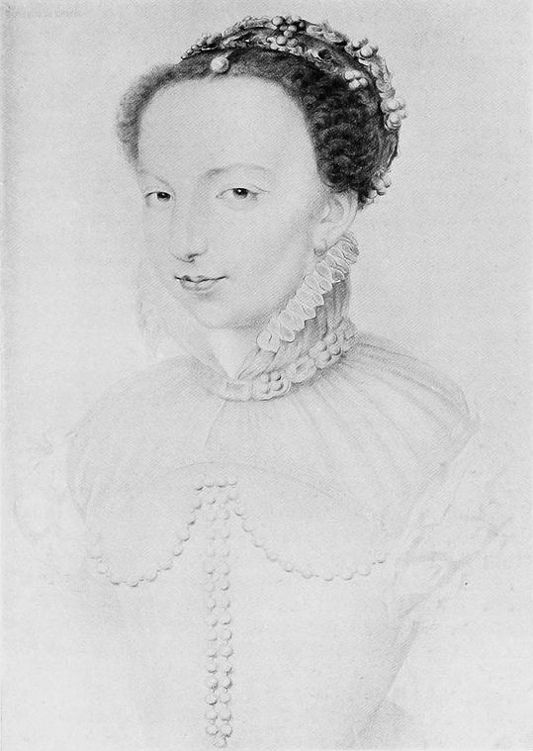
CATHERINE DE MEDICI
AFTER A DRAWING IN THE BIBLIOTHÈQUE SAINTE-GENEVIÈVE
Henri, indeed, who, it maybe mentioned, had been knighted by his royal father a few days before, might almost have been called handsome. He had inherited the fine dark eyes and straight nose of his grandmother, Louise of Savoy; his hair was black, his complexion very pale. In stature, he appears to have been rather tall for his age, with a well-knit frame, hardened and developed by tilting, fencing, tennis, and other manly exercises, in which he was already so proficient that few at the Court could hold their own against him.14
Of Catherine at the time of her marriage there is no authentic portrait in existence, for the painting of the happy event by Vasari is an allegory. There is, however, a painting of her at Versailles by an unknown artist, executed in all probability some three or four years later, which shows us a rather plain young girl, with full lips, a receding chin, and hair frizzled at the temples. On the other hand, Reumont speaks of another portrait of the future Queen of France, which, he thinks, must have been painted not long after her marriage, and which seems to be more flattering to its subject. "Without being beautiful," he says, "the face is at least agreeable, with features which, though rather strongly marked, are not irregular. She wears flowers in her hair, which is drawn back from her forehead, a high gown, a ruche of rich lace round her neck, and her sleeves are embroidered with pearls." Singularly enough, Reumont does not tell us in what collection he found this portrait.
Shortly after the ceremony, the King and Queen, the whole Royal Family, and the princes and princesses of the blood came to the Pope's residence and conducted Catherine to that of the King; François himself, "dressed in white satin, with a royal mantle of gold spangled with pearls and precious stones," escorting the bride, who was covered with brocade, her corsage being of ermine filled with pearls and diamonds, with a coiffe embroidered with pearls and precious stones on her head, surmounted by the crown of a duchess."15
At the royal lodging a sumptuous banquet had been prepared. There were three tables. At one sat the Pope and the Queen, Clement having decided to relax for the nonce the severe etiquette which his position imposed upon him; that in the centre was for the King and the Cardinals de' Medici and Rodolfi; while the third was occupied by the bride, the young princes, the princes and princesses of the Blood, the King of Navarre, the Duke of Albany, the Marchese di Saluzzo, and the Cardinal Salviati, Catherine occupying the place of honour. In the evening, there was a grand ball, which, however, was interrupted just before midnight, when the King conducted his daughter-in-law to the nuptial chamber, in which stood a state bed of such magnificence that it was reported to have cost more than half the bride's dowry.
Splendid fêtes followed the wedding, and the rejoicings were prolonged for nearly a month, greatly to the satisfaction of the worthy citizens of Marseilles, who must have reaped a bounteous harvest. Before the two Courts separated costly presents were, of course, exchanged. Among others, François gave the Pontiff a magnificent Brussels carpet, the pattern of which represented the Last Supper. To Ippolito de' Medici, who refused to accept any valuable presents, he gave "a tame lion, which he had received from Barbarossa."16 What the Cardinal did with this somewhat alarming kind of pet, History does not record. Among the gifts of the Pope to François, was "a piece of the horn of a unicorn,"17 beautifully mounted by the Milanese goldsmith Tobio, which was said to possess the power of destroying the effects of poison mixed with food. It seems a pity that his Holiness did not bestow this potent charm upon Ippolito, who needed it much more than the King of France, since not long afterwards his Eminence was poisoned by an emissary of his amiable kinsman Alessandro.
Clement also created four new French cardinals, one of whom was Odet de Coligny — brother of the celebrated Gaspard — who subsequently embraced the Reformed faith; while the King invested four of the Papal dignitaries with the Order of Saint-Michel.
On November 27, the Pontiff was escorted in solemn state to his galley and sailed for Civita Vecchia, and a few days later the French Court set out for Amboise.
While the fêtes and rejoicings were engaging the attention of the two Courts, Clement and François had not forgotten the real object of the former's journey to Marseilles, and had been frequently closeted together in earnest conference. The outcome of their deliberations was a secret understanding which threatened to bring the armies of the King and the Emperor once more into the already desolated plains of Lombardy. "The dowry is not such a poor one after all," observed Filippo Strozzi to the Treasurer of France, as the first instalment was being paid over, "if you reckon the three jewels which the Pope will presently give to his cousin: Genoa, Milan, and Naples. Do not such jewels appear to you worthy of a king's daughter? This was to rate the results of the Pontifical alliance rather too highly, for Clement had had the address not to take any positive engagements against the Emperor. In fact, his dread of incurring the Imperial displeasure was so great that in the following March he allowed himself to be intimidated into sanctioning the decree which pronounced Henry VIII's first marriage good and valid, thereby occasioning the formal revolt of England against the authority of the Papacy. That, on the death of Francesco Sforza, in October 1535, he would have supported François in the war which then broke out is, however, quite probable. But he did not live to see that day, as on September 25, 1534 — ten months after he had quitted the shores of France — his career of duplicity and prevarication came to an end.
And so François I gained nothing by the marriage which he had been at such pains to bring about, and lost even the final instalment of Catherine's dowry, as the new Pope, Paul III, naturally refused to be bound by the obligations of his predecessor.
Notes
(1) "Quantum attinet ad cultum muliebrem, Summus Pontifex Illustrem suam neptem, arbitratu suo, ornabit vestitu mundo ac gemmis: æstimabuntur autem gemmæ, idque scripto constabit ut si forsan ipsa marito superstes fuerit, illas aut illarum pretium possit recuperare."
(2) M. Henri Bouchot, Catherine de Médicis.
(3) "The earliest record of its presence in the Florentine collection," writes Trollope, "is in the catalogue drawn up in 1635."
(4) Reumont.
(5) Catherine de Médicis.
(6) When Clement had journeyed to Bologna to meet the Emperor, he did not leave his dominions, since Bologna was a Papal city.
(7) Miss Sichel, in her interesting work "Catherine de' Medici and the French Reformation," says that Marseilles was "the place insisted on by François for the meeting, as a proof of Papal deference to France." But this is quite incorrect.
(8) On a chair draped with velvet.
(9) The unfortunate Pope was far from being "hale and strong," as he was already suffering from the disease which caused his death eleven months later.
(10) Documents historique tirés des manuscrits de la Bibliothèque royale, published by Champollion.
(11) Ippolito de' Medici. He had lately returned from Hungary, and had accompanied the Pope to Marseilles.
(12) Honoré Bouche, la Chorographie, ou description de Provence et l'Histoire chronologique du mesme pays.
(13) Julia Pardoe, "The Court and Reign of François."
(14) Nine years later, Matteo Dandolo, the Venetian Ambassador, wrote that Henri was "so strongly built that one might believe him all made of muscle." Brantôme tells us that he was a remarkably fine runner and the best long-jumper among the young men at the Court.
(15) Bouche.
(16) "Dedit mansuefactum leonem eximia proceritatis, quem e Mauritania Haradienus Barbarussa transmiserat." — Paulus Jovius (Paola Giovio), Historia sui temporis.
(17) Presumably, an elephant's tooth.