
Early married life of Henri and Catherine de' Medici — Unpopularity of the marriage — Diplomacy of Catherine, who contrives to secure the favour of François I and the friendship of Marguerite d'Angoulême and the King's mistress, Madame d'Étampes — Sketch of the last-named lady — Execution of François's agent, Maraviglia, at Milan — The King prepares to invade the Milanese, but the death of Clement VII and the expedition of Charles V against Tunis cause him to suspend operations — Death of Francesco Sforza — François demands the Milanese for the Duc d'Orléans — The French occupy Savoy and Piedmont, but the King allows the Emperor to delude him with negotiations — Charles's speech to the Pope and the Sacred College — Treachery of the Marchese di Saluzzo — The Emperor invades Provence — Devastation of the country by Montmorency — Death of the Dauphin François makes Henri heir to the throne — Grief of the King — The Conte Sebastiano Montecuculli arrested on a charge of having poisoned the prince — He confesses, under torture, to having been instigated by the Imperialists to poison the King and his three sons — His execution — The Imperialists repudiate the charge and accuse Catherine de' Medici
THE first three years of the married life of Henri and Catherine present few features of interest. In the case of the former, the event which had required so much tortuous diplomacy to bring about made comparatively little change. It is true that he now possessed a wife — a luxury with which he would no doubt have been very willing to dispense, if he had been allowed any voice in the matter — and was required to give her the benefit of his society at stated times; but, since he was a younger son, and his elder brother was still unmarried, he was not allowed an establishment of his own, but shared that of the Dauphin and the Duc d'Angoulême, as he had before his marriage. In like manner, the ladies and officers attached to Catherine's person were also the attendants of her sisters-in-law, Mesdames Madeleine and Marguerite, and the three young princesses were placed on a footing of equality.
The restless crowded existence of the Court afforded the young couple small opportunity of understanding one another. The Valois Kings did not, like those of later times, reside in one spot; they were continually on the move from one royal Château to another: from les Tournelles, in Paris, to Fontainebleau, from Fontainebleau to Amboise, and from Amboise to Blois, while visits were often paid to the country-seat of some great noble whose forests afforded unusual facilities for sport. Thus, the newly wedded pair enjoyed little privacy, nor is it probable that they had any great desire for a closer companionship. Henri saw before him a plain, unformed girl, who was reputed to be clever, a fact which made him feel awkward and constrained in her presence; Catherine, a morose, tongue-tied boy, who resisted all her efforts to draw him out, or even to bring a smile to his lips. We may here observe that for some time after her marriage Catherine's health was too delicate to permit of her being a wife in the true sense of the word, a circumstance which no doubt goes far to explain why she so signally failed to gain the affections of a husband "de nature plus corporelle que spirituelle."01
Her consort's indifference was not the only mortification which Catherine had to endure. The marriage was distinctly unpopular with both Court and people. The former looked upon it as a mésalliance; the latter, mindful of the intolerable burdens which the King's Italian enterprises had entailed, regarded the Papal alliance as the forerunner of further ruinous wars, and did not conceal their resentment. The non-payment of the balance of Catherine's dowry and the favour shown by her to her Italian attendants naturally did not tend to make her any the more popular, and two years after the marriage the Venetian Ambassador, Giustiniani, writes that it "displeased the entire nation and that it was considered that Pope Clement had deceived the King." The Ambassador adds, however, that Catherine is "very submissive," and that the King, the Dauphin her husband, and the Duc d'Angoulême appeared much attached to her.
This submissiveness, or rather suppleness, was to stand the young princess in good stead, for, if she failed to gain her husband's affection, she at least ensured kindness and consideration at his hands, while, if she were far from a popular personage with the majority of the courtiers, she succeeded in gaining the goodwill of the King.
To secure the favour of such a squire of dames as François was not difficult. Her shrewdness, her ready wit, her liveliness and good-humour, pleased him greatly; he admired her grace in the dance, her skill and courage on horseback, and he was flattered by her evident anxiety to conform to his wishes and the pleasure she seemed to take in his society. At her urgent entreaty, he enrolled her in the "Petite Bande" — that little company of beautiful, witty, and complaisant ladies, of whom Madame d'Étampes was the acknowledged chief, whose privilege it was to accompany the King on his visits to his different country-seats, to follow him in the chase, to dine and sup at his table, to bandy jests with him, most of which, we fear, would scarcely bear repetition in a modern drawing- room, and, generally, to do their best to make him forget that he was now a middle-aged man in very indifferent health. From that time Catherine was seldom free from his Majesty's side, and was soon firmly established in the royal favour.
It is probable that Catherine's success with the King was facilitated by the fact that she had had the wit to insinuate herself into the good graces of two persons who possessed more influence with François than all the rest of the Court combined. One was the Queen of Navarre, to whose kind heart the lonely, unloved girl made an irresistible appeal, and whose sympathy, once enlisted on her side, she was careful to preserve by a skilful appearance of deference. The other was the reigning favourite, Madame d'Étampes,dame d'honneur to the princesses, without whose sanction no lady was ever admitted to the King's intimate circle. Finding her young mistress disposed to seek her friendship and counsel, the duchess was graciously pleased to accord her the ægis of her protection and to commend her to the favourable notice of her royal admirer.
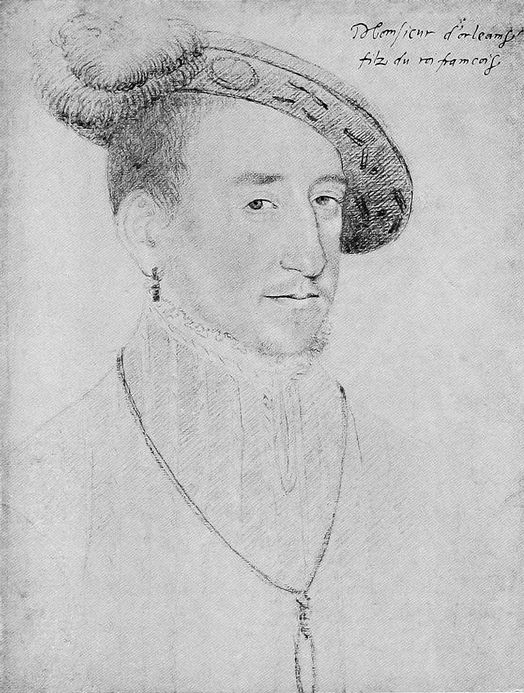
HENRI DE VALOIS, DUC D'ORLEANS (AFTERWARDS HENRI II)
FROM THE DRAWING BY FRANÇOIS CLOUET IN THE MUSÉE CONDÉ, CHANTILLY
A few words concerning this all-powerful lady may not be without interest.
Anne de Pisseleu, the future Duchesse d'Étampes, was born towards the close of the year 1508, at the Château of Fontaine-Lavaganne, near Beauvais. Her father was Guillaume de Pisseleu, Seigneur d'Heilly, a nobleman whose views on the subject of children were so completely in accord with those of the Psalmist that he married three times and gave to his Majesty no less than thirty lieges. Anne belonged to the second brood, her mother being a Mlle. Sanguin.
As the years went by, the worthy seigneur began to find the weight of so very full a quiver somewhat difficult to sustain, and, so soon as Anne had attained a marriageable age, he procured her the post of maid-of-honour to Louise of Savoy, in the hope that her pretty face might suffice to secure her a husband who would be disposed to waive the question of dowry.
Many writers, on the authority of Brantôme, state that the girl was presented at Court during the captivity of the King, and that François met her, for the first time, at Mont-de-Marsan, on his return from Spain in the spring of 1526, and fell in love with her at first sight. But, in point of fact, she had made her appearance at Court four years earlier, and there is reason to believe that she had attracted the attention of the King before the débâcle of Pavia, and that it was to her, and not to Madame de Chateaubriand, that were addressed those plaintive verses with which the prisoner of the Alcazar endeavoured to beguile the tedium of his captivity.
However that may be, scarcely had François been restored to his kingdom than their relations were a secret from no one; his Majesty appeared at tournaments wearing the young lady's colours, and Madame de Chateaubriand was completely discarded. Nor can we wonder at the monarch's infatuation. Mlle. d'Heilly, by which name his new enchantress was henceforth known, was not only young and beautiful, but intelligent and accomplished. Charles de Sainte-Marthe called her "la plus belle des savantes et la plus savante des belles," and Marot wrote:
"À Heilly
Dix-huit ans je vous donne,
Belle et bonne;
Mais à votre sens rassis,
Trente-cinq et trente-six
J'en ordonne."
Moreover, she was sprightly and vivacious, and possessed in a supreme degree the art of pleasing. In short, it would have been difficult to find anyone more calculated to appeal to a man of François's temperament at a moment when his only desire was to forget his misfortunes and sufferings in a round of pleasure and excitement.
The subjugation of the King was as complete as it was speedy, and when his new favourite imperiously demanded that he should require her predecessor in his affections to restore the jewels which he had given her, "not because of their price and value, but because she coveted the beautiful devices engraved upon them, which the Queen of Navarre, his sister, had made and composed,"02 his Majesty consented without the least hesitation. To the messenger charged with the King's commands Madame de Chateaubriand replied that she was ill, but that he might return in three days. She profited by this respite to send for a goldsmith and have the jewels melted down, and when the messenger returned, she handed him the simple ingots. "Go," said she, "carry them to the King, and tell him that, since it is his pleasure to take back what he gave so generously, I restore his gifts in ingots of gold. As for the mottoes, they are so indelibly engraved on my mind, and I hold them so sacred, that I cannot suffer another than myself to appropriate or find pleasure in them."
When this message was delivered to François, he had the grace to feel ashamed of his shabby treatment of the woman whom he had once professed to love, and whom he had cast off for Mlle. d'Heilly "ainsi qu'un clou chasse l'autre." "Take them all back to her," he exclaimed; "I valued them not for their intrinsic worth, but for the mottoes and devices which they bore, for willingly would I have given her double. Since she has caused these to be destroyed, I do not wish for the gold, and she may keep it. She has given proof of more courage and generosity than I should have believed a woman capable of showing."03
Like Madame de Pompadour, two centuries later, Anne de Pisseleu had the talent to assure by the charms of her mind the empire which her beauty would not perhaps have sufficed to maintain, and she ruled her royal lover to the day of his death. In order to save appearances and diminish the scandal, François decided to find the lady a husband, of sufficiently high lineage to be accepted by the Court, and of sufficiently meagre fortune to bestow the shelter of his name on the avowed mistress of the King. His choice fell upon Jean de Brosse, a direct descendant of the Vicomtes de Limoges, who consented to the marriage proposed to him in order to recover his family estates, which had been confiscated, owing to the participation of his father, René de Brosse, in the conspiracy of Bourbon.04 As the reward of his complaisance, the King not only restored to him his confiscated property, but created him Comte de Penthièvre, appointed him governor of Brittany, gave him the collar of the Order of Saint-Michel, and finally erected for him, or rather for his wife, the county of Étampes into a duchy.
Anne's marriage, of course, made no difference in her relations with the King, for the union was merely a nominal one, and her favour seemed only to increase with time. She used her credit to protect artists and men of letters, who vied with one another in celebrating her charms,05 and to sustain the Reformed ideas, but especially to enrich her numerous relatives. On her recommendation, her uncle, Antoine Sanguin, was successively created Abbot of Fleury, Bishop of Orléans, cardinal, and, finally, Archbishop of Toulouse. She procured for Charles de Pisseleu, her second brother, the Abbey of Bourgeuil, and afterwards the Bishopric of Condom, and for another brother the Abbey of Compiègne. Two of her elder sisters became abbesses, while she found husbands for the younger among the greatest families in the kingdom. It is little wonder that, in those days, when a king happened to be concerned, people were inclined to regard the peccadilloes of their wives, daughters, or sisters with a very indulgent eye.
But we must now turn from the intrigues of the Court to more weighty matters.
Ever since the Peace of Cambrai, François had been eagerly looking forward to the moment when he should once more be in a position to challenge his arch-enemy's supremacy in Italy; and his alliance with the Papacy had brought the inevitable conflict appreciably nearer. Already, indeed, he had found a specious pretext for disturbing the peace of Europe. At the end of 1532, François had accredited to the Duke of Milan a secret agent named Maraviglia, a Lombard by birth, but engaged for many years past in the service of France. In the following summer, some bravi in the employ of this personage assassinated a gentleman who had insulted their master, whereupon Sforza, at the instigation, it was believed, of the Emperor, caused Maraviglia to be arrested and executed, after a summary trial. Although Maraviglia's mission was not publicly recognised, it was understood, and François at once declared that his death was a violation of the law of nations, indignantly refused to listen to Sforza's explanations, and announced his intention of avenging by arms the affront he had received.
However, though he began mobilising troops along the Savoy frontier, various causes contributed to suspend his operations. He was not yet quite ready for war, having a grand scheme in contemplation for the reorganisation of the French army, upon which we need not dwell, since it was never carried out; then, in September 1534, the death of Clement VII deprived him of the expected support of the Papacy; while the announcement of Charles V's expedition against Barbarossa and his pirate hordes necessitated a furtherpostponement. To attack the Emperor when he was on his way to avenge Christendom, devastated by the ravages of the Barbary corsairs, and to deliver from captivity thousands of Christian slaves would have excited the reprobation of Europe; while, on the other hand, by awaiting his return before declaring war, he might find him with a ruined army and an exhausted treasury.
In this hope he was deceived, for, at the beginning of September 1534, Charles returned triumphant, having twice defeated Barbarossa, taken Tunis, and rescued over 20,000 Christian captives, including a number of Frenchmen.
François had now no longer any motive for staying his hand, and he hastened to conclude a secret alliance with Soliman, which stipulated that, while the King of France invaded the Milanese, the Ottoman fleet should make a descent on the Neapolitan coasts. Pope or Sultan, it was all the same to this Most Christian King, if, by the aid of one or the other, he could succeed in regaining a footing in Italy.
Just as François was preparing to fulfil his part of this odious contract, Francesco Sforza died (October 24, 1535), leaving no heir. Imperial troops under Antonio de Leyva at once entered the Milanese and occupied it as a fief which had reverted to its suzerain.
François, on his side, lost no time in demanding the duchy for the Duc d'Orléans, promising that, if this claim were conceded by the Emperor, he would reiterate his own renunciation of the kingdom of Naples, and oblige Henri to renounce the pretensions which he had, in right of his wife, to the lordship of Florence and the duchy of Urbino. Charles refused the demand, so far as Henri was concerned, but offered to give the investiture of the Milanese to his younger brother, the Duc d'Angoulême, on certain conditions. It is doubtful if the Emperor was sincere in making this offer; but, any way, François persisted in his demand on behalf of Henri, and, after waiting in vain for a reply, requested of the Duke of Savoy a passage for the French army through his States. This being refused by Charles III, a feeble prince, who was entirely dominated by his wife, Beatrix of Portugal, a sister-in-law of the Emperor, he revived a frivolous and long-abandoned claim of Louise of Savoy to her father's dominions, and early in February despatched an army under Chabot de Brion and the Comte de Saint-Pol across the frontier. Neither in Savoy nor in Piedmont did the French meet with any serious resistance, and by the middle of March Turin and nearly all the towns of Piedmont had opened their gates to the invaders.
Had the victorious French marched at once into the Milanese they might have subdued it with almost equal ease, for the Imperialists there were too weak to have offered an effective resistance; but François, unwilling to take the offensive directly against the Emperor, so long as there remained any chance of an accommodation, allowed Charles to delude him with negotiations for the cession of the duchy to Henri. These negotiations were, of course, entered into by the astute Emperor with no other object than that of gaining time, and so soon as he had gathered sufficient troops to take the field, he proceeded to Rome, and there, before the new Pope (Paul III) and the Sacred College, delivered a remarkable speech, in which, after reviewing his past grievances against François, he threw all the responsibility for the new rupture upon his rival, and declared his willingness to offer him the choice of three courses: first, the Milanese for the Duc d'Angoulême, on condition of a firm and durable peace being made, and of the King's co-operation against infidels and heretics; or, secondly, single combat, to be fought out with sword or poniard in their shirts, with the duchies of Burgundy and Milan as the stakes; or, thirdly, war, in which he should engage with the greatest reluctance, but should, nevertheless, wage in such fashion that "nothing in the world should turn him aside until either he or the King had become the poorest gentleman in his country." He concluded by calling on the Pope to judge between him and his rival, from which invidious duty, however, the diplomatic Paul begged to be excused.
François returned no answer to the Imperial defiance,06 and hostilities began forthwith. Since Charles had profited by the time consumed in futile negotiations to send powerful reinforcements into the Milanese, the invasion of the duchy was no longer possible, and the King, therefore, resolved to act on the defensive. But the Marchese di Saluzzo, a shifty Italian, to whom he had been imprudent enough to leave the command in Piedmont, deserted to the Emperor,07 and by the end of June the French had been driven in confusion across the Alps. The garrisons of Turin, Pinerolo, and one or two other places alone held out.
Flushed with his triumphs in Africa, Charles, departing from his usual caution, now determined on the invasion of Provence, and, though Antonio de Leyva, who had a lively recollection of the fiasco of 1524, besought him to abandon such a hazardous undertaking, his remonstrances were unheeded, and on July 25 the Emperor crossed the Var at the head of 50,000 men; while, almost simultaneously, another army under the Comtes de Nassau and de Rœux invaded Picardy from the Netherlands.
François had entrusted the defence of Provence to Anne de Montmorency, who, with the authorisation of the King, had recourse to the most barbarous method of arresting the advance of an invader that it is possible to employ. The whole of the country from the sea to the Durance, and from the Alps to the Rhône, was ruthlessly laid waste, with the object of rendering it impossible for the hostile army to find sustenance. Vineyards, olive-yards, mills, and bake-houses were ruthlessly destroyed, cattle driven away, wine-casks emptied into the gutters, wells filled up, villages and even towns burned to the ground. Thousands of the unhappy peasants perished of starvation, and the fields were strewn with dead bodies. In the meanwhile, Montmorency had seized Avignon, in spite of the protests of the vice-legate who commanded for the Pope in the Venaissin, and had formed an entrenched camp between the Durance and the Rhône; while the King quitted Lyons, where the Court had been residing since the outbreak of war, and established himself at Valence, in order to be near at hand in case of emergency. Here a great sorrow befell him, which might well have been regarded by the devout as a judgment upon him for the calamities to which his restless ambition had condemned his unhappy subjects.
The Dauphin had remained at Lyons, awaiting the orders of the King to rejoin him. This prince, who was now in his twentieth year, had to some degree abandoned the gravity and reserve which had aroused so much surprise on his return from Spain, though he still continued to affect the most sombre colours in his dress and to drink principally water. In his relations with the fair sex he was accused of being far less austere, though, if we are to believe Brantôme — an historian who is not ordinarily inclined to be at all reticent on this delicate subject — rumour has done him some injustice.
"I have heard the ladies of that time say," he writes, "that he was most respectful to them, and treated them with marked deference, as he treated his mistress, about whom was composed this chanson:
'Brunette suis,
Jamais ne seray blanche.'
She was one of the Queen's maids-of-honour, belonging to the family of Maumont; a very good and ancient one of the Upper Limousin, and my first cousin, daughter of my father's sister. She was a very modest and virtuous girl; for the great choose their mistresses as much for their virtues as for other qualities."
But, whatever may have been the extent to which Monsieur le Dauphin shared the paternal susceptibility to feminine charms, he appears to have been an intelligent and level-headed youth, who gave every promise of one day making an excellent king.
The day before that on which it had been arranged that the Dauphin should leave Lyons, he went to play tennis at Ainay. As the weather was intensely hot, the prince soon became very thirsty, and ordered one of his pages to bring him some water from a neighbouring well. The page hurried off, taking with him a Portuguese pitcher, which had been given his master by Doña Agnese Pachecho, dame d'honneur to Queen Eleanor. This pitcher, we are told, was of a peculiar clay, "which was said to possess the virtues of keeping the water cool, and, at the same time, preventing it having any injurious effect, even when imbibed after violent exercise."08 A rather hazardous assertion in view of what followed.

FRANÇOIS DE VALOIS, DAUPHIN OF FRANCE, ELDEST SON OF FRANÇOIS I
FROM THE DRAWING BY FRANÇOIS CLOUET IN THE MUSÉE CONDÉ, CHANTILLY
Having drawn the water, the page, without waiting to rinse the pitcher, filled it, and returned to the Dauphin, who emptied it almost at a draught, for, though he seldom touched wine, it was his habit to drink immoderate quantities of water. Shortly afterwards, he complained of feeling ill. Four days later (August 10), despite all the efforts of the doctors who attended him, he was dead.
The consternation when the news reached Valence may be imagined. At first, no one dared to inform the King, who, though he was aware that his son was ill, had apparently been given to understand that he was in no danger. At length, after much discussion, it was decided that the Cardinal Jean de Lorraine, the oldest and most intimate of his Majesty's friends, should undertake the painful duty. On entering the royal presence, however, the cardinal, though naturally "fertile and eloquent," was unable to utter a word; but the King, observing his distress, had a presentiment of what had occurred, and inquired anxiously if he came with news of the Dauphin. In a voice broken by emotion, his Eminence replied that the prince was worse, but that they must trust in God and hope for his recovery.
"I understand perfectly," rejoined the King. "You dare not tell me that he is dead, but only that he will soon die."
The Cardinal's emotion and the sobs of those present confirmed the King's fears, and, with a cry of anguish, he walked to the window, turned his back upon his courtiers, and endeavoured to master his grief. His efforts were vain, however, and, with another cry of grief, he turned round, doffed his cap, and, "raising his hands and his thoughts towards Heaven," exclaimed: "My God, I know that I must accept with patience whatever it be Thy will to send me; but from whom, if not from Thee, ought I to hope for strength and resignation? Already hast Thou afflicted me by the diminution of my dominions and the defeat of my army; Thou hast now added this loss of my son. What more remains, save to destroy me utterly? And, if it be Thy pleasure so to do, give me warning at least, and make me know Thy will, in order that I may not rebel against it, Thou, who art all-powerful, succouring and strengthening my natural and human weakness."09
It was an age when the death of notable persons was continually being attributed to foul play — not infrequently, it must be admitted, with good reason — and, though modern historians are agreed that the death of the Dauphin was due to an attack of pleurisy occasioned by his imprudence in drinking a copious draught of cold water after taking violent exercise on a summer's day, the physicians who had attended him were unanimously of opinion that he had been poisoned.
Suspicion pointed to a certain Count Sebastiano di Montecuculi, a nobleman of Ferrara, who held the post of sewer in the Household of the unfortunate prince. Montecuculi, it was remembered, had followed the page to the well on the fatal afternoon, as if with the intention of assisting him, and might easily have slipped the poison into the pitcher while the other was engaged in drawing the water.
Unhappily for the supposed culprit, he appears to have been a student of toxicology, as a great many of his countrymen were in those days, generally for very practical reasons, and when he was arrested, "les poisons d'Arsigne et de Reargart"10 were found at his lodging. He was immediately put to the question, and, in order to curtail his sufferings, confessed that he had poisoned the Dauphin, and added that he had been bribed by the Imperial generals, Antonio de Leyva and Ferdinando di Gonzaga, cousin of the Duke of Mantua, who, he understood, were acting under superior authority, to remove the King himself and his two other sons by the same means.
When, in October, François returned to Lyons, he convened a council, at which assisted the princes of the Blood, the grand officers of the Crown, the cardinals, the ambassadors, and all the German and Italian nobles who happened to be at the Court. "And when they had assembled," says Guillaume du Bellay, "the King caused the proceedings against the miserable man who had poisoned the late Dauphin to be read to them from beginning to end, together with all the interrogatories, confessions, confrontations, and other formalities employed in a criminal trial. After the reading of the said trial was concluded, and all those present, at least, those who were entitled by law to vote in criminal matters, had given their advice on this monstrous and miserable case, the judges proceeded to pass sentence and condemned him to be dismembered by horses."11
This barbarous sentence was duly carried out, in the presence of the King and the whole Court, including even the ladies (October 7, 1536).
After the execution, François addressed a circular letter to the German Protestant princes, wherein he acquainted them with all the details of his eldest son's death, and the fate of the supposed criminal, and openly accused the two Imperialist generals of having instigated Montecuculi to the commission of the deed. Leyva had died at Aix on September 14, but Gonzaga indignantly protested against such an accusation, and, complaining that Montecuculi had not been allowed to live until he could have called him to account, expressed his readiness to meet in arms all who dared to impeach his honour. The Cardinal de Granvelle, the Imperial Chancellor, wrote a letter intended to demonstrate the utter absurdity of such reports, and to exculpate not only his master, who was accused by implication, but also Leyva and Gonzaga (December 1536); and the Duke of Mantua sent an Ambassador Extraordinary to the French Court to defend his cousin. One or two members of the Council advocated reprisals, but the majority was opposed to such a course, and eventually the charge was allowed to drop.
It was, indeed, one in which it was impossible to persist, for the only persons to profit by the removal of the unfortunate prince were the Duc d'Orléans and his wife, who now found themselves on the highest step of the throne. This circumstance did not escape the Imperialists, who retorted by accusing Catherine de' Medici of having poisoned her brother-in-law. The charge was utterly preposterous, but Italians bore an unenviable reputation for their skill in ridding themselves of those who stood in their way, and the Medici were not inclined to be very scrupulous as to the means which they employed to smooth the path of their ambition. In consequence, there were not wanting persons, even about the Court, who believed in Catherine's guilt, which occasioned both her and Henri the deepest distress.
Notes
(1) Saulx-Tavannes, Mémoires.
(2) Brantôme, Dames galantes.
(3) Ibid. It may be here observed that there is no truth in the tradition that, overwhelmed by the loss of the royal favour, Madame de Chateaubriand retired to her husband's Château in Brittany, where, after being kept in solitary confinement for several months, in a room draped with black, she was put to death by orders of her injured consort. M. de Chateaubriand had long since accepted the rôle of mari complaisant, and had found it a not unprofitable one; and, so far from hastening to avenge his honour, he lived with his erring wife for more than ten years, and in 1532, when François visited Brittany, he was magnificently entertained by the count and countess. Nor did the fair délaissée's wounded heart cause her to eschew altogether the pleasures of the Court, since in the following year she attended the royal wedding at Marseilles, when we hear of her preferring a petition to Clement VII that she might be permitted to eat meat three times a week during Lent.
(4) René de Brosse had followed the Constable to Italy, and was killed at Pavia, fighting in the ranks of the Imperialists.
(5) Here are some pretty verses which Marot addressed to the favourite, apparently on her return from a long journey, when fatigue had caused her to lose a little of the freshness of her complexion:
"À Madame d'Étampes
Sans préjudice à personne
Je vous donne
La pomme d'or de beauté,
Et de ferme loyauté
La couronne.
Vous reprendrez, je 1'affie,
Sur la vie,
Le tainct qui vous a osté
La déesse de beauté
Par envie."
(6) This was the second time that "le roi chevalier" had declined to adventure his person against that of his rival. "There was," observes Henri Martin, "less of chivalry in François I, and more of passion and romance in Charles V, than is commonly believed."
(7) Having been induced to betray his trust, it is said, by the predictions of an astrologer, who prophesied for Charles universal monarchy.
(8) Brantôme.
(9) Du Bellay, Mémoires.
(10) Extrait des Registres du Grand Conseil, in Cimber and Danjou, Archives curieuses de l'Histoire de France.
(11) Du Bellay, Mémoires.