
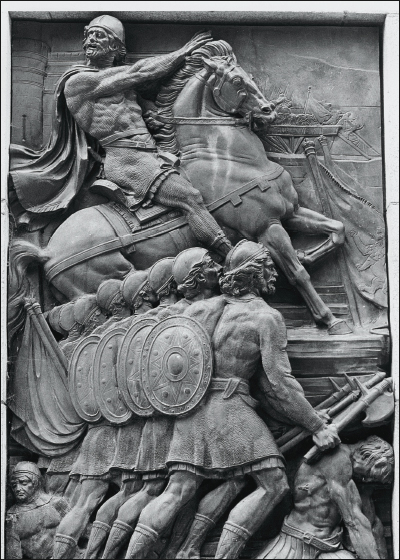
One of the four illustrated plaques found on the Elderslie Wallace Monument. Wallace is seen here leading the Scots at the Battle of Stirling Bridge. The plaques were added to the monument in 1970.
The legends and traditions surrounding William Wallace share common characteristics with those other great legendary figures King Arthur and Robin Hood. All are seen as great leaders fighting for a just cause and their names have become synonymous with heroic resistance to oppression. All three have more legend than history attached to them, and it is these legends that have received great attention and much embellishment through the most powerful modern medium, cinema. The traditions and myths surrounding Arthur and Robin Hood have developed without paying much attention to the historical evidence. William Wallace, on the other hand, can be pinned down historically to the years 1297–1305. Yet, despite this fact, there has been such a tremendous development of legends surrounding William Wallace from the fourteenth century onwards that the historical figure has been almost completely submerged. The layers of this development have recently been fully traced in Graeme Morton’sWilliam Wallace: Man and Myth (Stroud, Sutton Publishing, 2001).
The popularity of Blind Harry’s biography The Wallace (c. 1475) and Mel Gibson’s film Braveheart (1995) has meant that the legendary William Wallace has been fixed ever more firmly in popular consciousness than the historical character and his deeds. Historians must recognise the importance of the development of traditions in their historical contexts as well as continuing to investigate the roots of these traditions. The search for the ‘real’ Arthur and Robin Hood by historians and archaeologists has shed little light on the ‘heroes’ themselves, yet it has revealed a great deal about the world in which Arthur and Robin Hood existed and their legends developed.
Through In the Footsteps of William Wallace Wallace will be examined against the background of recent historical research on both the Scottish political community in the late thirteenth and fourteenth centuries and the nature of Edward I’s ‘direct rule’ over Scotland after 1296. In this context particular questions will be investigated. Was Wallace a loner or merely an agent for his overlords? What was his relationship with the political leaders of late thirteenth-century Scotland – Balliol, Stewart, Comyn and Bruce? Why did he provoke such hostility from Edward I? In addition, is there any historical accuracy in some of those firmly held traditions about William Wallace? History and tradition are equally fascinating elements of the story of William Wallace and here the text and photography reflect both.
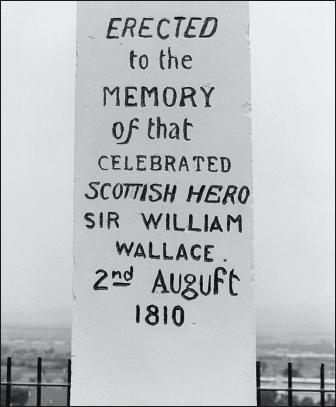
The Wallacestone Monument, overlooking Falkirk.
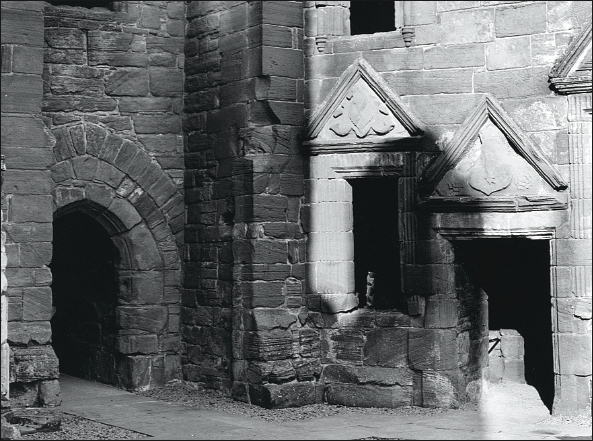
A doorway at Caerlaverock, a key castle to control in Edward I’s campaign in the south-west of Scotland between 1300 and 1304.
ACKNOWLEDGEMENTS
Anumber of individuals and institutions have contributed to the completion of this work. In particular, Professor G.W.S. Barrow’s advice on this topic has been greatly appreciated .and we are particularly grateful for his helpful comments on the book’s final draft. This has helped us to prevent a number of errors and infelicities creeping into the text. The mistakes that remain are entirely our own, as are the opinions contained in the book.
We would like to thank, most heartily, Mrs G.C. Roads, Lyon Clerk and Keeper of the Records at the Court of the Lord Lyon, for her valuable assistance with research on seals. Staff of Historic Scotland were most helpful in sourcing photographs, as were the staff at the Scottish National Portrait Gallery, Paisley Museum and Art Galleries and the British Library.
We are again most grateful to Joanne Ripley for the speedy and efficient manner in which the final draft was put on disk. Thanks are also due to Jaqueline Mitchell and Alison Flowers at Sutton Publishing for their support for this project, patience and help in seeing it to completion and also to Jo de Vries and Siubhan Macdonald at The History Press.
Alan Young
Michael J. Stead

Dunfermline Abbey has traditional associations with William Wallace’s mother. Blind Harry tells a story of Wallace’s mother fleeing to Dunfermline disguised as a pilgrim.