
1
Anyone attempting to understand the William Wallace phenomenon in Scottish history must, first of all, establish how Wallace was viewed by his contemporaries. Only then can it be seen exactly when, how and why the legend and traditions now surrounding this character have evolved and developed over the last 700 years. As part of this process of unfolding layers of history and tradition that most significant source on the life of William Wallace the epic poem The Wallace, written in the 1470s by Henry the Minstrel (better known as Blind Harry), will be closely examined. The Wallace will be set in both the political and cultural context of the day, noting too the sources that had an effect on Blind Harry’s work. In turn it will be seen what impact this late fifteenth-century poem has had on the late twentieth-century film Braveheart (1995) in terms of its portrayal of William Wallace. A number of questions arise. Why has Blind Harry’s view of Wallace remained such a powerful, indeed dominant, influence on the popular perceptions of William Wallace? What other interpretations are there and why have these remained in the background? How far does this accepted view of William Wallace distort what is known of the historical Wallace?
Contemporary evidence for the historical William Wallace is restricted narrowly to the years between his sudden emergence onto the military scene in 1297 and his death in 1305. Within this time information is unevenly spread. Most material relates to the period from the summer of 1297, just before his triumph over the English army at the Battle of Stirling Bridge (11 September 1297), until shortly after his defeat at the Battle of Falkirk (22 July 1298). It is to these years that the only four historical documents emanating from William Wallace himself belong. After defeat at Falkirk, Wallace left Scotland, acting as a roving ambassador for the Scottish cause, principally at the French and papal courts between 1298 and 1302. Little is known in detail of his activities during these years. Following his return to Scotland in late 1302 or early 1303, Wallace can be traced only through fragmentary references to his appearance in skirmishes with the English and in reports of Edward I’s efforts to capture him. This pursuit ended with Wallace’s capture by John of Menteith in 1305, after which Wallace was taken south to London where he was tried and executed. Reports of Wallace’s trial and savage death form the bulk of the surviving contemporary comments on him.

The Braveheart Statue. This representation of Mel Gibson as William Wallace was placed in the car park of the National Wallace Monument in 1998. It is the work of Tom Church and is a reminder of how significant Mel Gibson’s film Braveheart has been in the development of the Wallace legend.
One very interesting aspect of contemporary evidence on William Wallace is how little emanates from Scottish sources. The main Scottish strand in the standard narrative of Scottish medieval history was John of Fordun, whose Chronicle of the Scots Nation was compiled in the 1380s. Though written long after Wallace’s death, Fordun’s Chronicle is now acknowledged as an invaluable source of information for the period of William Wallace’s influence. He had access to original thirteenth-century material and therefore must be recognised as the closest Scottish source to Wallace himself. Yet, though Fordun’s reporting of facts may be accurate, his interpretation of events was naturally affected by the politics of his time. After Robert Bruce’s (King Robert I’s) death in 1329, Scotland had endured some years of great political instability – there had been a minority period, civil war and the constant threat of English invasion to support Edward Balliol’s attempt to gain the Scottish throne. All of these threats to the Scottish situation seemed to be replicating the events that followed the death of Alexander III in 1286 which led to Edward I’s interference in Scottish affairs. To make matters worse, the Scottish King David II had been captured by the English at Neville’s Cross (near Durham) in 1346 and was subsequently held in lengthy captivity. As a result of these circumstances, Fordun’s narrative strongly emphasises three themes – the growth of the Scottish nation and patriotism, the cause of Scottish independence and the importance of the Scottish monarchy in supporting these objectives. In view of the latter point, it is hardly surprising that Fordun’s chief hero was Robert Bruce, who restored an independent Scottish monarchy in 1306, rather than William Wallace.
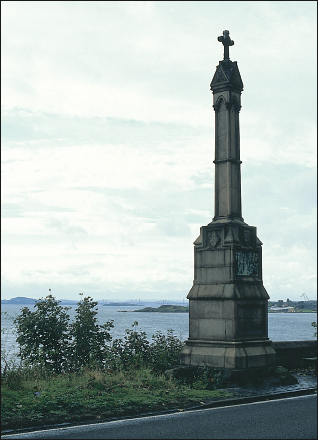
The Kinghorn Monument. This monument to King Alexander III, who died mysteriously on 18 March 1286 while travelling in a storm from Edinburgh to Kinghorn in Fife, is a reminder of the political uncertainty in Scotland during William Wallace’s early years.
When Fordun’s text is examined for information on William Wallace, he gives only a framework for his activities, an outline of his actions with little material about his background and, interestingly, in respect to later writings, nothing on his appearance. Undoubtedly, William Wallace was a hero, as can be seen in the following extract:
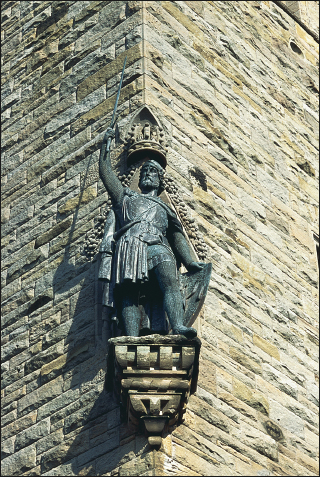
The Abbey Craig Monument, close to the scene of his great triumph at Stirling Bridge, features this bronze statue of Wallace in chain mail holding aloft a huge sword.
From that time there flocked to him all who were in bitterness of spirit and were weighed down beneath the burden of bondage under the unbearable domination of English despotism, and he [Wallace] became their leader. He was wondrously brave and bold, of goodly mien and boundless liberality . . .
However, to Fordun Robert Bruce was the hero of his Chronicle. Significantly, Fordun makes no connection between Wallace and Bruce in his narrative – they acted quite separately.
Though there are the beginnings of hero-worship contained within Fordun’s descriptions of Wallace’s actions, these can hardly be considered the foundations of a legend. Ironically, it is to contemporary English sources that the historian must go to gain not only more details of Wallace’s activities but also to trace the origins of the legend. Foremost among these English sources are two northern chronicles, the Guisborough Chronicle (North Yorkshire) and the Lanercost Chronicle (Cumbria), while the annals of Peter Langtoft, which derive from Bridlington, are also of use. All English material is biased against William Wallace, targeting him as a hate figure. This surely reflects Edward I’s attitude to Wallace at the time – to the English King Wallace came to symbolise, in 1297 and 1298, the spirit of the Scottish opposition and this became even more apparent between 1303 and 1305 when most Scottish resistance was crumbling away. It is interesting, if hardly surprising, that the most extreme English anti-Wallace sentiments were expressed by chroniclers living much further south, such as William Rishanger (St Albans Abbey in Hertfordshire), Nicholas Trivet (Oxfordshire), Matthew of Westminster and the Norwich monk Bartholomew Cotton. The anonymous author of the poemSong on the Scottish Wars shared their opinions too. Whatever the degree of hostility shown towards Wallace by contemporary English sources, there was a common desire generally to discredit Wallace’s reputation both during his life and after his execution. To the Guisborough chronicler, Wallace was ‘a common thief . . . a vagrant fugitive’. To the Lanercost chronicler he was ‘a bloody man . . . who had formerly been a chief of brigands’. Within the Lanercost Chronicle was published a song describing Wallace:
Thou pillager of many a holy shrine
Butcher of thousands, threefold death be thine
Similar views, if more extreme, were voiced by Matthew of Westminster, who referred to Wallace as:
. . . a man void of pity, a robber given to sacrilege, arson and homicide, more hardened in cruelty than Herod, more raging in madness than Nero . . .
The anonymous author of the political song On the Execution of Sir Simon Fraser pointed to Edward I’s motives in using Wallace’s death as a lesson to the Scots:
Sir Edward our king, who is full of piety
sent the Wallace’s quarters to his own country
to hang in four parts (of the country) to be their mirror
thereupon to think, in order that many might see and dread
The targeting of Wallace as a hate figure and the triumphalism of England’s popular songwriters at his death probably had the opposite effect to that intended. Instead of destroying Wallace’s reputation, it heightened it, made Wallace a martyr for the Scottish cause and helped to create the legend of his life and deeds.
In Scotland it was not until the fifteenth century that the successors and amplifiers of John of Fordun began to promote a more detailed picture of William Wallace as patriot hero. The Scottish enhancers of Wallace’s reputation were, principally, Andrew Wyntoun – Oryginale Cronykil of Scotland (c. 1420), Walter Bower – Scotichronicon (c. 1440) and most famously Henry the Minstrel (Blind Harry) – the vernacular poem The Wallace (1470s). It is clear that well before The Wallace was written there were tales, or ‘gestis’, circulating about William Wallace. Andrew Wyntoun comments:
Of his good deeds and his manliness
Great Gestis, I heard say, are made . . .
Whoever his deeds would all endite
Would need a mighty book to write
Unfortunately, no traces of these ‘gestis’ have been discovered.
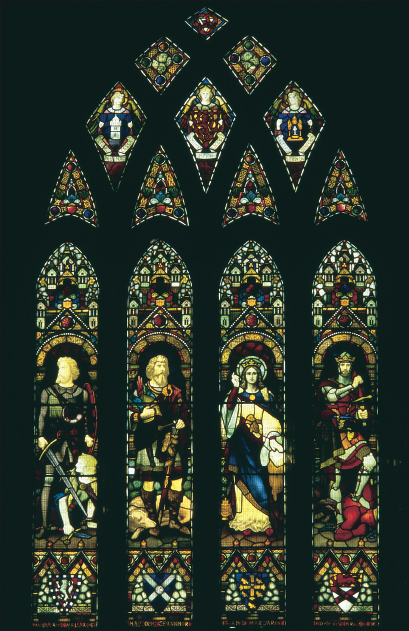
Dunfermline Abbey, famous as the burial place of Robert Bruce and other Scottish kings, contains this very fine stained-glass window showing Wallace, bearing a sword and guarding Scotia (represented by a young woman), with Bruce, St Margaret and Malcolm Canmore.
In the hands of Scottish chroniclers of the fifteenth century, William Wallace became a strongly Christian figure. Walter Bower, Abbot of Inchcolm, describes Wallace:
Moreover the Most High had distinguished him and his changing features with a certain good humour, had so blessed his words and deeds with a certain heavenly gift . . . a most skilful counsellor, very patient when suffering, a distinguished speaker who above all hunted down falsehood and deceit and detested treachery; for this reason the Lord was with him and with His help he was a man successful in everything . . . with veneration for the church and respect for the clergy, he helped the poor and widows, and worked for the restoration of wards and orphans bringing relief to the oppressed. He lay in wait for thieves and robbers, inflicting rigorous justice on them without any reward. Because God was greatly pleased with works of justice of this kind, He in consequence guided all his activities.
This clearly demonstrates that Wallace was well on the way to unofficial canonisation before Blind Harry’s biography in the 1470s. It is rather ironic to compare contemporary English descriptions of Wallace as ‘a common thief’ and ‘pillager of many a holy shrine’ with the depiction of him as an exalted Christian hero in the fifteenth-century Scottish chronicles.
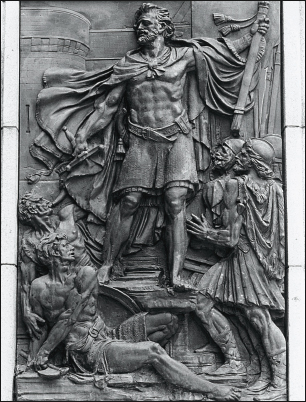
Another of the plaques mounted on the Elderslie Wallace Monument. Wallace is seen here raising the Scottish standard.
Walter Bower not only portrays Wallace as a paragon, he also provides the first detailed physical impression of Wallace. This too is a prestigious, classical portrait:
He was a tall man with the body of a giant, cheerful in appearance with agreeable features, broad-shouldered and big-boned with belly in proportion and lengthy flanks, pleasing in appearance but with a wild look, broad in the hips, with strong arms and legs, a most spirited fighting-man, with all his limbs very strong and firm.
This description seems to be modelled on the well-known vignette of Charlemagne given by his biographer Einhard, who in turn was influenced by the Roman writer Suetonius.
It is to Walter Bower we must turn for the popular tradition whereby William Wallace inspired Robert Bruce to take up the cause of Scottish independence in the aftermath of the English victory over Wallace’s forces at the Battle of Falkirk (22 July 1298). According to Bower, Robert Bruce was on the English side at the battle – a debatable issue – and, pursuing the defeated Scots, encountered William Wallace who accused him thus:
Robert, Robert, it is your inactivity and womanish cowardice that spur me to set authority free in your native land . . .
Bower relates that this stirred a profound reaction in Robert Bruce:
On account of all this Robert himself was like one awakening from a deep sleep; the power of Wallace’s words so entered his heart that he no longer had any thought of favouring the views of the English. Hence, as he became every day braver than he had been, he kept all these words uttered by his faithful friend, considering them in his heart.
It is important to note that no fourteenth-century source hints that Wallace had a role in rousing Robert Bruce’s dormant nationalism. John of Fordun, the most well-regarded Scottish commentator on the period during which Wallace is said to have exerted influence, does not mention the episode. Another piece written at about the same time as Fordun’s Chronicle was the epic poem The Bruce (1375), by John Barbour, the Archdeacon of Aberdeen. This comprehensive work praises in detail the life of Robert Bruce, but significantly William Wallace does not even warrant a mention.
Despite this, it is clear that the legend of William Wallace had already received some considerable development before Blind Harry’s poem The Wallace took his reputation onto another plane of hero-worship. The Wallace was not only an epic in style but also in length, comprising almost 12,000 lines. It became, as will be seen, the most well-known representation of William Wallace. However, to appreciate fully the value of Blind Harry’s work it should be placed in a number of settings – the Scottish historical context of Fordun, Wyntoun and Bower; the literary background of popular writing: outlaw ballads, the tales of Robin Hood, William Tell and Arthur and the writings of Chaucer; and the political circumstances of late fifteenth-century Scotland where the pro-English policies of James III of Scotland provoked hostile anti-English sentiments. According to M. McDiarmid, editor of a valuable critical edition of Blind Harry’s The Wallace for the Scottish Text Society (1968–9): ‘Harry’s Wallace is firstly a poetical narrative and to be read as such, but an awareness of its propagandist bearing on the Scots’ political situation of 1477–9 is essential to an understanding of the poet’s free treatment of his subject-matter.’ In the political sense, William Wallace was an ideal figurehead for the anti-English party. Indeed, in Blind Harry’s hands, William Wallace even took on the appearance of Alexander Duke of Albany, the leader of the anti-English party in Scotland during Blind Harry’s time. Thus a new layer was added to the already exaggerated physical image of Wallace that had been fashioned by Walter Bower. Blind Harry used Bower’s classical representation and contemporary knowledge of the Duke of Albany (later verified by sixteenth-century chronicle accounts) to compose a portrait that was influential for several centuries:
In stature he was full nine quarters high,
When measured, at least, without a lie.
Betwixt his shoulders was three quarters broad,
Such length and breadth would now-a-days seem odd . . .
Great, but well-shaped limbs, voice strong and sture,
Burning brown hair, his brows and eye-bries light;
Quick piercing eyes, like to the diamonds bright.
A well proportioned visage, long and sound;
Nose square and neat, with ruddy lips and round.
His breast was high, his neck was thick and strong;
A swinging hand, with arms both large and long.
Grave in his speech, his colour sanguine fine,
A beauteous face wherein did honour shine.
In time of peace mild as a lamb would be,
When war approach’d, a Hector stout was he.
The value of The Wallace in understanding the historical William Wallace has been widely debated. In the eighteenth century, Sir David Dalrymple described Harry as ‘an author who either knew not history or who meant to falsify it’. These two strands represent the extremes of the debate. John Mair, writing The History of Great Britain (1518), thought that Harry was blind from birth and that the information within The Wallace would have been obtained from popular oral tales rather than books. The work of M. McDiarmid (1968–9) has clearly demonstrated that Harry was not blind from birth and had, in fact, access to chroniclers such as Bower, Wyntoun, Barbour and Froissart. Indeed, Harry seems to follow and elaborate upon Bower at key points in his narrative, such as the emphasis on Wallace’s personal qualities and physical characteristics, the episode after Falkirk in which Wallace awakens in Robert Bruce a latent sense of patriotism and duty, and the religious exaltation of Wallace. As far as the latter issue is concerned, Harry presents Wallace dramatically as the patriot leader appointed by God. Harry describes Wallace’s vision in Monkton church in which St Andrew confers the sword of Scotland on him:
Into that slumber Wallace thought he saw,
A stalwart man, that towards him did draw;
Who hastily did catch him by the hand;
‘I am’, he said, ‘sent to thee by command’;
A sword he gave him of the finest steel,
‘This sword’, said he, ‘son, may thou manage weel’;
A topaz fine, the plummet, did he guess,
The hilt and all did glitter o’er like glass.
‘Dear son’, said he, ‘we tarry here too long;
Shortly thou must revenge thy country’s wrong.’
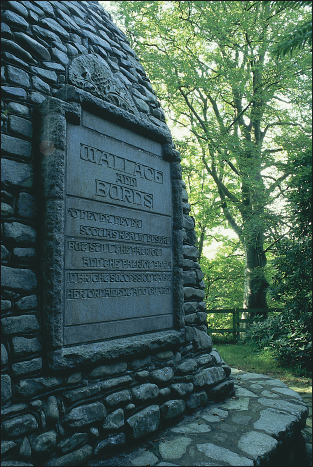
This cairn in Leglen Wood commemorates both William Wallace and Robert Burns, who was influenced by Blind Harry’s writings. In The Wallace Blind Harry describes Wallace’s attacks on the English garrison at Ayr from bases such as Leglen Wood.
The focus in both Bower’s and Blind Harry’s work is passionately anti-English. Bower’s Scotichronicon ends with the words ‘He is no Scot, O Christ, that finds this book displeasing.’ As with the other themes, Blind Harry takes this a stage further, describing with relish a series of Wallace’s violent anti-English acts of vengeance. Indeed, so overwhelming is this that Wallace’s cause itself seems to become revenge against the English rather than defence of John Balliol’s right to the Scottish throne, which is barely mentioned in The Wallace.
Historians have shown that Blind Harry’s The Wallace is a complex blend of some fact with much fiction, distortions of other chroniclers and incorrect chronology. There are a number of major historical inaccuracies embedded in the poem, of which some of the most significant are: the Battle of Falkirk is dated five years (rather than one) after the Battle of Stirling Bridge and is turned into a Scottish victory; the Battle of Loudoun Hill is taken from Robert Bruce’s career, as is the threat to the English war capital at York; Wallace is said to invade England as far as St Albans (there is no evidence that he came further south than the Tyne); the ‘battles’ of Biggar and Linlithgow are added to Wallace’s war record; and he is given credit for coming to Scotland’s rescue no less than three times. Yet, despite the misleading nature of the material in The Wallace, the general lack of detailed authentic information on many aspects of Wallace’s career has led historians to hope that there might be some true facts hidden in the poem. The mystery surrounding Wallace’s background and family origins is one area that has puzzled historians as they attempt to understand the motivation for his dramatic emergence in 1297. Within the twelve books into which The Wallace is divided, the Battle of Stirling Bridge (1297) does not appear until the end of Book VII. Given that Blind Harry wrote the poem under the patronage of Sir William Wallace of Craigie, who was a descendant of William Wallace and probably familiar with Wallace family history and traditions, there may well be some accuracy in the details recorded in the first six books of The Wallace, which deal with William Wallace’s youth.
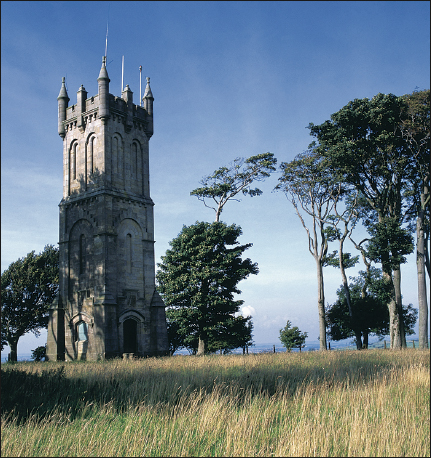
The Barnweill Wallace Monument in Ayrshire, which was completed in about 1855. This memorial preserves another tradition, again graphically established by Blind Harry, that says Wallace made a revenge attack on a barn full of English soldiers. Apparently, Wallace, having set fire to the barn, shouted ‘the barns of Ayr burn well’, which gave the area its name.
Perhaps more important to the making and confirming of the legend from this period is the fact that Blind Harry’s narrative was generally believed until at least the eighteenth century and that The Wallace was hugely ‘popular’. Blind Harry wrote with the support and encouragement of Sir William Wallace of Craigie in order to prevent William Wallace’s career and achievement as patriot hero from being completely overshadowed by that of Robert Bruce. As is well known, it is the winners (or their friends) who write the history of a nation. It is hardly surprising that Robert Bruce was the major hero promoted by Scottish nationalist writers in the fourteenth and fifteenth centuries – John of Fordun, Andrew Wyntoun, Walter Bower and especially John Barbour. Blind Harry and his patron sought to do for Wallace what Barbour had done for Robert Bruce a century earlier.
Blind Harry’s main historical influences were the Scottish nationalist writings of the period 1370 to 1470, with Walter Bower being particularly important. However, other genres of literature also had an impact on the creation of The Wallace – the outlaw ballads especially, but also the work of Chaucer. As a result, Wallace came to be seen as a hero in the mould of popular figures of the time, such as Robin Hood, William Tell and Arthur. By the end of the fourteenth century, Robin Hood’s reputation was already widespread and during the fifteenth century William Wallace came to be seen as a Scottish Robin Hood. Langland referred to the ‘rymes’ of Robin Hood in Piers Plowman in 1377 and it is important to note that two Scottish chroniclers known to have influenced Blind Harry, Andrew Wyntoun and Walter Bower, were among the first historians to mention Robin Hood and were clearly familiar with the ballads. Blind Harry’s work follows the conventions of these ballads and it is hardly surprising that they share common features. Both present their respective heroes as proud outlaws, expert archers, using the inaccessibility of woods and forests to fight guerrilla-type warfare against their oppressors. The spirit of the Greenwood is strong in both. In both the protagonist employs a variety of disguises to avoid capture, displays generosity to the poor and fights for just causes. In The Wallace and the ballads of Robin Hood, the arch-enemy is a sheriff, chief representative of their oppressors.
It is interesting to note that, apart from the legend of Robin Hood, which had been in existence for over a century, the tale of William Tell was also being embellished at about the time Blind Harry was writing. In addition, rather more well-established stories were gaining new life in the late fifteenth century. In 1485 Malory’s Le Morte D’Arthur was published in England, giving greater prominence to this long-lived saga. There are certainly parallels between the amount of violence in this work and Blind Harry’s poem.The Wallace should be examined amid this array of legends and the image of William Wallace was undoubtedly affected by exposure to this literary genre. No doubt too this style was popular and perhaps enhanced with some stylistic elements from Chaucer.
The Wallace was one of the first printed books in Scotland in about 1508–9 and became one of the most successful books in that country. There were at least twenty-three editions of the poem before 1707 and, according to Dr James Moir who produced the first Scottish Text Society edition of the poem, only the Bible was found more often in Scottish homes. The popularity of Harry’s The Wallace was no doubt increased with the translation by William Hamilton of Gilbertfield in 1722, A New Edition of the Life and Heroick Actions of the Renoun’d Sir William Wallace, General and Governor of Scotland. The many editions of this version ensured the ascendancy of The Wallace throughout the eighteenth and nineteenth centuries. It outstripped Barbour’s The Bruce in popularity and this also extended beyond Scotland.
The story of William Wallace inspired Robert Southey in his The Death of Wallace (1798):
He call’d to mind his deeds
Done for his country in the embattled field,
He thought of that good cause for which he died,
And it was joy in death
William Wordsworth also made reference to Wallace in his Prelude (1805):
How Wallace fought for Scotland, left the name
Of Wallace to be found, like a wild flower,
All over his dear country, left the deeds
Of Wallace, like a family of Ghosts,
To people the steep rocks and river banks,
Her natural sanctuaries, with a local soul
Of independence and stern liberty.
These words reflect the reality of Wallace’s popular association with the Scottish landscape. The name of Wallace is linked with hundreds of placenames across Scotland (though the majority of them are to be found in central and south-west Scotland) including: Wallace’s Tower, Wallace’s Monument, Wallace’s Hill, Wallace’s Stone, Wallace’s Trench, Wallace’s Cave, Wallace Moor, Wallace Seat, Wallace’s Well, Wallace Wood, Wallace Road, Wallace’s Pass, Wallace’s Leap, Wallace’s Camp, Wallace’s Rocks, Wallace’s Brae and even Wallace’s Bed and Wallace’s Beef Barrell! These names bear remarkable witness to William Wallace’s public appeal.
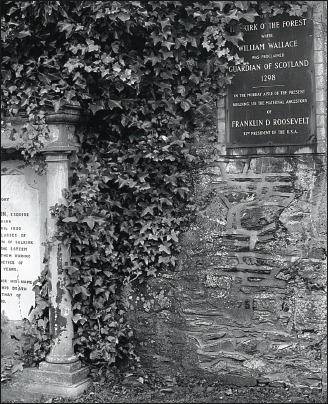
Selkirk plaque. Selkirk Forest, the ancient Ettrick Forest, was often used as a base by William Wallace during his campaigns against English forces in Scotland. Tradition has it that this was the site where Wallace was created Guardian of Scotland but it is not known precisely where or when he received this honour.
The popularity of William Wallace was also perpetuated through Robert Burns. Blind Harry’s The Wallace was the most renowned work in Scotland before the era of Burns and Walter Scott. Robert Burns was, like many others, influenced by the life of William Wallace and ranked him alongside Hannibal as one of his chief heroes (as cited by Elspeth King in Blind Harry’s Wallace, William Hamilton of Gilbertfield [Edinburgh, Luath Press, 1998]):
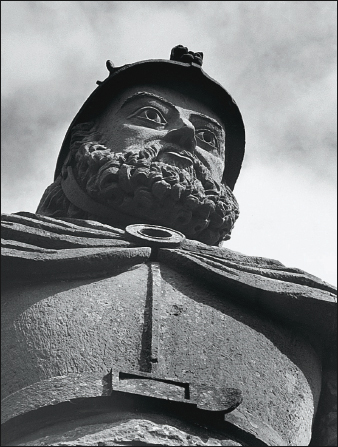
The face of the Dryburgh Statue. The image of Wallace depicted here, typical of many nineteenth-century portraits, tends to add both years and gravitas to him.
The story of Wallace poured a Scottish prejudice in my views which will boil along, there until the floodgates of life shut in eternal rest.
It might be thought that the formal political Treaty of Union between England and Scotland in 1707 would lead to the need for a different kind of symbolic national hero in Scotland. During the long periods of actual or threatened warfare between Scotland and England during the fourteenth, fifteenth and sixteenth centuries it was natural to promote figures who would be held up as fighting symbols of resistance. Blind Harry’s portrait of Wallace at the end of the fifteenth century represented an extreme form of violently anti-English hero and divinely appointed martyr for his country’s cause. However, the Treaty of Union did not bring to an end Scotland’s need to defend and maintain a distinct identity. Marinell Ash noted in The Strange Death of Scottish History(Edinburgh, Ramsay Head Press, 1980) that the nineteenth century was a time ‘that Scotland was ceasing to be distinctly and confidently herself . . . also the period when there grew an increasing emphasis on the emotional trappings of the Scottish past’.
One aspect of this was the raising of monuments to national heroes, and William Wallace was central to this movement. Wallace statues and memorials were set up as enthusiastically as Wallace placenames were adopted. A number of structures were erected in the early nineteenth century including the Wallace Monument at Wallacestone on 2 August 1810 and more notably the 21-ft memorial at Dryburgh on 22 September 1814. Even more magnificent was the National Wallace Monument which was built by public subscription on Abbey Craig at Stirling and promoted by the Revd Charles Rogers, founder of the Royal Historical Society. Constructed between 1861 and 1869 and eventually rising to a height of 220 ft, the National Wallace Monument attracted much public attention from the outset – a crowd of over 50,000 people attended a great ceremony to mark the laying of the foundation stone.
Many other monuments testify to the cult of William Wallace in the nineteenth century. The Wallace Tower in Ayr, for example, was renovated in Gothic style in 1834. Another Wallace statue in Stirling town centre depicts Wallace in Grecian fashion. The Wallace Memorial Window in Paisley Abbey, set up in 1873, portrays Wallace as Samson. Wallace was seen as a hero in classical and biblical style. It is apparent from the monuments and memorials of this time that Wallace was represented with a seniority of years and a certain ‘gravitas’, which was in keeping with the Victorian period.

The Dryburgh Statue, commissioned by the eleventh Earl of Buchan in 1814, was sculpted from red sandstone and is 21 ft high.
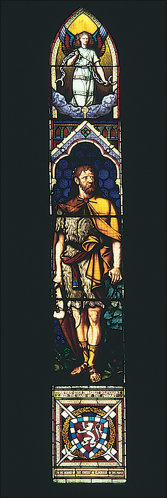
This window at Paisley Abbey depicts Wallace as Samson and dates from 1873. The Cluniac abbey of Paisley was founded by Walter Fitz Alan, Steward of Scotland, in about 1163. The nearness of Elderslie and the Wallace link with the Stewarts has led to the tradition that William Wallace may have received early schooling here.
William Wallace was still a cult figure in Scotland in the nineteenth century, but his image had changed to suit the time. Nationalism in nineteenth-century Scotland meant something quite different from what it had in Blind Harry’s time and the symbol of William Wallace adapted too. The Scottish Patriotic Society through the Revd David MacRae played a key role in the funding of the monument to Wallace’s capture at Robroyston, which was unveiled in 1900. The National Association for the Vindication of Scottish Rights supported the National Monument to Wallace but could also, without any sense of incongruity, voice admiration for Scotland’s partner in the Union, England. Recent research has revealed that backing for the Union was the majority view in Scotland and that supporters of this were as fervent as any in promoting the cult of William Wallace.
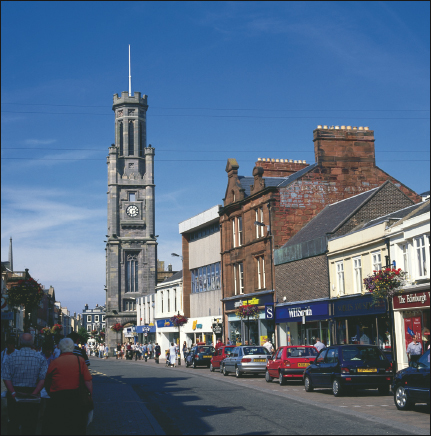
Standing at a height of 113 ft, the Wallace Tower in Ayr was built in Gothic style in the 1830s and contains a statue of Wallace high up on the front. This is one of two statues of Wallace in the town, the other one being placed in a niche in a building in Newmarket Street in 1819.
Nationalism and Unionism could go hand in hand. According to this view, a Union profitable to Scotland had been achieved partly as a result of Wallace’s contribution to the resistance movement, which ultimately prevented the English conquest of Scotland. The names of prominent men who supported the Union and the building of Wallace memorials included the Earl of Elgin, who was to the fore when the movement to build the Wallace Monument started in 1856. His views expressed the opinion of many: ‘. . . that it is the successful struggle carried on under Bruce and Wallace, that it is that the Union between Scotland and England has not only been honourable to the former but profitable to the latter . . . that if the whole truth were to be told in this matter, we might show that England owes to Wallace and Bruce a debt of obligation only second to that which is due to them by Scotland’. (quoted by G. Morton, as cited in David McCrone, ‘Scotland – the Brand’, p. 45 in Images of Scotland, Journal of Scottish Education Occasional Paper No. 1). This notion of nationalism within the political framework of the United Kingdom remains a viewpoint supported by mainstream politics in the twentieth century. Both Bruce and Wallace are incorporated. In 1993, the Conservative ex-Secretary of State, Ian Lang, claimed that the Union of the nations of Scotland and England in 1707 was a legacy of Bannockburn. In 1997, the date 11 September (undoubtedly chosen to stir memories of William Wallace and his victory on that date at Stirling Bridge) was deemed appropriate for the great majority of the Scottish people to vote for a Scottish parliament (which they did).
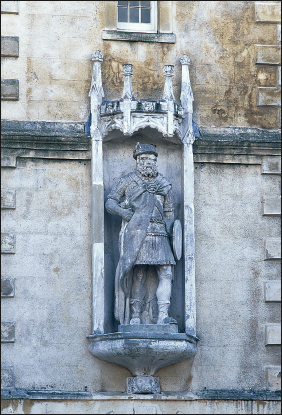
This statue of William Wallace stands above the doorway of St Nicholas’ Church in Lanark. It dates from about 1820.
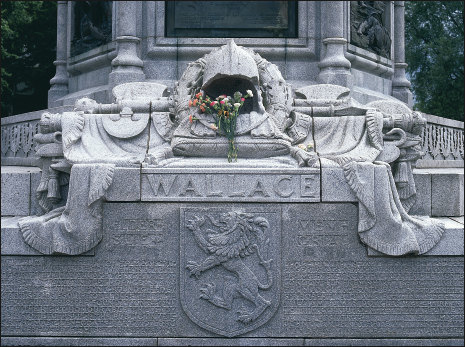
Detail from the Elderslie Wallace Monument, completed in 1912. This memorial celebrates the traditional birthplace of William Wallace and has often been the focus of rallies held by the Scottish Nationalist Party.
William Wallace has become a national symbol for Scotland and this has been acknowledged by political parties in general. From the nineteenth century to the present, Wallace has had widespread support across political parties and across class. To the working classes in nineteenth-century Scotland he came to represent the ‘common man’ fighting for freedom against oppression, while to the middle classes he came to personify a ‘middle-class’ hero who had saved the country from the folly of the aristocratic governing class. The legend and image of William Wallace have evolved from the fifteenth century and are still developing. In this context the film Braveheart (1995) represents not so much a twentieth-century expansion of the legend, a ‘Hollywood history’ version of William Wallace’s life, but a reversion to Blind Harry’s character, a late fifteenth-century two-dimensional Wallace. Based on Randall Wallace’s novel Braveheart (London, Signet, 1995), which in turn used Blind Harry’s The Wallace as its main source, Mel Gibson’s film Braveheart follows closely the legend created by Blind Harry. Not all details are the same though there are some significant similarities – the bridge at Stirling that played such a major role in the Scottish victory at the Battle of Stirling Bridge did not feature in either Blind Harry’s poem or the film Braveheart. In general, however, the film represents a rather less exaggerated portrait of its hero than Blind Harry does. In the poem Wallace’s invasion of England reaches St Albans, whereas Braveheart’s Wallace only reaches York. Nevertheless, both accounts have strayed a long way from the footsteps of the real William Wallace.
The widespread success of Blind Harry’s The Wallace from the 1470s and the popular acclaim of the film Braveheart from 1995 to the present have combined to produce a very powerful image of one basic interpretation of William Wallace. It is very difficult, therefore, to reach beyond this to understand the many and varied layers of the legend and the complexities of a multi-faceted hero. Only an integrated study of Wallace that incorporates the views of thirteenth-century English chroniclers, fourteenth- and fifteenth-century Scottish nationalist writers (where fact first starts to blend with legend), nineteenth-century nationalists and twentieth- and twenty-first-century commentators on William Wallace and his legend can hope to achieve a more complete picture of Wallace in history and legend.
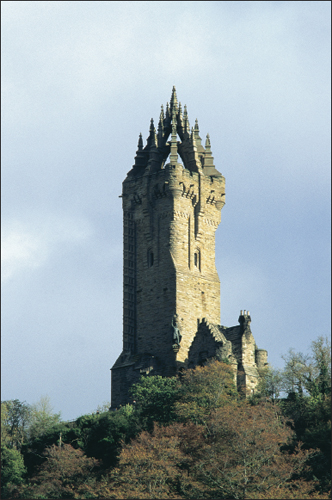
Taking its name from the nearby abbey ruins at Cambuskenneth, the National Wallace Monument at Abbey Craig has become the focal point of both ‘Wallace tourism’ and Scottish nationalism since its opening in 1869.