
3
The actions of William Wallace and his lord, James Stewart, in 1297 need to be set in the context of the Anglo-Scottish war, which began so disastrously for Scotland with the defeat at Dunbar in 1296. Their roles should also be examined against the background of the Scottish political community, its leadership and its policy in 1296. The Scots were led into war in 1296 by the Comyn family, who had dominated Scottish politics and landholding for much of the thirteenth century. The two main branches of the family, the Comyn lords of Badenoch and Lochaber and the Comyn earls of Buchan, controlled key castles and therefore the main lines of communication, especially in northern Scotland where their virtually vice-regal power stretched from Inverlochy Castle in the west to Slains Castle in the east. Between these two points they had in their power strategically situated castles at Ruthven, Lochindorb, Blair Atholl, Balvenie, Dundarg, Cairnbulg (originally called Philorth), Rattray and Kingedward. In particular, Comyn strongholds controlled important passes from the north and west Highlands into the Tay basin.
However, Comyn power was not only restricted to northern Scotland. The family, including a third branch – the Comyns of Kilbride – had a great deal of land and power in central and southern Scotland. They held castles at Kirkintilloch (Dumbartonshire), Dalswinton (Nithsdale), Cruggleton (Galloway), Bedrule and Scraesburgh (Roxburghshire) and Kilbride (East Kilbride). In addition to their private landholding, the Comyns controlled a number of royal castles through their role as hereditary sheriffs of Dingwall and Banff (in the north) and Wigtown (in the south-west). In the early 1290s the family took additional responsibility for the royal castles at Kirkcudbright, Aberdeen, Jedburgh, Clunie, Dull and Brideburgh (Barburgh in Dumfriesshire). Comyn influence over the political scene was further enhanced by marriage alliances in the course of the thirteenth century with the earls of Mar, Ross, Dunbar, Angus, Strathearn and Fife and with the powerful families of Macdougall, Moray, Balliol, Mowbray, Umphraville and Soules. Other prominent allies were the Grahams, Frasers, Sinclairs, Cheynes, Mowats, Lochores, Maxwells and Hays. The Comyns, therefore, with their wide-ranging and extensive landed power and their network of powerful partners exercised political influence at the centre as well as in many regions of Scotland. Their long-standing authority was witnessed by their extended tenure of the Justiciarship of Scotia, the most important political and administrative office in the kingdom – three successive Comyn earls of Buchan were justiciars of Scotia for no fewer than sixty-six years between about 1205 and 1304.
In the context of this network of well-established noble ruling families, it is interesting to place the families of Stewart and Bruce. It is clear that the Stewarts were not within the Comyn network of allies who so dominated Scottish government. However, it would appear that the Stewarts were part of the aristocratic group upon which Alexander III depended to consolidate royal authority in the regions. The Stewarts, with their hereditary role as ‘Steward’ guaranteeing them a role in the royal circle, moved firmly to the forefront of Scotland’s political community with their extensive landholding in the west of Scotland, recognised and further consolidated by control of the sheriffdoms of Ayr and Dumbarton. The family were prominent in the royal circle from the 1250s to the 1280s. The Bruces, on the other hand, held no political offices in Alexander III’s reign. However, their status and landholding power in Scotland had been increased in 1272 when the family gained the earldom of Carrick in south-west Scotland, and this built on their existing strength in this area, which was based upon the lordship of Annandale they had held since 1124. The Bruces, though outside the political elite of noble families in Alexander III’s reign, did have much ambition and a dormant claim to the Scottish throne – apparently acknowledged by Alexander II in 1238 and by the Scottish baronage in the late 1240s – should the male line of the Scottish royal family die out. It is in this light that the Stewarts’ family connections with the Bruces should be noted. A marriage between Walter Fitz Alan II and Euphemia, daughter of William Bruce and sister of Robert Bruce, indicates that these links dated from 1261.
The Stewarts’ role at the centre of Scottish government as well as their family links with the Bruces were both emphasised in the dramatic events of 1286. On 18 March 1286, Alexander III, King of Scots, died suddenly, aged forty-four, the result of a tragic accident on a dark, stormy night when he was on his way to Kinghorn to meet his new French wife (of less than six months), Yolande de Dreux. There was great uncertainty over the succession. Yolande, Alexander III’s queen was, at first, believed to be pregnant, though the magnates of Scotland had acknowledged the ‘Maid of Norway’, Alexander III’s granddaughter, Margaret (then aged one), as rightful heir in February 1284 should Alexander III not produce an heir. As a result of the confusion and the inevitability of a long period of minority government, a provisional government of six Wardens or Guardians was set up. This comprised two earls (Alexander Comyn, Earl of Buchan, and Duncan, Earl of Fife), two bishops (William Fraser of St Andrews and Robert Wishart of Glasgow) and two barons (John Comyn of Badenoch and James Stewart). The Lanercost Chronicle’s description of this group as ‘guardians of peace’ highlights its key function: to maintain peace and stability within the kingdom and protect freedom from external interference. The Guardians were also in a good position to implement the succession and help to establish the next heir to either Yolande’s child or Margaret, a delicate child of three years at the time of Alexander III’s death. The two families considered to have the best claims to be heir presumptive were the Balliols and the Bruces. However, the Comyns dominated the Guardianship and had a strong family link to the Balliols – John Comyn, Lord of Badenoch (died 1302) was the brother-in-law of John Balliol, the Balliol candidate and eventual King of Scots in 1292. These factors persuaded the Bruces to resort to strong-arm tactics in 1286, and they launched attacks on the Balliol castle at Buittle and the royal castles of Wigtown and Dumfries.
Bywell Castle on the River Tyne.
JOHN BALLIOL
The names of William Wallace and Robert Bruce have captured popular imagination and hold a unique place in Scottish history and tradition. In contrast, that of John Balliol has been associated with the abject surrender of his kingdom to Edward I in 1296. Balliol acquired the derogatory nickname of ‘Toom Tabard’ (’Empty Surcoat’) after his coat of royal arms was stripped from his tabard in public and humiliating circumstances following his formal submission to Edward I at Montrose on 8 July 1296. As the main opponent of the Bruces’ dynastic ambitions in the ‘Great Cause’ (1291–2), John Balliol has naturally been given a ‘bad press’ by the pro-Bruce Scottish writers of the fourteenth and fifteenth centuries. To Walter Bower (c. 1440) the Scottish kingdom was ‘abnormal in the time of this disastrous King John’. This was in keeping with the official government propaganda of the Bruce kingship, which in 1308 referred to itself as the successor to Alexander III (ignoring any reference to John Balliol’s kingship) and in 1309 (for the first time) declared that Balliol had been imposed by English force on the Scots. Despite Balliol’s lack of political experience and personal frailties, it should be remembered that the Scots fought in his name and on his behalf from 1296 onwards. He symbolised Scottish independence for William Wallace between 1297 and 1305. Even after Robert Bruce’s ‘coup’ of 1306, Balliol remained a significant focus for opposition to Robert Bruce until his death in 1313, after which his son Edward Balliol continued to represent Balliol interests. The Bruces still needed to wage a propaganda war even after Bannockburn.
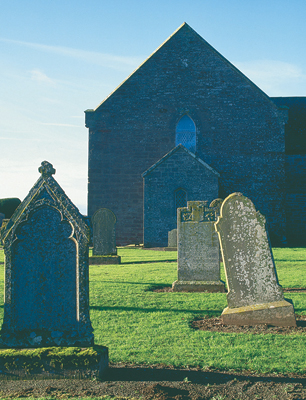
Stracathro church. After the Scottish defeat at the Battle of Dunbar in April 1296, John Balliol (who was probably not present) fled to the north with his main supporters, the Comyns. The Comyns, the real leaders of the Scottish political community, decided to seek surrender terms during the summer. In early July 1296, Balliol submitted to Edward I at Stracathro church, north of Brechin, before proceeding to Montrose where he was forced to give up his crown.

Barnard Castle, the principal English stronghold of the Balliol family (their other northern base was Bywell in Northumberland). Barnard Castle received significant additions in the second half of the thirteenth century, a reflection of the family’s wealth at this time.

Sweetheart Abbey, Nithsdale. Probably not completed before the outbreak of the Scottish wars, Sweetheart Abbey was founded in 1273 by the rich and pious Devorguilla Balliol in honour of her husband, John (died 1268). Devorguilla was the mother of John Balliol, King of Scots, 1292–6.
The potential for a clash of allegiances for James Stewart, and his following, was clearly present in 1286. The Turnberry Band of September 1286 seemed to indicate that the Stewarts were putting family loyalty before national interests. The pact made at Turnberry (the chief castle of the Bruce earldom of Carrick) linked Robert Bruce, Lord of Annandale (a potential claimant to the Scottish throne and the future Robert I’s grandfather), his son Robert Bruce, Earl of Carrick, James Stewart (the Guardian), his brother, John Stewart of Jedburgh, Walter Stewart, Earl of Menteith, and his sons, Patrick, Earl of Dunbar, Angus Macdonald, Lord of Islay, and his son in an agreement to support Richard Burgh, Earl of Ulster, and Thomas Clare against their enemies. This involved swearing oaths of allegiance to the English King and whoever should be King in Scotland ‘by reason of the blood of the lord Alexander, king of Scotland, according to the ancient customs hitherto approved and used in the Kingdom of Scotland’. The oath has been interpreted as an indication of a deliberate bid by the Bruces, supported by their close family allies, the Stewarts, for the Scottish throne. This is, probably, reading too much into the statement and there may have been nothing more to the agreement than a family/factional pact to conquer land in the west of Ireland. Yet, at a time of uncertainty following the death of Alexander III, when disorder in south-west Scotland was being initiated by the Bruces, any military pact such as that at Turnberry must have been viewed with suspicion by the Comyn-led government and their allies.
James Stewart, despite the Stewart family’s support for the Bruces at Turnberry, tended to put his duties as Guardian before the concerns of his partners within Scotland. He backed, for example, the Guardians’ policy of putting the host on twenty-four hours’ readiness to suppress unrest. Perhaps the Stewarts felt that their interests in the south-west and west were threatened by the Bruces’ strong-arm actions, which could have turned that area into a civil-war zone. It is difficult to assess the individual role of James Stewart within the six-man team of Guardians between 1286 and 1290. Evidence suggests that he supported the collective policy decisions of the committee but did not play a leading part in their active implementation. Stewart was not a member of, for instance, either of the two embassies dispatched to Edward I in France during the summer of 1286 to receive his counsel and perhaps ask for his help to bring stability to the Scottish political scene.
In 1289 the committee of Guardians was reduced to four by the deaths of Alexander Comyn, Earl of Buchan, and Duncan, Earl of Fife. Despite this, James Stewart maintained his low-key role, for example, in the negotiations for a marriage between Margaret, ‘Maid of Norway’, the Scottish heiress, and Edward I’s heir, Edward of Caernarfon. He was not one of the Guardians who arranged the Treaty of Salisbury (1289) with the English representatives; nor was he involved in the discussions for bringing the young Scottish heiress from Norway to Scotland in 1290. Stewart was not regarded as a member of the dominating Comyn clique who tended to control membership of missions and embassies implementing Guardian policy. Undoubtedly, the Comyns were suspicious of the Stewarts’ association with the Bruces, openly displayed in 1286, while appreciating the need to acknowledge the importance of Stewart authority in the west in order to maintain stability in that area. It can only be surmised that Stewart followers, such as the Wallace family, shared Stewart ambivalence in a difficult political climate. The Stewarts could not afford to lose their position in central and local government which consolidated their power and influence in western Scotland, yet their family connection with the Bruces must have caused some tension with the dominant Comyn family.
The position of the Stewarts in the network of influential noble families is important for understanding the factors that affected William Wallace and his family. Another important consideration is the policy and political stance adopted by Scotland’s aristocratic governing community in the ten years between the death of Alexander III in 1286 and the outbreak of the Anglo-Scottish wars in 1296. The tendency of Scottish tradition – the foundations of which were firmly laid by the writings of John Barbour (writing in about 1375), John of Fordun (1380s), Andrew Wyntoun (c. 1420), Walter Bower (c. 1440) and Blind Harry (c. 1470s) – has been to emphasise the factiousness of a nobility whose motivation was self-interest rather than the national interest. This served to highlight the roles of William Wallace and Robert Bruce as champions of Scottish nationalism, the only clear embodiments of a policy of Scottish independence against English imperialism. This distorted view, from the fourteenth and fifteenth centuries, has hidden the reality that a definite political focus did emerge in the period after Alexander Ill’s death. The negotiations for the marriage between Margaret, ‘Maid of Norway’, and Edward of Caernarfon culminated in the Treaty of Birgham (eventually signed in July 1290), which embodied a detailed and carefully considered expression of the Scottish government’s position on Scottish rights and Scottish independence. Scotland had a defined political manifesto and a distinct sense of its own identity before William Wallace (in 1297) and Robert Bruce (in 1306) came to dominate the Scottish political scene. The following extract is taken from the Treaty of Birgham:
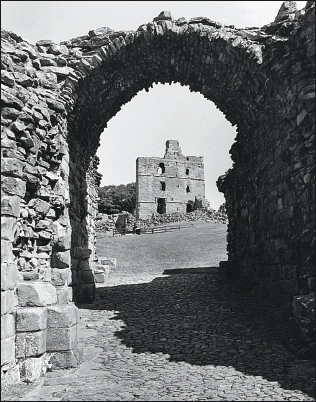
Norham Castle, the chief border stronghold of the Bishop of Durham. It was appropriate that Edward I stayed here – Anthony Bek, Bishop of Durham, was his chief adviser on Scottish affairs – while hearing the claims of the thirteen Competitors for the Scottish throne in 1291.
. . . the realm of Scotland shall remain separated, apart and free in itself, without subjection to the realm of England, by its rightful boundaries and marches, as it has been preserved down to the present . . . the rights, laws, liberties and customs of the same realm of Scotland to be preserved in every respect and in all time coming throughout the said realm and its borders, completely and without being impaired . . . The relics, charters, privileges and other muniments which concern the royal dignity and the realm of Scotland shall be deposited in a secure place within the realm of Scotland, under strong guard, under the seals of the greatest magnates of the realm and under their supervision . . . Parliament shall not be held outwith the realm of Scotland or its marches to deal with these matters which concern that realm or its marches, or to deal with the status of the inhabitants within that realm. No tallages, aids, military service of maltols [an arbitrary tax on exports, imports or internal markets] shall be demanded from the aforesaid realm, or be imposed upon the people of the same realm, unless it be to meet the common needs of the realm and in circumstances in which the kings of Scots have been used to demand such things . . .
The leaders of the Scottish political community, including James Stewart, steadfastly pursued the key terms of the Treaty of Birgham. These elements became the backbone of the Scottish fight for independence when this was threatened by the death of the Scottish heiress, the ‘Maid of Norway’, in Orkney late in September 1290 as she made her way to Scotland. Edward I had been taking an increasingly interventionist stance towards Scotland even before the Treaty of Birgham and this became accentuated after the death of the ‘Maid of Norway’. It is important to trace the development of this approach in the years prior to William Wallace’s emergence in 1297. As early as February 1290, for example, Edward I granted to Anthony Bek, Bishop of Durham, the custody of the lands and tenements in Cumberland and Northumberland which had formerly been held by the King of Scotland. Later, in June 1290, the custody of the Isle of Man, clearly a part of the Scottish kingdom, was given to Walter Hunterscumbe. While the position adopted by the Scottish Guardians in the terms of the Treaty of Birgham (July 1290) could be viewed as a response to incipient English encroachment, Edward I still reserved some rights for himself in this treaty:
We reserve to our aforesaid lord, and to any other person, such right, concerning matters on the border or elsewhere, as may have belonged to them prior to the date of this present grant, or which could rightfully belong to them in the future . . . by reason of this present treaty nothing shall be added to, nor taken away from, the right of either realm . . .
In August 1290, Edward I asked the Guardians of Scotland to recognise Anthony Bek, Bishop of Durham, as the Lieutenant in Scotland of his son, Edward, and of his future wife, Margaret. The Guardians were then instructed to defer to Bek in matters ‘which are required for the governance and peaceful state of the realm’.
Despite the promises made at Birgham that Scotland’s independence would be safeguarded, the English attitude was increasingly clear – Scotland could only be stable politically with Edward I’s oversight. English policy following the demise of the Scottish heiress (and, therefore, the marriage contract with Edward I’s son) was to have English claims for overlordship over Scotland formally acknowledged in return for his assistance in securing the royal succession in Scotland and resisting the aggressive tactics of the Bruces, which again threatened the country with civil war. In keeping with the terms of the Treaty of Birgham, the Scottish Guardians at first refused to acknowledge Edward I’s claims to overlordship. The King, however, cleverly outflanked the Guardians by getting the thirteen claimants to the Scottish throne to recognise that he was their rightful overlord and, as such, could oversee the process by which the Scottish succession would be decided. The spirit of Birgham was still present, however, and Edward had to concede that he would maintain the customary laws and liberties of the kingdom until a decision about the rightful king was made. Significantly, Robert Wishart, Bishop of Glasgow, one of the Guardians and a close ally of James Stewart, rejected Edward I’s claim to suzerainty. In addition, some, and perhaps all, of the Scottish royal castle commanders refused at first to hand over their castles to Edward on the grounds that they had been entrusted to their custody by Alexander III or the Guardians, not by the English King. James Stewart, himself, held the castles of Ayr and Dumbarton at this time.
These signs of resistance to full English overlordship turned out to be brief, however, for in June 1291 the Guardians felt they had no option but to agree to surrender Scottish royal castles; they also resigned their positions to be reappointed by the English King. They were no longer ‘elected by the community’ but now ‘appointed by the most serene prince, the Lord Edward’. There then followed a general swearing of fealty to Edward I by all substantial freeholders, both lay and clerical. James Stewart, Robert Wishart and Sir Nicholas Segrave were appointed commissioners at Ayr to supervise the receipt of the fealties for western Scotland. Edward I clearly recognised the authority of Stewart, sheriff of both Ayr and Dumbarton, in western Scotland.
In August the court appointed by Edward I to decide which of the thirteen claimants or ‘Competitors’ had the best right to the Scottish throne met for the first time – the lawsuit that came to be known as the ‘Great Cause’ in the eighteenth century had begun. It was acknowledged at the time that the two most serious candidates were John Balliol and Robert Bruce (grandfather of the future king). As part of the process, Bruce was allowed to nominate forty auditors supporting his candidature, with Balliol and John Comyn (a relative as well as a Competitor) together nominating another forty in their support. The list of auditors is instructive. Again, James Stewart and Robert Wishart, Bishop of Glasgow, are positioned prominently among the Bruce auditors, which also include other families associated with the Stewarts such as the Lindsays and Crawfords. The Balliol and Comyn collection of auditors represents families that had been long associated with the Comyn family in government. The fact that Balliol was the official ‘ruling party’ candidate is emphasised by the Comyns’ conduct of their own claims through John Comyn of Badenoch, the Competitor. Comyn withdrew his claim saying specifically that he did not want to prejudice the claims of John Balliol, his brother-in-law.
The final judgement in favour of John Balliol, based on superior legal strength by the principles of primogeniture of the Balliol cause, took place on 17 November 1292 and Balliol was enthroned on St Andrew’s Day, 1292. It should be noted that Robert Wishart and James Stewart had both been determined and outspoken in support of the Bruce cause, though they had to accept the final judgement.
In terms of the Scottish government under John Balliol’s kingship, it is hardly surprising that there was continuity in both personnel and policy with the time of the Guardianship. The dominance of the Comyn party continued. Judging from their appearance in the royal circle, the leading secular figures in the Balliol administration were John Comyn, Earl of Buchan, John Comyn II, Lord of Badenoch, Alexander Balliol, Geoffrey Mowbray and Patrick Graham. These men seemed to be the inner core of advisers most frequently involved at the centre of government. James Stewart retained his important role in the administration of western Scotland despite his strong support of the Bruce candidature for the Scottish throne. His role in the west was, in fact, increased during the first Parliament of Balliol’s kingship in February 1293. An ordinance in this Parliament sought the establishment of three new sheriffdoms in Lorn, Skye and Kintyre in order to provide a permanent solution to the problem of royal authority in the north and west. The sheriffdom of Kintyre, comprising Bute, the Cumbraes, Kintyre and probably Arran, would be under the authority of James Stewart, adding to his offices of sheriff of both Dumbarton and Ayr.
Stewart backing for the Bruces was still apparent, however. With another Bruce ally, the Earl of Mar, James Stewart supported the confirmation of Robert Bruce, the future King, as Earl of Carrick at the Stirling Parliament of August 1293. This was despite the fact that Bruce’s father and grandfather refused to do homage to John Balliol as Scottish King. It seems that the youngest Robert Bruce must have done homage to Balliol – he was still hoping to press Bruce claims to power in Scotland. The Bruces were not the main danger to the Scottish government in 1292. Stewart, as an important member of this government, must have been aware of the threats posed to that body, and therefore his role in it, by an increasingly interventionist approach by Edward I. As soon as judgement had been made in favour of Balliol’s claim to the Scottish throne, there was, apparently, a warning that if he did not rule justly Edward would have to intervene.
Only one week after John Balliol’s enthronement, on 7 December 1292, Roger Bartholomew, a Berwick burgess, complained to Edward about three adverse judgements of the Guardians. Edward’s rapid response – compensation payments were made by 6 January 1293 – indicated his desire to demonstrate his right to hear pleas. This drew an appeal from the leaders of the Scottish political community, represented by John Comyn, Earl of Buchan, Bishop William Fraser of St Andrews, Patrick Graham and Thomas Randulph – again neither Bishop Robert Wishart of Glasgow nor James Stewart were leading players. This, on behalf of their King, objected to Edward I making judgement outside Scotland and asked that the English King should keep the promises made in the Treaty of Birgham. Edward I’s response was unambiguous: he had the right to review their decisions as the Guardians were, after June 1291, responsible to him alone as their overlord; any promises made by Edward in the interregnum, i.e. their Guardianship, were for that time alone and were no longer binding. Very early in Balliol’s kingship, Edward was seeking to define his overlordship in a steadily more opportunistic way. The English King expressed the forcible viewpoint that he could hear whatever pleas might be brought to him, that he could, if necessary, summon the Scottish King, himself, and that, as far as appeals were concerned, he would not be bound by any previous promises that he had made.
Given these early indications of Edward I’s severe definition of his overlordship of Scotland, as well as the government’s increasingly desperate attempts to cling on to the principles of Scottish independence established at the Treaty of Birgham, it is hardly surprising that a clash occurred early in John Balliol’s kingship. On 8 May 1293, John was summoned before the King’s Bench to answer for his failure to do justice in the case of John Mazun, a Bordeaux wine merchant who was owed money by Alexander III. When Mazun died, and the lawsuit became void, another appeal – from Macduff of Fife who complained to Edward I that he had not received justice in King John’s court concerning his inheritance of lands – was scheduled for 24 May. Although he had rehearsed his answers and been coached by his more experienced counsellors, John Balliol was inexperienced in such matters. The King was put under severe pressure by Edward I, who judged him to be in his mercy for contempt of court and threatened him with the forfeiture of his three chief castles and towns (probably Edinburgh, Roxburgh and Berwick). Under the circumstances Balliol abandoned all resistance and once more acknowledged Edward’s overlordship in abject terms.
A year afterwards, following the outbreak of war between England and France, in June 1294, Edward I summoned John Balliol, ten Scottish earls and sixteen barons to perform personal feudal service against the French. Not since 1159 had a King of Scotland performed overseas military service for a King of England. Again John Balliol seemed weak on this issue as a month earlier he appeared to offer aid to Edward I. When the summons came, on 29 June 1294, Balliol, undoubtedly under pressure from his baronial advisers, made excuses. As the Welsh rose in revolt in September 1294, which was due partly to Edward’s demand for them to fight for him against the French, Scottish prevarication on their summons could not be dealt with immediately. Indeed, the fact that the Welsh rebellion lasted until March 1295 may have encouraged Scottish leaders to assert independent action. By December 1294, they had absolution from the Pope freeing them from any oaths exacted from them under duress. The Scottish political community also sought help from the French in order to preserve the independence of the Scottish kingdom. Discussions had taken place between March and May, and by 5 July 1295, King John addressed letters to Philip IV appointing four persons to negotiate in France regarding John Balliol’s son, Edward, and a relative of Philip. At the same July Parliament, in another key move, government was taken out of the hands of John Balliol and given to a Council of Twelve who would assume control on behalf of King John. The treaty with France followed on 23 October 1295, and was ratified by the Scottish King and Parliament on 23 February 1296.
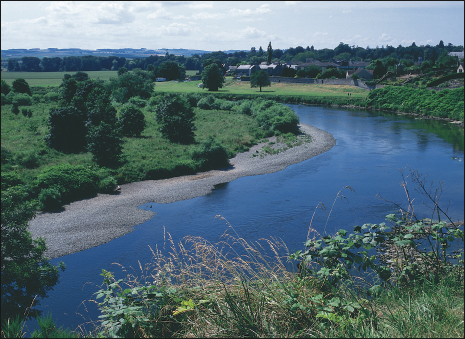
Coldstream, looking towards England. Edward I invaded Scotland in 1296, crossing the Tweed near this point, and then moved in the direction of Berwick.
The treaty with France amounted, in practice, to a Scottish declaration of war against the English. In fact a summons to the host went out to assemble on 22 March. It is important to understand the stance taken by James Stewart and his following within the Scottish political community on the eve of the Scottish wars. The Stewarts were regarded as indispensable parts of Scottish government under John Balliol’s kingship because of their power and landed influence in the west. Their role had been consolidated from the days of Alexander III and the Guardians. However, the Stewarts, in the person of James Stewart, were still not part of the inner core of central Scottish government and did not take a leading role in the negotiations for the Franco-Scottish treaty. Yet Stewart supported government actions and the stand against English interference, and he was one of the Council of Twelve chosen to direct Scottish government on behalf of John Balliol. In 1295, James Stewart was given added responsibility for the important border castle of Roxburgh. As a member of the Council of Twelve (together with his ally, Robert Wishart, Bishop of Glasgow), he undoubtedly adhered to the policy of the Scottish government if not necessarily to the Comyn-dominated leadership of that body. No doubt, Stewart and Wishart supported the words of defiance by which John Balliol (or the government acting on his behalf) formally renounced his homage to Edward I on 5 April 1296:

Berwick Castle. On 30 March 1296 the town of Berwick, then only surrounded by a ditch and timber palisade for defence, was attacked by the English army of Edward I and many people killed. Edward strengthened the town walls and Berwick became the focal point for his direct rule over Scotland after the Battle of Dunbar.
You yourself and others of your realm . . . have caused harm beyond measure to the liberties of ourselves and of our kingdom . . . for instance by summoning us outside our realm at the mere beck and call of anybody, as your whim dictated, and by harassing us unjustifiably . . . now you have come to the frontiers of our realm in warlike array, with a vast concourse of soldiers . . . to disinherit us and the inhabitants of our realm . . . we desire to assert ourselves against you, for our own defence and that of our realm, to whose defence and safekeeping we are constrained by the bond of an oath and so by the present letter we renounce the fealty and homage which we have done to you . . .
The Stewarts, and presumably their followers such as the Wallaces, were committed to war against Edward I in order to preserve their position of power in Scotland. They tied their fortunes, as did the Comyns and their associates in government, to the principles of an independent Scotland, which had been upheld by the ruling aristocracy in Scotland since the second half of the thirteenth century. It is interesting, however, that the Bruces, close family allies of the Stewarts but excluded from Scottish government, did not respond to the Scottish host – in fact, Robert Bruce the elder, the leader of the Bruces after the death of his father in 1295, and his son (the future King) testified on 25 March that they had already done homage to Edward. In the Scottish wars, the Bruces started on the English side with Robert Bruce, the elder, defending Carlisle Castle for Edward I. His son forfeited the earldom of Carrick. The Bruces were not the only noble families to swear to support Edward I: Patrick, Earl of Dunbar, and Gilbert Umphraville, Earl of Angus, also sided with Edward I when war with the Scottish government seemed probable.

Spott Burn. It was near here, in the vicinity of Dunbar, that the Scottish army suffered a major defeat at the hands of the English army on 27 April 1296 at the very beginning of the Scottish wars.
Hostilities broke out on 26 March 1296 with an attack on Bruce-controlled Carlisle by John Comyn, Earl of Buchan, six other earls of Scotland and John Comyn, the younger. James Stewart was once again not involved in front-line activities, though whether he would actually have wished to participate in an assault on family allies, the Bruces, is questionable. At about the same time, the English army was gathering around Berwick and on 30 March the town was stormed and many townsmen (by one exaggerated account, over 11,000) were butchered. In reprisal, another Scottish raiding party, based at Jedburgh (which had been under Comyn control in the early 1290s) attacked Northumberland, particularly Redesdale, Coquetdale and Tynedale. On their way back from this action they took Dunbar with the help of the Comyn Countess of Dunbar who, unlike her husband, remained loyal to the Scottish government. It was at Dunbar on 27 April that the first phase of the Scottish wars took a decisive turn when the Scottish army, trying to relieve the siege of the town by English troops, was routed and those within the castle surrendered.
Dunbar was a conclusive defeat for Scotland, though the scale of Scottish casualties – estimated at 10,000 dead by the Lanercost chronicler – is probably greatly exaggerated. Certainly only one major Scottish aristocrat, Patrick Graham, is known to have been killed and it seems that most nobles soon abandoned the conflict. It is probable that the full Scottish host were not present and that neither John Balliol nor James Stewart was involved in the battle. Indeed, James Stewart surrendered Roxburgh Castle to the English only a week after Dunbar and on 13 May swore fealty to King Edward. It seems that Stewart was seeking to distance himself from the Comyns and their allies who had clearly lost their political control over Scotland at Dunbar. By so doing, Stewart hoped to maintain his position of authority in western Scotland. His policy seemed to work for he was soon being employed by Edward I to receive the surrender of two castles within his area of influence, Kirkintilloch and Dumbarton. A marriage alliance between James Stewart and Egidia, sister of Richard Burgh, Earl of Ulster and one of Edward I’s close supporters, was, no doubt, intended to consolidate Stewart’s loyalty. According to John of Fordun, the elder Robert Bruce also approached Edward I with hope of reward for the Bruce family in Scotland, only to be rebuffed unceremoniously, ‘Have we nothing else to do but win kingdoms for thee?’ Even the Comyns, whose leading members had fled along with John Balliol to the Comyn-dominated north of Scotland, adopted a more pragmatic policy, returning south to seek favourable surrender terms from the English King.
Edward I had tried to control the Comyns and, through them, the Scottish King, who was a puppet of his relatives, the Comyns, rather than Edward I. He had shown favour to the family and their allies in Scotland when he was overlord in 1291 and 1292, and also in England. By 1293, John Comyn, heir of the senior Badenoch branch of the Comyn family, was married to Joan Valence, daughter of William, Earl of Pembroke, and cousin of the English King. By a mixture of favour and threat – Edward I made it clear to the Comyns and Balliol how much they were under his financial control – the English King hoped to use Comyn power and influence across Scotland to secure political stability as well as his own interests.

Dunbar Castle and harbour. Few medieval remains of the castle exist today, it having been ruined by Order of Parliament in 1567. William Wallace does not seem to have been present at the Battle of Dunbar, 1296, but he certainly emerged, with William Douglas among others, in the aftermath of this severe Scottish defeat and the beginning of English direct rule.
The events of 1295 and 1296 proved Edward I wrong. It also showed that he could not ride roughshod over the strong feelings of national independence held by the Scottish government without provoking a reaction. Unfortunately, Edward I did not learn this lesson immediately, partly because of the deceptive ease with which Scotland had been conquered in 1296. After key Scottish castles such as Roxburgh, Edinburgh and Stirling had surrendered soon after Dunbar, Edward I marched north through Scotland via Perth, Montrose, Banff and Elgin to impose his authority. On 8 July 1296, at Montrose, King John Balliol formally submitted to Edward, resigning his kingdom to the English King and having his coat of royal arms stripped from his tabard in a public and humiliating manner. In July and August, Edward I visited royal centres such as Aberdeen, Banff and Elgin, which had been under Comyn influence, and sent commissioners to search more remote areas in the north such as the district of Badenoch, the lordship of the senior Comyn branch. Edward also took the homages of the leading men of Scotland during his progress through Scotland. This was followed by the swearing of fealty to Edward by every freeholder.
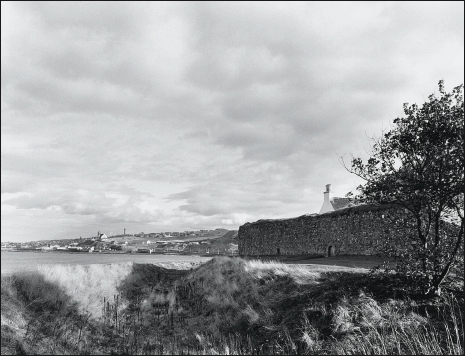
Banff, an important royal centre in northern Scotland by the late twelfth century. However, it was removed from English possession by Andrew Moray during the successful summer of Scottish resistance in 1297.
At first, after Dunbar, Edward I did seem willing to negotiate with those who exercised power and influence in Scotland. Initially, even with John Balliol, he was prepared to discuss terms. Apparently Anthony Bek and John Warenne, Earl of Surrey (Balliol had married Isabel, second daughter of Warenne in 1281), were sent with a compromise proposal – Balliol would receive an English earldom; in return Edward would be granted Scotland. Similarly, initially Edward accepted James Stewart’s early surrender in return for using him as one of his agents in Scotland. The Bruces also seemed to expect Edward I to bring them into power in Scotland. However, the expectations of both Bruces and Stewarts were soon to be dashed as Edward decided, instead of employing them in Scotland, to take charge himself. This significant toughening of stance undoubtedly influenced the roles of James Stewart and the younger Robert Bruce (the future King) in the 1297 revolt.
Edward I’s assumption of direct control of Scottish government was seen in a number of his actions. His takeover was demonstrated most clearly by his removal of the Stone of Destiny, the most precious symbol of Scottish monarchy, from Scone Abbey to Westminster Abbey. Other Scottish muniments and government records were seized. This was a direct contravention of the rights of the Scots agreed in the Treaty of Birgham in 1290, ‘the relics, charters, privileges and other muniments which concern the royal dignity and realm of Scotland shall be deposited in a secure place within the realm of Scotland’. Though Edward I no longer regarded the terms of the treaty as valid, the leaders of the Scottish political community definitely did. The removal of the Scottish King and the mainstays of Scottish government, the Comyns and their allies, to England was part of the same English policy. It should be noted that Edward I’s twenty-one-week search through Scotland was concentrated in areas that were under the influence of the Comyn family and their allies in northern Scotland. No fewer than eight members of the Comyn family were committed to detention in England. Other powerful families in Scottish government were also imprisoned in England – members of the Moray family, including Andrew Moray who was Justiciar of Scotia, members of the Mowbray, Balliol, Macdougall, Graham and Randolph families who had been mainstays of government, similarly members of the Sinclair, Lochore, Cheyne, Ros and de la Hay families who held a number of sheriffdoms. Edward I hoped to teach the Comyns and their supporters, involved in both central and local government, a harsh lesson.
The Stewarts tried to dissociate themselves from the Comyns and win English favour by an early submission to Edward I after Dunbar. The Bruces hoped they would be asked by Edward to start a Bruce dynasty and an alternative Scottish government, friendly to the English King. However, there was disappointment for both parties as Edward I refused to fill the political vacuum he had created. Instead, Edward gave responsibilities to his own officials, John Warenne, Earl of Surrey, as Lieutenant Keeper of Scotland, Hugh Cressingham as Treasurer and Walter Amersham as Chancellor. The headquarters for Edward I’s new government in Scotland was established at Berwick and the English pattern of administration was adopted with two escheators for north and south of the Forth. Edward hoped to achieve stability within Scotland by restoring lands to those who swore fealty to him and had not been involved in the war against him.
Thus far, there is no mention in historical record of William Wallace or his family and the motivations of that family can only be guessed at in the context of their lords, the Stewarts. The background factors to take into consideration in understanding William Wallace’s emergence onto the military and political stage are: the development of an increasingly mature Scottish government by the end of the thirteenth century with a clear sense of identity and a keen desire for independence; the interplay between different aristocratic power groups both within government (the dominant Comyns and their associates, and the non-Comyn grouping including the Stewarts) and outside it (chiefly the Bruces); the increasingly interventionist policy of Edward I since 1289; and finally the implementation of Edward’s policy of direct rule in Scotland after the submission of John Balliol in July 1296 and the political exile in England of the Scottish families of government that followed.
It has been seen that the Stewarts were a part of the aristocratic governing community that clearly articulated a policy of national independence in the difficult years after Alexander III’s death in 1286. They were not, however, allies of the Comyns and their associates who dominated most of the key government positions at the centre as well as in the localities. Indeed, the Stewarts had family sympathies with the Bruces and supported their claims to the Scottish kingship during the ‘Great Cause’ of 1291–2. The Stewarts supported war with England, although the exact nature of their involvement in the war efforts of 1296 is unclear. They did not, like their family allies the Bruces, side with Edward I before the outbreak of hostilities. The Stewarts were independent-minded enough within Scotland to make an early submission after English victory at Dunbar in the hope of preserving their power and influence in western Scotland under a new Scottish regime more greatly influenced by Edward I. As far as the Stewarts’ followers were concerned, it would seem natural, after James Stewart’s early swearing of fealty on 13 May 1296 and his brother John’s on 15 May, for them to do the same. That this happened is attested by Edward I’s employment of Stewart and his henchmen in receiving the surrender of the castles of Kirkintilloch and Dumbarton (the latter, of course, had formerly been in Stewart’s hands as Sheriff of Dumbarton) on about 10 June.
A list of Stewart followers in the ‘Ragman Roll’ under the date of 28 August is impressively wide-ranging. There are a number of important absences, however. William Wallace is not mentioned, and even if he was in 1296 of insufficient age or status to be named, it is certainly odd that his elder brother, Malcolm, is not referred to. The Wallace name does, however, feature on the list – Alan Wallace, Adam le Wallace, John la Wallace Fitz Thomas le Wallace, Nicol le Wallace and John la Wallace of Over Etone. Evidence from William Wallace’s seal of 1297 suggests that this Alan Wallace may have been William Wallace’s father. All those who submitted to Edward I had their lands restored to them. As for the Stewarts’ tenants and sub-tenants, on 8 September the Sheriffs of Ayr and Lanark as well as those of Berwick, Edinburgh and Roxburgh were commanded to return the lands that had been confiscated. The evidence from the ‘Ragman Roll’ suggests that the Wallaces – if not William, his elder brother (or brothers) – had had their lands seized and did not recover them. They would have had the status of outlaws. William Wallace’s sense of family grievance would have been exacerbated if, as suggested by both Andrew Wyntoun and Blind Harry, William’s father and/or an elder brother had been slain by the English. The legal record of 8 August 1296 that refers to a ‘William le Waleys, thief’ in Perth could tie in with William Wallace as a man on the run, though this may be stretching probability. A sense of injustice regarding land rather than the traditional tale referring to the capture and murder of his supposed mistress, Marion Braidfute, who is described as his wife by Blind Harry, seems to provide a more likely motivation for turning against the Sheriff of Lanark in 1297. It also seems probable, based on John of Fordun’s evidence, that William Wallace was already an outlaw before his attack on the Sheriff of Lanark.
In terms of the debate about William Wallace being an individual adventurer or merely an agent of his overlord, the Stewarts, the evidence suggests that initially, at least, Wallace was operating on his own. Wallace and his elder brother, Malcolm, did not swear fealty to Edward I in 1296. Perhaps their father’s homage was deemed sufficient. James Stewart’s decision to seek alliance with Edward I in May 1296 may have been caused by Edward’s attempt to extend English influence in western Scotland in April 1296. In this month, he appointed Alexander Macdonald of Islay as Baillie of Kintyre, an area formerly under James Stewart’s jurisdiction. Edward I’s employment of Stewart and his supporters in June 1296 and the marriage of James Stewart into the Burgh family, close followers of the King, suggested that the Stewarts would retain their influence in western Scotland with the King’s support. However, Edward I’s policy towards Scotland itself, i.e. direct rule, and therefore his attitude towards the Stewarts, changed during the summer of 1296. Edward I nominated Henry Percy as English Warden of Ayr and Galloway in September 1296. This was a real blow to Stewart power and control in the region, especially after his loss of power in Kintyre earlier in the year. By September 1296, rather later than William Wallace, the Stewarts had developed a strong motivation for revolt.
Concentration on the role of William Wallace and the Stewarts in the rebellion of 1297 has tended to distract attention from unrest in other parts of Scotland than the south-west. Indeed, it is probable that the revolt in northern Scotland involving the Moray and Macdougall families preceded the activities of William Wallace in the south. To understand why there was insurrection in both northern and southern Scotland in 1297, who spearheaded these uprisings and who supported them, it is necessary to look a little more closely at the activities of Edward I’s English administration in Scotland in 1296 and 1297.
Recent research by Fiona Watson in Under the Hammer: Edward I and Scotland 1286–1306 (East Linton, Tuckwell Press, 1998) has shed more light on the English impact on Scotland and therefore the possible causes of resentment that contributed to the revolts of 1297. It is apparent that Edward I concentrated most of his resources south of the Forth, no doubt to consolidate English authority from his new centre of administration in Scotland, Berwick. In the north, there is little evidence of how he sought to impose English authority. Presumably he thought that Scotland north of the Forth would be suitably impressed (perhaps cowed) by his royal progress around the main royal castles, burghs and baronial centres there. Following this, English garrisons appear to have been placed at Aberdeen (under Henry Lathum) and at Urquhart (under William Fitz Warin). In the north, Edward seems to have used a mixture of English officials and Scots, apparently intimidated into acting on Edward’s behalf by the imprisonment of family members in England. In the latter category was Reginald Cheyne, senior, who was Sheriff of Inverness, Euphemia, the Countess of Ross, and Gartnait, son and heir of Donald, Earl of Mar. In addition, an Englishman, Henry Rye, was appointed escheator north of the Forth with custody of the royal castles of Elgin and Forres. Following Scottish administrative practice, another official, a justiciar of Scotland north of the Forth, was appointed – once again an Englishman, William Mortimer.
Rather more evidence exists for a more thoroughly English administrative system south of the Forth. As well as Edward’s triumvirate of chief officials – John Warenne, Earl of Surrey (Lieutenant), Walter Amersham (Chancellor) and Hugh Cressingham (Treasurer) – that was based in southern Scotland, there was a Justiciar of Lothian (William of Ormesby) and a Justiciar of Galloway (Roger Skoter), an escheator south of the Forth (Peter Dunwich) and, after 8 September 1296, the Warden of Ayr and Galloway (Henry Percy). In addition, most of the new sheriffs in Scotland after 1296 would have lacked any connection with the local community or, indeed, Scotland in general and were probably unable to speak the local language. In the south-west of Scotland, for instance, it is unlikely that the new officials could communicate in Gaelic, as the Stewarts, Bruces and Wallaces probably could, and this would have reinforced the feeling that the area had been taken over in a hostile manner.
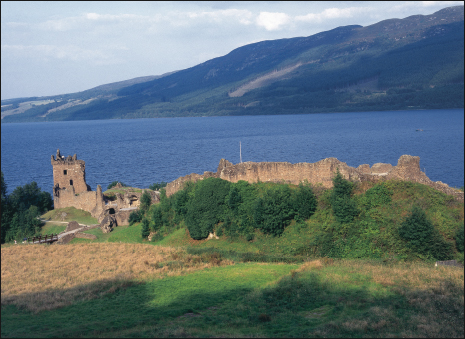
Castle Urquhart. Situated on Strone Point on the western shore of Loch Ness, Urquhart controlled the strategic route along the Great Glen to Inverness. It was, therefore, a terrific boost to Scottish resistance when Andrew Moray recaptured this English-held castle in 1297.
What was the impact of these English office-holders on Scottish communities? Certainly the attitudes of some of the more senior people must have caused resentment. Even the English chronicler, Walter of Guisborough, referred to Hugh Cressingham as ‘a self-important and proud man who loved money’. The collection of funds from the native population had been a feature of Edward’s policy in Ireland and Wales and the apparent lack of Scottish military resistance to English forces in 1296 may well have given Edward and his officials the impression that there would be relatively little resistance to financial exactions. Initially, a large sum, over £5,000, was raised and Walter of Guisborough’s description of Cressingham as a man ‘who robbed too much’ seemed justifiable. The fact that by late July 1297, this flow of money had practically stopped is surely a sign of general Scottish resistance to these demands. Cressingham wrote to Edward in late July that ‘no county is in proper order excepting Berwick and Roxburgh’, and slightly later,
. . . from the time when I left you, not a penny could be raised in your realm by any means until my lord the earl of Warenne shall enter your land and compel the people of your country by force and sentences of law . . .
According to the Guisborough Chronicle, persecution of those who did not swear fealty to Edward I was a particular fault of the Justiciar William Ormesby and another cause of resentment. The threat of military service overseas, on the part of ‘all the middle people of Scotland’, was a concern expressed during the surrender negotiations after one of the revolts in the south-west was halted. Such a fear would have affected most classes from the nobles, who might have to supply personal knight service, to the non-noble foot soldiers, who had sometimes been conscripted for campaigns from Ireland and especially Wales as well as from the English counties. There is no real proof that this was what Edward I intended, though there is evidence that fifty-seven Scottish nobles were summoned on 24 May 1297 to serve Edward I in Flanders. In addition, the compulsory seizure of wool, one of the chief economic assets of Scotland, must have been another source of both indignation and apprehension (of where the next appropriation or enforced sale would be). It is known that such confiscations took place at both Melrose Abbey and Sweetheart Abbey.
There has been a natural tendency to focus on what the Scots were fighting against in 1297 rather than what they were fighting for and to give more attention to revolt in the south than the north. Yet rebellion in Scotland in 1297 probably started earlier in the north and involved two families who had something to fight for as well as against. The Macdougalls and the Morays had been stalwarts of Scottish government and in 1296 that regime’s figurehead was John Balliol. Both Macdougalls and Morays were related to the Comyns, the power behind the Scottish King (who was, of course, also related to the Comyns). Macdougalls and Morays had enjoyed the power that went with holding public office and it was unlikely that they would willingly consent to losing this. Macdougall control in the north-west was seriously threatened by Edward I’s appointment of Alexander Macdonald of Islay in April 1296 as Baillie in the sheriffdoms of Lorn, Ross and the Isles. Edward I presumably thought that with Alexander Macdougall of Argyll having done homage to him and being a prisoner in Berwick Castle the rest of the Macdougall family would cause him no problems. However, Alexander’s son, Duncan, who had never sworn loyalty to Edward I, led the Macdougall resistance to Macdonald’s attempt to control ‘their’ area using the strategic castle of their Comyn allies at Inverlochy to aid their fight.
Even more important in the insurrections of 1297, however, were the Morays, another of Scotland’s ‘government’ families. A successful revolt in northern Scotland was led by Andrew Moray, son of Andrew Moray of Petty who had been Justiciar of Scotia during the Balliol kingship (to 1296) and deemed important enough to be imprisoned in the Tower of London. The younger Andrew had himself been imprisoned at Chester but had escaped to lead an impressively effective campaign against English bases across northern Scotland. The efforts of both Morays and Macdougalls in 1297 could both be seen as motivated by patriotism and self-interest. They were representatives of John Balliol’s government and were seeking to defend their privileged positions within it. They also symbolised a resistance to Edward I’s infringements of the rights of the kingdom and a defence of the principles encapsulated in the Treaty of Birgham (1290), ‘the rights, laws, liberties and customs of the same realms of Scotland to be preserved in every respect and in all time coming throughout the said realm and its borders completely and without being impaired . . .’. Such ideas epitomised the feelings of those families involved in the governing of Scotland in 1296 and the views of the same families who were able, in 1297, to translate theory into military action.
The young Andrew Moray soon recaptured the English-held castles in the north, including Inverness, Urquhart, Banff, Elgin and Aberdeen between May and mid-July 1297. This area had been very much under Comyn influence and it is worth noting the family relationship by marriage between the Morays and the Comyns. Both Morays and Macdougalls were part of the Comyn patronage system. Evidence from letters to Edward I from northern Scotland indicate that Andrew Moray soon acquired popular support in the region. He had ‘a very large body of rogues’ and this army of foot soldiers fought ‘guerrilla-type’ warfare as ‘they betook themselves into a very great strong-hold of bog and wood, where no horsemen could be of service’.

Elgin Cathedral. Andrew Moray recaptured a series of English-held castles in northern Scotland during the summer of 1297. These included Urquhart, Banff, Elgin and Aberdeen. Elgin Cathedral, regarded as one of the most beautiful Scottish cathedrals, was founded in 1224 as the seat of the bishopric of Moray. Much of the structure dates from the thirteenth century.
Rather more attention has been paid to the rebellion in the south of Scotland, which involved two apparently separate risings. One was led by James Stewart, Bishop Wishart and Robert Bruce, and is generally seen as an aristocratic revolt, and the other was organised by William Wallace, and is usually viewed as a ‘spontaneous act of middling and common folk’(A.A.M. Duncan, ‘The Community of the Realm of Scotland and Robert Bruce’, Scottish Historical Review XLV [1966]). Too much contrast has been made between the ‘official’ revolt of Bishop Wishart and James Stewart (who were joined by the young Robert Bruce) and the ‘popular’ revolt of William Wallace. The Lanercost chronicler thought that the rising was planned and instigated by Wishart and Stewart who
. . . caused a certain bloody man, William Wallace, who had formerly been a chief of brigands in Scotland to revolt against the king and assemble the people in revolt . . .
It seems, however, that Wallace’s rebellion had already started by early May at the latest. The active involvement of Wishart and Stewart may have been provoked by Edward I’s demand for over fifty Scottish nobles to give military service overseas in his campaign in Flanders. This summons was issued on 24 May and it is unlikely that they came out in open revolt before then.
William Wallace’s first action on historical record, as has been mentioned, was the assault and murder of the English Sheriff of Lanark, William Heselrigg. The Sheriff was apparently at Lanark holding a local court at the time of the attack. Most information about the incident comes from the fourteenth-century Scalacronica of Thomas Gray, whose father was an eyewitness to events.
The said William Wallace came by night upon the said sheriff and surprised him, when Thomas de Gray [father of the chronicler] who was at that time in the suite of the said sheriff, was left stripped for dead in the mellay when the English were defending themselves. The said Thomas lay all night naked between two burning houses which the Scots had set on fire, whereof the heat kept life in him, until he was recognised at daybreak and carried off by William of Lundy, who caused him to be restored to health.

Monkton church, Ayrshire. This is where a priest, according to Blind Harry’s narrative, interpreted a dream that Wallace had had – Wallace received confirmation that he should fight for Scotland and that he had Church support.
It is probable that this attack was motivated by something personal to Wallace and that he was already an outlaw by this time. As Sheriff, Heselrigg had responsibility for the organisation of fealty-taking to Edward I as well as property matters in his area and it may have been, as argued in Chapter 2, that Wallace’s grievance was a family one relating to swearing fealty and/or the confiscation of property. As the Guisborough chronicler points out, there was persecution by some English officials of those who did not wish to pledge their allegiance to the King of England. While in the Lanercost Chronicle William Wallace is referred to as a ‘certain bloody man . . . who had formerly been chief of brigands in Scotland’, Walter of Guisborough’s earliest reference to Wallace is as ‘a vagrant fugitive’ who ‘called all the exiles to himself and made himself almost their prince: they grew to be numerous’. Thus, at first, it seems that William Wallace was an independent adventurer, motivated by the persecution of his family by the English.
Clearly, however, William Wallace was not the only one with a complaint against the English. An early associate of Wallace’s, according to Walter of Guisborough, was William Douglas who had been in command of Berwick Castle in 1296 and had to surrender it to the English. Douglas had a reputation as a troublemaker to both the Guardians and Edward I. He was known to Edward I for his rash actions in abducting and marrying by force an English widow, Eleanor Ferrers, who was staying with relatives in Scotland. However, after his surrender at Berwick:
When the king had restored everything to him he became unmindful of these good deeds and turned robber working with a robber . . . the two Williams with perverse people thought they could find the justiciar of the king at Scone, where he had heard pleas, and they hastened to destroy him. But he was forewarned and escaped with difficulty, leaving to the enemy many spoils.
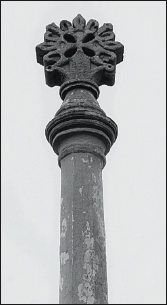
Scone Cross. Scone played a prominent part in the early years of the Scottish wars. It was important symbolically as the King of Scots was traditionally crowned at Scone Abbey where the Stone of Destiny was kept. Thus the raid of William Wallace and William Douglas on William Ormesby, the Justiciar and therefore one of Edward I’s most important officials, while he was holding court there, was a very significant development.
It is unlikely that the attack on the Justiciar William Ormesby was a random attack. It is Walter of Guisborough again who notes that Ormesby was a particularly intense prosecutor of ‘all those who did not wish to swear fealty to the king of England without making distinction of person’. The Douglas family were related to the Stewarts by marriage and also to the Morays. William Douglas, before his infamous abduction of Eleanor Ferrers, was married to James Stewart’s sister, Elizabeth. This common association with the Stewarts gives further backing to the assertion by the Lanercost and Guisborough chroniclers that James Stewart was one of the ‘authors of the whole evil’ (Guisborough Chronicle).

Loudoun Hill. This area was, in fact, the location of a skirmish fought by Robert Bruce in June 1307. Blind Harry transferred the episode to William Wallace’s career and made it the place where Wallace gained revenge for the death of his father.
It seems that Stewart secretly backed the risings of Wallace and Douglas before coming out openly against Edward I in about July 1297. According to Walter of Guisborough, Wallace, while at Perth, received messengers ‘in great haste on behalf of certain magnates of the kingdom of Scotland’, probably Stewart and Wishart. In this escalation of his resistance, Stewart was joined in alliance again with Bishop Robert Wishart of Glasgow, who had a distinguished record of outspoken opposition to Edward I’s interventionist approach. The involvement of Stewart and Bishop Wishart, who had acted as Guardians and had played active roles in the government of John Balliol, certainly gave their military endeavours an ‘official’ character. Contemporary chroniclers, as well as later historians, have tended to pay more attention to this revolt because of two of the participants’ seniority within the Scottish ruling hierarchy. As has been seen, Stewart had been threatened in his attempt to stay in public office and retain political power in western Scotland under Edward I. Now, Stewart and Wishart, it is clear from the negotiation terms following their ignominious surrender at Irvine in early July 1297, regarded themselves as leaders and representatives of the ‘whole community of the realm of Scotland’ (from the Treaty at Irvine) and John Balliol’s kingship.
An interesting twist to this so-called ‘aristocratic revolt’ – Andrew Moray and William Douglas were also noblemen – was the involvement of the young Robert Bruce, Earl of Carrick, and future King, as one of the leaders alongside Stewart and Wishart. Robert Bruce had been exiled with his father by the Comyn/Balliol government – his father had not sworn fealty to Balliol and they had both been on Edward’s side at the outbreak of war in 1296. The fact that Edward I showed no inclination to reward the Bruces after Dunbar with either the kingship of Scotland or even political power in Scotland may have persuaded the younger Bruce to join in the 1297 revolt after it had started. The Guisborough chronicler believes that Bruce was already aiming at the throne. It seems more probable, however, that he was, as a first step, trying to use his military power as a Scottish earl and his family friendship with the Stewarts and Wisharts to establish himself as one of the chief leaders of the Scottish political community in the absence of his Scottish rivals, the Comyns and John Balliol.
Despite the ease of the English victory over Wishart, Stewart and Bruce at Irvine, rebellion in Scotland was beginning to trouble Edward I. The surrender negotiations lasted for some time and it may have been that there was a deliberate attempt by the three leaders to procrastinate and draw attention away from revolts elsewhere in Scotland. Meanwhile, Edward I who was generally, in 1297, more concerned with his expedition to Flanders, sought to use the Comyns and their associates in government in late June 1297 (duly chastened, he hoped, by their defeat, political exile and imprisonment in England in 1296–7) to restore order in Scotland. The role of the Comyns was vital given their dominance over central and local government in Scotland prior to 1296. In the north, John Comyn, Earl of Buchan, and his brother, Alexander, were sent to help Henry Cheyne, Bishop of Aberdeen, the Countess of Ross and Gartnait, son of the Earl of Mar, to control the rebellion of Andrew Moray. John Comyn of Badenoch was commanded by Edward I to assist Brian Fitz Alan, the new custodian of the kingdom, in the south. Alexander Macdougall had been released from prison at Berwick on 24 May 1297, a month earlier than the Comyns, to help dissuade his son from continuing his revolt in the north-west. The news from Hugh Cressingham in late July and early August 1297 cast doubt on either the ability or the willingness of the Comyns to promote Edward I’s interests in Scotland (in a letter of 5 August 1297 to Edward I):
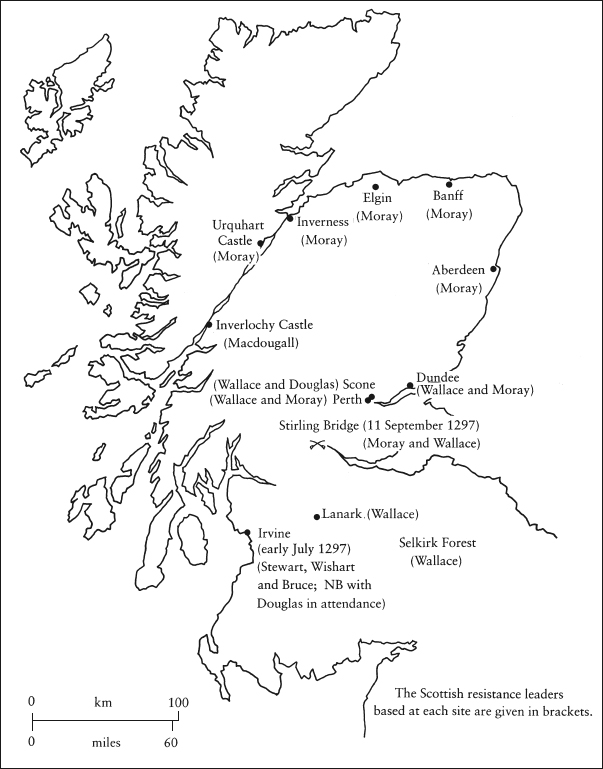
Scottish resistance in 1297 before the Battle of Stirling Bridge, 11 September 1297.
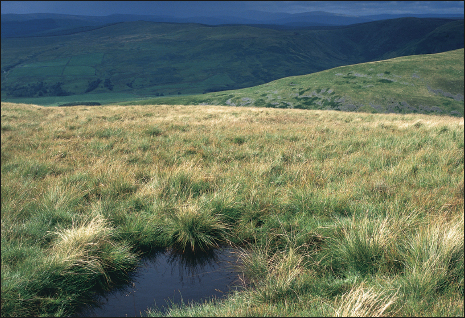
Ettrick Forest, above Moffatt, the base for William Wallace’s military efforts both before and after the Battle of Stirling Bridge. In areas such as these, the historical William Wallace and the ‘Scottish Robin Hood’ tradition of the fifteenth century come more closely together.
. . . in some counties the Scotch have established and placed bailiffs and ministers so that no county is in proper order excepting Berwick and Roxburgh . . . the peace on the other side of the Scottish sea is still in obscurity, as it is said, as to the doings of the earls [the Comyns are meant here] who are there . . .
According to the Guisborough Chronicle, John Comyn, Earl of Buchan, ‘at first pretended to repress rebellion, but in the end changed sides and became a thorn in our flesh’. The Comyns did not come out openly in support of revolt and resume their leadership role within Scotland – the presence of John Comyn, the younger, of Badenoch, heir of the senior branch of the family, in Edward I’s army in Flanders may have dissuaded the Comyns from an open stance. However, the ability of the Scots to establish their own officers and the ability of Moray to gather a large infantry unit in the Comyn-dominated north and make his way to join Wallace’s forces in the south strongly suggests collusion with the Comyns. Moray and his forces had military control as far south as Perth and were preparing to meet up with Wallace’s troops. Meanwhile, Wallace took advantage of the delays after the Irvine capitulation to gather a large company in the forest of Selkirk ‘like one who holds himself against your peace’ (letter from Hugh Cressingham to Edward I, 23 July 1297).
In the context of lackadaisical English command in Scotland and, it seems, wide-scale sabotage of the English administration in the country, Wallace’s following grew in number and strength. According to the Guisborough Chronicle:
. . . that bandit Wallace gathered the people to him . . . By now, indeed, he had raised an immense army, for all the common folk of the land followed him as their general and prince. All the retainers and tenants of the nobleman also came in to him, and though the nobles themselves were with our king in body, yet their hearts had long been with their own people . . .
Wallace’s forces, having replenished and equipped themselves at Bishop Wishart’s manor at Ancrum, moved north from Selkirk Forest to meet Andrew Moray’s unit near Perth. The combined strength of Wallace and Moray was great enough to besiege Dundee.

Howe of Mearns. It is known that William Wallace and William Douglas were at Scone, but Blind Harry’s narrative has Wallace proceeding afterwards north through the Mearns.
In early September, however, the delayed English reaction at last happened – as late as 26 September 1297, the English still believed that John Comyn, Earl of Buchan, remained loyal. Revolt in Scotland had escalated and sparked off an increasingly violent general rising between Forth and Tay, backed in this area by Macduff, son of the Earl of Fife. News of the increasingly racial attacks on the English in Scotland, including clerics, were related to the monks at Guisborough, apparently by an eyewitness:
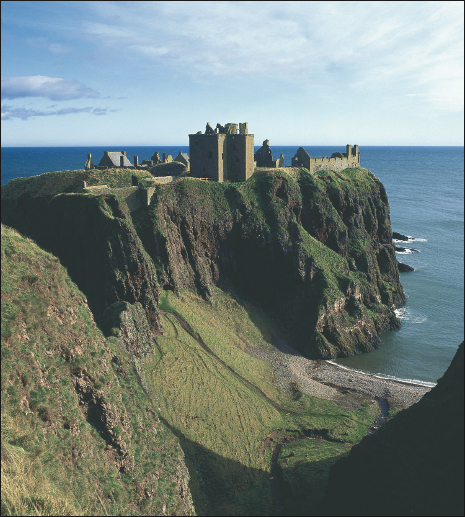
Dunnotar Castle. There is no historical record of Wallace laying siege to any castle north of Dundee, though Blind Harry’s account has Wallace – it was, more probably, Andrew Moray – besieging and capturing Dunnotar Castle. This castle, taken by Edward I in 1296, has spectacular natural defences. No part of the present structure is earlier than the late fourteenth-century keep.
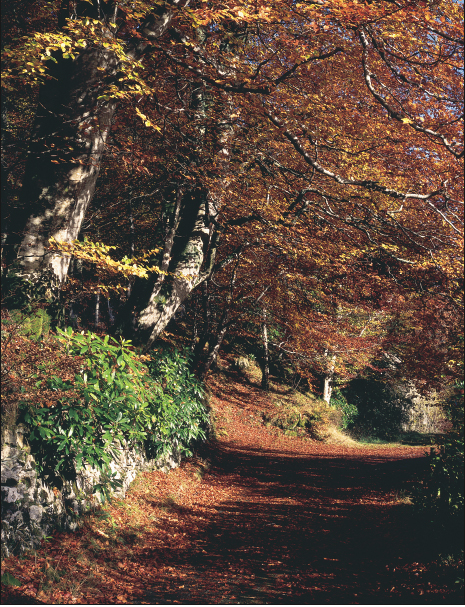
Strathfillan. Blind Harry’s description of Wallace’s campaigns north of Glasgow through Strathfillan to Loch Dochart is rather reminiscent of Robert Bruce’s campaigns in this area in 1307.
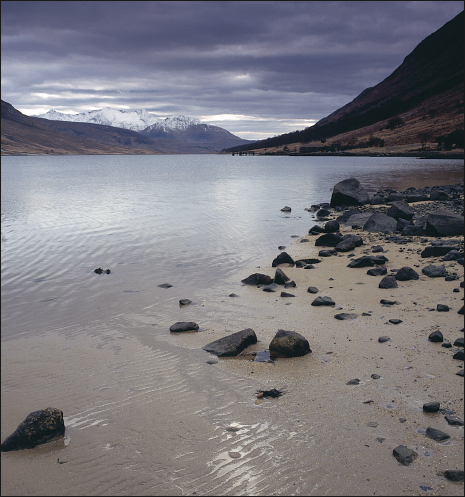
Loch Etive. Blind Harry says that Wallace spent some time on the north shore of this loch.
They even dragged English monks violently from monasteries . . . and made a sport and spectacle of them . . . Among their victims were two English canons of St. Andrews, who were carried to the bridge at Perth . . . they stood there, being subjected to a kind of mock-trial before that bandit Wallace and expecting death at any moment . . . three Englishmen who had been given a house at St. Andrews . . . fled from Wallace and his men and ran to the sacred stone called St. Andrew’s Needle, believing that they would be protected by the sanctuary of Holy Church: but the Scots pursued them, and cut them down at that very stone . . .
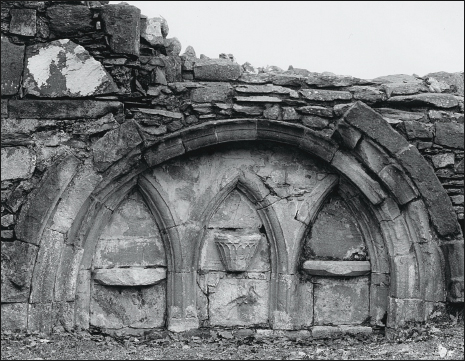
Ardchattan Priory, on the north side of Loch Etive. According to Blind Harry, Wallace held a council here but there is no historical evidence for this. It may be another example of the poet taking episodes from Robert Bruce’s campaigns and adding them to Wallace’s record.
Such incidents were, perhaps, necessary to provoke a reaction from the slothful, indecisive English commanders in Scotland.