
6
Between the battles at Stirling Bridge and Falkirk William Wallace occupied a central role on the military and political stage and, therefore, in historical record. The period after Falkirk saw Wallace apparently revert to being a peripheral figure. Yet so significant was Wallace’s position between 11 September 1297 and 22 July 1298 that, despite few references to him in the sources for the time after Falkirk up to his capture and execution in 1305, he still exerted a powerful influence on both Scottish and English operations in the continuing war.
Wallace lost political power after Falkirk as controversially as he had gained it after Stirling Bridge. It is not clear whether he resigned the office of Guardian or was asked to relinquish it. Fordun blames the treachery of the Comyns at Falkirk for Wallace’s voluntary renunciation of his office:
William Wallace, seeing by these and other strong pieces of evidence, the obvious wickedness of the Comyns and those who were in league with them, chose rather to serve with the crowd, than to be set over them, to their ruin, and the grievous wasting of the people. So, not long after the Battle of Falkirk, at the water of Forth, he, of his own accord, resigned the office and charge which he held, of the Guardian . . .
The strength of the condemnation, of course, reflects the need of nationalist narratives of the fourteenth century to condemn the Comyns specifically as rivals and enemies of their heroes, William Wallace and Robert Bruce. The Lanercost Chronicle blames the inadequacy of the Scottish cavalry in general rather than the military role of the Comyns in particular: ‘all the Scottish cavalry being quickly put to flight’. The accusation of perfidy sits slightly strangely with the Comyns long-held support both of the customs and liberties of Scotland and John Balliol’s kingship (to which William Wallace also keenly adhered). It is also at odds with John of Fordun’s own statements that the ruling class accepted John Comyn, the younger, as Guardian of Scotland ‘in the same year’ as Wallace’s resignation ‘not long after’ Falkirk. Wallace’s political leadership of Scotland, his martial Guardianship, could only last as long as he was militarily successful. It is probable, therefore, that he was forced to give up the Guardianship shortly after Falkirk as John Comyn, the younger, and Robert Bruce, Earl of Carrick (and future King), were officially designated joint Guardians by December 1298, in an attempt to establish a new Scottish government of national unity.

Selkirk above St Mary’s Loch. This area was often used as a refuge and base in Wallace’s ‘career’ as a fugitive.

Loch Dochart.
ROBERT BRUCE
History is written by the winners rather than the losers. Thus Robert Bruce became the hero of fourteenth- and fifteenth-century Scottish nationalist writers such as John of Fordun, Andrew Wyntoun, Walter Bower and John Barbour. It should be remembered, however, that Robert Bruce’s elevation to national hero came after he had defeated Scottish opposition to his 1306 ‘coup’ and had assumed the Scottish kingship. Bruce’s standing was secure in Scotland, at least, by 1309 but it was not until his victory over Edward II at the Battle of Bannockburn in 1314 that his position as King of Scotland was truly safe. Fourteenth- and fifteenth-century writers regarded the Battle of Bannockburn as a fitting climax of a just, indeed a holy, war, as expressed by John of Fordun in The Chronicle of the Scots Nation (c. 1380):

Robert Bruce’s Grave, Dunfermline Abbey. During alterations to the church in 1819, Bruce’s remains were found wrapped in a cloth-of-gold shroud. The report of the find noted that the skeleton was of a man between 5 ft 11 in and 6 ft tall.
But God in His mercy, as is the wont of His fatherly goodness, had compassion . . .; so He raised up a saviour and champion unto them . . . Robert Bruce. The man . . . putting forth his hand unto force, underwent the countless and unbearable toils of the heat of the day . . . for the sake of freeing his brethren . . .

Bruce’s heart stone, Melrose Abbey. Robert Bruce made a deathbed wish for his heart to be buried at the abbey after it was taken on Crusade by James Douglas. It lay buried there until discovered by archaeologists in the 1920s. It was re-found in 1996 (the burial spot was not indicated in the 1920s) and returned in 1998 with the present stone marking the heart’s re-burial for the third time in its history.
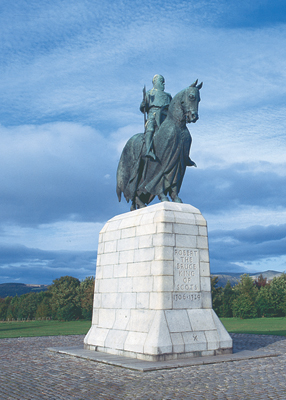
The Robert Bruce Statue, Bannockburn. The Pilkington Jackson bronze monument, modelled on the equestrian representation on the King’s Second Great Seal, was unveiled by HM Queen Elizabeth II on 24 June 1964 to celebrate the 650th anniversary of the Battle of Bannockburn.
Yet in the context of William Wallace, Bruce’s achievement and his status as a winner came after Wallace’s death in 1305. Robert Bruce was twenty-two years old in 1297 when William Wallace emerged ‘from his den’ and his actions between 1297 and 1305 show uncertainty about how to achieve his family’s dynastic ambitions in Scotland. This contrasts with William Wallace’s undaunted and single-minded approach in these years – Bruce’s boldness and certainty would come in 1306.
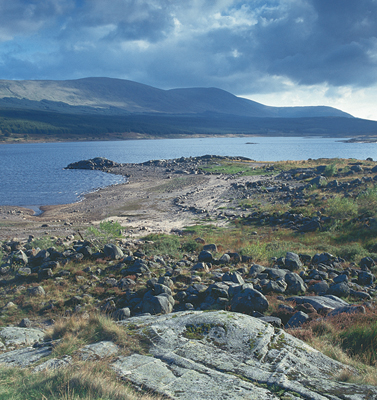
The site of Castle Doon, Loch Doon. The Bruce earldom of Carrick had Turnberry Castle, Ayrshire, as its headquarters. The castle at Loch Doon also had great strategic significance and, until damming in the 1950s, it could be seen on an island in the loch.
That William Wallace left the highest office in Scotland in anger is reflected in an English spy’s report (see J. Bain [ed.], Calendar of Documents Relating to Scotland, II, no. 1978 [Edinburgh, 1881]) of an argument that broke out at the baronial council in Peebles in August 1299:
At the council sir David Graham demanded the lands and goods of sir William Wallace because he was leaving the kingdom without the leave or approval of the guardians. And sir Malcolm, sir William’s brother, answered that neither his lands nor his goods should be given away, for they were protected by the peace in which Wallace had left the kingdom, since he was leaving to work for the good of the country . . .
It seems that, after the Battle of Falkirk, Wallace was once more out of sympathy with the traditional aristocratic leadership but, just as importantly, they no longer had an affinity with him. Present at the council meeting were Malcolm Wallace, William’s brother – described by the spy as ‘of the earl of Carrick’s following’, William Lamberton, Bishop of St Andrews, and James Stewart, who tried to act as mediator. A year after Falkirk, William Wallace was, clearly, still a cause of much bitterness in Scottish political circles. While his brother was in Bruce’s following, it was unlikely that William Wallace, with his strong defence of John Balliol’s kingship, would be anything other than suspicious of the motives of Robert Bruce, who was in the unlikely position of acting in 1298 and 1299 on behalf of Balliol. James Stewart’s actions in 1299, too, appear not to be those of a firm supporter of William Wallace’s cause. It is hardly surprising, given the nature of the new government in Scotland, that William Wallace, as he had done in the past, acted in 1298 independently ‘without the leave or approval of the guardians’. The impression given by the account of the 1299 council is that the political community, having been bullied by his uncompromising manner into supporting his military leadership, was taking the opportunity of putting Wallace in his proper place. Wallace would not serve under their terms. John of Fordun may have been correct in his comment that Wallace ‘chose rather to serve with the crowd’.
The reality of hard political in-fighting in Scotland after Falkirk should be set against the rather charged nationalist writings of Walter Bower and Blind Harry in the fifteenth century. To them Wallace’s main legacy after Falkirk was the kindling of a true vocation of nationalism in Robert Bruce, the future King. Bower was not content simply to repeat Fordun’s inaccurate report that Robert Bruce (mistaken in probability for his father) played a significant role in the English victory at Falkirk. Instead, he told an elaborate story linking Wallace and Bruce with a mutually held cause:
Pursuing them [Wallace and his men] from the other side, Robert de Bruce . . . is said to have called out loudly to William, asking him who it was that drove him to such arrogance as to seek so rashly to fight in opposition to the exalted power of the king of England and the more powerful section of Scotland. It is said that William replied like this to him: ‘Robert, Robert, it is your inactivity and womanish cowardice that spur me to set authority free in your native land . . .’
On account of all of this Robert himself was like one awakening from a deep sleep, the power of Wallace’s words so entered his heart that he no longer had any thought of favouring the views of the English. Hence, as he became every day braver than he had been, he kept all these words uttered by his faithful friend, considering them in his heart . . .
This powerful picture, which supports the traditional view that Robert Bruce took over the leadership of the national cause after Wallace’s capture and execution in 1305, is far from the reality of 1298. Robert Bruce, the younger, if not at Falkirk in 1298, was certainly on the Scottish side at the time – shortly after Falkirk he seems to have been at Ayr setting fire to the castle in order to prevent its use by the English. In 1298 Wallace and Bruce probably regarded each other with mutual suspicion. At this time Bruce was just breaking into the political elite in Scotland, and his opinion of Wallace was likely to have been shared by other aristocratic families. Wallace must have been aware that the Scottish ‘cause’ that he was fighting for, i.e. Scottish independence under King John Balliol, was at odds with the Bruces’ ambition to found their own dynasty. Robert Bruce, the future King, started the war of 1296 on the English side opposing a Scottish government trying to uphold John Balliol’s kingship and Scottish independence. Despite the apparent confluence of interests in 1297 and 1298 when the young Robert Bruce came over to the ‘patriot’ side, the actions of Robert Bruce between 1298 and 1305 do not support Bower’s story that Bruce became a true patriot in Wallace’s image after 1298.
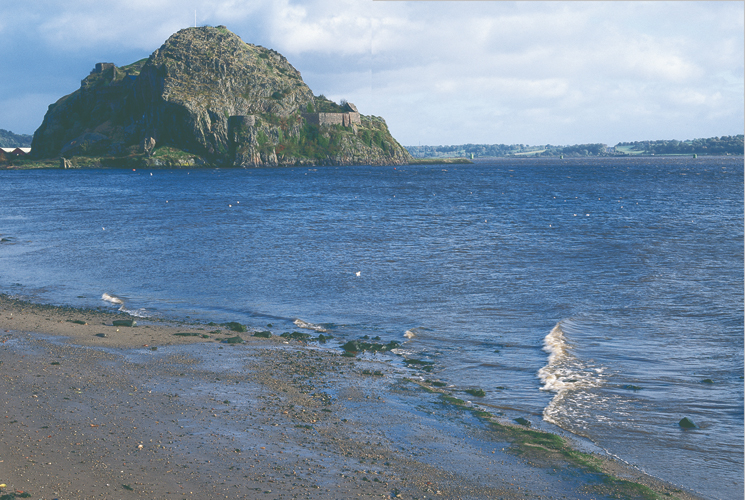
Dumbarton Castle, a naturally strong site similar in origin to the great rocks at the castles of Edinburgh and Stirling. Dumbarton rises dramatically from the north shore of the Clyde as it meets the River Leven, where Wallace was held after his capture. Most of the medieval stronghold has been destroyed by later fortifications, though some sections of the medieval curtain wall and the portcullis arch remain.
It seems that William Wallace left Scotland without the leave or approval of the Guardians (both Bruce and Comyn) to assist in the diplomatic negotiations in France and at the papacy on behalf of Scotland. As a military man, he had observed the weaknesses of the Scottish in the face of the English cavalry, and would, no doubt, have been looking for French military help as part of the Scots-French alliance of 1295. In addition, he would, of course, have been interested in pursuing all avenues to secure the release of King John Balliol. It is not known when Wallace left Scotland, although he was present at the French court by November 1299. It is unlikely that he left Scotland before being briefed by William Lamberton, who owed his elevation to the bishopric of St Andrews to Wallace. Lamberton was consecrated in Rome on 1 June 1298, before joining fellow Scots at the French court. It should be remembered that Lamberton’s predecessor, William Fraser, had died in France in 1297, no doubt, also, on an ambassadorial mission. Scottish representatives at the French court, in 1298, seem to have included Bishop Matthew Crambeth of Dunkeld, John Soules and the Abbot of Melrose. This Scottish diplomatic endeavour seems to have had some success judging by the letters of Philip IV, King of France, and Pope Boniface VIII, in June and July 1298, to Edward I demanding the liberation of John Balliol. Although this request was at first refused, Balliol was released into papal custody in July 1299. The Pope also wrote to Edward I urging the English King to abandon the war in Scotland. Boniface claimed that
. . . from ancient times the realm of Scotland belonged rightfully, and is known still to belong to the Roman church . . . you are known to have safeguarded the interests of the nobles . . . by writing [in the Treaty of Birgham, 1290] that the realm should remain for ever entirely free, and subject, or submitted to nobody.
Scotland was constantly strengthening its diplomatic mission in France, the Abbot of Jedburgh and John Wishart being warmly received in April 1299. Discussion of the nature of French aid to the Scottish cause was clearly at the heart of the negotiations which Lamberton had been leading on behalf of the Scottish mission. Apparently Lamberton had unsuccessfully proposed to Philip IV that the French King’s brother, Charles of Valois, should be sent to Scotland with an army. It seems probable that Lamberton would have briefed Wallace thoroughly on these matters when he returned to Scotland, which he had done by August 1299. Given Wallace’s expertise in martial affairs, it would have seemed perfectly natural for him to volunteer his services to press the French King further on the military needs of France’s ally, Scotland. Wallace had left for France by 19 August (the date of the baronial council in Peebles where discussion of Wallace’s lands led to an ugly brawl between Comyn and Bruce supporters) and in early August did not take part with the rest of the Scottish leaders in an extensive raid across Scotland, south of the Forth. By November 1299, Wallace and a small group of associates (Roger Mowbray, William Vieuxpont, Richard Fraser, Edmund Leilholm and Hugh Fotheringay) were at the French court in Paris. All had links with the Balliol cause and it seems that they were formally representing Balliol interests to the French King – perhaps suggesting the restoration of Balliol to Scotland. The fact that they were receiving loans and payments from Philip IV in November 1299 implies that Wallace’s party were warmly welcomed at the French court.
English sources give a rather less glowing account of Wallace’s reception in France. The Rishanger Chronicle records that William Wallace and five knights were seized by the King of France on arrival in Amiens; the King of France subsequently offered to deliver Wallace to King Edward. Such an action, if correctly reported, would only have been feasible during a temporary truce between England and France. This, perhaps, could have occurred during the summer of 1299 following the conclusion of the marriage agreement between Philip IV’s sister, Margaret, and Edward. Edward’s reply to Philip’s offer, according to Rishanger, was to ask the French King to hold Wallace in his care in France. This rather puzzling piece of evidence suggests that Edward I no longer felt that Wallace was a threat to him – it would not, of course, be the first time that he underestimated Scottish ‘patriot’ resistance. By November 1300, the date of the next known reference to William Wallace in France, it is clear that Wallace was well regarded at the French court (after a stay of one year). At this time, Philip IV wrote a letter of recommendation, on Wallace’s behalf, to his (French) agents in Rome asking them to help ‘our beloved William le Walloys of Scotland knight’ in his diplomatic business with the Pope. Fifteenth-century Scottish nationalist writings have elaborated considerably on Wallace’s adventures in France. According to a later version of Walter Bower’s chronicle, Wallace impressed his hosts by fighting French pirates and English invaders in France. Blind Harry develops the same tradition in his own inimitable way, detailing Wallace’s struggles not only with the French pirate known as the ‘Red Rover’ but also an angry French lion!

The Robroyston Monument. This cross was erected to commemorate the capture of William Wallace at Robroyston. It was unveiled in 1900.

The plaque on the Robroyston Monument gives details of William Wallace’s capture.
There are no specific contemporary details about his business at the papal court but it is apparent that Wallace, self-appointed or otherwise, played a key role in putting diplomatic pressure on both the French and papal courts to secure both military aid and the restoration of John Balliol to Scotland. With Balliol’s release into the custody of the papacy in July 1299, it was an obvious next step for Wallace to move from the French to the papal court to secure the freedom of John Balliol and counter the diplomatic efforts of the English. Wallace, of course, cannot be given all or even the major credit for the success of the Scottish pleas at the papal court during this period. Master Baldred Bissett probably deserves the most acclaim for the revival of John Balliol’s fortunes there. Balliol’s reinstatement as King of Scotland seemed a growing possibility in 1301. In the summer of that year he was released from papal custody and, no doubt, with Philip IV’s support was returned to his ancestral home at Bailleul-en-Vimeu, in Picardy. The Truce of Asnières, negotiated in France and ratified by King Philip, granted a truce to the Scots in the war with England to last from 26 January to 1 November 1302 but there was no agreement about the future of John Balliol. According to this settlement, the French were to hold certain lands in the south-west of Scotland during the truce.
These developments on the continent had a significant impact on the leadership of the Scottish political community. The years 1298 to 1304 saw many changes in the composition of the Guardianship, the presence of the Comyns being the one constant factor, simply due to their dominant landowning and political power and their network of allies and castles. The tense joint leadership of John Comyn and Robert Bruce in 1298 gave way to a triumvirate in which Bishop Lamberton acted as a stabilising influence. By May 1300, however, Robert Bruce had resigned to be replaced by the pro-Comyn, Ingram Umphraville. This new triumvirate lasted until early 1301 when they were, apparently, superseded by John Soules, appointed by John Balliol directly as his agent in Scotland, pending his return. A number of official documents issued between 10 July 1301 and 23 November 1302 refer either to John Soules acting in the name of (not on behalf of) King John or are royal acts issued by King John himself. There is no doubting his special role in Scotland from 1301 but it is probable that John Soules was acting with Comyn rather than instead of him. He was the representative of Balliol, perhaps nominated as a result of French influence, and seen as the link between Balliol and the Comyn-led Scottish political community. Anyone who wanted to make an impact on Scotland in the 1290s and 1300s had to seek some accommodation with the Comyns because of their landed, political and military power. This was true for John Balliol in 1301, as it had been for Edward I in the 1290s and as it would be for Robert Bruce in 1306. This was also the case for William Wallace but, as has been seen, Wallace was an uncompromising individual.
Fear of the imminent return of John Balliol to Scotland caused Robert Bruce to leave the Scottish patriot side and return to an alliance with Edward I by February 1302 (as quoted in E.L.G. Stones, Anlgo-Scottish Relations 1174–1328, Some Selected Documents[Oxford, Clarendon Press, 1970]):
Because Robert . . . fears that the . . . realm of Scotland might be removed from the hands of the king, which God forbid, and delivered to John Balliol, or to his son, or that the right [landed rights or his claim to the throne?] might be put in question or reversed . . .
However, just as the diplomatic efforts of Wallace and others in Paris seemed set to restore Balliol to Scotland, the French army suffered a devastating defeat at the hands of Flemish forces at Courtrai on 11 July 1302. This meant that Philip IV was forced to concentrate on Flanders rather than Scotland. An Anglo-French peace followed (made on 20 May 1303) which excluded the Scots, who were thus effectively abandoned as allies, despite the intervention of John Soules, William Lamberton, James Stewart and John Comyn, Earl of Buchan, in Paris. It must also have been a bitter blow to William Wallace’s diplomatic efforts. Scottish hopes of valuable assistance from the continent were further dashed when Pope Boniface VIII abandoned his support for the Scottish patriot cause in 1302, ordering the bishops of Scotland, in a letter of 13 August, to make every effort to promote peace with Edward I, and accusing Robert Wishart, Bishop of Glasgow, of encouraging Scottish resistance against the English King. The events of 1302, undoubtedly, persuaded William Wallace to return to Scotland and renew his military career fighting the English in Scotland. His work at the French and papal courts between 1299 and 1302 has, because of fragmentary evidence, been underestimated as part of his overall contribution to the patriot causes. It is possible that he also tried to win support from King Hakon V of Norway – when he was captured in 1305 a safe conduct from the Norwegian King was among the documents found on him – and this may explain his absence from record between the Battle of Falkirk and the summer of 1299.

Solway Firth, near Caerlaverock. The Solway Firth was the main crossing into Scotland for Scottish campaigns in the southwest, and for this reason Edward I could not afford the strategically important castle of Caerlaverock to remain in Scottish hands.
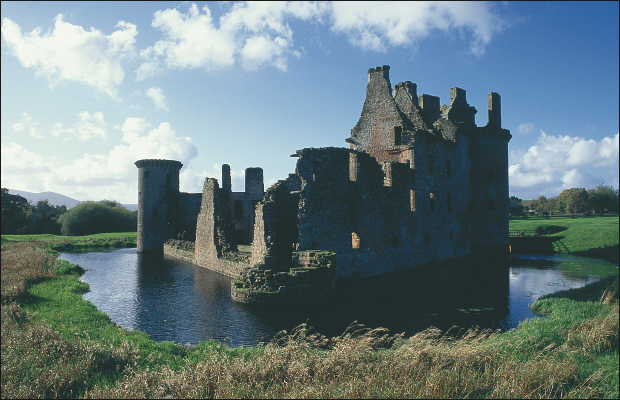
Caerlaverock Castle. Caerlaverock was ‘in shape like a shield’ according to a contemporary ballad about the siege of 1300. Its capture by the English strengthened their position in the south-west.
What was the situation in Scotland when William Wallace returned, sometime in late 1302 or early 1303? Edward I had not consolidated his victory at Falkirk with a follow-up campaign in 1299 because of political problems in England. He was unable to lead a military expedition into southern Scotland until the summer of 1300. Only in the south-east of Scotland was English authority reasonably secure between 1298 and 1303, and most of the fighting took place in the south-west where the English only controlled parts. The Scottish cavalry again took flight at the Cree in August 1300 but, in general, the Scots showed that they had learnt something from Falkirk by adopting more harrying tactics. The Scots mastery of the surrounding countryside enabled them to capture Stirling late in 1299 as a result of the English garrison’s lack of provisions. The main achievement of Edward I’s 1300 campaign was the capture of Caerlaverock Castle in July of that year. The siege was graphically described in the poem the Song of Caerlaverock:
But their courage was considerably lowered during the attack by brother Robert who sent numerous stones from the ‘robinet’ . . . Moreover, on the other side he was setting up three other very large engines, of great power and very destructive, which cut down and break through whatever they strike . . . nothing is safe from their strokes . . . And when they saw they could not hold out any longer or endure more, they begged for peace and put out a pennon but the man who displayed it was shot through the hand into the face with an arrow by some archer . . . the whole army rejoiced at the news of the capture of the castle which was so noble a prize.

Lochindorb Castle, Badenoch. This castle was the main base of the Comyn lords of Badenoch, leaders of the political community of Scotland for most of the period of the Scottish wars, 1296–1304. Their importance is attested by Edward I’s use of Lochindorb Castle as a base in 1303 to receive the formal submission of northern Scotland.
Edward’s son largely led the English offensive of 1301. Scottish tactics were the same as the Lanercost Chronicle described them in 1300 and consequently little was achieved, ‘. . . because they [the Scots] always fled before him, skulking in moors and woods.’ The English, however, took the important Scottish castles at Bothwell and Turnberry (Bruce’s headquarters in Carrick), but supply problems and general lack of progress led to Edward agreeing a truce from 26 January to November 1302. It is possible that Wallace returned to Scotland sometime in late 1302 or early 1303 but not as the Scots ‘chief leader and commander’, as claimed in the Rishanger Chronicle. It is clear that John Comyn, the younger, was sole political and military leader of the Scots from the autumn of 1302. It was in this capacity that he led a Scottish force (along with Simon Fraser) on a successful, surprise raid against the forces of Sir John Segrave at Roslin (south-west of Edinburgh) on 24 February 1303. There is no mention of William Wallace’s involvement, though Blind Harry gives Wallace the credit for the victory. This achievement was recognised as a great boost to morale by the Scots in Paris, who wrote to Comyn on 25 May:
For God’s sake do not despair . . . it would gladden your hearts if you would know how much your honour has increased in every part of the world as the result of your recent battle with the English.
The letter also expressed a rather naïve belief that the King of France would still look after the interests of the Scots and bring Scotland into the peace agreement. Bishop Lamberton sent a similar letter of encouragement – perhaps written at the same time – to his ally, William Wallace. Lamberton urged Wallace to help the Scottish political community to fight against Edward I. Practical help was offered in the form of revenues from his bishopric, which his officials were ordered to supply to Wallace.
Spurred on by the English defeat at Roslin, Edward I launched the first English campaign against northern Scotland since 1296. It is notable that the offensive targeted Comyn power in Scotland north of the Forth. Edward’s route, bypassing the key castle of Stirling (using three floating bridges), took in major centres of Comyn influence in the north – Aberdeen, Banff and the private Comyn castles of Lochindorb (which he used as a base to receive the submission of the north) and Balvenie (Mortlach) – during August and September 1303. There was little resistance as the Scots sought to avoid a pitched battle. It is possible that Wallace was involved in the raid with other Scots (Comyn and Fraser) on Annandale and down to south Cumberland in June 1303 – this may have been a diversionary attack to stretch Edward I’s supply lines.
Having returned to Scotland to reinforce military efforts, Wallace must have been disturbed by the steady flow of Scottish support to Edward I. The Macdougalls had submitted in 1301, as did Alexander Balliol, Robert Bruce had submitted by early February 1302, Alexander Abernethy also in 1302 and William, Earl of Ross, in September 1303 (when he was released from prison in England). In February 1304, John Comyn, accepted political leader of Scottish resistance, was trying to secure the best terms for those Scots who had not yet surrendered to Edward. He also seemed to be acting for the Scots delegation in France. Again Wallace and Comyn disagreed, fundamentally, on the methods used to preserve the country’s independence. Comyn, as ever the pragmatist, sought to negotiate from a position of military strength – the Scottish army had not been defeated in 1303 and had won some status by the victory at Roslin. The preliminary terms of submission set out by Comyn required, in return, that all the laws, usages, customs and franchises should be kept as they were in Alexander III’s time. In keeping with his uncompromising approach to the patriot cause (whether by fighting or diplomacy), Wallace decided (along with Simon Fraser) to fight on.

Selkirk near Happrew. Selkirk Forest again provided cover for William Wallace (with Simon Fraser) in early 1304 when the English forces tried to track him down. He was nearly captured at Happrew, west of Peebles.
Comyn, acting on behalf of the community of the realm in Scotland, surrendered at Strathord, near Perth, on 9 February 1304, and discussions for a settlement commenced. In late February 1304, Edward, at Dunfermline, dispatched a mounted force under John Segrave, William Latimer and Robert Clifford on a secret mission into Selkirk Forest where Wallace and Simon Fraser were thought to be lurking (J. Bain [ed.], Calendar of Documents Relating to Scotland, II, no. 1432 [Edinburgh, 1881]):
. . . when these officers come to the water of Forth, they are to search strictly their followers, and if they find any strangers, to arrest them with horses and harnesses . . .
This unit did come upon and defeat Fraser and Wallace’s forces at Happrew in Stobo, just to the west of Peebles, but the Scots managed to escape. In the English party was Robert Bruce, the future King, who had been active in Edward’s service for two years. Despite the failure to capture Wallace, Bruce, Segrave and their soldiers were commended by Edward (J. Bain [ed.], Calendar of Documents Relating to Scotland, II, no. 1432 [Edinburgh, 1881]):
. . . [Edward] applauds their diligence in his affairs, and begs them to complete the business they have begun so well and to bring matters to a close before they leave the parts on that side [the Forth]. He urges them earnestly ‘as the cloak is well made, also to make the hood’.
Edward I had failed to consolidate his military victories over the Scots at Dunbar in 1296, Irvine in 1297 and Falkirk in 1298 – he had been unable to eradicate resistance. This fact may have preyed on his mind as he sought to bring a final end to the war in 1304, following another successful military campaign in 1303. This seems to have revealed itself in a harsher attitude towards those who had not submitted to him by February 1304. When Alexander Abernethy (who had surrendered to Edward I in 1302) was, like Bruce and Segrave, trying to track down William Wallace, he enquired how Wallace was to be treated, if taken. Edward I’s reply (3 March 1304) is forthright (J. Stevenson [ed.], Documents Illustrative of the History of Scotland 1286–1306, II):
And in reply to the matter wherein you have asked us to let you know whether it is our pleasure that you should hold out to William le Waleys any words of peace, know this, that it is not our pleasure by any means that either to him, or to any of his company, you hold out any word of peace, unless they place themselves absolutely and in all things at our will, without any exception whatsoever.
In March 1304, Edward I convened Parliament in Scotland (at St Andrews) at which a declaration of outlawry was passed on those – William Wallace, Simon Fraser and the Stirling garrison – who held out against him. Edward’s conduct of the three-month siege (May–July 1304) at Stirling Castle is indicative of his growing desire to make examples of those who defied him. The garrison at Stirling was not allowed to surrender with honour on 20 July but was rather cruelly subjected to some target practice for one of Edward’s new siege-weapons, ‘the Warwolf’. The following extract is taken from J. Bain, Calendar of Documents Relating to Scotland, II, no. 1560:
Stirling castle was absolutely surrendered to the King . . . without conditions; but the King wills that none of his people enter till it is struck with the ‘Warwolf’; and that those within defend themselves from the said ‘Wolf’ as they best can.
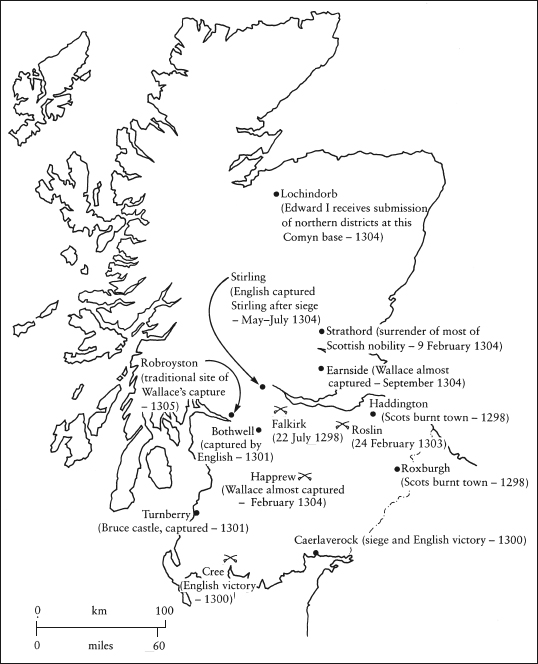
Main events, 1298–1305.
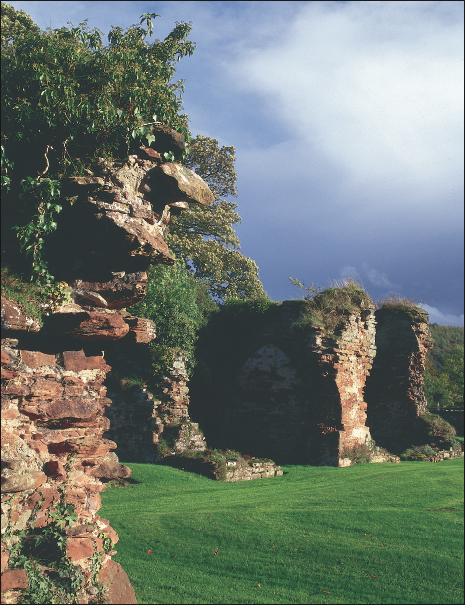
Lindores Abbey, Fife. Wallace’s last-known armed conflict took place in September 1304 at Black Earnside (Ironside). This was between Abernethy and Lindores.
The terms agreed in the surrender negotiations, which started in February 1304 and were not finalised until 1305, are a further indication of Edward’s desire to punish those who continued to resist him. When Simon Fraser submitted in July 1304, William Wallace became even more the symbol of resistance to Edward. On the day after the siege of Stirling had ended, Edward I ordered John Comyn, Alexander Lindsay, David Graham and Simon Fraser, all with sentences of exile hanging over them at this stage in the surrender negotiations (F. Palgrave [ed.], Documents and Records Illustrating the History of Scotland [London, 1837]),

Earnside (Ironside), site of the last skirmish in which William Wallace is known to have participated (September 1304). In medieval times this was a heavily wooded area, a suitable refuge for a hunted outlaw. Once again Wallace was lucky to escape.
. . . to make an effort between now and the twentieth day of Christmas 13th January 1305 to take Sire William Wallace and hand him over to the king so that he can see how each one bears himself whereby he can have better regard towards the one who takes him, with regard to exile or ransom or amend of trespass or anything else in which they are obliged to the king.
Edward was stepping up the pressure on Wallace’s former ‘allies’ in the patriot party. He therefore refused to admit James Stewart, John Soules and Ingram de Umphraville to his peace until Wallace was captured. Edward clearly linked Stewart and Bishop Wishart with support for Wallace’s activities. In the initial surrender terms of 4 February 1304, Wishart was due to be punished with two or three years’ exile from Scotland ‘for the great evils he has brought about’. James Stewart’s lands were not restored to him until November 1305. Wallace’s special place in Scottish resistance was recognised from the outset of the discussions: ‘Item about William Wallace, the king intends that he be received to his will and ordinance.’ There was to be no compromise regarding the coercion of the leaders of the ‘patriot’ party, and financial rewards – the man who first discovered Wallace was promised 40 marks, his following would share 60 marks – still did not lead to the arrest of William Wallace in 1304. He was almost apprehended, once again, in a skirmish at Earnside (Lindores, Fife) in September 1304.

Dumbarton Castle, where Wallace was imprisoned after his arrest at Robroyston. John of Menteith, who took responsibility for his capture and custody, was Sheriff of Dumbarton.

Wallace’s Well at Robroyston. There are a number of memorials to Wallace’s capture in Robroyston in 1305 in the town. These include a monument and Wallace’s Well, though there is nothing to connect Wallace with the latter.
William Wallace was eventually betrayed (by whom, it is not known) in 1305. He was captured on 3 August by John of Menteith who, since his submission to Edward I between September 1303 and March 1304, had been entrusted with the sheriffdom of Dumbarton. Although Scottish sources put all the blame for the betrayal on him (and Edward I was keen to reward him with land worth £100), it is not certain whether Menteith was doing any more than fulfilling his duties in the area of his responsibility. As Menteith later appeared in the following of Robert Bruce, it has even been suggested that Robert Bruce could have been implicated in Wallace’s arrest. Bruce undoubtedly would feel that the removal of one of the two mainstays and supporters of John Balliol’s kingship – John Soules being the other – could improve the chances of a Bruce claim. Bruce came close, indeed, to taking Wallace himself near Peebles in late February 1304. It seemed rather that the traditional ruling families of Scotland preferred to leave Wallace to his fate. Comyns, Bruces, Stewarts and the bishops of St Andrews and Glasgow were engaged in their own political games – to achieve as much independence for Scotland as they could but at the same time ensure retention of political power in Scotland for themselves. Yet the mystery over the degree of contact and cooperation between the traditional ruling families of Scotland and Wallace in 1297 (when active revolt began) still existed in 1305 (at his capture).
When he was arrested – according to Peter of Langtoft, ‘Sir John de Menteith . . . took him in bed beside his strumpet’ – documents were found in his possession that included confederations and ordinances made between Wallace and the magnates of Scotland. There were certainly plots afoot in 1304, though it is not known whether Wallace was involved in them. On 11 June 1304, for instance, Robert Bruce made a secret bond with Bishop William Lamberton, promising ‘to be of one another’s counsel in all their business and affairs at all times and against whichever individuals’. Bruce was clearly seeking wider support even if this meant making unlikely partnerships. Any conspiracy would have to take account of the Comyns’ power (still not destroyed after their tactful submission to Edward I in early 1304) and it seems possible that a similar general agreement to an alliance of mutual cooperation may have been made between Robert Bruce and his fierce rival, John Comyn of Badenoch, in 1304. Those responsible for a plot may also have sought military affiliation with William Wallace, whose popular support was known to Scottish and English leaders alike. The involvement of Lamberton (a close ally of Wallace) and Wishart (who had also been associated with Wallace in 1297) in the scheme to help Bruce usurp the Scottish throne suggests that Wallace may have been approached at some stage. It is also probable, given his loyalty to the Balliol cause, that Wallace would have rejected such overtures, as John Comyn did in 1306.
After his arrest, Wallace was sent to London in the custody of John Segrave. He arrived there on 22 August 1305 and was taken to the property of William Leyre, alderman, in the parish of Fenchurch. The intended public humiliation of Wallace started the next morning with a procession through crowds to Westminster Hall with the prisoner being led on horseback. A crown of laurels was placed on his head, a mocking riposte to the popular story that Wallace had once boasted that he would wear a crown at Westminster. There was no trial. Peter Mallory, Justiciar of England, read the indictments against Wallace who, as an outlaw, had no right to a trial and could only expect judgement and sentence. Wallace was charged with committing ‘all the felonies and seditions he possible could’ against Edward, killing the Sheriff of Lanark, usurping the power of ‘lord superior’ of Scotland, convening parliaments, pursuing a policy of alliance with the French; he was also accused of war atrocities – killing, burning, destruction of property and sacrilege. Wallace’s only known outburst during his ‘trial’ was his denial of the charge of treason, ‘that he had never been a traitor to the king of England’ because he had never acknowledged any allegiance to Edward I.

The Houses of Parliament. After his capture, William Wallace was taken to London and led to Westminster Hall, the oldest part of the Houses of Parliament. One of Wallace’s offences was that he had convened parliaments in Scotland.
After John Segrave read the sentence, Wallace had to face the penalty that his crimes warranted; it was not specially devised just for Wallace. The various stages of Wallace’s ritual punishments began when he was stripped, bound to a hurdle and dragged behind a horse from Westminster to the Tower, then through the city streets to Aldgate, on to Smithfield where he was hanged, cut down while still alive, disembowelled and then beheaded. According to Matthew of Westminster, his heart and entrails ‘from which his perverse plans had arisen’ were burnt, and his corpse was hacked into four pieces. His head was hoisted onto London Bridge and his four quarters were displayed at Newcastle upon Tyne, Berwick, Stirling and Perth. Peter Langtoft outlines how Wallace was treated:
. . . judged on the following conditions: – first to be drawn to the gallows for his treasons, – to be hung for robbery and slaughter, – and because he had destroyed by burning – towns and churches and monasteries, – he is taken down from the gallows, and his belly opened, – the heart and bowels burnt to ashes, – and his head cut off for such faults, – because he had by these . . ., – maintained war, given protections, – seized lordship into his subjection – of the realm of another by his intrusions – His body was cut into four parts, – each hung by itself in memory of his name, – instead of his banner these are his standards – To finish his history, – at London is his head, – his body is divided in four good towns, – whereby to honour the isles – that are in Albania – And thus may you hear, – a lad to learn – to build in peace – It falls in his eye, – who hacks too high, – with the Wallace.

The Tower of London. The first part of William Wallace’s punishment involved being dragged from Westminster to the Tower. Following the English victory at Dunbar in 1296 and John Balliol’s submission, Balliol, his chief supporters, Scottish royal regalia and all records were brought to the Tower of London.

Whitehall. Wallace was paraded through the streets of London from Whitehall to the Tower.

Eleanor Statue, Charing Cross. This is one of a number of Eleanor crosses commemorating Edward I’s first queen who died in 1290. There is an effigy of Queen Eleanor (by William Torel) on her tomb in Westminster Abbey. Edward I’s grief at Eleanor’s death may have been an important contributory factor in the changing nature of his regime after 1290.
A similar punishment was meted out to Simon Fraser a year later, and is described in the Song on the Execution of Sir Simon Fraser:
To be a warning to all the gentlemen who are in Scotland . . . the head [Wallace’s] to London Bridge was sent – to prison there, – Afterwards Simon Fraser, who was traitor and fickle, – Sir Edward our king, who is full of piety – sent the Wallace’s quarters to his own country, to hand in four parts (of the country) to be their mirror, thereupon to think, in order that many might see – and dread – Why would they not take warning – of the battle of Dunbar – how ill they sped
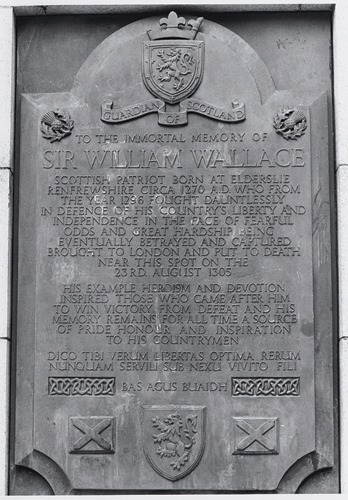
Found on the Elderslie Wallace Monument, this is a copy of the plaque on the wall of St Bartholomew’s Hospital, London, close to the spot where he was executed (see following page).

The monument commemorating the death of Edward I in July 1307 at Burgh-on-Sands. Earlier in the year the English King had recognised that his policy for settling Scotland may have been ‘harsh and rigorous’. This was Edward I’s way of explaining the continuing levels of resistance that he was still experiencing after 1305 when he established a new government for Scotland. He was campaigning against the new opposition movement led by Robert Bruce at the time of his death.

St Bartholomew’s plaque, St Bartholomew’s Hospital, near Smithfield, London. This panel commemorates William Wallace as ‘Scottish patriot . . . put to death near this spot’.
The English had firmly established William Wallace’s as the symbol of Scottish resistance by focusing attention on his capture, ritual trial and savage punishment in 1304 and 1305. There is no evidence that Wallace’s death caused Robert Bruce to come out in open rebellion in 1306. Bruce was already developing his own plans in 1304, with or without Wallace’s assistance. Undoubtedly, Wallace’s savage execution on 23 August 1305 raised the political temperature in Scotland and perhaps expedited Bruce’s own plans for revolt. Bruce and Wallace, however, represented two very different sides of the Scottish ‘patriot’ coin. Nationalist histories of the fourteenth and fifteenth centuries have placed them closer together than they were at the time. Yet Bruce, by going it alone in 1306, and gaining some military success in 1307, soon found himself on a similar journey to the one that Wallace embarked on in 1297. It was not, however, until 1307–8 that Bruce gained the same degree of popular support enjoyed by Wallace between 1297 and 1298.
It is clear that Robert Bruce was not the natural successor of William Wallace. Wallace and Robert Bruce deserve entirely separate reputations as Scottish ‘patriot’ heroes. The number of Wallace placenames, statues and memorials found in Scotland attest to the popular appeal of William Wallace. While, however, Blind Harry and Braveheart have undoubtedly exaggerated Wallace’s efforts and somewhat distorted his reputation, there is no denying the real historical achievement of William Wallace. The Scottish political elite of Comyn, Balliol, Stewart and Bruce (albeit on it’s fringe) wrote and spoke the language of nationalism and Scottish independence but no one acted on those words more passionately and with such utter lack of compromise than William Wallace between 1297 and 1305.