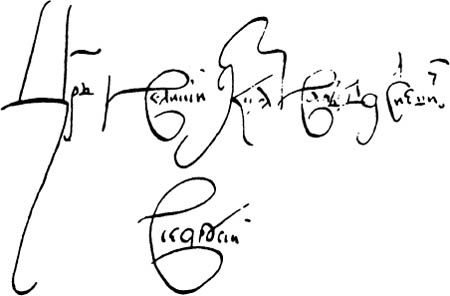
Ivan’s signature. Some historians believe he never signed documents, but ordered his chief secretary to sign for him. It reads: “Tsar and Grand Prince Ivan Vasilievich of all Russia.”

OF ALL THE PEOPLE in Russia the Grand Prince Vasily III regarded himself as the most miserable. He could trace his descent back to Rurik, the legendary founder of the Russian state, and through his mother, Sophia Palaeologina, to a long line of Byzantine emperors, but he had neither sons nor daughters to continue the line. One day, walking in the countryside around Moscow, he saw a bird’s nest and gazed at the chicks with a feeling of shame. “Whom do I resemble?” he asked. “Not the birds of the air, for they are fertile. Not the beasts of the earth, for they produce young ones. . . .” A few days later, talking to his boyars, he again bewailed his fate. “Who will rule after me in the Russian land, in all my cities, within my frontiers?” he exclaimed. “Shall I give them up to my brothers? But they do not know how to order affairs in their principalities!” The boyars replied: “Lord, Grand Prince, the barren fig tree must be cut down and cast out of the orchard!”
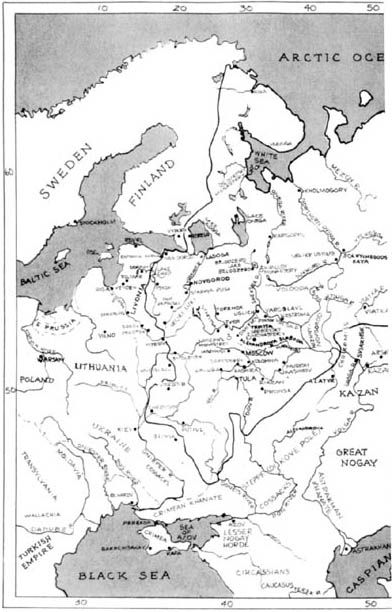
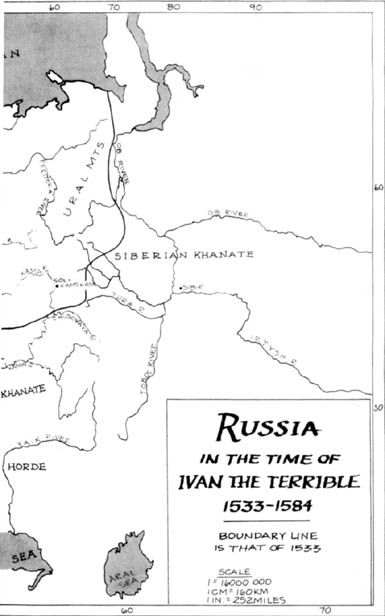
The Grand Prince Vasily III was a mild-mannered prince, well-liked by the people. Unlike his more famous father, Ivan III, known to history as Ivan the Great, who conquered large territories and fought the Tatars, Vasily III possessed none of the gifts of a conqueror. He had fought desultory wars against Lithuania, drawn Pskov, Smolensk, and Ryazan into his kingdom, and shown himself to be a cautious and sensible man who rarely permitted himself the luxury of showing his full strength. A portrait of him on the walls of the Cathedral of Michael the Archangel, which he built at the beginning of his reign, depicts him as a tall, heavy-set man, sad-eyed and vulnerable, with pursed lips and a huge beard which flows heavily across his chest. He wears an air of settled melancholy and looks more somber than any of the other somber figures who crowd the cathedral walls.
His wife, the Grand Princess Salomonia, the daughter of a rich boyar, was regarded at the time of her marriage as the most beautiful woman in Russia. She was devout, gentle, and loving, and no one had found any fault in her. Now at the age of forty-seven, having reigned for nearly a quarter of a century, the Grand Prince found a fault in her that was beyond curing. She was barren and must be cast out of the orchard. She protested that she had committed no crime, it was God’s will that she was barren, the Church categorically forbade divorce on the grounds of barrenness alone. She had powerful allies. They included the Metropolitan Varlaam, the great theologian known as Maxim the Greek, and Prince Simeon Kurbsky. The Metropolitan was banished to a monastery in the far north, Maxim the Greek was put on trial on the charge of heresy and banished to Tver, and Prince Simeon Kurbsky was banished from court. The Grand Princess Salomonia was divorced and sent to a nunnery in Suzdal. It was said that she raged against the injustice of her divorce to the very end and cursed the husband who had cast her out. It was said, too, that an even more terrible curse was laid on him. Mark, Patriarch of Jerusalem, heard about the coming divorce and thundered: “If you should do this evil thing, you shall have an evil son. Your nation shall become prey to terrors and tears. Rivers of blood will flow, the heads of the mighty will fall, your cities will be devoured by flames.” And all this came about.
Vasily III entered upon his new marriage joyfully and light-heartedly. His bride was Princess Elena Glinskaya, by origin Lithuanian, now living as a refugee in the Russian court. She was the ward of her uncle, Prince Mikhail Glinsky, whose adventurous career had led him to fight in the armies of the Emperor Maximilian and Albert of Saxony. His ward was about twenty, strong-willed, exuberant, beautiful. To please her the Grand Prince shaved off his beard, even though the Orthodox Church regarded it as a sin for a man to shave off his beard. But though he doted on her, he was not especially enamored of her family. Prince Mikhail Glinsky was at that time spending his days in a Russian prison; he had been arrested for treason, he was in chains, and his lands were confiscated. He was not finally released until February 1527.
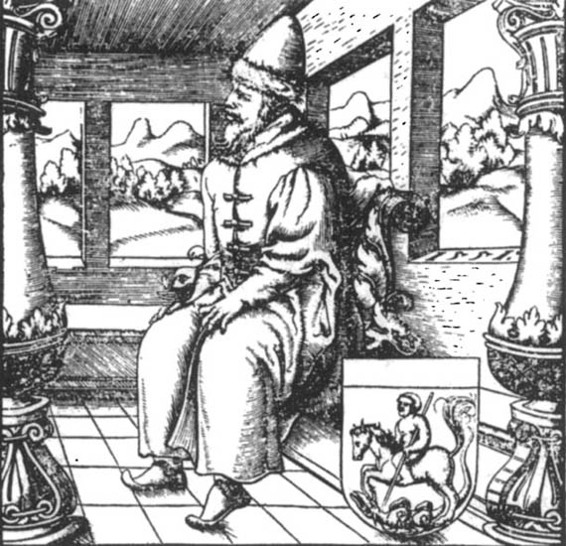
Vasily III with his coat of arms in the foreground. (From Herberstein’s Rerum Moscoviticarum Comentarii)
The boyars viewed the coming wedding with mixed feelings. They resented Elena as a foreigner and suspected that she might have more love for Lithuania than for Russia. Almost inevitably she would outlive her husband, and unless she quickly produced a son and unless the Grand Prince survived long enough to superintend the education of his son, there was no certainty that the succession could be maintained. They observed that she had a will of her own and might prove intractable. Her ancestors were Lithuanian princes who had fought against Russia, but she also claimed descent from Mamay, the Tatar prince who had laid waste Muscovy until he was defeated by the Grand Prince Dmitry Donskoy at the battle of Kulikovo.
Yet there were many who saw advantages in the marriage. She was young, eager, well-educated. She was not so devout as Salomonia, and she had a fund of gaiety which kept Vasily amused and happy. The court would be rejuvenated by her presence. She brought excitement and pleasure to a court that had become monotonous and stuffy.
The marriage took place on January 21, 1526. The day appears to have been carefully chosen, for it was the Feast of the Assumption of the Virgin. The marriage ceremony began the moment she walked into one of the painted halls of the Golden Palace in the Kremlin, with two noblemen bearing candles leading the way and accompanied by her matrons of honor. She wore a sumptuous robe inlaid with jewels and sat on a chair upholstered with forty black sable skins. Prince Yury of Dmitrov, one of Vasily’s two brothers, called out, “Lord, come to the place where God summons you,” and then Vasily, dressed in equally sumptuous garments, entered, prayed before the icons, and then took his place beside Elena on another chair upholstered with forty black sable skins. The nuptial candles were lit, prayers were read, the matrons of honor combed the hair of the bride and groom, and over Elena’s head there was placed the headdress appropriate to a married woman and a kerchief of the finest silk. Hops were sprinkled on the couple to assure fertility. Bread and cheese were offered to the wedding guests. It was a long ceremony and they needed refreshment.
The second part of the ceremony took place in the Cathedral of the Annunciation, the smallest and most beautiful of the cathedrals in the Kremlin. Vasily walked to the cathedral; Elena drove in a horse-drawn sleigh. A carpet of red damask bordered with sables was spread out for them in the cathedral. The Metropolitan Daniel offered them a glass of Italian wine, and when they had both drunk from it Vasily tossed the glass on the floor and ground it to pieces under his heels. There were many hymns, many blessings, many prayers. The boyars and the court nobility passed in procession, offering their congratulations, while the choir sang a hymn invoking God’s blessing on them and the hope that they would enjoy a long life.
There followed the wedding feast, where a roast cock was served to the wedded couple, and later they were escorted to the bedroom and the nuptial candles were stuck into tubs of wheat. On the bed were laid twenty-seven sheaves of rye. In each corner of the room sable furs and wheat loaves were laid, and arrows were shot into the corners. The arrows signified that the enemies of the marriage would be laid low, while the wheat loaves signified the hope of fertility.
Unfortunately, as the months passed, Elena appeared to be no more fruitful than her predecessor. Vasily, who had gone to so much trouble to procure a new wife, remained childless. An absolute monarch, possessing more personal power than any European king, he was unable to produce what peasants produced with the greatest ease.
Baron Sigmund von Herberstein, the ambassador of the Emperor Maximilian to the Kremlin, was a remarkably observant man who came to know the workings of Vasily’s mind and the dazzling complexities of the Russian court. He knew a good deal about Elena and her brothers Yury and Mikhail, and he had a certain fondness for Vasily. What struck him most of all was that Vasily was more absolutely supreme over his subjects than any other monarch in the world. “The will of the Lord is the will of God,” said the Muscovites, and in their eyes Vasily was “God’s steward and gentleman of the bedchamber.” Yet the autocracy was not absolute; Vasily and his Boyar Council decided upon all important issues; the Metropolitan had the right to intercede for anyone who had fallen into disfavor; the concept of the Third Rome, with Muscovy taking the place of fallen Byzantium, was still being debated.
When Herberstein turned his attention to the machinery of government, he realized that it was often very erratic indeed. Decisions were made by the sovereign in consultation with the Boyar Council, a carefully selected group of noblemen, but the carrying out of these decisions depended upon an army of clerks. He estimated that half the people he met in the government offices inside the Kremlin were clerks. Whenever he went to see a boyar about some matter connected with his diplomatic mission he would find two or three clerks present; if he asked a question, the clerks would whisper the answer into the boyar’s ear. Since they were usually more competent than the boyars, they could do very nearly whatever they pleased; and if a boyar annoyed them, they would threaten to haul him off to the Grand Prince. Herberstein relates that he once saw an important noble, the head of a department, dragged away by force to the Grand Prince by an army of enraged clerks.
These clerks were a law unto themselves. They were the bureaucracy, the permanent civil service. They took bribes, made promises that they promptly forgot, and worked continually to their own advantage. We understand Vasily better when we realize that he was all-powerful but at the same time he was dependent upon them, often submitted to them, and found them indispensable. The boyars called the clerks “nettle seeds,” as we might call them “hillbillies,” for they usually came from priestly or poor families. Sometimes the real power was in the hands of half a dozen trusted clerks.
These clerks ran the country when Vasily and his young bride absented themselves from Moscow and visited the holy shrines in the hope that the saints would intercede and grant them a son. Vasily enjoyed hunting and traveling, and on these expeditions he was usually accompanied by his brothers, Prince Yury of Dmitrov and Prince Andrey of Staritsa. Dmitrov and Staritsa were the appanage principalities bestowed on them by their father.
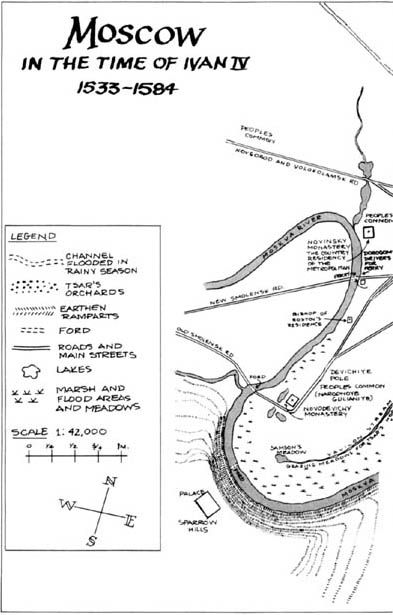
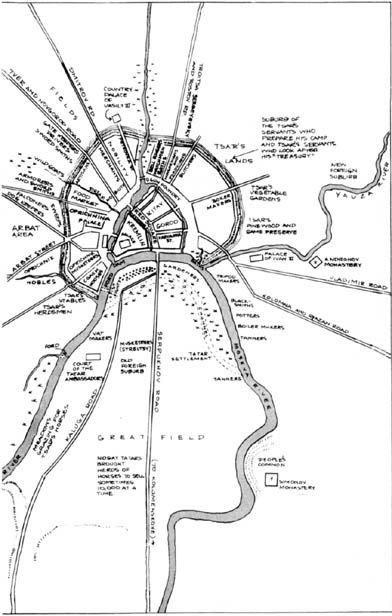
The Muscovites saw very little of their Grand Prince except on ceremonial occasions. The new Grand Princess was presented to them, and they rejoiced and went about their business. The city had a seething life of its own; the vital center of this life was a vast field stretching from the Moskva River to the Neglinnaya River outside the Kremlin wall. In those days it was called simply “the Square”; today it is called “the Red Square.” The field served many purposes. It was the main marketplace with painted booths set up in orderly rows, where men could buy anything from silks and damasks to iron stirrups and leather saddles, from wooden vats to wooden sleighs. When the booths were cleared away, the Square became a parade ground or a fairground with clowns and jugglers and performing bears. Here executions were held, and here a man might pray for mercy in one of eight or nine wooden churches, or get a letter written by a scribe, or watch a religious procession with great painted banners waving in the wind, or listen to the herald proclaiming a decree signed by the Grand Prince himself with his royal seal.

The Grand Prince Vasily III, from a contemporary French engraving.
On any ordinary day the most remarkable thing about the Square was the noise. Merchants were shouting their wares, horses were galloping, farm carts were rumbling. There was the incessant sound of creaking wheels and cracking whips. Dogs barked, women screamed, children wailed, barkers shouted at the top of their lungs. But if the noise was deafening, the individual human speech was wonderfully rich and vibrant, for in those days the common speech was closer to the rhythms of Church Slavonic and even more resonant and emphatic than the speech of today. Amid all the uproar there would suddenly appear a naked yurodivy, a fool of God, with tangled beard and glaring eyes, calling upon men to repent their sins and walk in the paths of righteousness.
Life in the Square was hot-blooded and human, with little righteousness in it. There was a good deal of thieving, and most men carried daggers in their sleeves or in their boots. Drunkards wandered about merrily. Mead and vodka were the favorite drinks; the mead, which was served boiling hot, kept the cold away on long bitter winter nights. Anthony Jenkinson, who was in Moscow in 1558, heard of men and women selling off their children in the taverns and then selling off all their earthly goods to buy a drink until finally there was nothing left but to pawn themselves. Then the taverner would throw them out and beat them over the legs with a cudgel until a sympathetic passerby took pity on them and ransomed them. “All the burden lieth on the poor people,” he wrote.
The poor suffered atrociously; a growing middle class lived comfortably; the rich were unbelievably rich. There were nobles who owned scores of towns and villages and lived in breathtaking luxury. A class of rich wholesale merchants was rising to prominence; they owned the shops in the area called Kitay Gorod, which lies immediately behind the Square. They controlled the grain marts and fur markets, financed fishing fleets in the far north, traded with Persia, the Baltic, France, and Italy. Banking was in its infancy, but complicated barter deals were practiced. Foreign merchants had their agents in Moscow, and a Frenchman selling cloth would receive its worth in furs, leather, and jewelry. Foreigners spoke of the honesty and probity of the merchants of Pskov and of the shrewdness and hard dealing of the merchants of Moscow, always eager for a profit. Bargaining with foreigners, they would ask for five, ten, or twenty times what their merchandise was worth, and sometimes made fantastic profits. The Tatars too were known as good traders. They brought their sturdy ponies for sale in the field reserved for them on the south bank of the Moskva River and rode off to the south and east with furs, cloth, silks, jewelry, mirrors, finished leather goods, and whatever knickknacks took their fancy. They were nimble men with slant eyes and flat noses, bowlegged and smaller than the Russians. Giles Fletcher said, “Their speech is very sudden and loud, speaking as it were out of a deep hollow throat. When they sing, you would think a cow lowed or some great bandog howled.” They were absolutely fearless, as befitted a people who had once conquered the whole of Russia except the northern principality of Novgorod and made the Russians pay tribute to them. But the great days of the Golden Horde had passed away and the Tatar empire had dissolved into quarreling khanates.
In October, when the rivers were frozen over, the booths that were formerly on the Square were set up again on the ice of the Moskva River, which became a fairground, a merchandise mart, a main thoroughfare. Sleighs, wooden vats, pots and pans, cattle, horses, poultry, bread, and every kind of food were sold on the ice. The Muscovites regarded the ice as their friend, for it preserved meat and made travel easier. Winter was a time for feasting and great religious processions.
But what the Muscovites loved most of all was their Square, with the high Kremlin wall towering over it. Then, as now, history passed through it. The parades, the processions, the flags, the banners, the gaily striped awnings of the shops, the bright clothes of the people—for everyone who could afford it dressed to the hilt—the bustle and movement intoxicated them. Here, too, on a summer evening the youths practiced fisticuffs. Herberstein once watched them at it after hearing a low whistle which summoned the youths together. They fought well, attempted to hammer each other into insensibility, and sometimes had to be carried off the field. “They fight in this way,” he wrote, “to prove that they can give blows and tolerate punishment.”
On the Square, late in the evening of August 25, 1530, the Muscovites learned that the Grand Princess Elena had at last, after four years of marriage, given birth to the long-awaited heir to the throne. The birth took place in the Terem Palace in the Kremlin at six o’clock in the evening. The chroniclers report that in various parts of Russia the birth was accompanied by sudden terrifying storms which shook the foundations of the earth. Auguries, real or imaginary, attend the birth of great princes, and these sudden storms on a day of clear summer skies seemed an appropriate augury for a child who was to be known as Ivan Grozny, for grozny means “dreadful” or “terrible,” and derives ultimately from grom, meaning “thunder.”
All Vasily’s past miseries were forgotten in the celebration of the birth of his firstborn. Church bells rang. Solemn thanksgiving services were held. Presents were heaped upon the mother and on the tombs of the saints who had interceded with God so that the holy work of the dynasty of Rurik should be continued. The christening took place at the Troitsa-Sergeyevsky Monastery fifty miles northeast of Moscow on September 4, 1530. The fortresslike monastery was sacred to the Holy Trinity (Troitsa) and to St. Sergius of Radonezh who was buried there in an ornate tomb. On this tomb the newborn child would receive his name, and they believed he would be protected throughout his life by the Holy Trinity and by the divine influence of the saint.
In the great cathedral behind the high walls of the monastery Vasily solemnly presented Ivan to Abbot Ioasaf. Almost the entire court was present. For the occasion everyone wore sumptuous garments. Vasily wore his crown, the candles flickered on the walls painted with scenes from the life of St. Sergius, prayers were offered, and the choir sang. The Abbot advanced solemnly through the royal gate of the iconostasis to the altar and implored blessings on the child. Then he emerged from the sanctuary and gave the child back to Vasily, who placed his son on the saint’s tomb, praying tearfully: “O Sergius, by your prayers to the Holy Trinity, you gave me my son. Protect him from all evil, seen and unseen, until he has grown in strength. All my faith is placed in you.”
By being placed on the tomb, the child was officially dedicated to St. Sergius. He was christened by a saintly monk known as Cassian the Barefoot, and given the name of Ivan, the Russian equivalent of John, after John the Baptist. He was also blessed before an icon of the Virgin. At his christening, therefore, the Holy Trinity, the Virgin, St. Sergius, and John the Baptist were all invoked, and to the end of his life Ivan believed he was under their special protection. In time he would accumulate many more saints, praying to them fervently and trusting in their powers of intercession, but he never wavered in his allegiance to the saints who attended his christening.
After giving costly gifts to the monastery, Vasily returned to Moscow with his son who, in the words of the chronicler, “had been sent by God for the comfort of his soul, the alleviation of his hopes, and the strengthening of the Tsardom.” Elena was not present at the ceremony, and the chroniclers relate that he journeyed home in a great hurry “because a loving mother cannot suffer to be separated for long from her child.”
A year later, on the anniversary of his birth, Ivan made his first public appearance. A small wooden church, dedicated to John the Baptist, was erected at Vasily’s orders just outside the Kremlin walls. Large crowds assembled to watch the church being built and to pay tribute to Vasily, Elena, and their infant son, who was solemnly presented to the people. The church was built in a single day.
A year passed, and once again Ivan attended the consecration of a church. This time it was the Church of the Ascension, built in gratitude for the birth of the long-awaited heir on the family estate at Kolomenskoye ten miles west of Moscow. The church was built on a rise above the Moskva River in the grounds of the wooden palace of Kolomenskoye, among orchards and rolling fields. With its outer galleries and slender tent-shaped steeple, faced with white stone and wonderfully proportioned, this church was to be the supreme architectural achievement of Vasily’s reign; and though quite small, for the interior was scarcely larger than a living room, it gave an impression of great size and the steeple could be seen twenty miles away. On one wall of the church stood the Grand Prince’s throne emblazoned with the double-headed eagle, and here he sat with his son sitting on a smaller throne beside him to receive the congratulations of the nobles and the church dignitaries.
For three days there were prayers, chants, festivities, and feasts. The Metropolitan Daniel presided over the religious ceremonies. Vasily’s brothers, Yury and Andrey, were present. All eyes were on the small, red-haired, bright-eyed boy, in whose honor the church was erected and who therefore played an important role in the ceremonies.
These ceremonies came to an end on September 5, 1532, and soon Vasily was hurrying once more to the Troitsa-Sergeyevsky Monastery for the annual memorial service for St. Sergius. Ivan remained in the Kremlin with his mother, who was expecting hersecond child. Yury was born on October 30. We learn from the chronicler that “there was great rejoicing in Moscow.” The parents may not have rejoiced, for Yury was born deaf and dumb, and so he remained to the end of his life.
We have a few brief glimpses of Ivan in his early childhood. On February 2, 1533, the two-and-a-half-year-old Ivan attended the wedding of his uncle, Prince Andrey of Staritsa, in the Kremlin, where he gracefully presented gifts to the wedding couple. We learn, too, that both Ivan and his mother suffered from ill-health. Elena was afflicted with headaches, earache, and various bodily pains, and Ivan suffered from boils. Vasily learned of these illnesses while he was on his travels, and wrote to his wife:
From Grand Prince Vasily Ivanovich of Russia to his wife Elena.
Thou hast written to me on Friday that Ivan became ill. Now thou writest that he is suffering from a hard boil on the nape of his neck. Thou didst not mention this in thy previous letter. Now thou writest that on Sunday morning at one o’clock the boil on his neck became larger and redder, and that it was painful, and there was no pus.
Why didst thou not tell me this before? Why didst thou not write about it before? Previously thou saidest only that Ivan was ill. Thou shouldst write to me, telling me how God watches over him and exactly what it is that appeared on his neck. How did it come about? When did it begin? How is it now? Speak to the princesses and the ladies of the court, and ask them what our son Ivan is suffering from, and whether it is customary among small children. If it is customary, then find out whether it comes from birth or from some other cause. Speak to the ladies of the court and ask them about all these things, and write to me so that I shall know what is happening. Tell me what they think will happen. Does it happen often? What do they think? How does God watch over thee and our son Ivan? Write to me about everything.
There was no doubt that Vasily was deeply shocked by the news from his wife, and feared that there might be even more severe ailments in store for his son. Elena had mentioned her own aches and pains, but he was more concerned with those of his son. She wrote to her husband describing how Ivan’s boil had opened, and he seemed to be recovering. Vasily was still not satisfied, and he wrote another urgent letter:
From Grand Prince Vasily Ivanovich to his wife Elena.
Do not keep me without news of thy health. How does God watch over thee, and how art thou? Write to me, too, about our son Ivan. How does God keep him? As for me, thanks to God and the prayers of His most perfect Mother and of all the saints, I am alive and in good health.
Thou hast written to me that the boil on our son Ivan’s neck has opened and the pus came out, but now only lymph comes out. Thou shouldst write to me about whether there is anything else coming out, and what condition the boil has reached, whether it is larger or smaller. Write to me also how God is keeping thee. Does half thy head and ear and side ache? Write to me about everything.
These letters appear to have been written in the summer of 1533. Boils were very serious matters in those days, for complications often set in and people were known to have died of blood poisoning after a boil had been lanced. Vasily had reason to be concerned.
On September 21, 1533, he set out from Moscow once more for the Troitsa-Sergeyevsky Monastery. His whole family accompanied him. This time there would be only a brief visit, for he intended to hurry on to his estate near Volokolamsk, some ninety miles northwest of Moscow, for some hunting. As usual, the monks welcomed him at the monastery with candle-lit icons, and there were services and prayers beside the tomb of St. Sergius. Later Vasily invited all the monks to a feast, and then with a large retinue he went on his way. He had prayed to St. Sergius to watch over his health, but his prayers were unavailing, for on the first stage of the journey to Volokolamsk he developed a sore on the inside of his left thigh, presumably caused by chafing against the saddle.
The journey to Volokolamsk and to his hunting lodge at the small village of Klop took four or five days, and by the time he reached the hunting lodge he was in considerable pain. He was able to attend a banquet in his honor given by his favorite chamberlain, Ivan Shigona, and on the following day he was observed making his way painfully to the bathhouse. But there were clear skies, the weather was perfect for hunting, and he could not resist the temptation. After resting for a day or two, and summoning Prince Andrey of Staritsa to join him, he went hunting on his estate. The horns sounded, the hounds were let loose, Vasily and his retinue set out for the chase on their small nimble ponies. They had ridden little more than a mile when Vasily complained he was in such great pain that it was impossible for him to go on. The hunt came to an abrupt end, and they all returned to the hunting lodge. For a few minutes Vasily sat down at a table with his brother, and then took to his bed. He knew now that he was a very sick man.
Doctors were summoned, but they could do little to relieve the pain. The sore had developed into a huge abcess, which was beginning to fester. A poultice of fresh honey, wheaten flour, and baked onions was applied. It had little effect. The boil grew larger and more painful, ripening slowly; the pus came out; the swelling increased. Vasily was carried to Volokolamsk on a litter, and there once more the huge abcess was examined and poulticed, and he complained of pains in his chest. The doctors gave him a purgative of seeds, but the only effect was to make him weaker, so that he had difficulty in talking.
Because he was so ill, and because his death might bring about an upheaval in the nation, he became increasingly concerned about the succession. He was afraid his brother Prince Yury would attempt to seize the throne. Prince Andrey remained with him, but when Prince Yury arrived at Volokolamsk he was ordered to return to his principality because Vasily did not want him to know how sick he was. At all costs he was determined that the throne should pass to his son Ivan.
Two confidential secretaries, Yakov Mansurov and Grigory Putiatin, were sent on a secret mission to Moscow. The mission was so secret that neither Elena nor the Metropolitan Daniel nor any of the boyars were informed. Their task was to secure the last will and testament of the Grand Prince and those of his father and grandfather and bring them in great haste to Volokolamsk. It was especially important that they should find Vasily’s will, because it had been drawn up before his marriage to Elena. This will was to be destroyed, the other documents were to be studied. The secretaries succeeded in removing the will without attracting attention, and on their return to Volokolamsk they attended the secret council appointed to help Vasily draw up a new will.
Meanwhile his condition was growing worse. The swelling had gone down, but huge amounts of pus continued to pour out of the wound, and it was clear that his whole system was infected. For a few days he seemed to be holding his own, but toward the end of October it became obvious that they would have to employ desperate measures to save him. Already the heavens were providing the appropriate auguries of his death, for on the night of Friday, October 24, on the eve of the Feast Day of St. Demetrius, falling stars were seen all over Russia. According to the chroniclers the stars fell “like hail or rain.”
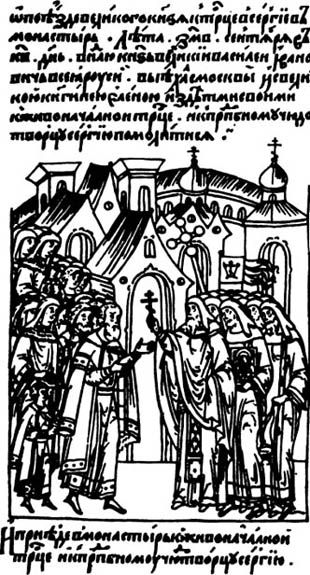
The young Ivan (left) accompanies Vasily III and Elena to the Troitsa-Sergeyevsky Monastery and receives the blessing of the abbot. (From the Nikon Chronicle with Miniatures)
To a monk called Missail Sukin, summoned from Moscow to hear his confession, Vasily announced that even if he was saved from death by the intercession of the saints, he would cease being the ruler of Russia. He would become a monk and live out his days in a monastery.
The days passed and he still clung to life, though growing progressively weaker. Perhaps a miracle might save him. The life-giving tombs of saints were generally acknowledged to possess miraculous powers, and there happened to be such a tomb nearby. Some twelve miles north of Volokolamsk stood a fortresslike monastery founded by Joseph Sanin, later canonized under the name of St. Joseph of Volokolamsk. At a famous church council held in 1503 Joseph Sanin defended monastic wealth against a certain Nilus Maikov, who firmly believed in monastic frugality. Joseph insisted that there could be no charity without wealth and Nilus insisted just as emphatically that unless a man stripped himself of all his possessions he could not come to Christ. The Russian Church in its wisdom canonized both Joseph and Nilus, who became known as St. Joseph of Volokolamsk and St. Nilus of Sorsk.
Joseph of Volokolamsk died in 1515, and his tomb lay in the sumptuous Church of the Assumption within the monastery. Vasily could scarcely stand and had to be supported by two of his nobles. He prayed before the tomb with Prince Andrey of Staritsa, Elena, and his two young sons at his side. Elena was in tears, and Vasily became so weak during the ceremony that he had to be carried out and laid down in the outer gallery. He spent the night in the monastery, and the next morning set off for Moscow.
He was driven in a sleigh, with many cushions and pillows, for every jolt was excruciatingly painful. Two of his nobles rode with him, and from time to time they turned him to avoid bedsores. They traveled in slow stages, and they were in some doubt whether he would reach Moscow alive. If possible, they hoped to enter Moscow unobserved, for it was essential that Vasily’s real condition should remain unknown until all the arrangements for the succession had been completed. Also, there were ambassadors and foreigners in Moscow, who would listen to rumors, tell tales, and inform their governments. Winter was coming down, the snow was falling, and ice covered the rivers.
Vasily reached the outskirts of Moscow on November 21. He possessed a large estate on the Sparrow Hills overlooking the city, and remained there for two days. The Metropolitan Daniel and the great boyars of his court came to visit him. They found him emaciated, for he had been able to eat very little during the journey. To Metropolitan Daniel he said: “There are some who do not want me to become a monk, but let no one dissuade you—make me a monk, for it is God’s wish and so I have vowed.” The Metropolitan hesitated, for the great boyars were not yet ready to see their monarch transformed into a monk, and their counsels prevailed.
The ice on the Moskva River was not thick enough to allow the passage of a sleigh, and therefore it was decided to throw a bridge across the river. The wooden bridge was constructed quickly—too quickly. When on the morning of November 23 the sleigh carrying the dying Vasily drove over the bridge, part of the bridge collapsed, the horses fell into the water, and the sleigh itself was saved only because the drivers had the presence of mind to cut the traces of the four horses. All this happened very quickly, Vasily was not hurt, the sleigh was pulled off the bridge, new horses were procured, and they drove back to the Sparrow Hills.
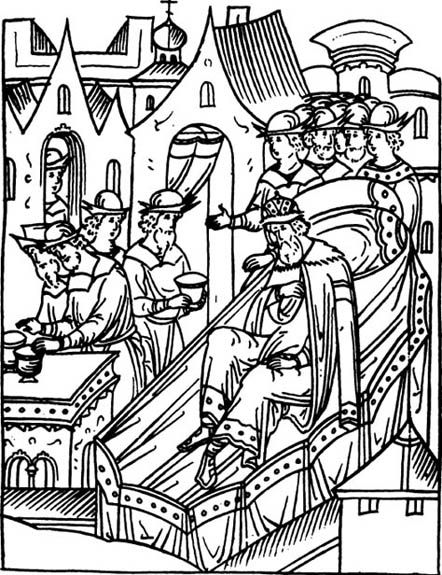
Vasily III during his last illness. He is returning to Moscow on a sleigh and pausing to receive medicines. (From the Nikon Chronicle with Miniatures)
Later in the day Vasily and his retinue crossed the Moskva River on the ferryboat at Dorogomilovo without incident. There was little time to lose. As soon as he reached his quarters in the Kremlin Palace, he summoned a meeting of the Privy Council to discuss the succession. The meeting was attended by Princes Vasily and Ivan Shuisky, and the boyars Mikhail Zakharin, Mikhail Vorontsov, and Mikhail Tuchkov-Morozov. Peter Golovin, the chief treasurer, and Ivan Shigona, the chamberlain, were also present, and in addition there were two secretaries to take down the Grand Prince’s words. Finally, there was Prince Mikhail Glinsky, Elena’s brother, a huge, burly man, who was invited to the meeting because it was necessary that someone should represent the Grand Princess.
Lying in bed, Vasily dictated the terms of the will prepared in Volokolamsk, and already written, but never previously divulged. It was a very simple will. He gave Russia to his three-year-old son Ivan, who would rule until the age of fifteen under the regency of his mother with the advice of the Council of Boyars. Vasily was too ill to discuss the succession in any greater detail, and for the next two days he rested.
On the third day, November 26, he was well enough to receive Holy Communion and to address a much larger meeting of church dignitaries and boyars. The Metropolitan Daniel, Prince Yury, Prince Andrey, and all the high officials of the court attended. Vasily was concerned to emphasize the strong bonds which attached the boyars to the sovereign, and he wanted above all that these bonds should endure during the reign of his son. They must swear an oath of loyalty to his son, they must assist Elena, and they must not allow divisions among themselves. It was as though he foresaw a long peaceful reign, his son Ivan working in perfect harmony with the boyars. There would be no friction, no quarrels. Ivan would draw strength from the boyars, and the boyars in turn would draw strength from their sovereign. He said:
As you well know, our sovereignty over Moscow, Vladimir and Novgorod descends from Vladimir, Grand Prince of Kiev. We are your hereditary sovereigns, and you have been our boyars from time immemorial. With me, you governed the land, and I held you in honor and especially favored your children, and my fame reached all countries. You have all taken the oath to serve me and my children. So now, on your lives, I commend to you my Princess and her son, Grand Prince Ivan. Brethren, preserve the Russian land, his sovereign state, and preserve Christianity entirely from all its enemies. . . .
I know now that I am near to death, and therefore I have written in my will how it must be with Princess Elena, my sons, and my brothers in the years to come. If you wish to see good come to pass, then put your names to the will and kiss the Cross as a sign that you will keep your oaths. And if I have written anything unworthy, it can be changed.
All the boyars agreed to sign the will, some with their signatures, others by affixing their seals. It was not expected that the Grand Prince would survive for more than a few days.
Surprisingly, he was still alive six days later. He was very weak, but in no pain. Gangrene had set in, and the smell of the wound was almost unendurable. The doctors, and Prince Mikhail Glinsky, hovered over the bed. A doctor, Nikolay Bulev, pronounced that there was no more hope, no medicines would cure him, and only divine aid would save him. Vasily overheard him and said to the nobles of the bedchamber: “Brethren, Nikolay has just said my sickness is incurable. The time has come for me to save my soul from perdition!” The nobles wept. Soon Vasily lost consciousness. From the depths of unconsciousness he was heard chanting, “Alleluya! Alleluya!” And when he became conscious again, he said, “Let God’s will be done! Let God’s name be blessed now and forever!”
Such at least were the words which the monkish chroniclers record, and since Vasily was very devout and desperately ill, it is likely that he said words like these. In the early hours of the following morning Abbot Ioasaf, of the Troitsa-Sergeyevsky Monastery, came to the bedchamber. Vasily was wide awake, and asked for a blessing. “Pray, father, for the well-being of the country, and for my son Ivan, and for my sins,” he said. “God and St. Sergius, the great miracle-worker, through your prayers, gave me my son. He was baptized before the miracle-worker’s tomb, and I presented him to the saint, I placed him on the tomb, I gave him into your arms. Pray God, the pure Virgin and the great miracle-worker for my son Ivan, and for my poor wife, and do not leave the city.”
This time the words have a more authentic ring, for the chronicle reflects the passion of a dying man. Later that day, when he felt he was failing rapidly and wanted to say goodbye to his wife and son, he summoned them and then changed his mind. Only his wife must be allowed to see him, for as he explained, “My son is young and I am in great sickness. He might shudder at the sight of me.” Then he changed his mind again, and Ivan was brought into the bedchamber in the arms of Prince Mikhail Glinsky. The Grand Prince removed the Cross of St. Peter the Metropolitan from his own neck, pressed it to his son’s lips, and then placed it round the boy’s neck. To Agrafena Cheliadnina, the boy’s governess, he said, “Guard my son closely and never leave him for a single moment.” And then hearing the sound of sobbing—for the Princess was on her way to the bedchamber—he dismissed Ivan and the governess, and prepared to receive his wife, who was being supported by Prince Andrey of Staritsa.
The Princess was weeping uncontrollably, and he did his best to console her. He said he was in no pain, which was true, and that he felt better, which was untrue. He was dying, and he was now saying farewell to his family. She asked him about the inheritance, and he replied that Ivan would inherit Russia, she would receive an appanage, according to the custom, and Yury would receive the principality of Uglich. She would be the ruler of Russia until Ivan came of age. He was going to speak to her about the art of governing, but she was weeping so violently that he had to let her go away.
The time had now come for him to receive the last rites of the Church and to exchange the vestments of a Grand Prince for a monk’s gown. The relics of St. Catherine of Alexandria were brought to him and he kissed them reverently, and when Prince Yury of Dmitrov came close to the bed, he said, “Brother, do you remember how our father was overcome with weakness on the day and night of his death? In the same way, brother, I am approaching the hour of my death.” Then he reminded the priests that he wanted to be made a monk, and at once an argument broke out. Prince Andrey of Staritsa objected strenuously, reminding everyone at the bedside that the heroic Grand Prince Vladimir of Kiev “did not die a monk but instead received the peace of the righteous, and so did many other Grand Princes.” It was an unseemly quarrel beside the bedside of a dying man. The boyar Mikhail Zakharin argued that the ordination should proceed, and Prince Andrey aided by the boyar Mikhail Vorontsov argued that it was quite unnecessary. The Metropolitan flared up in anger, looked straight into the eyes of Prince Andrey, and said: “I will grant you no blessing either in this life or the next!” The quarrel subsided. The Grand Prince was dressed in a monk’s robes. The Metropolitan Daniel presided over the ordination, but the ceremony was conducted hurriedly, for he was sinking fast. The man lying on the bed was no longer the Grand Prince Vasily III, lord of Pskov, Novgorod, and a hundred other cities. He was the monk Vassian.
He died at midnight on December 3, 1533. Ivan Shigona said that at the moment of his death the Grand Prince’s soul leaped from his body taking the form of a thin silvery vapor.
The dead man became a Grand Prince again when he was buried in the Cathedral of Michael the Archangel in a stone coffin beside his father. The bells tolled, the choirs sang, the funeral service was conducted with all the panoply due to a reigning monarch. Elena, too weak to make the journey on foot, was carried the short distance from the Kremlin Palace to the cathedral on a sleigh. Ivan was not present, perhaps because the mournful ceremony would be harmful to an impressionable child. It was a long and exhausting ceremony with many invocations and anthems, and in the crowded cathedral ablaze with lamps and candles there were few who did not feel that a good man had perished and the future was dark and uncertain.
The chroniclers relate that the people of Moscow wept like children watching the burial of their father.
For more than seventy years under Ivan III and Vasily III Russia had been in strong and capable hands. No one could remember a time when there had not been an experienced man on the throne. Now Russia was rudderless and adrift.