

IN THEORY all power was vested in the three-year-old Grand Prince Ivan Vasilievich,
A few days after the burial of his father he was present at a ceremony held in the Uspensky Cathedral, where he was proclaimed the true Sovereign of all Russia. The small, red-headed boy sat on his throne wearing a crown and royal vestments while the Metropolitan Daniel intoned the proclamation: “May God bless you, Sovereign, Grand Prince Ivan Vasilievich of Vladimir, Moscow, Novgorod, Pskov, Tver, Smolensk, Yugorsk, Perm, the land of the Bolgars, and many other lands, Tsar and Sovereign of all Russia! And may you remain in good health upon the grand-princely throne of your father!” The orb and scepter, the emblems of kingship, were placed in his hands, and the assembled princes, boyars, clergy, courtiers, and all those who had been invited to the ceremony swore allegiance to him and sang the anthem “Long May He Reign.” At the end of the ceremony they passed in procession before him, laying rich presents at his feet.
The country he ruled over was vastly smaller than the Russia we know today. The total population was about eight million. It stretched from the Arctic Ocean to the southern steppes where the Tatars roamed. To the east it was bordered by the powerful Khanate of Kazan and to the west by Livonia, Lithuania, and Poland. Most of what is now known as the Ukraine, including Kiev, belonged to Lithuania.
For the young Ivan, living out his ceremonial life within the Kremlin palaces, rarely penetrating beyond the high Kremlin walls except to go on pilgrimage to the shrines of the saints, there could be little consciousness of the vast powers he had inherited from his father. He was treated with great deference, shown to visiting ambassadors, propped on his throne on ceremonial occasions, and made to listen to many speeches in which he was addressed as sovereign, lord, autocrat, Tsar and Grand Prince, while at the same time it was deeply impressed on him that he possessed no powers at all. As a child he appears to have spent his life in the company of adults, his only playmate being his deaf-mute brother Yury. Priests attended to his education. He was a quick student with an agile mind, given to brooding. He was being brought up in an atmosphere which was far from being conducive to a proper education. Scarcely anywhere else in the world was there such an ostentatious display of luxury as in the small area within the Kremlin, somewhat smaller than a city block, occupied by the palaces of the Grand Prince.
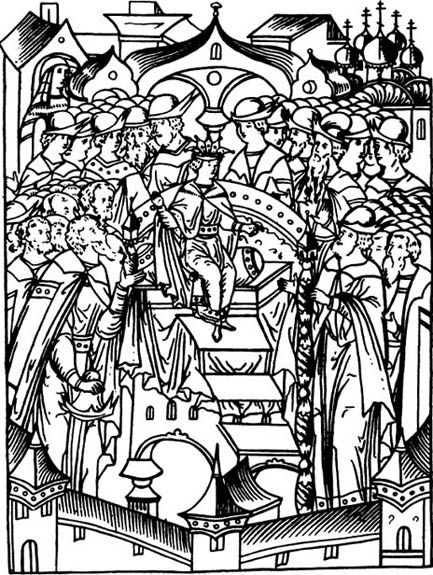
The young Ivan receiving the boyars. Elena is at top left. (From the Nikon Chronicle with Miniatures)
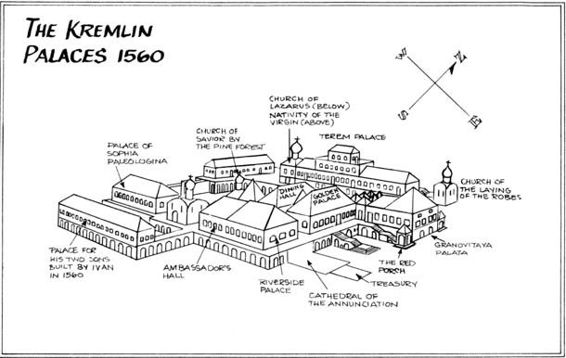
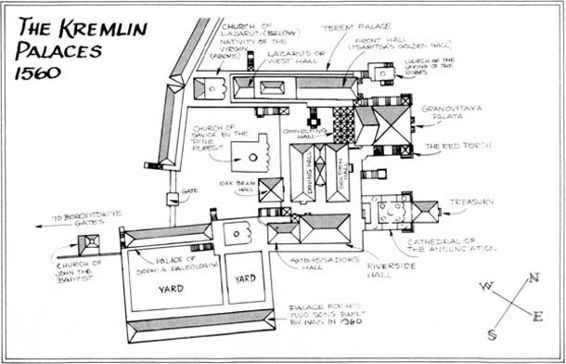
Here palaces crowded on palaces; gold domes proliferated; everything was new and splendid; an army of palace servants kept everything spotless. The palace area contained three separate but adjoining palaces, three cathedrals, five churches, a chapel, a treasury, government offices and council chambers, storerooms, bathhouses, prisons, and an establishment supervised by the Tsaritsa for weaving silk embroidery and gold cloth. Most of these buildings were quite new, having been designed by Italian architects during the reign of Ivan’s grandfather. Thus the Uspensky Cathedral (the Cathedral of the Assumption of the Virgin), the center of the religious life of the rulers of Russia, was designed by Rudolfo Fioravante of Bologna between 1475 and 1479. The Cathedral of Michael the Archangel, where the Grand Princes were buried, was designed by Marco and Aloisio Novi some twenty years later. Marco Ruffo and Pietro Antonio Solario designed the Granovitaya Palata, the principal palace, so named because the stones were faceted like pomegranates. The impressive bell tower, which dominated most of the buildings around it, known as the bell tower of Ivan the Great, was designed by Marco Bono.
Except for the Granovitaya Palata, which resembled a small and luxurious Italian palazzo, few of these buildings betrayed their Italian origins. The architects steeped themselves in traditional Russian architecture, traveling widely and studying the great cathedrals of Vladimir and Novgorod, and working closely with Russian architects. What they added was a certain grace and lightness; they rejoiced in subtle proportions; and they took care to conceal the influence of the Italian Renaissance while making it all the more manifest.
Among these palaces and cathedrals Ivan spent most of his boyhood, dimly aware that this small corner of the Kremlin generated the royal power which stretched beyond the Kremlin walls to the remotest regions of Russia.
This concentration of power within a small space was deliberate; it expressed the needs of the ruling dynasty, and followed the Byzantine model. Here all the important ceremonies of royalty were performed; here, usually, the Grand Princes were born, here they were married and were crowned, here they died and were buried. It was not really necessary for a Grand Prince to travel outside this well-guarded area, except to lead his armies. The palaces and cathedrals were designed as expressions of his authority, his majesty, his preeminence above all other mortals. In this setting everything was designed to exalt the person of the sovereign.
Yet life in the Kremlin was not altogether pleasant or rewarding. A strict protocol was observed; complexities abounded; there were subtle gradations of rank; and power moved from the throne room in mysterious ways. Titles might mean much or little, depending on the owner. Traditionally the boyar families, who belonged to the untitled aristocracy, wielded great power. There were about fifteen boyar families; they possessed enormous prestige as the hereditary lords of Moscow under the Grand Prince. The history of Moscow was very largely the history of these fifteen families—the Cheliadnins, Morozovs, Zakharins, Saburovs, Saltykovs, Vorontsovs, Sheremetevs, Pleshcheyevs, Kolychovs, and a few more. To be a prince was not necessarily to be wealthy or powerful, but to be a Morozov or a Zakharin was to have wealth and power beyond the wildest dreams of ordinary men. All this Ivan had to learn in his boyhood.
Titles had not yet proliferated, and there were in fact only two titles: veliky knyaz, or Grand Prince, the title of the sovereign, and knyaz, a title held by about a hundred princely families. In these families the sons of princes were princes and all their daughters were princesses; hence the multitude of princes and princesses, some wealthy and powerful, others living in modest circumstances. Here again there were infinite gradations. To be a Prince Belsky or a Prince Mstislavsky, who were closely related to the sovereign on the maternal line, meant a great deal. The Princes Shuisky, who descended from the Grand Princes of Nizhni-Novgorod, were also held in high respect. Descendants of Grand Princes who had once ruled over vast principalities counted far more than princes who had ruled over lesser principalities. The greatest princes were the princes of the blood royal, the brothers and uncles of the reigning Grand Prince.
The throne rooms and reception rooms in the Kremlin palaces were approached by narrow outside stairways which led from the ground floor to the first floor. In all the Kremlin there were no wide flights of steps. These stairways were well guarded; only two or three people could climb up them abreast; and they could be watched from above and below. Access to the Grand Prince depended upon an exact protocol. If a visitor was very important, if for example he was one of the princes of the blood royal, descended from Rurik, the ancient founder of the dynasty, then even the Grand Prince himself might welcome him at the foot of the stairs and at the very least there would be high-ranking nobles to escort him up the stairs. If he was less important, if for example he was a boyar, he might be met by another boyar or by a prince attached to the court. Depending on his importance, the visitor would be greeted at the foot of the stairs or half way up or at the top by noblemen or by palace servants or simply by a solitary tipstaff. An ambassador would know from the moment he approached the stairs whether he was likely to be received with favor or disfavor in the throne room. His value in the social organism had already been precisely calculated and the degree of deference to be paid to him was expressed in smiles, bows, greetings, the number of steps he climbed unescorted, the number and rank of the people who welcomed him. It was a complex maneuver which satisfied an age that delighted in hierarchies.
Just as the steps leading to the palace were deliberately made narrow, so too, within the palace, the openings that led from one room to another were narrow. They were very low, and a man had to bow his head in passing from one room to the next. These small openings testified to the fear that reigned over the palaces. The young Ivan, who learned protocol before he learned his letters, soon learned that royalty was dangerous. The greatest danger always came from his close relatives: uncles, cousins, princes of the blood royal were likely to be contenders for the throne. The guards who stood at the doorways were not there for ceremonial purposes: they were fully armed.
As a child Ivan saw very little of the great world beyond the Kremlin wall. His secluded and cloistered life was spent largely in the Terem Palace, where the Grand Princess Elena lived in great state among her ladies-in-waiting. This long palace, five stories high, was luxuriously decorated; there were ornate carvings around the windows and the walls were painted with enormous flowers; on the second floor were the looms where immense quantities of gold cloth and embroidered silk were produced for the use of the grandprincely family, who wore sumptuous clothes on all ceremonial occasions. This cloth was also bought by the princes, boyars, and priests, and there were shops in Moscow which sold the cloth from the royal looms. One of Ivan’s earliest memories was the incessant clicking of the looms.
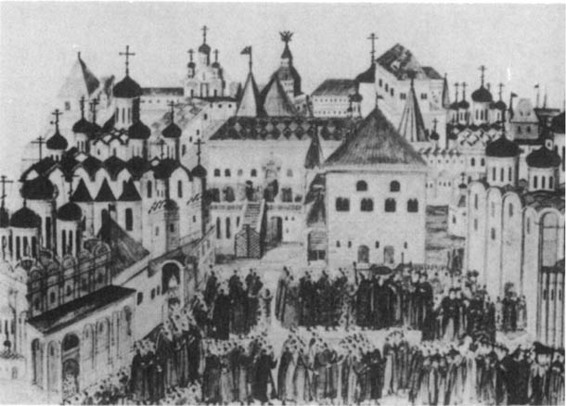
Seventeenth-century painting of the Kremlin Palace. At bottom left the Cathedral of Michael the Archangel, with the Cathedral of the Annunciation above it. The Zolotaya Palata, or Golden Palace, is in the center, with the Hall of Facets center right, and the Uspensky Cathedral on the right. The Terem Palace is the high building behind the Hall of Facets.
Behind the palaces were two small gardens, the summer and winter gardens, where he was permitted to walk and take exercise under the watchful eyes of armed guards. He was also permitted to visit the houses of his relatives, who lived nearby. His world was minutely organized within the stifling protocol of a Byzantine court. Within the Kremlin plots and counterplots flourished, the wildest rumors sped along the shadowy corridors, and treason filled the air like incense.
The most powerful man in Russia was a man once regarded by Vasily III as an arch traitor. This was Prince Mikhail Glinsky, the uncle of Elena, astute and tough-minded, possessing a formidable instinct for survival. He exerted vast power at court; nor was he in any mood for half-measures. Once he was chief minister in the court of Sigismund Augustus, King of Poland and Grand Prince of Lithuania, but fell out with him, turned traitor, swore allegiance to the Grand Prince of Moscow, and then turned traitor again because Vasily refused to grant him the great city of Smolensk, and he was returning to Lithuania when he was arrested. Insanely proud, contemptuous of death, despising everything except power, he was brought before Vasily III to answer for his latest treachery. He replied that he had himself captured Smolensk and therefore deserved to have possession of the city. As for the accusation of treachery, he answered, “I have never been disloyal, and if you had been true to your promise to me you would have had in me the most loyal of servants. I have always despised death, and eagerly welcome it, if only because I shall no longer see your tyrannical face!”
Many men had suffered many deaths for lesser acts of treason and for lesser boasts, but Vasily was in a forgiving mood. Prince Mikhail Glinsky was thrown into prison, and released in 1527, after his niece married Vasily. Thereafter he grew in Vasily’s favor. His fiery temper and outrageous pride were excused because he had spoken honestly and bluntly, and never dissembled.
Prince Mikhail Glinsky was now the de facto ruler of Russia, the man who made all the final decisions. When he learned that there was an obscure plot to place Prince Yury of Dmitrov on the throne—or perhaps it was no more than the rumor of a plot invented by Prince Andrey Shuisky, for everything about this plot smells of the agent provocateur—he had no hesitation in arresting Prince Yury. Only eight days had passed since the death of Vasily. Prince Yury, loaded with chains, was removed to a prison within the Kremlin Palace by order of the Regent Elena and the Council of Boyars. Two and a half years later, Prince Yury died in his cell and was buried in the Cathedral of Michael the Archangel “in the place reserved for disgraced princes.” The chroniclers also remembered that before burial his body was laid out and rubbed with oils in an attempt to remove the marks left by the chains.
A prince’s life was one of perpetual danger, for he was at the mercy of jealousies, rumors, and suspicions. It was not necessary that he should commit an act of treason to find himself in prison or without a head. If someone in authority found some advantage in throwing him into prison or beheading him, this was reason enough. The Regent Elena was strong-willed like her uncle, and inevitably there were quarrels. When she took as her lover the young and handsome Prince Ivan Obolensky, Prince Mikhail Glinsky protested vigorously. It was unseemly; it was disgraceful; it was against state policy. It was also a threat to his own position as the wielder of power behind the scenes. He argued so persistently that Elena used the only weapon left to her. He was summoned before the Boyar Council and accused of wanting to rule despotically. Arrested on August 5, 1534, he was sentenced to life imprisonment, having enjoyed supreme power for a little more than seven months. Like Prince Yury of Dmitrov, he was loaded with chains. He died, according to the chroniclers, in “the stone building behind the Kremlin Palace” on September 15, 1536, having outlived Prince Yury by little more than six weeks. Elena ordered that he should be buried quietly, without honors, in the Church of St. Nikita on the farther side of the Neglinnaya River. Once again the chroniclers remembered that an attempt was made to remove the marks left by his chains. A few months later Elena suffered a change of heart, and the body of the man who had once held all the reins of power in his hands was dug up and reburied in the Troitsa-Sergeyevsky Monastery with all the pomp appropriate to the burial of a great prince.
The young and personable Prince Obolensky was now the power behind the throne. His sister Agrafena was Ivan’s nurse. The Regent Elena had appointed him Master of the Horse and a member of the Boyar Council. He was therefore in a position to dominate the small circle around the Regent, and since Ivan liked and trusted him, and Elena loved him to distraction, there appeared to be no reason why Prince Obolensky should not continue in power. The Boyar Council, consisting of about fifteen members, was torn by factions, with the Belsky and Shuisky families playing the leading roles. As the only member of the Boyar Council continually in touch with the throne, Prince Obolensky was able to maneuver the councillors according to his wishes. His power, as he knew, depended on the survival of Elena. If she died, he could expect to feel the full weight of all the enmities he had aroused, and to this extent he was at the mercy of the councillors.
Prince Dmitry Belsky, who presided over the Boyar Council, was one of those calm, sober, cautious men, who are so accustomed to being in positions of authority that they show very little interest in the intrigues swirling around them, knowing that they can scotch these intrigues with a stroke of a pen. As he presents himself to history, he is superbly detached while remaining consummately loyal to the throne. He was descended from one of the daughters of Ivan III and from the Grand Princes of Lithuania and Ryazan. Royal blood flowed in his veins, and he was well aware of it. His younger brothers Ivan and Simeon lacked his innate self-discipline and engaged in desperate stratagems, but no one ever suggested that the older brother aided them. He seemed to live apart from them in a world of his own.
The Shuisky princes were violent and predatory, none more so than Prince Andrey Shuisky, whose curious intrigues led to the arrest and imprisonment of Prince Yury of Dmitrov. For his pains he was thrown into prison; few regretted his absence, and his cousins Vasily and Ivan Shuisky, both members of the Boyar Council, both enormously powerful, did nothing to help him. Prince Andrey Shuisky was the black sheep of the family. His reputation tarnished beyond redemption during a later period when he ruled over Pskov and oppressed the inhabitants as though they were no more than the instruments of his avarice. The Shuiskys descended from the Grand Princes of Nizhni-Novgorod and Suzdal, which were conquered by the Grand Prince of Moscow at the beginning of the fifteenth century. The task they gave themselves was to seize power at the first opportunity, and they were prepared to wait patiently.
The intrigues lapped at the gates of the Kremlin Palace, but rarely penetrated them, for Prince Obolensky took care that the inner citadel should remain intact and inviolable. Ivan, in the care of his nurse and priestly tutors, performed his royal duties with distinction. He was present at all ceremonial occasions: a grave, wide-eyed boy well aware that he must be treated with the utmost deference. When the ambassadors came from the Tatar Khans he would address them in their own language, and he would listen politely and perhaps uncomprehendingly when treaties were read out and formally signed in his name by his mother. He was six years old when he received an ambassador from the Khan of the Crimea, and thereafter he was nearly always present when ambassadors arrived at his court.
Nervous, passionate, easily excited, and incapable of concealing his emotions, Ivan as a child showed many of the characteristics he would reveal later. He was fascinated by Church rituals, pilgrimages, sacred relics, the panoply of kingship. At an early age he learned long passages of the Scriptures by heart. From his tutors he acquired an absorbing interest in sacred and profane history: his heroes were David, Solomon, Augustus, Constantine, and Theodosius. The kings and emperors of Jerusalem, Rome, and Byzantium interested him as much as the Grand Princes of Moscow, his ancestors. The emperors of Byzantium were also his ancestors, and he could thus convince himself that he was descended from a long line of royal personages reaching back to King David. He was fascinated by the Russian chronicles, the sermons and homilies of the Church Fathers, Roman and Byzantine histories. He walked with kings and saints, and knew very little about the lives of ordinary people.
All through his childhood the macabre dance of the princes around the throne continued. Prince Andrey of Staritsa, who was Ivan’s uncle, possessed many of the qualities of Vasily III. He was proud, stubborn, generous to his friends, conscious of his rights as a member of the ruling family. His brother had bequeathed to him in his will the rich principality of Volotsk; the Regent Elena refused to grant him this bequest, but gave him the customary gifts offered to the brothers of deceased Grand Princes. Prince Andrey was given some horses with richly adorned saddles and many furs and goblets, and he was told that the principality of Volotsk would remain in the possession of the Regent. When he complained that the terms of the will were not being fulfilled, he received more horses, more furs, and more goblets. He retired to Staritsa profoundly dissatisfied but in no mood to intrigue against the Regent. His brother, Prince Yury of Dmitrov, was languishing in prison on a trumped-up charge of treason. It was clear that some people in the court hoped that Prince Andrey would suffer the same fate.
Soon rumors reached Moscow that he had been heard to complain bitterly over the loss of his promised principality. Prince Ivan Shuisky, as a member of the Boyar Council, was sent to Staritsa to negotiate with him and to invite him to Moscow for a conference with the Regent. He refused to make the journey without a safe-conduct signed by Elena, and when at last he set out for the capital he seems to have gone with a heavy heart, knowing that no good would come from the conference even though the Metropolitan Daniel had offered to act as the mediator. Elena was forthright. “We have heard that you have spoken angry words against us,” she said. “You should be loyal and not listen to troublemakers. Tell us who these troublemakers are, and there will be no further quarrel between us.”
It was the classic gambit of the prosecutor. Prince Andrey denied everything; he was not the kind of man to surround himself with troublemakers; he was loyal to the throne, though gravely provoked. Elena made him sign a document promising he would reveal the names of any future troublemakers and that he would never take into his service anyone who served the Grand Prince. Ivan was present, and watched the solemn oath-taking. Prince Andrey was treated with the greatest honor and attended all the ceremonial functions in the Kremlin Palace, but he was under no illusions. His freedom and his life were in danger. He returned to Staritsa to brood on his powerlessness, the loss of Volotsk, the imprisonment of his older brother, and the prospect that he too might find himself in a stone cell near the Kremlin wall.
When he learned, in August 1536, that his brother had died in prison, he appears to have taken the news calmly. He had expected it; and he suffered in silence. Months passed before the Regent heard, or pretended to hear, that he had decided to flee the country. She therefore sent word that he must immediately appear in Moscow, together with the nobles of his principality, their horses, weapons, and servants, because the Tatars of Kazan were about to wage war against Russia. The Tatars were in fact on the rampage, and large areas around Nizhni-Novgorod were being devastated, but she had never previously called upon him to serve in the army and he was afraid of a trap. He replied that he was unable to come to Moscow because he was ill. The Regent sent a doctor to Staritsa, and when the doctor reported that the illness was not serious—“He says he is suffering from a sore on his thigh and he is forced to lie in bed”—Elena, accustomed to being obeyed, suspected a plot, sent more nobles to Staritsa to report on the strange behavior of Prince Andrey, and learned without too much surprise that the reason why he refused to come to Moscow was that he was mortally afraid of what would happen to him. Nevertheless she was determined that he should appear before her court. Twice she summoned him; twice he rejected her summons. On the third summons he composed a letter written ostensibly to the Grand Prince Ivan, in whose name he had been summoned to appear in Moscow. He wrote:
My Lord, you have commanded me most categorically to appear before you. It grieves me sorely that you place no credence in my sickness and demand my immediate presence. My lord, in former days it was not considered proper that we should be dragged on a stretcher in order to appear before you, our lords. From sickness, calamity and sorrow I have lost my mind and reason.
Therefore, my Lord, you should shew me mercy and favor, thus warming the body and heart of your servant. Thus your servant, receiving your favor, will be released from fear and sorrow, as God guides your heart.
While the letter was still on its way to Moscow, the Regent decided to act vigorously. She sent a delegation of clergy to Staritsa to urge Prince Andrey to come to her court, and at the same time she sent a column of troops to Volotsk to intercept him in the event that he should attempt to flee to Lithuania. The matter was so important that she ordered her lover, Prince Ivan Obolensky, to take command of the troops. At all costs he must arrest Prince Andrey. There were spies on both sides. About the same time that Elena heard that Prince Andrey had finally decided to leave the country, the Prince heard that Obolensky’s troops were racing toward Staritsa. He had wanted to be left in peace; he had never intended to be disloyal; and now disloyalty was forced on him.
On May 2, 1537, Prince Andrey, accompanied by his family, his armed nobles, and all his court, rode out of Staritsa. He rode due north to Torzhok, and it was expected that he would then turn west and make for the Lithuanian frontier. Instead, he rode on to Novgorod at a leisurely pace, confident that Obolensky would not catch up with him. He had forgotten that spies were everywhere and that all his movements were known. He issued proclamations to the people of Novgorod province to come out in open revolt against the Regent and the Grand Prince, and some thirty nobles from Novgorod joined his forces. Prince Nikita Obolensky, a young cousin of Elena’s lover, was ordered to race with a column of troops to Novgorod to place the city in a state of defense. Prince Andrey was outmaneuvered, for the young Obolensky reached Novgorod in good time, the city fathers swore allegiance to the Regent Elena and her son Ivan IV, and the entire population was set to work building fortifications. Novgorod was impregnable. Reluctantly Prince Andrey was forced to the conclusion that he could be safe only if he crossed the Lithuanian frontier. His nobles were deserting him, and his hopes of raising a revolt were fast vanishing. He was forty miles from Novgorod, on his way to Lithuania, when the troops of Prince Ivan Obolensky caught up with him. There was nothing left for him but to fight. Just as the two small armies were about to do battle, Prince Obolensky sent an envoy promising him in the name of the Regent and the Tsar that if he returned to Moscow no harm would befall him. He would be allowed to return to Staritsa and all his past sins would be forgiven him.
In this way the trap cunningly prepared in Moscow was sprung.
Trusting in the words of Prince Obolensky, Prince Andrey rode to Moscow, where he was treated with ceremony and permitted to take up residence with his wife Efrosinia and his two-year-old son Vladimir in his own house inside the Kremlin walls. He thought himself a free man, but in fact he was closely guarded. For two days Elena and her lover debated what they would do with their prisoner; then they sentenced him to a lingering death in the same cell once occupied by his brother. Loaded with chains, Prince Andrey of Staritsa died in his cell six months later.
Elena’s victory was not yet complete, for it was necessary to punish all those who had assisted and followed the Prince during his short-lived rebellion. The members of his court, his boyars and nobles, were arrested, flogged, and thrown into prison, while a special punishment was reserved for the thirty Novgorod nobles who had joined him on his northward march. Their bodies hung on gibbets along the Moscow-Novgorod road, so that all travelers to Novgorod would know what fate to expect if they rebelled against Moscow.
The Regency was secure; it had no more enemies. Elena would reign until Ivan came of age, for Russia was at peace and the Boyar Council supported her. She was in her late twenties, young, proud, and vigorous, with a full life in front of her. Then quite suddenly, without any warning, the Regency came to an end. Early in the morning of April 3, 1538, she died. She may have suffered a heart attack; someone may have administered poison. On the same day she was buried without pomp in the Church of the Resurrection in the Kremlin. Her sudden death and unobtrusive burial hinted at murder, but Ivan himself seems to have believed that she died a natural death. Her death terrified him, but still more terrible was the behavior of Vasily Shuisky, who seized power and became the new Regent. Within a week Ivan Obolensky was thrown into prison while his sister Agrafena, Ivan’s nurse, was ordered into a nunnery. Vasily Shuisky had no sympathy for Ivan. The boy would serve as a figurehead, and his very welfare depended upon his total submission to the Regent. At Vasily Shuisky’s orders all the jewels and gold vessels belonging to Elena were unceremoniously bundled up and carried off to the well-guarded State Treasury.
Many years later Ivan remembered vividly what happened after his mother’s death. He wrote:
Thus by God’s will it came to pass that our mother, the pious Tsaritsa Elena, went from the earthly kingdom to the heavenly, and we and our brother Yury were orphaned, being without parents and having no one to look after us, but trusting in God. We threw ourselves upon the mercy of the Most Pure Mother of God and the prayers of all the saints and the blessings received from our parents. . . . When I entered my eighth year, then our subjects achieved their design to have a kingdom without a ruler. They did not regard me as their Sovereign, worthy of their loving attention, but instead they set about pursuing wealth and glory, and quarreled violently with one another. And what did they not do? How many boyars and well-wishers of my father, how many generals were killed by them! And they took my mother’s treasures and carried them to the Great Treasury, furiously kicking them and poking them with sharp instruments, and some of the treasures they divided among themselves.
The world, which was beginning to open wide, now enclosed Ivan in its iron claws. He was living on sufferance, in fear and trembling. His mother worshipped him, his nurse doted on him, Obolensky talked to him, and now they were all swept away. Guards were set over him to watch and report on all his actions and everything he said: his only weapons were cunning, secrecy, and the knowledge bred into him that he was indeed the rightful Lord and Grand Prince of Russia. This knowledge would sustain him through all the trials ahead.
Vasily Shuisky was not inexperienced in the art of governing. He was in his sixties, a hard-bitten soldier and administrator, a man of few words. They called him “the silent one,” and silence was one of his most formidable weapons. Totally without scruples, totally merciless, he had once, when governor of Smolensk, arrested the traitors who preferred to be ruled by the Grand Prince of Lithuania and hanged them on the city walls garlanded with the gifts they had received from the Grand Prince. One of his first tasks when he came to power was to open the prisons and release all those sentenced by Elena for treachery. Two months after her death he married Anastasia, Ivan’s first cousin, the daughter of his aunt Evdokia. The princess had not the least desire to be married to him, but he was the Regent with power of life and death over everyone and she submitted to his will. By marrying into Ivan’s family Vasily Shuisky was legitimizing his usurpation of power. The princess was doubly royal, for she was the granddaughter of the Grand Prince Ivan III and of Ibrahim, a former Khan of Kazan. Immediately after the marriage Vasily Shuisky moved with his young bride into the Kremlin palace of Prince Andrey of Staritsa.
The chronicles record that Ivan “gave away his sister1 Anastasia in marriage,” and he must therefore have been present at the wedding, wearing his crown and robes of state. He did not attend the wedding as a free agent, but as a puppet manipulated by the Regent and mechanically reciting the words put into his mouth. He feared and detested the Regent, all the more so when he learned that Vasily and Anastasia Shuisky were living in the palace of his dead uncle, close to his own palace. Above all, it was necessary not to show any fear. While still a child he was acting out many roles and learning to dissimulate, knowing that a false move would bring about his death or imprisonment.
Three people remained close to him. They were the Metropolitan Daniel; Fyodor Mishurin, who had once been his father’s secretary; Prince Ivan Belsky, the ambitious younger brother of Prince Dmitry Belsky, who presided over the Boyar Council. Prince Ivan Belsky was playing for the highest stakes: he wanted to ensure the survival of Ivan with himself as the closest friend of the throne. The blood of the Grand Princes of Moscow flowed in his veins and he saw himself as the future Regent. His elder brother, who had a greater claim to high position, was totally disinterested. As president of the Boyar Council he was immersed in the day-by-day operations of government and showed no interest in exchanging real power for the panoply of power.
The cards were being dealt out afresh; new groups of intriguers were being formed; inevitably Prince Ivan Belsky would attempt to bring down Prince Vasily Shuisky, and inevitably there would be palace revolts with the losers exiled, tortured, or loaded with chains in a small prison cell. Those who were prepared to revolt knew the risks they were taking. Prince Ivan Belsky, unknown to the Regent, was attempting to pack the Boyar Council with his own friends and relatives. This was the first step. The next step would be to reduce Vasily Shuisky to the rank of a Boyar Councillor. The third step would be to deprive the Shuisky family of its wealth and influence.
If Ivan knew of these intrigues, he was silent about them. Every year he made a ceremonial visit to the Troitsa-Sergeyevsky Monastery to pray at the saint’s tomb and to call down blessings on his reign from heaven. Accordingly, on the birthday of St. Sergius, he appeared at the monastery with the usual large retinue, which included his deaf-mute brother Yury, the Regent, and the Regent’s brother, Prince Ivan Shuisky. Ivan offered presents to the monks and conducted himself in a manner that showed he was accustomed to following the most complicated rituals. In Moscow Prince Ivan Belsky was preparing a revolt against the Regent. The revolt failed, perhaps because Prince Belsky lost his nerve or more likely because it was badly organized. When the Regent returned to Moscow he ordered the arrest of all the conspirators.
Prince Belsky was placed under house arrest, his close friends were banished to their country estates, and the main punishment fell on the hapless secretary, Fyodor Mishurin, who was stripped naked before being executed. Since Prince Belsky was related by ties of blood to Ivan, he received no further punishment. The quarrels of the princes had a strangely unreal character and ended when, very conveniently, the Regent died shortly after the execution of Fyodor Mishurin. His successor was his younger brother Prince Ivan Shuisky.
The macabre dance of the princes, which would not end until Ivan was crowned Tsar, continued relentlessly. It was a ring dance with Ivan at the center, the Belskys and Shuiskys circling around him in the candlelit darkness. Sometimes mysterious figures would emerge out of the darkness to join them and then vanish. Ivan would try to slip past the dancers, but always in vain. To the end of his life he would remember the suffocating presence of those dimly seen dancers, armed with swords and axes, as they revolved around him; and he vowed that when he was in power he would make them dance to his tune.
Once again he had lost his friends: Fyodor Mishurin was dead, Ivan Belsky arrested, the Metropolitan Daniel under suspicion. On February 2, 1539, Prince Ivan Shuisky demanded of the Boyar Council that they should pass judgment on the Metropolitan Daniel, whose chief crime was that he had taken part in the Belsky conspiracy. The new Regent did not, however, mention the conspiracy. Instead, he drew up a catalogue of the Metropolitan’s vices. “The Metropolitan acted with merciless cruelty to all,” he declared. “He has thrown people in prison, put them in chains, and starved them to death. He has acquired an immense fortune.” The Boyar Council decided that it was simpler to argue the merits of banishing the Metropolitan than to let him continue in office. Ioasaf, the chief abbot of the Troitsa-Sergeyevsky Monastery, who had officiated at Ivan’s baptism, became the new Metropolitan.
No decision had been reached about the fate of Prince Ivan Belsky, who was still under house arrest. Guards stood outside the house with orders to prevent him from leaving, but on July 25, 1540, he quietly slipped out, entered the Kremlin Palace and was immediately received by Ivan, who was overjoyed to find the man he regarded as a friend and a confidant. Ivan Shuisky, who had been taken by surprise, raged but could do nothing against the combined forces of Prince Belsky and the Metropolitan. Indeed, he found some comfort in doing nothing, for he rejected all invitations to discuss the situation with Ivan and the Boyar Council. He accused the Metropolitan Ioasaf of engineering the coup and implicated some members of the Boyar Council, but refused to participate in the government.
Ivan Belsky became Regent. His first task was to decide what should be done to Ivan Shuisky, and he came to the sensible conclusion that he should suffer no punishment, since his fall from power was punishment enough. Even-handed and sober-minded, tolerant and intelligent, Ivan Belsky, who was descended from the Grand Princes of Lithuania, ruled Russia well. For two years his moderating influence was felt, and then the wheel turned full circle and once more Ivan Shuisky came to power in one of those sudden upheavals which threatened to make a mockery of the throne.
Ivan was now nearly ten years old. From his childhood he had known nothing but coups and countercoups, intrigues, treachery, the great princes continually attempting to seize power by surprise attacks on the Kremlin, by murder or by stealth. Sensitive, widely read, with a knowledge of political affairs far in advance of his years, Ivan was well aware of the dangers of his high position. Many of the tragedies of his reign have their source in his childhood fears and childhood terrors.
Meanwhile there was a brief period when fears and terrors fell away and for the first time during a war against the Tatars he was allowed to play a kingly role.
1 By Russian court usage quite distant female relatives of the Tsar were regarded as “sisters.” Evdokia, the sister of the Grand Prince Vasily III, married Kudaikul, Prince of Kazan, the younger brother of the reigning Khan Alegam. Kudaikul was converted to Christianity and given the name of Peter. The marriage of Peter and Evdokia took place on January 25, 1506.