

OF ALL THE WORKS OF ART created in Ivan’s reign the most splendid is the many-domed and brilliantly colored Cathedral of the Intercession of the Virgin in the Red Square. We know it better as the Cathedral of St. Basil, but this was not its original name; nor was Basil a saint of any eminence; nor, except by accident, did he have anything to do with the cathedral. Basil was a yurodivy, a holy fool, who was buried in the cathedral yard. The Muscovites loved him and it pleased them to call that wildly improbable cathedral by the name of a fool.
Nevertheless this cathedral with its domes and towers melting into one another belongs to the Virgin, and for good reason. Ivan firmly believed she had interceded for him to bring about the victory at Kazan, and the cathedral was built because he owed a special debt to her. The cathedral was to be her dwelling place, shimmering with her radiance and reflecting her divine glory and triumphant majesty. The architects were instructed to build something so new and unprecedented that it would astonish everyone who set eyes on it. To this day it continues to astonish us, and even the presence of Lenin’s granite tomb nearby cannot detract from its soaring splendor.
At first there was only a small wooden church near the Lobnoye Mesto, on the high ground just before the Red Square dips toward the Moskva River. This wooden church, built in 1553, was taken down less than two years later and work was begun on the cathedral under the direction of two architects from Pskov, Postnik and Barma. By the Tsar’s orders it was to enclose eight altars; the architects, who are described as “ingenious and competent men,” were of another opinion. We learn from a seventeenth-century document that “they, by God’s Providence, built nine altars, which was not according to their instructions.”
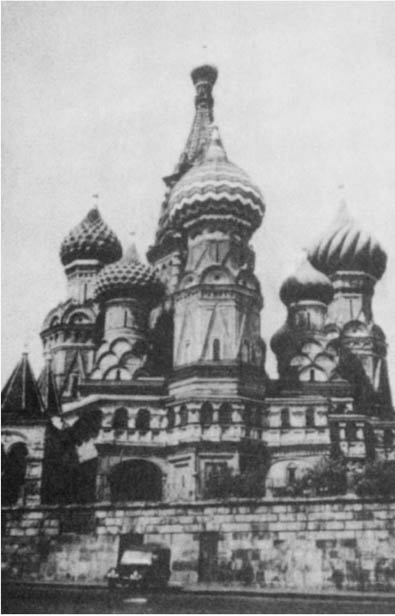
The Cathedral of the Intercession of the Virgin (St. Basil’s), Moscow.
Postnik and Barma are shadowy figures, and there is even some doubt about their names. Recently Soviet scholars found documents that suggested they were one person called Postnik Yakovlev, nicknamed Barma. Whether they were one or two matters as little as the legend that they were killed when the cathedral was completed so that their secrets would die with them. The legend is certainly untrue. What is certain is that the cathedral was both an affirmation of victory and of faith in the powers of the Virgin.
The ground plan was based on the eight-pointed star of the Virgin, an emblem which appears on her robe and headdress in innumerable Byzantine and Russian icons. From this rigid ground plan the architects improvised a cluster of domed chapels of different heights and colors around the central spire crowned with a small golden dome. In this way they were able to suggest an effortless and springing grace, the thrust of flowers, vegetables, and young trees. The secret lay in building the domes at different heights and in defying the normal laws of symmetry. Originally the platform supporting the cathedral was broken by archways leading to a vast subterranean gallery filled with what remained of the eleven wooden chapels once scattered around the Red Square; and these archways were conceived as essential elements of the design, adding to the illusion of ease and weightlessness, so that the visitor ascending the slope from the Moskva River was made suddenly aware of a spontaneous flowering. And yet everything about the building, which seems to be so spontaneous, so haphazard, was in fact carefully calculated to produce this precise effect. Out of white stone, red brick, many-colored tiles and golden domes the builders created an image of youthful daring and unself-conscious power.
When, after nearly five years of work, the cathedral was finally consecrated on October 1, 1559, in the presence of Ivan and Anastasia, the central spire had not yet been completed and it must have had a somewhat ungainly appearance. Since this central spire is the kingpin around which the eight colored domes revolve, it would appear that there were formidable problems of design, with many false starts and many delays, until the soaring pinnacle acquired its final shape. But all these delays were worthwhile. The spire, as we see it today, holds the entire complex structure together and gives it a unity it would not otherwise possess. The whole building has the quality of inevitability, which is the sign of mastery.
In later years many additions and alterations were attempted. In 1588 a new domed chapel was erected over the tomb of St. Basil.1 Turrets were placed over gateways and vaulted galleries were built late in the seventeenth century, and in the nineteenth century the archways on the platform were blocked up. But none of these changes could affect the simple majesty of a cathedral built out of so many complex elements. The Cathedral of the Intercession of the Virgin remains the supreme architectural achievement of Ivan’s reign.
Only one other surviving church from this time displays this originality. This is the Church of St. John the Baptist at Dyakovo near the royal estate of Kolomenskoye on the outskirts of Moscow. The church stands on the edge of a ravine in proud isolation from all the other churches on the estate, most of them built by Ivan’s father. It was built, at Ivan’s orders, to commemorate his adoption of the title of Tsar and as a votive offering for the birth of an heir to the throne. What is chiefly remarkable about the church is how faithfully it reflects the exaltation of the Tsar, his sense of surging power and self-conscious triumph, and this is largely brought about by the powerful thrust of short pillars supporting the massive dome. These pillars, actually half-cylinders, leap to the eye. Even if the dome weighed a thousand tons these pillars would support it, and indeed they give the impression of being powerful enough to support the whole sky. This prodigious invention was never repeated. Both the Cathedral of the Intercession of the Virgin and the Church of St. John the Baptist derive from the early years of Ivan’s reign, when he was still in his twenties. There is a sense in which both buildings may be regarded as abstract portraits of Ivan in the eagerness of his youth and the consciousness of a great destiny, when the people were buoyed up with vast hopes and an exultant Tsar sat on the throne.
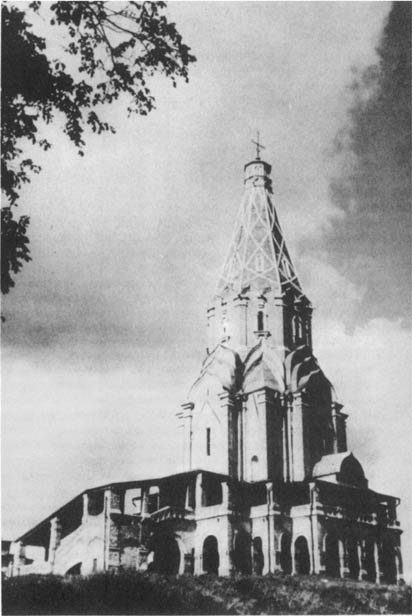
Church of the Ascension, Kolomenskoye.
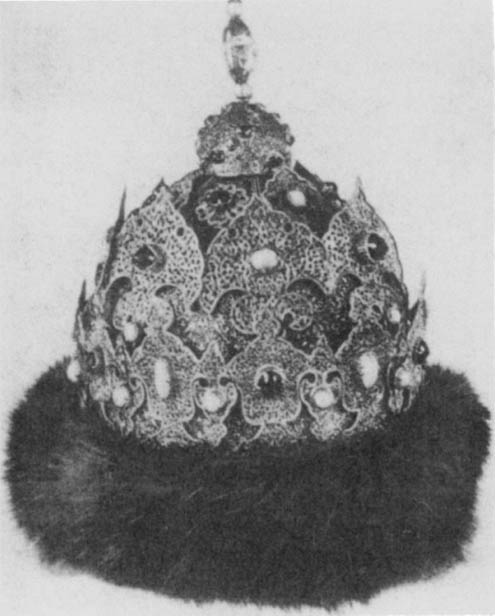
The Crown of Kazan.
This sense of exultation reappears in the crown of Kazan, which was especially made for Ivan to celebrate his victory. This crown, in its delicacy and grace, must be counted among the most superb achievements of the goldsmith’s art. Formed of leaf-shaped plaques of gold, fretted and jewel-studded, flaring up like fire, the crown represents a departure from existing Russian crowns and may have been modeled on the original crown of Kazan worn by the Tatar Khans. Many Russian crowns have perished, but the crown of Kazan survives to this day and can be seen in the collection of treasures in the Armory Museum in the Kremlin.
Another splendid creation was the gilded wooden throne, which at Ivan’s orders was set up in the Uspensky Cathedral in 1551. In twelve panels carved in walnut, four on the back and four on each side, are carved the legendary incidents in the life of the Grand Prince Vladimir Monomakh, “the greatest of the princes of Greater Russia.” According to the legend, which was elaborated toward the end of the fifteenth century, the prince, who died in 1125, received his regalia from the Emperor of Byzantium and was crowned by the Bishop of Ephesus as sovereign ruler of Russia. The twelve panels depict the reception of the ambassadors from Byzantium, his coronation, and his wars against Thrace. The carving is at once hieratic and full of movement, with a kind of monumental calm, as befitted a ruler whose historical significance was outweighed by his towering legend. This throne can still be seen in the cathedral, but most of the gilding has worn off and time has smoothed away the delicacy of the carving.
The throne was a magnificent object in its own right. For Ivan, who identified himself with Vladimir Monomakh, the throne was something more. It was the visible sign that he derived his powers from Byzantium, and he found comfort in contemplating that princely figure who was so heroic, so handsome, so deeply religious and so conscious of his imperial destiny.
If Ivan turned slightly while sitting on the throne, he would see hanging on the wall of the cathedral an enormous icon thirteen feet long and about four and a half feet wide. In the cathedral inventory the icon was called “The Blessed Army of the King of Heaven.” The knights were Russian princes and saints carrying spears and banners and moving in three columns toward the Heavenly Jerusalem, where the Virgin and Child stand at the gates to welcome them. The columns are led by the Archangel Michael, riding a winged scarlet horse, and immediately behind the archangel comes Ivan on a gray mare, wearing armor, jewel-studded boots, and a gold cuirass, and holding high a scarlet banner. Both Ivan and the archangel are looking over their shoulders at the huge and monumental figure of Vladimir Monomakh, who dominates the entire panel. He rides a black charger, wears sumptuous jeweled vestments and a gold crown, the perfect portrait of a Byzantine emperor even to the elongated jeweled cuff which he alone was allowed to wear. His features are clearly discernible, and it is not surprising that he should resemble an idealized portrait of Ivan himself with his long nose, penetrating eyes, and red hair. He wears a youthful red beard and carries himself with heroic grace, a cross in one hand, a white sudarium in the other, and he sits gracefully on a scarlet saddlecloth.
It is an amazing painting, filled with color and movement, crowded with angels who strew crowns of glory on the martyred saints and warrior princes who risked their lives in defense of the Orthodox Church and their Orthodox subjects. Above all, it is notable because it depicts the apotheosis of the youthful Ivan raised to sainthood and almost within reach of Jerusalem. In the figure of Vladimir Monomakh we see Ivan as he saw himself in his imagination: first among all the Grand Princes, greatest of conquerors, and especially dear to the Virgin and Child, who open their arms in expectation of his coming.
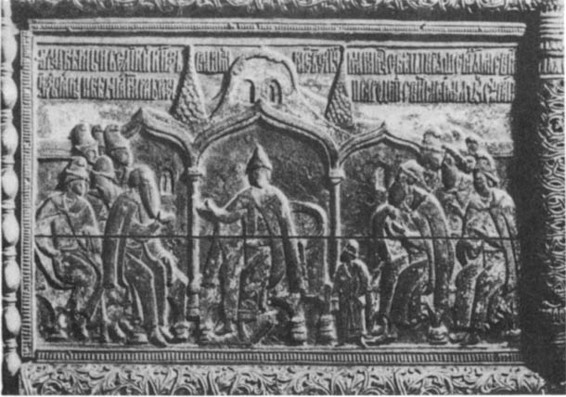
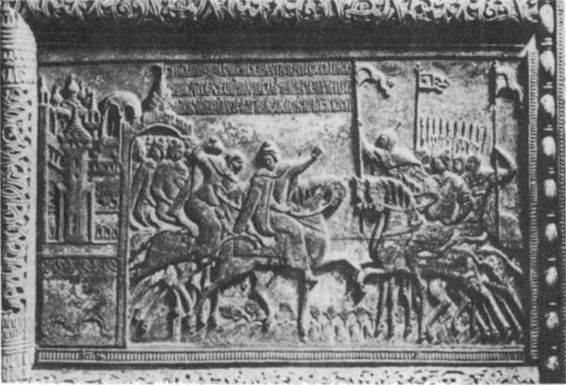
Two of the gilt panels on Ivan’s throne made in 1551, ostensibly describing the life and victories of Vladimir Monomakh. At top Vladimir Monomakh is receiving his boyars; at bottom he is starting out on a campaign.
Under Makary the Moscow school of painting undertook a grandiose program of monumental designs demonstrating the power and glory of Ivan’s reign. Was not Russia especially favored by God? Was not Moscow the third Rome? The imperial succession had been established, for while the Byzantine empire had gone down to defeat before the Turks, it had been revived in the new Muscovite empire under its sovereign autocrat, the Grand Prince and Tsar Ivan Vasilievich.
All this was expressed in the icons, frescoes, and wood carvings of the time. Most of them have perished. There survives an astonishingly detailed account written in the seventeenth century of the frescoes that once adorned Ivan’s Golden Palace, the Zolotaya Palata, where the Chosen Council met and foreign ambassadors were received. The frescoes were designed to exalt Ivan and at the same time to impress upon him a proper humility toward Christ and the Church. It appears that Sylvester was in charge of the arrangement of the frescoes and the choice of subjects. On the ceiling was the inevitable Christ in Majesty seated on a rainbow, with orb and scepter, reigning over the universe. Below Christ were the four Virtues and the four Vices. There were panels representing the four seasons, the sun, the moon, the sea, and the earth. Parables and biblical episodes were also depicted. There was the rich Lazarus in Hell and the poor Lazarus at his prayers, the parable of the wedding feast, the parable of the lost sheep, Hezekiah rising from his sickbed, Gideon waging war against the Midianites. Ivan had a particular fondness for Gideon, and some of the incidents depicted may well have been chosen by him. In the lower courses of the fresco were the portraits of Ivan’s father and grandfather, the saintly Prince Alexander Nevsky and the Grand Prince Mikhail of Tver, who refused to kneel down to Tatar idols and met a martyr’s death. Essentially the fresco took the form of a cosmic allegory, with the great princes of the past supporting the weight of the universe, while Christ, the Tsar of Tsars and Grand Prince of Grand Princes, crowned the edifice. Unfortunately the Golden Palace was torn down and rebuilt by the Empress Elizabeth many years later, and this brilliantly colored and rather confused fresco vanished with it. During the reign of Ivan the Moscow school of painters enjoyed painting immensely crowded scenes. Compositional rhythm was sacrificed, while harmony and simplicity were forgotten in an effort to include as many figures as possible.
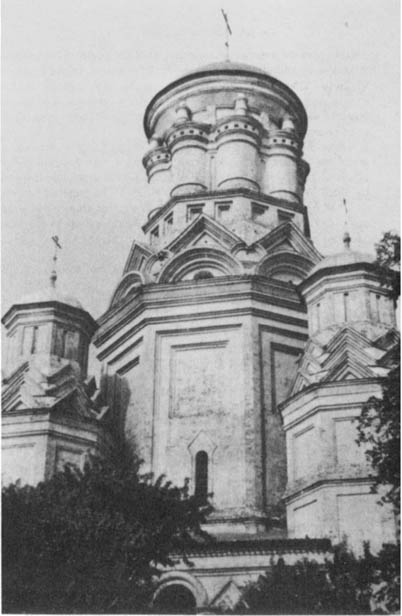
The Church of St. John the Baptist, Dyakovo.
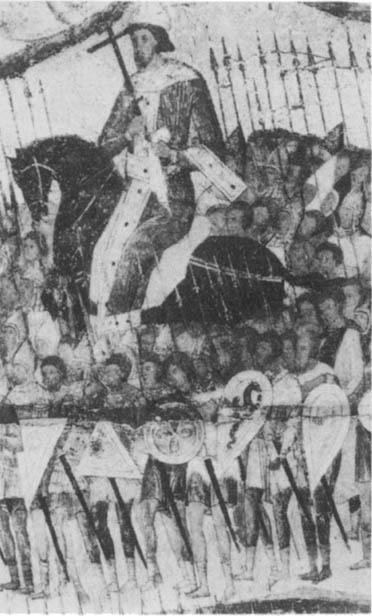
Detail from the icon called “The Blessed Army of the King of Heaven” painted to celebrate the victory of Kazan. The central figure on the black horse represents Vladimir Monomakh and is an idealized portrait of Ivan.
Not all the Russians approved of these frescoes. Ivan Viskovaty, the Secretary of Foreign Affairs, objected to the painting of Lust, depicted as a harlot with loosely hanging sleeves dancing shamelessly in close proximity to Christ. No one appears to have been surprised when the Metropolitan Makary took issue with Viskovaty, who was placed on trial before the Church Council. A three-year penance was imposed on the unfortunate layman who dared to speak out against a picture of Lust in the Tsar’s palace.
In the later years of Ivan’s reign, when the entire country was plagued with disasters, famine, war, a kingdom divided against itself, and the oprichniki embarking on large-scale murder, artists emerged with the power and the energy to depict the cruelty of the age. They did not paint the horrors they saw in front of them; instead they painted icons which subtly reflected those horrors. The colors became somber and menacing. Scenes of triumph and glory disappeared. The gold backgrounds, common during the first half of the century, were replaced by stark green and brown backgrounds; the faces of the saints became more deeply lined and acquired an earthen color; the figures were strangely isolated, standing out stark and gaunt, full of unappeasable sorrow.
One of the most remarkable icons of this time shows a gaunt John the Baptist, winged like an archangel. He is thin and haggard, his deep-set eyes haunted by death—his own death. In his left hand he carries a bowl which contains his own bleeding head. So there are two heads, one living, the other dead. Nevertheless he raises his right hand in blessing over a world which has known too much of death. Beneath the bowl there is a small withered tree gashed by an ax, with an inscription reading: “Now also the ax is laid unto the root of the trees; therefore every tree which bringeth not forth good fruit is hewn down, and cast into the fire.”
The bleak and muted color scheme offers no consolation: the background is green and brown, the flesh is earth-colored, there are scarlet lights on the ax and the saint’s powerful wings. They are the same colors that will be seen later in Grünewald’s Crucifixionat Colmar. Like Grünewald, the unknown icon painter has painted a moment of visionary terror—a saint, a tree, an ax, a bowl, all seen in the lightning flash. The saint blesses, the ax threatens, the world is entering into darkness.
From his own writings it appears that Ivan had very little visual imagination; his audial imagination was strong. It appears in the rush and roar of his sentences, his control over their turbulent music. We know that he wrote music, composed hymns, enjoyed singing and was a competent choir master. And when he writes prose, it sings vehemently.
It appears that Ivan himself may have been partly responsible for an important innovation introduced at a Church Council in 1551. Part-song, long practiced in Novgorod and Pskov, was made compulsory in the Moscow churches. Ivan enjoyed part-song and wrote at least two hymns in this mode, one addressed to the Icon of the Virgin of Vladimir, the other to St. Peter the Metropolitan. In Russian hymnology they have an assured place, and not only because Ivan wrote them. They were written with a sense of grandeur and of urgency, with deep religious feeling. Ivan wrote both the words and the music, which was transcribed with the cumbersome kryuki (“hooks”) which Russian composers derived from ancient Byzantine sources.
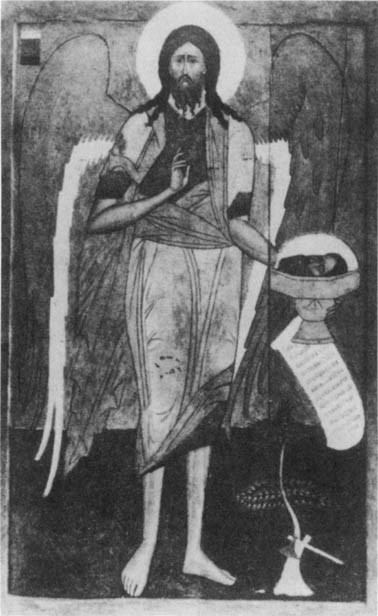
John the Baptist carrying his head, from an icon once in the Monastery of the Holy Trinity at Alexandrov, now in the Rublev Museum, Moscow, circa 1570.
Throughout his life Ivan showed a special veneration for the Icon of the Virgin of Vladimir, said to have been painted by St. Luke but in fact by a great Byzantine master of the twelfth century. This icon showed the Christ Child pressing his face with grave gentleness against the face of his Mother, and that somber painting conveys both a sense of human tenderness and divine dignity, so that it stands out among the conventional paintings of the Virgin with its sense of authority as though here, finally, there had been discovered the true lineaments of divinity in the sorrowing Mother and the compassionate Child. For the Russians the icon represented divine tenderness. It was almost the country’s pallium, to which they always returned in times of danger. It was widely believed that when Timurlane turned back before the gates of Moscow, he did so because at that very moment the icon was being carried in procession and pointed in his direction. The eleven-year-old Ivan at the time of the Crimean invasion of 1541 had thrown himself down on his knees and prayed before the icon which hung in the Uspensky Cathedral in the Kremlin.
Thus there were good reasons why Ivan should compose a hymn to the icon to be sung on June 23, the feast day associated with the coming of the icon to Moscow. He wrote:
O WONDROUS MIRACLE
Composed by the Tsar
O Thou who art most compassionate toward sinners,
O most pure Mother of God, ready comforter, our salvation and intercession,
Rejoice, O most great city of Moscow, to receive the miracle-working icon of Vladimir.
O ye faithful, let us sing forth with the bishops and the princes.
Rejoice, O joyous one, the Lord is with Thee, grant us thy great mercy.
Wondrous is thy mercy, O Sovereign Lady:
For when the Christians implore thee on their knees to deliver them from awful ruin,
Then invisibly dost Thou pray to thy Son and by this holy image saved the people.
O ye Christians, rejoice and sing forth.
Rejoice, O joyous one, the Lord is with Thee, grant us thy great mercy.
The bishops and priests, the Tsars and princes,
The monks and clergy and all the people, women and children, glorify thy intercession,
The lords and the Russian warriors kneel before thy holy icon.
They glorify Thee and sing forth unto Thee.
Rejoice, O joyous one, the Lord is with Thee, grant us thy great mercy.
Trumpet forth the song on the day of our blessed feast.
The darkness shall perish and the light will come, shining brighter than the sun:
For she is the Queen and Sovereign of all of us, Mother of God, Mother of the Creator of all human creatures, and of Christ our Lord.
As she hears the prayers of her unworthy servants, she is full of compassion and invisibly raises her arms toward her Son and our God,
And prays to him on behalf of all the Russians to deliver them from evil and from the wrath of God.
O most compassionate and sovereign Lady!
O most merciful Empress and mighty intercessor!
O Mother of God, who by thy prayers to thy Son and our God
And by the coming of thy holy and most glorious icon, which is beyond all praise,
Hast delivered the city and all its people from adversity and death.
Tsars and princes gather together, bishops and priests rejoice:
Let the assembled multitudes of the faithful of all ages sing out her praises.
Rejoice, O dwelling-place of God and living city of Christ our Lord and God.
Rejoice, O fountain of charity and mercy and providential assistance.
Rejoice, O refuge of those who come unto Thee for intercession, deliverance and salvation.
Ivan’s six strophes were trumpet blasts rather than polite invocations. They demanded with great insistence, and there was nothing humble in his prayers. He was speaking as one sovereign to another, and because he was certain the Virgin heard his prayers he spoke triumphantly.
The date of the composition of the hymn is unknown, but we learn from the fifth verse that it was composed to celebrate the deliverance of the city from the enemy. Quite probably it was composed in 1551 or 1552, at a time when he was deeply influenced by the Novgorod style of composition and by the victory over Kazan, a city which he regarded as a perpetual threat to Moscow. Yet there can be no certainty about the date of composition, for he was pious in his own way throughout his life and there was no period when he was not immersed in music.
St. Peter, Metropolitan of all the Russias, who lived in the time of the Grand Prince Ivan Kalita, had been buried within the Kremlin for over two centuries when Ivan composed a hymn in his honor. He lay now in the ornate tomb built for him in the Uspensky Cathedral, not far from the Icon of the Virgin of Vladimir. He had become the patron saint of Moscow and was worshipped as the “Sufferer for the Russian land,” because he had lived in a time of calamity when it seemed that Moscow could not survive against her enemies, and yet he had prophesied that Moscow would become one of the greatest and most powerful cities in the world if the Muscovites would build a church to the Virgin. This was done, and thereafter he always received men’s prayers. He was preeminently the saint of suffering surmounted and hope regained. His powers were of course far less than those of the Virgin, but they were believed to be sufficiently substantial to warrant the earnest attention of the faithful. Ivan’s hymn to St. Peter the Metropolitan, like the hymn to the Icon of the Virgin of Vladimir, is composed of six strophes. The first three strophes follow:
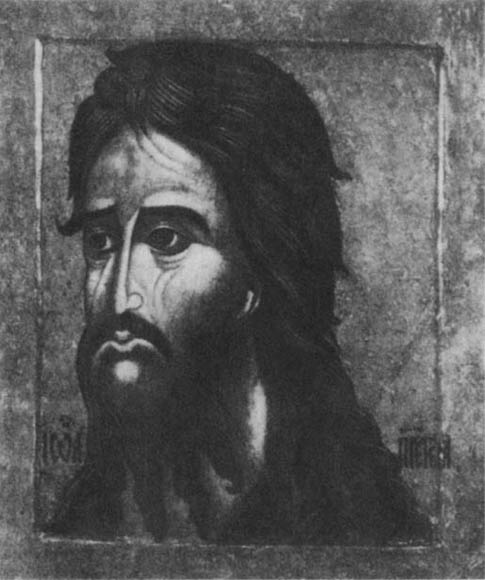
John the Baptist, from an icon once in the Church of Dmitrov, now in the Rublev Museum, Moscow, circa 1560.
HYMN IN PRAISE OF ST. PETER, METROPOLITAN OF RUSSIA
Composed by the Tsar Ivan, Despot of Russia
Let us now adorn the Bishop with crowns of praise.
He who lies in the Russian earth can be reached in spirit by all those with pure hearts.
He defends the faithful and intercedes for them, and comforts all who are sorrowful.
O Peter, stream of piety, whose waters bring joy to the Russian land,
Our ardent defender and guardian!
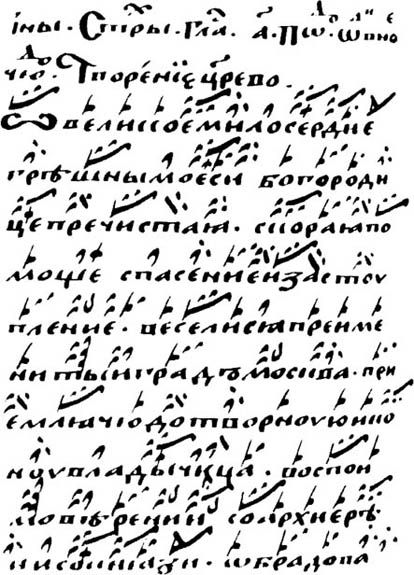
Opening verse with musical notation of the Hymn to the Virgin. The second line reads: “Composition by the Tsar.”
With prophetical hymns we crown the Bishop,
Unshakable pillar of the Church, warrior against evil, upholder of faith,
Blessed from the cradle, conqueror of Moslems, bringing shame to all evildoers,
O Peter, stream of many miracles, whose waters bring joy to the Russian land,
Our ardent defender and guardian.
With prophetical songs we praise the Bishop,
Who prophesies far into the future and brings it close to us,
Prophecies were the visions of this most pure priestly miracle-worker.
O Peter, stream of healing remedies, whose waters bring joy to the Russian land,
Our ardent defender and guardian. . . .
That an emperor should also be a hymn writer was not regarded as unusual in those times. Two Byzantine emperors, Leo IV the Philosopher and his son Constantine VII Porphyrogenitus, were famous for their hymns, which still survive.
But while Ivan was an eminent composer he has an even greater claim to fame as a prose writer. His letters, which sometimes take the form of long essays, are written in a style of violent invective—he writes out of seething anger—and with a churchman’s conscious use of biblical rhythms. It is writing on the grand scale with all the organ stops pulled out. Prince Andrey Kurbsky, whose letters drew Ivan’s fire, writes nearly as well but lacks the Tsar’s sustained vigor. In an age which produced little great prose the correspondence between Ivan and Prince Kurbsky is outstanding.
Literature was largely dominated by the Church. The lives of saints, theological arguments, homiletics, passionate statements against heresy and abstruse discussions on the nature of God, all these were produced by monks, copied and recopied, and disseminated throughout Russia. Many monasteries compiled their own chronicles, but the chroniclers sometimes differ sharply among themselves. A monk writing in Novgorod about the events of Ivan’s reign would necessarily see them quite differently from a monk writing in Moscow. Nevertheless the chroniclers are in general agreement on nearly all the main issues and they provide an invaluable historical commentary on these times. From time to time new chronicles, long buried in monastic archives, are found, and one by one the gaps in our knowledge are being filled up.
The most representative work of the age was a manual of instruction, the Domostroy, written by Sylvester to implant a proper sense of morality into the Russian people. He explains how life should be lived, and since he was hardheaded and practical he went into all aspects of household economy, discussing not only the need to be virtuous but going into such subjects as cooking, sewing, embroidering, preserving food, cultivating vegetables and orchards, the clothes to be worn in church and when visiting, and how to entertain guests, with the result that we are provided with a detailed picture of life as it was lived in the sixteenth century among the middle classes. Sylvester was a stern man, with little joy in him. He prohibited amusements of all kinds. Dancing, singing, and unedifying games like chess were prohibited. Laughter was the invention of the devil. The entire family owed obedience to the master of the household. The wife was not so much the husband’s helpmate as the chief of his servants, blindly executing his orders. She must rise before the servants, wake them, and spend every remaining moment of the day busily occupied, and even if guests came she must go on working.
Sylvester, with his pathological distrust of woman, treats her as a slave or beast of burden, and he enjoys describing the punishment to be meted out to her for her graver sins. A whipping on the bare back is recommended, but only birch twigs may be used. Iron staffs (like the staff Ivan habitually carried with him) are not recommended, nor is it permissible to punch a wife under the heart or to slap her face. Children, too, must be whipped when they do wrong. “Whip your child hard,” he writes. “It will not kill him, but on the contrary does him good, since by beating him you save his soul from perdition.” Servants fare little better than sons and daughters. “Beat your servant, even when he is in the right. Thus strife is brought to an end, and nothing is lost and there is no hatred.” One would have thought that he was encouraging hatred, but he proclaims that gentleness and patience are the greatest virtues. He offers man a cheerless life in preparation for a more cheerful Heaven.
Puritanical, stubborn, self-worshipping, and without much kindness in him, Sylvester, without being aware of it, offers us a complete portrait of himself. He is well aware of his high priestly office and encourages good Christians to be equally aware of it. Priests should be revered, for do they not take care of our immortal souls and answer for us on the Day of Judgment? One should bow low to them, invite them into our homes, heap gifts upon them, and never even think of abusing or reproaching them. They are God’s representatives on earth, but they are also God’s watchdogs. Woe betide anyone who commits evil and forgets to say his prayers!
There were prayers in Russia for all occasions and all purposes. Sylvester urged lengthy morning prayers, more prayers in the evening, and this was not the end, for after having gone to sleep the good Christian must awake at midnight and pray tearfully to Godconcerning the sins committed during the day. He wrote in the Domostroy:
When rising in the morning, you must pray for the forgiveness of sins, for the Tsar, for the Tsaritsa, for their children, for the Tsar’s brothers, for his boyars, for his Christ-loving Army, for aid against the enemy, for the release of captives, for the clergy, for those who are sick and in prison, for all Christians, for those of one’s own household, and for one’s relatives and for one’s spiritual fathers.
You must always pray at Evensong in your houses. Every evening the husband, his wife, and their children and servants must attend Evensong with the singing of hymns and prayers and bowing to the ground. And before going to bed you must bow three times to the ground, and at midnight you must wake and rise and pray tearfully to God as much as you possibly can concerning your sins.
Sylvester’s moral maxims and his detailed advice for leading the Christian life may not be very appealing to modern generations but they answered to the hard puritanical core in the ecclesiastical mind. Like Sylvester, the Russians of his age were exceedingly devout, believed firmly in the efficacy of prayer, adored ritual and flocked to the churches to take part in the awe-inspiring services. The Orthodox Church was a living force that penetrated into all regions of human life. And while Sylvester was the first to produce a manual of Christian instruction which described how men should behave at every moment of the day, much of what he said had long since been said by others. He practiced what he preached, and those who knew him well regarded him as an exemplary head of his household, who loved his dependents and provided well for their future, practical and honest, a man who engaged in trade and usually made a profit, and men liked to have dealings with him. But there was also a sharp, astringent side to his character, and too often he was overbearing. “Imitate me!” he wrote to his son. “See how I am respected by all, loved by all, because I have been able to please everyone!” He did not please everyone, for Ivan, who spent many years under his tutelage, rebelled violently against him and thought he had wasted his life in obedience to his stern taskmaster. Sylvester must bear some blame for Ivan’s erratic conduct. He had pressed down too hard; insisted too often; demanded too much. Ivan’s rebellion took the form of a total repudiation of all the restraints imposed upon him.
Sylvester’s book was widely read and hundreds of manuscript copies were distributed, but it was not printed until the following century. Printing came late to Russia, the first printed books appearing more than a hundred years after Johann Gutenberg printed the Vulgate Bible. After the conquest of Kazan Ivan began to think of the needs of the people living in the conquered territories, and ordered churches to be built and religious books to be provided for them. Someone pointed out that the available manuscript copies of Psalters and the New Testament were riddled with copyists’ errors and only a very small number of accurate copies could be found. “When the Tsar heard this,” wrote Ivan Fyodorov, the first Russian printer, “he began thinking that it would be good to have printed books like those which exist in Greece, Venice and Italy.” With the blessing of the Metropolitan Makary Ivan set about finding a man who would learn how to print, and his choice fell on Ivan Fyodorov, the deacon of the Church of St. Nicholas Gostunsky, which stood in the Kremlin. The first Russian printing office was set up in the church.
Of the early trials of the printing office we know very little. It appears that Fyodorov learned his trade with the help of an Italian printer, for Italian technical terms were used from the beginning. The first book, Triod Postnaya (Lenten Psalms), was undated but was almost certainly printed about 1554. This was followed by Triod Tsvetnaya (Easter Psalms) and by a New Testament. The printing was unskillful, the red ink for the initials was smudgy, and some of the pages of Triod Postnaya were mixed up. The first dated book was the Apostol, containing The Acts of the Apostles and all of St. Paul’s Epistles. Fyodorov began printing the book in April 1563 and completed it in March 1564. The work was painfully slow. Later in the year he produced a Book of Hours which was completed in two months, and in the following year he brought out another New Testament. But the first flowering of printing on Russian soil was very brief, and soon Fyodorov departed for Lithuania, taking his printing press with him. He complained that he left Moscow because certain ecclesiastical authorities were accusing him of heresy and making life difficult for him. “Because of this unreasonable envy and hatred,” he wrote later, “we were expelled from our land, from our fatherland, from our people, to other lands unknown to us.”
Ivan showed only a desultory interest in the printing of books. In 1568, at the height of the Oprichnina Terror in Moscow, two printers, Andronik Nevezha and Nikifor Tarasiev, both students of Ivan Fyodorov, were permitted to print a Psalter, and nine years later at Alexandrova Sloboda a second Psalter was printed by Andronik Nevezha. In Ivan’s reign no more books were printed.
Because he possessed a vast private library of manuscripts, Ivan was among the most highly educated men in Russia. He wrote with passionate intensity in defense of his autocracy, his absolute dominion over the lives of his subjects; and if, even in his own time, he failed to be convincing, it was not for lack of any command of language. So Justinian might have spoken if anyone had dared to question his absolute supremacy over his subjects, and like Justinian he celebrated only those arts that served his own glory. It would never have occurred to him that any other glory was worth contemplating, for the glory of God was manifest in the Tsardom.
Thus he became a composer of hymns and a benefactor of architects and painters, but only when they celebrated his own greatness. The Cathedral in the Red Square and the Church of John the Baptist at Dyakovo showed to what heights Russian architecture might have risen if he had not succumbed to the overwhelming sense of anxiety that shadowed all his later years. The arts of his time reflected his early triumphs, but they also reflected his anxieties, his despairs, and the horrors of the closing years of his reign.
1 St. Basil was canonized by the Orthodox Church in 1588. He was born in 1469, the son of peasants belonging to the village of Yelokhino near Moscow. While apprenticed to a shoemaker, he discovered that he possessed the gift of second sight. A customer entered the shop and asked for a pair of boots that would last for several years. Basil took the order and smiled. When he was asked later why he smiled, he said the customer would not need a long lasting pair of shoes because he would die tomorrow. And so it happened.
Soon he left the shoemaker’s shop and became a yurodivy, wandering naked about the city, wearing heavy chains, and sleeping under the stars. One day, in the marketplace, he scattered a tray of cakes on the ground. It had been revealed to him that the cakemaker had added chalk to the dough. On another occasion he was walking in the square wrapped in a fur coat given to him by a rich benefactor. A thief approached him, pointing to another pretending to be dead, and asked Basil for his coat, saying that it would pay for the funeral expenses. Basil saw through the ruse and said to the man pretending to be dead: “You will surely die for your wickedness, for it is written that the wicked shall perish.” And so it happened.
Ivan honored Basil, and with Anastasia visited him when he was lying on his deathbed. When Basil died in 1552, Ivan accompanied the bier to the small cemetery of the Troitsa Church on the Red Square. Over this cemetery the Cathedral of the Intercession of the Virgin was built, but Ivan ordered that Basil’s bones should remain untouched. The tomb, with the chains lying on it, became an object of veneration and many miracles were said to have been performed there. In this way Basil became one of the many saints of Moscow.