

ON MAY 9, 1553, Sebastian Cabot, a Venetian by birth and an Englishman by adoption, finished writing a long and detailed set of instructions for the captains and crew of the three ships he was sending from London to Cathay. He was in his seventies, very old, very venerable, and very powerful, for he had been appointed governor for life of an extraordinary institution called the “Mystery and Company of the Merchant Adventurers for the Discovery of Regions, Dominions, Islands, and Places Unknown.” The three ships were the Edward Bonaventure, 160 tons, the Bona Speranza, 120 tons, and the Bona Confidentia, 90 tons. He believed that in the space of a few weeks they would reach Cathay by way of the northeast passage.
Cabot’s instructions were contained in thirty-three paragraphs which distilled the learning acquired during many voyages of discovery. The crew were instructed to dress properly at all times, to be obedient to their captains, to avoid blasphemy, drunkenness, and the telling of filthy stories, and to make careful notes of everything they saw. They should not be afraid of foreigners wearing lion skins or bear skins, for such people are usually less dangerous than they seem to be, but they should be especially on guard against naked swimmers armed with bows and arrows, who might attempt to clamber on board and seize “the bodies of men, which they covet for meat.” Cabot paid particular attention to the first confrontations with foreigners and suggested that when they rowed ashore in their pinnaces, the sailors should sing and play musical instruments to show that they came joyfully, but afterward they should attempt to entice some of these foreigners onto their ships and make them drunk on wine or spirits, thus learning their secrets. It was sensible advice, and there was some evidence that it was faithfully followed.
Two days after drawing up his set of instructions Cabot watched the three ships sailing down the Thames. They sailed past Greenwich Palace, where the fifteen-year-old King Edward VI lay dying, and they fired a salute in his honor. A few days earlier the King had signed a letter addressed to the Emperor of Cathay and all other kings and potentates in the northeast parts of the world, which, it was hoped, Sir Hugh Willoughby, the captain-general of the fleet, would place in their hands. The fleet vanished into the North Sea and nothing more was heard of it for a year. In the summer of 1554 the Edward Bonaventure returned to England with the news that the Bona Speranza and the Bona Confidentia had been caught in the ice off the coast of Lapland and all their crews had perished. Richard Chancellor, captain of the Edward Bonaventure, had reached Moscow and been entertained by the Tsar of Russia.
Chancellor’s account of his journey to Russia is one of the most satisfying documents of the time. He sees vividly and directly, and we have the feeling of being present by his side. He liked the Russians, marveled at their hardness and straight living, and was impressed by the brilliant luxury of the Tsar’s court. The Russian soldiers were unbelievably tough, living on oatmeal and water, capable of defying the cold for months on end. “Yea and though they lie in the field two months, at such time as it shall freeze more than a yard thick, the common soldier hath neither tent nor anything else over his head. The most defense they have against the weather is a felt, which they set against the wind and weather, and when snow cometh he doth cast it off, and maketh him a fire, and layeth him down thereby.” But if the soldier was wonderfully capable of resisting cold, Chancellor had not much good to say of him as a fighter. “They run hurling on heaps,” he wrote, “and for the most part they never give battle to their enemies; but that which they do, they do it all by stealth.”
He was appalled by their poverty and half-admired the poor for being able to eat rotten fish and then proclaiming that it was sweeter than fresh meat. They told him that life in prison was better than life outside, and would have been paradise “except for the great beating.” In prison men get meat and drink without labor; there is always merriment in prison, and well-disposed people give them charity. “But being at liberty they get nothing.”
From the mouth of the Dvina River on the White Sea Chancellor made his way to Moscow and was cordially received by Ivan. He was almost blinded by the glitter of sumptuous gold garments when he entered the throne room in the Kremlin. Ivan sat on his high, gilded throne, wearing “a long garment of beaten gold, with an imperial crown upon his head, and a staff of crystal and gold in his right hand, and his other hand half leaning on his chair.” Chancellor presented the letter signed by Edward VI, and Ivan then graciously asked about the health of the King of England, and Chancellor replied that he believed the King was in good health; in fact he was dead, and “bloody Mary” was on the throne of England. A little while later Chancellor was invited to dine with the Tsar. By this time Ivan had changed into a gown of silver and sat on a high chair apart from his nobles, who were dressed in cloth of gold. Chancellor was struck by the profusion of massive gold plates, cups, and salvers; liveried servants with napkins over their shoulders waited upon two hundred guests at tables spread with white tablecloths. Great handfuls of bread were given out by the Tsar to his favorites, and the master of ceremonies announced that these gifts came from the hands of Ivan Vasilievich, Tsar of Russia and Grand Prince of Muscovy. The Tsar’s cups flashed with jewels. Chancellor observed that Ivan had a good appetite for drink and sometimes drained his cup at a single throw.
The great meals enjoyed at Ivan’s court were to become familiar later, and we have many accounts of them. But Chancellor preserves details which many forgot. He observed that when Ivan took bread or a knife in his hands, he always crossed himself on his forehead, and that the servants changed their uniforms three times during the course of a meal. Dinner was a lengthy affair, beginning in the afternoon and going on into the evening, when the candles were brought in, and the Tsar, in bidding his guests farewell, recited all their names apparently to assure them that they were in good standing. It was a remarkable feat of memory and Chancellor was suitably impressed.
But what chiefly impressed him was the Tsar’s majesty, his ease and dignity. “There was a majesty in his countenance proportionable with the excellency of his estate,” Chancellor wrote. He was impressed, too, by the astonishing luxury of the Tsar’s appointments, for even his tents were made of cloth of gold and hung with jewels; and he observed that the Tsar liked to wear different crowns at different times of the day, and he might wear two crowns during the course of a single dinner.
Chancellor was a man of many gifts, and had no difficulty making himself pleasant to the Tsar, who rewarded him with a letter to King Edward VI that was remarkable for its generosity of feeling. The Tsar granted all Chancellor’s requests. Henceforth the English might have “their free Mart with all free liberties through my whole dominions with all kind of wares to come and go at their pleasure.” The letter, dated February 1554, was written in Russian and accompanied by a Dutch translation. Attached to it was the great seal of the Tsar, which showed a man on horseback treading a dragon underfoot.
In the following year Chancellor returned to Moscow, this time bearing a letter from Queen Mary written in Greek, Polish, and Italian, for in all England there was apparently no one who knew Russian sufficiently well to write in it. Once again there was a set of instructions: the travelers were earnestly requested to make inquiries about the sea and land routes to Cathay, and to abstain from drinking and fighting while in Russia. George Killingworth was appointed the first English agent in Muscovy, and the Tsar was much taken with this former draper who sported a beard “which was not only thick, broad and yellow coloured, but in length five foot and two inches of assize.” Killingworth reported that the great secretary of state, Ivan Mikhailovich Viskovaty, whom he calls Ivan Mecallawich Weskawate, was regarded as “their very friend”; and indeed the Englishmen received nothing but friendship at court.
One of the fruits of the second journey to Moscow was a detailed inventory, signed by the Tsar, of the rights and duties of English traders in Russia. It could scarcely have been more favorable. The English were permitted to trade without paying duty throughout Russia; disputes between English and Russian merchants would be decided by the Tsar himself; no Englishmen could be arrested for debt provided they possessed surety; and disputes among the English were to be judged by the agent and, if necessary, the Russian authorities would imprison the guilty one or provide the instruments of punishment. If an English ship sailing to or from Russia was in any way damaged, robbed, or attacked by pirates, the Tsar himself promised to indemnify the shipowners. The exact words were: “We shall doe all that is in us to cause restitution, reparation, and satisfaction to bee duely made to the said English marchants by our letters and otherwise, as shall stand with our honour, and be consequent to equitie and justice.” No doubt there were legal loopholes in the ten separate clauses of the agreement, but it gives the impression of having been drawn up by men of good faith, who were determined to bring about an equitable understanding between the two countries.
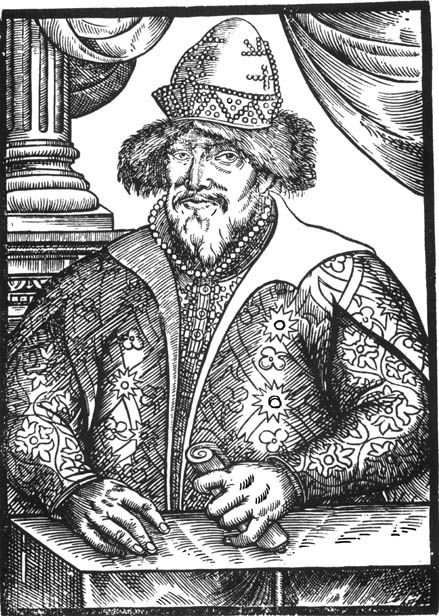
A contemporary German engraving of Ivan the Terrible.
Ivan wanted more trade, especially in materials of war, and proposed to send an ambassador to England when Chancellor made the return journey. His choice for ambassador fell on Osip Nepea, a high official in Vologda, who was apparently celebrated for his oratory, for he was described as “ambassador and orator.” The letters written by the Tsar to the English court were addressed to monarchs whose titles were as lengthy as his own. Mary, the daughter of Henry VIII and Catherine of Aragon, had married Philip II of Spain, who thus became King of England. Ivan’s letter was accordingly addressed to “the most famous and excellent princes, Philip and Mary by the grace of God, King and Queen of England, Spain, France and Ireland, Defenders of the Faith, Archdukes of Austria, Dukes of Burgundy, Milan and Brabant, Counts of Hapsburg, Flanders and Tyrol.” So many possessions in the hands of the King and Queen of England powerfully disposed Ivan toward them, and he was very hopeful that the embassy would be successful.
On July 20, 1556, Chancellor sailed from the White Sea in the Edward Bonaventure with a cargo of wax, train oil, tallow, furs, felt and yarn to a value of £20,000. In addition the ship carried an enormous collection of sables, including four live sables, as a gift to the King and Queen of England, who were also presented with a large white gerfalcon with a gilded lure. Nepea, who was a merchant as well as an ambassador, brought with him a cargo valued at £6,000, which represented a considerable fortune. Three other ships, the Philip and Mary, the Bona Confidentia, and the Bona Speranza, accompanied the Edward Bonaventure.
Of all these ships only one, the Philip and Mary, reached London after being blown off course and taking nine months to make the journey. The Bona Speranza vanished and was never heard of again. The Bona Confidentia struck on the rocks of Norway and sank with its whole crew. The Edward Bonaventure, after a stormy passage of four months, came to grief during a storm in the Scottish Bay of Pitsligo, where it was dashed to pieces on the rocks. Chancellor went to the aid of the Russian ambassador, and was drowned. His son was drowned; most of his crew was lost; and of the sixteen Russians who accompanied the ambassador seven were lost. Nothing was left of the ship, and what cargo spilled ashore was plundered by the villagers living nearby. The shipwreck occurred on November 10, 1556; news of it reached London on December 6; and it was not until December 23 that two envoys, sent at the express command of Queen Mary, reached Edinburgh to placate poor Nepea, who had been ill-treated by the villagers and had watched what remained of his cargo being “conveyed away, concealed and utterly embezzled.” Sometime later the Queen ordered a commission of inquiry to discover exactly what happened to the cargo. One hundred and eighty witnesses were examined; they all told their stories, but none professed to know what had happened to the treasure of gold, silver, jewels, costly furs, and rich apparel which had once been on the Edward Bonaventure. All that was ever discovered were a few small parcels of wax.
The Russian ambassador finally arrived in London on February 27, 1557, escorted by a bevy of noblemen. He was lodged in a merchant’s house, was given gold cloth, silks, and velvet, and a fine horse with rich trappings, and received with honor wherever he went. When he rode out to meet the Lord Mayor of London, three hundred horsemen accompanied him, and it was more like a triumphal procession than the visit of an ambassador. People in the streets ran after him, to feast their eyes on the first Russian ambassador who ever set foot on English soil. Since the merchant’s house was somewhere in the north of London, it was decided to give him lodgings closer to the center of London. Lodgings were found for him in Fenchurch Street, with a rich cupboard of plate and the best furniture and hangings available, and as he entered his new lodgings a messenger arrived from Queen Mary with more gifts of cloth of gold, damask, and crimson and purple velvet. Finally on March 25 he was received by King Philip and Queen Mary at Westminster. The letters from Ivan were translated into English and Spanish; their Majesties embraced him, and all kinds of entertainments were prepared for him before he returned to his lodgings by ship along the Thames.
Nepea made a good impression on the English. He was very grave, very courteous, and carried himself with stately demeanor, as befitted the representative of a great imperial power. As a special honor, he was invited by King Philip and Queen Mary to attend the annual celebrations of the knights of the Order of the Garter, which always took place on St. George’s day, April 23. Six days later there was a banquet in his honor at Draper’s Hall. But there were agreements to be concluded and much business to be done, and on May 3, 1557, he left London for Russia on board the Primrose, Anthony Jenkinson being the captain-general of a small fleet of four well-equipped ships which all reached the White Sea safely.
Jenkinson was no ordinary seaman; he had the modern temper: cool, restrained, with a gift for clear-cut observation, wildly adventurous. He was scarcely out of his teens when he traveled across Europe, visiting France, Spain, Portugal, Flanders, the Netherlands, Germany, and Italy. He knew all the islands and seaports of the Mediterranean, and had been to Damascus and Jerusalem. His secret ambition was to reach China, and for him Russia was only a way station, a temporary halting place, on a longer journey. He reached the bay of St. Nicholas in the White Sea with his fleet on June 12, and while Nepea immediately set off for Moscow to report to the Tsar, Jenkinson deliberately delayed his journey at Kholmogori and Vologda, then the major centers of the salt trade and the chief entrepôts of the north. He wanted to study the Russian way of building boats, how they traded, how they went about their affairs; and mostly he traveled by boat, spending the night on the river bank. When he reached Moscow in December, he knew more about northern Russia than any Englishman and most Russians.
He had his first audience with Ivan on Christmas Day. The Tsar sat on his throne, wearing a richly jeweled crown. He was robed in cloth of gold, and in one hand he held a gold scepter. His brother Yury and the twelve-year-old Utemish Guirey, Khan of Kazan, sat beside him. Jenkinson evidently made a good impression on the Tsar, who invited him to dinner and set him down at a small table immediately facing him. Like many others who were invited to dine in the Kremlin, Jenkinson was awed by the splendid barbarity of the scene: the gold and silver plate on his own table, the jewel-studded goblets, the cupboards filled with sumptuous plates on display. Jenkinson calculated that a single gold cup set with precious stones was worth four hundred pounds sterling. A gold receptacle, decorated with fortress towers and dragons’ heads, dominated the rest, for it was six feet long. Never had he seen such a display of conspicuous wealth, and his head reeled.
At the end of the banquet the Tsar called him by name and gave him a goblet filled with wine, and everyone rose to salute him.
A few days after Christmas came the ceremony of blessing the water. Jenkinson wore Russian dress and accompanied the procession to the river, which was frozen over. The Tsar stood bareheaded among his nobles while a hole was cut in the ice, and then the Metropolitan blessed the water and sprinkled it on everyone around him.
That done, [wrote Jenkinson] the people with great thronging filled pots of the said water to carry home to their houses, and divers children were thrown in, and sick people, and plucked out quickly again, and divers Tatars christened, all which the emperor beheld. Also there were brought the emperor’s best horses to drink at the said hallowed water. All this being ended, he returned to his palace again and went to dinner by candlelight and sat in a wooden house very fairly gilded. There dined in the palace above three hundred strangers, and I sat alone as I did before directly before the emperor, and had my meat, bread, and drink sent me from the emperor.
Jenkinson was a proud man, and felt that he was receiving his due. He was fascinated by Russia and by the Tsar, but still more fascinated by the prospect of exploring the vast regions of the Orient, with China hovering like a mirage at the end of the journey. Accordingly, with the hope of reaching China, he acquired safe-conducts from the Tsar which permitted him to travel down the Volga to Astrakhan and beyond. He never reached China, but he succeeded in sailing across the Caspian and arrived in Bokhara shortly before it was sacked by the Prince of Samarkand; then, sadly, he returned to Moscow, bearing presents for the Tsar—a white cow’s tail and a Tatar drum—and a Tatar girl called Aura Sultana, who was later presented to Queen Elizabeth.
As he journeyed along the Volga, Jenkinson observed that the Nogay Tatars were suffering terribly from famine, plague, and war. Many of the survivors fled to Astrakhan, hoping to find food and shelter, but the Russians drove them away or sold them into slavery, and the banks of the Volga near the city were strewn with dead and decaying bodies. They were “like to beasts unburied, very pitiful to behold,” and Jenkinson found himself wondering why the Russians had not made greater use of them. They were an admirable people, proud, independent, and resourceful, but helpless against famine and the plague.
The Russian attitude toward the Tatars was ambiguous: they were admired and detested, feared and loved. Many of the Tatar princely families married into the Russian nobility, and there was scarcely a family in Russia which had not received some admixture, however slight, of Tatar blood. But the Tatars were predators, by instinct and training hostile to settled government, and capable of extraordinary savagery. The Khan of the Crimea, with the support of the Sultan of Turkey, continually raided Russian territory. The Russians, in turn, raided the territories of the Khan. In the spring of 1558 a particularly successful raid was carried out by Prince Dmitry Vishnevetsky in the regions immediately north of the Crimea. This was a deep thrust into Tatar territory, and the Khan was determined upon revenge. Later in the year, hearing that Ivan was marching with his troops against Livonia, the Khan raised an army of a hundred thousand men and ordered a three-pronged attack on Ryazan, Tula, and Kashira. In fact, Ivan was still in Moscow, the Russian army had not set out for Livonia, and the Tatars withdrew when they reached the Mecha River, a tributary of the Upper Don. The Russians drew the inevitable inferences. The time had come to attempt the conquest of the Crimea.
By February 1559 all the preparations had been completed and the plan of attack had been worked out. Daniel Adashev, the younger brother of Alexey Adashev, was given command of an army of 8,000 men and ordered to sail down the Dnieper and attack the Crimea by sea from the west. Simultaneously Prince Dmitry Vishnevetsky was ordered to sail down the Donets and the Don to Azov. There they would build ships, cross the Sea of Azov, and attack the Crimea from the east. The double attack was well conceived, but only Daniel Adashev’s army succeeded in engaging the enemy. At the mouth of the Dnieper they captured two Turkish ships and forced the captains to sail toward Perekop. Suddenly the Russians spread out and attacked all the Tatar camps and settlements near the coast. The maneuver was brilliantly conducted. The Tatars were taken by surprise, many were killed, many more were captured, and huge herds of camels were destroyed. The pillage continued for more than two weeks. Daniel Adashev was specially pleased because he was able to bring about the release of many Russian and Lithuanian prisoners of the Tatars.
The Russians had no navy, but the two Turkish ships served them well. Filled with plunder and prisoners of war, the ships were forced to sail back to the Turkish fort of Orchakov at the mouth of the Dnieper. To the commanders of the fort, Adashev explained with perfect politeness that he had no quarrel with the Sultan of Turkey and surrendered the two ships together with some Turkish captives, and then transferred his army to the same small boats which brought them down the Dnieper. The Turks, though allied to the Tatars, were equally polite, showered gifts and provisions on the Russians, and murmured understandingly when Adashev explained that the expedition had been undertaken as an experiment and there would be more such expeditions in the future. And when Adashev’s small fleet sailed up the Dnieper, the Turks bade them a courteous farewell.
The Lower Dnieper has hundreds of islands and is surrounded by marshlands. Traditionally it was the home of pirates and outlaws. Here twenty men could stand up against an army of a thousand and vanish into the morning mists. The Tatars marched along the banks of the river in search of the elusive Russian fleet and sometimes found it. But the Tatar arrows were no match for the Russian muskets, and there were few serious engagements, even though the Khan of the Crimea swore that at all costs he must avenge the insult to his honor. After six weeks the Russians reached Monastyr Island, which they fortified, having learned that the Khan had sworn to destroy them on the island. But the expected attack never came, the Khan retreated to the Crimea, and from Moscow Ivan sent a delegation to the island to congratulate Adashev on his victory and to distribute gold medals to his soldiers. The supremacy of Russian arms had once more been vindicated. According to the chronicles, Ivan was inclined to give himself much credit for the success of the expedition. “As a result of the Tsar’s prayers, his wisdom and courage, a great miracle occurred,” wrote the chroniclers. Prince Vishnevetsky’s expedition was less miraculous. He failed to reach the Crimea, but succeeded in destroying a column of Crimean Tatars who were attempting to slip into Kazan. Soon there came the welcome news that the Crimea was suffering from famine and that the Cossacks left behind by Adashev were continually raiding the enemy’s camps. Ivan began to believe that the Crimea would soon be added to his crown.
But there were enemies nearer home who demanded his attention. These were the Livonians, who occupied the southern shores of the Gulf of Finland, ruled by the Knights of the Livonian Order. The knights were German, who commonly spoke German in their great cities of Riga, Reval, Dorpat, and Narva, while permitting their peasants to speak in their own Latvian and Estonian dialects. Rich and powerful, dominating the Baltic, the knights were determined to prevent Russia from expanding westward to the sea. In 1242 the knights were defeated by Alexander Nevsky, Grand Prince of Novgorod, in a famous battle on the ice of Lake Peipus, but their essential aims remained unchanged. Livonia was a hammer poised over Russia.
There was no love lost between the Germans and the Russians. The feudal knights were masters of the arts of blockade. They permitted no guns, no gunners, no armor, no armorers, no metal-smiths, no skilled artisans to enter Russia under pain of death. Determined to isolate Russia from the military inventions of the West, they succeeded only in alienating the Russians, who regarded the Germans as interlopers and all of Livonia as their own ancestral property. For more than fifty years Livonia and Russia had lived together in an uneasy peace. Tempers on both sides were wearing thin, and by the late fall of 1557, on the excuse that the city of Dorpat had failed for fifty years to pay tribute to the Grand Princes of Muscovy, Ivan mounted an army of 40,000 men on the Livonian frontier under command of Khan Shigaley of Kasimov. The failure of Dorpat to pay tribute was merely one of many things that exasperated Ivan, who wanted to break the blockade and to acquire a seaport on the Baltic.
The Livonians acted quickly. They preferred to fight at a time and place of their own choosing, and therefore sent ambassadors to Moscow to negotiate a truce. In particular, they offered to pay a yearly tribute of 1,000 gold ducats and a lump sum of 45,000 talers. Ivan asked them whether they had brought the money with them, and learned that they had not. He therefore invited them to a state dinner at which they ate off empty plates. Then, still hungry, they were permitted to return to Livonia. In the following month Ivan unleashed his army. It was to be a punitive expedition designed to ravage and destroy as much of Livonia as possible, with no frontal assaults on the fortresslike cities. Those who suffered most were the peasants, not the knights and the landowners. Next time the Livonians would come to the conference table with money in their pockets.
The war against Livonia was protracted, inconclusive, curiously unreal. Senseless and inexplicable acts were continually taking place. For example, the German gunners in Narva suddenly opened fire on the nearby Russian city of Ivangorod during a period of truce and while Livonian ambassadors were in Moscow negotiating a peace treaty. The bombardment continued for two weeks, thus demonstrating that the guns were not being fired accidentally. Ivan was enraged, dismissed the ambassadors after demanding an increased indemnity, and ordered that Narva should be bombarded in turn. This was done, a new embassy arrived from the people of Narva, and the Tsar graciously accepted their allegiance, promising them the same freedoms they possessed under the Livonian Order—freedom to trade as they pleased, freedom to retain their ancient customs. Suddenly and unpredictably, at almost no cost, Ivan had obtained what he wanted above all—a window on the west. For twenty years Narva remained a Russian city and Russian merchandise flowed uninterruptedly into the Baltic.
The Order of the Livonian Knights was dying of a familiar disease: they had lost confidence in themselves. Each feudal city cherished its independence at the expense of the other cities. Having acquired Narva, Ivan resolved to capture Dorpat, the largest and richest city in central Livonia. The city had to be taken by assault or by demonstrating overwhelming force. In July 1558, Prince Peter Shuisky surrounded the city, which had been abandoned by the knights and was defended by 2,000 mercenaries. Hermann Vieland, Bishop of Dorpat, took command. He was no match for Prince Shuisky, who under cover of darkness and fog built towers against the walls and dug tunnels under them. At the appropriate time he ordered the beating of drums to attract the attention of the populace and then announced that they had two days to decide whether to surrender or be annihilated. He threatened that not a single man, woman, or child would be left alive if they refused to surrender.
The prince-bishop was a man who knew the Russians well and was aware that the Russians had no real intention of destroying the city. He drew up a long list of conditions. The religious beliefs of the people must be respected, the nobility must be allowed to retain their lands, no Russian soldiers must be billeted on the good citizens of Dorpat, all crimes must continue to be judged by the city courts, and no citizen of Dorpat could be deported to Russia or indeed to any other place. All together fourteen conditions were presented to Prince Shuisky, and they were all accepted. On that same day, July 18, 1558, the city gates were opened and the Russian army marched in. The prince kept his word, the people of Dorpat were treated courteously, the nobility retained their land and took the oath of allegiance to the Tsar while Bishop Vieland and some of the people left the city. At a banquet given for the dignitaries of Dorpat Prince Shuisky announced, “My house and my ears will be open to all. I have come to punish the wicked and to protect the good.”
Such sentiments from the lips of. Russian military commanders were highly unusual, but there was a simple explanation. Ivan had reached the conclusion that all of Livonia could be conquered without the loss of a single soldier; all that was necessary was to employ blandishments and threats. By promising the Livonian cities their freedom once they had sworn allegiance to the Tsar he was ensuring their submission. In this way some twenty fortified towns in Livonia surrendered without resistance.
Not all the Livonian towns surrendered. Reval, although promised greater privileges than before, refused to submit and the Russians therefore devastated the countryside around it. Punishment for smaller towns which resisted was swift and sure: they wereburned to the ground and the people were massacred. Prince Shuisky’s campaign ended in the fall. The Tsar offered an exuberant welcome to his victorious generals at the Troitsa-Sergeyevsky Monastery, where prayers were offered in celebration of so many victories, and then he escorted them to his small palace at Alexandrova Sloboda, where they were presented with furs, jeweled goblets, and suits of armor. In addition he offered them great estates and permitted them to choose horses from the royal stables. To the provincial nobility, who made up most of the army, he gave estates in Livonia.
Although Russian garrisons were left behind in the Livonian towns, the bulk of the army was disbanded. The Knights of the Livonian Order took this opportunity to mount an offensive against the fortress at Ringen, which they captured. The Russian prisoners, numbering between two and three hundred, were thrown into the fortress dungeons. A few days later, fearing that Russian reinforcements might soon arrive, the knights abandoned the fortress, leaving the prisoners to die of starvation in the dungeons.
In January 1559 the Russians returned in force to resume a war of devastation. Gottgard Kettler, Grand Master of the Livonian Knights, turned in desperation to Gustavus Vasa, the Swedish King, for help and was rejected. The city of Reval sought the help of King Frederick II of Denmark, who obligingly wrote to the Tsar, urging him to send no more troops into Livonia. Ivan thundered that he had every right to send as many troops as he liked into Livonia, because it was his own property. “Since the days of our ancestors all the Livonians have been our subjects,” he declared. Nevertheless he was prepared to declare a truce to please the King of Denmark. Let Gottgard Kettler come to Moscow and swear allegiance to the Tsar: peace would be immediately established. Kettler turned for help to Sigismund II Augustus, King of Poland and Grand Prince of Lithuania. At all costs he was attempting to avoid coming under Russian dominance. Sigismund II Augustus offered him a treaty of alliance on condition that the southeastern region of Livonia was ceded to him; the German states sent soldiers; it appeared that a Grand Alliance of Germany, Poland, Lithuania, and Livonia was about to come into being, with inevitable disastrous results to the Russians. But the campaigns fought during the winter were inconclusive, and in January 1560 Sigismund II Augustus sent ambassadors to Moscow with instructions to seek out a settlement on the basis that the Grand Master of the Livonian Knights had become a vassal of the King of Poland and Grand Prince of Lithuania. Ivan was not amused by this argument. He wrote to Sigismund II Augustus:
God knows, and so do all the rulers and all the people, to whom Livonia rightfully belongs. From the time of our ancestors until this day Livonia has always belonged to us. With our knowledge and agreement Livonia chose German Grand Masters and German priests, but always paid tribute to us. Your demands are laughable and improper.
It has come to my knowledge that the Grand Master has been to Lithuania and illegally offered you some fortresses. If you desire peace, remove your people from them, do not take up the cause of traitors, for their fate must depend upon my mercy. I have sincerely desired an alliance with you against the infidels, and do not now refuse to conclude an alliance. I await your ambassadors and expect them to offer reasonable proposals.
The Tsar’s claim to Livonia was not so well-founded that he could dismiss all counterclaims simply as examples of effrontery. Sigismund II Augustus wrote back: “You call Livonia yours. But how was it that the war between Moscow and Livonia at the time of your grandfather was brought to an end by a truce? What ruler concludes a treaty with his subjects?” It was a hard thrust, and there was no reply. The German Emperor sent an envoy to Ivan with a polite and friendly letter, pointing out that Livonia was an imperial province and therefore the Russians should not wage war against it. Ivan replied with an ill-tempered admonition to the German Emperor to send ambassadors rather than messengers if he wanted to discuss important affairs.
The Russian campaigns in Livonia continued in their desultory fashion. Ivan was aware that little was being accomplished and sent his close friend and confidant, Prince Andrey Kurbsky, to Dorpat to take charge. The best troops had been sent to the south to guard against Tatar invasions, and the Russian troops in Livonia were no match for the enemy. Ivan urgently wanted to put more mettle into them. Prince Kurbsky described how one day in the early spring of 1560 he was summoned to an audience with the Tsar: “He led me into his bedchamber and then said to me with much kindness, amiability and many promises: ‘Because so many of my generals have run away, I am forced myself to march against the Livonians or to send you, my beloved friend, so that, God aiding you, my troops may become brave again. Therefore go and serve me faithfully.’ Whereupon I left in haste.”
The raids, the battles, and the skirmishes continued until there was scarcely a square yard of Livonia which was not devastated. Prince Kurbsky attacked the German knights at Weissenstein, soundly defeated them, took 170 high-ranking prisoners, and retired to Dorpat. Ivan ordered a massive attack on the fortress of Fellin with 30,000 cavalry, 10,000 musketeers, and 90 guns. Alexey Adashev, Prince Peter Shuisky, and many other Russian generals took part in the siege, which was made memorable by the bravery of a German, Philipp von Bell, who attacked the Russians near Fellin with his small army consisting of five hundred knights and five hundred foot soldiers. Philipp von Bell was one of those rare soldiers who command the admiration of their enemies. The chroniclers described him as “the last defender and last hope of the Livonian nation.” Captured by Alexey Adashev, he was brought before the Russian generals and replied to their questions so eloquently and bravely that they made him their dinner companion, finally sending him to Moscow with a letter to the Tsar urging that he should be well-treated, for, wrote Prince Kurbsky, “all of Livonia regarded him as a father.”
Philipp von Bell was as brave and eloquent in Moscow as he had been at Fellin. Brought before the Tsar, he described the terror let loose on the people of Livonia by the Russian armies. “You are attempting to conquer our fatherland in bloody, unjust ways,” he declared. “You are not behaving like a Christian Tsar.” Ivan was so enraged that he ordered the immediate execution of the German knight. Too late Ivan had second thoughts, ordered the execution stopped, and learned that the knight was already dead.
Fellin surrendered to the Russian forces, but on its own terms. The German soldiers were allowed to leave on safe-conducts, only the knights being made captive. The most distinguished of these knights was Wilhelm Fürstenberg, a former Grand Master of the Livonian Knights, and he was treated with the decorum due to a princely ruler. The other knights were less well-treated. The story was told that a Tatar prince fighting for the Russians spat at the knights as they were being led out. “Serves you right, you Germans!” he shouted. “You gave the Tsar a whip, which he beat us with! Now it’s your turn!” The former Grand Master was invited to sup at Ivan’s table and given an estate in the province of Kostroma, but the knights were paraded through the Moscow streets and fared badly.
With the surrender of Fellin the Livonian war came to a temporary end. Large areas of Livonia were in Russian hands, but most of Estonia and all of Courland remained in the hands of the knights. Livonia had become a patchwork, a no-man’s-land. Soon it would be given over to civil war, for the peasants began to fight the knights who for so long had burdened them with heavy taxes and made them foot soldiers in their interminable wars. With some pleasure Ivan watched the disintegration of a country which was once rich and powerful.
In the summer of 1560 he enjoyed few other pleasures. His wife, the Grand Princess Anastasia, was dying. She had been ill of a wasting sickness for more than six months; the doctors had failed to diagnose her sickness; and though her condition improved somewhat during the spring, the summer brought a relapse. Hearing that a certain Katrina Schilling, a widow living in Dorpat, was renowned for her ability to cure diseases, he sent for her, examined her closely, and promised her half the income of the bishopric of Dorpat for life if she could save the Grand Princess.
Anastasia was a woman of great faith.
“You can certainly help me,” she said, when Katrina Schilling was brought to her bedside. “Help me!”
But instead of getting better, Anastasia became worse. Ivan sent her to his palace in Kolomenskoye, hoping she would benefit from the quieter life outside of Moscow, where the usual summer fires were breaking out. To amuse himself and to forget his sorrow, he led the fire-fighters. A large area around the Arbat went up in flames on July 17, and two days later there was another fire. Ivan and Prince Vladimir of Staritsa fought the flames with a company of musketeers. In the intervals of fire-fighting Ivan made plans for the construction of a new palace for his two sons, the seven-year-old Ivan and the four-year-old Fyodor, near the Kremlin wall. For some unexplained reason he wanted the new palace built with extraordinary speed. The order for the construction of the palace was dated August 6, 1560.
On the following day Anastasia died at Kolomenskoye. Her death threw Ivan into paroxysms of grief. At the funeral he wept bitterly and noisily, and those who accompanied him had to hold him up, for otherwise he would have fallen to the ground. The burial took place within the Voznesensky Monastery near the Florovsky Gate, the main entrance to the Kremlin. Thousands of Muscovites attended the ceremony and followed the coffin to the grave. They wept unrestrainedly, for she was greatly loved. She was one of those who shed a benign influence around them, beautiful and devout, quiet and merciful. They knew they would not see her like again.
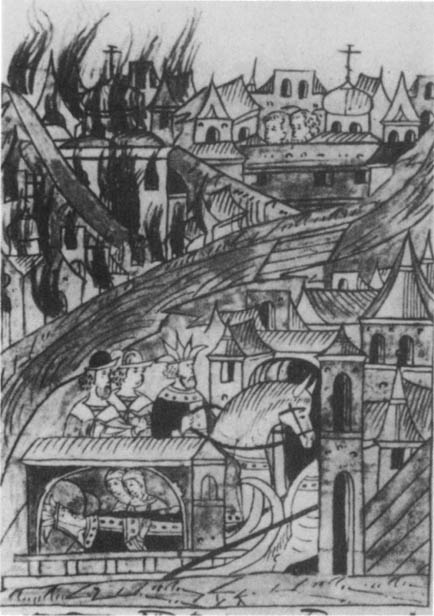
The fire of Moscow in 1560 and Ivan IV escorting the sick Anastasia to Kolomenskoye. (From the sixteenth-century edition of the Nikon Chronicle with Miniatures)
Many years later Jerome Horsey, who probably came to know Ivan better than any other Englishman, made some inquiries about Anastasia. He wrote: “This empress became wise and of such holiness, virtue and government, as she was honored, beloved, and feared of all her subjects. He, being young and riotous, she ruled him with admirable affability and wisdom.” Horsey believed she deserved full credit for whatever successes Ivan achieved during the early years of his reign.