

FOR ALL THESE YEARS Ivan had been straining at the leash, determined to exert his will, but finding himself at every turn confronted by powerful forces which attempted to reduce him to the status of a constitutional monarch. He saw himself as an autocrat ruling by imperial decree, his wishes instantly obeyed, his demands immediately accepted, his slightest whispers becoming laws. A profound study of the Old Testament had demonstrated the existence of divinely appointed rulers who took counsel from no one but God. Why then should he listen to the advice of the boyars? He detested advice, just as he detested the traditional usages of the court which decreed a balance of power between the Tsar and his boyars. What he wanted above all was the freedom to rule as he saw fit, without the interference of anyone, as a pure autocrat. He had wanted this almost from the beginning of his reign, and as he grew older he wanted it more insistently and more imperiously.
There was nothing in the least strange in this desire. He lived at a time when the divine right of kings was still an acceptable dogma; and Queen Elizabeth believed no less emphatically in her divine right to rule. She chose her ministers well, used them to advantage, trusted them, rewarded them generously, rarely executed them, and sailed serenely from one crisis to another. Ivan distrusted his ministers, and there was no serenity in him. In his ideal world there were no ministers at all, only servants obeying his commands. As he wrote in a letter to Prince Kurbsky, the Tsar receives his power from God, and therefore the boyars must offer him implicit obedience. The Tsar needs no instruction from anyone and he has the right to bestow his favors on anyone he pleases and to punish at his pleasure.
The boyars, and Prince Kurbsky, thought differently. They remembered the years when Ivan ruled righteously, in purity and penitence, submitting to the restraints of kingship. “He humbled himself and ruled well,” Prince Kurbsky wrote of those years. The Tsar remembered only that he had been ill-treated. Writing to Prince Kurbsky in July 1564 he complained that the boyars not only took the government out of his hands, but they regulated his daily life in the minutest detail. From this intolerable situation he was determined to free himself.
Gradually there emerged the plan to create a separate kingdom, over which he would rule with absolute authority. He was a timid man, and therefore he embarked upon the plan cautiously, by stages, reluctant to advance too far before he had assured himself that each stage had been accomplished safely. He was a master of stratagems and deceptions, and he went about the creation of the new kingdom with extraordinary cunning. Not all the steps he took are known, and it is possible that for some weeks he did not know precisely what form the new kingdom would take. He liked to shroud his acts in mystery, and he enjoyed spreading rumors about his plans to test the reactions of the boyars, and as likely as not he would do something completely different. At all costs it was necessary to conceal his real intentions.
In the winter of 1564 Moscow was full of rumors that the Tsar was about to abdicate in favor of his ten-year-old son, thus releasing him for a life of contemplation and solitude in a monastery. “My soul is satiated with power,” he is supposed to have said, “but I only desire to have power over myself, to remove myself from the cares and temptations of this world and to flee from situations which breed sinfulness.” Albert Shlichting, who records these words, goes on to describe the Tsar’s formal abdication. But nothing so simple as a formal abdication took place. Instead, the Tsar summoned the clergy and the nobles, lectured them on their behavior, accused them of disloyalty and treason, and even of wanting to hand over the Russian state to a foreign power, and there in the Great Hall of the Kremlin took off his crown and royal robes. He did not abdicate; he accused. The theatrical gesture was intended to inspire fear, and the crown and royal robes remained in his possession.
He addressed the clergy and the nobles about the middle of November 1564. During the following days his actions became even more ominous. He went around Moscow plundering the icons and holy banners in the churches, kissing them before they were piled high on his sledges. All that was most holy in Moscow he reserved for himself. Then, on Sunday, December 3, 1564, about two weeks after his last meeting with the clergy and the nobles, he summoned them again to meet him in the Uspensky Cathedral, where the Metropolitan Afanasy was presiding over the morning service. After the service the Tsar gave his blessing to the Metropolitan, the archbishops, bishops, priests, monks, princes, boyars, voyevodas, nobles, and merchants, who were all gathered outside the cathedral. They all kissed his hand and he made the sign of the Cross over them, and then, accompanied by the Tsaritsa Maria and his two sons, he departed.
It was a strange leave-taking, for he made it abundantly clear that he was going into a kind of exile, but never for a moment did he declare his intentions. When he went on pilgrimages he always traveled in state with a large retinue, but never before had he left Moscow burdened by so many holy images or by so much gold plate from his treasury. There was an uneasy feeling that some strange silent drama was being performed in the dead of winter. Those farewells on a savagely cold day boded ill for Moscow, for if he was going into exile it could be expected that he would exact some terrible retribution from the city. He was not the kind of person who would simply leave Moscow and vanish from sight. He was one of those who made their presence felt even when they were far away.
He reached Kolomenskoye the same day, announcing that he intended to take part in the celebrations for the Feast of St. Nicholas on December 6. With him went a small army of mounted men in full armor, and it was observed that the wives and children of his favorites accompanied him. With the exception of a few government officials, who were brought along for a special purpose, the Tsar’s companions belonged to his private and intimate court. They were sinister men going on a sinister errand.
The celebrations for the Feast of St. Nicholas passed without incident, but then the weather suddenly changed. The sun came out, the ice melted on the rivers, the snow turned into slush, travel became impossible. Ivan and his large retinue were forced to remain in Kolomenskoye on the outskirts of Moscow for two weeks. The improvement in the weather did not improve the Tsar’s temper.
When travel became easier, the Tsar set out for the Troitsa-Sergeyevsky Monastery where on December 21 he celebrated the memorial day of St. Peter the Metropolitan, who died in 1328. St. Peter was the first Metropolitan of Moscow, a man of great sanctity. Formerly the Metropolitan ruled the church from Vladimir. St. Peter was responsible for making Moscow the religious capital of the country. Ivan possessed great reverence for the saint, and the ceremonies took place in an atmosphere of pious exaltation. Meanwhile Ivan was working out the last details of his extraordinary plan to carve out a separate kingdom for himself, to be called the Oprichnina, from the word oprich, meaning “separate.” It was the word used to describe the portion of a man’s estate set apart for his widow, and Ivan may have chosen the word because it suggests both separation and bereavement. His new capital would be the former hunting lodge of Alexandrova Sloboda. His new ministers and servants would be known as oprichniki, “the separated ones,” mercilessly ferocious and instantly obedient to his orders. They wore black gowns, rode black horses, carried brooms to signify that they intended to sweep away all treachery, and tied dogs’ heads to their saddles or under the horses’ necks to indicate their determination to savage their enemies.
On the road to Alexandrova Sloboda the Tsar punished some of the boyars and courtiers who had been ordered to accompany him. Lev Saltykov, Ivan Chobotov, and others were summarily dismissed, stripped of their robes of office, and ordered to return to Moscow. They were naked, or nearly naked, and it is not known how they survived the journey in the depth of winter. Lev Saltykov was the Master of the Armory, one of the five most important officials of the court; he superintended all court affairs and had little to do with the armory. His abrupt dismissal was a warning to the establishment. Boyars in high administrative positions were expendable.
About the same time Ivan sent two letters to Moscow by the hands of Konstantin Polivanov. In these letters Ivan announced his intention of residing permanently in Alexandrova Sloboda and of resigning rather than abdicating from the throne. One letter was addressed to the Metropolitan Afanasy, the other to the people of Moscow. The complete text of these letters has not survived, but we know from contemporary sources that the letter to the Metropolitan was intended to be read by the church hierarchy, the boyars, and members of the Tsar’s court, and contained the inevitable vitriolic attack against them. He accused the church hierarchy of continually interceding for the lives of malefactors who deserved to be punished, “wherefore the Tsar and Grand Prince, not wishing to endure these many acts of treachery, has abandoned the Tsardom with a heavy heart, and now travels wheresoever God may lead him.” He reminded the boyars that during his minority they committed many acts of treason and embezzled the state treasury. He accused them, too, of failing in their duty to defend Orthodox Christianity against its foreign enemies—Tatars, Lithuanians, and Germans. These same accusations were made in Ivan’s letter to Prince Kurbsky written during the previous summer and in a speech to the people of Moscow delivered on the Red Square fifteen years earlier. He had not changed, and he would never change, but now at last he possessed a strange weapon forged in secret: the threat to create a separate kingdom. He would retain all his powers, he would not abdicate, he would abandon Moscow and go wherever God directed him to go, and he would resign from the government of Moscow, leaving it in the hands of the scoundrels who now held office, but only as long as he saw fit, for he would return and gather up his powers whenever he felt it was necessary. He wrote: “If God and the weather permit, I shall go to Alexandrova Sloboda and I commit the Tsardom into the hands of traitors. Nevertheless the time may come when I shall once more demand the Tsardom and take it back.”
The intention of the letter was clear: to sow confusion into the ranks of the clergy and the boyars. He was Tsar and not Tsar; he had abdicated and not abdicated; he was content that Russia should be ruled by traitors, and at a time of his own choosing he would wrest it from them. By creating so much confusion he was giving himself the maximum freedom to maneuver.
In his letter to the people, Ivan wrote that he had no quarrel with them at all and they were not in disgrace. His quarrel was with their masters, the church hierarchy and the boyars. He was obviously attempting to drive a wedge between the people and their rulers, pretending that he stood on the sidelines. He was also hinting that it was to the advantage of the people to rise in rebellion against the ruling boyar families. Although the letter to the people did not provoke a rebellion, it caused, as he had hoped, great distress among them. According to the chronicles they came in droves to the Metropolitan Afanasy, saying: “Woe on us who have sinned before God and angered the Tsar by our many wrongdoings against him. To whom shall we turn now, and who will save us from the attacks of foreigners? How can the sheep live without a shepherd? How can we endure without a Tsar?”
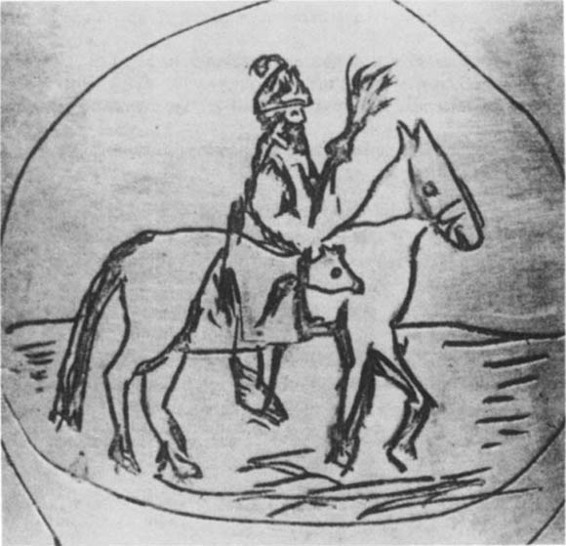
A seventeenth-century engraving on the base of a silver candlestick, showing a mounted oprichnik with broom and dog’s head.
These letters were received in Moscow on January 3, 1565, when for over a month there had been no news from Ivan. There was such consternation that the Metropolitan Afanasy and the boyars decided to act at once, drawing up a petition to the Tsar begging him not to resign and arranging for a delegation of dignitaries to present the petition. It was learned that Ivan had at last reached Alexandrova Sloboda, which he had transformed into an armed camp. Since his real intentions were unknown, the petition was carefully designed to uncover them by asking him to make a public announcement mentioning the names of the people he regarded as traitors. The petition read:
With grave reluctance and sorrow in our hearts we have learned from our Great Lord, who merits every praise, that he is displeased with us and especially that he is abandoning the Tsardom and us. We are but poor and inconsolable sheep without a shepherd, and the wolves, our enemies, surround us. We therefore request and beg him to see fit to change his mind.
In the past nations have been conquered and left without rulers, but that a mighty Sovereign should abandon his loyal subjects and his Tsardom needlessly—such things are unheard of, and not to be read in books!
If the Tsar knows of the existence of traitors, then he should proclaim their names and they must answer for their crimes, for our Lord has the right to punish them and to pass exemplary sentences upon them.
Should the Tsar agree to hear our petition, we shall gladly submit ourselves to his will.
Such was the petition drawn up with great care by the Metropolitan with perhaps some assistance from the leading boyars and immediately dispatched to Ivan with the delegation, which was led by Pimen, Archbishop of Novgorod, and the Abbot Levky of the Chudov Monastery, a man known to be among Ivan’s favorites. The Metropolitan remained in Moscow, but many of the important boyars including Prince Ivan Belsky and Prince Ivan Mstislavsky accompanied the delegation. Hundreds of nobles, officials, merchants, and ordinary people of Moscow went with them. Everything was being done so quickly that many did not have time to go home to eat and change their clothes. They made their way to Alexandrova Sloboda in the snow, in the freezing cold, holding up banners and singing hymns as though they were going on pilgrimage.
All the approaches to Alexandrova Sloboda were guarded, and at the village of Slotino the whole procession came to a halt, while the guards sent messengers to discover whether he was prepared to receive the petitioners. The message came back that he was prepared to receive only the leading members. Accordingly only seven or eight dignitaries were permitted to make the rest of the journey.1 They spent the night at Slotino, and rode the remaining twenty miles to Alexandrova Sloboda the next day. All the time they were under close guard.
The reception given to the petitioners was cold, formal, courteous. They were treated as though they were ambassadors from a foreign state. Ivan listened to Archbishop Pimen’s long speech on the manifest duty of the Tsar to uphold Orthodox Christianity, and how could he do this if he exiled himself from his people? If he abdicated, the true faith would inevitably be tainted with heresy, for he alone had the power to instill fear into the hearts of heretics. Gravely the Archbishop repeated the argument contained in the petition: if there were crimes and shortcomings committed by the people, then the Tsar should be empowered to set things right either by acts of mercy or by employing the most terrible punishments. Having read the letter and listened to the Archbishop’s plea, the Tsar dismissed the petitioners, saying he would make his decision on the following day.
At the reception on January 5, 1565, Ivan was in a rancorous mood. He spoke about the interminable rebellions against the Tsar’s majesty, which were recorded in the chronicles, and therefore there was no reason why he should recite them. From the time of Vladimir Monomakh to the present Russia had been full of traitors who wanted to dethrone the reigning Sovereign and put someone else in his place. Officers of his court were continually negotiating secretly with foreign powers: the King of Poland, the Sultan of Turkey, and the Tatar Khans all had secret agents in his court. The traitors wanted to kill him in the same way that the Tsaritsa Anastasia had been killed. All this was well-known to them. Then why did they expect him to return to Moscow except under the most stringent conditions? Only if they accepted these conditions would he condescend to put aside his wrath against the Muscovites.
There were two conditions: the right to strike down anyone he considered a traitor, and the right to form a separate kingdom with its own army, its own boyars, nobles, secretaries, and officials. For the first time the petitioners heard the dreaded word Oprichnina. Out of Russia there would be carved a new kingdom reserved for his own use, where his followers, the oprichniki, would be granted estates commensurate with their rank, and these estates would necessarily have to be taken over from their present owners. Whole towns and provinces would be included within the Oprichnina for the upkeep of his own court and the courts of his sons. The rest of Russia, known as the Zemshchina, meaning “the dominion,” would be ruled by the boyars in obedience to his wishes. Over the Oprichnina he would rule directly and absolutely, without any restraint whatsoever.
The dignitaries, when they heard these conditions, were relieved, for they feared that the conditions might have been more onerous. They thanked the Tsar, accepted his conditions, and promised to conduct their affairs according to his commands.
“Thus,” commented a Livonian knight who took service under the Tsar, “they prepared the whip and the birch with their own hands, and all those brightly painted devil-masks before which all the spiritual and secular orders bowed down.”
The dignitaries returned to Moscow expecting that Ivan would soon follow, taking up his residence in that part of the city now reserved for the Oprichnina, which included a large area to the northwest of the Kremlin, but excluded his own palaces. The only part of the Kremlin which he claimed for himself was an area “where the Tsaritsa’s palace stood formerly, behind the Church of the Nativity and St. Lazarus, including all the cellars, kitchens and ice-houses as far as the Kuriatny Gate.” Exactly why he chose this area is unknown, but he clearly desired to have a foothold within the Kremlin walls.
When Ivan returned to Moscow a month, or perhaps six weeks later—the exact date is unknown—he was a changed man, and scarcely recognizable, for he had lost a good deal of hair and beard. The uncharitable Livonian knight wrote that his hair and beard “had been devoured and destroyed by his rage and by his tyrannical soul,” but it is at least possible that they had fallen out as a result of illness. To the assembled nobles and dignitaries of the Church, he explained why he had abdicated and then changed his mind, feeling it necessary to curb his anger and to act with mercy.
In his speech, which was recorded by his secretaries and inserted in the chronicle, he explained his views on the new Russian state henceforth to be divided between the Oprichnina and the Zemshchina. For the first time he announced his intention to bequeath the Oprichnina to his younger son, while the Zemshchina would be inherited by the Tsarevich, and he urged the boyars to prevent any disputes arising between his sons, for, as he said, “your task is to root out injustices and crimes, while at the same time upholding order, peace and unity.”
Unity, however, was precisely what he refused to grant. The cumbersome machinery of a divided state was not calculated to produce either order or peace, and he seems to have realized that there were inherent difficulties in the division of power. On all matters concerning the Zemshchina the boyars were permitted to make the final decisions, but he reserved for himself the right to intervene in military matters and great affairs of state. He did not define the powers of the boyars, though his own powers were adequately defined, for he remained the Tsar and the owner of a vast private principality. For his expenses in running his principality he demanded that the Zemshchina should contribute 100,000 rubles, a vast sum in those days, equivalent to perhaps 10 million dollars. The assembled dignitaries publicly assented to the new tablets of the law, while privately agreeing among themselves that the division of powers was dangerous, cumbersome, and perhaps unworkable. No one dared to protest. They held the Tsar in such awe that they would have agreed to almost anything so long as he resumed the throne.
Their fears were soon justified, for on the day following the Tsar’s speech from the throne Prince Alexander Gorbaty-Shuisky was arrested together with his seventeen-year-old son on a trumped-up charge of treason, and they were executed a few days later. According to Prince Kurbsky, the son was about to lay his head on the block when the father suddenly asked permission to be the first to be executed. This permission was granted, and when his head was struck off, the boy lifted it up and kissed it, saying: “I thank Thee, Jesus Christ our Lord, who has deemed us worthy to be executed in our innocence, being like unto Thee, the innocent lamb, who was also slain!”
A shiver of horror ran through Moscow, for no one could guess what secret reasons compelled Ivan to execute them. Prince Gorbaty-Shuisky was one of the heroes of the battle of Kazan; his daughter Irina was married to Prince Ivan Mstislavsky, another hero of the battle. Still another daughter was married to Nikita Zakharin, the younger brother of Anastasia. A few days after the execution Ivan sent 200 rubles to the Troitsa-Sergeyevsky Monastery to pay for prayers for the soul of Prince Gorbaty-Shuisky. In this way he reduced the burden of responsibility, for some of the burden now rested on the well-rewarded monks of the monastery he favored above all others.
Ivan’s rage against the men he regarded as traitors was not exhausted by the murder of Prince Gorbaty-Shuisky. Those who were very close to him, those who had received special marks of his favor, and those who thought they were very safe were in mortal danger. Prince Peter Gorensky was an accomplished courtier, young, rich, and well-connected. He was one of the leading members of the Tsar’s intimate circle, and in a testament written in 1561 Ivan nominated him to be one of the regents in the event of the Tsar’s death. In March 1564 he was still in high favor, but in the fall of the same year he was out of favor and serving on the Lithuanian frontier. Ivan appears to have believed that Prince Gorensky was plotting against him. Orders were given for his arrest, but he fled with fifty of his retainers into Lithuania, only to be pursued and overtaken by Ivan’s security forces, who executed him on the spot. He was impaled, and his retainers were all hanged. About a week later Ivan sent fifty rubles to the Troitsa-Sergeyevsky Monastery to pay for prayers for the soul of the prince.
Those who had incurred Ivan’s displeasure in the past also suffered, victims of his long memory. Prince Simeon Rostovsky had always been troublesome. He had criticized Ivan’s marriage to Anastasia, and during the following years he complained frequently about the appointments he received, saying they were unworthy of his high birth. In 1553, when the Tsar was thought to be dying, he favored the succession of Vladimir of Staritsa. In the same year it became known that he had spoken slightingly about the Tsar to the Lithuanian ambassador to Moscow and had even gone so far as to reveal some secrets of the Boyar Council. It was said too that he had advised the Lithuanian ambassador against making peace with Moscow. A year later he attempted to flee to Lithuania, was caught, found guilty of high treason, deprived of boyar rank, and sent into exile. Later he was pardoned, but though he received important positions he never regained the rank of boyar. In the spring of 1565 he was made governor of Nizhni-Novgorod. The Tsar intensely distrusted him, and sent thirty oprichniki to Nizhni-Novgorod, with orders to bring back his head.
The oprichniki set out from Moscow with enthusiasm. It was the time before the thaws, the roads thickly covered with ice, but they accomplished the journey in a few days. Arriving in Nizhni-Novgorod, they learned that the prince was praying in church accompanied by some of his servants and retainers. They rushed to the church, shouted, “Prince, you are the Tsar’s prisoner!” and arrested him. The servants and retainers were led off to jail. The prince, realizing that he was powerless, threw down the staff of office, which he had received from the Tsar’s hands and which he carried with him wherever he went. The oprichniki then tore off his clothes, leaving him naked, for it was inappropriate that a doomed man should be seen wearing the costly vestments of his high rank. He was then wrapped in a soiled gown, bound hand and foot, and placed on a sledge. For some reason it was decided that the execution should not take place in Nizhni-Novgorod, but on the ice-covered Vetluga River three or four miles away. Two or three oprichniki were sitting on the prince to prevent him from escaping, while others rode beside the sledge. Suddenly the small procession came to a halt and some men were ordered to chop the ice on the river. As though awakening from sleep, Prince Rostovsky askedwhat they were doing. They answered that they were making a hole in the ice so that the horses could drink.
“I know very well it is not for the horses, but for me,” the prince said.
A few moments later the leader of the oprichniki dismounted from his horse, swung his sword, and cut off the prince’s head. He ordered the body to be thrown into the hole in the ice. Then, with the head, they rode back to Moscow.
Ivan was delighted with their exploit, congratulated them, and rewarded them. When the head was presented to him, he shook his finger at it, saying: “Head, head—you with your crooked nose—you were very thirsty for blood while you were alive, but now that you are dead, you will quench your thirst in water!” He placed his foot on the head, kicked it aside, and gave orders that it should be thrown into the river.
The reign of terror had begun. The murder of these princes was merely the curtain raiser for a bloody drama that lasted for seven years.
1 One of the most brilliant passages of Eisenstein’s film on Ivan the Terrible shows the vast procession of petitioners winding through the snow and singing hymns, while Ivan gazes down at them from a high tower at Alexandrova Sloboda like an eagle in his eyrie. In fact, the main body of petitioners was stopped twenty miles away and only a handful of people were allowed to enter his presence.