

THE FORMER HUNTING LODGE at Alexandrova Sloboda now became the capital of the separate kingdom. Surrounded by a moat and a wooden palisade which was later faced with stone, it stood amid gloomy forests some seventy-five miles north of Moscow. Like all the royal hunting lodges it consisted of many buildings: there was the Tsar’s palace, his chapel, offices for his ministers, guest houses, residences for his large retinue, barracks for his bodyguards, guard houses, and in addition there were prisons, warehouses, store houses, and dormitories for the servants, butchers, bakers, cooks, stewards, grooms, falconers, bear-keepers, storytellers, tailors, priests, clerks and their families, all those whose presence was necessary for the upkeep of a royal residence. During the years of the Oprichnina the hunting lodge at Alexandrova Sloboda grew in size and splendor; there were more and more buildings; new churches were built; wealth poured in; and soon it came to resemble a thriving town. Sloboda means “a large village.” But the visitor from Moscow would recognize at once that the village had been transformed into a royal town where the builders were continually at work. The basic industry of the town was the generation of royal power.
In its remoteness and isolation Alexandrova Sloboda fitted Ivan’s mood. Here he could live in seclusion, safe from the tumult of Moscow. No one could possibly reach the place without being observed, for there were forts and guard posts scattered along theapproaches, and two high towers or belfries served as observation posts enabling the watchmen to survey the countryside. A river flowed past the palisade, and there were lakes and pools nearby.
Ivan’s palace, built of stone and brick, stood on high ground, and so did the terem, where the Tsaritsa Maria lived with the womenfolk of the court. But the region was marshy and insalubrious and there were times when much of the area enclosed within the palisade was under water. Wooden causeways extended from the ornamental gate, so that visitors on foot would not get their feet wet. For Ivan, life went on very much as it went on in Moscow with some special refinements due to the special nature of the separate kingdom. The councillors met, ambassadors were received, and high officials were entertained at meals where the Tsar presided at a high table. In the middle of the dining room there was the inevitable grandiose display of gold plate and gold goblets. Rushes were strewn on the floor, while embroideries and painted curtains decorated the walls.
In Alexandrova Sloboda the Tsar lived in great state in a court much smaller and more manageable than the court in Moscow, and more responsive to his whims. The leading members of this court were the boyar Alexey Basmanov and Prince Afanasy Viazemsky. Basmanov, whom Prince Kurbsky blamed for many of the horrors of the Oprichnina, came from an ancient family and was chiefly remarkable for his extraordinary courage in the service of the Tsar; and Basmanov’s son Fyodor, an exceptionally handsome youth, was also in the Tsar’s trust. Basmanov was intelligent and totally unscrupulous, and the son was worthy of the father. He was a dissolute young man, and sometimes shared Ivan’s bed.
Prince Afanasy Viazemsky descended from one of the minor princely families and unlike the Basmanovs, who had known Ivan intimately for the past six years, he had only recently come to the Tsar’s attention. He had been living in the western provinces and therefore had no connection with the established court nobility. He owed his present position to his charm and his gift for flattery. Peter Zaitsev was another unscrupulous adventurer. He was one of the three men commanded to murder Prince Ivan Belsky in 1542 and his lack of scruple commended him to the Tsar. The Basmanovs, Viazemsky, and Zaitsev constituted the Council of Four who superintended the day-to-day operations of the oprichniki. There was also a body of councillors called the Oprichnina Duma, presided over by Prince Mikhail Temriukovich, the brother of the Tsaritsa.
Recruiting for the Oprichnina was a cumbersome and time-consuming process. Some 6,000 provincial nobles appear to have been interviewed, and their genealogies and those of their wives were cautiously examined. They were asked questions about their relationships with other princes and boyars, and interrogated about their loyalty to the Tsar. If they were approved, and if four trusted nobles from their own districts vouched for them, they were admitted into the ranks of the oprichniki. Never before had there been such a close investigation of provincial nobles. Ivan demanded and received absolute loyalty from these chosen members of the nobility, and if they were poor, he rewarded them with handsome estates expropriated from other nobles.
It was a time of massive expropriations and endless journeys. Those whose lands were expropriated were given new estates, usually far away. They were ordered to make their way to these new estates in the clothes they stood in, and no one was permitted to help them. The orders were harsh: “If any citizen in the towns or any peasant in the villages give shelter even for an hour to the sick or to noblewomen about to give birth, then he shall be executed without mercy and his body not buried, but left for the birds, the dogs and wild animals.” The new estates given by the Tsar were no more than areas marked on a map scores of miles from the nearest cities. Once wealthy landowners and their families appear to have made the long journey on foot, living on the charity of peasants.
Young provincial noblemen, possessing no land, suddenly found themselves owning estates teeming with villages, because the Council of Four was satisfied that they would perform any deed demanded of them in the Tsar’s name. Once accepted into the confraternity of the oprichniki, these nobles uttered a solemn oath to defend the Tsar at all costs. The oath, which has survived, read as follows:
I swear to be loyal to my Lord the Tsar and to his kingdom, to the young Tsareviches and to the Tsaritsa, and I swear not to be silent about any evils I know of, those that I have heard or will hear about, which are meditated by this or that person against the Tsar and Grand Prince, his kingdom, the young Tsareviches and the Tsaritsa.
I also swear on oath that I shall not eat or drink or have any dealings with, or have anything in common with, anyone from the Zemshchina. On this I kiss the Cross.
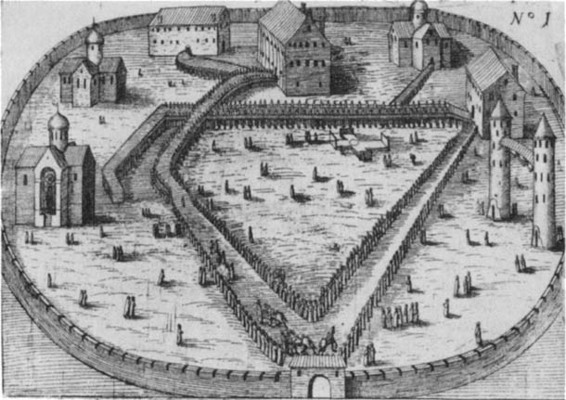
Alexandrova Sloboda, the walled fortress-palace. There were many more buildings than this rough sketch suggests. (From Jacob Ulfeld, Legatio Moscovitica, 1608, courtesy, the New York Public Library)
This was perhaps the milder form of the oath introduced at the beginning of the Oprichnina. In his History Prince Kurbsky speaks of a more fearful oath, which called upon the oprichnik to break away completely from his parents and relatives, his friends and brethren, so that he could serve the Tsar with total devotion.
Once admitted into the oprichniki, the nobleman found himself in a secret conspiratorial organization of vast scope and unlimited power. His life was organized to the last detail, but his rewards were commensurate with his duties. He was above the law, with power of life and death over everyone he encountered. His lawlessness was a right and privilege which he earned by entering the magic circle of the Tsar; and his reward was wealth and power and as much blood as he cared to spill.
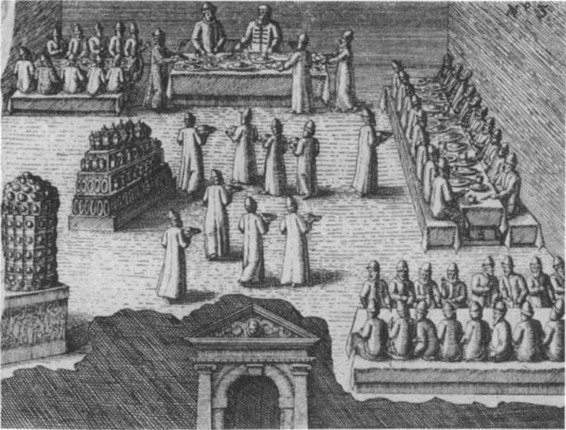
Alexandrova Sloboda, the dining room. The Tsar with the Tsarevich on his right sits at the center table. Five Danish diplomats can be seen sitting against the wall at top right. (From Jacob Ulfeld, Legatio Moscovitica, 1608, courtesy, the New York Public Library)
The oprichniki at Alexandrova Sloboda resembled the Knights Templar in their double roles as monks and warriors. All, including Ivan, wore the simple black robes of monks. They rose early, long before dawn, to attend the morning service where Ivan presided, and woe betide those who failed to appear! Unless they were excused by sickness, they were punished with eight days of penance or a brutal beating. The service lasted for three hours, from four to seven o’clock in the morning, and there was an hour’s rest. The service was resumed at the stroke of eight and continued until ten o’clock, when they all breakfasted. Ivan, assuming the role of the watchful abbot, remained standing, while the rest sat. When they addressed him, they called him “brother,” and he addressed them in the same way. They ate and drank well, and when they had finished, Ivan sat down to eat alone. So it went on day after day, the long religious service followed by a breakfast where Ivan stood and watched and waited.
What he was waiting for was the opportunity to wreak vengeance on his imagined enemies. Hundreds of people had been rounded up by the oprichniki and led off to the prison chambers of Alexandrova Sloboda. Having eaten, Ivan made his way to the torture chamber where he would himself interrogate the victims and order those whose answers were unsatisfactory to be tortured. He took great pleasure in watching them in their agony. “He was always gay and cheerful and spoke excitedly when he attended these interrogations and tortures,” report Taube and Kruse, two foreign mercenaries who joined the oprichniki. Albert Shlichting was another observer who carefully watched the behavior of the Tsar in the dungeons:
The tyrant habitually watches with his own eyes those who are being tortured and put to death. Thus it happens frequently that blood spurts onto his face. He is not in the least disturbed by the blood but on the contrary he is exhilarated by it and shouts exultantly: “Goida! Goida!” (“Hurrah”) and then all those around him shout:“Goida! Goida!”But whenever the tyrant observes someone standing there in silence, he immediately suspects that he is sympathetic to the prisoner, and asks why he is sad when he should be joyful, and then orders him to be cut to pieces. And every day people are killed at his orders.
Taube and Kruse relate that scarcely a day passed without the killing of twenty to forty people at Alexandrova Sloboda.
In the art of killing, the Tsar had become a master who exulted in his powers. If sufficiently roused, he would kill with his own hands, but he preferred to let others do the killing for him. Sometimes he would read out the names of the people he wanted killed while he was in church, during the service, and there would be a written order with the name and manner of execution: strangling, drowning, burning, hacked to pieces. There were no special executioners. All the oprichniki were liable to be called upon to perform these offices at a moment’s notice. They carried long black staffs with sharp iron points with which they could knock a man off his feet and then transfix him to the ground, while beneath their garments long knives “the length of a forearm or even longer” were concealed, and with these they could hack a man to pieces. “No one protested against these executions,” wrote Taube and Kruse. “On the contrary they considered themselves fortunate to be able to do this good and holy work.”
Ivan luxuriated in torture, pools of blood, stiffening corpses. This was the world where he was most at ease and enjoyed his greatest triumphs. More than one of the oprichniki attested to his full-throated joy when the blood of his victims spurted on his face. It was as though he was happy only when he was inflicting the ultimate degradation on defenseless and innocent peoples. He was mad and evil, and there was no remedy for his madness. The evil would endure through all the remaining years of his reign.
Sometimes we are given small clues to the nature of his madness. Albert Shlichting wrote that he always found it difficult to ride into Alexandrova Sloboda because of the stench of the corpses. We know that the corpses often remained unburied for many days, and this happened because Ivan ordered it, because he believed that traitors deserved more than death, and because the decomposing bodies were a warning to others. It was part of the punishment that they should receive the ultimate degradation of being refused Christian burial.
Understandably he did not sleep well, and we are told that he had to be coaxed to sleep by storytellers. They were three blind men who recited fables and ancient histories until at last he fell into a fitful sleep.
Outwardly, when he went on pilgrimage or traveled through the country, Ivan presented himself as a man of imperturbable dignity. Very few people outside the ranks of the oprichniki knew what was happening at Alexandrova Sloboda. Thus when Ivan set out from Moscow on September 21, 1565, for the annual pilgrimage to the Troitsa-Sergeyevsky Monastery, he was greeted with the usual deference and respect. There were the usual gifts to the monks and heartfelt prayers for his safety. He went on to Rostov, Yaroslavl, and Vologda, which he proposed to transform into a powerful base of operations for the Oprichnina, and then, following the pattern of earlier pilgrimages, he rode as far north as St. Kirill’s Monastery near Beloozero. He returned to Moscow on December 27 to learn that Devlet Guirey, the Khan of the Crimea, had threatened the Russian fortress at Bolkhov on the southern frontier but had been repulsed. Prince Ivan Belsky and Prince Ivan Mstislavsky, in command of the main army on the Oka River, had sent reinforcements to the fortress only to learn that they were not needed. There was therefore nothing to fear from the Tatars.
By the spring of 1566 Russia was learning to adapt itself to the strange invention of the Oprichnina, which divided the country into arbitrary segments at the whim of the Tsar. The system was not working well, but the resources of the country were such that even worse depredations could be tolerated. Ivan himself was pleased with his experiment and was quite prepared to moderate some of the penalties he had imposed on the nobility. When the Metropolitan Afanasy and the Boyar Council petitioned him to permit Prince Mikhail Vorotynsky to return from his exile in Beloozero, he graciously assented and Prince Vorotynsky’s vast estates were given back to him. Similarly he repealed the order to the nobles who had been exiled to Kazan. They had only just settled in Kazan and were now once more uprooted; and the complicated redistribution of their estates would occupy the government for many years to come. Some got back their estates immediately, but most of them had to wait until bureaucracy had finished its work. The Estates Office in the Kremlin was working overtime.
Suddenly, while the Tsar was away from Alexandrova Sloboda inspecting the southwest frontier, the Metropolitan Afanasy submitted his resignation “on account of an infirmity,” and it was sometimes thought that the infirmity he suffered from was too great a knowledge of Ivan’s crimes. Afanasy retired to the Chudov Monastery inside the Kremlin, and when Ivan returned from his tour of inspection he appointed Herman Polev, Archbishop of Kazan, a distant descendant of the princes of Smolensk, to be the new Metropolitan. Prince Kurbsky described him as “a man of great physical stature, of pure and holy life, well versed in the Scriptures,” adding that he was kind to the poor and steadfast in time of trouble.
Such a man would inevitably find himself at odds with the Tsar, and this happened much sooner than anyone had expected. Herman engaged the Tsar in a long conversation on the subject of the oprichniki immediately after his appointment; he spoke about God’s punishment for men’s sins, the Last Judgment, and the necessity for a Tsar to act justly in the eyes of all. The Tsar was impressed and recounted this conversation to the oprichniki, who were alarmed and frightened. If the Tsar followed Herman’s advice, then the oprichniki would be disbanded and reduced to insignificance. Now they basked in the Tsar’s favor and had full power to murder and rob as they pleased. Alexey Basmanov worked on the Tsar’s sense of authority and convinced him that the new Metropolitan should be deprived of his office. The ceremonies of induction had not yet been performed; it was therefore a comparatively easy matter to unseat him. “You have not yet assumed office,” the Tsar told him, “and yet already you are trying to make me your captive!” After being Metropolitan for two days, Herman Polev returned to Kazan to resume the conversion of the Tatars to the true faith.
It remained to appoint a new Metropolitan, and to the surprise of many Ivan chose a man who was even more saintly than Herman Polev. His choice fell on Philipp Kolychev, Abbot of Solovetsky Monastery, in the far north. The monastery lay on the small island of Solovki in the White Sea. Ivan did not immediately announce his choice; the abbot was first summoned to Moscow so that Ivan could have the benefit of his “spiritual counselling.”
When he reached Moscow early in July 1566 the abbot was dumbfounded to learn that he was about to be appointed the Metropolitan of all Russia. He refused, saying, “The Tsar should not entrust a great cargo to so small a ship.” He then asked to be allowed to return to his monastery in the far north, but Ivan insisted that no one else could fill the position. Finally Philipp Kolychev agreed, making one condition: that the Oprichnina be abolished. “I will obey your wish,” he said, “but you must first satisfy my conscience. There must be no Oprichnina. I cannot give you my blessing, seeing that the country is in so much anguish.” With great difficulty the Tsar succeeded in controlling his anger. “Do you not know,” he said, “that my people desire only to devour me? There are people close to me who are preparing to destroy me!”
Such words indicated that Ivan was in the grip of an obsession for which there was no cure, and Philipp Kolychev sensibly returned to the subject of the Oprichnina, thinking that its abandonment might at least help the Tsar to live more peacefully. The Tsar lost patience and ordered him to be silent. The meeting ended in a deadlock: both the Tsar and the priest had laid down their conditions, which were irreconcilable. This became known to the boyars and bishops, who were desperate to have Philipp Kolychev as their Metropolitan on any conditions, even the condition that he maintain silence about the Oprichnina, for they hoped that his presence would act as a shield against oppression. If he rejected the pleas of the boyars and the bishops, he lay open to the charge that he was proud and obstinate. If he accepted the position on the Tsar’s terms, he could expect to live dangerously. Finally on July 20 he signed a document in which he promised not to interfere “in the Oprichnina and the Tsar’s domestic affairs” and five days later he was consecrated Metropolitan of all Russia in the Uspensky Cathedral.
After the consecration the Metropolitan delivered a sermon in which he said that rulers should act justly, reward those who merited rewards, and be fatherly toward their subjects. He spoke of “the abominable flatterers” who crowd around the throne and seek to blind the mind of the ruler, to pamper him, to pander to his passions, to praise those who are unworthy of praise and disparage those who are praiseworthy. He went on to speak of the transitoriness of earthly glory and of the victories of “unarmed love” which are accumulated through good deeds and are more glorious than victories on the battlefield. He said, “Silence may bring the soul to sin and cause the death of the entire people.” The words were barbed, but the Tsar listened quietly and showed only courtesy to the new Metropolitan.
The battle was engaged, but in silence. The Metropolitan Philipp, armed with spiritual weapons, would continue to wage a strange underground war against the Tsar, armed with weapons of terror and oppression. There could be only one end to this war: the martyrdom of the Metropolitan. It was a fate which he appears to have accepted cheerfully, believing that by quietly opposing the Tsar he was serving the Russian people.
Meanwhile Ivan continued to refine and embellish his ideas on the Oprichnina. He was determined to push these ideas to their furthest limits and thus to alienate himself completely from the people. He was no longer in his own eyes the ruler of Russia but only of a segment of Russia that resembled pieces of a jigsaw puzzle, selected by him without any coherent boundaries to be his own private domain. He had abandoned the Kremlin palaces but decided to build a new Oprichnina Palace nearby, just outside the Kremlin wall, in the Oprichnina region of Moscow beyond the Neglinnaya River. In May 1556 the architectural plans were ready and he gave orders for the new palace to be built in the quickest possible time. Whole streets of houses were expropriated and then torn down, and by the end of the year the palace was almost completed. The walls were eighteen feet high and formed a square whose sides measured eight hundred feet. There were three gates each surmounted by carved emblems representing a double-headed eagle between two lions. The eagle was painted black and the lions’ eyes were set with mirrors. Exactly what he intended to convey by this new emblem was unclear, but Heinrich Staden, a German mercenary who described the Oprichnina Palace at some length, says the lions had wide-open mouths. Perhaps the lions represented the spirit of the oprichniki roaring out their defiance of the world around them.
Within that vast square there were the usual appurtenances: a debtors’ prison, kitchens, cellars, bathhouses, ice houses, stables, and administrative quarters. Staden adds the curious information that Ivan had a small cottage built in one corner of the square and it was his practice to take breakfast and lunch in this cottage. The wall near the cottage was a little lower than elsewhere, so that there was more sunlight and so that he could catch the morning breeze. Because the square was damp, it was strewn with white sand.
Although the palace and all the other buildings were made of wood, only the best workmen were employed and only the best materials were used, with the result that it was prodigiously costly. Staden says that it cost so much that some of the Zemshchina people wished it would burn down, and when he heard of this Ivan told his oprichniki that he would give them a fire that they would not quickly put out.
While the Oprichnina Palace was being built, in August or early September, some three hundred people led by Prince Vasily Pronsky, Ivan Karamyshev, and Krestianin Bundov took their lives in their hands and presented a petition to the Tsar, urging that theOprichnina be abolished. Prince Pronsky belonged to a famous and well-established princely family, Karamyshev to the nobility, Bundov to the lesser nobility. They therefore represented the entire spectrum of the nobility. Albert Shlichting has preserved the sense and perhaps the words of the petition:
Most illustrious Tsar and Lord, why have you given orders to kill our innocent brethren? We have all served you loyally and spilled our blood for you! This is the way you reward us for our services. You throw the oprichniki at our throats, they pluck our brethren and blood relatives from our midst, they commit outrages against us, they beat, stab, and strangle us, and in the end they will kill us all.
No doubt there was a good deal more of this, none of it especially palatable to Ivan, who flew into a rage and ordered the entire deputation arrested. Five days later, having mastered his anger sufficiently to enable him to determine how many of them should be punished and what the punishments should be, he gave them over to the oprichniki. Pronsky, Karamyshev, and Bundov were decapitated, others had their tongues cut out, while some lost their arms and legs, and still others were set free; and some days later, remembering that he had let so many free, he ordered them rearrested and cut to pieces. Prince Kurbsky wrote that about two hundred nobles and officers in the army met their deaths for having petitioned the Tsar to put an end to the Oprichnina.
So large a massacre could not be concealed, and Ivan seems to have been concerned about the effect of these massacres on people abroad; and when in February 1567 he sent ambassadors to Lithuania, he cautioned them to explain that Prince Pronsky and Ivan Karamyshev had been executed justly because they were found plotting against the Tsar. They were to say, “The Tsar is indeed merciful and guilty men must always face execution.”
As always, the Tsar was so certain that people were plotting against him that he scarcely troubled to think seriously about the plotters. Outside the Oprichnina, whose members had sworn a special oath of loyalty to him, everyone could be assumed to be guilty. When he told the Metropolitan Philipp, “Do you not know that my people desire only to devour me?” he was saying what, in his overheated mind, he firmly believed.
All through this period he was relentlessly suspicious, apprehensive, and murderous. Danger lay everywhere; there was safety only in flight, in finding some hiding place beyond the reach of his enemies. He spoke of leaving Russia or of becoming a simple monk or of abdicating and becoming a private citizen. Rumors of these unformed plans reached the Zemshchina and generated talk about the succession, and when the Tsar heard that people were talking about his successor, he became more apprehensive than ever. The oprichniki, who feared for their own safety if the Tsar abandoned the throne, did everything possible to keep the Tsar’s suspicions at fever pitch. They invented rumors, imagined plots, produced false witnesses, and murdered at their leisure. The Tsar’s enemies were much closer to him than he knew.
On January 12, 1567, he made his ceremonial entry into the new Oprichnina Palace, which had been built at such vast expense. Three weeks later, grown weary of the palace, he left Moscow and set out on a long pilgrimage which brought him at last to St. Kirill’s Monastery in the far north. To the abbot he confided his desire to abandon the throne and to become a monk, and he gave the abbot 200 rubles for the preparation of his cell. Since it was unthinkable that he would find peace of mind in a plain, undecorated cell, he arranged later in the year to send gold plate, icons, and crosses to the monastery “for the furnishing of his cell.” During the journey he spent some time at Vologda, where stone walls and towers were being built and the whole city was being transformed into a powerful fortress. A new cathedral in honor of St. Sophia was also being built. Of the three Oprichnina fortresses—the new palace in Moscow, Alexandrova Sloboda, and Vologda—the last was by far the strongest, and it was here that he expected to fight his last ditch battle against his enemies.
When he returned to Moscow at the end of June 1567 he was confronted with a real plot instigated by King Sigismund Augustus. He learned that four of the greatest dignitaries in Russia—Prince Ivan Belsky, Prince Ivan Mstislavsky, Prince Mikhail Vorotynsky, and the boyar Ivan Cheliadnin—had received messages from the King inviting them to come over to the other side. The families of Belsky and Mstislavsky belonged originally to a long line of Lithuanian princes and were distantly related to Sigismund Augustus; it was therefore not altogether surprising that an attempt should have been made to wean them away from Russia. These letters, brought to Moscow by Ivan Kozlov, a former Muscovite who served as a secret envoy of the King, were at once shown to Ivan, who proceeded to compose suitable replies in his own characteristic style. Sigismund, reading the letters, would have no difficulty recognizing their real author. Simultaneously the four Russian dignitaries had received letters from Gregory Hotkevich, the commander of the Lithuanian army, and Ivan wrote answers to these letters, ordering that they should be signed by the Russians who received them. Altogether Ivan wrote eight separate letters.
Disgusted, indignant, enraged, Ivan wrote in tones of unrelieved fury, as though calling upon God to witness the treachery of a foreign King. Pretending to be Prince Belsky, he wrote:
We have carefully read your letter and we understand it well. You have written in the manner of a procurer, swindler and scoundrel. Surely it is beneath the dignity of a great ruler to start a quarrel between sovereigns in this way! What you cannot acquire in honest battle you try to achieve by surreptitious means, darting snakelike upon your prey!
You should know that the will, the mercy and the hand of God uphold the autocracy of our Tsar, and bless us who are his worthy councillors. We cannot be destroyed by a little gust of wind or even by a great storm because we stand upon the strong foundations of the Church, which was established by Christ, and the very gates of Hell will not overcome it. That is why our autocratic Tsar and we who are his principal councillors do not fear destruction. As His Majesty the Tsar, who is our lord, grants favors to his loyal councillors and shows them the appropriate honor, so do we, who form his Council, demonstrate our loyalty and deepest submission to the unconstrained power of the Autocrat.
At every point Ivan betrays his authorship, and there can even be detected a note of wry amusement mingled with overweening pride as he paces the floor of the royal apartment and dictates those letters which, pretending to come from his subordinates, celebrate his own majesty, his power, his glory, and his obsessions.
One of his chief obsessions was free will, or rather the total lack of free will in a world which must obediently follow God’s designs. Thus when King Sigismund Augustus mentioned in his letter to Prince Belsky that God gave men freedom and dignity, Ivan replied angrily that God gave Adam freedom but all later generations were deprived of their freedom as a result of Adam’s sin; and if Sigismund Augustus did not understand this, he was palpably ignorant. Ivan wrote:
You say that God created man and gave him freedom and dignity, but what you have written is far from the truth. Truly Adam, the first man, was granted power and free will, but God commanded him not to eat the fruit of the tree. Since he broke this commandment, he was severely punished. In this way his power was taken from him and he fell from grace: from light into darkness, from naked splendor to garments made of skins, from leisure to hard labor for his daily bread, from immortality to mortality, from life to death. And later God sent the Flood on the unclean people, and after the Flood he commanded that no soul should eat blood, and then after they raised the Tower of Babel he scattered the people, and then commanded Abraham to be circumcised as a sign of faith, and then to Isaac and later to Jacob he uttered his commandments, and then He gave to Moses the tablets of the law for the justification and purification of men, and in Deuteronomy He proclaimed damnation unto death to transgressors, and this same truth was established by Jesus Christ, who also ordered the punishment of transgressors.
So now, Brother, you see there never was any freedom and what you have written is far from the truth. And what good is it, Brother, if your nobles have freedom to make you a swindler and urge you to append your signature to these follies?
Ivan was clearly enjoying himself as he wrote these interminable vituperative letters concerning the sinfulness of men, especially the Lithuanians, and the ultimate virtue of the autocrat “who acts for the good of his subjects, while those who lack the Tsar’s authority stumble like drunken men and do no good to anyone.” The Tsar stood above all men, as God stood above the Tsar. It was a lesson he hoped Sigismund Augustus would learn by heart.
Again and again Sigismund Augustus had argued that Ivan had brought so much evil to Russia that good and sensible men had only one recourse: to escape, to come over to his side. So, pretending to be Vorotynsky, Ivan thundered that there was no evil, there was no Oprichnina, no one was being harmed so long as he obeyed the law, and only traitors were being executed. Only the malicious and the envious could harbor such thoughts. As for Sigismund Augustus, he was no better and no wiser than “the godless kings” of the past like Nebuchadnezzar, Sennacherib, and Chosroes, men of devilish pride and appalling ambitions. Ivan, pretending to be Vorotynsky, writes to Gregory Hotkevich concerning Sigismund Augustus’s belief that Ivan had brought about a reign of terror in Russia:
Being possessed by the devil, you wrote that your king heard tales about the senseless cruelty of our Tsar and about his unjust persecutions and merciless rages against his Christian subjects. What kind of diabolical nonsense is this? Is it permitted, does God allow other men to dictate the laws of a foreign country? And as for you, who are ignorant of the law and not only criminals but apostates as well, how can it be permitted to you? How dare you speak, you whelp of the devil, in such an improper manner about His Majesty the Tsar? Our Tsar is a true Orthodox ruler and wisely directs his country; he favors the good and punishes the bad, and of course traitors are executed in all countries.
As we watch Ivan writing these letters, we observe a strange transformation: he is grimacing with rage, but painted on his face there is another and larger grimace. The rage is real but the greater rage is artificial, as he whips himself up into a prodigious and calculated fury. The insults, the innuendoes, the diatribes are all timeworn; he has used them so often before that they no longer startle. The rhetoric was becoming mechanical, and he was more dangerous than he had ever been.
In September 1567, not long after writing these letters, Ivan set out to attack Lithuania, staying first at the Troitsa-Sergeyevsky Monastery to pray at the tomb of St. Sergius, and then joining the Zemshchina army at Novgorod. He went with a large retinue which included the Tsarevich Ivan, Prince Afanasy Viazemsky, Peter Zaitsev, and the young Fyodor Basmanov. The names of two other oprichniki appear on the official lists of his retinue: they were Maliuta Skuratov and Vasily Griaznoy. At this time they occupied very minor positions, though they were destined to supplant his favorites and to become the most dreaded men in Russia. Maliuta Skuratov came from the petty nobility and owned hereditary estates seventy miles from the Lithuanian frontier. Vasily Griaznoy—his surname means “muddy”—also came from the petty nobility and owned hereditary estates in the province of Rostov.
A large army stood poised at Novgorod for an attack on Lithuania. There was an atmosphere of ferocious excitement at the prospect of war with a well-armed and well-disciplined foe, and then quite suddenly the excitement was dissipated in frustration. The Tsar abruptly cancelled the invasion. He had, in fact, excellent reasons for doing so—the weather was bad, sufficient artillery had failed to arrive in time, a plague was raging in Livonia, and there was an absence of provisions in the border towns. Worse still, Sigismund Augustus was known to be preparing an invasion of Russia and it was thought advisable that the Russian army should go over to the defensive. Ivan returned to Alexandrova Sloboda in an unusually somber mood. For some time nothing had been going well, frustrations were piling on frustrations, he was at odds with the world.
At such times Ivan had recourse to his most powerful weapon—murder. He was not content to murder those who had served him well, but he must bring about the destruction of their entire families, kill all their servants, burn and pillage their houses and estates. A new and even more terrifying campaign of mass murder was now unleashed on Russia.