

LORD NOVGOROD THE GREAT—such was the proud name the citizens of Novgorod gave to their rich and beautiful city with its gilded domes and white-walled churches, its huge warehouses, and fleets of merchant ships. Novgorod, meaning “new city,” was one of the most ancient cities in Russia, having come into existence long before there was a settlement in Moscow. For six hundred years it was an independent principality ruling over a vast area of northern Russia, acquiring over the centuries so much wealth, so much prestige, and so many settled habits and traditions that it had come to be regarded as the chief city of Russia, sending its ambassadors to half the kingdoms of Europe and trading with all of them. To the cultivated Novgorodians tyranny was anathema, and they conducted their affairs through an elected council. Only when they were at war did they permit a prince to rule over them, and even then the councillors met regularly and decided upon all issues concerning the business of the city.
The city took the shape of two half-moons lying on the banks of the swift-flowing Volkhov River a few miles north of Lake Ilmen. On one side was the red-walled Kremlin dominated by the six domes of the Cathedral of St. Sophia and the Archbishop’s palace; on the other side was the Market Side teeming with huddled streets, where most of the working population lived. Moats, high walls, and watch towers protected the city, and a wide wooden bridge connected the two half-moons.
At the end of the fifteenth century Ivan III sent a large army against Novgorod and conquered it. He confiscated many of its treasures, divided the lands belonging to the See of St. Sophia among his nobles, and expelled most of the nobles and merchants of the city. All together nearly three million acres of arable land were granted to the Muscovite nobility on condition that they serve the Grand Prince of Moscow. Nevertheless Novgorod succeeded in retaining its original character; the monks, the workmen, the common people had not been uprooted, and in many subtle ways they succeeded in conquering their conquerors. Novgorod preserved its separateness and individuality.
In the eyes of Ivan IV, who knew Novgorod well, for he had visited the city several times, the separateness and individuality of the Novgorodians smacked of treason. They were a people who spoke their minds, and they complained bitterly about the exactions of the Muscovite army in its wars against Livonia. Special levies and special taxes were raised to support the army; the army was usually billeted in Novgorod before it set out against Livonia; trade with foreign countries came to a standstill while the wars were being fought. It appeared that the Novgorodians were more concerned with trade than with enlarging the boundaries of the Muscovite empire. Ivan decided to punish them.
When Ivan punished his officers of state, he rarely gave precise reasons. It was enough that his suspicions had been aroused, that they had acted in a manner incomprehensible to him, that he had taken a sudden and unreasoning dislike for them. He believed he had a good nose for smelling out treachery and he thought he could recognize a traitor even before he became treacherous. So with Novgorod; he felt under no necessity to proclaim the reasons that led him to believe that Russia would benefit by a general massacre of the inhabitants. The reasons could be invented later, if anyone dared to ask for them.
Nevertheless certain macabre rituals had to be performed before he could order the oprichniki to march against Novgorod, and a casus belli had to be found. This was provided, according to the Novgorod Chronicle, by a certain Peter Volynets, who had been brought before the courts of Novgorod for a crime and severely punished. He had a score to settle with Novgorod. After his release he journeyed to Alexandrova Sloboda and succeeded in convincing the Tsar that Archbishop Pimen headed a conspiracy to bring all the Novgorod territories under the sway of King Sigismund Augustus, who was both King of Poland and Grand Prince of Lithuania. According to Peter Volynets there existed proof of the conspiracy in the form of a letter signed by Archbishop Pimen on behalf of the people of Novgorod. Where was the letter? It was concealed in the Cathedral of St. Sophia in Novgorod. Peter Volynets suggested he should be permitted to return to Novgorod in the company of one of the trusted officers of the Tsar’s court and in his presence retrieve the letter which lay behind an icon of the Virgin directly facing the Archbishop’s throne. In this way he would offer demonstrable proof of the letter’s existence. Ivan professed to be deeply impressed by the story of the hidden letter, and Peter Volynets was sent to Novgorod with orders to bring back the letter as soon as possible. This was done. Ivan was overjoyed, for the letter provided him with the visible proof that his long-smoldering suspicions and desires were justified.
Not all the oprichniki appear to have been in favor of the expedition against Novgorod. Three of them, Prince Afanasy Viazemsky and the two Basmanovs, Alexey and Fyodor, seem to have been reluctant to attack the city. What was to be gained by a general massacre? Prince Viazemsky was especially close to Ivan, and they had no secrets from one another. The prince always acted as the taster when the court physician, Dr. Arnolfo, prescribed medicines for Ivan. But among the prince’s proteges was a certain Gregory Lovchikov, who attracted Ivan’s attention and was soon high in his favor. Lovchikov was ambitious, prepared to sacrifice anyone to his ambitions. Although he owed his position at court to Prince Viazemsky and was therefore in duty bound to serve him loyally, he became an informer against him. One day in late November or early December 1569 he informed Ivan that Prince Viazemsky had already divulged to the Novgorodians the secret plans for the attack on their city. There was no truth in the story, but Ivan had his own reasons for believing it. Prince Viazemsky’s lack of enthusiasm was now sufficiently explained.
For an extraordinary crime an extraordinary punishment was appropriate. Ivan’s solution was simple. He gave orders to his bodyguard to ambush and murder the prince’s servants, a few each day. Every day the prince would come to confer with Ivan, and when he returned home he would find some of his servants lying dead in the courtyard. Terrified, the prince said nothing about the dead servants to Ivan. Day followed day, and at last there were no more servants left. Next it was the turn of the prince’s brothers. They, too, were murdered, and still the prince attended the daily conferences with Ivan. Suddenly he panicked and fled to the house of Dr. Arnolfo. Ivan knew where he was, allowed five days to pass, and then ordered the prince into his presence. “You can see for yourself that all your enemies are conspiring to destroy you,” Ivan said. “If you are wise, you will flee to Moscow and await my coming!”
By this time Prince Viazemsky was almost mad with fear. He knew he was in mortal danger. His only hope of salvation lay in blind obedience to Ivan’s orders. He galloped from Alexandrova Sloboda as fast as his horse would carry him, and because he knew Ivan’s mind and was afraid of being ambushed, he attacked and killed everyone he encountered on the Moscow road.
The Basmanovs, father and son, were also suspected of having dealings with Novgorod. They were not punished at this time, but were placed under arrest to await the hour of their execution. Only a short time before Fyodor Basmanov had commanded the Oprichnina army sent to guard the southern frontier against the Tatars, but his services in the field were of no avail to him. Power within the Oprichnina fell more and more into the hands of Maliuta Skuratov and Vasily Griaznoy.
At a secret meeting held in the throne room at Alexandrova Sloboda Ivan announced that he had formed the irrevocable decision to punish Novgorod, and not only Novgorod, for Pskov and all the towns of the former Grand Principality of Tver also deserved punishment. He had proof that they were all in secret communication with King Sigismund Augustus and preparing to swear allegiance to him. He had decided to march against these towns in the greatest secrecy in order to preserve them for the empire of Muscovy.
In the third week of December the Tsar set out from Alexandrova Sloboda for the march against Novgorod, westward across the snow. It was the worst time of the year, and therefore the most propitious for the Tsar, who hoped to fall on his enemies unawares. He was accompanied by the members of his court, by the Tsarevich Ivan, who was not yet fifteen years old, and by an army of about 15,000 men, of whom about 1,500 were armed with muskets. There was also a small detachment of Tatar mercenaries.
In the normal course of events the army would pass through Moscow. Ivan ordered a wide detour, chiefly because he was afraid that if the Muscovites learned his intentions they would warn the Novgorodians. The army moved along the forest pathways silently, stealthily, killing everyone encountered along the way, for it was necessary that the existence of the army should be kept secret. In this way they came to Klin, a small unfortified town on the frontier of the former principality of Tver. Here Ivan himself gave the signal for a general massacre of the inhabitants, sparing neither women nor children. The streets and houses were filled with the dead and dying. A few weeks earlier he had given orders that about a hundred families from Pereyaslavl should take up residence in Moscow, and by ill fortune the exiles happened to be passing through Klin when the Oprichnina army arrived. They were killed, and someone took the trouble to count the corpses. All together 470 exiles from Pereyaslavl were killed. No record was made of the number of people of Klin who died on the same day.
Before leaving Klin Ivan ordered that all the treasure from the local churches and monasteries should be carried away; and the baggage carts were loaded with icons, vestments, golden candelabra, and altar screens as the army marched northward.
Secrecy was the watchword: no one was permitted to know Ivan’s intentions. Six hundred oprichniki rode ahead to clear the way; six hundred rode behind, and on both flanks there were six hundred. Their orders were to kill everyone they encountered. If a luckless peasant stumbled into the Tsar’s camp, he was seized, stripped naked, and rolled in the snow until he died. If one of the oprichniki left the camp, even if it was only to obtain provisions, he was killed. The officer in charge of preparing the camp each night was told during the morning where the camp would be; then, with three hundred armed men, he rode ahead to prepare the site. Woe betide the captain who did not prepare the new camp to the Tsar’s perfect satisfaction.
It was a simple matter to kill the people of Klin, but it was considerably more difficult to kill the people of Tver, who lived in a large and handsome city well-protected with towers and wooden walls. In the fourteenth century the Grand Principality of Tver rivalled Moscow for supremacy over the Russian states and could put an army of 30,000 men in the field. Now, although it no longer possessed an army, it was still an important city, and the Tsar therefore approached it with extreme caution and secrecy. No one in Tver had yet heard about the killings. It was necessary to lull the people into a false sense of security. Ivan established his court in the nearby Otroch Monastery and commanded the oprichniki to stand guard outside the city walls and on no account to make their way inside. Meanwhile he lived royally in the well-appointed monastery, attended divine services, and conducted himself as though he were merely on a tour of inspection.
The most distinguished resident in the monastery was the former Metropolitan Philipp. He lived in a small secluded cell, and was not permitted any communication with the monks. An old man, alone with his God, Philipp had no fear of death and least of all did he have any fear of Ivan. When Maliuta Skuratov entered the cell and asked Philipp to bless the undertakings of the Tsar and to grant a special blessing on the expedition to Novgorod designed to punish Archbishop Pimen for his treachery, Philipp refused and went on to denounce the crimes of the Oprichnina army, saying, “Only those who are good and perform good deeds may be blessed.” From the expression on Maliuta Skuratov’s face, Philipp knew that his words were a death sentence, and he said quietly: “I have long awaited death. Let the Tsar’s will be fulfilled.” Saying this, he turned away and began reading the service for the dying. Maliuta Skuratov, who knew that Philipp possessed an inflexible will and would never change his opinion of the Tsar, did what was demanded of him. He strangled Philipp or smothered him with a pillow, and then summoned a meeting of the community of the monks, where he announced that the former Metropolitan had regrettably died “as a result of the unbearable heat in his cell.” He gave orders that the body should be buried immediately, and this was done. Without any ceremony the terrified monks dug a grave behind the altar and buried him.
Ivan remained in the Otroch Monastery for five days. On the first day, December 22, he laid his plans. On the second day Philipp was murdered, thereafter to be remembered as a martyr and a saint. On the third day Ivan gave orders that all the treasure of the monastery should be collected and piled into baggage carts; everything valuable, even the possessions of the monks, must be removed to Alexandrova Sloboda, together with all the treasures from neighboring monasteries. The people of Tver imagined that Ivan was in a rage with the monks, and would leave ordinary people alone. For the next two days Ivan remained quiet and on the sixth day he gave the order for the massacre.
A massacre is not merely a general slaughter; it follows complex laws, and goes through complex stages. Ivan’s intention was to punish Tver for its crimes of treachery and lèse-majesté, and it was therefore not sufficient merely to kill the inhabitants. First, he must make them conscious of their sins. Secondly, he must abase them. Thirdly, he must kill them. Since Tver was a rich city, the first step involved the capture of their treasure and the destruction of everything that could not be carried away. The oprichniki were ordered to seize the treasure and destroy the rest. They broke down the doors of houses, smashed the furniture and the household utensils, and carried off the stores of lard, wax, grain, and furs to the courtyard and made bonfires out of them. In this way the rich were reduced to penury and the poor to starvation. Ivan emphasized that any officer who failed to carry out these orders would be treated like a common criminal, which meant that he would suffer the fate of the people of Tver.
Since Ivan was bent upon acquiring the utmost amount of treasure, the rich suffered most. Those who refused to say where they had hidden their money and valuables were tortured until they had confessed, and then hanged. Women and children were not spared; the old were not respected. Some Livonians and some exiles from Polotsk were living in Tver. Ivan ordered them to be rounded up and brought to the banks of the Volga, where they were summarily executed in his presence and their bodies pushed under the ice of the river. About 9,000 people died during this two-day reign of terror. Something very like this massacre had taken place in Tver in 1327, when Khan Uzbek sent 50,000 Tatars against the city, but the cruelties of a Khan were only to be expected. The cruelties of the Tsar were totally unexpected, and therefore all the more terrifying.
Ivan resumed his journey to Novgorod, killing and pillaging along the way. At the town of Torzhok there were two prisons, one filled with prisoners-of-war from Livonia, the other with captured Tatar nobles. Ivan gave orders that all the Livonians should be executed. This was done, and he then turned his attention to the Tatars, who had somehow learned about the execution of the Livonians and knew what to expect when the Tsar, Maliuta Skuratov, and a well-armed detachment of oprichniki entered the prison courtyard. There had been five hundred Livonian prisoners; they were bound and shackled, and many old men, women, and children were included among them; and he watched the executions with the certain knowledge that no harm would come to him. There were only nineteen Tatar prisoners, and he expected they would be dispatched in a few seconds. He did not know they were armed with long knives concealed in their sleeves, and they were neither bound nor shackled. When they realized they were about to be executed by the armed oprichniki, the Tatars hurled themselves upon them and succeeded in killing two of them and severely wounding Maliuta Skuratov. According to a contemporary record, he was knifed in the stomach. One of the boldest of the Tatars hurled himself on Ivan, but was cut down just in time. Ivan hurried away after ordering that musketeers should be sent to the prison to shoot down the surviving Tatars.
These murders were merely minor divertissements to provide him with entertainment during the journey. More serious matters lay ahead. On January 2, 1570, while the army was two day’s march from Novgorod, he ordered the advance troops to race ahead, surround the city, set up guard posts and barriers along all the roads leading to it, and ensure that no one left it. This time there was no pretense that he was on a tour of inspection or that he was leading an army against the Livonians. The city was effectively sealed off, to await its punishment.
Because Ivan believed, or pretended to believe, that Archbishop Pimen and his priests and monks were responsible for the terrible act of treachery which had brought him to embark on this punitive expedition, he reserved a special fate for the churchmen. Once they had sealed off Novgorod, the oprichniki were under orders to seal off the surrounding monasteries. The abbots and monks were led away, and the Tsar’s seal was placed on the monastery gates. About 500 abbots and monks were brought to Novgorod, where they were beaten from morning till night. Meanwhile the priests and monks living within Novgorod were rounded up and they were also beaten, and all the churches and monasteries were sealed off. The houses of nobles and prominent citizens were sealed off in the same way, and these citizens were put in chains and kept under guard together with their wives and children. For twenty Novgorod rubles, a very large sum, any monk or priest living within the city could go free. If he could not pay the money, he was beaten mercilessly or put in irons.
The Tsar deliberately slowed down his march, and it was not until January 6 that he arrived with his army within sight of the city. It was a Friday, and the Feast of the Epiphany, but no bells were ringing. Novgorod was frozen in the silence of fear.
The Tsar’s camp was established on raised ground about a mile and a half from the city walls, on the right bank of the Volkhov River. The site was chosen carefully, for here were the ruins of the Gorodishche, the ancient castle and settlement built by Rurik, the founder of the Russian state and the ancestor of the Tsar. According to the legend, the Novgorodians had summoned to their city the Varangian chieftain Rurik, saying, “Our land is great and rich, but there is no order in it. Come and rule over us.” Here, where his ancestor had brought order, Ivan was about to bring chaos.
His first command was that all the abbots and monks who had come from the outlying monasteries should be beaten to death with clubs. The mangled bodies could be returned to the monasteries for burial. Abbesses and nuns shared the same fate. His intention was to create a wasteland around Novgorod, for these monasteries were also trading centers, storehouses, and potential centers of resistance. Novgorod must be reduced to impotence before he struck out with all his available force.
The order to club the monks to death was given on Saturday, January 7. Since the following day was a Sunday, he decided to attend divine service in the Cathedral of St. Sophia within the walls of the Kremlin of Novgorod. The murder of about 500 monks and nuns rested lightly on his conscience, and he proposed to go to church as though nothing had happened.
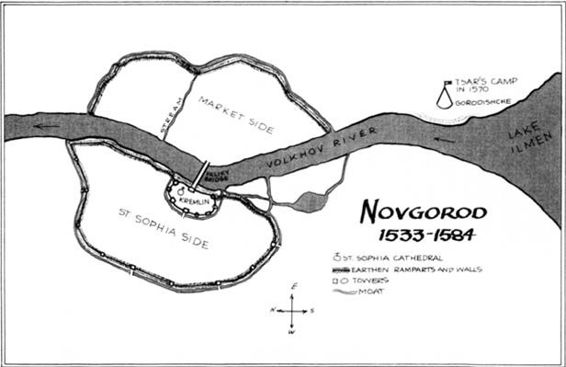
On Sunday he set out with the Tsarevich and a large detachment of his army for the Cathedral. He rode along the right bank of the Volkhov River, entered the Merchants’ District, and then began to ride across the great wooden bridge which led to the Kremlin wall. At this moment Pimen, Archbishop of Novgorod, accompanied by all the clergy of the Cathedral armed with golden crosses, icons, and brilliantly colored banners, came across the bridge to meet him. The Tsar and the Tsarevich led the armed procession coming from the east and the Archbishop led the procession coming from the west. The Archbishop held out the cross, thus attempting to offer the Tsar a blessing, but the Tsar drew back, for he had no intention of being blessed by the man he was about to destroy. The Third Chronicle of Novgorod records the words Ivan shouted from the bridge:
Because you worship evil, you have no holy cross in your hands. Instead, you are carrying a weapon, and this weapon, together with your evil thoughts, your monks and the citizens of Novgorod, is an instrument designed by you for the surrender of Novgorod the Great, which is our patrimony, to the enemy, the foreigner, the King of Poland, Sigismund Augustus!
So you are no longer the shepherd, nor the teacher, nor the holder of the Archbishopric of St. Sophia. No, you are a wolf, a predator, a destroyer, a traitor, an enemy of our crown!
Having spoken these words in a terrible rage, Ivan ordered the Archbishop to turn back and celebrate mass in the Cathedral. During the mass Ivan was seen to be praying fervently. Afterward, followed by the Tsarevich and the oprichniki, he rode to the Archbishop’s palace for the midday meal and for a while he seemed to be on his best behavior. It was believed that his rage had subsided. Suddenly he stopped eating and began screaming at his soldiers, telling them they must take the Archbishop’s treasury and strip the palace of all its valuables. As for the Archbishop, his nobles, servants, and attendants, all of them must be placed under arrest. The Cathedral of St. Sophia must be plundered and left a barren shell. Icons, sacred vessels, embroidered robes, even the great doors must be piled onto the baggage carts. The famous bronze bell weighing 18,000 pounds, which summoned the people of Novgorod to church, that too must be removed to Alexandrova Sloboda. The Kremlin of Novgorod was to be pillaged of all its treasures.
Archbishop Pimen was wearing gold-embroidered robes and a closely fitting white cowl surmounted by a gold crucifix. Enraged by the spectacle of the Archbishop in full episcopal attire, Ivan ordered the oprichniki to remove the cowl and the robes. He was made to stand in his underwear.
“You have no right to be an Archbishop!” Ivan shouted. “You would be better if you were dressed up like a clown, and I’ll find a wife for you!”
No man could become an Archbishop unless he had led a chaste and virtuous life, and these last words were therefore especially offensive. The abbots of twenty-seven monasteries had accompanied Ivan to the midday feast. Nearly all the monks from these monasteries had already been slaughtered. To these abbots Ivan addressed himself: “Come, be my guests! I invite you all to contribute to the expenses of the wedding!” It appeared that the expenses of the wedding were extraordinarily high, and each abbot was assessed according to the wealth of his monastery.
Ivan had not yet finished with the Archbishop. He ordered the servants to produce a white mare, and it became clear that the Archbishop was to be married to the mare.
“Here is your wife!” the Tsar said. “Saddle her, mount her at once, and ride off to Moscow! When you have reached Moscow, add your name to the register of clowns!”
Archbishop Pimen climbed on the mare, and Ivan then gave instructions that his feet should be tied to it. The Archbishop was then told to ride off in the direction of Moscow, but a moment later Ivan had a better idea: he had thought of some new indignity for the long-suffering Archbishop. A musical instrument attracted his attention. It was a kind of lyre with strings and bellows. Ivan thrust the instrument into the Archbishop’s hands, saying: “Since you now have nothing else to do and since you have taken a wife, here’s something for you to play with!”
There was a good deal of mirthful laughter. The Archbishop was in his underwear; the oprichniki were crowding around him; Ivan was enjoying the degradation of a churchman who was far from being saintly but had genuinely attempted to rule his flock justly. As he rode away on the white mare in the direction of Moscow with a strong bodyguard, the Archbishop plucked the strings and blew the bellows.
A few days later Ivan wrote to the Metropolitan Kirill in Moscow that “Archbishop Pimen may not perform any services in the church, but his style and dignity are not to be removed from him until he has been judged and sentenced by the Church Council.”
The sacking of the Cathedral of St. Sophia and of the Archbishop’s palace, and the degradation of the Archbishop, put Ivan in a good temper. He sent an order to the people of Novgorod telling them to go about their affairs as usual and he urged them to sell their goods to the oprichniki at a just price.
When he returned to the Gorodishche later in the afternoon, his mood was somber and threatening. The time had come to confront the people with their sins. Men, women, and children were brought to him to be interrogated. He wanted evidence of treachery. How, and why, had it come about that the Novgorodians had sent secret messages to King Sigismund Augustus, asking him to rule over them? Since they had not done so, no evidence was forthcoming. The evidence therefore had to be manufactured. Under torture some of the prisoners confessed to imaginary crimes, incriminating one another, and invented totally untrue stories, and were sentenced to death. Roped together and tied to the backs of sleighs, some with ropes round their necks and others with ropes round their legs, they were dragged across the snow to the wooden bridge across the Volkhov River to await their punishment.
Ivan cherished the refinements of punishment. He ordered a high platform to be built on the wooden bridge. Some were to be thrown off the platform, others from the bridge. The ice had been broken below the bridge, and there was a dark pool of water below. The arms and legs of the victims were bound, and it was thus impossible for them to swim away, and even if they could swim, it would not have helped them. Underneath the bridge the oprichniki, armed with boat-hooks, pikes and axes, were waiting for them in boats. The victims thrown from the bridge sank in the water and then rose to the surface; the oprichniki then hacked and chopped them with axes, or thrust at them with the pikes and boat-hooks, until the bodies sank again.
The chroniclers have recorded one curious detail. They say the men were thrown off the bridge, while the women and children were thrown from the high platform. The Tsar was accustomed to seeing men being killed, but the sight of women and children being hurled to their deaths was an unaccustomed diversion.
For nearly four weeks the killings continued. What the chroniclers called “the unabatable fury of the Tsar” brought about the deaths of about 30,000 people. On some days a thousand people were thrown into the river and then stabbed and axed to death. Occasionally the figure rose to fifteen hundred; sometimes it fell to five or six hundred. Ivan had discovered an efficient way of disposing of the corpses, for they were carried downstream under the ice and left no trace. Mass murder was being practiced at little expense, hygienically, with a minimum of death-dealing instruments, and without any complications.
While the waters under the bridge were the principal execution grounds, Ivan had recourse to novel methods of killing in order to relieve the monotony. High picket fences were erected round a field, and some Novgorod merchants were then led into the field. Ivan, wearing armor, mounted his horse, lowered his lance and charged them. He derived so much satisfaction from spitting a merchant on the end of his lance that he invited the Tsarevich to join him. After killing a few merchants, he left the field to the oprichniki, ordering them to chop up the remaining merchants and throw the pieces into the Volkhov River. In this way he killed perhaps twenty merchants with his own hands. Maliuta Skuratov claimed to have killed 1,490 Novgorodians with his own hands, excluding the fifteen he shot with a musket. The wound he had received at Torzhok from a Tatar knife had evidently healed rapidly.
Two desires worked on Ivan: the desire to massacre, and the desire to acquire treasure and loot. One of the richest merchants in Novgorod was a certain Fyodor Syrkov, known for his munificent endowment of monasteries. He had hidden his wealth and refused to divulge where he had hidden it. The Tsar had no difficulty in making him reveal the hiding place. First, Syrkov was thrown into the ice-cold river at the end of a long rope. Before he could drown, he was pulled out and taken before the Tsar.
“Did you see anything in the water?” the Tsar asked him.
Syrkov was a brave man and answered: “Yes, I saw the evil spirits living in the deep waters of the Volkhov River, and they were about to rise to the surface to steal your soul from your body!”
Ivan had no liking for bold men and ordered the oprichniki to stand him up to his knees in a caldron of water. A fire was lit beneath the caldron, and long before the water had reached boiling point the unhappy Syrkov revealed the hiding place of his treasure amounting to 12,000 silver rubles, which was equivalent in purchasing power to more than a million dollars of today’s money. The revelation did no good to Syrkov, for Ivan ordered him to be chopped to pieces and thrown into the river.
Before the end of the first week of February 1570 Ivan decided that the massacres at Novgorod had gone far enough. About a third of the population had been killed, and most of the wealth of the city was in his hands. He needed a change of air, and more exercise, and therefore set out on a tour of inspection which would take him to all the great monasteries in the neighborhood. The monks had been killed, but the treasuries had been left intact and the buildings themselves were under seal. He spent a day in each monastery superintending the removal of costly fabrics, sacred vessels, icons, bells, and whatever else he could lay his hands on. His rage for destruction extended to the granaries, which were burned, and all the horses and cows belonging to the monasteries were slaughtered. Then he returned to Novgorod gorged with his loot.
The final punishment took the form of a general sack of the city. The shops and warehouses were looted and burned down. The stalls in the marketplaces were smashed, the private houses were invaded, the young women were raped and sometimes carried off by the oprichniki, and all the valuables were removed. Heinrich Staden, who was present throughout the campaign against Novgorod, wrote as follows about Ivan’s last days in Novgorod. “After the pillage of the monasteries the sack of the city began. Nothing was allowed to remain in the city and everything that the soldiers could not carry away was either thrown into the river or burned. If any of the Zemskiye people retrieved anything from the water, he was hanged. All high buildings were torn down, and all the beautiful doorways, stairs, and windows were destroyed.” By this time the oprichniki had grown weary of massacre, and perhaps no more than a thousand died during these last days.
Suddenly, in the early morning of February 13, 1570, Ivan decided to make his peace with Novgorod. The time was propitious, for it was the Monday of the second week of Lent. At sunrise he ordered messengers to announce that by the Tsar’s orders every street in Novgorod must send its leading citizen to the Gorodishche. There could be no question of disobeying the Tsar’s orders, and the messengers returned to the Gorodishche with about sixty elders, who believed themselves as good as dead. Clearly there would be another massacre, and another, and another, until no one in Novgorod was left alive. To their surprise they found the Tsar in an accommodating mood. According to the chronicler, the Tsar gazed upon them with merciful and kindly eyes, and said:
Men of Novgorod the Great, all those of you now remaining in this city, I pray you to beseech the all merciful, ever generous and most loving God, and His pure Mother and all the saints, on behalf of our Tsardom, and my children Ivan and Fyodor, and my Christ-loving army, so that Our Lord may grant us victory over our enemies whether visible or invisible. God shall judge Archbishop Pimen, who is a traitor to me and also to you, and all his evil collaborators, and they will be held accountable for this bloodshed. But you must not grieve any more. Go, and be thankful!
Why was he saying this? Perhaps it was because he had punished them enough. Perhaps it was because he wanted a breathing space or because the stench of the dead was more than he could bear, or because the ultimate humiliation of the injured lay in making them bless the name of the one who does the injury. He was asking that his victims pray for him, his sons, and his Christ-loving army, which was still murdering wantonly, still scouring the countryside and creating havoc in the villages.
Even now he continued to punish the people of Novgorod. A large amount of their wealth consisted of goods and supplies stored in the warehouses at Narva. Accordingly, he sent five hundred oprichniki to Narva with instructions to set fire to the warehouses and kill anyone who attempted to save anything from the flames. Their bodies were to be thrown into the river and all their property was to be burned. This appears to have been the last order given by the Tsar before he set out for Pskov.
When the Tsar said, “Go, and be thankful,” he was speaking with massive irony. Even before he arrived in Novgorod there was a shortage of foodstuffs and during the time he stayed in the city all the available grain including seed grain and all the domesticanimals were destroyed at his orders. As a result Novgorod suffered from a terrible famine which was followed by pestilence. The chroniclers report that in September of that year ten thousand people were buried in a mass grave in Novgorod and in May 1571 another mass grave was dug. So many people had been killed or had died as a result of starvation and the plague that Ivan ordered people to be transferred to Novgorod from all over Russia.
Carts loaded with all the treasure plundered at Novgorod set out for Alexandrova Sloboda. Gold and silver, pearls and precious stones, holy icons, furs and silks, and even the great bell from the Cathedral of St. Sophia and the great bronze doors carved in 1336 were sent under guard to Alexandrova Sloboda, the treasure being sealed up in the vaults under the two new churches built to celebrate his victory over the people of Novgorod. It occurred to Ivan that the bronze doors of the Cathedral of St. Sophia would serve as an admirable decoration to his own cathedral at Alexandrova Sloboda, but they proved to be too large and had to be cut down to size. The less valuable booty was loaded on sledges, driven to a monastery outside Novgorod, and distributed among the oprichniki.
No one was ever able to count the number of the dead at Novgorod. John Horsey wrote that 700,000 were killed, but this is clearly an error, for the population of Novgorod including the children cannot have numbered much more than 100,000. By comparing all the available estimates it is possible to reach a figure of about 30,000 people killed while the oprichniki were occupying the city, and at least 20,000 died in the ensuing famine and pestilence.
The Tsar’s attitude throughout these murders was one of calm condescension, implying that he had conferred a favor on the people of Novgorod by rescuing them from treason. That there was not the slightest evidence of treason was a matter of indifference to him. There was a plan, and everything must be carried out according to the plan. The city must be emptied of its traitors, and all available means were to be used against them. He liked his orders to be carried out calmly, methodically, without passion. The river, in his eyes, became a conveyor belt quietly removing the people from the scene. It did not happen like that. The river, choked with the dead, became the prime source of the plague that threatened to engulf all Russia in the following months.
Albert Shlichting tells the story of the beggars of Novgorod who were expelled from the city to wander about in the snowy wastes. They were unharmed, perhaps because Ivan felt there was some sanctity in extreme poverty. Some of the citizens, seeing that the beggars were allowed to go free, disguised themselves in rags and escaped. But there was no food to be found in the snow and most of them perished. The more daring ones returned secretly to the city at night to feed off the corpses, which they kept salted in barrels. In time Ivan himself learned about this practice. It interested him. He asked his officers to inquire into it and to bring some of the cannibals into his presence. According to Shlichting he was interested in the purely technical question of why they kept the bodies salted in barrels. They did not answer his question; they said only that they were dying of starvation and ate the bodies to keep alive. He ordered them to be thrown into the river.
Before leaving the city Ivan took possession of the Torgovaya Storona or Market Side, which contained most of the warehouses and shops. Here he built a palace where he resided whenever he visited Novgorod. Accordingly, a month after he departed for Pskov, when the ice was beginning to melt, the builders set to work to dig the foundations of his new palace, which was splendidly furnished.
He was well content with himself. The oprichniki had served him well; all his orders had been obeyed; he had punished the enemy and acquired a vast treasure; and it remained only to make the westward journey to Pskov, the white-walled city, as rich as Novgorod and almost as powerful, where the processes of murder and plunder would be repeated with whatever refinements he felt necessary.
Five days later, on February 18, he came in sight of the virgin city. Exhausted by the long journey, he decided not to enter it that day and spent the night in the Monastery of St. Nicholas just outside the walls. The monastery was built like a fortress and offered him all the protection he needed. It was a Saturday, and on Sunday he intended to remind the people of Pskov that he was their Tsar and that they owed everything, even their lives, to him.