

IF WE COULD LOOK into Ivan’s mind when he returned to Alexandrova Sloboda, we would find it choked with suspicions and alive with cruelties. There had once been some brightness in his mind, but now it gleamed fitfully, like the small flames that dance over the dying embers, flickering and menacing. He could still go through the motions of ruling, but there was something strangely mechanical in all his actions. Murder, too, had become mechanical. He was not so much acting as reacting to ever-present frustrations and an overwhelming sense of his own unworthiness.
At the age of thirty-seven he had become an alien in his own land. The sense of alienation, his difference and remoteness from ordinary people, had of course always been there and he could never entirely escape from the knowledge of his own majesty. But now there could be detected a new and more profound alienation which expressed itself in a desire to escape from Russia altogether, in his creation of a separate kingdom, and his repeated hints that he would give the crown to a foreigner. He was playing with the thought of abandoning the world he had known since his childhood, and found comfort in the idea of living in a monk’s cell on the shores of the White Sea. All the ceremonies of power were becoming meaningless as he searched without success for an escape route worthy of an emperor. But there are no escape routes worthy of an emperor except on the battlefield. He was a physical coward, and therefore a glorious death on the battlefield never appealed to him. He must continue to live, and there were few satisfactions in living. But he could give himself up to cruelties that excite the nerves and discover strange consolations in the contemplation of people dying in agony. This was the drug he employed to ease the pain of living, and it was provided in abundance by the oprichniki. Terror became his entertainment, and during the following years he destroyed people more ruthlessly and in greater numbers than ever before.
He now stood so far above the laws that it was as though the law had no existence, and so far above the flesh that it was as though flesh and its sorrows had no existence. Torture, which had always fascinated him, now obsessed him. He was continually inventing new and more excruciating forms of torture, while he filled the emptiness of his life with imaginary enemies, imaginary plots, imaginary crimes.
In later years he would say that the oprichniki had misled him and that he was as much their victim as the innocent people they tortured to death. He claimed that he had never really ordered those innumerable executions and he would pretend to a grief he had never felt when he wrote to the monasteries asking the monks to pray for the souls of the dead. Finally he would turn against the oprichniki and destroy them as calmly and mechanically as he had destroyed the poor devils who were tortured to death in the cellars of the Oprichnina Palace. He had no mercy for anyone, and this total absence of mercy was only another sign of his alienation from the world.
In time a myth grew up that Ivan was pursuing a carefully formulated social and political policy to bring about the annihilation of the boyar class. It was a myth that gave some comfort to Stalin, who was engaged in liquidating the kulaks, the more prosperous peasants who rejected the idea of working in the collective farms. The Russian historian Robert Wipper wrote a book idealizing Ivan for his wide-ranging understanding of the social forces at work and for his determination to destroy the oppressive boyars and to inaugurate a new and more egalitarian social system. But in fact Ivan had no understanding of the social forces at work; he destroyed blindly, impassively, scarcely caring who was destroyed, like a maniac.
Ostensibly the reason for the new wave of terror was the discovery of another plot implicating high officials of the court. The oprichniki told Ivan that Prince Belsky and Prince Mstislavsky were implicated. Ivan was not convinced of the guilt of these two princes of royal blood, saying, “I and these two comprise the three pillars of Moscow and on us rests the whole state.” But beyond the circle of royal princes he permitted himself to believe there was treachery everywhere.
The mild-mannered Kazarin Dubrovsky, the assistant secretary of the treasury, was executed. He was sitting quietly in his house with his two sons when the oprichniki broke in, killed them, and threw the bodies into the well. They also killed his servants and retainers, and went on to kill Dubrovsky’s brothers and their entire families.
Ivan Cheliadnin, the former governor of Moscow, renowned for his kindness and gentleness, had long been in disfavor with Ivan, who sent him to govern Polotsk to get him out of the way. He was one of those who received letters from King Sigismund Augustus and Gregory Hotkevich. Heinrich Staden said of him: “He willingly helped the poor to find justice quickly.” He was now about sixty and had a great career behind him. Suddenly Ivan summoned him to Moscow, dispossessed him of all his valuables, his clothes, his properties, even his household utensils, and then ordered him to fight the Tatars. Cheliadnin, now a pauper, begged a horse from a monk and set out for the southern front, where he remained until on September 11, 1568, he received another summons to Moscow.
He must have known he was doomed, for he said farewell to his wife and close friends before he went to the Kremlin palace, but he could not imagine the fate reserved for him. The Tsar ordered him to be dressed in royal robes and to mount the throne with the scepter in his hands. Thereupon the Tsar doffed his hat and knelt before Cheliadnin in homage, saying, “This is what you have been wanting all along—to be Grand Prince of Moscow in my place. Now rejoice and enjoy the power you were thirsting for!” There was a pause, and then the Tsar rose to his feet, and said, “Just as it is in my power to establish you on the throne, so it is in my power to remove you from it!” Then he seized a dagger and struck Cheliadnin several times in the chest. Then, seeing that he was not yet dead, Ivan ordered the guards to finish him off.
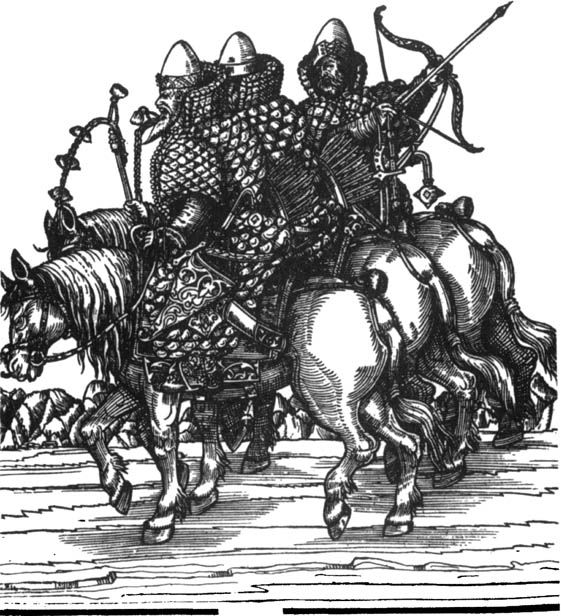
Russian cavalry. (From Herberstein’s Rerum Moscoviticarum Comentarii)
At the Tsar’s orders the body of Cheliadnin was unceremoniously dragged across the Kremlin and dumped in the middle of the Red Square for all to see. There followed for six weeks a reign of terror directed against all the nobles who might conceivably have some connection with Cheliadnin. For some reason the Tsar was merciful toward Cheliadnin’s wife, who was sent off to a nunnery, but all Cheliadnin’s servants were killed by drowning. Some three hundred people living on his estate at Kolomna were also drowned. The oprichniki were permitted to go on a long rampage. The estates of the nobles around Moscow who were known to be friendly to Cheliadnin were devastated in sudden raids, and at the Tsar’s orders the wives were abducted, thrown into waiting carts, and carried off in triumph to Moscow. Prince Afanasy Viazemsky, Maliuta Skuratov, and Vasily Griaznoy were placed in charge of these expeditions, which usually took place at night and with the assistance of small armies of musketeers. The houses of officials, merchants, and scribes were also devastated and their wives, too, were thrown into the carts.
The Tsar took the more beautiful wives to himself and distributed the rest among his entourage. Some were passed on to the musketeers. Albert Shlichting relates that of some five hundred women gathered in these expeditions, the Tsar kept fifty for himself and five hundred horsemen were commanded to guard them. Those who pleased him he kept; the rest were thrown into the river. From time to time the survivors of the women who had been rounded up for the pleasure of the Tsar and the oprichniki were returned to their homes, always at night and in great secrecy. Some women killed themselves, while others died of shame.
In Ivan’s eyes the wives of traitors deserved to be raped, and in taking these women he was simply inflicting a necessary punishment.
Ivan himself rode with the oprichniki on some of these expeditions, gave orders, and saw that executions took place in the manner he desired. Thus when he came to one of Cheliadnin’s estates he sought out the soldiers, ordered them to be stripped naked, locked them up in a house, and blew up the house with gunpowder.1 Shlichting says the Tsar was greatly amused with this new form of execution and the sight of the bodies flying through the air. For the women on the estate he invented still another form of execution. They were stripped and herded into the woods like cattle, and then the oprichniki went hunting after them, torturing and killing all of them. Another form of entertainment was to bring chickens to the execution ground, and when the chickens were let loose, the naked women and girls were ordered to catch them. While they were running after the squawking chickens, they were shot down with arrows.
On one occasion a nobleman, Nikita Kazarinov, was arrested and brought to Alexandrova Sloboda wearing a monk’s robes. Ivan gazed at him speculatively and said: “He is an angel, and therefore it is proper that he should fly to Heaven.” Then he ordered the man to be tied to a barrel of gunpowder and blown up. Ivan, as a connoisseur of mass murder, had learned that it is easier to kill when the victims are deprived of their human dignity.
All through the summer and autumn the reign of terror continued. The oprichniki were now in the ascendant, murdering, looting, raping as they pleased. Secret death lists were compiled, and every day small groups of privileged assassins, numbering from ten to twenty, sallied forth from the Oprichnina Palace to carry out their orders. They rode on swift horses, wore coats of mail under their long black cloaks, were armed with heavy axes and swords, and carried the familiar emblems—the broom stuck in a quiver and a dog’s head tied to the saddle. They were the privileged agents of the terror. “None of the victims,” wrote Taube and Kruse, “knew what crime he had committed, or when he would die, or whether he had been condemned to death. Thus each man went unsuspectingly to work, to the courts and the offices, and suddenly the oprichniki would descend upon him, strangle him or cut him to pieces in the street, at the gates, or in the marketplaces, although he was quite innocent. The bodies were left to lie on the ground and no one was permitted to bury them. The marketplaces and the streets were so filled with corpses that the people, and the foreigners too, could not go about their work, not only because they were afraid but also because of the unbearable stench.”
Mass murder had become a habit recklessly pursued by a Tsar who cared only for inflicting punishment on his own people. As usual, he busied himself thinking up refinements to murder, and he discovered a surprisingly large number of them. A woman was hanged on her own gatepost. He ordered that her husband should pass through the gate without showing any sign of emotion, otherwise he too would be hanged. A woman was hanged from the roof beam above her dining table, and her family was ordered to take their meals at the table. This kind of thing went on all over Russia.
Only one person was in a position to protest and to be listened to. This was the Metropolitan Philipp, who begged the Tsar to put an end to these meaningless massacres. The Tsar answered, “Those who are close to me have risen up against me and seek to do evil to me. Then what business of yours is it to give me advice?” Philipp answered that it was a sin to encourage evil men and that the Tsardom was in danger as a result of their actions. He attempted to convene a synod of bishops who would deliver a public warning to the Tsar, but only Herman, Archbishop of Kazan, supported him. The others were too terrified to act, and one of them, Pimen, Archbishop of Novgorod, reported secretly to the Tsar that Philipp was behaving treacherously. The bishops remained silent; the Tsar was forewarned; the fate of Philipp was sealed.
Philipp’s opportunity to confront the Tsar publicly came on Sunday, March 22, 1568, in the Uspensky Cathedral. The Tsar and his guard of oprichniki entered the cathedral dressed in black, with black cloaks and high-peaked black caps. The Tsar made his way to the Metropolitan’s throne and stood there, awaiting a blessing. There was no blessing. The Metropolitan was gazing at an icon of the Savior, refusing to pay any attention to Ivan, although conscious of his presence. Finally some boyars came up and said, “Holy father, the Tsar is here! Give him your blessing!” And then the Metropolitan turned slowly toward Ivan and in the presence of all the clergy and the boyars he said:
“I do not recognize the Orthodox Tsar in this strange dress, and I do not recognize him in the actions of his government. To what limits have you gone, O Tsar, to place yourself beyond the reach of a blessing? Fear the judgment of God, O Tsar! We are now offering up the bloodless sacrifice to the Lord, while the blood of innocent Christians is being spilt beyond the altar! Since the day when the sun first shone in the heavens, no one has ever seen or heard a God-fearing Tsar persecuting his own countrymen so ferociously!”
The words of the Metropolitan, preserved in the chronicles written by priests, were remembered also by Taube and Kruse, who recorded the same words with only slight variants. The Metropolitan’s voice was harsh and somber as he went on:
“Even in heathen kingdoms law and justice prevail, and there is compassion for the people—but not here! Here the lives and possessions of the people are unprotected, everywhere there is pillage, everywhere there is murder, and all this is perpetrated in the name of the Tsar! You sit high on your throne, but there is a God who judges us all. How will you stand before His judgment seat, stained with the blood of the innocent and deafened by their screams under torture! Even the stones under your feet cry out for vengeance! I speak, O Tsar, because I am a shepherd of souls and I fear only the one and only God!”
Trembling with fury, Ivan struck the ground with his iron-tipped staff.
“Do you dare to challenge my will?” he shouted. “It would be better for you if you were more in agreement with us!”
“Then where would be my faith?” the Metropolitan answered. “The sufferings of Our Saviour and His commandments were vain, if I remained silent. I am not grieving for those innocents who have suffered—they are God’s martyrs! I am grieving for your soul!”
Ivan was too angry to speak, and therefore made menacing gestures. Once again he struck the ground with his staff. Then when he had sufficiently composed himself to say what was on his mind, he said in a terrible voice: “Up to now I have spared you traitors to no purpose! From now on I shall behave as you depict me!”
The Metropolitan showed no sign of fear.
“I am a stranger and a pilgrim on the earth, like all the priests,” he answered, “and I am ready to suffer for the truth. And if I remained silent, where would be my faith?”
Hearing this, the Tsar stormed out of the cathedral, followed by the oprichniki in their black gowns.
On the following day Ivan ordered the arrest of all the principal members of the Metropolitan’s court. They were tortured and interrogated, but no incriminating evidence was found. It was decided to invoke the assistance of Pimen, the Archbishop of Novgorod, who dearly wanted to be installed as Metropolitan of all Russia. One day Pimen confronted the Metropolitan in the cathedral and said: “You are making accusations against the Tsar and all the time you are committing evil.” The Metropolitan replied: “You are trying to seize my throne—you, who will soon lose your own!” It was becoming increasingly clear to Ivan that all attempts to depose Philipp would fail unless extraordinary measures were taken. It was necessary to act cautiously because the Metropolitan was venerated and revered by the people of Moscow.
On July 28, 1568, a strange incident occurred at the Novodevichy Monastery, where the Metropolitan was presiding over the celebrations in honor of the feast day of the monastery. Ivan and his bodyguard of oprichniki attended the celebrations and took part in the customary procession around the monastery walls led by priests bearing crosses, icons, and banners. During the procession the Metropolitan turned and observed that one of the oprichniki was wearing the round skull cap worn by the Tatars. Since it was always the custom for the laity to remain bareheaded while taking part in processions and since the skull cap was associated with Islam, the Metropolitan concluded that the oprichnik was deliberately mocking the Christian faith, and in his anger he turned to the Tsar and said, “When we are glorifying our God and His words are being read in affirmation of our Christian faith, it is proper that men should remain uncovered. Whence comes this Tatar custom? Do not all of us who are present profess the same faith?”
“Who has dared to do this?” Ivan asked.
“Someone in your suite,” the Metropolitan answered.
Already the man had slipped the Tatar cap off his head, and when Ivan turned round he saw that all the oprichniki were bareheaded. It occurred to him that the Metropolitan had simply invented the incident in order to admonish him and he began to abuse Philipp, calling him a liar, a traitor, and an evildoer, cursing him and threatening to expose him. Yet, for the moment, he could do nothing. To rid himself of the Metropolitan it was necessary to have the Church on his side, and the Church was still devoted to its saintly Metropolitan.
But the Tsar was determined to depose Philipp, however long it took, and there were some churchmen who were prepared to assist him. He decided to send a delegation of church officials to the Solovetsky Monastery, where Philipp had lived for thirty years, to discover whether there had been any scandalous conduct on the part of the Metropolitan. The delegation consisted of Pafnuty, Bishop of Suzdal, and Feodosy, the Abbot of the Andronikov Monastery, some clerics, and an armed guard under the command of Prince Vasily Temkin-Rostovsky, who had only recently returned from captivity in Lithuania. Prince Temkin-Rostovsky had been given a high rank in the Oprichnina army, and his presence was intended to emphasize the importance of the mission.
Neither Pafnuty nor Feodosy were able to obtain any evidence of wrongdoing by the Metropolitan from the monks at the Solovetsky Monastery. They protested that he had always behaved in the most saintly manner and not a single impious or unpatriotic thought had ever crossed his mind. Unhappily, however, Abbot Paissy of the Solovetsky Monastery was an ambitious man who was quite prepared to sign a fabricated catalogue of misdeeds performed by the Metropolitan. The list was compiled by Prince Temkin-Rostovsky with the assistance of Abbot Feodosy. Bishop Pafnuty refused to have anything to do with it.
By the beginning of November 1568 everything was ready for the trial of the Metropolitan. The Tsar had read the list of misdeeds and was satisfied with it. Philipp was summoned to meet his accusers in the presence of the Boyar Council. He appeared in his elaborate vestments, wearing the white cowl of a Metropolitan and carrying his staff of office, an austere and commanding figure. Abbot Paissy read out the catalogue of misdeeds and crimes. Philipp listened in silence, refusing to defend himself. Herman, Archbishop of Kazan, spoke strongly in his defense, but to no avail. Philipp gazed at the abbot and said: “The evil you have sown will not bring you the fruits you desire,” and then he addressed himself to the Tsar, saying:
“Tsar and Grand Prince, you must not think that I fear you or that I fear death. No, I am an old man who has led a blameless life in the monastery, free of rebellious passions and worldly intrigues, and in that innocence I desire to surrender my soul to God, who is your God as well as mine. It is better that I should leave behind the memory of a man who died innocently affirming the truth of his faith than that I should remain the Metropolitan silently submitting to a reign of terrible lawlessness! Do with me as you will! Here is my shepherd’s staff, here is my white cowl, here is the mantle with which you once desired to exalt me!”
Then he turned to the assembled churchmen and said: “You, bishops and abbots and all who serve at the altar, look faithfully after the flock of Christ, prepare to give an account of yourselves, remember to fear the Tsar in Heaven more than the Tsar on earth!”
With these words the Metropolitan turned to leave, having removed his cowl and mantle and having laid down his staff, as a sign that he had resigned from his high office. Ivan was infuriated and called him back, shouting that he had behaved with impermissible haste, the judgment and the punishment had not yet been pronounced, and he must put on his robes again. He also commanded the Metropolitan to conduct the services at the Uspensky Cathedral on the feast day of the Archangel Michael, which would take place on November 8. Only after he had conducted these services would he be permitted to lay down his office. Clearly the Tsar wanted more time to think up an appropriate punishment for a man he regarded as a declared enemy.
For Ivan there was only one appropriate punishment: torture unto death. The Metropolitan knew he was doomed, but neither he nor Ivan yet knew what tortures would be inflicted on him. During the four days between the trial and the feast of the Archangel Michael, the decision was taken. It was a very simple decision. The oprichniki would be let loose on him.
The Metropolitan was conducting mass when the armed oprichniki burst into the cathedral, led by Alexey Basmanov and Maliuta Skuratov. The Metropolitan’s crimes were read out and he was judged unworthy of his high office. Then the oprichniki hurled themselves on him, tore the crown from his head, jostled him, and stripped him of his vestments. Then they dressed him up in a monk’s tattered robe and ran him out of the cathedral, waving their brooms at him. They threw him on a sleigh and drove him across the Kremlin and into the Red Square and then to the nearby Bogoyavlensky Monastery. All the time people came running up to the Metropolitan, demanding a blessing. At the gate of the monastery the sleigh stopped long enough for him to make a farewell speech: “Children, I have done all I could, and but for the love I bear you I would not have remained a day on the Metropolitan’s throne. Have faith in God’s mercy. Guard your souls in patience.” Then they hurried him away and put him in a cell in the monastery.
But this was not quite the punishment which, according to Ivan, he deserved. Inevitably he would be executed, but something must first be done to degrade and humiliate him. He must be insulted and the last vestiges of human dignity must be removed from him by placing him on trial before his peers in his patched and tattered gown, the former Metropolitan reduced to the status of a beggar in rags. On the following day Ivan showed how little he understood the mentality of Philipp, who was brought back to the Kremlin and once more confronted his accusers. Pimen, Archbishop of Novgorod, advanced new charges. Abbot Paissy added new slanders. Philipp was condemned to perpetual imprisonment. It appeared that his chief crime was that he had practiced sorcery.
Of all those who attacked him, Abbot Paissy was the one who was most distasteful to Philipp. Once, looking at Paissy, who had been his pupil at the monastery, he said: “God’s grace on your lips, my son! False lips are speaking against me! Have you not heard the words of God that ‘whosoever is angry with his brother shall be in danger of hell fire.’2 And there is another text in Holy Scripture: ‘Whatsoever a man soweth, that shall he also reap.’ ” Then he added: “These are not my words—they are the words of the Lord!”
While there was breath in him, Philipp was determined to protest. The Tsar was present, and Philipp had the opportunity to say for the last time those things that had been in his mind for many months.
“Do not torture your people!” he said. “Remember always the hour of your death. Depart, O Tsar, from godless acts, and remember the fate of former rulers, for those who did good were blessed after their deaths and those who ruled evily were remembered without pity. Therefore you should endeavor to follow in the paths of those blessed ones, for high rank does not secure a person from death, which inexorably sinks its teeth into all things! Therefore, before the coming of death, you should offer the fruits of goodness and thus gather for yourself treasures in Heaven. Remember that all the treasure you amass on earth remains on earth, and all of us will have to answer for our lives!”
Philipp spoke in this way because it was the only way the Tsar could be made to understand the enormity of his crimes. The God-fearing Tsar might conceivably be brought to contemplate the wrath of God. Instead, the Tsar was incensed because the boyars and churchmen all listened silently and reverently, and because Herman, Archbishop of Kazan, once more defended Philipp, saying he was innocent in spite of the false witnesses brought against him. It was Archbishop Herman’s last official act, for on the following day the oprichniki, at the Tsar’s orders, entered his house and cut off his head. The official version was that he had died suddenly of the plague. Prince Kurbsky, in his history of the reign of Ivan IV, wrote that he was either poisoned or strangled. The exact manner of his death was learned when the Soviet government permitted his tomb to be opened.
In the eyes of the Tsar Archbishop Herman was a traitor, while Philipp was guilty of an even more outrageous crime—he had dared to call God’s wrath upon the Tsar. It was therefore necessary that he should be given a punishment worthy of his crime. According to Prince Kurbsky, he was loaded with heavy chains around his arms, legs, and loins, and carried off to prison where he was placed in a dark and narrow cell. Orders were given that he should receive no food, and it was hoped he would starve to death. Some days later officials from the Kremlin entered his cell. A miracle had taken place, the chains had fallen away and Philipp was standing there with his hands above his head, singing psalms. The officials fell to their knees, sobbing. When they reported what they had seen to the Tsar, he cried out, “Spells, spells has he cast! My enemy! My traitor!”
More miracles were recorded. It was said and firmly believed by Prince Kurbsky and many churchmen that the Tsar ordered a wild, half-starved bear to be led into the bishop’s cell, and on the following morning the Tsar himself came to peer into the cell, expecting to see Philipp’s bones lying there. Instead he found him standing in prayer, while the bear lay quietly in a corner of the cell. As he went away, the Tsar was heard muttering, “Spells! The Bishop casts spells!”
The Tsar was sufficiently impressed by these incidents to pay attention to a petition signed by the Church Council, which begged him to spare Philipp’s life. For some reason the Tsar decided to take him out of the prison and place him in a cell in the Monastery of Nikola Stary, across the Red Square from the Kremlin and close to the Bogoyavlensky Monastery. Crowds assembled outside the monastery from morning to night, all eagerly discussing the fate of the beloved Metropolitan and the miracles performed by God in order to save him. The Tsar, afraid that there would be riots, ordered him transferred to the Otroch Monastery near Tver.
Many strange stories were told about Philipp while he was in the Monastery of Nikola Stary. A close friend and relative of his called Ivan Kolychov came under suspicion and the Tsar ordered his execution. Execution by gunpowder was now much favored by the Tsar, who gave precise instructions on how Ivan Kolychov was to die. He was hoisted up and roped to the roof beam of his house. Kegs of gunpowder were rolled into the cellar and the house was blown up. Miraculously Ivan Kolychov survived, for after the explosion he was found sitting on the ground, dazed but alive, with one arm roped to a great beam. The Tsar was present and saw what had happened. Such miracles were not permitted, and so one of the oprichniki rode up to the man, cut off his head and presented it to the Tsar, who ordered that it should be placed in a leather bag and shown to Philipp. Accordingly a messenger was sent to the monastery with the bag, with instructions to present the head to Philipp with the words, “Here is the head of your favorite cousin! Your spells were of no avail to him!”
Philipp received the head in his hands, kissed and blessed it, and returned it to the messenger.
He was the last of the heroic Metropolitans. Those who followed him were self-serving, without courage, doing what was demanded of them. Philipp was followed by Kirill, who died in his bed and was followed by Anthony. They flitted like shadows through the last somber years of Ivan’s reign.
The chroniclers describe how the reign of terror spread across Russia, and no one, rich or poor, noble or peasant, was immune to it. The purpose of the terror was to make everyone afraid of the Tsar, and it accomplished its purpose. Inevitably people hoped for a change, and from time to time the Tsar himself seemed to hope that the burden would be removed from him. But while he was on the throne, he destroyed anyone suspected of having any designs on it. Toward the end of 1568 his suspicions fell on his cousin Prince Vladimir of Staritsa, who was totally without ambition, but there was not the least doubt that he was popular among the Muscovites, who would have rejoiced if, by some miracle, he was elevated to the throne. The oprichniki fanned Ivan’s suspicions, and he was soon engaged in discussions with his favorites about the best way of getting rid of his cousin.
The plot was involved and intricate. Hopefully, Prince Vladimir would enter the trap at a moment when he was least aware that he was doing so. The first step was taken early in 1569 when the Tsar learned that the Tatars were preparing a campaign against Astrakhan and Kazan. He ordered Prince Vladimir to proceed to Nizhni-Novgorod to take command of the army, with the boyar Peter Morozov as his second in command. Spies were sent out to follow Prince Vladimir’s progress to Nizhni-Novgorod, and they reported back that the Prince had been welcomed in Kolomna with more than the usual marks of affection, a fact which may or may not have had some connection with a recent punitive raid on Kolomna by an oprichnik army. At the gates of the city Prince Vladimir was welcomed by priests with banners and crosses, and he was offered the traditional bread and salt. While he continued his journey to Nizhni-Novgorod, all those who had played prominent roles in welcoming him were rounded up, tortured, and murdered. In Ivan’s eyes they were his supporters and therefore traitors. All this, of course, became known to Prince Vladimir, who now realized that he was in extreme danger.
Ivan continued to unfold the plot cautiously. Fish were plentiful in Nizhni-Novgorod, and Ivan began to send his cooks to the city to examine the fish and bring back the best for his table. Nothing could be more innocent than a cook selecting fish for the royal table, but when one of these cooks reported that he had met Prince Vladimir and received poison and a gift of fifty rubles to pour the poison on the Tsar’s food, the plot thickened. The cook was arrested and interrogated, and the poison was pronounced to be deadly. Although Ivan had himself concocted the plot with the help of the oprichniki, he came easily to the belief that Prince Vladimir was his mortal enemy and was intent on destroying him.
The next step was to find a pretext to invite the Prince to Alexandrova Sloboda. No satisfactory pretext being found, it was decided to ask him to come to Alexandrova Sloboda to discuss the invasion plans of the Tatars. It was now late in September; Prince Vladimir had taken no part in the sporadic fighting during the summer; and the season for Tatar invasions was long since over. Nevertheless he set out from Nizhni-Novgorod with his wife, his four children, his court, and his bodyguards, “knowing nothing whatsoever about his misfortune and his approaching death.” Just outside Alexandrova Sloboda, near a village, a camp was prepared for him, and there he spent the night of October 8, 1569.
The next morning a small army of oprichniki, led by the Tsar, rode up to the camp and surrounded it. There was a good deal of noise, trumpets blared, kettle drums were being beaten. The Tsar, according to his custom, slipped away into one of the village houses, leaving to Maliuta Skuratov and Vasily Griaznoy the task of confronting Prince Vladimir with the evidence of his crimes. Skuratov and Griaznoy announced that the Tsar no longer regarded him as a brother because he, Prince Vladimir, had made an attempt on the Tsar’s life and on his throne. The cook who said he had received poison and fifty rubles from Prince Vladimir was produced. The Prince denied everything. He knew now that he was caught in a trap and was doomed. His wife and children were weeping. He was told that the Tsar would soon receive him and pronounce judgment.
Then they were taken to the house in the village where Ivan had installed himself. Prince Vladimir protested his innocence and offered to renounce the world and spend the rest of his life in a monastery. Ivan remained unmoved. He said that since the Prince had attempted to poison him, it was proper that he should pay the penalty. He must die, and his family with him. A goblet was presented to him, but he pushed it away, saying, “I refuse to kill myself.” His wife reminded him that by drinking the poison he was not committing suicide. “Dear husband,” she said, “by drinking the poison you are suffering execution at the hands of him who offers you the poison. The Tsar himself is your murderer. God is just, and on the Day of Judgment the Tsar will be called to account for your innocent blood.” Then Prince Vladimir bade farewell to his wife, blessed his children, prayed that God would receive his soul, and drank the poison. He died in agony fifteen minutes later.
Princess Evdokia, the second wife of Prince Vladimir, took the poison, and so did one of her daughters; another daughter survived. Two children by the Prince’s first wife were spared. Having accomplished his purpose, the Tsar was in a mood to be magnanimous, and he summoned the Princess’s ladies-in-waiting, pointed to the bodies lying around the room, and said that if they would beg for mercy, he would spare them all, although he regarded them as guilty. To his surprise they refused to beg for mercy. One of them said, “We do not desire your mercy. We would rather be with God in Heaven, cursing you until the Day of Judgment, than remain under your tyrannical rule. Do with us as you will!” He had expected them to throw themselves at his feet. Instead they stood there proudly and defiantly.
The Tsar had ways of dealing with such people. Enraged, he ordered that all these women should be stripped naked, led out of the house and set upon by dogs, and the oprichniki were finally allowed to put them out of their misery by shooting them. The bodies were left where they fell, for the birds and wild animals to peck at. Many of the officials of Prince Vladimir’s court were also summarily dealt with. The Tsar had not forgotten the Prince’s mother, Princess Efrosinia, then living as a nun in the distant Convent of the Resurrection at Beloozero. Eleven days later, on October 20, 1569, she was drowned at the Tsar’s orders.
Ivan’s ferocious rage during those terrible days may have been brought about by an event that took place on September 6. On that day his wife, the Circassian princess who became the Tsaritsa Maria Temriukovna, died. Ivan himself spread the rumor that she had died as a result of the machinations of his secret enemies. Apparently he had come to dislike her, and for a long time they had been estranged. He ordered court mourning to be observed. No one walked in cloth of gold; instead dark mourning clothes of plain damask and velvet were worn, without any gold in them. Funeral services for the Tsaritsa were held throughout Russia, alms were given to the poor, donations were made by Ivan to monasteries and churches. Maria Temriukovna was buried in the Voznesensky Monastery within the Kremlin beside all the dead Grand Princesses and Tsaritsas of Russia, and Ivan was lonelier than ever.
All around him Ivan created a wilderness, a no-man’s-land, where no enemies could dwell. Princes, boyars, nobles, and common people were being executed for no better reason than that he felt safer when they were dead. In his diseased and illogical mind he saw his enemies crowding upon him and he knew exactly how to deal with them. He would destroy them all, to the very last of them. And not only people: cities, too, must be destroyed. In ever-widening circles he would reduce Russia to destruction. During that winter he planned the most breathtaking and the most infamous of his many massacres.
1 Ivan Cheliadnin owned vast estates—in the province of Beloozero alone he owned 120 villages. On every estate there were men trained for military duty who were called up in the event of war.
2 The first text comes from Matthew, V, 22, the second from Galatians, VI, 7.