

IN THE AUTUMN OF 1575 there occurred an event so strange, so unexpected, so out of keeping with Ivan’s known behavior that the historians have failed to offer any convincing explanation. Quite suddenly, without warning, Ivan stepped down from the throne, gave a Tatar Khan all the rights and privileges of a Grand Prince, and set up his residence outside the Kremlin. He announced that henceforth the former Tsar Ivan would be known as Prince Ivan Moskovsky.
The man he placed on the throne was Sayin Bulat, Khan of Kasimov, the tiny Tatar enclave on the Oka River. As a young man in 1561 the Khan accompanied Princess Kocheney, the daughter of the Circassian Prince Temriuk, to Moscow when she was about to become the second wife of the Tsar. Since his own mother and the Circassian princess were sisters and it was the custom to invite all the relatives to the wedding, he attended as an official guest. He was then about sixteen years old, and it appears that Ivan was attracted by his good looks and noble bearing.
Sayin Bulat was one of the many Tatar princes to enter Ivan’s court, but his close relationship to the new Tsaritsa gave him special prominence, and since he was totally loyal and obedient Ivan appointed him Khan of Kasimov, when the reigning Khan Shigaley died in 1566. This was a signal honor, demonstrating that Sayin Bulat was his favorite among all the Tatar Khans at court. The Russian envoy to the Sultan of Turkey was instructed to emphasize the power and freedom enjoyed by the Khans who possessed their own principalities within the Russian border, and none was more powerful and more free than the Tsarevich1 Sayin Bulat. The envoy declared that “our master has placed Tsarevich Sayin Bulat on the throne of Kasimov and has ordered the building of mosques and madrasahs according to Muslim law, and in no way has our master placed any bounds on his freedom.” No doubt this was an exaggeration. The Khans of Kasimov were always the vassals of the Tsar. Yet it is possible that Ivan out of his affection for the young Khan had given him more freedom than he gave to any of the other Tatar princes.
Inevitably the young Khan was called upon to perform military service for the Tsar. As a very young man he served as second-in-command of an army under his uncle Khan Tokhtomysh during the campaigns on the Livonian and Swedish fronts, and he commanded the vanguard during the Polotsk campaign of 1563. He was evidently a brave and resourceful general, being given bigger and bigger commands. In 1574 he commanded the Russian armies attacking Pernau in Livonia. By this time he had acquired a new name and a new religion. Sayin became Simeon at his baptism in July 1573. To this name was added Bekbulatovich, because he was the son of Bekbulat, grandson of Akhmad, the last Khan of the Golden Horde.
There was nothing at all unusual in the baptism and change of name of a Tatar Khan. Tatar royalty, flocking to Moscow, adopted the Christian faith whenever it suited their purpose. The Tatar Khans ranked above all the princes and boyars at court.
By the summer of 1575 the Tsarevich Simeon Bekbulatovich was a man of considerable importance, well-known in the circles of the nobility, a general with many victories to his credit. He was unmarried, in his early thirties and with a promising career in front of him. Ivan regarded him as a person of proven loyalty and trusted him implicitly. He was not implicated in the horrors of the oprichniki and he was liked by the princes and boyars. When the crisis came, Ivan turned to the still young Tsarevich, granted him the powers of a Grand Prince, and stepped down into a well-publicized obscurity. Simeon appears to have accepted his new role quietly and undramatically, as befitted a man superbly conscious that the blood of Jenghiz Khan flowed in his veins.
Exactly what caused the crisis and how it came about remain unknown. What is certain is that Ivan felt an overwhelming desire to be relieved of the burdens of kingship. Perhaps it was no more than a desire to be relieved of day-to-day decisions and to avoid the meetings of the Boyar Council, which remained in office and attended to affairs of state even when Ivan was behaving most autocratically and fancied he was the sole ruler, the single arbiter of Russia’s destiny. Or perhaps he had grown weary of bloodshed: the disembowelings, the slow stranglings, the impalings, the beheadings, the throwing of his victims into the bear-pits. For a long time he had been chief judge and executioner, and he may have wanted a rest from his labors. Many theories have been advanced, but none is satisfactory. Probably there was not one reason but a whole cluster of reasons. An obscure illness, a chance meeting with a yurodivy, a half-formed plan to leave the country and take refuge in the court of Queen Elizabeth, or simply the knowledge that he was living through one of those rare periods when the country was in no danger from its external enemies—the Tatars were unnaturally quiet, a long smoldering revolt in Kazan had been quashed, and the Livonian wars were at a standstill—and there was a breathing space when it scarcely mattered whether there was a Tsar on the throne. Any one or any group of these might have brought about the profound malaise which led him to enter into private life.
The popular imagination took a somewhat simpler view of these events. Some believed he abandoned the throne after receiving a warning from a soothsayer: “If you remain Tsar during this year, you will surely die!” Others believed he suspected a plot by which his son Ivan might attempt to seize the throne. The recently discovered Anonymous Chronicle notes that at this time “the Tsar and Grand Prince Ivan Vasilievich of all Russia began to suspect that his son Tsarevich Ivan had designs on the throne, and therefore the Tsar decided to thwart him.” Still others were of the opinion that he was scotching a plot by which the boyars hoped to gain power. But all these were surmises. The reality was that a Tatar Khan was on the throne of all the Russias, issuing orders and wearing the proper vestments. Simeon Bekbulatovich became the Grand Prince of Russia.
The investiture of Simeon Bekbulatovich as Grand Prince took place in the Uspensky Cathedral in the presence of Ivan and all the nobles of the court. It appears that he was not crowned, but the jewel-studded barmy, the shoulder-mantle always worn by the Grand Princes at their coronations, was solemnly placed on him by the Metropolitan Anthony and the appropriate anthems were sung. Thereafter in theory he possessed in full measure all the autocratic powers of a Grand Prince, while Ivan became Prince Ivan Moskovsky, a leading boyar. Ivan left his palace in the Kremlin and took up residence on Petrovka Street in a residential suburb north of the Kremlin. He was often seen riding in his private carriage between his house and the Kremlin, and when he attended meetings at the Kremlin he deliberately chose to sit as far away as possible from the new Grand Prince to emphasize his inferior station.
But all this was a polite fiction and the reality was very different. Ivan surrendered his power in such a way that he retained the possibility of regaining it whenever he pleased. He resembled a man who divorces his wife and continues to keep her as a mistress. The Grand Prince Simeon was not permitted to use the title of Tsar, and Ivan continued to regard himself as Tsar of Russia, and when writing to his lieutenants in Kazan, he called himself Tsar of Kazan. Just as previously he had split the country into two separate parts, the Zemshchina and the Oprichnina, so now he devised a formula by which the rule should be divided between two separate people, and he remained the senior partner while outwardly professing to be the junior partner. Prince Ivan Moskovsky was as powerful as ever. He was still Tsar; he still possessed great estates; he still ordered executions; he still received ambassadors; he still presided over his own court; but now there were advantages previously denied to him: he was more inaccessible than before and he could now work mysteriously in the background without anyone knowing what he would do next. He had achieved a state of perfect irresponsibility.
Nevertheless the polite fiction was pursued. If Prince Ivan Moskovsky wanted anything from the Grand Prince, it was necessary for him to write a petition couched in the usual terms of abject supplication, with the petitioner naming himself in the most humble way. Characteristically, when Prince Ivan Moskovsky petitioned the Grand Prince Simeon Bekbulatovich, he omitted his own title and represented himself as Ivanets Vasiliev, Ivanets being a humble form of Ivan and Vasiliev being such a name as a commoner might bear if his father was called Vasily.
Although Ivan quite seriously maintained that he had entered private life, he still needed to have his own courtiers and favorites around him. It was therefore necessary to come to some arrangement with the Grand Prince concerning the courtiers who remained in the Kremlin and those who served in the court on Petrovka Street. A new apportionment had to be made, and accordingly Ivan addressed himself to the Grand Prince:
TO THE LORD,
THE GRAND PRINCE SIMEON BEKBULATOVICH
Ivanets Vasiliev together with his sons Ivanets and Fedorets humbly petition for permission to apportion the members of the court, the boyars, the court nobility, the provincial nobility, and the attendants. We petition further that some may be kept and others dismissed and submit that all this may be arranged with the help of the Lord’s officers. Also, we request permission to make our choice from all the members of the court. Also, we crave permission to rid ourselves of those who are not wanted by us. And when we have sorted the people out, then, O Lord, we shall submit their names to you and thereafter we shall take none without Your Lordship’s express permission. And we request, O Lord, your favor in not sequestering the private estates of the people who come to us, as was done previously in the case of the appanage princes. We urge you to let them remove from their estates granted to them by the government their money, their harvested corn, and their movable belongings. We ask that they should be allowed to leave the estates without being robbed.
We request that you will show mercy to those who desire to join us and that they will be permitted to leave without incurring your displeasure and that they will not be taken away from us. And as for those who desire to leave us in order to join you, we request, O Lord, that you will show favor to us and be merciful to us by not taking them into your court and not accepting their petitions.
Do us also, O Lord, the kindness of granting us a decree in your name showing what provisions should be made for the court attendants, whether by letters patent of our clerks, or by charter signed by us, or would you demand a full bond? Let us know, O Lord, the terms of your decree.
Thus do we petition you! Show us your mercy and favor, O Lord!
Ivan’s petition, full of blandishments and commands, is a strange document to be written to a reigning Grand Prince. What Ivan was saying clearly enough was that he proposed to take a select group of boyars and nobles into his service, leaving Simeon Bekbulatovich with the rest.
Ivan also chose a wife for the Grand Prince. She was Anastasia, the daughter of Prince Ivan Mstislavsky, who was descended from both Ivan III and Khan Ibrahim of Kazan. Since Prince Mstislavsky ranked first among the Russian princes, the choice was not made lightly. The wedding took place in the Uspensky Cathedral with the splendor that accompanied all royal weddings. Ivan himself gave the bride away and his son, the Tsarevich Ivan, acted as chief usher. Simeon Bekbulatovich could regard this arranged marriage as still another sign of the high favor in which Ivan held him, a reaffirmation of Ivan’s intentions regarding him. The marriage took place a few days after his investiture as Grand Prince.
On November 29, 1575, in his house on Petrovka Street, Ivan gave an audience to Daniel Sylvester, the Englishman sent by Queen Elizabeth to appease his wrath, for Ivan had been extremely displeased with the results of his embassies to England. Elizabeth paid no attention at all to his suggestion that both sovereigns should agree to grant refuge to one another in the event of internal disorders; or rather, she offered him asylum but did not request asylum for herself. Ivan was infuriated by her lack of reciprocity, her assumption that she was in no need of his help. He had therefore made life very difficult for the English merchants in Russia. But the audience with Sylvester was friendly as he discussed, among many other things, the reasons that led him to abandon the throne. Sylvester was an intelligent man; he knew Russian well; and he gives the impression of a man who reported quite accurately what Ivan told him. Ivan explained that the real reason why he conducted these negotiations with Queen Elizabeth was that he “highly foresaw the variable and dangerous estate of princes,” and had therefore come to suspect his “own magnificence,” by which he meant that he had begun to doubt whether he would long remain on the throne. He went on to say:
We have resigned the estate of our government which hitherto hath been so royally maintained into the hands of a stranger who is nothing allied unto us, our land or crown. The occasion whereof is the perverse and evil dealing of our subjects who murmur and repine at us, forgetting loyal obedience they practice against our person. The which to prevent we have given them over unto another prince to govern them but have reserved in our custody all the treasure of the land with sufficient train and place for their and our relief.
In a characteristically Russian way Ivan insisted that Queen Elizabeth had been prevented from understanding the real purport of his letter because traitors had “interpreted our meaning to their pleasure and misinformed our sister.” The truth was that his sister knew exactly what he meant. Ivan hinted at conspiracies and spoke darkly of Queen Elizabeth’s agent in Lübeck who had obviously poisoned her mind against him: evidently there were so many misunderstandings that the cause was hopeless. But Ivan remained affable throughout the audience and Daniel Sylvester would later be given another opportunity to present Queen Elizabeth’s case to him.
The audience was doubly important, for it showed Ivan wrestling with two problems which were quite separate yet linked together by his desperate need for safety in an uncertain and dangerous world. Queen Elizabeth had offered him asylum but on terms that were quite unacceptable, for she had not accepted his own offer of asylum to her. For the moment his safety was assured by the fact that he had resigned in favor of a stranger who was “nothing allied unto us, our land or crown.” This was stretching the truth: Simeon Bekbulatovich was distantly related to him by marriage and was in no sense a stranger. Moreover he could be relied upon to be abjectly obedient to Ivan’s purposes. On one subject Ivan spoke truthfully: he had reserved in his custody all the treasure of the land. The reins of power were still in his hands and he alone possessed the keys to the treasury.
About the same time that Ivan was speaking to Daniel Sylvester there arrived, on the frontier between Russia and Lithuania, the ambassadors of Maximilian II, the Holy Roman Emperor. Maximilian and Ivan were on friendly terms and both professed to be shocked by the St. Bartholomew’s Day massacre of 1572. “Dear brother, you grieve over the blood that was shed,” Ivan wrote to Maximilian. “It is seemly for a Christian sovereign to grieve over the inhuman treatment of so many people by the King of France and over the blood he spilt without cause.” Ivan was not being disingenuous: he regarded religious quarrels among Christians as relatively unimportant. When he committed his own massacres, he maintained that they were necessary in order to extirpate treason.
The imperial ambassadors, Hans Kobenzl and Daniel Printz, had not come to Russia to discuss massacres. They wanted to discuss a vast range of important subjects from the election of a King of Poland to a joint attack on the Turkish Empire. This was not an ordinary embassy, for the ambassadors were empowered to conduct the most far-reaching negotiations. Maximilian did not know there was a new Grand Prince on the throne, and for a while Ivan appears to have been in a quandary. Should he, or should he not, receive the ambassadors? Since he was now Prince Ivan Moskovsky, did he have any right to receive them? As usual, in such circumstances, he procrastinated and kept them kicking their heels on the border, where they remained for about six weeks. Such behavior was insulting to the Emperor, and in December Ivan, writing from what he called “the Tsar’s Palace in Moscow,” urged them to be patient. He wrote:
You should not be alarmed because we have not yet received you. Certain important and difficult matters having arisen in our territory, it has become encumbent upon us to investigate them. As quickly as possible We shall arrive in our city of Mozhaisk and We shall give instructions to have you escorted to this place where you will be received in audience.
“The important and difficult matters” that occupied Ivan’s attention were perhaps connected with the furnishing of his house in Mozhaisk in a manner suitable for receiving ambassadors. It was also necessary to arrange for the most sumptuous foods, the most magnificent vessels, and the most splendid clothes for his courtiers. At all costs he must appear in his utmost magnificence and the ambassadors must be left in no doubt that he was the real ruler of Russia.
All this took time, and it was not until the middle of January that the audience took place. The ambassadors were staggered by the opulence and cultivated good taste of the court, all the more so because they had been warned when traveling through Poland that they were about to enter a country where intolerable crudity was the rule. In his report to Vienna Kobenzl wrote that he had visited the courts of the Kings of Spain, France, Hungary, Bohemia, and of the Grand Dukes of Tuscany, but never had he set eyes on so much treasure as he saw at Mozhaisk. Ivan, wearing his gold crown and golden robes, received the ambassadors graciously. The ambassadors were led from one vast hall to the next, and each hall gleamed with treasure.
Only four brief descriptions of Ivan’s personal appearance have survived. One of the most convincing was supplied by Daniel Printz in his report to the Emperor:
He is very tall and physically very powerful, though somewhat tending to fat. He has large eyes which are perpetually darting about, observing everything thoroughly. He has a red beard with a somewhat black coloring and wears it rather long and thick. But like most Russians he wears the hair of his head cut short with a razor.
Although Ivan was on his best behavior throughout the embassy, Printz soon learned about his formidable temper. “They say that when he is in the grip of anger he foams at the mouth like a stallion and appears close to madness. When he is in this state, he rages against everyone he encounters.” Printz also observed that the whole court, but especially Ivan, were continually crossing themselves and gazing at the icons. Whenever Ivan lifted up his goblet or began to eat one of the dishes set before him, he made a large, expansive sign of the cross while gazing at an icon of the Virgin or of St. Nicholas, who was especially venerated in Mozhaisk.
The ambassadors carefully observed Ivan’s eating habits. He sat at his high table with the Tsarevich beside him and the great nobles sitting at the same table some distance away. He liked to see the meats and poultry before they were carved, and so processions of young noblemen entered the dining hall bearing platters and passed below his table for his approval. At one of these dinners the main course consisted of swans. Ivan approved, and then the swans were taken away so that the carvers could go to work. Meanwhile Ivan offered bread to his guests, first turning to the Tsarevich, then to the nobles, and finally to the ambassadors, who were told, “The Tsar and the Grand Prince present this loaf to you.” Thereupon they rose and thanked Ivan for the gift of bread and they also thanked the nobles who brought it to them. Soon the swans, carved up, placed in smaller dishes and garnished with onions, were served. First Ivan received his portion, and then the nobles, and then the ambassadors, who rose and thanked the Tsar. All through the long dinner which went on late into the night, the ambassadors were bobbing up and down to thank Ivan, who sat with his elbows firmly planted on the table, smiling indulgently at the procession of food bearers, for he had a hearty appetite.
Then as now a Russian banquet involved innumerable toasts. The Tsar drank to his son, to his nobles, to the ambassadors, and the toasts were repeated. The ambassadors wisely permitted themselves the luxury of not drinking everything that was offered them. They observed that Ivan was provided with a taster who stood behind him. Wine or mead would be poured into Ivan’s goblet and then into the taster’s goblet. Only after the taster had drunk the wine would Ivan drink.
The Poles had warned the ambassadors that they were about to enter a rude and barbarous country. In one respect this was true. Everyone ate with his fingers, tearing off the portion of meat he wanted and throwing the rest back in the dish. The ambassadors, accustomed to knives, successfully borrowed a knife from a Russian noble and then shared it between them. But if the manner of serving was atrocious, and if there was too much garlic for their tastes, nevertheless they found nothing but praise for the cooks. Toward the end of the meal the Tsar presented a pickled plum to each of the nobles he wanted to honor. The granting of favors was not reserved to the Tsar; the nobles in their turn would give choice morsels to their favorites.
In the intervals of feasting the ambassadors negotiated with the Tsar. These negotiations were curiously unreal; they bargained for properties they did not possess and made plans to attack enemies they had no intention of attacking. Sigismund Augustus, King of Poland and Grand Prince of Lithuania, the last of the Jagellon dynasty, died on July 18, 1572, without issue and the question of his successor was discussed at great length. The French had their candidate: Henry of Valois, the son of Catherine de Medici. The Emperor Maximilian thought his son, the Archduke Ernst, was a more suitable candidate. Ivan did not present his son as the candidate but thought seriously of acquiring Lithuania for himself. In fact Henry of Valois had been crowned King of Poland in the Cathedral at Cracow but proved to be preposterously incompetent and soon returned to Paris. There remained the claims of Ivan and Maximilian. According to Ivan, Lithuania must be permanently united to Muscovy; also Livonia and Kiev belonged to him; and if these matters were agreed to, he would permit the Archduke Ernst to become King of Poland. He had no passionate convictions regarding Poland, which was far away and inhabited by Roman Catholics. Kobenzl, or perhaps Maximilian speaking through him, conveyed the substance of many wild dreams by which Maximilian and Ivan would acquire new empires. The East lay at their mercy, Constantinople was within reach, the Sultan could be hurled out of Europe and Asia Minor into the deserts of Arabia. Ivan was not encouraged by the prospect of fighting the Ottoman Empire; he was more concerned with Livonia and Lithuania, for above everything else he wanted a window on the Baltic. The imperial ambassadors offered him the empire of the ancient Greeks and the Ottoman Sultans, while Ivan would have been perfectly happy to have Riga and Reval.
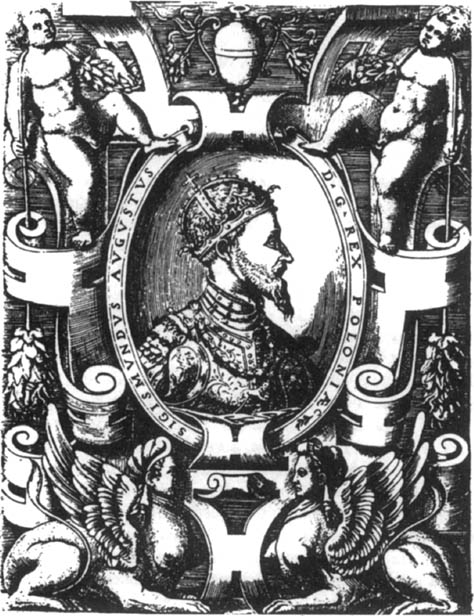
Sigismund II Augustus, King of Poland and Grand Prince of Lithuania.
The negotiations concerning the Kingdom of Poland were being conducted without the advice and consent of the Poles, who were conducting their own negotiations. Their choice fell on Stephen Bathory, Prince of Transylvania, a vassal of the Sultan and a man of remarkable courage and resourcefulness. They made one stipulation: they would welcome him as King if he married the Princess Anna, the sister of Sigismund Augustus, thus maintaining a link with the beloved Jagellon dynasty. Stephen Bathory accepted the condition. He was crowned on May 1, 1576, and immediately afterward celebrated his marriage with the Princess.
Although rumors that Stephen Bathory was being considered for the throne of Poland had reached Mozhaisk, neither Ivan nor the ambassadors attached much importance to them. It was not to be believed that the Poles would elect their own King without the consent of the Tsar and the Emperor. So the long negotiations continued—they lasted from January 14 to January 27, 1576—and all the time they concerned matters that had very little relation to reality. There were polite discourses, many toasts, interminable meals. The main purpose of Ivan appears to have been to ensure that the Emperor would not meddle with his affairs in Livonia.
The ambassadors departed after signing a treaty of friendship.
A few weeks later Ivan sent his own ambassador to the Emperor Maximilian in Vienna. He chose Prince Zakhary Sugorsky, formerly the governor of Astrakhan and an ambassador to the court of the Crimean Khan. He was graciously received by the Emperor, who doffed his hat to the ambassador. Prince Sugorsky expected the Emperor would then extend his hand to be kissed. He waited; no hand was extended; and the ambassador showed signs of being deeply troubled until it was explained that the German Emperor was not accustomed to extending his hand. Finally the Emperor, following the Russian custom, extended his hand and the ambassador kissed it.
There survives a contemporary woodcut showing the Russian ambassador and his retinue at the court of Maximilian. The Russians are dressed in their finery, and Prince Sugorsky is shown defying tradition by not wearing a beard.
On January 29, 1576, Ivan gave an audience to Daniel Sylvester, the English envoy, in his house on Petrovka Street in Moscow. Sylvester was about to leave for England and wanted to receive Ivan’s final message to Queen Elizabeth. Fresh from what he regarded as a brilliant victory at Mozhaisk, Ivan was in a belligerent mood, accusing Queen Elizabeth of “a kind of haughtiness” which he found insufferable because she demanded “the abasing of our self towards her.” Since he was not accustomed to abasing himself toward anyone, he raged against her until Sylvester interrupted with a request that the Tsar should “certify” his “great dislike,” meaning that he should list the reasons why he had come to have such a low opinion of her. It transpired that the chief reason was that she did not have total confidence in him, even though he had behaved with extraordinary liberality towards the English merchants in Russia and shown them countless favors. The question of asylum was still uppermost in his mind. The Tsar had had no difficulty in extracting from the ambassadors the promise that if he needed asylum in the territories of Maximilian, it would be granted to him, and similarly, if Maximilian ever had occasion to seek refuge in Russia, Ivan guaranteed him asylum. The doctrine of reciprocity was established. The crime of Queen Elizabeth was that she had refused to entertain the thought that she would ever be in need of asylum at Ivan’s court. She had demonstrated her “haughtiness,” thus placing him in the position of a suppliant, and this was intolerable to him.
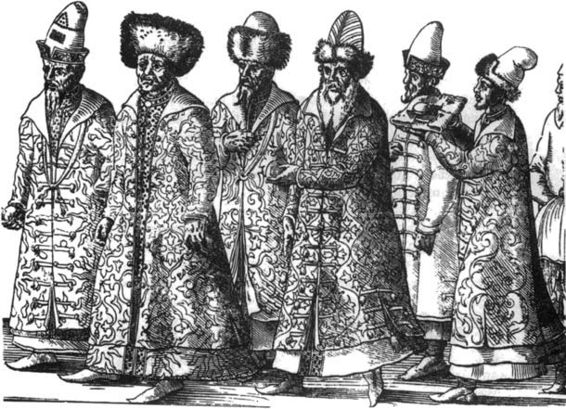
Prince Zakhary Sugorsky (second from left) and his retinue on his way to offer his sealed credentials to the Emperor Maximilian. The Russian ambassador’s credentials are being carried by the young man at right. (From a contemporary German engraving)
Then, so that there should be no doubt about who was the real ruler of Russia, Ivan went on to explain that Simeon Bekbulatovich, although he had been “enthroned in the imperial dignity,” had not been crowned. He reigned at the Tsar’s pleasure and was therefore merely the temporary occupant of the throne. Ivan retained the imperial regalia, the scepter and the seven crowns, and as long as they were in his possession the real power belonged to him. “At our pleasure we can take the dignity unto us again,” Ivan said, “and will yet do therein as God shall instruct us, for that the same is not confirmed unto him by order of coronation nor he by assent elected, but for our pleasure.” Such were the Tsar’s words as Daniel Sylvester wrote them down immediately after the audience. They provide the only certain testimony concerning the Tsar’s reasons and intentions when he elevated Simeon Bekbulatovich to the throne. It was done “for our pleasure,” and could be undone “at our pleasure.” The Tsar had taken all the precautions necessary to ensure that while Simeon Bekbulatovich was given certain limited powers, he was little more than a figurehead. Daniel Sylvester was to convey to Queen Elizabeth the information that he was still the supreme ruler of Russia and with this warning he dismissed the English envoy, who kissed his hand and the hand of the Tsarevich, who was present throughout the speech from the throne.
Only a few decrees signed by Simeon Bekbulatovich as Grand Prince of all Russia have survived. One of these decrees concerns a certain Ivan Liubovnikov, who petitioned against the Board of Internal Revenue that he was being made to pay all the taxes on a property in Murom when in fact he owned only half the property. Simeon decreed that “it shall be as Ivan petitioned us.” The decree was sealed with the Grand Prince’s seal on March 27, 1576.
Meanwhile Ivan continued to appear at court, ostentatiously assuming a humble role and permitting Simeon Bekbulatovich to precede him both in the council chamber and in the cathedral. When the summer came, the Tsar ordered the Grand Prince to sign a decree commanding Ivan to serve with the troops on the Oka River. The decree was read out by the Secretary for Military Affairs in the presence of the Boyar Council. It read simply: “Prince Ivan Vasilievich Moskovsky! The Grand Prince Simeon Bekbulatovich of all Russia commands you to serve at the river bank against the coming of the Khan of the Crimea.”
On the following day, pleading poverty, Ivan submitted a petition for a grant-in-aid in order to outfit an army. The petitioner no longer called himself Ivanets Vasiliev, as he had done when he petitioned about the apportionment of the two courts. He wrote:
TO THE LORD, THE GRAND PRINCE
SIMEON BEKBULATOVICH OF ALL RUSSIA
We, Prince Ivan Vasilievich Moskovsky and my son Prince Ivan Ivanovich, hereby submit this petition. Having received your command to serve on the river bank, we request that you should favor us with the means to serve you, as God shall instruct you.
This petition was solemnly handed to Simeon Bekbulatovich, who handed it to the Secretary for Military Affairs, who then read it aloud to the Boyar Council. The Secretary, who had already discussed the matter with Ivan and Simeon, then announced that the petition had been granted, saying, “Prince Ivan Vasilyevich and Prince Ivan Ivanovich! The Grand Prince Simeon has decided to grant you 40,000 rubles for your services.” Ivan and the Tsarevich then bowed to Simeon, and a few days later they set out for the southern front.
Ivan and his son spent the summer at the fortress town of Kaluga on the banks of the Oka River, accompanied by the great nobles of his court. The main army was commanded by Prince Ivan Mstislavsky, the father of the Grand Princess. A very powerful force, largely financed by the grant of 40,000 rubles—an immense sum in those days—stood guard on the river bank, but the expected battles did not take place, for the Tatars failed to attack. Ivan spent a pleasant summer holiday with the army and returned to Moscow late in August. The long, lazy days in camp had given him time for reflection and when he finally returned to Moscow he had decided to put an end to the rule of Simeon Bekbulatovich.
He issued a series of decrees, appointing himself once more Grand Prince of all Russia, and he granted Simeon Bekbulatovich the rank and style of Grand Prince of Tver in reward for his services, thus reviving a grand principality that had become extinct at the end of the fifteenth century. Thereafter Simeon Bekbulatovich vanished from the scene and little more was ever heard of him.
Ivan was once more Tsar and Grand Prince of all Russia at the age of forty-six. The strange year-long charade was over, and he now resumed the task given to him by God, that task which he found so burdensome, so terrible, so satisfying, and so delightful.
1 The Russians generally addressed a Khan as Tsar. The sons and grandsons of Khans were addressed by the title of Tsarevich.