

ONE OF THE PIECES of unfinished business that loomed large in Ivan’s mind was the conquest of Livonia, which he regarded as a perpetual thorn in his side. One of his first tasks therefore after he had resumed the throne was to prepare for an invasion of Livonia on a massive scale, to put an end once and for all to the pretensions of those who claimed to be its rulers. Northern Livonia was now being claimed by the King of Sweden, and southern Livonia by the King of Poland. Preparations for the invasion of Livonia occupied most of the spring and early summer of 1577. In May, accompanied by his sons Ivan and Fyodor, he set out from Moscow for Novgorod, and in the middle of June he left Novgorod and advanced on Pskov, where King Magnus was waiting for him. There the final plan of conquest was worked out. Magnus was to attack the heavily fortified city of Venden while Ivan was to march south against Lithuanian Livonia. Surprise was all the easier to achieve because Russia and Lithuania had signed a truce which would not expire until later in the year.
Ivan’s army carried everything before it. The terror of his name, the suddenness of the attack, and the unpreparedness of the Livonians led to easy victories. When the army appeared before Marienhausen, the town surrendered without a fight on the promise that the garrison would be allowed to leave unharmed. It was the same at the heavily fortified town of Dinaburg (Dvinsk). Sometimes the garrisons left before the army arrived. But when the garrison at Chestvin failed to surrender, the punishment was swift and terrible, for heavy guns were brought up, the fortress was demolished, all the soldiers were executed, and the women and children were sold into slavery to the Tatars.
King Magnus was also winning victories. He captured Venden and went on to capture so many other towns that he came to regard himself as the rightful king of Livonia, owing allegiance to no one. He wrote to Ivan, commanding him to desist from any further conquests in Livonia. Outraged, Ivan advanced on the nearest German town claimed by Magnus, executed the entire garrison, and wrote off an angry letter:
To Magnus the king, our vassal. I sent you from Pskov to take only Venden, but following the advice of evil persons or your own stupidity, you want everything. Know that we are close to you. I have many soldiers and can act efficiently. Either obey or go back beyond the sea. I can send you to Kazan. I can take Livonia without your help.
Ivan was a master of the threatening letter, and Magnus felt properly chastised. He hoped his impolitic letter would be forgotten, but Ivan never forgot. At the head of the Russian army, Ivan advanced on Venden, sending messengers ahead to demand that Magnus come out and meet the Tsar and make his submission. Unwisely Magnus sent two ambassadors with his apologies. Infuriated, Ivan had the two ambassadors whipped with birch rods and sent them back with instructions to Magnus to present himself immediately to the Tsar. Magnus hesitated; he was afraid for his life; and it was only when the citizens convinced him that the fate of the whole city depended upon his compliance that he summoned up enough courage to ride out with an escort of high officials to meet the Tsar. He had reason to be afraid. Ivan had learned that he was already negotiating with King Stephen Bathory and was preparing to swear allegiance to the King of Poland. In Ivan’s presence Magnus fell on his knees and begged forgiveness. Ivan raised him up and gave him a tongue-lashing:
Fool! So you dared to think of your Livonian kingdom! You—a poor vagabond, who was received into my family, married to my beloved niece, given clothes by me, given money and cities by me—only to betray me, your lord, your benefactor, your father! Answer me! How many times have I heard about your wicked schemes, and yet I did not believe them and was silent! Now everything has been revealed to me! It was your intention to betray me, take Livonia from me, and become the vassal of the King of Poland! But God is merciful, for he protected me and gave you into my hands!
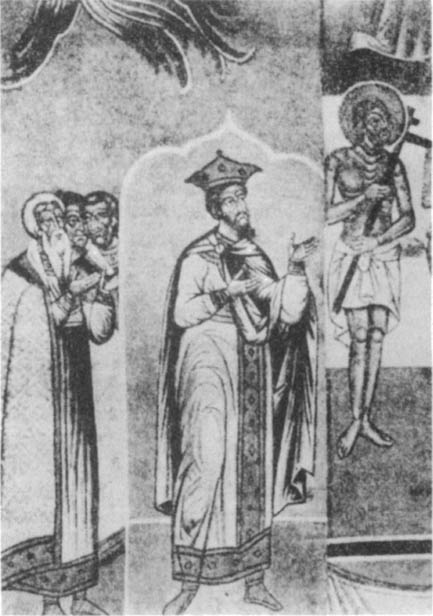
Wall painting in Svyazhsk Cathedral. Ivan is in center.
Now return to me what is mine, and sink once more into insignificance. If you had not been a king’s son, I would have taught you a lesson for opposing me and taking my cities away from me!
Having admonished Magnus, Ivan ordered that he should be imprisoned with his escort in an empty mansion, where they spent the following days and nights. Later, Magnus was let out so that he could arrange for the formal entry of the Russian troops into Venden. Lodgings in Venden were prepared for Ivan and orders were given that there should be no molestation of the citizens by the Russian troops. At all costs there must be a peaceful entry. But neither Ivan nor Magnus had paid any attention to the German garrison still in command of the fortress. The fortress guns opened fire, some Russian soldiers were killed, and Ivan predictably ordered all his heavy guns to be brought up to reduce the fortress to rubble. No mercy would be shown to the Germans. The bombardment continued for three days. When the Germans realized that the fortress could no longer hold out and that the survivors would inevitably be tortured to death, they decided to blow themselves up. The three hundred defenders therefore filled the cellars with gunpowder, received the last sacraments from their pastors, embraced their families, and watched in silence while Heinrich Boysmann, formerly a member of the court of King Magnus, threw a lighted torch to the gunpowder. On that day, September 20, 1577, the entire garrison of Venden perished.
Within a few weeks all the other towns and castles claimed by King Magnus surrendered to Ivan, and all the cities of Livonia, with the exception of the important ports of Riga and Reval, fell into his hands. One surrender especially delighted him—Volmar, where Prince Andrey Kurbsky had taken refuge after his flight from Dorpat. Ivan therefore took this occasion to write a long letter to Kurbsky full of his griefs, his agonies and triumphs, accusing his former friend of murders and treacheries without number, enumerating his own sins which were legion, and confusing all issues with sudden outbursts of paranoiac rage. Prince Kurbsky was out of his reach, and Ivan seems to have felt that the very vehemence of his rage would be sufficient to strike Kurbsky dead. Implicit in the letter is the desire to torture his former friend to death. At the same time, to compensate for so many remembered wounds, Ivan continually vaunted his triumphs.
The violence of Ivan’s rage knew no bounds. Speaking of the boyars who had oppressed him and, as he firmly believed, wished to bring about his downfall, he spits out one violent accusation after another. He accused Kurbsky of causing the death of Anastasia and of wanting to give the crown to Prince Vladimir of Staritsa. There was no truth in these accusations, but Ivan half-believed they were true. He saw himself as a man continually bedeviled by conspiracies which he had scotched just in time. He wrote:
I could not endure these vexations any longer, and so I defended myself, and then you began to act against me and betray me still more. And so I set myself against you with greater severity. I wanted you to submit to my will, and because of this—how you defiled and outraged the sanctity of the Lord! Having become angered with a man, you have struck against God! . . .
Behold, O Prince, the ways of the Lord. God giveth power to whomsoever He wills. You and the priest Sylvester and Alexey Adashev speak boastfully like the devil in Job, saying: “I have been going to-and-fro in the earth, and walking up and down in it, and I have brought all things under the sky under my feet.” But God said to him: “Hast thou considered my servant Job?” Just so did you think of having all Russia under your feet! But all your conspiracies have come to nothing by the will of God! . . .
You said: “There are no people left in Russia—no one stands firm.” Well, you are not here now, and who do you think is conquering the German fortresses? The fortresses are falling before the power of the life-giving Cross, which defeated Amalek and Maxentius! The German cities do not even make preparations for battle; they merely bow their heads at the sight of the life-giving Cross. And when it so happened, due to our sins, that the life-giving Cross did not appear, then we gave battle. . . .
And so we have been brought by God to Volmar, where you had hoped to rest from all your toils. Yea, by God’s will, we caught up with you in your resting-place, and forced you to ride further afield. . . .
Written in our patrimony, the land of Livonia, in the year 1577, the forty-third year of our reign, and of our tsardoms: the thirty-first year of our Russian tsardom, the twenty-fifth of our Kazan tsardom, the twenty-fourth of our Astrakhan tsardom.
Having put his seal to the letter, Ivan placed it in the hands of the Lithuanian Prince Alexander Polubensky, the man who had revealed to him the treachery of King Magnus, with instructions that it should be dispatched immediately to Prince Kurbsky. As for King Magnus, Ivan was surprisingly lenient. He was pardoned, made to renew his oath of allegiance, and given several cities in central Livonia. Then Ivan returned to Alexandrova Sloboda, leaving behind some verses which he ordered to be translated into German and hung prominently in all the Livonian churches. The verses read:
I am Ivan, lords of the many lands
Enumerated in my title. I worship
The faith of my ancestors,
Which is the true Christian faith
According to the teachings of St. Paul,
And this is the same faith
Which is followed by the good people of Moscow.
I am their hereditary Tsar.
I neither begged for this title
Nor did I purchase it.
My Tsar is Jesus Christ.
With this German doggerel Ivan put the seal on his Livonian conquests. Twenty-seven towns and cities had surrendered to him or had been battered into submission. To his regret Riga remained in the hands of Stephen Bathory and Revel remained in the hands of John III, the King of Sweden.
A red-hot iron rake had been dragged across Livonia; thousands of soldiers and peasants had been slaughtered; the life and economy of the country were completely disorganized; and all to no avail. The Swedes and the Lithuanians were now more determined than ever to avenge Ivan’s insults. Dinaburg fell to the Lithuanians by a ruse. They sent barrels of wine to the Russian garrison, waited till they were drunk, then scaled the walls and massacred them. A German force attached to the army of King Stephen Bathory advanced on Venden, acquired the keys to the main gateway, opened the gate, and crept stealthily into the city. Other towns and cities fell to the Swedes. Ivan had enjoyed a hollow victory. Once more the patchwork quilt was being torn to shreds.
Predictably, too, King Magnus went over to the enemy. He concluded a secret treaty with King Stephen Bathory and went into hiding in Courland.
The loss of Venden stung Ivan to a massive retaliation. Prince Ivan Golitsyn with an army of 18,000 men besieged the city in the fall of 1578. The siege was broken off when a combined force of Germans, Lithuanians, and Swedes attacked the Russians. Prince Golitsyn fled into the night, taking his cavalry with him, but leaving his artillery and foot soldiers behind. There was a spectacular slaughter, the Russian gunners hanged themselves from their cannon to avoid a worse fate if they were captured, and a third of the Russian army perished.
This victory at Venden provided Prince Kurbsky with a suitable occasion for admonishing the Tsar for so much deplorable boasting. “As for your vaunting and boasting that you conquered the Livonians by the power of the life-giving Cross, I do not know nor do I understand how this accords with the truth—the thief’s flag would be more appropriate,” Kurbsky wrote, and went on to describe the Russian generals captured at Venden who were put in chains and led off to Poland where they were “mocked and jeered at by all, to your criminal and everlasting shame and to the shame of Holy Russia and to the disgrace of the people, the sons of the Russian land.”
Kurbsky’s letter was hard-hitting, with a bitter humor. Of those life-giving Crosses which gave so much comfort to Ivan he wrote, “Those Crosses of yours have been broken in many places.” Remembering Ivan’s accusation that he was one of those who brought about the death of Anastasia, he wrote, “In my family we are not accustomed to destroying our relatives, unlike the rulers of Muscovy.”
But the kernel of the letter is a single sentence written in hot blood. “You have transformed the tsardom of Russia into a fortress in Hell by closing the frontiers and suppressing freedom.” It was an accusation which could be made against many of Ivan’s successors.
Ivan’s campaign against Livonia, embarked upon so light-heartedly, produced many bitter fruits. Polotsk, once an important city in Kievan Russia, fell to the Lithuanians in the spring of 1579. It was a year of bad omens. They said a tombstone fell on Moscow with some indecipherable lettering, and the Tsar ordered it to be smashed. They said, too, that thunder was heard out of a cloudless sky. Moscow trembled when it heard of the loss of Polotsk and the neighboring town of Sokol. For once Ivan decided that it was best to make a clean breast of it, and the state secretary, Andrey Shchelkalov, was ordered to address the people on the Red Square and admit defeat. Dressed in somber black, Shchelkalov read out the words dictated by Ivan:
Good people! Know that the King has taken Polotsk and put Sokol to the flames! I bring you melancholy news. Prudence demands that we remain firm, nothing is permanent in the world, fortune betrays even the greatest of rulers.
Although Polotsk is in Stephen’s hands, all of Livonia remains in ours. We have lost some Russians, but the Lithuanians have lost more. In this minor misfortune let us console ourselves with the memory of the many victories and conquests of the Orthodox Tsar.
The women of Moscow shouted that they wanted their husbands returned to them. Failing that, they demanded that the state secretary should give them new husbands. They could not be quieted until Shchelkalov ordered men with birch rods to drive them away.
While all these battles were taking place, Ivan himself seemed strangely unaffected. He continued to live in great state, held audiences with his councillors and with ambassadors, and conducted himself as though he had no cares. Jacob Ulfeld, an ambassador from Denmark, visited him in August 1578, when he was living at Alexandrova Sloboda, and later wrote a detailed account of the audience.
The Danes arrived in great state, the ambassador being provided with a retinue of 106 persons. Accommodation was provided for them outside Alexandrova Sloboda, and they were a little surprised to discover that the road from their residence to the palace was heavily guarded by two thousand musketeers. This was a sure sign that the negotiations which concerned Danish claims in Livonia would be difficult.
Jacob Ulfeld was a remarkably observant man and his account of his embassy includes some drawings which provide us with the only surviving contemporary pictures of Alexandrova Sloboda. Unfortunately these drawings leave much to be desired. Although they are evidently based on quick sketches made at the time, they cannot be taken as accurate depictions of the scene. The drawings, which are reproduced in this book, show cavernous halls and some oddly isolated buildings. We see watch towers, raised causeways, three churches, three stone houses. It is quite obvious that there must have been many more buildings and that they were more richly ornamented than they are depicted. The interiors are more satisfying. Here is Alexandrova Sloboda as Jacob Ulfeld remembered it some years later—the Tsar at his high table, the solemn processions, the youths in white silk guarding the throne, and the great officers of state in their long golden robes. But the overwhelming impression is one of awkwardness and discomfort, as though it was all taking place in a vast cow barn.
As they were about to enter the audience chamber, the Danes were warned that they must on no account fail to recite all the Tsar’s titles with the proper respect. They found the Tsar and the Tsarevich Ivan sitting on their thrones. Ivan wore a gown of yellow velvet sewn with jewels with a gold jewel-studded collar. His gold crown was surmounted with a velvet cap sparkling with precious stones, and he wore jeweled rings on all his fingers. The Tsarevich wore a red velvet gown, and this too was studded with jewels. As Ulfeld approached the throne, Ivan stretched out a glittering hand in welcome. Ulfeld was not quite sure what was expected of him, and the herald said, “Jacob! Ivan Vasilievich is so gracious toward you that he offers you his hand. So go up to him and give him your hand!”
Ulfeld did as he was directed and then gave his hand to the Tsarevich. Other members of the embassy did the same. Then the Tsar inquired about the health of the King of Denmark, and after receiving a satisfactory answer he permitted Ulfeld to make his opening speech. The ambassador carefully recited the long catalogue of Ivan’s titles, and he observed that a change came over the Tsar’s face. His eyebrows rose, he puffed himself up, and he looked pleased. But when the ambassador began to talk about the serious matters which had brought him to Russia, Ivan stopped him, saying that these would have to be discussed with his advisers. “Thus,” wrote Ulfeld, “we were unable to tell him what the King of Denmark had ordered us to say to him.”
Ivan told them to sit down, and then a herald came up and said, “The Tsar invites you to feast with him today. So stand up and thank His Majesty.” This they did, feeling more and more like marionettes on strings. Then they were ordered into another room to begin negotiations with the four councillors of state, Bogdan Belsky, Ivan Cheremisinov, Andrey Shchelkalov, and Andrey Sherefedinov. Bogdan Belsky was the Tsar’s new favorite; he was not related to the Belsky princes and had acquired his high position through his cousin Maliuta Skuratov. The negotiations were conducted “while the tables were being laid.” When they saw Ivan again he wore a simple gown of dark silk and a small red cloth cap sewn with precious stones, and the Tsarevich wore white. During the feast the Tsar followed his familiar custom of presenting dishes to the members of his court, and Ulfeld noted that the first dish went to Prince Ivan Mstislavsky and the second to Nikita Zakharin, the brother of Anastasia. After that it was the turn of the Danish ambassador and some of the members of his suite, and then the Tsar resumed his offering of dishes to the nobles. Ulfeld counted the number of times the Tsar presented these dishes and came to a grand total of sixty-five. Malmsey was poured from a gold beaker into a glass; the Tsar sipped the wine, and then sent the glass to Ulfeld, who concluded that he had received a special mark of the Tsar’s favor. “I know you have had a long journey by land and sea,” the Tsar said through an interpreter, “and you have suffered great hardships. I shall see that you have everything you need.”
On the tables the dishes and glasses were so crowded that it would have been impossible to add any more. Once more Ivan presented Ulfeld with wine—this time it was mead in a silver beaker. But these marks of favor had no effect on the negotiations, which continued to be difficult. And Ulfeld observed that the Tsar’s table manners left much to be desired.
On August 25 Ulfeld and his suite were summoned to the palace, greeted by Ivan, who wore a gown of green velvet, and then sent off to continue their negotations. The Russians were not pliable; they refused to cede any points and were incapable of compromise; and the Danes found it hard going. The negotiations broke off and were resumed two days later. Around midnight on August 27, 1578, Ivan indicated that he wanted several changes in the agreement and the Danes reluctantly agreed, and on the following day, in the morning, Ivan requested that the document should be read. The reading lasted an hour, and at the end Ivan gave his assent to it. As usual, he was crowned and bejeweled, and Ulfeld, who was standing close to him, could not help observing that the orb “was the size of a boy’s head and covered on all sides with precious stones.” There was a gilded casket beside Ivan, and he would sometimes place the orb in it, and there was another casket for his crown.
While the treaty was being read, Ivan paid not the slightest attention. He talked with some of his nobles and once he summoned Bogdan Belsky to his side and showed off his beautiful rings and the gold scabbard and gold belt which he wore under his outer garment. But this display of total disinterest came to an end when the reading was over. With great solemnity Ivan placed the two copies of the treaty in a casket and then a crucifix was placed on the top copy. He kissed the casket and swore to abide by the treaty and then called the Danish ambassador to his side and made him place his hands on a New Testament open at the Gospel of St. John and kiss the book and swear in the name of the King of Denmark that he would abide by the treaty. When this was done, he gave each of the Danes three glasses of mead, bade them greet the King of Denmark on his behalf, and let them go. Some time later forty-three servants brought farewell gifts to the Danes. These consisted of furs, and were intended for the ambassador, his suite, and the King of Denmark.
On the following day, at two o’clock in the afternoon, the Danes learned that they were expected to leave at once. They packed hurriedly, for such peremptory demands could not be denied. They therefore set out on the return journey to Denmark at nine o’clock in the evening and traveled throughout the night without sleeping.
While Ivan presented himself as a man of august majesty, scarcely interested in such mundane things as treaties and embassies, he was becoming increasingly aware that the Livonian war had become a costly mistake. It was draining Russia of its youth, its wealth, its guns. The landed gentry, who supplied the bulk of the army, were being ruined; the peasants were running away from the estates to avoid being taxed and conscripted as laborers; the entire social system was being disrupted. By the winter of 1579 the Tsar had come to the conclusion that the Church, which owned vast properties, must be made to disgorge some of its wealth. He therefore summoned the leading bishops, abbots, and archimandrites to a council in the Kremlin to decide how the wealth of the Church should be put to the service of the State.
In his opening speech Ivan spoke of the nation’s desperate need, his unavailing efforts to replenish the exhausted treasury, the incessant dangers that confronted the country. It was one of the best speeches he ever made. Sir Jerome Horsey, who clearly had a copy of the speech in front of him, translated it into Elizabethan prose:
He told them that which he was to say was best known to themselves; he had spent the most part of his time, wits, vigor and youth in warfaring for their wealth and safety, preservation, and defense of his kingdoms and people; what dangers and troubles he had passed was not unknown to them, above many others. They, apart to whom he makes his moan, have only reaped the benefit thereof. By which his treasures have been exhausted and theirs increased; their safeties, peace, and tranquillity preserved, and his lessened and daily endangered by foreign enemies and practices, both at home and abroad, which he was very sensible they were too well acquainted with. How could he or they any longer subsist without their essential assistance.
Their willingness must be the touchstone and trial of their fidelity, as well as their contemplations, which proved of no force. Their pretended prayers prevailed not; whether for their iniquities, his sins and people’s, or both, he leaves to the divine knowledge.
The utility of their holy thoughts and actions must now be the supply out of their infinite abundance; yea, the urgent necessity and miserable estate both of him and people doth now require their devotion; the souls of their own patrons and donors, saints and holy workers of wonders, for redemption of their souls and sins, commands it. Prepare therefore your thoughts with holy resolutions, without sophistical or exorcisms of refusal.
Ivan’s demands were robed in ecclesiastical flattery; the words flowed like prayers; a knife was concealed in them. As they debated among themselves how to placate him, his spies among them reported the progress of their thoughts. It was clear that they aimed to surrender as little as possible of their wealth. Ivan lost patience and summoned forty of the most distinguished prelates and urged them to remember the example of King Henry VIII and the fate that befell Ananias and Sapphira. He commanded them under pain of terrible penalties to produce “a faithful and true inventory what treasure and yearly revenues every of your houses have in their possessions,” reminding them pointedly that they had accumulated a third of the wealth of all Russia “by your witchery and enchantments and sorcery.” And what had they done to deserve so much wealth? In a towering rage he enumerated their crimes:
You buy and sell the souls of our people. You live a most idle life in all pleasure and delicacy, commit most horrible sins, extortion, bribery, and excess usury. You abound in all the bloody and crying sins, oppression, gluttony, idleness, and sodomy, and worse, if worse, with beasts.
If the Church had been sensible, it would have offered Ivan a good half of its possessions. The Church was not sensible, Ivan lost patience, and inevitably had recourse to the weapons he knew best. The fattest monks, seven in number, were arrested and the entire Church Council was invited to watch them being clawed to death one by one in a bear-pit. Each monk was provided with a five-foot-long spear, but none of them had any experience in fighting bears. A monk from the Troitsa-Sergeyevsky Monastery showed that he had some inkling of the proper method to be employed when confronting a bear, for he so planted the spear in the ground that the bear’s chest was split open, but unfortunately the bear still had enough life in him to devour the monk.
Ivan let it be known that this was only the beginning. He proposed to burn seven more monks at the stake unless a full inventory was forthcoming. An inventory was quickly drawn up, and on January 15, 1580, the Church Council agreed to pay three hundred thousand marks into the Tsar’s treasury, to surrender all mortgaged lands in their possession together with all the patrimonial lands of the princes which had been purchased or bequeathed to the Church, and to acquire no further lands. Ivan’s treasury was now brimming over.
Ivan had won his battle against the Church but he had not solved the problems of the ruined nobles. By tradition and custom their peasants were free to leave the estates every year after harvest time. They were free agents; they might serve whatever master they chose. On November 26, St. George’s Day, there was always a great coming and going among the peasants, who had no difficulty finding new landowners to work for. A good peasant, even if he was in debt to his former landowner, would take service under a new landowner, who would cheerfully pay his debts. To save the nobles, Ivan now decreed that during the period of emergency no peasant would be allowed to leave his master’s service. In this way, as a result of the Livonian wars, Russia took the first dangerous step which led to the serfdom of the peasants.
As usual, when confronted with disasters, Ivan imagined himself surrounded by traitors and conspirators. Famine and pestilence were abroad; his armies had been mauled by King Stephen Bathory; the country faced economic ruin. All this could be explained only by treason. The people feared a new bloodbath. Instead, on Ascension Day, the anniversary of the day in 1571 when the Crimean Tatars sacked and burned Moscow, Ivan delivered himself of a three-hour speech in which he first announced the forthcoming marriage of his second son Fyodor to Irina Godunova, and then launched into a ferocious denunciation of his disloyal and treacherous subjects. He threatened to abandon them, leaving them as a reproach to all the nations of the earth. Russia was doomed. “God and his prodigious creatures in the heavens fight against us!” he roared, and went on to point out that the famine was God’s punishment on “a naked, a disloyal, and distressed people.” Sir Jerome Horsey, who acquired a copy of the speech, concluded that it was too long to quote. “Little was answered, less done, at this assembly,” he noted. This was all to the good, for Ivan exhausted himself with the speech and had no energy left for murdering his poor subjects. Everyone prostrated himself before the Tsar, wished him long life and happiness, and called upon God to bless the marriage of Fyodor and Irina. Then he dismissed them “with good words and more favorable countenance, which was held for a mutual reconciliation and forgiveness of all.”
In the summer of 1580, shortly after Fyodor’s marriage to Irina, Ivan married Maria Nagaya, from a family of boyars who had served the former Grand Princes of Tver before becoming members of the court nobility in Moscow. Jerome Horsey believed that the marriage was forced upon him because it had become known that he was seriously thinking of abandoning Russia and taking refuge in England, and it was necessary that he should perform some act to show his intention to remain in Russia. “To put out all jealousy thereof in their minds,” wrote Horsey, “he married again the fifth wife, the daughter of Fyodor Nagoy, a very beautiful young maiden of a noble house and great family, of whom he had a third son called Dmitry Ivanovich.”1
Horsey himself was becoming more and more indispensable to the Tsar. He knew many court secrets, embarked on many intrigues, acted as a double agent, spying for both Elizabeth and Ivan, and was at ease in everyone’s company. He had a quick tongue, a lively imagination, and had learned to speak Russian, Polish, and Dutch with considerable fluency. Ivan, desperately needing ammunition, sent him to England for gunpowder, saltpeter, lead, and brimstone. Shortly before Horsey left Moscow for London he had an audience with Ivan, who asked him whether he had seen the ships that were being built at Vologda. Many people believed the ships were intended to carry the Tsar and his treasure to England. Horsey said he had seen the ships, and there was the following conversation:
|
Tsar: |
What traitor hath showed them to you? |
|
Horsey: |
The fame of them was such, and people flocked to see them upon a festival day, I ventured with thousands more to behold the curious beauty, largeness, and strange fashion of them. |
|
Tsar: |
Why, what mean you by those words, strange fashion? |
|
Horsey: |
For that the portraiture of lions, dragons, eagles, elephants, and unicorns were so lively made and so richly set forth with gold, silver, and curious colors of painting. |
|
Tsar: |
It is true; you seem to have taken good view of them; how many of them? |
|
Horsey: |
It please your majesty I saw but twenty. |
|
Tsar: |
You shall see forty, ere long be, no worse. I commend you. No doubt you can relate as much in foreign place, but much more to be admired if you knew what inestimable treasure they are inwardly to be beautified with. It is reported that the queen, my sister, hath the best navy of ships in the world. |
|
Horsey: |
It is true, and please your majesty. |
|
Tsar: |
Why have you dissembled with me then? |
|
Horsey: |
For strength and greatness to break and cut through the great ocean, turbulent seas. |
|
Tsar: |
How framed so? |
|
Horsey: |
For art, sharp-keeled, not flat-bottomed, so thick and strong-sided that a cannon shot can scarce pierce through. |
|
Tsar: |
What else? |
|
Horsey: |
Every ship carries cannon and forty brass pieces of great ordnance, bullets, muskets, powder, chainshot, pikes, and armor of defense, wild fireworks, stanchions for fights, a thousand mariners and men at arms, soldiers, captains, and officers of all sorts to guide and govern; discipline and daily divine prayers, beer, bread, beef, fish, bacon, pease, butter, cheese, vinegar, oatmeal, aquavitae, wood, water, and all other provisions. . . . [Horsey then gives a lengthy list of the sails, flags and musical instruments on board the English ships.] |
|
Tsar: |
How many such hath the queen as you describe? |
|
Horsey: |
Forty, and please your majesty. |
|
Tsar: |
It is a good royal navy, as you term it. It can transport forty thousand soldiers to a friend. |
Ivan’s last statement was especially significant, because it showed clearly that he expected Queen Elizabeth to come to his help when needed. In his overheated imagination her navy existed in order that forty thousand Englishmen should come to his rescue. He was wrong on all points, and not least in his estimate that each English ship could carry a thousand troops. Nevertheless his faith in Queen Elizabeth remained unbounded; England was his anchor, the protecting hand that would save him in his worst extremity; the forty ships at Vologda and the forty ships of the English fleet would soon be at his disposal. Such were his hopes as he sent Horsey on a secret mission to Queen Elizabeth.
Since it was winter and the sea route from the White Sea around Scandinavia would be frozen, it was decided that Jerome Horsey should make the dangerous journey through Livonia and take ship from Hamburg. Ivan delighted in secret stratagems and discussed with Sawa Frolov, his secretary of state, the best way to conceal the letter. They hid it in the false side of a wooden bottle filled with aquavitae, and since the bottle was not worth three pennies and would be hidden under the horse’s mane, they thought no one would pay any attention to it. Horsey’s expenses for the journey were sewn into his boots and his old clothes—they amounted to four hundred gold ducats. At his farewell audience, Ivan insisted that Horsey should not read the document addressed to Queen Elizabeth until he had reached safety for fear that it might become known to his enemies, and said, “Always be thou trusty and faithful, and thy reward shall be my goodness and grace from me hereafter.”
Hearing these words, Horsey fell prostrate with his head on the Tsar’s foot, his heart heavy with the thought of all the dangers ahead.
That night with twenty servants and a high-ranking official in attendance he drove by sleigh to Tver, where he stopped long enough to acquire provisions and fresh horses. Then he sped on to Novgorod, Pskov, and Neuhausen. He claimed that he traveled six hundred miles in three days. Arriving near the frontier of Livonia, he dismissed his companions and drove off alone into enemy territory. He was arrested several times but always succeeded in talking his way out of danger. At Arensburg he was arrested and lodged in a wretched house infested with snakes and hens. He was brought before the governor, and was in danger of being shot as a Russian spy, but it happened that the governor’s granddaughter, Madelyn van Uxell, was a prisoner in Moscow. Horsey had befriended her, and her letters home had been full of his praises. From being a prisoner he became an honored guest, feasted, magnificently entertained, and provided with passports. He rode on to Pilten, where he was entertained by King Magnus, who was drinking heavily, having lost most of his possessions in riotous living. The King had a poor opinion of Horsey’s drinking capacity; Horsey had a poor opinion of the royal spendthrift. For the rest of the journey to Hamburg Horsey was treated with all the honors due to an ambassador. By day he hid the wooden bottle under his cloak, and by night it was his pillow.
At last, reaching England, Horsey broke open the bottle and found that the documents smelled strongly of aquavitae. There was nothing he could do about it. When he handed them to the Queen, she remarked upon their smell, and was pleased by his explanation. He was sworn esquire of her body, and she gave him her picture and he kissed her hand.
What Ivan asked for in his letter was provided by the Queen in ample measure. Thirteen English ships laden with copper, lead, gunpowder, saltpeter, brimstone, and much else to the value of £ 9,000, set out for Russia by the northern route. At the North Cape some Danish ships attempted an ambush but were fought off. All the ships arrived safely at the White Sea bay of St. Nicholas in the early summer of 1580, only five or six months from the day when Horsey set out with the wooden bottle from Moscow.
At Alexandrova Sloboda Ivan welcomed his secret messenger, promised payment as soon as he reached Moscow, and carried out his promise. A letter from Queen Elizabeth was placed in the Tsar’s hands secretly, by which Horsey meant that he was alone with the Tsar when the letter was handed over. He was commended for his speed, his loyalty, his diplomacy, and basked in the Tsar’s favor. Thirteen shiploads of military supplies found their way into the Tsar’s warehouses in Moscow.
They came just in time. Soon the Tsar’s armies would be reeling from the blows of King Stephen Bathory and Russia was in greater danger than ever.
1 Russian historians usually credit Ivan with seven marriages. (1) Anastasia Romanovna, d. 1560, (2) Maria Temriukovna, d. 1569, (3) Marfa Sobakina, who married Ivan in October 1571 and died sixteen days later, (4) Anna Koltovskaya, who was sent to a nunnery in 1575, (5) Anna Vasilchikova, d. 1577, (6) Vasilissa Melentieva, who was sent to a nunnery in 1577, (7) Maria Nagaya, who married Ivan in 1580 and survived him. The marriage with Marfa Sobakina was never consummated and there appears to have been no formal marriage ceremony with the beautiful widow Vasilissa Melentieva.