

DURING HIS LIFE IVAN COMMITTED every imaginable crime and he was rewarded with astonishing triumphs. The gods favored him, granting him most of his desires. Scarcely an enemy went unpunished; his victories on the battlefield would be remembered throughout recorded Russian history; and to the empire he had inherited from his father he added vast new territories. These triumphs sometimes took place without his knowledge; he was not responsible for them, and they often occurred in spite of him rather than because of him; and he took full credit. Thus it happened that the Russian army soundly defeated the army of the Crimean Tatars at a time when Ivan was taking refuge in the north. He returned to Moscow to enjoy the victory celebrations and thereafter regarded himself as a great conqueror. In the last years of his life the pattern was repeated. He scarcely lifted a finger and the vast new empire of Siberia fell into his hands.
This new empire was given to him by the powerful and wealthy merchant family of the Stroganovs, whose landholdings reached from the Northern Dvina River to the Ural Mountains. Originally they were merchants of Novgorod; they became Russia’s first large-scale industrialists. They possessed saltworks, lumberyards, smithies, and forges, and traded in wood, iron, salt, fish, grain, furs. As they moved eastward, they were granted charters authorizing them to colonize unoccupied land and to conquer territories occupied by the Tatars, Voguls, and Ostiaks who lived there. The Stroganovs had their own private armies, their own fortresses, their own capital at Solikamsk. Sporadic fighting between the small Stroganov armies and the armies of Kuchum, Khan of Siberia, beginning in 1573, had become continual, and by 1581 the Stroganovs had concluded that they would be best served by destroying the khanate. Khan Kuchum was descended from Prince Shiban, one of the younger sons of Jenghiz Khan. His capital was the town of Sibir on the Irtysh River, which flows into the even longer Ob River. Both rivers had their source in the mountains of Outer Mongolia.
Ivan welcomed the decision to conquer Siberia, but offered very little help. The Stroganovs were permitted to conquer at their own risk. To lead the expedition they chose Yermak Timofeevich, who had formerly earned his living by brigandage on the lower reaches of the Volga River. He had a rather flat face, a heavy black beard, broad shoulders, and he carried himself with an air of authority. His army consisted of 540 Cossacks and about 300 volunteers, all armed with muskets, and in addition they were provided with three field cannon. The Stroganovs also provided them with food and banners with holy images painted on them. The total cost of the expedition was 20,000 rubles.
Yermak set out for Siberia on September 1, 1581, from a base camp on the Chussovaya River, sailing up the river toward the Ural Mountains, passing beneath fierce cliffs and dense forests. After six days his men dragged the boats ashore and began to carry them over a pass. Here, in the pass, they built a fortified camp where they remained throughout the winter, and in May they broke camp, lowered their boats on the Tagil River, and sailed eastward into the domain of Khan Kuchum, raiding Tatar settlements along the way. Once, when they captured an important Tatar officer, they sent him ahead to Sibir where he reported to the Khan that the Cossacks had weapons that “spewed out flame and smoke with a sound like thunder.” The muskets and the three cannon terrified the Siberians, but they continued to fight.
Yermak fought a whole series of engagements on the way to Sibir. Progress was slow; many of his men were killed, and many more were wounded. He fought his first pitched battle against the Tatars on October 23, 1582, when winter was already coming down. There had been so many losses in the previous engagements that many of his men wanted to return to Russia. “If we retreat, we shall be filled with shame for not having carried out our promise to the Stroganovs,” Yermak answered, and he ordered the attack on the Tatar camp, protected with felled trees, which guarded the approaches to Sibir. The Tatars were armed with bows and arrows, and were no match for the Cossacks with their cannon and muskets. But the battle was hard fought, the Tatars darted out from behind the felled trees to engage the Cossacks in hand-to-hand fighting, and the issue was still in doubt when Mametkul, Khan Kuchum’s nephew commanding the Tatar forces, was wounded and had to be carried away to the farther bank of the Irtysh, and then the Tatars lost heart. Shortly afterward Khan Kuchum, who had been watching the battle from a hill some distance away, rode off to Sibir, not to put the town in a state of defense but to gather up his treasure before escaping eastward.
The Russians had lost about two hundred men in the previous engagements, and they lost over a hundred more in the battle for Sibir. Three days later they entered the abandoned town. A few days later the Ostiaks and the Tatars began to return, having been promised that no punishment would fall on them. Yermak threatened his Cossacks with death if they so much as touched the local inhabitants. Yermak was well aware of the importance of his conquest, for the way was now open for the conquest of the rest of Siberia to the Pacific Ocean.
For his own reasons Yermak delayed his report to Ivan, and it was not until the end of the year, on December 22, 1582, that Ivan Koltso, his second in command, set out from Sibir for Moscow, together with fifty of the Cossacks. They took with them a larger number of furs and skins as presents for the Tsar—there were sixty bundles of sables, forty pelts to a bundle, twenty black fox skins, and fifty beaver skins. They also carried long letters from Yermak addressed to Ivan and to the Stroganovs with a full account of their exploits. To the Tsar Yermak wrote that he had undertaken the expedition to expiate his sins of brigandage, and now that he had succeeded in conquering the Khanate of Siberia, which will remain in Russian possession “for ever and ever, so long as God lets the world stand,” he hoped and prayed for a free pardon for himself and his Cossacks. If no free pardon was granted, he promised to offer his life heroically on the scaffold.
The long letter, which had taken two months to write, finally reached Ivan at the end of January or the beginning of February 1583. The church bells rang, and there were services of thanksgiving to celebrate the new conquest. In the streets of Moscow the people could be heard congratulating one another with the words, “God has given a new kingdom to Russia.” Everyone shared in the excitement, remembering that there had been little good news in Russia for many years. Ivan Koltso became the hero of the hour, feted by everyone, and welcomed in the throne room of the Kremlin Palace, where he bowed before Ivan and kissed his hand. The misdeeds of the Cossacks were forgotten; they were showered with gifts. Ivan ordered that Yermak should be presented with a special coat of mail with a golden double-headed eagle emblazoned on the accompanying cuirass.
Siberia passed into possession of the Tsar. The Bishop of Vologda was commanded to send ten priests, together with their families, to Siberia. Ivan Koltso was authorized to seek new settlers for the conquered land. Prince Simeon Bolkhovsky was ordered to proceed at once with five hundred musketeers to Sibir to establish the Tsar’s authority. Yermak himself was granted the title Prince Sibirsky.
The Stroganovs too found themselves in high favor. Ivan summoned them to court, heaped praises on them, presented them with new lands and estates on the Volga, and permitted them to trade without paying any taxes or duties in all their towns and villages. This was a princely gift, representing vast new wealth, a proper reward for having added a new empire to Ivan’s vast territories.
About the same time that Ivan Koltso was being feted in Moscow, in February 1583, the Cossacks succeeded in capturing Mametkul, the nephew of Khan Kuchum. Yermak received him kindly, but kept him under strong guard, for he was a brave and daring commander and had caused much havoc during the previous three months. When Ivan heard of the capture of Mametkul, he ordered that the Tatar prince should be brought to his court, received him well, and according to the long-established custom granted him the rights enjoyed by all the Tatar princes who swore an oath of loyalty to him and entered his service.
Meanwhile Khan Kuchum roamed the steppes of central Asia, determined at all costs to regain his lost kingdom, continually plotting. Once conquered, the Tatars often rebelled. They had many advantages: they outnumbered the Russians, they traveled lightly, and they did not suffer from scurvy, which killed off half of Yermak’s Cossacks. An uprising, led by a certain Karacha, spread across Siberia, and Sibir, now a heavily defended fortress town, was surrounded by Karacha’s forces. On the night of June 12, 1585, the Cossacks crept out of the town, attacked Karacha’s forces while they were sleeping, killed many of them and sent the rest fleeing along the Irtysh River. The Tatars were quite capable of using the same trick. On August 5, less than two months later, Yermak himself was resting in his camp only two days’ march from Sibir when he was surprised by a force commanded by Khan Kuchum. During the night it rained heavily, a strong wind rose, and Yermak gave his men permission to sleep, for it was inconceivable that the Khan would attack on such a night. He did not know that the Khan’s spies had been following him closely and knew exactly where he was. In the middle of the night Khan Kuchum’s Tatars fell on the camp, which was set in an ancient Tatar burial ground, and slaughtered all the Cossacks except for two men who succeeded in escaping. One of the men succeeded in regaining Sibir, the other was Yermak, who dived into the swift-flowing Irtysh River in full armor, hoping to reach the place where the Cossack boats were moored. But weighed down by the armor emblazoned in gold with the double-headed eagle, he drowned. On that same night forty-eight of his Cossacks were killed in the burial ground.
Thus died Yermak, the thickset, broad-shouldered, black-bearded conqueror of Siberia, having ruled over his conquest for less than three years. Dead, he entered into legend. Songs were sung and stories were told about him, and some of them had little enough relation to historical truth but were all the more truthful for being imaginative. After the conquest of Siberia, he never returned to Russia, but the popular imagination demanded that he should be seen confronting the terrible Tsar, and so they sang:
Then Yermak and all the Cossacks departed from Sibir
And made their way to the stone city of Moscow,
To the terrible Tsar Ivan Vasilievich,
And the Lord Tsar spoke to him, saying:
“Well, Yermak Timofeevich, where have you been?
How many people have you been robbing?
How many innocent souls have you killed?
How did you capture the Tatar Khan?
How did you bring the Tatar army into my power?”
Then Yermak fell to his knees,
Bowing low before the terrible Tsar,
And thrust a letter into the Tsar’s hands
And with the letter went the accompanying words:
“Before you, O Lord, I profess my guilt.
We have been brigands on the blue waters!”
And the Lord Tsar was not in the least angered,
And showed great mercy to the sinner,
And ordered him to be loaded with gifts.
Then Yermak was sent back to the land of Sibir
With orders to collect tribute from the thieving Tatars
So that the Tsar’s treasury should be filled up,
And he returned with his Cossacks to Siberia
To fulfill the orders of the Tsar
To extract from the thieving Tatars
The necessary tribute and to bring them
Even more under the Tsar’s authority,
And they did so with the utmost eagerness.
Inevitably Yermak became a folk hero and suffered the strange transformations that occur to heroes. In legend he became the man who almost single-handedly opened up Siberia to the Russians, and it was forgotten that at the time of his death there was scarcely a single Russian left alive in Siberia. Yermak had opened the way; his successors fought the descendants of Khan Kuchum for nearly a hundred years before they had all of Siberia in their grasp.
Ivan, too, became a legend in his own lifetime. In the songs he was always “the terrible Tsar Ivan Vasilievich,” the man who exulted in terrible deeds, uttering violent curses like Beelzebub in the old English morality plays, given over to violence and rapine, and then exulting in his grief. Here the Tsar addresses his people:
“Ho, there, my boyars and princes,
Put on your clothes of mourning,
Come to the morning service,
Come to the funeral service of the Tsarevich.
I will boil you all in a caldron!”
And throughout all white-walled Moscow,
And throughout the Tsardom of Muscovy,
He gave orders that the people should fast
And go to God’s church and pray
And put on their clothes of mourning.
Soon, much sooner than anyone expected, they would be putting on the clothes of mourning for the Tsar himself.
Although he was only fifty-three, Ivan had the appearance of an old man in the winter of 1583. He was swollen with dropsy and riddled with diseases of many kinds and many origins. His excesses had at last caught up with him; and his fears, for he was a man who always feared greatly, now gathered around him in huge and ungainly flocks. In the past he had always succeeded in containing his despairs by destroying people; now he knew that he was himself about to be destroyed, and he found no satisfaction anywhere.
One day, early in 1584, he was standing on the Red Porch of the Kremlin Palace when he saw a comet shaped like a fiery Cross hanging in the sky between the Cathedral of the Annunciation and the great tower known as Ivan’s Belfry. He gazed at it for a long time, and then he said, “This sign foretells my death.”
He had always possessed faith in witchcraft, necromancy and magic, and now, but too late, he hoped to use the dark powers for his own advantage. Lapland was famous for its witches and soothsayers, and at his orders some sixty Lapp magicians were brought to Moscow and placed in the care of Bogdan Belsky, the Tsar’s favorite. They cast spells, consulted oracles, studied the stars. Belsky visited them daily and reported their findings to Ivan. Unhappily their findings continued to be unsatisfactory; they pronounced that their own spells were powerless against the signs of the stars. They were even able to foretell the date of his death—March 18. Belsky kept this information for himself, regarding himself as a contender for the throne, and promised the witches that he would have them burned if their prophecy proved to be wrong. On March 10 Ivan gave orders that a Lithuanian embassy should be stopped on its way to Moscow, and about the same time he wrote to all the monks of St. Kirill’s Monastery at Beloozero pleading for their prayers in his extremity. He wrote:
To the great and most pure Monastery, to the saintly and blessed monks, to the priests, deacons, elders and choristers, and to those who are bedridden in their cells and to all the brethren, the Grand Prince Ivan Vasilievich sends his greetings.
He bows to your feet and prays kneeling before your blessedness, begging you to favor him, whether you are assembled together or in your cells alone, with prayers to God and the most pure Mother of God on behalf of my most sinful self that I may be released, great sinner that I am, of all my sins by virtue of your blessed prayers and that I may be granted recovery from my present mortal sickness and made well.
In whatsoever we have transgressed against you, we ask from you the favor of forgiveness, and in whatsoever you have transgressed against us, God will forgive you all.
There was a good deal more of it, and Ivan did not forget to remind the monks of the many benefactions he had granted to the monastery. He had provided oil for their lamps, food for their tables, and alms for their poor. They owed him something, and it was time they repaid the debt.
On the same day that he ordered the Lithuanian embassy to be stopped, he wrote his last will and testament, appointing his sweet-tempered and simpleminded son, the Tsarevich Fyodor, to be his successor. To help Fyodor govern the country, he appointed a Council of Regents of four men. They were Prince Ivan Mstislavsky, Prince Ivan Shuisky, Nikita Zakharin, and Boris Godunov. Ivan’s younger son Dmitry was to be given the principality of Uglich.
In his will Ivan paid tribute to the boyars and voyevodas, whom he described as “my friends and collaborators,” in his victories over the Tatars, the Livonians, and the Turks. He bade the Regents avoid war with Christian powers, pointing to the unfortunate consequences of his wars with Lithuania and Sweden, which brought about the exhaustion of the country. He ordered taxes reduced and the release of all Lithuanian and Livonian prisoners of war. And he bade Fyodor to reign in the fear of God, with love and mercy.
He knew he was dying, but he could not acquiesce to his own death. The comet still hung in the sky, and in addition a strange bird hovered over Moscow at night, cawing loudly, proclaiming his death. It was said that the bird was of enormous size and that it would continue its loud cawing until the moment he died. And so it happened.
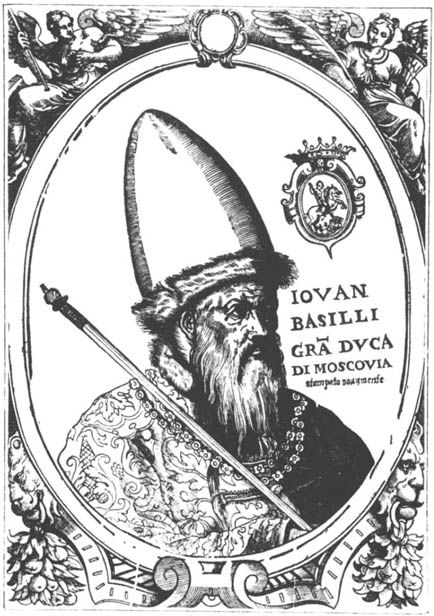
Ivan in old age, a seventeenth-century portrait.
He hoped he would die quietly, without pain, but with just sufficient warning to enable him to offer up his prayers for salvation at the last moment. Many years before he had written a hymn to the Archangel Michael, “the leader of the heavenly hosts and guardian of all mankind,” in which he asked that every day and most especially when he lay dead and his body was giving off a fearful stench, this hymn would be chanted. The terrible emperor addressed the terrible angel:
Before thy fearful and terrible coming,
Pray for thy sinful servant.
Let me know when my time comes,
That I may repent of my evil deeds
And throw off my burden of sin.
I shall travel a long journey with thee.
O fearful and terrible angel,
Do not terrify me, for I am helpless.
O holy angel of Christ, O terrible leader of the hosts,
Have mercy upon me, thy sinful servant.
When, O angel, the time comes to summon me
And to separate my soul from my wretched body,
Then come gently, let me look upon thee joyfully,
And dost thou look upon me reassuringly.
O fearful and terrible angel,
Do not let thy coming terrify me.
There were many more anguished verses, and it was clear that he had thought deeply about death and his inevitable encounter with the terrible angel. Indeed, death was the one subject he knew best.
Yet life still stirred in him; he still lusted after women. When the beautiful Tsarevna Irina, the wife of Fyodor, entered his bedroom to inquire after his health, he half-rose from the bed and attempted to throw his arms round her. She screamed and ran from the room. He still lusted after his wealth, and every day he was carried in his chair into the treasury to gaze upon the accumulated wealth of the Tsars. On one of these occasions, only a few days before his death, he beckoned to Jerome Horsey to accompany him. Horsey observed that Ivan had begun “grievously to swell of the cods, with which he had most horribly offended above fifty years altogether, boasting of a thousand virgins he had deflowered and thousands of children of his begetting destroyed.”
In the treasury Ivan discoursed on his treasures. They included loadstones, which possessed the “great and hidden virtue” of enabling mariners to navigate their ships and to keep the tomb of the Prophet Mohammed hanging in midair in the mosque at Derbent. He then ordered some needles to be touched with the loadstone and marvelled to see them hanging together in a chain. Then he ordered coral and turquoise to be placed on his hand and arm, and observed that they suddenly grew pale, a sure sign that his death was imminent. “I am poisoned with disease,” he said, and went on to contemplate a unicorn’s horn which he called “my royal staff,” and which like so many of his treasures was studded with diamonds, rubies, sapphires, and other jewels. This unicorn’s horn had cost a fortune of seventy thousand marks sterling paid to the great banking family of the Fuggers at Augsburg. For many centuries it was believed that the unicorn’s horn was wonderfully equipped to indicate the presence of poisons, but it could no longer cure the poisons in his blood. His mind darting, he turned to a wooden board, and ordered his court physician, Johan Eylof, a Dutchman, to scrape a circle on it with the horn and place a spider within the circle. The spider died; another died a little later; a third ran outside the circle and survived. Ivan was in despair. Of the unicorn’s horn he said, “It is too late. It will not preserve me.”1
Jerome Horsey was watching everything that happened with the intensity of a man who knows that strange things are spoken by dying emperors. Ivan was casting a long, last, helpless look at his treasures, and the Englishman remembered his words:
“Behold these precious stones. This diamond is the Orient’s richest and most precious of all other. I never affected it; it restrains fury and luxury and abstinacy and chastity; the least parcel of it in powder will poison a horse given to drink, much more a man.” Points at the ruby. “O! this is most comfortable to the heart, brain, vigor, and memory of man, clarifies congealed and corrupt blood.” Then at the emerald. “The nature of the rainbow, this precious stone is an enemy to uncleanness. Try it; though man and wife cohabit in lust together, having this stone about them, it will burst at the spending of nature. The sapphire I greatly delight in; it preserves and increaseth courage, joys the heart, pleasing to all the vital senses, precious and very sovereign for the eyes, clears the sight, takes away bloodshot, and strengthens the muscles and strings thereof.” Then takes the onyx in hand. “All these are God’s wonderful gifts, secrets in nature, and yet reveals them to man’s use and contemplation, as friends to grace and virtue and enemies to vice. I faint; carry me away to another a time.”
On March 17, 1584, Ivan felt better, took a bath, and sent out orders that the Lithuanian embassy which had been detained at Mozhaisk because of his illness should proceed at once to Moscow. It would take them two or three days to make the sixty-mile journey and by that time he thought he would be in better shape to receive them. On the following afternoon he read his will again, and sent Bogdan Belsky to see the Lapp magicians. Horsey tells us that the Lapps were quite certain he would die that day, and when Belsky reminded them that he was “as heart whole as ever he was,” they replied, “Sir, be not so wrathful. You know the day is come and ends with the setting of the sun.”
Meanwhile Ivan ordered his apothecary and physicians to prepare for his “solace,” by which he meant that they should give him the various potions for his diseases, and afterward he took another bath. They heard him singing in his bath; he was evidently in high spirits. Returning from his bath, wearing a loose gown, shirt and linen hose, he sat down on his bed and called to Rodion Birkin, a nobleman from Ryazan, to bring out a chessboard. Bogdan Belsky, Boris Godunov, and other high officers of the court were standing around him. Jerome Horsey, who appears to have been present, relates that Ivan set the pieces on the board but could not make the king stand up properly. Suddenly he fainted and fell backward across the bed.
During these last years he had often suffered from fainting spells, but it was clear that this was no ordinary fainting spell. There was a lot of shouting and running about. Someone sent for brandy, someone else called the doctors and the apothecary, rose water and marigold were brought to him, but it was all in vain. Within a few minutes, in Sir Jerome Horsey’s words, “he was strangled and stark dead.”
Yet there were some who still believed there might be some life in him. Twice before he had suffered from strokes, and had recovered. Therefore the court officials remained silent, afraid that if they gave way to grief or rejoicing the Tsar would hear them. Only Feodosy Viatka, the Tsar’s confessor, seemed to know exactly what should be done. He dressed the dead man in a monk’s robe and put a monk’s cowl on his head, and gave him a new name, and performed the ceremony appropriate for a living man who enters the community of monks. Ivan had hoped that like his father he would become a monk before dying. Instead he became a monk after his death, acquiring the new name of Iona.
The four Regents were all in Moscow and the transfer of power took place quietly and efficiently, with the overwhelming use of military power. All the Kremlin gates were closed, all the gunners on the walls were ordered to be ready to fire at a moment’s notice to put down any rebellion by a usurper who might attempt to seize the throne. The treasury was sealed off; the guards were mounted; the matches for firing off the great cannon were lit. On the terrace of the Kremlin Palace Boris Godunov gave out orders. When Sir Jerome Horsey hurried up to him, and offered himself, his servants, powder and pistols to the new lord protector of Russia, his services were accepted. “Be faithful and fear not!” Godunov said with a cheerful countenance. He and the other Regents had long ago mapped out the strategies of the transfer of power.
The Tsarevich Fyodor entered the bedroom where Ivan lay in his monk’s habit. He wept uncontrollably, and was followed by the Metropolitan with a train of priests, who also wept. The Metropolitan chanted:
Where is the city of Jerusalem?
Where is the wood of the life-giving Cross?
Where is our Lord Tsar, the Grand Prince Ivan
Vasilievich of all Russia?
Why hast thou left thy Russian Tsardom and thy
noble children and left us all orphans?
Having uttered the conventional and yet deeply moving complaint, the Metropolitan set about consoling the Tsarevich and the nobles in the bedroom, urging them to place their trust in God and not to forget that a new Tsar would soon be on the throne. The Metropolitan hurried away to his palace to write letters to the archbishops and bishops all over Russia, summoning them to Moscow to attend the funeral and the coronation of the Tsar’s successor.
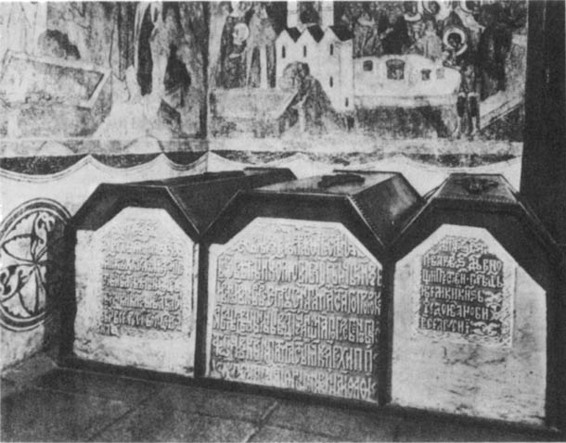
The graves of Ivan the Terrible and his two sons Ivan (left) and Fyodor (right) in the Cathedral of Michael the Archangel in Moscow.
For two days the body lay in an open coffin and the people crowded to see the man who could no longer punish them. They saw him wearing a monk’s habit and there was an embroidered apron on his chest depicting the Crucifixion. They wept unrestrainedly not because they had any affection for him but because they were aware that an age died with him and because they were aware that the future might be even more terrible than the past. For fifty years they had known no other Tsar, and they wept too because they were bereft of a familiar figure, a known presence. They wept more for themselves than for the dead Tsar.
After the funeral service the coffin was laid beside the tomb of Tsarevich Ivan. Then it was bricked over, and in time a bronze sepulcher was fashioned, bearing his name and titles. Songs were sung about him and he entered into legend, suffering that strange process by which the legend escapes from history altogether. His virtues and vices were reassembled, and the people recreated a figure which bore little resemblance to the real Ivan. They saw him against the moonlight, gleaming with a fierce moonlit brightness, heroic and terrible, haunting their dreams. In the streets of Moscow they sang:
O bright moon, O father moon,
Why didst thou not shine as in former times,
As in the ancient times long ago?
It happened to us in Holy Russia,
In stone-built Moscow, in the golden Kremlin,
In the Uspensky Cathedral,
In the Cathedral of Michael the Archangel.
They struck the great bell
And the echoes spread over all the moist Mother Earth.
All the princes and boyars came together,
All the warriors rode up together
To offer prayers in the Uspensky Cathedral.
There stood the newly fashioned cypress wood coffin,
And in the coffin lay the Orthodox Tsar—
The Orthodox Tsar, Ivan Vasilievich, the Terrible!
The life-giving Cross stood at his head,
And beside the Cross lay the Tsar’s crown,
At his feet the sharp and terrible sword.
Everyone prays to the life-giving Cross,
Everyone bows to the golden crown,
Everyone looks trembling at the terrible sword.
Around the coffin the wax candles are burning,
And the priests and patriarchs all stand before the coffin,
Chanting and singing the service for the dead.
Thus they bade farewell to our Orthodox Tsar—
The Terrible Tsar—Ivan Vasilievich.
It was his fate to be remembered as the bearer of the sharp and terrible sword, the strange avenger who punished men for crimes they had never committed, the symbol of ruthless majesty let loose upon a people who yielded to him because he claimed to be their divinely appointed ruler. He had played with them like a small boy tearing off the wings of flies, and they bore him no resentment. He had spilled more Russian blood than any other Tsar, and they were proud they had so much blood to spare. Sometimes, in the troubled years following his death, they sang another song which showed that they wanted him back again:
You have shone, O father moon!
You shine, O moon, throughout the dark night—
Light up, O moon, the stone city of Moscow!
In the stone city of Moscow, in Holy Russia,
Beside the Uspensky Cathedral,
A young soldier is standing guard.
He is standing guard and praying to God,
He is praying to God and tearfully he cries:
“O turbulent winds, hurl yourselves down from the mountains!
O winds, scatter the yellow sands!
O moist Mother Earth, split open!
Lift up, O tomb stone!
Burst open, O thin white shroud!
Rise up, rise up, O Orthodox Tsar,
Our Orthodox Tsar, Ivan Vasilievich!”
The prayers of the young soldier remained unanswered, and there was no second coming of Ivan the Terrible. On April 23, 1953, a few weeks after the death of Stalin, his tomb was opened and the skeleton, with shreds of the monk’s gown still clinging to it, was examined by Soviet authorities. They found little more than they had expected to find: the remains of a tall, barrel-chested, heavy-set man with a low forehead and long arms. From the examination of the bones it was clear that he had suffered from a peculiarly painful form of arthritis. They found traces of arsenic and quicksilver, but these were not sufficient to suggest he had been poisoned, for they were used in the medicaments of the time. A plaster cast was made of the skull and a sculptor attempted on the basis of the skull to reconstruct the features of the Tsar. Then, still wearing the shreds of his monk’s robe and the embroidered apron depicting the Crucifixion, the remains of Ivan the Terrible were removed from the laboratory table and replaced in the coffin in the presence of movie cameras which recorded the scene for posterity. Then they covered him with sand and sealed the coffin.
Such was the second coming of Tsar and Grand Prince Ivan Vasilievich, known as Ivan the Terrible, who was descended from the ancient line of Rurik and from Byzantine emperors and from many obscure forefathers, a tormented man who visited his torments on his people. His greatest gift to the Russian people was his own death. By his mere presence, during the second half of his reign, he corrupted all the life around him, poisoning and defiling everything he touched. He left his country in disarray, exhausted by his savagery. He did all this with wide-open eyes, knowing at every moment what he was doing, his fierce intelligence undimmed by the knowledge that he was causing irremediable harm. In his own lifetime he was called “the Terrible,” and he was more terrible than anyone can imagine. Not until our own time did anyone arise who could be compared with him.
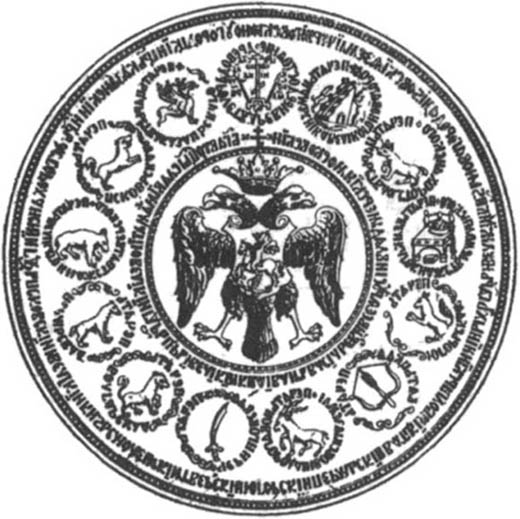
The Great Seal of Ivan IV, 1583. The small circles represent his principalities and kingdoms. Kazan is represented by the winged chimaera, upper right.
1 The belief in the miraculous power of the unicorn’s horn against poison was widespread in Europe. Supposedly the horn sweated and changed color in the presence of poison. Queen Elizabeth possessed such a horn valued at £100,000. As late as 1789 a unicorn’s horn was used to detect poison at the French court.