

THERE REMAINED for Ivan less than two and a half years of a life that had grown burdensome. He continued to sleep badly, at the mercy of his nightmares, and the days were no more endurable than the nights. He tried not to think of his dead son and carefully avoided all the places associated with his son’s death. He had killed the Tsarevich at Alexandrova Sloboda and therefore orders were given that the place should be shut down. Once it was the capital of his empire, the seat of power, with its dungeons, torture chambers, and vast treasuries, and now it was given back to the surrounding forests.
He was weary of life, weary of murders, weary of wars. King Stephen Bathory was still sending raiding parties into Russia and hoping to starve Pskov into surrender, and Ivan was hoping the war would go away. He sued for peace, rejecting all suggestions that he should send an army to the relief of embattled Pskov. On December 13, 1581, less than a month after the death of the Tsarevich, the negotiations began at Yam Zapolsky, a small town deep inside Russian territory, some fifty-five miles southeast of Pskov, in the midst of a region devastated by the long war. A mediator, the papal emissary Antonio Possevino, presided over the negotiations. At whatever the cost in territory Ivan wanted the negotiations to succeed, if only to give himself the satisfaction of establishing a peace which was certain to be insecure; for whenever territory is surrendered to the enemy, he can be expected to demand more. Ivan’s secret dispatches to the Russian envoys during the peace parlays have not survived, but we can sometimes guess the contents. We know, for example, that he ordered all the Russian delegates to be splendidly dressed and to ride beautifully caparisoned horses. They were ordered to make a show of wealth and the assurance that comes from wealth. Into that desolate region where even the heavy snowfall could not conceal the miseries of war, merchants were sent from Moscow to set up their shops, displaying their costly wares in tents. No one must know that Russia was impoverished and exhausted by the three-year war.
The Lithuanians knew the real situation better than Ivan. They were not especially impressed by the gaudy display of the Russians. They made harsh demands. All of Livonia must be surrendered by Russia. Henceforward Polotsk, Veliki Luki, and all the other important towns would be included within the empire of King Stephen Bathory, and in addition they demanded a war indemnity of 400,000 Hungarian gold crowns. Ivan hoped to retain Dorpat and some other towns, which would give him access to the sea. Impressive efforts were made to convince Antonio Possevino of the rightness of the Russian cause. Meat was brought down from Novgorod especially for his use, and it was explained to him that unless the Russians possessed a seaport on the Baltic, they would be unable to form alliances with the Pope and the Emperor against the Moslems. The papal intermediary played his cards well; he pretended to be neutral and showed signs of favoring both sides while demonstrating an inevitable partiality for Catholic Poland and secretly hoping to convert the Protestants of Lithuania to Catholicism. The negotiations continued for three weeks, with nothing accomplished. Suddenly the besieged fortress of Pskov erupted. Prince Ivan Shuisky had already sent out forty-five sorties in the hope of breaking the siege. On January 4, 1582, he gave orders for a forty-sixth sortie. His cavalry and infantry fought so ferociously that the Poles and Lithuanians concluded that the Russian army would never surrender the city. Prepared to sue for peace, they announced that on the orders of King Stephen Bathory they were breaking off negotiations. Both sides were bluffing. On January 15, 1582, they agreed to a ten-year truce on condition that Russia cede the whole of Livonia to the Poles and Lithuanians. King Stephen Bathory waived the indemnity of 400,000 Hungarian gold crowns and returned Veliki Luki to the Russians but kept Polotsk. Ivan lost Dorpat, but was saved from greater humiliation by the heroic defense of Pskov, which saved Russian honor. Ivan by his cowardice and pusillanimity had no share in these triumphs. The loss of Livonia was a disaster of the first magnitude and most of the blame must be laid at Ivan’s door.
Soon after the signing of the Treaty of Yam Zapolsky, the papal intermediary, who had worked so successfully on behalf of the Poles and Lithuanians, arrived in Moscow. His purpose was to discuss religious matters with Ivan, who was sunk in gloom. “I found the Tsar in deep despair,” Possevino wrote. “The court, formerly so splendid, now resembled an abode of monks, their black gowns showing evidence of the Tsar’s somber spirits.” Ivan felt that nothing would be gained by religious discussions; they would lead to arguments; and arguments would lead to hatred. Possevino appears to have embarked on the discussions with misgivings and only because Pope Gregory XIII insisted that one last attempt should be made to unite the Orthodox and Catholic faiths under himself as the Supreme Pontiff. Ivan was rarely long-suffering, but he showed toward Possevino an unusual charity. We find him speaking in the tones of a very old and experienced man who harbors no desire to quarrel with anyone and desires only to be left in peace. He said:
Antony, we are already fifty-one years of age. We were brought up in our Christian faith and we have reached maturity, thanks to God’s grace! At this age we have no desire to change our faith, nor do we desire a greater kingdom to rule over. The Roman faith would not be in agreement with many articles of belief in our Orthodox Christian faith. We do not want to talk about it because we do not want any quarrels. Besides, we cannot take upon ourselves even to discuss such a serious matter without the blessing of our father, the Metropolitan, and the Church Council.
Possevino had the Jesuit temper, charming, ruthless, absolutely certain of the rightness of his cause; and he pressed hard. Ivan had his own ways to escape from his adversary’s arguments. Someone had told him that the Pope was often carried on a portable throne and Crosses were sown onto his shoes for the people to kiss. “In our church,” said Ivan, “it is not the custom to wear the Cross below the belt.” Possevino was puzzled and made a long speech on the necessity to revere Popes and Emperors, and bowed very low to Ivan to show how much he revered the supreme ruler of Russia. Reverence, even extreme reverence, was perfectly proper, he suggested until Ivan cut him short. “This man who calls himself the co-ruler with Christ orders people to carry him on a throne as if he were on a cloud, as if he were an angel, and does not live according to the teachings of Christ—well, that Pope is not a shepherd but a wolf!”
So it had come out at last, all the pent-up emotion of the Orthodox confronted with the Roman Catholic mind. Possevino was deeply shocked.
“If the Pope is a wolf,” he said sternly, “then I have nothing more to say.”
Ivan did his best to make amends.
“You see,” he explained, “when we talk about religion we only provoke each other. I do not call Pope Gregory XIII a wolf but I call a wolf a Pope who does not follow the teachings of Christ!”
Characteristically, in attempting to make amends, Ivan only made matters worse. He realized this, laid his arm on Possevino’s shoulder and permitted him to withdraw. Later that day he sent meats from his own table to the papal emissary.
Three days later, on February 24, 1582, Possevino was again summoned to an audience with the Tsar, who bade him sit down opposite the throne and said in a loud voice, so that all the people in the audience chamber could hear him: “Antony, please forget what I said about the Popes that so annoyed you! We do not agree on matters of faith, but I want to live in peace with all Christian rulers, and I shall send my officers to accompany you to Rome, and for the services you have rendered I offer you my gratitude.”
In this way the Tsar made his amends, and Possevino was permitted to continue his discussions on religion with a group of boyars. Since he had very little knowledge of the Russian character he continued to be something of a nuisance, making absurd requests. He asked for the expulsion of all Lutheran pastors and was told that all men were free to practice their faiths in Russia on condition that they made no attempt to convert the Orthodox Christians. He asked for permission to erect a Catholic church and was told that the Catholics were permitted to worship freely and bring their priests into Russia, but the building of churches was not permitted. Possevino then raised the question of a combined Catholic and Orthodox crusade against the Muslims, and Ivan let it be known that he would gladly join such a crusade if all the other crowned heads of Europe would do the same, an unlikely event, and therefore one that did not greatly concern him. Possevino was not so much outmaneuvered as placed in a position where he seemed to be continually out of step, and Ivan drew some wry satisfaction from watching the papal emissary as he became increasingly confused.
On the first Sunday of Lent Ivan once more summoned Possevino to an audience. In the silkiest tones he invited the representative of the Pope to attend an Orthodox service. He said:
Antony, I know you want to see the customs of our Church, and so I have arranged to have you escorted to the Uspensky Cathedral at a time when I myself will be present, and you will then see the beauty and majesty of a true service to God. There, in the Cathedral, we adore the heavenly, not the earthly, and we honor our Metropolitan without holding him aloft in our hands. The Apostle Peter was not carried aloft by the faithful; instead he walked without shoes—and your Pope calls himself God’s Viceroy!
Possevino was outraged, but kept his temper. He explained that there could be no communication between himself and the Orthodox Church until there was communication between the Pope and the Metropolitan; and he refused to attend the service. But the Uspensky Cathedral was next door to the palace, and at a signal all the nobles swept out of the audience chamber and made their way to the Cathedral, and Possevino found himself being carried forward by the crowd, until he was safely deposited on the doorstep of the Cathedral. Ivan shouted after him: “Antony, be careful that no Lutherans follow you into the cathedral!” He was pleased with this little gambit, but Possevino was able to slip away. Ivan was surprised, for he thought he had done everything possible to ensure that the papal emissary would attend the service. He rubbed his forehead with his hand and said, “He has a strong will!”
The trick had failed, but Ivan continued to deal with him courteously, even sending him a gift of seven black sables, for himself and the Pope. Possevino left Moscow on March 15, 1582, accompanied by Russian envoys to the papal court dressed in black. If they were asked why they wore such somber costumes, they were instructed to reply that they were in mourning for the Tsarevich Ivan. They were also instructed to deny that the Tsar had ever called the Pope a wolf.
Thus ended Possevino’s hopeless attempt to bring the Roman Catholic and Orthodox churches together, with Ivan as an amused spectator and his boyars as confederates in his amusement. The times were bitter and these amusements were rare enough to become memorable.
The wars were not over yet. The Nogay Tatars were becoming increasingly troublesome, the Cheremiss were rising, threats of another invasion from the Crimea were being taken very seriously. King John III of Sweden had captured Narva and was sending raiding parties into Russian territory. Happily he was on bad terms with King Stephen Bathory and there was very little possibility of concerted action by the Swedes, the Poles, and the Lithuanians. Having concluded peace with King Stephen Bathory, Ivan attacked the Swedes with the express purpose of capturing Narva, and then abruptly called off the war and invited the enemy to negotiate a peace treaty. He was clearly unsure of himself and terrified by the possibility of a Tatar invasion. In May 1583 he concluded a two-month truce with Sweden, which was later extended for three years. Sweden kept Narva and a large part of the former Russian coast of the Gulf of Finland.
Given adequate leadership, it is likely that the Russian army would have carried everything before it. But Ivan was not a war leader. Senile, guilt-ridden, suffering from various undiagnosed diseases, he was a pitiful remnant of the man who had once conquered Kazan. Among his many fantasies was one concerning England. He believed that England might become an invaluable ally; she would provide him with weapons and ammunition, and she would do this all the more readily if he were allied by marriage to a close relative of the Virgin Queen. English guns, English gunpowder, an English wife—armed with these, there were no enemies he could not conquer.
One of Ivan’s many doctors was Dr. Robert Jacoby, who at some period of his life appears to have encountered the family of Francis, the second earl of Huntingdon, whose large family included a daughter Mary, known as Lady Mary Hastings. It occurred to Dr. Jacoby that Lady Mary Hastings would make a suitable bride for Ivan, who was still married to his seventh wife. The doctor had arrived from England in 1581 with a letter of recommendation from Queen Elizabeth testifying to his great skill, and Ivan trusted him implicitly, listened to his stories about the court, and became infatuated with a woman he had never seen. According to Dr. Jacoby, she was a niece of the Queen. This was not true, but neither the Tsar nor the doctor was concerned with the truth. Lady Mary Hastings did belong to one of the most powerful families in England and there had been a time when her father thought of himself as a future King.
On August 11, 1582, Fyodor Pissemsky, ambassador and envoy extraordinary, was sent by Ivan to negotiate a close alliance between Russia and England and simultaneously to negotiate his marriage to Lady Mary Hastings. His instructions, which were voluminous, were also precise. Pissemsky was instructed to communicate the Tsar’s intentions in a private audience with the Queen; he must acquire a painting of the lady, meet her, describe her at length, and learn her exact relationship to the Queen, the number of her brothers and sisters, and her father’s rank. If Queen Elizabeth objected that the Tsar was already married, she was to be told that the present Tsaritsa had no royal blood, and furthermore he did not like her and would soon rid himself of her in favor of the Queen’s niece. Pissemsky, arriving in London a month later, had some difficulty approaching the Queen because it was a plague year and she had vanished into the seclusion of Windsor Castle. Finally, on November 4, 1582, a reception was given for him at the Castle and he was accorded all the honors due to him. The Queen rose graciously when the Tsar’s name was mentioned, and she stepped forward to receive from Pissemsky’s hands the gifts and letters from the Tsar. Smiling, she said she regretted her ignorance of the Russian language; she asked after the Tsar’s health, and she said she had been saddened by the death of the Tsarevich. When Pissemsky said that the Tsar loved her above all the other sovereigns of Europe, she answered, “I love him no less and sincerely hope one day to see him with my own eyes.”
The conversations between a sovereign and an ambassador are usually predictable. The Queen asked Pissemsky how he liked England, and he answered that he found every virtue and every imaginable grace in the country where he had the honor of being the Russian ambassador. Then the Queen asked him whether Russia was now quiet, and he replied predictably that it was very quiet, adding that all seditions had been stamped out, the rebels had repented, and the Tsar had dealt with them mercifully. These were the introductory pleasantries; the real business of the embassy would come later.
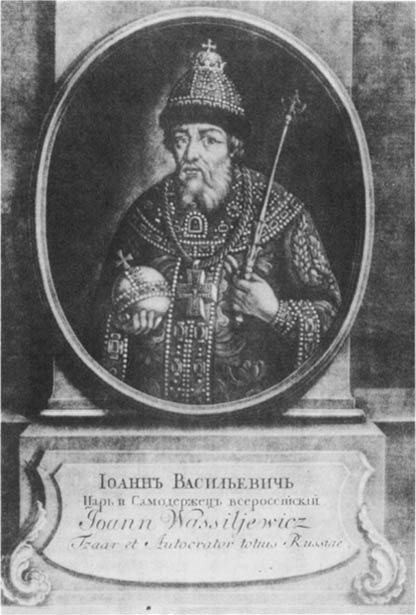
Seventeenth-century portrait of Ivan.
On December 18, 1582, Pissemsky had his first formal meeting with Queen Elizabeth’s ministers. The ambassador announced that he had been entrusted by the Tsar with the task of negotiating a defensive and offensive alliance; England was to make common cause with Russia in peace and war; and in the event of war the Queen was expected to furnish troops for the Tsar, or failing that, to render financial assistance and to send military supplies. There were long discussions on the precise terms of the treaty and on the English claim to the exclusive right of trading on the White Sea. No final agreement was reached, and exactly a month later, on January 18, 1583, the ambassador had his first private audience with the Queen on the subject of Ivan’s marriage to Lady Mary Hastings. It transpired that according to the Queen the lady was not beautiful enough to be worthy of Ivan and in addition she had recently suffered from smallpox which left her with a blemished skin. Later, when she had recovered, arrangements would be made to let the ambassador see her and a picture would be painted. Four months passed, and on May 18, 1583, the ambassador first set eyes on the lady.
The occasion was carefully stage-managed and resembled a slave market with the ambassador representing the prospective purchaser. Lady Mary Hastings was exhibited in a tent set up in the gardens of York House, the palatial residence on the Thames Embankment that had formerly belonged to the Archbishop of York. She was attended by young noblemen and maids of honor, and Pissemsky appears to have approached her in trepidation. “She put on a stately countenance,” wrote Sir Jerome Horsey, and he describes how the ambassador behaved in her presence. “Cast down his countenance; fell prostrate to her feet, rose, ran back from her, his face still towards her, and the rest admiring at his manner. Said by an interpreter it did suffice him to behold the angel he hoped should be his master’s spouse; commended her angelical countenance, state, and admirable beauty.” In his description of the lady, written for the Tsar, Pissemsky omitted to mention that she was beautiful. He wrote that she was “tall, well-shaped, slender, white of face, her hair dark blond, and she has a straight nose, and her fingers are long and slender.” It was an admirable portrait of a dignified and rather plain-looking English woman of the aristocracy. Queen Elizabeth in her forthright way commented on the confrontation a few days later when talking to the ambassador.
“I do not think your Sovereign will like my niece,” the Queen said, “nor do I think that you liked her.”
“It seemed to me that your niece is very beautiful,” the ambassador replied diplomatically. “Now it all rests in the hands of God.”
He had waited for many months for a glimpse of the future Tsaritsa; it had been granted to him; and he was satisfied. The Queen, too, appears to have thought she would lose nothing by marrying off an obscure kinswoman to the Tsar. Lady Mary Hastings was not averse to becoming an empress. Later, when she learned more about Ivan’s character, she changed her mind and begged Queen Elizabeth to put an end to the proceedings. For the rest of her life her friends amused themselves by calling her “the Empress of Muscovy.”
Just before the Russian ambassador left England, he was the guest of honor at a banquet given by Queen Elizabeth at her palace at Greenwich; and when he took his leave she placed in his hands two letters addressed to Ivan. In one letter she thanked him for his proposals for an alliance, and in the other expressed her pleasure at his intention to visit England not because of any danger arising in his country but simply because he genuinely desired to meet her. She promised to prove to him that England would be a second Russia for him. These diplomatic niceties were designed to prepare her own ambassador’s diplomatic efforts toward acquiring substantial trading privileges. The ambassador was also commanded to inform the Tsar as diplomatically as possible that the Queen had no interest in concluding an offensive alliance with Russia and that Lady Mary Hastings suffered from poor health and would not be able to make the long and arduous journey to Moscow. Also her relatives did not want to be parted from her.
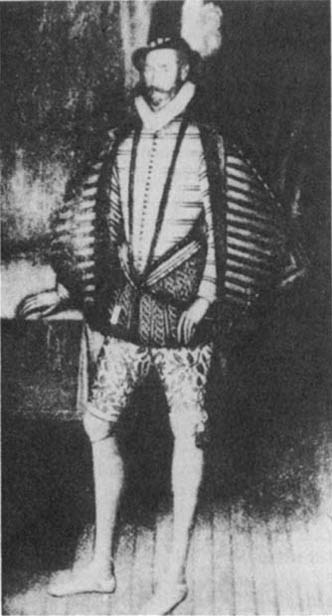
Sir Jerome Bowes.
The English ambassador was well chosen. Sir Jerome Bowes was a proud, peppery, rough-humored man, who permitted no nonsense from anyone and was quite capable of standing up to the Tsar. He possessed an exaggerated sense of his own importance, but in dealing with Ivan it was always useful to feel important. From the moment Bowes arrived in Moscow he was a power to be reckoned with.
The two ambassadors set out for Russia together, arriving at Rose Island in St. Nicholas Bay on July 23, 1583. Here in the far north Pissemsky separated from Bowes and hurried overland to Moscow, bearing the letters of Queen Elizabeth and the painting ofLady Mary Hastings, while Bowes went by ship, sailing up the Northern Dvina River as far as Vologda, where horses and provisions were furnished to him by the Tsar; and again at Yaroslavl he was given two fine horses at the Tsar’s orders. It was evident that he was going to be treated with quite extraordinary respect.
When he reached Moscow he was given an escort of three hundred well-appointed gentlemen of the court on horseback, led by Prince Ivan Sitsky, a man who had served Ivan in many high positions and most notably as an ambassador to the court of King Stephen Bathory. They accompanied him to his lodging where he received food from the Tsar’s table and was told that the Tsar was anxious to see him, but since no doubt he was tired from the long journey he would be permitted two days’ rest before his first audience. Bowes therefore rested and prepared himself for the ordeal of meeting a man who was even prouder and more rough-tempered than himself.
On October 24, 1583, at nine o’clock in the morning, Bowes in the company of Prince Sitsky and the same three hundred gentlemen of the court on horseback rode off to the Kremlin Palace. Accompanying him were thirty of his own servants, who carried the costly gifts intended by Queen Elizabeth for the Tsar. Bowes was peppery from the beginning, for he saw that Prince Sitsky rode on a better horse than the one provided for him and he insisted upon being as well horsed as the prince. But Bowes behaved well in the palace and in the Tsar’s presence he was permitted to sit close to the throne on a bench draped with a carpet. Ivan sat with his three crowns in front of him, and there were the inevitable four guards wearing silver clothes. There were the usual questions about Queen Elizabeth’s health and they were answered in the usual way. Soon Bowes was dismissed, and Ivan, who was favorably impressed by the ambassador’s demeanor, ordered that two hundred dishes be sent to his lodging. The embassy had begun well; it remained only to work out the details of the treaty with the help of a commission which consisted of Nikita Zakharin, Bogdan Belsky, and Andrey Shchelkalov.
But of course it was not simply a question of working out a simple treaty. Ivan wanted things his own way: the Queen must do his bidding. He proposed that a special clause be inserted in the treaty, reading: “Queen Elizabeth must either persuade Bathory to conclude a genuine peace with Russia, forcing him to return Livonia and the Province of Polotsk to Russia, or else she must attack Lithuania with us.” Bowes had no intention of accepting such a one-sided clause and vehemently reminded the commissioners that he had no authority to grant the request. “I cannot return with it,” he said bluntly. “The Queen would think me a fool if I did!”
Then there was the question of the special privileges granted to the English, permitting them the sole right to trade with the ports on the White Sea. The commissioners sensibly asked him whether he expected the Russians to abandon trade with all the other sovereign states, and Bowes replied that they were forgetting that the English were the first to discover the route to the White Sea and therefore were entitled to this special privilege. When Ivan finally agreed that the English should have the greater share of trade with the White Sea, but proposed that France and the Netherlands should also be accorded trading facilities, Bowes continued to demand exclusive privileges.
Then Ivan raised a curious matter which needed explanation. He wanted to receive embassies from the Pope and from the sovereign rulers of Catholic countries. Could they not pass through England and travel to the White Sea on English ships? Bowes was sure that Queen Elizabeth would not permit it. Ivan’s boyars replied sensibly, “Faith does not interfere with friendship. Look, your Queen and our Tsar are of different faiths, but he desires to keep her as his friend above all other sovereigns.” Ivan agreed that the Queen might have good reason to keep a papal ambassador out of her country, but he could not understand what was harmful about an ambassador from a Catholic country stepping foot on English soil for a few days before embarking for northern Russia.
The negotiations were going along badly, and Bowes attempted to cut through the knots by seeking private audiences with Ivan. In this he was helped by Dr. Robert Jacoby. But these audiences were sometimes noisy. Once, annoyed by Queen Elizabeth’s refusal to agree to a treaty on his terms, Ivan flew into a temper and shouted that he did not reckon the Queen of England to be his fellow, and there were others who were her betters. Bowes was appalled and answered heatedly, and the following exchange took place:
|
Bowes: |
The Queen my mistress is as great a prince as any in Christendom, equal to him who thinks himself the greatest, well able to defend herself against his malice whosoever, and counts no means to offend any that either she had or should have cause to be enemy unto! |
|
Tsar: |
Yea, how sayest thou to the French King and the King of Spain? |
|
Bowes: |
Mary! I hold the Queen my mistress as great as any of them both! |
|
Tsar: |
Then what sayest thou to the Emperor of Germany? |
|
Bowes: |
Such is the greatness of the Queen my mistress as the King her father had not long since the Emperor in his pay, in his wars against France! |
Ivan did not relish the idea that an English King could buy the services of a German Emperor and became even more enraged. He ordered Bowes to leave the Kremlin Palace at once, adding, “If you were not the ambassador, I would throw you out of the doors!” Sometime later, when he had calmed down, the Tsar said, “Pray God that I should have such a loyal subject!”
These uneasy conversations continued. One day Bowes was summoned to a meeting with the Tsar and his closest advisers. Present were Nikita Zakharin, Dmitry Godunov, Bogdan Belsky, Andrey Shchelkalov, Prince Fyodor Trubetskoy, two secretaries and three other nobles of the Boyar Council. These men were the rulers of the Russian state, and three of them—Nikita Zakharin, Bogdan Belsky, and Andrey Shchelkalov—stood near the apex of power. These three therefore were ordered to come close to the throne to discuss with Bowes a matter of the utmost importance: the Tsar’s marriage to Lady Mary Hastings.
It appeared that Ivan was well satisfied with the lady’s portrait and was determined to marry her. But would Queen Elizabeth consent to the bride joining the Orthodox faith? There were also other questions to be decided, and the Tsar seemed to be on the verge of declaring the date of the wedding. Bowes, who knew exactly what Lady Mary Hastings thought about the wedding, demurred. He said she was ill and it was unlikely that she would become an Orthodox Christian. The Tsar was bitterly disappointed, saying, “I see you have come here not to do business but to refuse! So I will no longer speak to you about the matter!” Bowes realized he was in danger of jeopardizing the main purpose of his embassy, which was to obtain exclusive trading privileges for English merchants in northern Russia, and he attempted to appease the Tsar by suggesting that Lady Mary Hastings was a very distant relative of the Queen and furthermore there were many others who were much prettier.
“Who are they?” the Tsar asked.
Bowes replied that he was not at liberty to reveal their names. He needed the permission of the Queen, and could do no more than assure the Tsar that they existed. This was bad news, and the Tsar relapsed into ill humor, saying, “Then what instructions do you have? We cannot conclude the treaty as the Queen of England desires!”
Bowes saw that he must appease Ivan once again, and he arranged through Dr. Jacoby for another private audience. This was granted, and Ivan immediately asked him whether he had received further instructions.
“I have no other instructions,” Bowes replied. “But the Queen ordered me to listen to whatever you will wish to say and to repeat your words to her.”
Bowes appears to have spoken haughtily, for Ivan immediately impressed upon the English ambassador the fact that he was the Tsar and all communications with him should take place through his boyars. If the Queen of England came to Moscow, then she could speak to him as an equal. Ivan continued: “You talk a good deal, but say nothing to the purpose. You tell us you have no instructions, but yesterday Dr. Robert told us you wanted to speak with us privately. So say what you want to say!”
Once again Bowes avoided the main issue. He told Ivan that when he was ambassador to France, he did not deal with lesser mortals but spoke directly to the King. Ivan wanted to get down to hard facts.
“Tell us what the Queen instructed you to say to us about the marriage. As for France, this tells us nothing. In our country we do not talk to ambassadors in this way.”
Nevertheless he was talking with the ambassador face to face; he was asking questions and pleading for an answer; and there was no answer. Bowes was saying: “Queen Elizabeth desires your friendship more than she desires that of any other sovereign, and mydesire is to serve you.” It was a brilliant improvisation designed to prolong the agony. Ivan said sternly: “Tell me who are the maidens who are the Queen’s nieces, and I’ll send my ambassador to look at them and make their portraits.”
Bowes offered to provide accurate portraits, but since he could not provide a single maiden Ivan remained frustrated and embittered. When he saw Bowes a few days later he shouted: “You are an ignoramus! From the moment you arrived here you have accomplished nothing!” This was not quite true, for Bowes had contrived a successful delaying action and still believed he would be successful in getting the treaty he wanted. When Ivan became especially angry, Bowes complained that he was being ill-used: they had given him only pork, which he detested, and demanded lamb and chicken. He placed the blame on Andrey Shchelkalov, and the Tsar immediately gave orders that Shchelkalov should have no further dealings with Bowes, and the merchants who contracted to send food to Bowes were thrown into prison, while Bogdan Belsky was ordered to apologize on behalf of Ivan for the verbal abuse Bowes had suffered at court. Ivan was especially anxious that Bowes would pardon him for saying he was an ignoramus.
There were altogether about six meetings with Bowes, the last of them taking place on February 20, 1584. They were always spirited, ironical, curiously graceful, like a dance. At one of these last meetings Ivan announced that he was so determined to marry one of Queen Elizabeth’s kinswomen that he had come to the conclusion that he must himself go to England and claim his bride, and he added that he would take his treasure with him. He seems to have felt that Queen Elizabeth would be so dazzled by the splendor of his treasury that she would give him everything he wanted.
In those last weeks of his life he was infatuated with an unseen and unknown English woman. England beckoned to him, and for him that mysterious island shone like a vision of paradise. Since he was not a man who permitted anyone to oppose his will, he would have made the long and difficult journey from Moscow to London for no other purpose than to choose a wife distantly related to the Queen of England. Less than a month after his last meeting with Bowes the Tsar died quite suddenly, and history was deprived of the spectacle of the Tsar walking hand in hand with Queen Elizabeth through the gardens of Windsor Castle.
Andrey Shchelkalov was a man of vast experience and proven loyalty who often suffered savage beatings at Ivan’s hands. He held the office of Chancellor and was therefore one of the most powerful men in Russia, but this did not save him when Ivan flew into one of his rages. He was genuinely puzzled by many of Ivan’s policies; he had no love for Englishmen, disliked Bowes, and sometimes wondered why Ivan wanted an English bride. On the day of Ivan’s death he hurried to Bowes’ house. He had information of great importance and it was necessary that it should be phrased in the proper way. He said: “Your English Tsar is dead!”