

FORTIFIED BY THE PRAYERS of the Church and with the certain knowledge that he had been called upon by God to punish the treacherous Tatars, Ivan resolved to conquer Kazan with a deep awareness of his responsibility as the divinely appointed ruler of Russia. He saw himself as another Joshua or another Gideon leading his people to the promised land, smiting the enemy with terrible blows. No longer would he direct the course of battles from a distance; he himself, in all the panoply of kingship, would lead the Russian army in the field. He was then twenty-one years old.
First it was necessary to ensure that divine influences would work in his favor and he therefore set out on the inevitable pilgrimage to the Troitsa-Sergeyevsky Monastery, which he regarded as a fountain of spiritual power, a place charged with the energy of the Holy Trinity. He had given many gifts of gold, jewels, and precious stones to the monks, and the Icon of the Holy Trinity, the chief object of worship in the monastery, was thickly studded with gold and pearls from his own treasury. It was to this icon therefore that he offered his prayers, falling on his knees and crying out in a loud voice:
O merciful Creator, hear the prayers and entreaties of thy sinful servant, and do not remember my trespasses, those which I committed when I was a youth and those which I committed when I became of age. I have recourse to Thee, my Creator and Lord. Behold my sighs and my tears, the sighs and tears of thy slave, and forgive me my sins and accept my repentance as Thou hast done for David and Hezekiah and Manasseh and the thief and the people of Nineveh.1 Have mercy upon me in Thy great compassion, O Lord, and grant me victory over our enemies, so that the godless shall not say: “Where is God?” and so that all shall know Thou art the true God and under Thy mercy we shall defeat our enemies.
The Tsar then knelt beside the relics of St. Sergius, weeping profusely, calling upon the saint to protect him and his Christ-loving army. Had not the saint aided and protected Dmitry Donskoy, Grand Prince of Moscow, who was the Tsar’s ancestor? His parents had brought him to be christened at the saint’s tomb, and had they not beseeched him to protect the infant prince? Therefore it was incumbent upon the saint to protect the Tsar, who had given so much treasure to the monastery. In this way, cajoling and bargaining, the Tsar impressed upon St. Sergius the need for his holy protection, demanding it as a right, not as a gift. A little while later he received the blessings of the abbot, the clergy, and the monks, and after presenting gifts to the brethren, he returned to Moscow.
At the thought of committing his army to battle against the infidels, Ivan felt an overwhelming need for divine protection. A few days after his visit to the Troitsa-Sergeyevsky Monastery, he entered the Uspensky Cathedral in the Kremlin and prostrated himself before the Icon of the Savior, a twelfth-century work of great beauty and elegance. He beseeched the Savior to show him mercy and to grant victory to his army. Had not Abraham triumphed over the King of Sodom, Joshua over the seven kings of Jericho, Gideon over the Midianites, and Hezekiah over Sennacherib? He reminded the Savior of the circumstances of all these triumphs at great length and with fervor, and tearfully begged for divine assistance. If this assistance were given, “then all our enemies will know we are Thy true servants and our enemies will be defeated because we have faith in Thee.”
Another wonder-working icon in the Uspensky Cathedral was the Icon of the Virgin of Vladimir, also painted by a twelfth-century Byzantine master. This icon, showing the Child’s face nestling tenderly against the face of the Mother, was, if possible, even more elegant and beautiful than the Icon of the Savior, and by common consent was regarded as the wonder-working icon above all wonder-working icons. To this icon Ivan also prayed tearfully, calling upon the Virgin to intercede for him and to grant him victory, “so that our enemies will know we are victorious not because we are strong and brave, but because God has helped us through the prayers and the intercession of the Virgin and the saints.” Then he prayed at the tomb of St. Peter the Metropolitan, whose prayers had assisted Dmitry Donskoy to overcome the Golden Horde, and afterward asked for the blessing of Makary. The Metropolitan blessed him and promised to pray for him at all times “when we are gathered together and when we are alone in our cells.”
It remained to tell Anastasia about the coming war against the Tatars. No doubt she had known for many days that he had decided to conquer Kazan but he appears to have felt the need to inform her officially, in the presence of his brother, his cousin, and his nobles. So he walked in procession from the cathedral to his private apartments in the Kremlin Palace. The highly emotional speech delivered by Ivan to Anastasia was recorded by a priest called Adrian Angelov:
Wife, it is my wish and desire to make war against the infidels, placing my trust in Almighty God, who loves mankind. I desire to wage war on behalf of the Orthodox faith and the holy churches, not only unto the shedding of my blood, but even unto death, for it is sweet to die for the Orthodox faith, and to endure death for the sake of Jesus Christ is to enter eternal life.
Thus did the martyrs undergo their sufferings, and so did the apostles, and the former Tsars who lived in fear of God, and their kinsmen, and for this they received on earth not only Tsardom from God, but also glory. For their valor they were feared by their enemies, and they also received a glorious and long life on earth.
Why, then, do I speak so much about what is mortal and perishes? It is because God gave them a place in Heaven because they were God-fearing and because they suffered for the sake of Orthodoxy, and when they passed from the world they lived in perpetual happiness and joy in the Lord together with the angels and the righteous, as it is said in the Scriptures: Eye hath not seen, nor ear heard, neither have entered into the heart of man, the things which God hath prepared for them that love him and keep his holy commandments.
Therefore, Wife, I bid thee not to grieve while I am away. I bid thee to fast, to perform works of grace, to go often to God’s holy church and to say many prayers for me and for thyself. Give alms plentifully to the needy. I bid thee to grant pardon to the many poor wretches living under the Tsar’s displeasure, and I grant thee the power to release prisoners at thy pleasure. Thus we shall receive great rewards from God: I for my valor, and thou for thy good works.
Adrian Angelov records that Anastasia was so disturbed by her husband’s speech that she would have fallen if he had not supported her, and for some time she remained speechless, weeping bitterly. At last, addressing herself to “My Lord, the God-fearing Tsar,” she begged him to return victorious and unharmed to the greater glory of God and of the Orthodox faith. “How will I endure the absence of my lord?” she asked, like every good Russian wife seeing her husband go off to the wars.
Thus the rituals of departure were observed in the proper medieval style with long speeches, sermons and prayers, with Ivan exultantly proclaiming his coming victory over the Tatars while simultaneously abasing himself before God and the saints. He saw himself as a warrior by divine grace, the brother of Abraham, Joshua, Gideon, and Hezekiah, and all the legendary warriors of the past. He walked in legends, and if he had come upon Abraham under the tree of Mamre he would not have been in the least surprised.
At the head of a formidable army, drums rolling and banners waving, Ivan set out for Kazan early in the morning of Thursday, June 16, 1552, leaving Anastasia, Makary, and his brother Yury to govern his country. The army marched through the village of Kolomenskoye on the Moskva River, and here Ivan rested for a while, ate some food, and pondered what course to pursue. The boyars had cautioned him against a march on Kazan, thus leaving Moscow open to attack by the Crimean Tatars. He decided there was no danger, but a few hours later, when he was on the march again, a messenger from Putivl, a town on the Russian border far to the south, brought news that the Crimean Tatars had crossed the border. Ivan held a council of war and decided that the greater evil was presented by the Crimean Tatars with their declared aim of “destroying the Orthodox faith,” not by the Kazan Tatars who were merely guilty of treachery and of killing many Christians. He ordered the army to march to the heavily defended fortress city of Kolomna and arranged to strengthen the defenses along the north bank of the Oka River which commanded the river crossings. Instead of marching to Kazan, the army waited for the Crimean army to attack. In this way the Russians lost their momentum and were placed on the defensive.
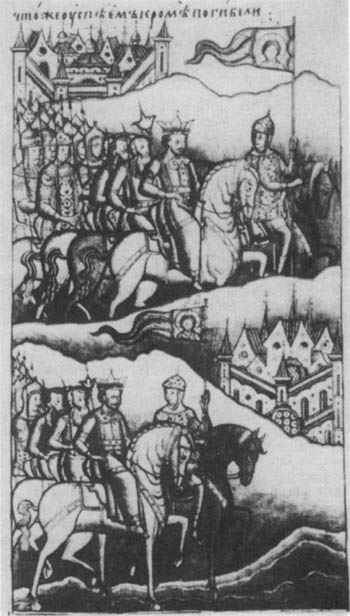
Ivan IV leaving Moscow and arriving in Kazan with his army and standard-bearer. (From an early, seventeenth-century edition with miniatures of the Kazansky letopisets)
For a few days nothing more was heard about the advance of the main forces of the Crimean Tatars. No scouts returned with reports of enemy movements, no hard-riding messengers brought news from the south. Ivan was in a quandary, for this silence was ominous. Then there came a report that a force of about seven thousand Tatars had appeared before the gates of Tula only to vanish again. A scouting party had been sent to explore the state of Tula’s defenses. A few hours later, while he was at dinner on the evening of June 23, Ivan learned that Devlet Guirey, Khan of the Crimean Tatars, had reached Tula with his vast army composed of Tatars and Janissaries, and with heavy Turkish cannons. Without finishing the meal Ivan hurried to the cathedral of Kolomna to pray for divine help and then gave orders for his whole army to march on Tula, a distance of about 75 miles as the crow flies. His own royal guard, composed of nobles, formed the rear of the army.
The siege of Tula was soon over, for the defenders were emboldened by the news that the Tsar’s army was on its way and they fought brilliantly, even the women sallying out to attack the Tatars. The Khan lifted the siege and ordered a retreat as soon as he learned that the Russian army was approaching. Many of his heavy guns were captured outside the walls of Tula, together with stores of gunpowder. The Khan with the remnants of his army fled to the south, abandoning camels and baggage carts and huge stores of provisions.
Ivan was overjoyed by the victory and returned to Kolomna to offer thanks to the Icon of the Virgin in the cathedral. This icon was believed to have accompanied Dmitry Donskoy at the time of his great victory on the Don River. In Ivan’s eyes the Virgin had blessed his army. In fact, he had not covered himself with glory; he had simply waited on events and owed the victory chiefly to the courage of the ordinary people of Tula, where there was only a small garrison. The people armed themselves against the enemy. Tula was heavily bombarded by the guns of the Janissaries, and flaming arrows set fires raging through the town.
From Tatar prisoners the Muscovites learned a strange story. The Khan of the Crimea was far from being a redoubtable warrior. Some miles south of Tula he held a council of war and decided it was too dangerous to proceed farther. He had thought, or half-believed, that the Tsar was in the neighborhood of Kazan, leaving Moscow open to attack. He panicked when he learned the Tsar had reached Kolomna and immediately ordered a general retreat. At the last moment one of his advisers suggested that it was intolerable to march so deep into Russian territory with so little profit. A sudden attack on Tula would bring great stores of booty, and there was still time to raid the villages. The Khan agreed with his adviser, ordered the attack on Tula, and sent groups of Tatars fanning out into the villages to capture young Russians to be sold in the Crimea as slaves. He was not so much a military commander as the captain of an army of looters.
With this defeat of the Khan of the Crimea the way was now open for the march on Kazan.
The plan of campaign was carefully worked out. From Kolomna the army would march to Sviazhsk in two columns, the northern column taking the road through Vladimir and Murom, the southern column taking the road through Ryazan and Meshchera. The two columns would meet at a crossing of the Sura River before advancing on Sviazhsk. The northern column was commanded by Ivan and the southern column by Prince Ivan Mstislavsky and Prince Mikhail Vorotynsky. Khan Shigaley, too fat and too indolent to ride on horseback, was given permission to make the journey by riverboat. The southern column, which was intended to shield the Tsar from attacks by marauding bands of Nogay Tatars, amounted to about 15,000 men, while the main army including the troops in Sviazhsk amounted to perhaps 125,000 men.
While preparations were being made for the march, there was some murmuring in the army. It came principally from the petty nobility of Novgorod, who complained that they had been fighting the Tatars without respite for many months, and had neither the money nor the strength to endure a long campaign. The problem was a real one, for they had to equip and maintain their own troops, and Ivan listened to their complaints with an outward show of sympathy. He ordered a list to be made up of all those who wanted to go on the march and another list of those who wanted to stay behind, promising substantial rewards to those who marched and hinting at substantial punishments for the rest. He learned that many of the petty nobles from Novgorod possessed no land and simply could not afford to campaign any longer. Finally he convinced them that he would take care of all their needs when he reached Kazan, and they promised to follow him.
On July 3, 1552, after once more praying before the Icon of the Virgin in the Cathedral at Kolomna, Ivan gave the order to march. In five days the main army reached Vladimir. Here, following his custom, he prayed before the relics of the saints, invoked on his army the blessings of God and the Virgin, and learned, as though in answer to his prayers, that the plague of scurvy which threatened to kill off the entire garrison at Sviazhsk had come to an end. It appeared that the whole town had been sprinkled with holy water, the priests led the people and the army in procession through the town and round the walls, and prayers were offered up in the churches. The people of Sviazhsk had surrendered to sensuality and license. Now in their despair, seeing death all round them, they gave themselves up to good works in thankfulness to God, who had spared them and pardoned their sins. Ivan was very pleased. Once more God had favored him. He regarded these acts of divine mercy without the slightest incredulity. It was as though God was speaking through him, and he was the intercessor between God and the Russian people.
He spent a week in Vladimir, and on July 13 reached Murom, where he received a long and strenuous letter from Makary, at once blessing and rebuking him. “Be pure in heart, be humble in glory, do not despair in adversity,” wrote the Metropolitan. “Remember that a virtuous Tsar is the salvation of his country.” The Metropolitan went on to stress the paramount importance of virtue, courage, wisdom, truth, purity, justice, and mercy. All this, of course, was predictable, but the Metropolitan had more serious matters to discuss. He reminded Ivan that the garrison at Sviazhsk had behaved abominably, giving themselves up to pride, drunkenness, and the lusts of the flesh. Did not the Apostle say that sinners would have no place in the Kingdom of Heaven? Had not many men of virtue succumbed to sinfulness? Who possessed more virtue than King David? “But David fell by the wayside and suffered grievously, and for all the remaining years of his life he soaked his bed with tears.” This was only one example; there were many others. Noah had made himself a laughingstock by his drunkenness, and Solomon in old age became proud and fell into sin and perished. He begged Ivan to remember his ancestors, who had lived chastely and soberly in holy wedlock, and were therefore rewarded by God with victory over the heathen. “We therefore beseech you, pious Tsar Ivan, and your brother Vladimir Andreyevich and all your great lords, princes and boyars and voyevodas, and all your Christ-loving army, that you remain pure, humble, wise, chaste and repentant, while keeping all the other virtues as well.”
Ivan replied in a letter that was uncharacteristically brief and to the point:
To our father, His Holiness Makary, Metropolitan of all Russia, greetings from the Tsar and Grand Prince Ivan Vasilievich.
You wrote to us instructing us to abjure sin and to be pious. We promise, lord, to do as you request.
Now we go forth with Vladimir of Staritsa, the boyars, and all the Christ-loving army, calling upon God, the Holy Virgin and all the saints to help us.
On March 20 Ivan marched out of Murom with his troops and two weeks later reached the Sura River, which marked the boundary of Russia and Tatary. Here he received a delegation of Cheremiss chieftains who had revolted but were now willing to renew their allegiance to the Tsar. Ivan forgave them, presented them with food from his table, and flattered them with kind words. On the same day by prearrangement the southern column also crossed the river. Prince Andrey Kurbsky, who rode with this column, remembered the journey to the Sura River with horror, for their food soon ran out and while riding across the uninhabited steppe they lived on fish and whatever wild animals they were able to catch. They had encountered no enemies and fought no battles. What dismayed the prince most of all was the endless loneliness of the steppe and the lack of bread. When they came up to the main army, their chief thought was for dry bread, which they begged, borrowed or bought at inflated prices, happy to get their teeth in any crust.
The worst part of the march was now over, for in little more than a week they would be reaching Sviazhsk. Bread was still uppermost in Prince Kurbsky’s mind as they rode north to the great Russian stronghold on the Volga:
From the Sura River we rode with the army for eight days across the steppe and through woods and sometimes through forests. We saw few villages, for these people conceal their houses behind natural fortifications invisible even when you are quite close to them. But we were getting food now, and as we traveled through these places we were able to buy bread and meat, though we paid dearly for them. Yet, because we had been faint with hunger, we were grateful. As for malmsey wine and other liquors and sweetmeats—we could forget about them! We found Cheremiss bread tasting better than our costly biscuits.
Above all, we were joyful and grateful because we were fighting for our Orthodox Christian fatherland against the enemies of the Cross of Christ and because we were marching with our Tsar. We felt no distress at all, vying with one another in good deeds, and the Lord God Himself helped us.
In this mood the great cavalcade came in sight of Sviazhsk to be greeted by the townspeople overjoyed at the safe arrival of the Tsar. The entire garrison came out to welcome them in a grand parade which included companies of Cheremiss soldiers who had only recently submitted to the Tsar. There were feasts and processions and prayers, solemn meetings and conclaves, more parades, more inspections. The Tsar inspected the town, visiting the churches, the arsenal, the fortifications, and the private houses, and he found it all good and especially admired the view from the walls. In fact, Sviazhsk was beautifully situated on the shores of the green Sviaga River which flows into the Volga less than a mile away. On one side there were the plains, hills, woods, dark forests, and on the other there were the wild cliffs of the Volga and the white islands in midstream. Here and there you could see the Chuvash villages half lost among the hills.
Prince Kurbsky felt that it was “like coming home after a long and arduous journey.” All of Russia seemed to be pouring into Sviazhsk, for the merchants of Moscow, Yaroslavl, and Nizhni-Novgorod had sent ships downstream laden with every conceivable article of merchandise. The sandy shores of the river were transformed into a marketplace, and every day more ships came to unload their treasures.
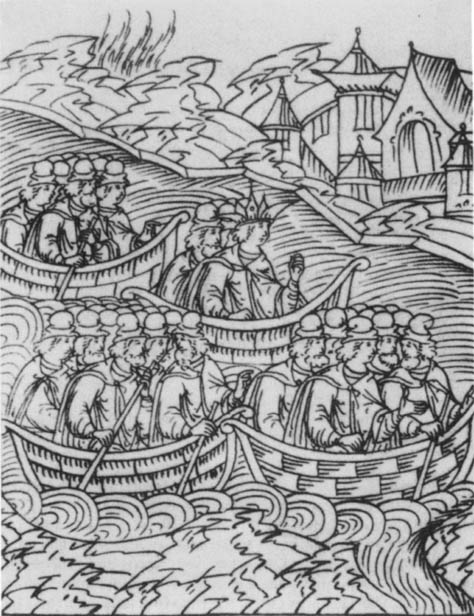
Ivan crossing the Volga to attack Kazan. (From the Nikon Chronicle with Miniatures)
In Sviazhsk it was hoped that the Tsar would occupy one of the larger houses, but instead he set up his tent in a meadow outside the walls. In this sumptuous tent he held another council of war attended by Vladimir of Staritsa, the boyars, and voyevodas. Khan Shigaley also attended the conference. He was instructed to write a letter to Khan Yediger Makhmet demanding his submission. If he came to the Tsar, he would have nothing to fear and would receive many rewards from the Tsar’s hands. At the same time the Tsar sent another letter addressed to the chief mullah and all the Tatars living in Kazan, promising that if they submitted all their past acts of rebellion would be forgiven. These letters were sent on August 15, two days after the army reached Sviazhsk.
Ivan had no real hope that Khan Yediger Makhmet would surrender the city. The letters therefore were merely formal statements of his claim to Kazan.
Without waiting for a reply, he ordered the army to begin crossing the Volga the next day. Two days later, on August 18, he crossed the river with his bodyguard, and it was not until the following day that the whole army reached the left bank of the Volga. The days of clear sunshine had come to an end, torrential rains filled the sky, the river rose and the low-lying plains became lakes and marshes. In the darkness and the rain the army drove toward Kazan, the wheels of the carts and gun carriages clogged with mud. The heavy guns, which had come down by boat, were landed at a point only four miles from Kazan. The chief obstacle was the small and swift-flowing Kazanka River, but it presented little difficulty. Six bridges were thrown over it, and by August 20 the whole army had crossed over.
The weather cleared a little, but the skies were still gray and there would be more torrential rains in the days to come. From his camp at the mouth of the Kazanka River the Tsar saw the fortress city of Kazan four miles to the east standing dark against the sunrise, with its citadel perched on a high rock, while the rest of the city sloped toward the surrounding meadows. The Tatars had closed the gates and were waiting for the attack. The Tsar, too, was waiting. He would conquer the fortress in his own leisurely time.
1 The reference to Manasseh, the wicked king of Judah, is to be found in II Chronicles, 33, and the repentance of Nineveh is described in Jonah: 3, 5–10.