

IF YOU STOOD in Ivan’s camp on the shores of the Volga River, you would have seen a city on a hill with towers and pinnacles and walls made of huge balks of timber from the surrounding forests, and this city would have something of the appearance of a medieval castle in a fairy tale. On the western heights overlooking the Kazanka River there were minarets, mosques, palaces of white stone, flags flying, battlements thrusting up against the sky. These formidably defended heights offered little comfort to conquerors. They could be stormed only by scaling the sheer cliffs on the west or climbing the steep pathways on the east. The defenders, who regarded their city as impregnable, saw no reason to be especially alarmed when they saw Ivan’s army. They could see every boat coming up the Volga and every Russian soldier in the plains, while their own soldiers remained invisible behind fortress walls.
If all of Kazan had stood on a high cliff, then the problem of conquering it would have been nearly insurmountable. But in fact the city followed the pattern of many ancient and medieval cities: there was the acropolis, the fortress on the heights, while below it, sprawling across the plain, lay the lower town with its huddled streets and long avenues leading to heavily fortified gates. Here and there the lower town was cut by ravines, and sometimes the huddled streets opened out into gardens and lakes. In the lower town lived the merchants, the artificers, the workmen, the poor, and the soldiers who manned the wooden towers.
To defend the city Khan Yediger Makhmet had an army of about 30,000 well-trained soldiers and about 2,700 Nogay tribesmen. They were armed with bows and arrows, spears, swords, lances, maces, and muskets. They also had heavy guns and ample supplies of gunpowder, and there was enough food in the city to take them through a long siege. Both the Tatars and the Russians wore chain mail and pointed iron helmets, so that it was sometimes difficult to tell them apart.
Ivan was under no illusions about the dangers confronting him. Khan Yediger Makhmet was a determined, daring, and ruthless adversary, who could be expected to use every ruse to prevent the city from falling into Russian hands. There was no possibility of a sudden surprise attack. It was not simply a question of conquering a well-defended city, but there was also the problem of how to deal with the Tatar armies outside the city, the many soldiers based in the town of Arsk which lay on the other side of a dense forest stretching almost to the walls of Kazan. The Russians would have to defend themselves against sudden sorties from the forest and against marauders from all directions. All together there were about 35,000 Tatar and Cheremiss troops loyal to the Khan outside the city, most of them hidden in the forest of Arsk. Of necessity Ivan would have to take special measures to protect his rear, his lines of communication with the supply ships moored on the Volga, and his own person, for the Tatars well knew that if the Tsar was killed or captured the siege would be lifted.
The plan of campaign was carefully worked out by the Tsar’s war council, which consisted of about a dozen generals, many of them princes and many of them related to his own family. For the most part they were young men in their twenties and thirties, who already had experience in fighting the Tatars. Each army was led by two generals, one senior and one junior. Thus the main army was led by Prince Ivan Mstislavsky with Prince Mikhail Vorotynsky acting as his second-in-command. His brother, Prince Vladimir Vorotynsky, commanded the Tsar’s elite corps, with Ivan Sheremetev the Elder acting as his second-in-command. The Sheremetevs were not princes, but members of an ancient boyar family which regarded itself as at least the equal of any princely family. In addition to the main army and the elite corps, there were seven other armies. They were called the vanguard, the rear guard, the right wing, the left wing, the scouts, and the armies of Vladimir of Staritsa and Khan Shigaley. Each army was given its own separate task, and all the armies were under the command of Prince Ivan Mstislavsky, who was then only twenty-five years old. He had the curious distinction of being descended from Rurik, from Jenghiz Khan, and from the ancient line of the Grand Princes of Lithuania. His grandfather, Prince Kudaikul of Kazan, had married the sister of Vasily III, and his mother was their daughter. He was therefore a quarter Tatar. He was an outstanding commander and Ivan had complete trust in him.
These generals were arrayed like peacocks, for they rode about in shining armor, wore plumes in their helmets, and trailed richly embroidered capes from their shoulders. The elite corps, numbering about twenty thousand men, and consisting mostly of nobles and their retainers, was also magnificently arrayed. The watchmen, looking down from the acropolis of Kazan, could see at a glance the progress of the nobles in their finery.
Ivan was accompanied by his retinue and a full court. His Keeper of the Signet, Master of the Horse, his state secretaries, equerries, heralds, armorers, pages, and royal clerks were constantly with him. In addition there was a large number of priests attached to his court including his father confessor, the priest Andrey Protopopov. There were also innumerable messengers all wearing the Tsar’s livery and a host of servants.
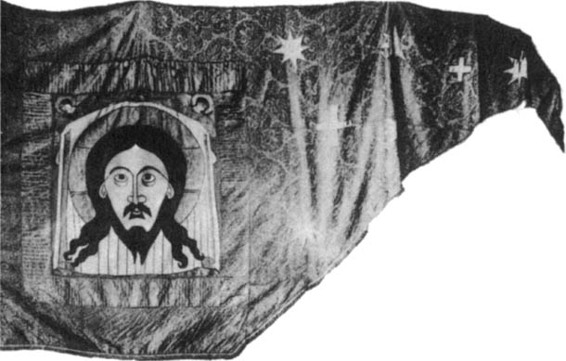
A war banner carried by Ivan IV’s standard-bearer, now in the Armory Museum in the Kremlin.
By August 20 this entire army with its heavy cannon and war machines was standing on the shores of the Volga, waiting for the order to storm Kazan. But the order did not come. Prince Ivan Mstislavsky and the council of generals decided to move cautiously, wanting to learn more about conditions inside the city before attacking. On that day two persons entered Ivan’s camp, each of them bringing information of the utmost importance. One was a Russian, a former prisoner of the Tatars, who was allowed to go free on condition that he give a letter written by Khan Yediger Makhmet to Khan Shigaley. This letter denounced Khan Shigaley as a scoundrel and traitor, and went on to denounce the Tsar and the Orthodox Church with extraordinary savagery. “We are preparing a banquet for you!” the letter concluded, and there was not the least doubt what kind of banquet was meant.
The letter from Khan Yediger Makhmet gave some indication of the temper of the defenders. Kamay Mirza was the second person to escape from Kazan. He was a Tatar nobleman who slipped out of the city with seven companions, the survivors of about two hundred men who had hoped to join the Tsar’s forces but had been arrested and executed. He brought news about the city’s defenses. He reported that the Tatars were well-armed and well-equipped, numbered about thirty thousand, and there was another Tatar army under Prince Yepancha hiding in the forest of Arsk. This was alarming news. During the two following days the council of generals decided upon the final disposition of the troops outside the walls of Kazan. The order to march was given during the early hours of the morning on August 23.
The plan of campaign was based on the assumption that Kazan could be conquered only after a lengthy siege. The main army would be stationed outside the east and south walls, the vanguard outside the north wall, the rear guard and left wing outside the west wall, and the scouts in the marshy ground south of the Kazanka River facing the acropolis in the east. The brunt of the fighting would fall on the main army, which would also have to fight the Tatar troops coming from the forest of Arsk. Since the walls of Kazan were over twenty-four feet thick, they could be breached only by blowing them up with gunpowder. All round the city the soldiers were ordered to build earthworks, which took the form of enormous wicker baskets about eight feet high and seven feet in diameter, known as gabions. They were solidly packed with earth to protect the guns and to provide defense works against the Tatars issuing out of the gates in sudden attacks against the Russian troops.
On that early morning, as the army moved toward Kazan, Ivan was in a deeply reflective mood, feeling the need for divine guidance and protection. When the army had traveled about three-quarters of the way across the plain known as the Khan’s Meadow, he called a halt and unfurled his great standard which bore an image of Christ “not made by human hands.” There was the sound of trumpets, the drummers beat their drums, and the Tsar and all his generals dismounted to pray for victory and to celebrate the glorious deaths of those who would fall in the coming battles. “I am ready to give my life for the triumph of Christianity,” Ivan said, and Vladimir of Staritsa encouraged him, saying: “Go forth, O Tsar! We are all united before God and before you!” According to the chronicles, Ivan gazed at the great standard with the image of Christ throughout the ceremony. Addressing himself to Vladimir of Staritsa, the boyars and voyevodas, and all the men in his army, Ivan declared that the time had come for a decisive battle, and he went on:
Therefore strive together to suffer for piety, for the holy churches, for the Orthodox Christian faith, summoning God’s merciful aid with the purest trust in Him, and strive on behalf of our brothers, those Orthodox Christians who have been made captive for many years without reason and who have suffered terribly at the hands of the infidels of Kazan. Let us remember the words of Christ, “Greater love hath no man than this, that a man lay down his life for his friends.” Let us therefore pray to Him with a full heart for the deliverance of the poor Christians, and may He protect us from falling into the hands of our enemies who would rejoice over our destruction.
I therefore bid you serve us as much as God will help you. Do not spare yourselves for the truth. If we die, it is not death, but life! If we do not make the attempt now, what may we expect from the infidels in future? I myself have marched with you for this purpose. Better that I die here than live to see Christ blasphemed and the Christians, entrusted to me by God, suffering at the hands of the heathen Tatars of Kazan. No one can doubt that God will hear your continuous prayers and grant us His aid. I shall bestow great rewards on you, and I shall favor you with my love, and provide you with everything you need, and in every way I shall reward you to the extent that God in His mercy offers His aid. And I shall take care of the wives and children of those of you who die!
In this way, making vast promises, the Tsar ensured the loyalty of his troops, who shouted enthusiastically, wept, prayed, and gave every indication of being swayed by religious emotion. For about an hour they gazed at the standard of Christ fluttering above their heads, and at last, speaking in a voice that carried across the plain, the Tsar said, “Lord, in Thy name we march!” Then he ordered them all to make the sign of the Cross, and they rode toward Kazan.
When the soldiers looked up at the walls of the city, they saw no sign of life. No guards manned the towers, the gates were closed, the city seemed silent and deserted. Many Russians rejoiced, imagining that the Tatars had been overcome by fear and had fled to the forest. Others, who knew the enemy better, advised caution. The Bulak River, little more than a muddy stream, followed the west wall of Kazan, and beyond the river and a small ridge lay the Plain of Arsk. Suddenly, as an advance patrol of about seven thousand scouts marched over the ridge, the great Nogay Gate flew open and streams of Tatars poured out of the city to attack them. The Russians were taken by surprise. About five thousand Tatar cavalry armed with lances hurled themselves on the scouts, and another thousand Tatar bowmen came running out of the gates. The scouts were forced back over the ridge and they would have been cut down to the last man if the vanguard under Prince Ivan Turantay-Pronsky had not rescued them. Finally the Tatars were driven back to the gates. They fought well; they had achieved surprise, and only ten prisoners had fallen into Russian hands, but they had lost the skirmish. The Tsar was well pleased with his small victory, but he knew that at any moment the gates would open again and the Tatars would come streaming out.
His own camp was established in the Khan’s Meadow about a mile to the west of the city. Before erecting his own tent, he gave orders that three church tents should be erected. These tents were dedicated to the Archangel Michael, St. Catherine the Martyr, and St. Sergius the Miracle-Worker. Beside the tent of St. Sergius he dismounted and offered prayers for his army. Throughout all the weeks of the siege the Tsar would continue to pray in these tents which were richly furnished with icons and relics. When he spoke of “continuous prayers” to be uttered by his soldiers, he meant precisely what he said, and prayers were continually on his lips. Only by “continuous prayer” could final victory be assured.
But God listened only intermittently to the Tsar’s prayers, for on the night of August 24 there rose a storm so terrible that it could be understood as a sign of divine displeasure. Many Russian ships were sunk, and vast supplies of food and ammunition were lost, so that it became necessary to send to Sviazhsk and as far as Moscow for replenishments. All the Tsar’s tents including the church tents were hurled down by the storm, and the Khan’s Meadow became a shallow lake. The storm lasted throughout the night and subsided early in the morning. On August 25 the Tsar was seen riding round the walls of the city and inspecting his troops. The heavy gabions were rolled into place during the day and the following night, and by morning Kazan was surrounded by a ring of earthworks. Then the heavy guns were brought up and placed behind the gabions. While all this was happening, the Tatars made a number of sorties against the Russian lines and sometimes they were able to reach the gabions, but no farther. Sometimes, too, the Tatars opened fire from the walls with muskets and cannon. They did little harm, for by this time the Russians were protected by their earthworks.
With Kazan enclosed within a wall of earth, it soon became clear that Prince Yepancha would attempt to break out of the forest of Arsk. Although the Russians knew about this force, they had not expected it to emerge for some time and had merely stationed a few detachments of cavalry along the edge of the forest. The first sortie from the forest took place on August 28, a Sunday. The Tatars came surging out of the forest, taking the Russians by surprise, killing the commander of the cavalry detachment, and routing them, so that they would all have been killed if reinforcements from the vanguard and the main army had not arrived in time. This first battle on the Plain of Arsk taught the Russians a lesson they would not forget: there was no safety as long as Prince Yepancha remained in the forest. The fighting was so severe that Ivan ordered a detachment from his own army to help them, and mounted his horse, saying he would fight with them. He was, however, dissuaded and he appears to have spent the rest of the day praying to St. Sergius the Miracle-Worker. His prayers were answered, for the Tatars were thrown back. On the Plain of Arsk there were more Russian than Tatar bodies.
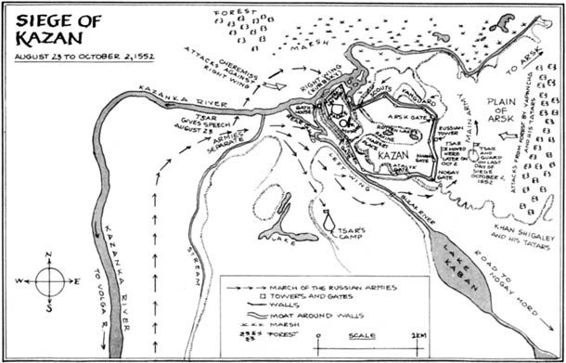
On the following day the Tatars again appeared on the edge of the forest, but this time the Russians were prepared for them. The Tsar gave strict orders that his troops were not to engage the enemy. All that day the Russians and the Tatars stood watching each other warily. The Muscovites could only guess how many more Tatars were hiding in the dark forest.
There had been many strange signs and portents, but the strangest of all came during the last days of the month when the city was already invested. According to Prince Andrey Kurbsky, the Tatars began to practice magic spells which were surprisingly effective. Just after sunrise some old men and women appeared on the acropolis plainly visible to the army below. They uttered incomprehensible words and made obscene gestures, turning their backs and lifting up their garments. A moment later the wind rose, clouds formed, and rain fell, even though there was not a single cloud in the sky before they appeared. “Then all the dry places became swamps,” reported Prince Kurbsky, “and the rain fell directly above our army, not elsewhere, and there was nothing in the sky to suggest this was about to happen.” Clearly the Tatars were using magic powers not possessed by the Russians.
But the Russians had magic powers not possessed by the Tatars. Ivan remembered that he possessed a piece of the True Cross. He sent for it, ordering his messengers to travel as quickly as possible to Moscow. Within eight or nine days they were back again in Kazan, having traveled by fast carriage from Moscow to Nizhni-Novgorod and thereafter by one of the small swift Viatka sailing vessels. The True Cross was carried in procession through the army, and Prince Kurbsky relates that thereafter all traces of the pagan magic disappeared.
Nevertheless there were no easy victories, and neither Ivan’s incessant prayers nor the presence of a holy relic saved the Russians from savage maulings at the hands of the Tatars, who had by this time taken the measure of their adversaries. Attacks from the forest were concerted with sudden sorties from the city gates. Occasionally, too, the Cheremiss tribesmen attacked the Russians from the northwest, pouring out of another forest. They were ill-equipped and no match for their enemies, but they tried men’s patience. The Tatars on the acropolis signaled to their friends on the edge of the forest of Arsk by means of battle flags flying from the huge tower dominating the city. The Muscovites also had a carefully worked out signaling system, using heavy drums. Throughout the day, and sometimes at night, there could be heard the booming of the great drum of Prince Ivan Mstislavsky, giving precise orders to every army gathered around Kazan. The drum was so large and so heavy that it had to be supported on the backs of four horses.
Already Ivan was coming to the conclusion that the siege might last through the winter. He had lost all hope of a speedy victory, for his soldiers were half-starved, living on dry bread, water, and whatever they could purchase at sharply inflated prices. “They could not even eat their fill of dry bread because there was so much harassment from the enemy,” wrote Prince Kurbsky, who went on to describe his own misery at night when he had to remain awake in order to guard the guns against a sudden enemy attack. Within ten days of arriving outside Kazan the army was showing signs of exhaustion.
Ivan himself had no doubt that Kazan would be conquered. His hopes rested on God, his army and his sappers, skilled and determined men who enjoyed tunneling under the earth and blowing up fortifications. Through Kamay Mirza the war council learned that the main source of Kazan’s water supply was a hidden spring which rose on the banks of the Kazanka River and fed into the city through a secret underground passage. Since the spring lay outside the walls, the Russians could blow up the passage if they could find it, and the people of Kazan would die of thirst. There were no springs inside the city, only some brackish pools and lakes.
A stone bathhouse on the northwest of Kazan had already been captured. It was logical to assume that the secret passage passed near the bathhouse. A certain Razmysl, an engineer of Lithuanian origin, took charge of the operation, and Alexey Adashev, the Tsar’s favorite, was given overall command, thus emphasizing the importance of a ruse that might bring the siege to a quick end. The sappers started digging on August 26, and in ten days reached a point underneath the secret passage. The sappers heard the voices and the footsteps of the Tatars overhead. Eleven barrels of gunpowder were rolled into the tunnel. At dawn on Sunday September 4 the gunpowder was ignited in the presence of Ivan, who had the satisfaction of seeing the explosion, which tore down part of the wall. Huge logs, stones, and rubble were hurled into the air; the wall caught fire; many Tatars were killed. The people of Kazan were dumbfounded by the destruction of their water supply, and many began to talk of surrender. They dug into the rock for another source of water, but found only a small spring so brackish that it was scarcely drinkable, and some people became ill and swollen from drinking it, and some died. Nevertheless the Tatars went on fighting.
The sappers continued to dig tunnels under the walls of Kazan. Two fortified towers, one on the southwest corner and the other on the eastern wall, were both mined. The work proceeded slowly and was not completed until the end of September. At the same time the Russians bombarded the Arsk Gate with their heavy guns, finally destroying it, but since the Tatars were able to put up a new wooden gate very quickly, little was gained. Meanwhile mortars kept lobbing stone balls over the walls day and night to keep the Tatars from resting.
Prince Yepancha, from his hiding place in the Arsk forest, continually made sorties against the Russians, and this incessant harassment grew costly. Finally the Russians lured him into the open plains, defeated him, and sent the remnants of his army running back into the forest, where they took refuge in a fortress built of huge balks of timber, situated on a hill surrounded by swamps. From this base at the proper time they intended to make further sorties against the Russians.
At a council of war the decision was made to destroy this formidable stronghold, whatever the cost. Prince Alexander Gorbaty-Shuisky was entrusted with the command of the punitive expedition; he was ordered to destroy the fortress and capture as many prisoners as possible. If the fortress was destroyed within a short time, his next task was to advance on the town of Arsk, which lay on the shores of the Kazanka River some twenty miles beyond the forest stronghold. Prince Kurbsky described Prince Gorbaty-Shuisky as “a very wise man, well versed in military affairs.” In addition to his own troops the prince was given command of the Tatars of Khan Shigaley and some Cheremiss tribesmen who served as guides through the forest pathways.
Prince Gorbaty-Shuisky rode into the forest with his cavalry as though it was the most natural thing in the world to capture and destroy a fortress hidden deep in the interior. The Tatars had warning of his coming and were ready for him. When the Russians reached the swamps at the foot of the hill, the cavalry dismounted and split into two groups, one group mounting a frontal assault on the fortress with bowmen and musketeers, while the other, led by the prince, made a surprise attack on the right of the fortress after hacking their way through dense forests. The battle was all over in two hours, the Tatars fleeing with the Russians in pursuit. About a hundred Tatars were captured, and a vast amount of booty.
Two days later the Russians reached Arsk to find the town deserted. Here in the plains beyond the forest were the estates of the Tatar nobles, rich fields, cattle, and grain, stores of honey, and many villages, which the Russians raided at their pleasure. On these estates they found Russians working as slaves. They were now liberated, and they joined the Muscovites in marauding expeditions that led them to the banks of the Kama River. Ivan gave strict orders that Prince Gorbaty-Shuisky should return in the shortest possible time, but the prince was in no hurry. He had found a land of milk and honey, and his soldiers were enjoying themselves.
As the days passed, Ivan became more and more disturbed by the prince’s long absence. As always, he was full of foreboding. His spirits revived a little when the monk Adrian Angelov reached his camp, bearing gifts from the Troitsa-Sergeyevsky Monastery. Ivan was deeply moved by the gifts, which included many icons. Angelov describes Ivan falling on his knees before the icon of the Holy Trinity, saying, “Glory to Thee, my Creator, who comest to me, sinner that I am, in these far away lands. I gaze upon this icon of Thee, and it is as though in very truth I see my God, and I pray for mercy and help for myself and my army!” Then he ate the holy bread and drank the holy water and raised his arms to heaven, saying, “Holy Trinity and the most holy Mother of God, help us!”
Ivan spent half the day praying and the other half in conference or inspecting his troops. Angelov was struck by the Tsar’s extraordinary religious fervor and also a little puzzled by it. He therefore questioned Ivan, taking the greatest care not to offend him. Why, he asked, was the Tsar so relentlessly determined to conquer Kazan? The Tsar answered that he had been sickened by the depredations of the Kazan Tatars. They had made too many Russians captives, they had spilled too much Russian blood, and they had brought desolation to too many Orthodox churches. Then, abruptly, the Tsar began to speak of himself and his own responsibilities. He said:
I have been appointed Tsar by God through the mediation of the Virgin and all the saints, and I am the shepherd over the Orthodox land and its people, and this has come about in order that I might govern God’s people, being unwaveringly faithful to the Orthodox Christian faith, and that I might protect them from all the evils they may encounter and take care of all their needs, because I am their Tsar by God’s favor and they must have fear of me and be obedient in all things. For I have received this power not from man but from God.
These breathtaking claims show that the Tsar, who had just passed his twenty-second birthday, regarded himself as possessing powers given to him by God for the furtherance of the divine cause. Since he was God’s representative on earth, he demanded blind obedience from his people, and it was proper that they should fear him. “They must have fear of me and be obedient in all things.” Throughout his life he would continue to make the same claim, justifying his most terrible acts by the self-evident fact that not only God but the Mother of God and the entire assembly of saints had commanded him to exercise his powers. A strange divinity had fallen upon him, and he accepted it with open hands.
Meanwhile Ivan continued to rage over the long absence of the army of Prince Gorbaty-Shuisky. His rage, however, turned to joy when the army finally returned to Kazan, bringing not only the liberated Russians and a multitude of prisoners but also herds of cattle and wagonloads of furs and treasure. The Russians, on short rations, found themselves in plenty. Cows could be bought for five copecks, and a large ox cost little more. The Tsar hurried to his tent church as soon as he heard of their safe arrival and orderedthanksgiving services to be held for the successful outcome of the campaign. He embraced Prince Gorbaty-Shuisky, permitted the officers to kiss his hand, gave them costly gifts, entertained them with banquets, and praised them. The Russians liberated from the Tatar yoke presented themselves at his camp, where he gave them new clothes, fed them for three days, and then sent them under escort back to their homes in Russia. At intervals he vanished into one of his tent churches, wept, prayed, and gave thanks for the victory that swept the Tatars out of the forest of Arsk and the plains beyond.
The siege was going well, though outwardly there was little to show for the constant hammering on the walls of Kazan. Ivan was waiting for the moment when Razmysl would report to him that he was ready to blow up the two towers. Through these breaches his army would pour into the city.
Ivan’s faith in eventual victory was confirmed by the presence of St. Sergius inside Kazan. People who had somehow succeeded in escaping over the walls reported that they had seen an old man in tattered robes sweeping the roads. He was evidently a monk and wore a thick but not very long beard. Asked why he was busy sweeping the roads, the old monk answered, “I am doing this, because soon I shall have many guests here.” When people tried to touch the monk, they discovered that he was as insubstantial as the air.
Such a visitation by his favorite saint was only to be expected, but Ivan gave orders that it should be kept secret. This was a matter that related to the divine economy, and should not be revealed until the grace of God was fulfilled.
Nor was Ivan content to rely on icons, prayers, and the presence of St. Sergius. A powerful siege engine was being built secretly some distance south of Kazan. It took the form of an enormous wooden tower forty-two feet high, considerably higher than the walls of the city. The formidable armaments, arranged on the top stages of the tower, consisted of ten heavy guns and fifty light cannon, the heavy guns being ten feet long and the cannon seven feet. They were manned by the best gunners in the army.
The tower, which took two weeks to build, was rolled up to the Khan’s Gate during the night. At dawn there was a thunderous roar as the guns fired directly into the city, causing fearful damage and killing vast numbers of women and children. The Tatar soldiers behind the Khan’s Gate quickly dug trenches or put up earthworks, but the presence of the huge tower bristling with guns was a constant reminder of the massive power of the invaders.
As they saw themselves more and more tightly encircled, the Tatars made more sorties, fighting desperately at the gates, hoping to bring about such heavy losses that the Russians would raise the siege. In Ivan’s eyes the huge losses were immaterial, for a Russian soldier went straight to heaven the moment he fell on the field of battle. Had not God told him he would conquer Kazan? The Metropolitan Makary sent him an icon of the Assumption ornamented with pearls and precious stones, and another icon of the Annunciation, similarly ornamented, was sent to Vladimir of Staritsa. There was such an accumulation of relics and icons in the tent churches that they threatened to burst open under the weight of treasures.
Everything now depended on the sappers, who had been digging for a whole month. Ivan, who liked things done quickly, appears to have been incensed by the long delay and to have threatened to punish the sappers for malingering. A famous ballad composed some years later describes Ivan standing among the sappers and threatening them with instant death because the fuse leading to the barrels of gunpowder was burning so slowly. In the ballad the sappers answered:
A candle burns up quickly in the wind:
Under the earth it burns more quietly.
The quiet work under the earth was completed on Saturday October 1, the Feast Day of the Intercession of the Virgin Mary. On that day Razmysl reported that all the tunnels had been completed, the gunpowder barrels were in place, and it remained only to light the fuse. The war council decided that the city should be stormed at dawn the next day.
On that Saturday the final preparations were made. There was an especially heavy bombardment, as though to prepare the Tatars for what was to come. Wherever possible, the moat around the city was filled with earth and tree trunks, so that the Russians could break through wherever the walls showed signs of weakness. The Tsar ordered all his soldiers to make their confessions and receive the sacraments, thus placing them in a state of grace beyond the reach of fear. When he addressed his troops, he dwelt on the theme of suffering, saying that the more they suffered, the more certain would be the victory. It was a subject he had pondered at great length and he had arrived at some definite conclusions, among them that suffering was good in the sight of God and of the Tsar. He said to the troops:
Those who suffer truly will receive glory on earth and laurels in heaven. Your names will be inscribed in the books of Heaven, and here on earth in the most famous city of Moscow, in the great cathedral,1 your names will be celebrated during divine services for everlasting, and they will be remembered throughout the whole of Russia. Should you die, I shall take care of your wives and children and pay your creditors. The estates handed down to you by your ancestors or granted to you by me will remain in the possession of your wives and children.
As for myself, dear brothers and friends, I too am prepared to suffer unto death for the sake of the holy churches, the Orthodox faith, the Christian blood, my own patrimony.
The Tsar’s speech was uttered with great fervor, and when his soldiers shouted that they were ready for any suffering he imposed on them, he wept with joy.
On the morning of October 2 Ivan awoke early, buckled on his armor, went to the tent church of St. Sergius, and prayed before the icons, tears streaming down his face. He asked the Virgin to intercede for him and begged for a special favor: that his own sins should not be counted against him in God’s sight. When the priest who performed the morning service came to the words, “There shall be one fold, and one shepherd,” there was a sound like thunder, the earth shook, and Ivan rushed to the door. In the dawn light he saw a huge black cloud rising into the sky and there were balks of timber and Tatars flying through the air. A few minutes later there was another thunderclap as the second tower was blown sky-high.
With the two towers blown up, the general assault began on all sides of the city, but especially along the east and south walls, where the Russians hurled themselves through the breaches. The noise of the attack was deafening, but Ivan seemed not to hear it. He was still praying when one of his officers entered the tent and said, “Lord, the time has come for thee to leave the tent, for there is fierce fighting in the city and the soldiers are expecting thee.” Ivan replied, “Let us wait until the end of the service. If we do so, we shall receive greater mercy from Jesus Christ and all the more will our prayers serve as weapons against our enemies.” Another entered the tent, summoning him urgently to the battlefield. Weeping, he addressed an icon: “Do not forsake me, O God, do not abandon me, help me!” Then he went to the icon of St. Sergius, kissed it, and said, “Help me with thy prayers,” and drank the holy water and ate the holy bread.
In the eyes of Ivan the icons were machines generating spiritual power, and the longer he remained in the tent the greater the spiritual power massed against the enemy.
At last he was prevailed upon to leave the tent, and with Vladimir of Staritsa and Khan Shigaley he rode from his camp to a position on high ground somewhere near the Khan’s Gate on the south of the city. As he rode, he could see Russian standards already flying from the city walls.
While the Russians were fighting ferociously in the city, pushing the Tatars back until they were being forced toward the ravine at the foot of the acropolis, something happened so unexpectedly that the commanders of the army could scarcely believe their eyes. Scores of Russians were slipping away from the city not because they were being vanquished by the enemy but because they wanted to safeguard their loot and bring it back to their camps. They were streaming out of the Khan’s Gate. The Tsar’s military advisers ordered the elite corps of mounted cavalry, all of them noblemen, to be thrown into the battle, to fight the enemy, and also to put an end to the looting. Usually the elite corps was held in reserve, acting as the Tsar’s bodyguard. The Tsar was terrified. Men pleaded with him to move closer to the Khan’s Gate, where his standard had been planted. He did so reluctantly, and Prince Kurbsky relates that “his councillors took his horse by the bridle and placed the Tsar close to the standard whether he liked it or not, and among these councillors were some men of the generation of our fathers.”
Prince Kurbsky was not present at the Khan’s Gate and he was merely relating what he had heard from others. With his brother Roman, he was fighting strenuously along the north wall of the city, attempting to capture the acropolis. The Tatars fled beyond the Kazanka River, and while Prince Kurbsky was charging them with three hundred of his cavalry, he fell from his horse and would have been trampled to death if he had not been wearing heavy armor. “I had so many grievous wounds that I lost consciousness,” he wrote. “When I came to about an hour later, I saw two servants of mine and two soldiers of the Tsar standing over me, weeping and sobbing as though I were dead. And I saw myself lying naked, wounded in many places but still alive, for I had been wearing a very strong armor inherited from my forefathers.” He recovered, but did no more fighting that day.
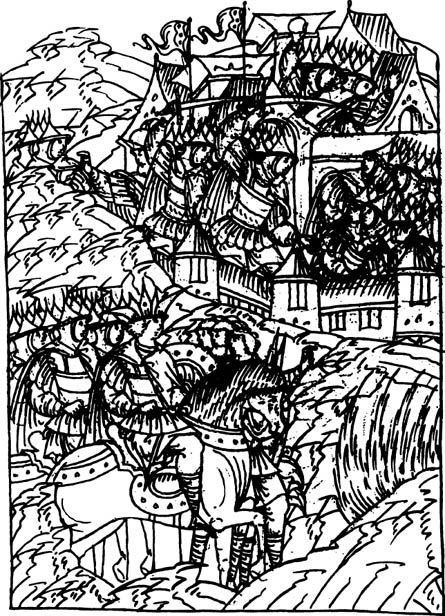
Ivan watches as his army storms Kazan. (From the Nikon Chronicle with Miniatures)
By this time the fighting was nearly over. Khan Yediger Makhmet retreated to his walled palace on the acropolis and continued to fight off the invaders. At last they broke into the palace, where they slaughtered men, women, and children indiscriminately, until the whole acropolis was running with blood. Kul Sherif, the chief mullah of Kazan, led a desperate charge against the Russians, but the mullah and all his men were slaughtered. Everywhere the dead lay in heaps. They lay in the narrow alleyways of the city, in the palaces, in the mosques, and they were piled high against the walls. The Russian chroniclers speak of the whole Plain of Arsk being carpeted with bodies, suggesting that the Tatars made massive sorties before they were cut down.
Escaping from his palace, Khan Yediger Makhmet took refuge in one of the fortified towers still remaining in Tatar hands. Here Prince Dmitry Paletsky parleyed with him, urging that he surrender because his cause was lost and it was time to put an end to the fighting. From the tower the Khan saw a city in flames and the Russians in full possession of the acropolis. He offered to surrender, but the remnant of his army, observing the fate of their countrymen, decided on flight. While the Khan, his wife, and his court went into captivity, the remaining Tatar soldiers succeeded in scrambling over the walls in the hope of making for the forests beyond the Kazanka River. Most of them were killed by the Russian cavalry.
Elsewhere in Kazan all resistance came to an end, and there was only the wailing of the women and the crackling of the fires. The fighting, which began at dawn, was over by early afternoon.
The Tsar’s faith in divine help was rewarded. He assured his soldiers that victory had come “by the grace of God and the prayers of the Most Pure Mother of God and of the saints of Moscow and of all Russia.” His own ancestors, the saintly Tsars and Grand Princes, had fought by their side. He paid tribute to his fighting men, his nobles, boyars, and voyevodas, Khan Shigaley and Vladimir of Staritsa, but above all they owed the victory “to the inexpressible mercy of God.” Embracing Vladimir of Staritsa, he cried out, “God has made me for my humility Lord of Great Russia and of the eastern kingdom of Kazan.” In this way he simultaneously invoked the humble Ivan and the other Ivan who was dazzled by his own success.
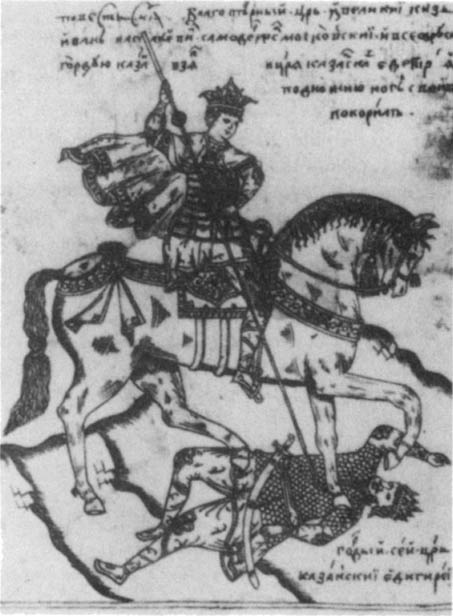
Ivan IV trampling Khan Yediger Makhmet of Kazan. (From the Kazansky letopisets)
The ceremonies of victory were performed in the manner of the medieval romances. The Tsar remained on horseback, while all his generals and even Vladimir of Staritsa bowed low before him, the sole victor, the lord of many lands, Ivan Vasilievich, Tsar and Autocrat. Khan Yediger Makhmet, his wife, and his courtiers were brought to the Tsar in chains, and prostrated themselves before him. To the interpreter the Tsar said, “Tell them that according to our merciful custom we reprieve them from the sentence of death and order them to be released from their bonds.” Then Khan Yediger Makhmet rose and walked up to the Tsar’s horse and kissed the Tsar’s stirrup.
It was a moment of exquisite triumph, never to be repeated. There would be many wars, many cities would be sacked, and many countries would be invaded, but never again would the Tsar achieve so complete a victory with the knowledge that God was walking by his side.
1 By “the great cathedral” Ivan clearly meant the Uspensky Cathedral in the Kremlin, where the Tsars were crowned, important decrees were proclaimed, and the most solemn ceremonies were held. The Metropolitans of Moscow were buried there.