
CHAPTER NINE
Politics is essentially a learning profession.
—Arthur M. Schlesinger
When 1956 began, Jack Kennedy was far from a household name. By year’s end, he’d managed to step into the ring as the most exciting Democratic challenger for the American presidency. He’d gotten there by sheer audacity.
President Eisenhower, having enjoyed a successful first term, was continuing to reap the prestige earned by his wartime victory. Despite the fact he’d suffered a heart attack the previous year, he was still expected to seek and win reelection. Offering himself to the task of opposing him was Governor Adlai Stevenson. The real question was who would be the Illinois Democrat’s running mate.
That was the brass ring on which Jack Kennedy, now thirty-nine, began to focus. He’d gotten the heads-up from Theodore H. White, then reporting for Collier’s magazine, that he was on Adlai’s shortlist. Though possibly no more than a signal to Catholic voters in Massachusetts that Stevenson understood their importance, the result was to get Kennedy thinking.
Why not make a move in ’56?
But if he were to do so, Jack saw how critical it was for him to arrive at the national convention and give the right impression. As an attractive war-hero-turned-thoughtful-politico, he could easily come across as the perfect complement to Adlai: youthful, active, eastern, Catholic, well-rounded. The prospective negatives of his candidacy—his religion and his relative conservatism—could even be regarded as ticket balancers.
Such boldness is in itself a selling point. But before he could turn his attention to this exciting notion of competing on the national stage, Jack Kennedy first had to face up to serious trouble back home. The problem was a central-Massachusetts farmer whose nickname derived from his cash crop: William “Onions” Burke, chairman of the Massachusetts Democratic Party.
Onions was a John McCormack guy, and an especially tribal Irishman. He hated the academic elite, Ivy Leaguers, and liberals. He couldn’t stand Adlai Stevenson. His idea of a Democratic leader was McCormack, a devoutly Catholic congressman from South Boston, who’d come to Washington in 1928 and risen to House majority leader. So Onions was a problem. For Jack to woo Stevenson, he needed to convince him he could deliver New England. Initially, he and Onions agreed to split the Massachusetts delegates going to the national convention. Burke then pulled a double cross, and organized a quiet write-in campaign for McCormack in the April primary that ended up beating Stevenson, whose name was on the ballot. McCormack won big: 26,128 votes to 19,024. It made Kennedy look like a political eunuch, a pretty boy who couldn’t control his people.
If Jack Kennedy couldn’t deliver his state in the primary, how could he be counted on at the convention? And if he couldn’t deliver votes, why should Stevenson even consider him as a running mate? Onions had put Jack, who now wanted badly to be on the Stevenson ticket, in an embarrassing situation.
Onions now added insult to the injury. “Anybody who’s for Stevenson,” he declared to the press, “ought to be down at Princeton listening to Alger Hiss.” The accused Soviet agent had just been released from federal prison. Invited to speak at his alma mater, he’d been celebrated as a returning hero. Translation: being for Adlai was the same as being for Alger. Joe McCarthy couldn’t have phrased it better.
Burke’s slur was unmistakable, intentional, and uttered with impunity, by a guy who figured he could get away with it. He’d put Kennedy in a position where he had no choice but to destroy the man who’d said what he had.
Kennedy knew he couldn’t let the charge go unchallenged. Until now, he’d been content using the political process simply as a mechanism for winning office. He’d avoided involvement in local politics. That had been his father’s early advice, and it still was. According to Bobby, his father had been telling his children that local Massachusetts politics was an endless morass. “You’re either going to get into the problems of Algeria or you’re going to get into the problems of Worcester.”
But, for Jack, Onions’s attack made his choice clear. Now he had to get down and dirty. He’d used the Massachusetts Democratic Party to win elections to office, but he’d never actually joined it, much less tried to lead it. He would now either prove himself a leader or be forever at the mercy of the locals. And that would be a problem, because, unlike him, they weren’t big thinkers. Nor did they regard themselves, of course, as national statesmen. Neither were they as liberal as the national party. The reputation that Massachusetts would gain for liberalism, never fully on the mark, was not the case even then. In 1956, it was Joe McCarthy country.
To get rid of Chairman Burke and the threat he presented, Kennedy needed to switch to a new brand of politics. He had to shift back from the wholesale politics of speeches and position-taking to the retail politics of the clubhouse. And he had to be tough. He needed to beat Burke in the back room, where the television cameras weren’t watching.
To this end, he ordered his staff to run a personal check on every member of the state Democratic committee. “Find out everything about them. Who do we know who knows them? What time do they get home from work at night? I’m going to ring their doorbells and talk to each one of them personally.” Armed with this intelligence, Kennedy began to travel the state, visiting a sizable percentage of the eighty committeemen.
The election for state chairman that year was held at the Bradford Hotel in downtown Boston. Larry O’Brien recalled the Kennedy hardball: “We argued that Onions shouldn’t be allowed to attend the meeting since he wasn’t a member of the committee. To back up our ruling, we had two tough Boston cops guarding the door, one of whom had reputedly killed a man in a barroom fight. Burke arrived with some tough guys of his own. Just as the meeting was about to begin, he and his men charged out of the elevator and broke past our guards. One of the leaders was ‘Knocko’ McCormack, the majority leader’s two-fisted three-hundred-pound younger brother. As shouting and shoving spread across the meeting room, I called the Boston police commissioner. He arrived minutes later.
“ ‘I’m O’Brien,’ I told him. ‘You’ve got to get those troublemakers out of here.’
“ ‘One more word out of you, O’Brien,’ the commissioner replied, ‘and I’ll lock you up.’ I hadn’t known the commissioner was a McCormack man. The whole thing was a scene out of The Last Hurrah. The two candidates for state chairman almost settled matters by a fistfight. There was shouting and confusion, and as the roll call began, one member who’d gotten drunk attempted to vote twice.”
The guy Kennedy had chosen as his candidate, Pat Lynch, wound up winning two to one. “He and his millions don’t know what honor and decency is,” Burke complained. Kennedy had risen to the occasion, done exactly what was necessary, changing his tactics to suit the situation, ambushing his complacent rival on his home turf. On the afternoon of victory, he made sure the press understood that the day marked a “new era” in Massachusetts politics.
The fact is, Jack Kennedy had no intention of staying involved in townie politics. He knew it was like quicksand: you got into the fray, picked sides, made enemies, and could never free yourself from it. He now needed to reengage himself in national politics.
As a Roman Catholic, Jack Kennedy would have been, until this moment, an unlikely candidate for national office. World War II had changed things, however, and it was obvious that now there were ways to position oneself favorably as an Irish Catholic, to take advantage of the changes. He needed to make the case that the number of Catholics Stevenson had lost in ’52 could be lured back to the fold with the right running mate. Catholics liked Ike, who’d vanquished Hitler, and were turned off by the divorced Adlai, who couldn’t escape the contemptuous label “egghead,” attached to him not just for his shiny high forehead but also because of his intellectualism.
Kennedy gave the job of proving the case for putting him on the ticket to Ted Sorensen. It was the same sort of tricky assignment he’d handed his legislative assistant two years earlier when he’d sent him up to Boston to work on the sly for Saltonstall against Furcolo. Again, Sorensen proved equal to the task, knocking out a seventeen-page memo showing the power of the Catholic vote in fourteen key states. It demonstrated how Catholics’ defection in ’52 had cost the Democrats the election. It showed, too, that they had split their tickets in the election, voting for Democrats for the House and Senate, but Ike for president.
However, Kennedy also understood that such a sales pitch coming from him would be seen exactly for what it was. It might even trigger a backlash. To camouflage the effort, he had the Sorensen memo distributed by Connecticut’s John Bailey, the state Democratic Party chairman, a close Kennedy ally. In any case, the “Bailey Memorandum,” as it was marketed, went out to fifty top Democrats thought to have Stevenson’s ear. A few days later, it showed its power. Stevenson’s campaign manager, Jim Finnegan, asked for a dozen copies of “that survey” that was going around. “You know, about the Catholic vote, “ the Philadelphian said.
Jack went to Chicago prepared for lightning to strike. He phoned Tip O’Neill and asked him to let Bobby take his place as a Massachusetts delegate. He said his brother was the smartest politician he knew and he wanted him there on the convention floor in case the odds broke in his favor.
He, nonetheless, remained cool about his prospects. On the way home from the Hill with Ted Reardon that summer, he sounded easygoing about the whole thing. “After all this, I may actually be disappointed if I don’t get the nomination. Yes, and that disappointment will be deep enough to last from the day they ballot on the vice presidency until I leave for Europe two days later.” He was thinking about his coming end-of-summer cruise along the south coast of France with Torby Macdonald, George Smathers, and his youngest brother, Ted.
It was at this moment that Jack Kennedy got one of those big breaks that made so many other ones possible. After Governor Edmund Muskie of Maine, another rising young Democratic figure, turned down the opportunity, Kennedy won a big role on the first night of the national convention in Chicago. He, a freshman senator, was asked to narrate a documentary film on the Democratic Party.
It would turn out to be the highlight of the convention’s opening. Hearing his distinctive New England accent echoing across the floor of Chicago’s International Amphitheatre and broadcast over the country’s television and radio stations, Americans discovered a new voice. The Pursuit of Happiness, created by Dore Schary, a Hollywood producer who’d made his name at RKO and MGM, was projected onto huge screens in the convention hall. It made Jack Kennedy the Democrats’ star of the night.
The applause in the hall, swelled by his friends, was prolonged when Jack was introduced from the floor. Edmund Reggie, a Catholic delegate from Louisiana, was astonished by this young promising Democrat. “I didn’t even know Senator Kennedy existed. The Louisiana delegates sat across the aisle from the Massachusetts delegation. And the first time I ever remember seeing him is in a film that he narrated.”
Nothing that Jack Kennedy had done before, not the offices he’d won, the books he’d written, even the heroics in WWII, would propel him so mightily as what had just happened. Everything before was now prelude.
The sensation created by Jack’s role in the convention film had an immediate effect. Stevenson picked him to be his chief nominator, Kennedy having gotten the word from Adlai himself on Wednesday morning. It came with the assurance that he was still in contention for the vice presidency.
Kennedy and Sorensen then went to work, laboring together on the speech until six o’clock in the morning. Criticized by the New York Times for relying too heavily on a “cliché dictionary,” the speech, nonetheless, was a genuine rouser. In it Kennedy warned that the Democratic ticket would be facing fierce opposition in the fall from “two tough candidates, one who takes the high road and one who takes the low road.”
The knock on Vice President Richard Nixon thrilled its intended audience. The liberals loved it, and continued throughout the campaign to repeat the line. In fact, it became a refrain, resonating throughout the months of the contest. Kennedy had understood exactly what he was saying and precisely whom he wanted to hear him. He was playing to the Nixon haters. It was a theme to which Stevenson, once nominated, would return. He wanted his fellow Democrats to keep in mind that Ike had been the first sitting president to have a heart attack. What would happen, he implied, if he died and Dick Nixon became president?
At eleven o’clock on Thursday, the convention’s fourth night, Adlai Stevenson made a surprise announcement: instead of picking his running mate himself, he would let the delegates do it. Seven of the country’s thirty-four presidents, he reminded them, had risen to office because of an incumbent’s death. Bluntly implying it could happen again—“The nation’s attention has become focused as never before on the . . . vice presidency”—Stevenson told the hundreds of assembled Democrats he wanted the decision made by the party rather than by a single man.
When the convention opened, Senator Estes Kefauver of Tennessee had been the front-runner. The field now included Senators Lyndon Johnson of Texas, Hubert Humphrey of Minnesota, and Albert Gore, Sr., of Tennessee, Mayor Robert Wagner of New York, and John F. Kennedy of Massachusetts.
Fourteen years older than Jack Kennedy, Kefauver had gained national attention for chairing a 1950 Senate committee investigating organized crime; in the ’52 election he’d sought the Democrats’ nomination for president but lost, in the end, to Stevenson. Trying again, this time he’d won a number of early primaries before falling to Stevenson in later big-state contests. He and the other contenders for vice president, including Kennedy, now entered upon what would be a twenty-four-hour effort to secure the honor of being Adlai’s running mate.
“Call Dad and tell him I’m going for it,” Jack instructed Bobby.
Reached in the South of France with the news, Joseph P. Kennedy was livid. Bellowing what an “idiot” his son was, he could be heard all the way across the room. Jack was ruining his career with this move. “Whew!” Bobby said, after the connection was broken. “Is he mad!”
To place his name in nomination, Jack picked Governor Abraham Ribicoff of Connecticut. This choice of a Jewish politician, the son of immigrants who’d begun his political career in the Connecticut state legislature back in the late ’30s, was a shrewd one. Equally savvy was the next phone call he made. At one in the morning, he reached George Smathers, asking him to give the seconding speech. When the Floridian asked what a Southern conservative might say that could help, Kennedy assured him it was a no-sweat assignment. “Just talk about the war stuff,” he said.
Kennedy now had to figure out how to beat the seasoned pros lined up against him. He already had a base of support in the Massachusetts delegation, and in the early days of the convention, he’d realized, during various sessions, that he’d emerged as leader of the New England region. He now had just hours to extend his support beyond it.
As his taxi headed toward the convention hall that Friday dawn, a sleepless Kennedy was clenching his fist, whispering again and again to himself: “Go! Go! Go!” Charlie Bartlett attributed it to his friend’s innate love of competition. “The way Stevenson laid that challenge on the floor was what really challenged him. At that point he decided this was going to move. And, of course, everybody was all around ready to move. I remember the whole family was milling around, ready to go. As soon as the competition arose, he lost his reluctance. He really went for it.”
For the rest of the morning, Kennedy would personally do much of the hour-to-hour campaigning. He discovered he had surprising strength in the South. Part of this was the result of antipathy toward Kefauver due to his record of civil rights support. But there was also clearly goodwill toward Kennedy himself, as a result of his war heroism and his reputation as a moderate. Many Southern delegates saw him as standing apart from the liberal pack.
Of course, he also had to face prejudice. “If we have to have a Catholic,” Speaker of the House Sam Rayburn told Stevenson, “I hope we don’t have to take that little pissant Kennedy.” But some Catholics were themselves a problem. James Farley, the old New Deal warhorse who’d helped make FDR and then broken with him when he ran for his unprecedented third term in 1940, gave Stevenson his opinion: “America is not ready for a Catholic yet.”
Kennedy also took a hit from the party’s liberal wing, who knew he wasn’t really one of them, who’d never forgotten, let alone forgiven, his failure to cast a censure vote against Joe McCarthy. To woo the keepers of the New Deal flame whom he’d spent his early congressional years bashing over Yalta and the loss of China—those same liberals with whom he said he did “not feel comfortable”—he now needed to do some genuflecting.
When he managed to set up a meeting with Eleanor Roosevelt in Chicago, the former first lady and Democratic grande dame didn’t make it easy. She’d let it be known how “troubled” she was by “Senator K’s evasive attitude on McCarthy.” Her opinion wasn’t changed by their get-together. Elaborately orchestrated, it turned out to be a disaster, with the rapport between them nonexistent. When Mrs. Roosevelt raised the McCarthy issue, Jack replied that it was “so long ago” it didn’t help. He also quibbled that the time to censure the Wisconsin senator had been when he returned to the Senate for his second term in 1953.
FDR’s widow was having none of it. In full dudgeon, she berated Jack in front of everyone present, including other politicians who came and went throughout the discussion. Mrs. Roosevelt correctly saw herself as not just Franklin Roosevelt’s partner within the Democratic Party but his political heir. She regarded Kennedy’s approach to her as less than sincere, which it was.
Balancing his failure to win over Mrs. Roosevelt, there now came good news. They began to get promises of support from delegates far and wide. Two or three in Nevada, one in Wyoming, one in Utah, and so forth, people who were for Jack Kennedy personally, but represented no large group of votes or delegates. They’d knock on the door of the hotel suite and say, “My name is Mary Jones. I’ve seen the senator on television and I think he is wonderful.” Or, “I’m from Oregon, and I want to vote for him.”
Winning the support of big-state delegations was a more serious challenge. Charlie Bartlett described the process of Jack going to the Democratic bosses of the country—all complete strangers to him—and asking for their backing. It was an intimidating group that included the major honchos of the New York machine. But he was breaking new ground.
“After Stevenson had thrown down the challenge, it was all beginning to accelerate, and he was obviously quite excited. I said, ‘Look, there’s Carmine DeSapio. You ought to go and see what you can do about him. He might be able to help you.’ I wish I had a movie of that scene. There he was—this rather slight figure, and DeSapio was a rather big fellow—and the reporters were all around DeSapio, completely ignoring Kennedy. But he went up and shyly said, ‘Excuse me, Mr. DeSapio, but my name is John Kennedy from Massachusetts, and I wondered if I could have a few words with you?’ That was the beginning. As I remember, he got a pretty good chunk of the New York vote.” It was like his old door-to-door campaigning in the Boston neighborhoods.
When the public balloting began, Kennedy mustered surprising strength, with the Southern bloc contributing to his numbers. “Texas proudly casts its fifty-six votes for the fighting sailor who wears the scars of battle,” Senate Majority Leader Lyndon Johnson hollered when his state’s delegation was recognized. The first ballot count was John F. Kennedy, 304 delegates; Estes Kefauver, 483; Albert Gore, 178. A total of 686 was needed for the required two-thirds majority.
With the second balloting, momentum further shifted to Kennedy. Once again, he was drawing more support than expected from the Southern states. “I’m going to sing ‘Dixie’ for the rest of my life,” Jack promised aloud as the states reported their counts to the podium. With 646 delegates, victory seemed assured.
Kennedy and Kefauver were now the two main contenders. The other candidates were flagging. The next ballot would be the decider.
Ted Sorensen was watching the broadcast from campaign headquarters at the Stockyards Inn, as was his boss. “The second ballot was already under way, and a Kennedy trend had set in. The South was anxious to stop Kefauver, and Kennedy was picking up most of the Gore and Southern favorite-son votes. He was also getting the Wagner votes. Kefauver was gaining more slowly, but hardly a handful of delegates had left him. Bob Kennedy and his lieutenants were all over the floor shouting to delegations to come with Kennedy. Our television set showed wild confusion on the convention floor and a climbing Kennedy total. But the senator was as calm as ever. He bathed, then again reclined on the bed. The race was now neck and neck, and Kennedy knew that no lead was enough if it could not produce a majority.”
The religious issue was about to intervene. The governor of Oklahoma stayed with the also-ran Gore, his candidacy now dead in the water, rather than back a Catholic. “He’s not our kind of folks,” he told a Kennedy pleader. With South Carolina, Illinois, and Alabama all seeking recognition to shift their delegates to Kennedy, the convention chairman, Sam Rayburn, instead recognized Oklahoma, which switched its Gore votes to Kefauver. Rayburn then called on Senator Gore, who now threw his own dwindling number of delegates to his fellow Tennessean.
Kennedy, who’d been in the lead, could see that the trend had shifted. “Let’s go!” Kennedy said to Sorensen. Once inside the Amphitheatre, he began pushing his way through the crowded floor up to the podium. While some convention officials tried to stop him, urging him to wait for the balloting to be completed, Jack walked onto the rostrum, smiling. Speaking impromptu, he congratulated Kefauver, saluted Adlai Stevenson for allowing the delegates to choose his running mate, and called for making the nomination of Kefauver unanimous.
That moment up on the stage, before the national television cameras, was Jack Kennedy’s unforgettable debut as a national leader.
In a matter of hours Jack had learned a slew of lessons. He’d discovered the need for state-of-the-art communications on the convention floor; the need for an ongoing, accurate delegate count; for a perfect grasp of the minutiae of convention rules. Friendships were important, too. Celebrated senators mattered less. Estes Kefauver had beaten Jack because he knew delegates personally; after all, it had been his second time around and what he himself had learned in ’52 he’d put into action now. Wearing his trademark coonskin cap—a reference to his pioneer ancestors—Kefauver was a familiar figure who had shaken a lot of hands in a great many small towns. Unlike him, Jack Kennedy lacked the experience of traveling the length and breadth of the country itself and connecting with voters face-to-face.
These lessons, absorbed and put to use later, were nothing in contrast with his triumph. He had taken a near-miss for the vice-presidential nomination and converted it, at the moment he raced to the podium, into a career-changing event. He had gone to Chicago one of several Democrats looking to the White House, and now was a subject of national fascination. In an inspired gesture of magnanimity, he had, in effect, won the first national primary of 1960.
In the short run, of course, all he counted was the loss itself. Just an hour ago, his vote total was rising, seeming to clinch the deal. Now he was absorbing the defeat. As Jackie and his aides gathered around him in their hotel suite, he refused to be cheered by those who said the close defeat was the best possible outcome, that he’d made a name for himself without having to endure the thrashing in November everyone expected for the Stevenson ticket.
“He hated to lose anything, and glared at us when we tried to console him by telling him he was the luckiest man in the world,” says Ken O’Donnell. The defeat brought Kennedy to a sober reckoning. He now believed that whatever lip service they paid to tolerance, the main party leaders, such as Rayburn, would simply not let him—young, independent, and Catholic—become their nominee. The 1956 experience also marked Kennedy’s metamorphosis from dilettante to professional. “I’ve learned that you don’tget far in politics until you become a total politician,” he told his crew. “That means you’ve got to deal with the party leaders as well as with the voters.”
Until that week in Chicago, the Kennedy people had been parochial in their experience and their outlook. But what had just happened to Jack—this incredible almost getting the vice-presidential nomination—was no real guide to what they’d have to do now. He, Jack Kennedy, needed to get out in the country, among the future delegates on their home ground, doing what Kefauver had done, but better.
“It was too damned close not to be disappointed,” Kennedy would say years later. “Kefauver deserved it. I always thought that, with his victories in the primaries. Because I had done much better than I thought I would, I was not desolate. I was awfully tired. We had worked awfully hard, and we had come damn close.”
Jackie Kennedy would recall how hard her husband had driven himself in his chase for votes: “Five days in Chicago, never went to bed.”
What mattered was that John F. Kennedy now owned an edge on which he’d had no claim before. Change was stirring out in that vast territory beyond Capitol Hill. Those who’d watched on television had seen a dazzling sight. In a sea of gray faces, the camera had lingered on the handsome countenance of Jack Kennedy. It had spotted, too, his radiant spouse: anyone with Jacqueline Kennedy by his side could hardly be counted among life’s losers. Moreover, by making himself so visible, even in defeat, Jack Kennedy had gained the advantage that would carry him to victory four years later—those millions of Catholics who’d seen him felt pride, then were disappointed, and now were on his side, ready for the next chance.
Yet Jack Kennedy was not, we now know, the perfect vessel for the hopes of America’s Roman Catholics. Though he and his gorgeous wife seemed in public a stunning portrait of the adoring, supportive couple, the reality behind the picture was far from perfection. As planned, once the convention ended, Jack left Chicago for a sailing trip in the Mediterranean with Torby, Smathers, and his brother Teddy tagging along. Just as he’d hung out with a buddy during his honeymoon, he was defecting again at another less than ideal moment. Left behind was his wife, eight months pregnant with their first child.
During his absence, Jackie found herself faced with dangerous complications of the pregnancy, necessitating a Caesarean. But it was too late. On August 23, less than a week after the convention ended, Jackie delivered a stillborn daughter she had wanted to name Arabella. She suffered this tragedy without the presence of her vacationing husband. He wasn’t even close by.
Jack had hurt his wife deeply. While he had always refused to accept his father’s politics, or his selfish view of the world, when it came to his marriage he was Joe Kennedy’s true son. Jackie was able to see the effect her husband had on other women, and it wasn’t easy. Yet she’d given him the nickname “Magic” for his ability to walk into a room and seduce all present. Charlie Bartlett could see the effect on her of his pal’s behavior in those early years of marriage. “She wasn’t the carefree, happy Jackie Bouvier anymore.” But Jack’s behavior now traveled beyond casual infidelity. He wasn’t there when she needed him. He’d shown off his wife at the convention for political gain, then left her to suffer her tragedy alone.
It was Bobby, usually politically astute, who made the decision not to alert his brother about what had happened. His reasoning seemed based on the belief that Jack’s returning from a pleasure trip to console his grieving wife would be the wrong sort of reunion. It was a bad call, and the newspapers got the story. George Smathers made it his business to persuade Kennedy to return home pronto, telling him that his marriage was at stake and, along with it, his ambitions for high office.
That fall Jack Kennedy traveled the country for Adlai Stevenson. He owed him, after all. What Stevenson was giving him now was actually better than the vice-presidential nod; it was the perfect trial run. It set Jack loose on the political circuit as a Stevenson man. To the Democratic Party, still dominated by its liberal faction, this was an incalculable benefit. After August 1956 Jack knew what he possessed, and what he needed to change. He was a smart and engaging outsider, a moderate in a party still run by its liberal establishment.
To win the next prize he sought, he’d have to become part of it. He would do what was necessary.
25 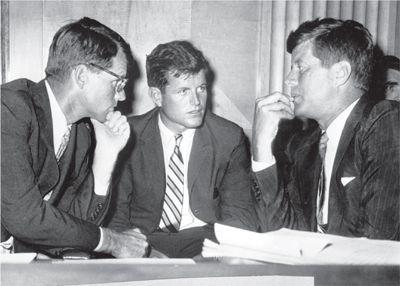
Senate Rackets Committee, 1959
26 
Ben Bradlee
27 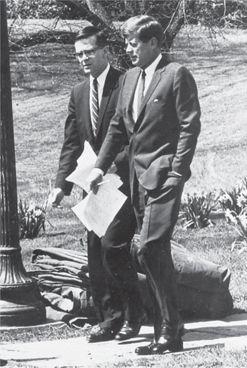
Ted Sorensen