
CHAPTER TEN
A little touch of Harry in the night.
—William Shakespeare, Henry V
What we are born with are our gifts. What we learn are our prizes. Jack Kennedy came into the world with good looks and wealth, and the social confidence that accompanies them. He possessed an instinctive trait for getting to the heart of a matter that enabled him to direct himself to the essence of a challenge. He possessed also an ability—rare and somewhat unsettling—to separate himself from the emotions of those around him. He was uncannily astute, moreover, when it came to seeing the motives of those he encountered. That he could know what moved others but not be moved himself brought hurt to those close to him, but it was for Kennedy himself a source of strength and provided for him an almost scary independence.
All these gifts would have been his had he never embarked on a career in professional politics. His prizes were what he picked up along the way. He now understood better than he might have before how the candidate who starts early gives himself the advantage. He saw how much simple personal contact mattered when you wanted something from people. He’d recognized the truth of that during his first race, back in ’46, when he was out at dawn, campaigning at the Charlestown docks, and then staying with it until late in the evening when he sat with constituents in their living rooms. To accomplish his goal, he’d practically killed himself—and it had worked.
He’d learned, too, in that first, winning effort, that the ambitious politician such as himself needs to create his own organization; he cannot expect existing political factions to whisk him forward. And he quickly realized that the key to forging loyalty within his organization was the invitation itself. The mere act of asking someone to become a Kennedy person was the step that mattered. Nothing builds fealty like getting people out there working for you. With time, discipline, experience, and trust, Jack Kennedy had forged a strong team, one that had been blooded in battle and now was ready for a fresh attack on an even greater trophy.
At the 1956 convention, Kennedy had begun to set the course for the next four years. Above all, he had made his presence known. But the strong backing for Kefauver, known as both a heavy drinker and difficult maverick, had been a clear sign that liberals didn’t see Jack as one of their own—which, of course, he wasn’t. The truth is, even Stevenson himself had reservations about the Tennessean who’d been twice his rival before he was his running mate. “Kefauver has never done anything to me,” he told his friend the historian Arthur Schlesinger. “I just instinctively don’t like that fellow.”
The pivotal revelation in Chicago for Kennedy and his budding strategists was the emerging power of the primaries. A big change had occurred in the way Americans choose presidents. Consider the difference in how Adlai Stevenson had won his party’s nomination in 1952 and how he gained it again in ’56. In January of ’52, he’d been summoned to meet with President Truman. In that meeting, Truman had offered him the presidential nomination, as if it were a Kansas City patronage job. Stevenson, to the dismay of his host, turned it down. He said he wanted to run for reelection as governor of Illinois.
In March, Truman met with him a second time and offered the nomination again. Stevenson once more held back. Only at the convention itself, staged in Chicago, did Adlai finally bow to the “Draft Stevenson” pressure and agree to be the party’s candidate against Dwight Eisenhower.
What’s particularly interesting, given what came later, is that, during all those months Truman and the party were urging Stevenson to run, Senator Kefauver was out there doing his own thing, running and winning primaries, including the New Hampshire contest in which he famously upset the incumbent, Truman. So, in 1952, what mattered was not victory in the primaries, but the blessing of the president, along with the excitement Stevenson was able to stir on the convention floor by the rousing speech he gave, which started a stampede for his nomination.
Four years later, the nomination went to the same man—but by a very different route. As he had before, Kefauver again won New Hampshire, this time swamping Stevenson. He went on to secure the primaries in Minnesota and Wisconsin. But then Stevenson turned the tide, winning in Oregon, Florida, and California, where he’d retained his popularity among the Democratic faithful. By the end, he won more primary votes, overall, than Kefauver.
So, if Jack Kennedy was to win the presidential nomination in 1960, there was only one route for him. He needed to go out in the country and build the basis for winning primaries. Here he faced a set of personal challenges. One concern was his health. His Addison’s disease required that he pace himself and, as needed, take time off to rest. In addition, he would have to contend with the perennial twin curses of his bad back and weak stomach. “I know I’ll never be more than eighty to eighty-five percent healthy,” he told Red Fay, “but as long as I know that, I’m all right.”
Beyond that were more basic challenges. How could he possibly run for president of the United States? Charlie Bartlett had challenged him. After all, he didn’t know the country. For all his intellectual curiosity, Jack had spent very little time in the real United States, if by that we mean the way regular Americans know it. Until he entered politics, Jack’s America had been Hyannis Port, Palm Beach, and the Stork Club. The product of elite prep schools and Harvard, he’d spent summers in Europe, touring with his chums and staying with his family in the South of France. During his father’s tenure in London, he was the ambassador’s son, a privileged American youth among the titled.
To win nationally, Kennedy would have to get out there and stay—from now until 1960. The goal would be to build a whole national organization, just as he’d constructed a local one in the 11th Congressional District in 1946, and then across the Commonwealth of Massachusetts in the lead-up to the Lodge race in ’52. He’d be required to “retail” himself the way he’d done in both those earlier races. Certainly, the countrywide scale of the enterprise was daunting, and he could hardly piggyback on any existing organization. This meant a whole new Kennedy Party from coast to coast.
Only by getting out there before everyone else could he build the sort of support he’d be able to use to dominate the Democratic big shots, especially the governors, who, he’d learned, control the bulk of the delegates. But before he could give them the Onions Burke treatment, he needed to secure his own clout.
At first, it was just him and Ted Sorensen. The two of them would head out together across the country to introduce Jack to the local political people, the ones who’d likely be chosen as delegates to the next national convention. “For Christmas that year, 1956,” Sorensen recalled, “I gave him a blank map of the United States, with each state shaded or colored . . . according to a code indicating what percentage of that state’s 1956 convention delegation had supported him for vice president. He pored over that little map often in the next few years, and it became a guide to our early strategy and travel priorities in his quest for the presidency.”
The hosts welcoming them out there in America’s cities and towns responded well to the attention of the glamorous Massachusetts senator. “The smaller states,” Sorensen remembered, “were flattered by this attention; the large states were pleased to have him speak at their annual fund-raising dinners.” Wherever he traveled, he was a hit, and for Sorensen, it was the hair-raising adventure of a lifetime: “To reach small towns not served by major airlines, private planes were an unavoidable part of political campaigning. Most politicians can tell stories of scary plane travels. Prior to my journeys with JFK, at least two sitting senators had been killed in small plane crashes.”
He found his boss to be great company. It almost always was just the two of them, with the budding candidate giving the speeches, shaking hands, getting to know people, while his aide took down the names and details. “It was more than a list of names and addresses. I attempted to add to the file notes on which people were most influential in each state, their attitudes toward JFK, and the issues that mattered most to them. I also made certain that they received Christmas cards, personal notes, some even phone calls, from JFK, gradually building a ‘Christmas card list’ of thirty thousand influential Democrats across the country.” With a goal of meeting every potential delegate, it meant dealing with a lot of politicians.
In those days the word politician, used today almost exclusively for candidates and officeholders, applied to those fellows behind the scenes as well. They were the ones calling the shots, picking the future mayors and governors. In the late 1950s and early ’60s, many of those less visible pols—the party chairmen, the big-city bosses, the ward captains—were Irish Catholics. Actually, almost all of them were. “When we said good-bye to almost every Irish-American mayor, party leader, or legislator we met around the country,” Sorensen recalled, “JFK would turn to me and say—depending on whether our host had been warmhearted or cold, compassionate or conservative—‘Now, that’s our type of Irish.’ “
With some of this crowd, their mission would prove a hard sell. The city bosses from New York, Philadelphia, Cleveland, and Chicago were the people Kennedy most needed to win over. Having them on board would lay the foundation for winning over big-state governors such as David Lawrence of Pennsylvania and Pat Brown of California. Such men were skittish about Kennedy, perhaps even resentful. Why back another Al Smith, the Irish-Catholic New York governor who’d lost to Herbert Hoover in the presidential race of 1928? Based on Smith’s performance, Kennedy could run and wind up bringing scores of other Democrats down with him, embarrassing Catholics like them in the process. Some begrudged the fact of Kennedy’s effort itself. If he could take it on, it undercut their own egos. Why weren’t they themselves running for president?
The key players the traveling duo of Kennedy and Sorensen hooked up with might include a congressman, an influential delegate, a governor, or sometimes just an old friend or relative. It was an education in national politics for both of them. “Those early trips were a way to test the presidential waters for 1960, to make friends and contacts while ascertaining whether a young, inexperienced Catholic senator would have any serious chance as a presidential candidate,” Sorensen said. “We discovered that there was no true national party, only a coalition of forty-eight—later fifty—state parties. JFK set out to win them over, state by state, building grassroots support, starting in smaller states, and encircling the big cities until we were ready to tackle them.”
They also operated with a low enough profile to avoid any backlash. Many of their stops were in remote corners of the west and Midwest where, as Sorensen put it, his man’s “candidacy could make solid gains without alerting the national party and press barons to mount a ‘Stop Kennedy’ movement.” By late in 1959, Kennedy had personally contacted half the delegates who would be headed to the 1960 Democratic Convention.
Larry O’Brien was separately traveling the country for Kennedy. His accounts of that period show what a pioneer effort the mere idea of such canvassing was at the time. “My main job, in those early months, was to go on the road, to travel around America to build a campaign organization, as seven years earlier I’d traveled through Massachusetts in search of Kennedy secretaries. I would pay special attention to the potential primary states, since we knew that Kennedy would have to score well in the Democratic primaries to have any chance for the nomination.”
Indiana was a typical destination, a central state where O’Brien spent days chatting up mayors, sheriffs, state legislators, and union officials. “I introduced myself as a representative of Senator Kennedy, a potential candidate for President in 1960. I soon realized I was a long way from Massachusetts, that most often Jack Kennedy was just a name, an image on a television screen. People were polite, sometimes interested, but there was no great groundswell for him. I found some support, a sheriff here, a mayor there, but more important, I found concern about Kennedy’s religion.”
O’Brien’s account of a trip through California revealed the problem Kennedy would have with fellow Catholics. “I paid a courtesy call on Governor Pat Brown in Sacramento, who was himself considered a dark-horse possibility for the presidential nomination or, more likely, the vice-presidential nomination. He was in a difficult position. Stevenson had a great deal of support in California, and I assumed the Stevenson people were hinting that Brown might be Stevenson’s running mate if he could deliver his state to their man. Brown certainly knew that, as a Catholic, he wasn’t going to be on the ticket with Kennedy. We had a pleasant talk, but we both were playing our own little games.”
After this, he met with Jesse Unruh, the astute Democratic leader of the California State Assembly. Unruh announced his support for Kennedy right away and stuck with him even when it got tough. “Jesse,” O’Brien would tell him, “Senator Kennedy has everypolitician’s name written in one of three books, and yours is written in Book One, in gold letters.”
In this way, O’Brien worked his way across the country, finding both resistance and acceptance, but also people who were waiting to commit. What he didn’t come across was the enemy doing the same thing that he and his candidate were doing: getting out there and meeting people one on one. “As I moved from state to state making friends, nailing down support, I kept waiting for the opposition to show up, but it never did. . . . It always amazed me how other politicians underestimated Kennedy. Johnson and Symington weren’t taking him any more seriously in 1959 than Henry Cabot Lodge had in 1952. His opponents never discovered how tough, gutty, and ring-wise he was—until it was too late.
“We were lucky in 1959, because if his opponents for the nomination had started earlier and worked harder, they could well have blocked Kennedy’s nomination,” O’Brien recalled. “Instead, they sat tight, the Washington columnists kept writing about what a political genius Lyndon Johnson was, and we kept locking up delegates.”
Because he had neither the party liberals nor the congressional leaders behind him, Jack was creating his own national political organization. Charlie Bartlett was amazed at his old friend’s commitment. “I don’t think anybody realizes, really, how much of a job that was. I mean, those weeks that he put in . . . and going into these towns where he really didn’t know many people and there was no great Kennedy organization. He was traveling most of the time alone or with Ted Sorensen. It wasn’t very lavish. But he traveled a long road. This was, of course, part of his strength.”
Kennedy’s feeling that his fate lay with a presidential run strengthened his resolve not to take a veep nomination. “He was urged to accept the vice presidential nomination to avoid a dangerous controversy,” Sorensen recalled, “to which he replied, ‘Oh I see, Catholics to the back of the bus.’ “ Kennedy still felt the sting of whatever anti-Catholic attitudes he’d come across over the years, even if they’d never been directed at him personally.
The four-year marathon taxed Kennedy to his limits. “As hard as it is on the speechwriter, a presidential campaign is even tougher on the candidate,” Sorensen said. “It is impossible for him to remember the names of all the people whose hands he shakes, to remember the time of day, the day of the week, and the town in which he is speaking; to remember his own previously stated positions on issues, much less those of his opponent. All day, the press is outside his door and window, the rooms are full of sweat and smoke, his hand is bruised, scratched, full of calluses. In JFK’s case, one callus burst with blood. Everyone you meet wants something from you, your time, your endorsement, your support for some local project or measure; and then you move on to three more stops in three more states before you fall into bed.”
Kennedy’s physical condition had improved somewhat since the surgeries of 1954 and early ’55, but his suffering continued. The pain in his back, attributed to loss of bone mass, was being alleviated with numbing injections. In September of ’57, an abscess was removed from his back at New York Hospital, where he remained a patient for three weeks. Not long after that, a bout of flu sent him back into a hospital bed.
For everything that ailed him he was taking a daily smorgasbord of prescription medications, hardly the usual diet for a man of forty. Yet they all proved nothing more than stopgaps when it came to putting an end to his ongoing health troubles. The cortisone he took for the Addison’s, however, had the positive side effect of filling out his face, and he didn’t mind that at all. As perilous as his health remained, he looked better than he ever had.
Ted Sorensen could do little to alleviate the strains of the road on Kennedy. “In the late 1950’s when we traveled the country together, I would ask each hotel to provide him with a hard mattress or bed board. When that failed, sometimes we moved his mattress onto the floor of his hotel room.” It was a replay of what had taken place in 1943 as young Lieutenant Kennedy was seen placing a piece of plywood under his mattress when he was training for PT-boat duty. “In retrospect, it is amazing that, in all those years, he never complained about his ailments,” Sorensen recalled. “Occasionally, he winced when his back was stiff or pained as he eased himself into or out of the bathtub.
“On the political circuit I assumed that his practice of eating in the hotel room before a Democratic party luncheon was intended to avoid the bad food and constant interruptions that characterized his time at the head table. But now I realize after reading an analysis of his medical file, that his many stomach, intestinal, and digestive problems required a more selective diet.” Jack, it turns out, was a man typical of his World War II generation. He didn’t complain.
As Sorensen noted, he’d committed himself to a year-upon-year commitment “best suited to fanatics, egomaniacs, and superbly fit athletes.” Jack Kennedy, well-rounded, pleasure-loving, was none of these.
As a candidate, Kennedy quickly had begun to give off the glow of celebrity. No politician had ever gotten the kind of star treatment he was accorded. It had begun at the Democratic Convention in Chicago: his debut in the public eye there threw the spotlight on him and his wife as well. In April 1957, he’d been awarded the Pulitzer Prize for Biography for Profiles in Courage, the book he’d dedicated to Jackie. Their first child, Caroline Bouvier Kennedy, was born in November 1957.
Whenever Senator Kennedy showed up at a local Democratic dinner in some small city where there were more hands to shake, it was if a Hollywood star had come to town. It was still the age of the glossy magazines, many of them pictorials. Look, Life, the Saturday Evening Post, all weeklies back then, did spreads on Jack and Jackie, as did McCall’s and Redbook.
“Senator Kennedy, do you have an in with Life?” a high school newspaper writer once asked the roving candidate. “No,” he shot back, “I just have a beautiful wife.” There was a professional’s assessment if ever there was one. But the fuss didn’t stop with the romantic-couple angle. The TV series Navy Log did an episode on PT 109. The Knights of Columbus magazine Columbia offered a salute to a brother knight. And at the end of 1957, in the issue of December 2, he was Time magazine’s cover boy, painted looking thoughtful by Henry Koerner, whose unmistakable celebrity portraits were often featured there.
This ongoing stream of media attention continued into the 1960 primaries. “You could go to the A&P store,” his rival Hubert Humphrey would later say, revealing his exasperation, “you could go to any grocery store. You’d pick up a women’s magazine—there would be a wonderful article. He had the publicity. He had the attraction. He had the it.”
The Jack and Jacqueline Kennedy Show had a powerful effect even on people who normally paid little attention to politics but now could not take their eyes away. Eventually, the “it” to which Humphrey referred would achieve a name: charisma, not a word much in popular use until the Kennedys made it so.
While the stillbirth in 1956 and Jack’s absence from the country at the time caused Jackie much pain, she and her husband had made their peace with it. Celebrating their new small family, they moved into a town house in Georgetown. Again, all the public saw were the pictures. Photos of infant Caroline with her splendid-looking parents captivated the American public.
Nonetheless, the audience with which Jack most needed to make inroads wasn’t falling for it. Not yet, anyway. The liberals, given life by Franklin Roosevelt and still in love with Adlai Stevenson, were looking for gravitas. Here, again, Jack Kennedy went to work, with the help of his most trusted and productive lieutenant. For several years now, Ted Sorensen had been turning out all kinds of articles under Kennedy’s name. They appeared in such journals as the General Electric Defense Quarterly, the Bulletin of the Atomic Scientists, and the National Parent-Teacher. Their purpose, Sorensen conceded, was “to promote Senator John F. Kennedy as a man of intensive progressive thought, balancing the flood of superficial articles about his looks and his romance with Jackie.”
There remained the challenge of winning over the Stevenson people. “I’m not a liberal at all,” the Saturday Evening Post had quoted him just after his election to the senate. “I never joined Americans for Democratic Action or the American Veterans Committee. I’m not comfortable with those people.”
Still, his pursuit of the intellectuals who persisted in carrying a torch for Adlai was soon to begin in full earnest. The winning of the Pulitzer for Profiles, in fact, had been no happy accident. Rather, it was the result of energetic lobbying by Jack’s dad. Through the good offices of Arthur Krock, a New York Times columnist and Kennedy friend, Joe was able to approach the members of the Pulitzer screening board, one by one. Even Rose Kennedy, for a change, was clued in. “Careful spadework,” she said, was the key. Joe learned “who was on the committee and how to reach such and such a person through such and such a friend.”
In this way, Kennedy senior and the influential Krock were able to get the job done. Rose, not always happy with her husband’s backroom activities, loved this bit of work. “Things don’t happen,” she said with untroubled pride, “they are made to happen.” That May, no doubt in recognition of the Pulitzer honor, Jack was named to chair the panel to select the five greatest senators in history, their portraits to be hung in the Capitol’s Senate Reception Room. The quintet chosen were Henry Clay of Kentucky, John C. Calhoun of South Carolina, Daniel Webster of Massachusetts, Robert Taft of Ohio, and Robert La Follette, Sr., of Wisconsin.
The fact that Kennedy now was being taken seriously as a historian exerted its appeal over the Stevenson crowd, as it was meant to. Meanwhile, Kennedy won another distinction, one that would carry him nearer to the goal of influencing international affairs that had motivated him since first entering politics. He found himself appointed to the Senate Committee on Foreign Relations. Now came his first curtsy to the Democratic Left, which needed to be a clear sign that he’d departed from his rigid orthodoxies of the early postwar years, a semaphore signaling that he shared the liberals’ more sophisticated attitudes.
On the Senate floor in July 1957, Kennedy called boldly for revision of the Eisenhower administration’s Eurocentric foreign policy. America, he said, should end its automatic alliance with its colonialist World War II allies and recognize instead the rising aspirations of the developing world. “The most powerful single force in the world today is neither Communism nor capitalism, neither the H-bomb nor the guided missile,” he began. “It is man’s eternal desire to be free and independent.” His criticism was aimed at French colonial rule in Algeria. Kennedy explained that France’s 1954 defeat at Dien Bien Phu had not resulted from a shortage of military power. France would have lost the war in Indochina, he argued, even if it “could afford to increase substantially the manpower already poured into the area.”
The speech, certainly prophetic for U.S. policy, stirred up the pot, just as he intended. “His words annoyed the French, embarrassed the American administration, and almost certainly would not satisfy Algerian nationalist leaders,” the London Observer tartly noted at the time. “But they did one thing: they introduced Kennedy the statesman.” This is precisely what he intended. Lou Harris, Kennedy’s new pollster, was to confess that the “Algeria speech” had, in fact, been customized to appeal to the wing of the party whose backing his client needed. It was meant to show the liberals just how far Joe Kennedy’s boy had come. The irony, Harris noted, like everyone else who knew Jack, was that his boss probably read more and was a good deal more informed than those on the Democratic Left into whose political bed he was trying to climb.
Kennedy had been careful to embed his argument in sound Cold War thinking; that is, that the fight in North Africa was weakening the far more important contest with the Soviet Union. “The war in Algeria, engaging more than 400,000 French soldiers, has stripped the continental forces of NATO to the bone,” he declared. “It has undermined our relations with Tunisia and Morocco.” And, more directly against U.S. interests: “It has endangered the continuation of some of our most strategic airbases, and threatened our geographical advantages over the Communist orbit.” Kennedy was still anti-Communist, but now he was connecting this great cause with America’s revolutionary roots. “The great enemy of that tremendous force of freedom is called, for want of a more precise term, imperialism—and today that means Soviet imperialism and, whether we like it or not, and though they are not to be equated, Western imperialism.”
Kennedy was remembering the compelling force of nationalism he’d seen firsthand on that trip to Indochina in 1951. He was being true to what he’d discovered himself.
The Algeria speech offered political benefit with little if any cost. It appealed to the Northern liberals, but not at the expense of the Democratic South. Algerian independence had no chance of angering those Southerners who had rallied to him in Chicago the previous summer.
Kennedy was still trying to have it both ways: he wanted to be the liberals’ candidate while not giving up those he’d won over in ’56. Even as he seduced the Democratic Left with urbane commentary on colonialism, he wanted to protect the popularity with Southerners that he’d demonstrated during his vice-presidential tug-of-war with Estes Kefauver. Whatever maneuvers he was slyly executing in order to win over the liberals, he wanted, at the same time, to keep himself positioned as the best hope of moderate and conservative Democrats. And this group included those Southerners still holding fast to segregation.
Such folks liked the fact he was a “moderate,” and he wanted to keep it that way. In the same year he gave the Algeria speech, Kennedy voted for the amendment to the 1957 Civil Rights Act that allowed jury trials for local officials charged in civil rights cases. While passage of this amendment was viewed as critical to avoiding a filibuster, it was also seen as a way for all-white Southern juries to continue, routinely, to acquit defendants in such cases. Kennedy’s position on the jury-trial question earned him a rebuke from the NAACP, but maintained the warm regard of his colleagues below the Mason-Dixon line.
The man himself was more complicated. Kennedy had an instinctive contempt toward discrimination. Speaking at the Somerset Club, a private men’s club in Boston, he suffered an introduction by a member who jokingly insinuated that the Democrats were the party of “the help.” After hearing this, Jack remarked to his friend Alistair Forbes: “Well, I wondered why more people weren’t blushing with shame. But can you believe that such people can still be around?”
Forbes recalled, “He was a man wholly devoid of rancor, and his personality was completely well integrated so that he had no worries of any kind at all. He could see everything with a sort of detached view.
“And yet he was aware of the interplay of snobbish forces in his life. In England he could see which English people basically didn’t like Americans, and he knew people who didn’t like Irish people. He was always amused and interested by this sort of sin, but absolutely unaffected by it because he was his own man and happy with his money in the bank—and damn good-looking.”
George Smathers agreed. He said his friend was “always greatly interested in civil rights.” Then he amended that: “Put it this way—not civil rights legislation so much, but civil rights because he was against discrimination. I think he felt that, as an Irishman, somewhere along the line he had been discriminated against. I don’t know, but I did get the feeling that he felt that other Irishmen had felt the sting of prejudice.”
At the same time, Kennedy operated at a distinct remove from certain realities, even as he crisscrossed the country broadening his reach. Forbes, for one, was struck by his lack of awareness about black America. “I remember very late, sometime in the fifties, he’d only just heard the phrase ‘Uncle Tom’ and was like a man who’d just made this extraordinary discovery. ‘Do you know that Clayton Powell’s got this marvelous expression?’ he asked me.” Powell, it seems, had been talking to Jack about a black colleague in Chicago, saying, “The trouble with him is he’s an Uncle Tom.” Learning this new expression from Harlem’s congressman delighted him.
Politically, he knew that if he wanted to make his way into liberal hearts and minds, he had to forge ties with those who cared about such issues as civil rights. He wanted very much to have the support of men such as Arthur Schlesinger, one of the co-founders of Americans for Democratic Action and a longtime Stevenson stalwart. Here’s an entry in Schlesinger’s journal from 1959. It displays just what kind of effort Jack Kennedy was mounting to win over a man whose support was critical.
July 19—Jack Kennedy called up around noon and asked us to come to dinner at Hyannis Port this evening. Marian could not go, so I went alone. The Kennedy place was less grand than I had imagined. I expected miles of ocean frontage with no alien houses in view; but it is a cluster of Kennedy houses, all large and comfortable but not palatial, in the midst of a settled community. Jackie Kennedy was the only other person present, and we all drank and talked about from 8 to 12:30. I only brought two cigars, one of which Jack took, having typically no cigars in the house. Jackie wanted for a moment to go and see A Nun’s Story, which was being screened in a projection room in one of the other houses; but, though somewhat encouraged by Jack to go, finally stayed the evening out with us. She was lovely but seemed excessively flighty on politics, asking with wide-eyed naivete questions like: “Jack, why don’t you just tell them that you won’t go into any of those old primaries?” Jack was in a benign frame of mind and did not blink; but clearly such remarks could, in another context, be irritating. This is all the more so since Jackie, on other subjects, is intelligent and articulate. She was reading Proust when I arrived; she talked very well about Nicolas Nabokov, Joe Alsop, and other personalities, and one feels that out of some perversity she pretends an ignorance about politics larger even than life.
As for Jack, he gave his usual sense of seeming candor. I write “seeming” without meaning to imply doubts; so far as I could tell, he was exceedingly open; and this was, indeed, the freest, as well as the longest, talk I have ever had with him. As usual, he was impersonal in his remarks, quite prepared to see the views and interests of others. He showed more animation and humor than usual and, indeed, was rather funny in some of his assessments of people and situations. He seems fairly optimistic about his presidential chances. He thinks that Humphrey can’t win, that Johnson will take care of Symington, and that he will go into Los Angeles with a large delegate lead. He seems to regard Stevenson as the next most likely person to get the nomination.
Then an uncomfortable subject was broached. “We had considerable talk about McCarthy. Kennedy said he felt that it would be a good idea to admit frankly that he had been wrong in not taking a more forthright position. I said that he was paying the price of having written a book called Profiles in Courage. He replied ruefully, ‘Yes, but I didn’t have a chapter in it about myself.’ “
The conversation that night in July of 1959 is telling in so many ways. The invitation itself was a fine gesture, with the arranging of an intimate evening around one person, a figure Jack saw as powerfully influential. Well aware of the liberal rancor over his failure to oppose McCarthy, he now was working at being convincingly conciliatory. Schlesinger observed his efforts: “I think he genuinely thinks he was wrong about it; but says he was constrained for a long time because Bobby had joined the committee staff—over Jack’s opposition, he says. He also said that his father and Joe were great friends, and that his father would defend Joe as a person to this day.”
During the course of the evening, Jack showed contempt for President Eisenhower, saying he refused to hang around with his old comrades in arms from the war. “All his golfing pals are rich men he has met since 1945.” He also went after Ike’s willingness to drop Nixon from the ticket in ’56. “He won’t stand by anybody. He is terribly cold and terribly vain. In fact, he’s a shit.”
But he was less candid on other matters. When Schlesinger pushed him on his Addison’s disease, he said the problem with his adrenal glands was caused by his wartime malaria, it had cleared up, and he was okay. “No one who has Addison’s disease ought to run for President; but I do not have it and have never had it.” He then claimed he was no longer taking cortisone, that, in fact, he took nothing. It was a pattern of denial that he would continue as he now campaigned for the backing of a group—the liberals—whose approval he’d never sought in the past.
Over the period from ’57 to ’59, Kennedy also had to build bridges with another key power in the Democratic Party: labor. Kennedy had started his Capitol Hill career on the Education and Labor Committee and made a name for himself by being tough on suspected Communist sympathizers among the union leaders. Now Bobby and he were targeting the corrupt ones.
The Senate Select Committee on Improper Activities in Labor and Management, to be famously known as the “Senate Rackets Committee,” was formed in January 1957. Senator John McClellan initiated the temporary panel to investigate the rivalry between Dave Beck and Jimmy Hoffa for the presidency of the International Brotherhood of Teamsters. Both men were accused of bribery and, in Hoffa’s case, fraud. McClellan brought Bobby Kennedy with him from the Government Operations Committee. He named him chief counsel and investigator. Bobby, in turn, named Ken O’Donnell, his administrative assistant, as his top aide.
Jack worried what this would do to him politically. Bobby’s new job now associated his brother with the Republicans and pro-management Democrats who dominated the committee. Any attacks on organized labor by Bobby Kennedy, a bulldog in pursuit of his goals, would be seen by labor and its political friends as an attack by Jack.
Bobby understood this. “If the investigation flops . . . it will hurt Jack in 1958 and in 1960, too. . . . A lot of people think he’s the Kennedy running the investigation, not me. As far as the public is concerned, one Kennedy is the same as another Kennedy.”
That mention of 1958 alluded to Jack’s reelection campaign. Seeing his weak opposition, Senator Kennedy begged Republican pals back home in the Commonwealth to put up a stronger candidate so he could at least prove something. What he ended up demonstrating was his overwhelming support among Massachusetts voters as he defeated the martyred Vincent J. Celeste, representing the Republicans, 1,362,926 to 488,318. The result of this rout was that Joe Kennedy at last saw great worth in Ken O’Donnell and Larry O’Brien. Not only had they delivered the goods; they’d done so without taking up much of Jack’s precious time. The efficiency of their performance had the effect of ensuring less interference from Joe, who now trusted the pair of them, in the big contest to come.
The Rackets Committee managed to strip Dave Beck of his title as president of the Teamsters Union and also to expose, by use of wiretaps, a plot set up by Hoffa and organized crime figures to establish phony locals to vote him in as president. This was new ground Bobby Kennedy was plowing. Over at the Federal Bureau of Investigation, Director J. Edgar Hoover still refused even to recognize the existence of the Mafia.
That November a meeting of organized crime figures in Apalachin, New York, was discovered by local police. But when Bobby Kennedy asked the FBI for records on the bosses, he discovered it had none. So he opened up his own hearings. The star witness was Salvatore “Sam” Giancana, heir to Al Capone. Kennedy interrogated him about his operations, which included hanging his victims on meat hooks and stuffing them into trunks of cars.
|
Robert Kennedy: |
Would you tell us anything about any of your operations, or will you just giggle every time I ask you a question? |
|
Sam Giancana: |
I decline to answer because I honestly believe my answer may tend to incriminate me. |
|
Kennedy: |
I thought only little girls giggled, Mr. Giancana. |
Bobby Kennedy was both fearless and relentless. On the wall of his office, buried in the basement of the Senate Office Building, was a quotation from Winston Churchill: “We shall not flag or fail. We shall never surrender.” It didn’t win him any friends in the labor world, or in those political fiefdoms where union leaders freely operated. A number of big-city mayors felt the heat and didn’t like it, didn’t like the paths Bobby Kennedy was heading down.
Meanwhile, Jack Kennedy’s performance on the Rackets Committee impressed one of Bobby’s assistants. Pierre Salinger, a reporter for the Saturday Evening Post who Bobby hired as an investigator, saw Senator Kennedy zero in on whatever relevant issue was at hand: “John F. Kennedy had clearly done his homework. . . . In what is essentially a nebulous area, he was very incisive in his questioning. He was able, with a question or two, to do what it seemed to me to take hours to get to from other people on the committee.” He was careful not to lump the clean labor executives in with the bad. “Senator Kennedy made a special effort not to join the Republicans and conservative Democrats on the committee when it came to dealing with honest union leaders like Walter Reuther of the United Auto Workers.”
Yet even the UAW was held to account. In Ken O’Donnell’s words, Jack “was not only good in terms of defending the union, but several times, armed by Bobby, he went right after the union and was probably tougher on them than some of the Republicans. He criticized them for the use of violence against their own men and against the company. He was tough, but tough in an appropriate way. The intellectual ability of Senator Kennedy and Bob Kennedy was established with the UAW. Reuther and the UAW saw the Kennedy brothers as not only honest, keeping their word, but also that they were both smart as hell. It wasn’t an image that the union had held of either brother up until that point.”
The Democratic governor of Maine, Edmund Muskie, who would enter the Senate himself in 1959, said the hearings made Kennedy a heavyweight there. It was the facing down of the criminals that impressed them. “I think that his performance in the Senate added tremendously to his stature, and to the respect which all his Senate colleagues, even those with a different political philosophy, had for him. I know that it was performances like this that enlisted the support of people like Dick Russell and other giants of the Senate. They did respect him. It wasn’t just because they liked him, because they were attracted by his charm, because he had a way with words. They respected his guts . . . respected him as a man.”
But Kennedy cited the struggle for labor reform as further proof that “the Presidency is the source of action . . . There is much less than meets the eye in the Senate.” Yet his service on the Rackets Committee gave Jack another memorable victory. He’d made himself a reputation, as had his brother. Both were seen now as tough, independent reformers, racket busters. The image remains suspended in the mind, in black and white, of the two of them staring insolently at the crude thug there in the witness seat. We see Bob, the hot-blooded Irish cop, asking questions close into the microphone; Jack, the cool brother, tapping his fingernails on his teeth, that old habit that betrayed his cunning.
Jack Kennedy made few new personal friends from the time he entered politics. But that was about to change. On a warm winter Sunday early in 1959, Ben Bradlee, a correspondent for Newsweek, and his second wife, Tony, were wheeling a baby carriage along N Street in Georgetown. In it was their baby boy, Dino. Another couple, Jack and Jackie Kennedy, were also enjoying the winter sunshine, with two-year-old Caroline. The couples, similar in background, quickly became friends.
Bradlee had been a young naval officer in World War II, and his experience had included being at the helm of his destroyer as it navigated Japanese waters. The bond with Kennedy was secured further by their prep school and Harvard backgrounds. Bradlee would say that he was, in fact, higher up in the social “stud book” than Jack Kennedy, having descended from an old New England family around a lot longer than the immigrant Kennedys. Ben was the sort of guy—smart, handsome, ironic, and seemingly fearless—that Jack liked on sight. A working journalist, Bradlee now counted as a close friend a man bent on achieving the presidency. “Nothing in my education or experience had led me to conceive of the possibility that someone I really knew would hold that exalted job.”
Bradlee soon saw clearly the obstacles ahead for his new pal, what he called “the mines” he’d have to navigate: “His age—at forty-three, he’d be the youngest man ever elected president, and the first one born in the twentieth century. His religion—too much of America believed that a Catholic president would have to take orders from the pope in Rome. His health—he’d been given the last rites several times. His father—Joseph P. Kennedy’s reputation was secure as a womanizing robber baron, who’d been anti-war and seen as pro-German while he was ambassador to Britain during World War II, and pro-McCarthy during the fifties.”
When Bradlee asked Jack if it didn’t seem “strange” to him to be running for president, Kennedy offered even his friend a stock reply: “Yes, until I stop and look around at the other people who are running for the job. And then I think I’m just as qualified as they are.” When he asked if he thought he could pull it off, Kennedy’s answer was even more studied: “Yes. If I don’t make a single mistake, and if I don’t get maneuvered into a position where there’s no way out.”
It was, in fact, a troubled time, as the 1950s were coming to a close. The country that had proudly, gloriously led the forces that vanquished the Axis dictators now had a growing set of worries when it looked beyond its borders in almost any direction. From the earliest moments of his run for the presidency, the country that Jack Kennedy was hoping to convince he could lead was beset by an unsettling feeling. Americans sensed they were losing pace in the Cold War, and weren’t sure how this had happened. The Soviets were moving worldwide; we were fading as a global power, not dramatically, but undeniably.
In October 1957, the country even became wary, suddenly, about the grandfatherly leadership of Dwight Eisenhower. The launching of the Soviet space satellite Sputnik sent an ugly shiver down the spines of complacent citizens long convinced of their country’s enduring edge against the “Soviet menace.” We’d been told by Wernher von Braun and Walt Disney—in 1955 more than 40 million of us had watched on TV the gung-ho film Man in Space, which they’d made together—that the United States would be the first to launch a satellite into orbit. Now the Russians had done it. Our leaders had committed the worst sin a politician can—as Churchill once noted: to promise success and then fail.
The second tangible sign of losing pace came on New Year’s Eve 1958. That evening the Cuban president, Fulgencia Batista, a dictator who’d been up until that moment agreeably rotten, sneaked out of Havana at midnight and headed into exile. His departure allowed the bearded leader Fidel Castro, a young lawyer-turned-guerrilla clad in fatigues, to come down out of the Sierra Maestra and assume power. When Castro, who’d sold himself as a democratic reformer, announced his allegiance to Marxist-Leninism, the Soviet Union had an ally ninety miles from our coast.
There was also intangible evidence of America’s failure to keep pace against the encroaching Soviet menace. As we fought the battle of the global game board, there came a creeping sense ours was not the winning side.
Kennedy had run on the spirit of the returning vet in ’46, then, in 1952, had catapulted himself past the Yankee order in Massachusetts, thanks both to the creative way he again worked his own tribe and also to its own rising self-estimation.
Now, with Ike aging and the decade slowing, the candidate saw how his fellow Americans were reacting against the dullness, feeling a restless urge to do something. Even in their prosperity, they knew the times weren’t living up to their aspirations, felt the pang of their unchallenged spirits. Jack Kennedy, having been out there in a way no one else was, sensed the mood of the country in a way uniquely his own, and now staked his claim on the task of getting us moving again.
28 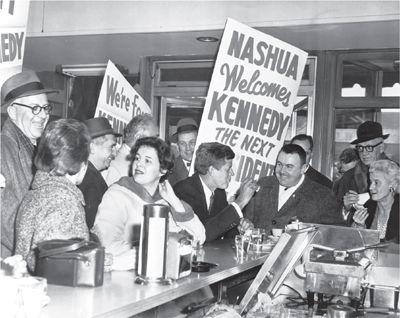
New Hampshire Primary
29 
West Virginia Debate