
CHAPTER TWELVE
How does Jack get them girls to squeal that way?
—Senator Herman Talmadge of Georgia
Jack Kennedy’s singular personal appeal was recognized by Ken O’Donnell for the first time at the Worcester tea in 1952. He noticed how women simply stared at the candidate. The effect Kennedy had on people, most noticeably women, is visible today in films from the Wisconsin primary. You see high-school-age girls racing down the sidewalk merely to capture a glimpse of him. As the campaign entered the general election phase in 1960, and the crowds around Kennedy grew deeper, these young women—“jumpers” they were called—would leap into the air to see over the heads of those in front of them.
It takes more than sex appeal, however, to win the American presidency. To gain the Democratic nomination, those victories in Wisconsin and West Virginia were necessary, but not sufficient. Jack still needed to conquer the resistance of pivotal governors, many of whom were Catholic like himself. It was not about whom they liked, or with whom they felt comfortable; the decisive question was whether they could be pushed to do what they didn’t want to do: commit, put their own political careers on the line for a guy who might well be stopped short of the nomination, halted for the sin of having the same religion as their own. These men had their own ambitions, too. They wanted the leverage, the clout that comes to a governor who arrives at a national convention with a bevy of delegates under his control.
But Jack Kennedy wanted those delegates under his control. He wanted the nomination locked up before he reached Los Angeles for the basic, understandable reason that he’d seen what could happen in the middle of a Democratic Convention roll call. People who don’t want you to win can stop you in your tracks, just at the very moment when you and your people think you’ve got it in the bag. Just four years before, he’d seen it unfold like that in Chicago.
So, to prevent it from happening again, he was taking certain steps, of a sort familiar to the Onions Burkes of this world.
It had started with Ohio. Bobby’s strong-arm treatment of Mike DiSalle had ensured that the Ohio governor was headed to L.A. on the Kennedy bandwagon. Next had been Maryland, whose primary came the Friday after West Virginia’s. Bobby, now an expert at strong-arm tactics, had taken care of the dirty work there, from the moment the campaign learned that Governor J. Millard Tawes planned on running unopposed on the primary ballot as a “favorite son.” He wanted to arrive in California with the state’s delegates under his personal control. The Kennedy brothers, however, thought otherwise. Just as he had in Ohio with DiSalle, Bobby went to meet with Governor Tawes personally. Here’s Ken O’Donnell’s account:
“We talked to the governor and suggested that the governor might want to talk to Bobby Kennedy alone, that he’d acquaint him with what our desires and our intentions were, and that he’d relay back to the senator what Governor Tawes’s intentions and desires were. We ushered the governor into a bedroom and Bobby went in and the governor was not happy, looking over his shoulder for some assistance. But there was none forthcoming. We closed the door.”
Once the door opened again, Tawes had agreed to what the Kennedy forces wanted: an open run for the primary in Maryland.
The Kennedy treatment of Governor Pat Brown of California was cordial, if only in comparison. Brown, after much prodding from Jack himself, O’Donnell, and O’Brien, worked out a deal. It was simple enough: he’d run on the ballot unopposed in his home state and then hand over his delegates at the convention if Kennedy continued to sweep the primaries and lead in the Gallup poll. Even with this agreement between Brown and Jack, Bobby continued to put pressure on the California governor. Although Senator Kennedy had agreed not to run in the California primary as long as Pat Brown was the only candidate on the ballot, Bobby filed a last-minute delegation. It was an insurance policy against the possibility of Hubert Humphrey attempting a comeback in delegate-rich California, where loyalties to the old liberal crowd ran high. Bobby agreed to withdraw the Kennedy slate of delegates only after Humphrey gave his personal guarantee he wouldn’t try to sneak in at the wire.
Fred Dutton, who was Pat Brown’s top political guy, thought this final move showed moxie on the Kennedy side. “It was a pretty good example of the sort of hard-boiled game that the Kennedy group was playing. They were just protecting themselves, they said.”
Even after the California primary, the Kennedy campaign wouldn’t let up. According to Dutton, “The Kennedys, as soon as the primary was over with, ran a very aggressive war of nerves to try to get Brown to come out for them and to pull over as many California delegates as they could. Bobby was in the state a half-dozen times; Larry O’Brien came out and met with me. They had every right to be worried, since a strong pro-Stevenson contingent made it increasingly difficult for Pat Brown to support Kennedy if he was going to protect his own skin in local politics. Liberals loyal to Adlai were beginning to make an eleventh-hour run for their twice-nominated hero. He’d taken on the challenge of Ike, went the argument. Didn’t he deserve the chance to beat the now far more beatable Nixon?”
Bobby again refused to allow any possibility of this romance with the past taking hold. He was keeping his fingers around Brown’s throat. “He was calling up and was impatient, a little petulant, and not at all understanding of why Brown couldn’t make up his mind.” Dutton figured he either didn’t understand Brown’s political problems or, if he did, he wasn’t going to show he did. Bobby Kennedy was not the sort to see it from the other guy’s point of view. Besides, his job was not to be convinced. “I’m not running a popularity contest,” he told Time’s Hugh Sidey. “It doesn’t matter if they like me or not. If people are not getting off their behinds and working enough, how do you say that nicely? Every time you make a decision in this business, you make somebody mad.”
Next in line was Pennsylvania. Jack Kennedy knew that Governor David Lawrence feared a backlash if he supported him. Having been the first of his religion to rise to this position there, he was uneasy about endorsing a fellow Catholic. To win Lawrence over, Jack needed an inside man. He found him in U.S. congressman William Green, who chaired the Democratic Party in Philadelphia. Green was a consummate big-city political boss. Two years earlier he had used his clout to get Lawrence the nomination for governor. After West Virginia, he was convinced his fellow Irish-Catholic had proven himself the strongest candidate. He believed no other Democrat would stand a chance of beating Richard Nixon. With the bulk of Pennsylvania’s delegates in his control, he began putting pressure on Lawrence to drop his loyalty to Stevenson and lead the delegation to Kennedy.
Despite Green’s backing, the governor remained stubborn. Lawrence remained neutral even after Kennedy’s impressive victory in the Pennsylvania primary as a write-in on the ballot. Time was starting to run short, and the deal needed to be closed. Thus, at the invitation of Governor Lawrence, Kennedy spoke at a luncheon in Pittsburgh that included the county leaders in the western part of the state. Lawrence himself introduced Kennedy, but wasn’t very warm. Implying in his remarks that Kennedy’s write-in triumph still wasn’t the last word, the governor seemed to have asked Jack to Pittsburgh to audition for a job he’d already won.
Understanding that he’d been set up, Kennedy strode to the stage. “I could tell, as Governor Lawrence was speaking, that the senator was very angry,” O’Donnell recalled. “He got up and laid it out cold and hard to them, that these political leaders better think what was going to happen to the Democratic Party if the candidate who’d won all the primaries and amassed all the delegates could be denied the nomination simply for being an Irish Catholic. He told them they’d better think long and hard about what might be left of the Democratic Party should they follow this course.
“Then he ended with a tough—and I mean tough—attack on Lawrence, kicking him good and hard where it hurts the most. All the color drained from Governor Lawrence’s face. He was stunned. There was a muttering in the room and a nodding of heads in agreement, along with chilly looks directed at Lawrence . . . who got up suddenly, almost knocked his chair over, and rushed out the door, claiming he had a meeting to go to. He didn’t even say good-bye to the senator, just fled the room. The rest of the people at the meeting got up and cheered and swarmed the senator.”
New York was a different story. There Kennedy had all the Irish bosses working for him. As Daniel Patrick Moynihan, former aide to Governor Harriman, described the situation: “It was still the last moment in history where Irish political leaders had that much power.” Rip Horton, Kennedy’s Choate classmate and Princeton roommate, was a New York volunteer who saw Kennedy’s religion pay dividends in the cities. “This organization, this Kennedy-for-President movement, encompassed everywhere: Albany, Syracuse, Rochester, and Buffalo. So the politicians were responding to the electorate,” seeing he might be a help to local candidates in their elections. His momentum was starting to be infectious.
Preparing for a possible power play at the convention, the Kennedy campaign began shuttling through the Midwest attempting to tie down delegates. Adlai Stevenson, presidential nominee of 1952 and 1956, was not ready to accept a changing of the guard in the Democratic Party. Moving into May, Kennedy still had received no support other than neutrality from Stevenson. “God, why won’t he be satisfied with secretary of state?” he demanded of a Stevenson loyalist.
On the eve of the convention, Jack asked Adlai, one last time, to back him. Again, the answer was no. When Kennedy made it clear he had the votes for the nomination, Stevenson still refused. Now came the threat: “If you don’t give me your support, I’ll have to shit all over you. I don’t want to do that, but I can and I will if I have to.” Nothing worked. The old campaigner wasn’t ready to give up his one last chance for glory. Eleanor Roosevelt would arrive in Los Angeles still bearing the torch for Adlai, but it was a flame that burned, just as brightly, against this younger favorite. The year before, Jack had sent a young ally, Lester Hyman, to secretly test her attitude toward him. Asked her opinion of a potential Kennedy presidency, and not knowing Hyman’s loyalties, Mrs. Roosevelt let loose with a broadside. “We wouldn’t want the Pope in the White House, would we?” Hyman, who is Jewish, told me he almost fell off his chair.
To Kennedy, the more formidable presence at the convention would be Lyndon Johnson. Kennedy kept his opinion of the Senate majority leader well guarded. To Ben Bradlee, he would refer to Johnson as a “riverboat gambler,” although leaving the impression that that wasn’t necessarily a bad thing.
Jack Kennedy had demonstrated over the years two vital capabilities that would now come into play. First, he was, generally, able to view situations without having his vision distorted by anger or any other emotion. Second, he could see through to the essence of a problem. Like Harry Hopkins, the FDR advisor Churchill once dubbed “Lord Root of the Matter,” Jack Kennedy was focused, shrewd, and incisive when it came to his basic interests.
And what he now knew, perfectly clearly, about Lyndon Johnson was that he’d beaten him. He understood that when Johnson went over his list of supporters at the Democratic Convention in Los Angeles, the proud man would have only senators, and that was if they were lucky enough to be there themselves. Jack, on the other hand, had delegates. After four years crossing and recrossing the country, he not only had them but knew a good number personally.
Johnson’s only hope lay in lassoing together a large enough herd of western delegates to add to his base in the South. Ted Kennedy, working for his brother in the mountain states, was able to shatter that strategy. And, with the help of Stewart Udall, a Tucson lawyer, he got half the Arizona delegation to declare early for his brother. It was a shocker right there in LBJ’s southwestern backyard, and the press play it got contributed significantly to the waning of the Texan’s chances.
Nonetheless, Kennedy flew to the Los Angeles convention still concerned with LBJ’s plans as well as Adlai’s. Tony Bradlee was on the same plane and had been given a list of questions by her husband to ask him. “He was having throat problems, and to save his voice, he took the list and wrote in his answers. The first question was ‘What about Lyndon Johnson for vice president?’ His tantalizing answer was ‘He’ll never take it.’ “
Jack Kennedy arrived in California far better prepared than he’d been four years earlier in Chicago. This time around he had the organization ready and backing him up as he entered the convention hall, and all the technology he’d been missing before, such as the walkie-talkies that would keep his operatives in continual contact. The country had been divided into “six regions, and every region was manned and they had a telephone and they were in touch with the Kennedy Shack which served as the command post. Pierre Salinger published a daily convention journal designed to look like an impartial newspaper.” All their efforts to build a “Kennedy Party,” starting back in early ’46 for that first congressional race, were now paying off. This time Bobby was masterminding its tactics, while, above him, Jack, the consummate political professional, was in command.
In the beginning, Kennedy looked a shoo-in. But then, Lyndon Johnson threw down the wild card of Kennedy’s health. “It was the goddamndest thing,” he said with mournful relish, “here was this young whippersnapper . . . malaria-ridden, yallah . . . sickly, sickly.” The wily Texan was well aware that the young front-runner rolling up his delegate total in the Los Angeles Memorial Sports Arena was suffering from health problems far worse than malaria, and, riverboat gambler that he was, he had no desire to keep that knowledge to himself.
For Jack Kennedy, who’d come so far, truth posed the greatest threat to him. By hook or crook, LBJ had learned the name of Jack’s most dreaded weakness. His staff, led by John Connally, were now ready to deploy what they knew: namely that, living as he did with Addison’s disease, the Massachusetts senator was perpetually at risk for new infections while also dependent on cortisone injections to keep him functioning. When Connally daringly called a press conference to lob this grenade, the Kennedys were enraged. Pierre Salinger had only one word for the maneuver: despicable.
As it had been in the past—in the Wisconsin primary, for example, when the issue was the thousand-dollar check hand-carried by Jack to Dick Nixon—the response was all-out self-protection. To scotch the accusation of ill health, Kennedy’s physician, Dr. Janet Travell, was thrown into action, on the principle that what they couldn’t defend, they would deny.
The release of a complete medical workup on the candidate would have handed Kennedy’s rivals, including Richard Nixon, enough to bury him. Given the closeness of the election, his Addison’s disease would undoubtedly have proven decisive. What if the public had learned of his regular intake of steroids, the degeneration in his bones that it caused, the corset he wore for his congenital back problem, his lifetime of stomach illness? What if they knew his constant tanning was to cover up the sickness that gave his skin a yellowish tint? What if the voters knew Kennedy and his people were engaged in a massive cover-up? Would they have responded as well as they did to his great call to arms?
Lyndon Johnson now took unerring aim at another of Kennedy’s vulnerabilities, this one a matter of public record: namely, his father’s backing of appeasement. “I wasn’t any Chamberlain-umbrella policy man . . . I never thought Hitler was right,” the majority leader reminded his listeners.
Kennedy kept his cool—and his cunning. And so, when Johnson challenged him to speak with him before the combined Texas and Massachusetts delegations, he accepted. “We seized on the opportunity to push it into a debate situation,” recalled Pierre Salinger. Kenny and Bobby, however, were worried not just about what theatrics Johnson might pull, but about the possibility of an embarrassing brawl between the two delegations. “There were a few rough Irishmen in the Massachusetts delegation, as well as Kennedy men who wouldn’t mind hitting a few Texans after some of the slurs they’d made against Kennedy, Catholics, and especially the Irish,” said O’Donnell. “So our concern, Bobby’s and mine, was that here we’d be on nationwide television and the potential for the best ruckus show of the year was there. We could be guaranteed that if it were to happen the Republicans would play it over and over again.”
“I was really digging at Johnson pretty hard,” Salinger remembered. He was angry, still, at the attacks on his candidate’s health—accurate as they were. He’d chosen to fight back by accusing Johnson of lacking guts, claiming he was afraid of Kennedy, and so forth. Then he got a phone call. “I heard the voice on the other end of the line say, ‘Young man, this is Phil Graham.’ I’d never met Phil Graham before in my life.” Of course, he knew who the Washington Post publisher was.
“And he said, ‘I just want to say one thing to you. Don’t tear something apart in such a way that you can never put it back together again.’ I said, ‘Okay,’ and hung up the phone. Of course, it immediately dawned on me what he was trying to say to me. It was that there was a chance of a Kennedy-Johnson ticket.” Graham, it turns out, was pushing Johnson to accept the vice presidency if Kennedy offered it, and was pushing the idea of the ticket to LBJ as being for the good of the country.
With Lyndon Johnson’s arrows having failed to hit their mark, the next rival Jack needed to render impotent was Adlai Stevenson. He’d retained scattered loyalists, but his support since ’56 had rusted, even on his home turf, Illinois. Despite some packing of the galleries, there was no demand for Adlai on the convention floor or in the deal-making back rooms.
Still Stevenson’s supporters persisted, keeping up the drumbeat, hoping the scene they were creating on the television screen would stir the delegates. Senator Eugene McCarthy of Minnesota gave the convention perhaps its most memorable oratory. “Do not turn away from this man. Do not reject this man. . . . Do not reject this man who has made us proud to be Democrats. Do not leave this prophet without honor in his own party.”
But nothing happened. The Kennedy “operation was slick, well financed, and ruthless in its treatment of Lyndon Johnson’s Southerners and the uncredentialed mob that was trying to stampede the convention for Stevenson,” noted John Ehrlichman, then a young campaign worker for Richard Nixon secretly scouting the opposition.
Beating Vice President Nixon was not going to be easy. Jack was going to need support in the once-reliable Democratic South. His decision to offer the job of running mate to Lyndon Johnson was a model of cold-blooded politics. The fact was, no one else brought to the table what LBJ did, which was Texas and much of the South. The big surprise was that he might accept the prize if offered. But such was the case. And one person who found himself a go-between, helping to seal the deal, was Tip O’Neill.
Johnson’s mentor was Sam Rayburn—a fellow Texan and the powerful Speaker of the House—who made it his business to contact Tip, saying, “If Kennedy wants Johnson for vice president, then he has nothing else he can do but to be on the ticket.” Instructing O’Neill to find Kennedy and tell him what he’d just said, he even passed on the phone number for Jack to call.
Tip located Jack that night at a legendary Hollywood hangout, Chasen’s. When the two met on the sidewalk outside the restaurant, O’Neill gave Jack the phone number and told him what Rayburn had said: Lyndon would accept if offered. “Of course I want Lyndon,” Kennedy replied. He said to tell Rayburn he’d be making the call that night.
The full story of what lay behind John F. Kennedy’s selection of Lyndon Baines Johnson remains murky to this day. When Salinger asked his boss for “some background” on the making of the decision, Jack was unforthcoming. “He said, ‘Well, I’d just as soon not tell you. I don’t think anybody will ever really know how this all really came about.’ “ Bobby, opposing the choice, had urged him to withdraw Johnson’s name. Jack himself appears to have wavered.
What remains impressive is his ability to absorb the attack he took from Johnson and his people and keep his political bearings. “It was a case of grasping the nettle,” Schlesinger wrote in his journal for July 15, 1960, “and it was another evidence of the impressively cold and tough way Jack is going about his affairs.” Indeed, in putting the Johnson assault in its place, Jack was simply sorting matters into compartments, as he often did. Fending off a last-ditch challenge to his nomination was one matter. Finding someone to help him in November was totally another. Whether Johnson had played tough to try to secure the presidential nomination for himself was no deterrent to his running as Jack’s vice president. Not in Jack’s eyes. Not now. Rather, it was an indicator of how tough Johnson was prepared to fight by his side.
Charlie Bartlett could sense Jack was brooding about the necessity of picking Johnson, just as he’d brooded four years earlier over the need to back the less than fresh Pat Lynch as his Massachusetts party chief in 1956. But he also remembers Joe Kennedy standing there in his smoking jacket and slippers saying, “Don’t worry, Jack, in two weeks, they’ll be saying it’s the smartest thing you ever did.” For once, the father’s political judgment was on the money.
With the issue of his vice-presidential choice resolved, and the waves of history lapping at his feet, now came Kennedy’s speech accepting the nomination.
What most people recall is the debut of his presidential signature. “Today some would say that those struggles are all over—that all the horizons have been explored—that all the battles have been won—that there is no longer an American frontier . . . But I tell you the New Frontier is here, whether we seek it or not. Beyond that frontier are uncharted areas of science and space, unsolved problems of peace and war, unconquered pockets of ignorance and prejudice, unanswered questions of poverty and surplus.
“For the harsh facts of the matter are that we stand on this frontier at a turning point in history. We must prove all over again whether this nation—or any nation so conceived—can long endure; whether our society—with its freedom of choice, its breadth of opportunity, its range of alternatives—can compete with the single-minded advance of the Communist system.”
Kennedy was really harking back to the same question that presented itself just before World War II, the one that had gripped him and driven his interest in foreign policy. It had not lost its relevance, for what he was asking was, could the democracies match the dictatorships when it came to responding to a dire threat? While we see the allusion to Lincoln in the wording, the question itself is pure twentieth century—only it was now Khrushchev, not Hitler, in opposition to us.
But it wasn’t just America’s Democrats who had their attention focused on the convention concluding in Los Angeles. The about-to-be Republican candidate, Richard Nixon, was watching television that night, viewing it carefully with the eye of a professional, and deciding, when all the shouting was over, that he was encouraged by what he’d seen.
Theodore White, then doing the reporting for his landmark book The Making of the President, 1960, described the response of the Republican cohort this way: “They sat rapt, then content, then pleased. The rapid delivery, the literary language, the obvious exhaustion of the Democratic candidate . . . all combined to invite in them a sense of combative good feeling.” Nixon told those with him that he thought Kennedy had turned in a poor performance, his speech above people’s heads and delivered too rapidly. He could take this man, his longtime colleague, now a known quantity, on TV—or so he felt.
So Nixon, made confident by what he’d seen, and trusting his judgment, was in a mood receptive to the idea of televised debate. Kennedy, when the moment came, jumped at the opportunity. “I took the telegram to him,” Pierre Salinger said. The networks were proposing a candidates’ debate, and, in the Kennedy camp, the decision to agree was quickly made. “The feeling was that we had absolutely nothing to lose by a debate with Nixon. If we accepted right away, we’d put Nixon in a position where he had to accept.”
No one, least of all Jack, could have predicted the vice president’s psychology or realized that Jack’s performance at the convention had allayed Dick Nixon’s worries about going head to head with him in front of the cameras. But by saying yes to a debate, what Nixon was handing his opponent was, in fact, a platform of such value that not even the senior Kennedy’s wealth could have purchased it. Here was an opportunity for Jack to face the American people and claim for himself a measure of the recognition already Nixon’s. Eight years in the vice presidency had given his rival a mammoth edge. TV would now hand it to the challenger.
The Kennedy themes, devised to differentiate his candidacy from Nixon’s, all looked to the future. While the one man was so closely associated with both the long-standing positives and the more recent negatives of the Eisenhower era, the other could recast the country’s complacency as a trap. Elect him, Jack Kennedy promised, and he’d arouse citizens to a new urgency, a new determination to face up to the challenges ahead. The United States was slowing down; everyone knew that. But he, John F. Kennedy, would get it moving again. He’d take on the Soviet threat, close the “missile gap,” and bring the enemy to the bargaining table. He would arm America, not to fight, but to parlay. In short, he’d do what Winston Churchill might have done to prevent World War II, had his own countrymen listened to him back in the 1930s.
Meanwhile, Kennedy had a vibrant domestic agenda as well. He vowed to be a Democratic activist in the tradition of Franklin Roosevelt, bringing medical care to the elderly, federal aid to education, and strong enforcement of civil rights.
When the two came together face-to-face, the strategy was for Nixon to be squeezed, maneuvered into appearing both weak on defense and inactive on the home front. The tactic had worked against Henry Cabot Lodge in 1952, and, since you repeat what works, Kennedy intended to deny Nixon any chance to benefit as a moderate-sounding Republican. Not hard enough on defense, not soft enough on taking care of people: Kennedy would keep up the punches and send his rival into a defensive crouch, trying to match point for point every charge made against the Eisenhower record.
However, before he could go head to head with Nixon, Kennedy first needed to deal once again with the religion issue, which, despite his facing it head-on in West Virginia, had never really gone away. The need to do so once again came in early September, as he was whistle-stopping his way down the Pacific coast from Portland to Los Angeles. Suddenly, at one stop, he was peppered with questions about a meeting of 150 ministers just held at Washington’s Mayflower Hotel. The purpose of the gathering, called Citizens for Religious Freedom, had been to band Protestant clergymen together to work against the election of a Roman Catholic president.
The meeting’s organizer, Norman Vincent Peale, the longtime pastor of New York’s Marble Collegiate Church and author of the best-selling The Power of Positive Thinking, also hosted his own radio program, The Art of Living. Thus, he was a popular and influential figure, now committed to using his clout against Jack Kennedy. “Our freedom, our religious freedom,” he proclaimed, “is at stake if we elect a member of the Roman Catholic order as president of the United States.” He worried that the pope was poised to assert his authority over any Catholic aspirant to the White House. His mission was convincing his fellow Americans of that risk.
As the waiting reporters clamored for a statement, Kennedy’s initial response was curt: “I wouldn’t attempt to reply to Dr. Peale or to anyone who questions my loyalty to the United States.” Later, though, he’d remark to Ted Sorensen—after hearing Peale had claimed “the election of a Catholic president would change America”—“I would like to think he was complimenting me, but I’m not sure he was.”
Yet, as he traveled on, it was becoming increasingly apparent that his responses to date still weren’t enough to put the issue to rest. He decided to accept an invitation to speak to the Protestant ministers of Houston. When he stood there in front of them, he intended to address thoughtfully what he’d actually come to view as legitimate questions about his loyalty. The effect of it, he hoped, would be enough to arouse the loyalty of all Americans, not only Catholics, who’d felt the sting of prejudice. Though it’s true he was sending mixed signals, telling Protestants not to vote their religion at the same time he was courting the Catholic vote, still, the eloquence he brought to bear upon bigotry cut deep and created a watershed moment in American politics.
The math, in fact, was straightforward enough. Kennedy understood the electoral power his religion actually gave him. While just one voter in four was Catholic, these citizens had sizable leverage in the states with the most electoral votes. So he needed, first off, to minimize the anti-Catholic vote by hanging the “bias” tag on any Protestant vote against him. Jews and other minorities would then get the picture, he hoped, and rally to the cause.
He also had to keep it light; he couldn’t allow himself, ever, to get publicly defensive. When Harry Truman, campaigning for Kennedy and sounding only like himself, let loose at Nixon-loving Southerners, telling them they could “go to hell,” the profanity earned him a pious rebuke from the Republican candidate himself. Kennedy, though, dispatched a clever telegram to the highly partisan, and also Nixon-hating, former chief executive. “Dear Mr. President,” he wrote, “I have noted with interest your suggestion as to where those who vote for my opponent should go. While I understand and sympathize with your deep motivation, I think it is important that our side try to refrain from raising the religious issue.”
En route to address the Greater Houston Ministerial Association, he made a stop in El Paso. Look magazine’s Bill Attwood, who was friendly with Jack, saw him there and has recounted a telling exchange. “It was night and we were late, and a crowd of 7,000 people had been waiting at the airport for hours. They wanted to yell and cheer, and they wanted him to wave his arms and smile and say something about the Texas sky and stars. But he just strode out of the plane and jabbed his forefinger at them and talked about getting America moving again. And then he turned and climbed into a car and drove away.
“A few days later . . . I told him the crowd had felt let down and suggested that the next time he should at least wave his arms the way other politicians did and give people a chance to get the cheers out of their throats. Kennedy shook his head and borrowed my notebook and pencil—he was saving his voice for the day’s speeches—and wrote, ‘I always swore one thing I’d never do is’ and he drew a picture of a man with his arms in the air.” There were limits to what he would do to win votes.
But someone else was impressed—and extremely so—that night at the El Paso airport. According to Ken O’Donnell, Sam Rayburn, the legendary “Mr. Democrat,” told him “ten times after we got to the hotel he had never seen such a crowd in El Paso and certainly not at that hour of the night. He didn’t quite understand it, saying ‘This young fellow has something special. I just didn’t realize until now.’ “
While the Kennedy advisors all agreed that a speech on his religion was necessary, they were equally against their candidate’s accepting the Houston invitation. Jack Kennedy himself was the sole voice in favor. “In the end, he alone made the decision to go,” O’Donnell recalled. “It came about casually; he was in shaving . . . and came out of the bathroom and said, ‘Notify them we’re going to do it. I’ll give the speech. This is as good a time as any. We might as well get it on the record early; they’re going to be asking this throughout the rest of the campaign. So, I’m going to do it.’ “
In the hours leading up to the speech, Kennedy continued to wonder aloud if he’d made the right decision. Then, just before leaving his hotel room in his black pinstriped suit, a nonpolitical issue arose. “Look!” he told the ever-present Ken O’Donnell, pointing at his shoes. “They’re brown!”
Finally, Dave Powers, the staff guy in charge of wardrobe, was located. His response brought common sense to bear: “I think, Senator, you’ll be behind a podium and nobody will notice it on television. . . . I think this once you’ll be okay.”
“Really, Dave,” Kennedy replied, “so you don’t think anyone will notice that I have brown shoes with a crisp black suit?”
“Nah, nobody will notice. I mean, come on, Senator, most people in America only have one set of shoes—and, Senator, those shoes! Those shoes are brown! You know what you did tonight, Senator! You know what you did! You sewed up the brown shoe vote.” At this, even Jack began to see the humor.
Kennedy walked into the meeting room alone. To make sure the audience viewing clips at home got the message, the advance man, Robert S. Strauss, had picked the “meanest, nastiest-looking” ministers to put in the front row. Assuming the role of defendant in the argument, Jack offered respect to these serious citizens with doubts about his loyalties. The invited ministers had a perfect right to question him, he said. But once having satisfied themselves as to his sincerity, they also had a responsibility to move on to other issues.
Kennedy’s opening presentation in Houston was, perhaps, the finest of the campaign. “So, it is apparently necessary for me to state once again not what kind of church I believe in, for that should be important only to me, but what kind of America I believe in. I believe in an America where the separation of church and state is absolute, where no Catholic prelate would tell the president—should he be a Catholic—how to act, and no Protestant minister would tell his parishioners for whom to vote.”
O’Donnell described Senator Kennedy’s performance there as “dancing on a needle.” On the one hand, he had “to satisfy this audience with regard to a Catholic in the presidency; and yet at the same time he had to be careful not to jeopardize his position with the Catholics across the country, the Catholic Church, or the Catholic priests.” If he “came across as too conciliatory to these people, some of whom were outright bigots, it would destroy his candidacy and his position.”
Not only did Kennedy speak eloquently; he presented himself with careful dignity, at the same time displaying an elegant pugnacity when roused. This was especially true in the long question-and-answer period that followed his speech. One focus of attention was Kennedy’s rejection of a 1947 invitation to address a dinner in Philadelphia to raise funds for a Chapel of the Chaplains. It had been intended as an interfaith house of worship honoring the four chaplains who went down with the Dorchester in World War II. Kennedy had, at first, accepted the invitation, only to later turn it down. He’d done so at the request of the local archbishop, Dennis Cardinal Dougherty.
Kennedy’s answer was that he had lacked the credentials to attend the dinner “as a spokesman for the Catholic church.” When pushed further on the question again, he’d finally had enough. “Is this the best that can be done after fourteen years? Is this the onlyincident that can be charged?” But in the end, he’d been respectful, made all his points, stood his ground, and came away looking like a winner.
There are many ways of preparing for a life on the political stage. To the usual list—remembering the names of people you meet once, smiling at proven enemies—Jack Kennedy now added making noises like a seal. Given to bouts of self-improvement—his famous speed-reading is an example—he had been concerned about the timbre of his voice, how he sounded to listeners when he spoke in public. His performance at the Los Angeles convention had not been that strong and he knew it. The loud daily barking, then, was an exercise assigned to him by the vocal coach David McClosky, one that Jack chose to practice in the bathtub. Unexpectedly hearing him emit these very peculiar sounds caused even the most loyal of his aides to wonder if there wasn’t, perhaps, a new health problem.
Jack’s ongoing transformation had other aspects, with one significant physical change being inadvertent, a side effect of the medication he was taking for his Addison’s. More than saving his life, the cortisone he’d been taking had transformed his face, fleshing out his features. Billy Sutton, who’d lived with him during those early years in Washington, would remark that he’d never looked better than he did in those months of running for president against Richard Nixon.
But cosmetic advantages didn’t guarantee elections. True enough, Dick Nixon had looked old even when he was young—he was, in fact, just four years the senior of his Democratic rival—but he’d also spent two terms as vice president in the shadow of the prize they both were after. He was no one Jack could take for granted.
Throughout that fall, Dave Powers, Kennedy’s campaign “body man,” used the specter of Nixon to motivate his boss each morning. He once told me that he’d walk into Jack’s room, in whatever town they happened to be in, pull open the curtains, and begin, tunelessly, to serenade the candidate: “I wonder where Dick Nixon is this time of day. I wonder how many factories he’s been to, how many events he’s had already.”
The coming debates were, of course, of far greater importance than a typical day on the campaign trail, and Jack Kennedy knew it. Hadn’t Nixon won his original seat in Congress by stomping on a first-rate New Dealer, Jerry Voorhis? It had been a no-holds-barred assault when he’d run against Congresswoman Helen Gahagan Douglas, defeating her in the even nastier 1950 Senate race, in which her lone success was in hanging on him a lasting nickname, “Tricky Dick.”
But as much as Jack had to be wary of Nixon, there was also the fact that they’d be facing each other in front of a huge audience, bigger than any in history. That year, 1960, wasn’t the first one in which television coverage had to be taken into account by presidential campaigns. It was, however, the first one in which nearly every voter had a television.
There were to be four debates, the first scheduled for September 26 in Chicago.
“Kennedy took the thing much more seriously than Nixon,” recalled Don Hewitt, the CBS producer assigned to direct the candidates’ first encounter. The Democrat had asked Hewitt to meet with him a week early in a hangar at Chicago’s Midway Airport. “Where do I stand?” Jack kept asking, eager to get an idea of what the setup would be in the WBBM studio. On the afternoon of the debate, wearing a terry-cloth robe, Kennedy lay in bed in his hotel room, clutching a fistful of cards in his hand, each with a probable question and its staff-prepared answer. Drilling him was Ted Sorensen and his other legislative assistant, Mike Feldman. After each card had been dealt with, Kennedy would throw it on the floor. Additionally, there was the “Nixopedia,” which Feldman had prepared—in a binder like the once-invaluable “Lodge’s Dodges”—to track and detail Nixon’s positions.
The pollster Lou Harris recalled Kennedy standing on his Ambassador East Hotel balcony with the sun on his face. “He was nervous, and would hit his fist. There he was, walking back and forth, hitting his fist.” To pass the time, Kennedy kept asking his pollster how he went about the business of calculating public opinion.
Also there with Kennedy was a veteran of the new camera-driven politics. Bill Wilson had been a young television producer when hired by Adlai Stevenson’s campaign in 1956. His role was to help the TV-shy candidate perform as best he could in the new medium, since, for all his eloquence as a platform orator, Stevenson was a primitive as far as TV was concerned. When the set in his hotel room went on the blink, for example, he telephoned Wilson to come fix it. He saw no difference between a television advisor and a TV repairman. Nonetheless, Stevenson had kept Wilson through the primaries and into the general election, although never quite sure what the point was. Such basic resistance was not the case, though, with Wilson’s new employer, who understood very well the importance of the tiny screen that sat there in voters’ homes.
As the two participants arrived at the studio, there was a moment of mutual appraisal that gave a harbinger of what was to come: Jack looked like a million bucks and Nixon knew it; Nixon looked terrible and Kennedy knew it. In the tapes from their prebroadcast rehearsal, you can see Nixon’s confidence shatter the instant Jack walked onto the set.
“He and I were standing there talking when Jack Kennedy arrived,” Hewitt recalled. Tanned, tall, lean, in a dark, well-tailored suit, the Democratic candidate positively gleamed. Photographers, seizing their chance, abandoned Nixon and fluttered about their new prey like hornets. The senator bore no resemblance to the emaciated, jaundiced, wounded figure he’d been. “He looked like a young Adonis,” Hewitt said simply.
Bill Wilson recalled his candidate’s strategy: “The design was that we attack Nixon and everything he was saying. He had to get the floor. He had to be the one that had the control and had the sense of command on the stage, which he did. I told him the things that counted in terms of his body language and when you look at the camera, you’re only talking to one person. When you’re doing a debate or sitting, you’re talking to one person and that’s the lens.”
Once the two men were on the stage together, going through the rehearsal, the psychological battle was on. Asked to pose with his rival, Kennedy appeared barely to notice him. They could have been total strangers for all the interest Jack Kennedy showed in the colleague with whom he’d enjoyed cordial terms since 1947. Nixon, for his part, seemed intimidated. From the moment Kennedy strode in, hijacking the attention of the photographers, he was not the same man. Visibly deflated by his rival’s matinee-idol aura and seeming nervelessness, Nixon slouched in his chair, his head turned away, as if in retreat.
Pierre Salinger recalled Nixon’s pale, unhealthy appearance. The vice president had injured his leg in August, with a subsequent knee infection forcing him off the campaign trail and into Walter Reed Hospital. He did not yet seem entirely recovered from the ordeal. “Nixon looked awful off camera. He really did. Kennedy went back to his dressing room and remarked how awful he looked.” It seemed to Salinger that Nixon’s ghastly appearance boosted Kennedy’s confidence. “I think he thought that Nixon was afraid.”
“Do you want some makeup?” Hewitt asked Kennedy. Hearing the Democrat’s “no,” Richard Nixon also declined it, ignoring the fact that his opponent had just spent days campaigning in the California sun and that he, himself, hadn’t fully regained his health. Kennedy’s people were taking no chances. “I was in the greenroom,” recalled Wilson, “and they were playing with him, asking him all kinds of questions. Bobby was there. Anyway, I said okay, we’ve got to close it down, he needs about ten minutes before he goes on to get quiet and I’ve got to put some makeup on him.
“Ted Rogers, who was Nixon’s guy, said, ‘When’s your guy going to get makeup on?’ And I said, ‘Well, after your guy’s going to get it.’ Rogers was wary. If the other guy didn’t ask for it, his guy wasn’t going to. ‘Nixon’s not going to get his makeup,’ he said, ‘until John Kennedy does.’ And I said, ‘Well, it looks like it’s a Mexican standoff.’ “
Both candidates now retired to their separate rooms. Wilson understood the dangers of going on without makeup, even for the already telegenic Kennedy. “So I went back and I said, ‘You know, we’ve got to do makeup. You’ve got a great tan; you look fine.’ But the lights in 1960 in studios were just broad and heavy, not like anything you see in studios today. They were just hot as hell. And if you put a little bit of makeup all over the face, it closed the pores. They wouldn’t sweat.”
Finally, Wilson quietly ran out to get makeup, and when he returned, cleared the room of the others. “And the last thing Bob Kennedy said after I said everybody’s got to get out, was ‘Kick him in the balls, Jack.’ It was a beautiful moment, because that was the whole strategy.”
The Kennedy guys had one more trick up their sleeve. Nixon was nervously waiting for the clock to tick down to the debate’s starting time. The countdown commenced over the loudspeaker. “Five minutes to airtime.” Nixon was staring at the studio door. Now there were only three minutes left. As Wilson described it, “Nixon was still watching the door, as tense a man as I had ever seen. By then, I was sure that no one had summoned Kennedy, and I was about to dash after him, when the door swung open. Kennedy walked in and took his place, barely glancing at Nixon. Kennedy had played the clock perfectly. He had thrown his opponent off stride. He’d set him up for the kill.”
In fact, Nixon may have arrived already off his stride, for reasons other than his impaired health. His running mate, Henry Cabot Lodge—Jack’s old opponent, who should have known better—had warned him to try to “erase the assassin image.” In other words, Nixon was not to be his hardfisted self, but rather more of a gentleman, a Nixon who’d be unrecognizable, say, to those citizens of California who’d seen him in action against Voorhis and Helen Douglas. “Kick him in the balls” would have been more useful counsel to him as well.
“The candidates need no introduction,” the moderator, Howard K. Smith, announced to 70 million watching Americans. Richard Nixon, for his part, looked ill at ease, unshaven, middle-aged. Jack Kennedy, by contrast, seemed poised, with his legs crossed and his hands folded on his lap. Nixon sat in his chair awkwardly, his legs side by side, his hands dangling from the chair arms. He was wearing a gray suit that didn’t flatter him in the harsh light, and soon he would be perspiring profusely.
By agreement, the focus of this first encounter was domestic policy. Believing the size of the audiences would grow with each debate, the Nixon people had insisted on saving foreign policy until last. In his opening statement, Kennedy showed he was intent on playing the game strictly by his rules, but hardly by Nixon’s plan. “Mr. Smith, Mr. Nixon,” he began, slyly equating the status of a two-term vice president and a television newscaster. “In the election of 1860, Abraham Lincoln said the question is whether this nation could exist half slave and half free. In the election of 1960, and with the world around us, the question is whether the world will exist half slave and half free, whether it will move in the direction of freedom, in the direction of the road that we are taking, or whether it will move in the direction of slavery.”
Kennedy then pushed the detonator. “We discuss tonight domestic issues, but I would not want . . . any implication to be given that this does not involve directly our struggle with Mr. Khrushchev for survival.” What he was doing was introducing precisely the topic Nixon had thought was postponed.
The United States needed to be strong economically, Kennedy declared, not just to maintain the American standard of living but because economic strength buttressed our fight against the Communists. “If we do well here, if we meet our obligations, if we are moving ahead, I think freedom will be secure around the world. If we fail, then freedom fails. Are we doing so much as we can do?” he asked an anxious country. “I do not think we’re doing enough.”
Kennedy’s words struck home for his largest audience ever. In eight minutes he’d shown himself as infinitely more appealing than the fellow who’d been vice president of the United States for eight years. There wasn’t a word of his opening presentation anyone could have argued with, not a sentiment his fellow citizens couldn’t share. No, the country was not meeting its potential. No, we were not the same nation of doers who’d, heroically and with such sacrifice, ended World War II. Yes, we could do better. And, yes, with the right leadership, it was in our power to “get the country moving again.”
After observing this tour de force, Nixon took his turn with the look of a man dragged from a five-dollar-a-night hotel room and thrust before the unforgiving glare of a police lineup, a man charged with a crime of which he knew, if not he himself, his political cohorts were guilty. Afraid to project the “assassin image,” he was stymied. “Mr. Smith, Senator Kennedy, there is no question but that we cannot discuss our internal affairs in the United States without recognizing that they have a tremendous bearing on our international position. There is no question that this nation cannot stand still, because we are in a deadly competition, a competition not only with the men in the Kremlin but the men in Peking.” Then, finally: “I subscribe completely to the spirit that Senator Kennedy has expressed tonight, the spirit that the United States should move ahead.”
Incredibly, Nixon was agreeing with his challenger. Yes, domestic policies affect the country’s foreign situation. Yes, we cannot afford to “stand still.” Yes, Kennedy has the right “spirit” to lead. His only concern was that Kennedy’s statistics made the situation appear bleaker than it was.
He gave a similar response on Kennedy’s call for medical care for the aged: “Here again may I indicate that Senator Kennedy and I are not in disagreement as to the aim. We both want to help old people.” Minutes later: “Let us understand throughout this campaign that his motives and mine are sincere.” And, after a small reminder that he knew “what it means to be poor,” he offered yet another genuflection to Kennedy’s goodwill. “I know Senator Kennedy feels as deeply about these problems as I do, but our disagreement is not about the goals for America but only about the means to reach those goals.”
Only? The race for the presidency is “only” about “means”? With staggering humility, Nixon was telling the largest American political audience ever assembled that his rival was not only a man of unquestioned sincerity but one of unassailable motive. It was merely a matter of method that separated the two applicants for the world’s most towering position. To avoid coming off as his nastier self, Dick Nixon was presenting himself as Jack Kennedy’s admiring, if somewhat more prudent, older brother.
Throughout, he kept his attention fixed exclusively on Kennedy. Just as he had at McKeesport, Pennsylvania, thirteen years earlier, Nixon was ignoring the audience. He seemed to crave his opponent’s approval, even to the point of rebuking his own administration. “Good as the record is,” he averred, “may I emphasize it isn’t enough. A record is never something to stand on. It’s something to build on.”
As the sitting vice president of the United States dealt with each of his opponent’s points, he tried desperately to elevate himself to an Ike-like pedestal, one from which Kennedy was just as determined to knock him. Asked about Nixon’s campaign charges that he was “naïve and sometimes immature,” Kennedy explained how the two men had come to Congress together in 1946 and how both served on the Education and Labor Committee. “I’ve been there now for fourteen years, the same period of time that he has, so our experience in government is comparable.” He went on to quote the unassailably noble and beloved sixteenth president: “Abraham Lincoln came to the presidency in 1860 after a rather little-known session in the House of Representatives and after being defeated for the Senate . . . and was a distinguished president. There is no certain road to the presidency. There are no guarantees that if you take one road or another that you will be a successful president.”
But more than either contestant’s words, it was their images, projected on millions of black-and-white Admiral and General Electric televisions, that affected the American judgment. Each time Kennedy spoke, Nixon’s eyes darted toward him uneasily, the same look that Kennedy’s aide Ted Reardon had spotted more than a decade before at a House committee meeting. When Nixon was on, Kennedy sat, sometimes professorially taking notes, at other moments wearing a sardonic expression as he concentrated on his rival’s answers. Sargent Shriver later noted that it was his brother-in-law’s facial language, more than anything he said, that in the end decided the results. By raising an eyebrow at Nixon, Jack had shown he had the confidence to lead the country.
In the hours that followed, the challenger was convinced he had won. “Right after the debate, he called me up at the hotel,” Lou Harris recalled. “ ‘I know I can take ’im. I know I can take ’im!’ “ Kennedy had exulted. He was not alone in the assessment. A despondent Henry Cabot Lodge, who had given Nixon the misguided advice to go easy on his rival, watched the last minutes of the debate with dismay. “That son of a bitch just lost the election.” On the other side of the case, those hearing the debate on radio—a much smaller audience—were more favorable to the Republican. Lyndon Johnson, listening in his car, was one of them. He thought Nixon was the winner.
But it was a debacle for the vice president. After weeks of parity in the polls, one candidate now moved into a clear lead. A Gallup survey taken in the days following the first debate found Nixon with 46 percent approval and Kennedy pulling ahead to 49 percent. Who had “won” the debate? Forty-three percent said Kennedy; 29 percent called it even. Just 23 percent gave it to Nixon. Kennedy’s captivating but also commanding performance in the first debate now made him the country’s number one box office attraction.
Nursing his wounds, Nixon sought a weapon with which to make his fighting comeback. He found one in a current Cold War issue, counting on it to be the club with which he might beat his rival. Since the Communist takeover of China in 1949, the two offshore islands of Quemoy and Matsu had been occupied by the forces of Chiang Kai-shek’s government on Formosa. The Chinese Communists had been shelling Quemoy and Matsu, demanding their evacuation. In an interview with NBC’s David Brinkley, Kennedy had questioned the U.S. policy of helping Chiang’s forces defend them, saying they weren’t essential to the defense of Formosa.
If his opponent was willing to back down in the face of Communist aggression, as Nixon saw it, he was going to call him on it. How could any American leader allow the other side to annex even a small chunk of global territory and not see it as an invitation to further aggression? He was ready to attack.
Nixon’s people, meanwhile, recognized they had other fronts to deal with as well. How their candidate looked mattered as much, obviously, as anything he said. This time Nixon was prepared to wear makeup. There’d be no macho hesitancy as before. He had his own dark suit to wear, and he’d been downing several milk shakes a day to give him the bulk he’d lost in those weeks in the hospital. But none of this would matter, his aides realized, if he showed the same sweaty look he had in that first, disastrous encounter with Kennedy in Chicago.
On the evening of October 7, Bill Wilson arrived with the Kennedy brothers at NBC’s Washington bureau for the second debate. They walked into the studio to realize that someone had set the temperature practically to freezing. It felt like a meat locker. “What the hell is this?” Jack asked. After complaining loudly to no avail, Bobby darted in anger to the control room. Bill Wilson remembers racing down to the basement of the building, looking for the air-conditioning unit. “There was a guy standing there that Ted Rogers had put there, and he said don’t let anybody change this. I said, ‘Get out of my way or I’m going to call the police.’ He immediately left and I changed the air-conditioning back. Ted wanted to keep his job because of the fuck-up in the first debate.”
That night, Nixon showed that he’d been preparing himself not simply to look better than in the first encounter with Kennedy but to fight better as well. There was no more of agreeing in principle. He knew he needed to draw a line. “I should point out here that Senator Kennedy has attacked our foreign policy. He said that it’s a policy that has led to defeat and retreat, and I’d like to know, where have we been defeated and where have we retreated? In the Truman administration, six hundred million people went behind the Iron Curtain, including the satellite countries of Eastern Europe and Communist China. In this administration we’ve stopped them at Quemoy and Matsu. We’ve stopped them in Indochina. We’ve stopped them in Lebanon. We’ve stopped them in other parts of the world.”
Nixon’s reference to Quemoy and Matsu was impossible to ignore. Kennedy’s response was tortured. “We have never said flatly that we will defend Quemoy and Matsu if it’s attacked. We say we will defend it if it’s a part of a general attack on Formosa, but it’s extremely difficult to make that judgment.” Then he started to backpedal. “I would not suggest the withdrawal at the point of the Communist gun; it is a decision finally that the Nationalists should make, and I believe that we should consult with them and attempt to work out a plan by which the line is drawn at the island of Formosa.”
Kennedy was now in Nixon’s Cold Warrior target zone. Fighting Communism, Nixon charged, wasn’t about being wishy-washy. “The question is not these two little pieces of real estate—they are unimportant. It isn’t the few people who live on them—they are not too important. It’s the principle involved. These two islands are in the area of freedom. We should not force our Nationalist allies to get off them and give them to the Communists. If we do that, we start a chain reaction. In my opinion, this is the same kind of woolly thinking that led to disaster for America in Korea. I am against it. I would not tolerate it as president of the United States, and I will hope that Senator Kennedy will change his mind if he should be elected.”
For the first time, Nixon had scored a hit. He’d wounded Kennedy where the Democratic candidate himself knew his own party was vulnerable. The point of contention, after all, was one at which Kennedy himself had taken aim back in the “Who lost China?” period. He knew firsthand the potential firepower of the issue: if the Democrats found themselves positioned again as the party of “appeasement” in Asia, they were finished. In the days ahead, Nixon continued to hit Kennedy for a craven willingness to cede territory to the enemy. “I think it is shocking for a candidate for the presidency of the United States,” he said in speech after speech, “to say that he is willing to hand over a part of the Free World to the Communist world.”
However, what Nixon portrayed as strength, Kennedy saw as brinkmanship. Why would we risk war with the Chinese Communists over such a slight point as this? It made no sense. What it seemed to be about was Nixon wanting to fight the Communists on their own terrain and at significant peril of it going global. “Mr. Nixon is not interested in policies of caution in world affairs,” he told a partisan audience at the Waldorf-Astoria. “He boasts that he is a ‘risk-taker’ abroad and a conservative at home. But I am neither. And the American people had caught a sufficient glimpse of the kind of risks he would take when he said in 1954, ‘We must take the risk now of putting our boys in Indochina on the side of the French if needed to avoid further Communist expansion there.’ That is a foolhardy and reckless decision. How much wiser it would be to follow the president’s original recommendation—to persuade the Chinese Nationalists to evacuate all military personnel and any civilians who wish to go—now, when we would not be seeming to yield under Communist pressure, before real pressure is put on again.”
There were now two hurdles facing Jack Kennedy as he headed into the third debate, on October 13. One was that he continued to be pegged as the squeamish candidate, ready to pull back from Quemoy and Matsu, while Nixon remained the vigilant champion, loudly prepared to hold the line. Helping to prepare him that day, Arthur Schlesinger observed his jitters. “I had the impression that he was a little nervous about the Q-M issue.”
The other problem was the new debate format, which separated the candidates physically, the Democrat in a studio in New York and his Republican opponent 2,500 miles away in Los Angeles. With an entire country between them, Kennedy’s ability to intimidate his rival, so crucial a factor in their first encounter, would be gone.
NBC’s Frank McGee posed the first question, asking Kennedy about his charge that Nixon was being “trigger-happy” in regard to Quemoy and Matsu. If that was so, would Kennedy be willing to take military action to defend Berlin? Ignoring the Asia reference, Kennedy limited his answer only to a commitment regarding Berlin. But when Nixon took his turn, he swiftly moved the issue back to the now notorious offshore Chinese islands. “As a matter of fact, the statement that Senator Kennedy made was, to the effect that there were trigger-happy Republicans, that my stand on Quemoy and Matsu was an indication of trigger-happy Republicans. I resent that comment.”
On the attack now, Nixon challenged Kennedy to come up with the name of a Republican president who’d led the country into war. “I would remind Senator Kennedy of the past fifty years. I would ask him to name one Republican president who led this country into war. There were three Democratic presidents who led us into war.”
Boldly, Nixon cited the pre–World War II legacy of Munich, comparing Kennedy’s position on Quemoy and Matsu to the appeasement policy toward Hitler’s Germany that his father had supported as ambassador to Britain. “This is the story of dealing with dictators. This is something that Senator Kennedy and all Americans must know. We tried this with Hitler. It didn’t work. He wanted, first, we know, Austria, and then he went on to the Sudetenland, and then Danzig, and each time it was that this is all he wanted.” Before a national television audience of millions, Richard Nixon was calling Jack an appeaser. He was reminding him of his father’s disgrace.
“Now what do the Chinese Communists want?” he asked, building dramatically to his climax. “They don’t want just Quemoy and Matsu. They don’t just want Formosa. They want the world.”
With the third debate over, Kennedy took off for Michigan. He was scheduled to spend the night in Ann Arbor and then begin a whistle-stop train tour of the state the next day. Arriving late at the University of Michigan campus, he found nearly ten thousand students waiting for him. Speaking in front of the Michigan Union building, he suddenly, out of nowhere, made a proposition. “How many of you who are going to be doctors are willing to spend your days in Ghana? Technicians and engineers? How many of you are willing to work in the Foreign Service and spend your lives traveling around the world? On your willingness to do that—not merely to serve one year or two years in the service—but on your willingness to contribute part of your life to this country, I think will depend the answer whether our society can compete.”
The speech lasted barely three minutes. He told Dave Powers he’d “hit a winning number” with it. He’d said it all before, pretty much, in that 1951 appearance on Meet the Press after he’d come back from the Far East. He’d talked then about sending off smart and idealistic young Americans to represent their country around the world. This time, however, he was speaking as a candidate for president. This time he was talking about something he would create. He was talking about the Peace Corps.
There on the steps of the Michigan Union, at two in the morning, he’d imagined out loud the genesis of a phenomenon that would change American lives. An idea that had not before existed in the minds of his countrymen now did: that of non-military service on foreign soil. Harris Wofford, a campaign aide and early civil rights activist, along with other Kennedy staffers, felt he’d been so angered by Nixon’s taunt about the Democratic habit of starting wars that he determined to push in a totally different direction. In the closing weeks of the campaign, Jack began to pair the call for nuclear disarmament that he’d been making with his vision of a “peace corps of talented young men and women, willing and able to serve their country.”
As for Quemoy and Matsu, Kennedy wanted it dropped, and to this end, he sought out Secretary of State Christian Herter, a former Massachusetts governor, to help broker a deal. The idea was that he, the Democratic candidate, as a point of national solidarity, felt it unwise to give the impression America was divided on the China issue. Kennedy’s people told Herter their candidate was even prepared to change his position in order not to appear out of step with administration policy.
Hearing this, Nixon, surprisingly, agreed to a moratorium on discussions of the disputed Chinese islands. Whatever the vice president’s posturing, as far as Kennedy himself was concerned, if there was ever to be a Cold War showdown, such an escalation made sense only when the value of the ground being fought over was indisputable.
And he knew of a hot spot near home, approximately ninety miles off the southern tip of Florida. On the night before the second debate with Nixon, Jack gave a major speech in Cincinnati attacking what he called “the most glaring failure of American foreign policy today . . . a disaster that threatens the security of the whole Western Hemisphere . . . a Communist menace that has been permitted to arise under our very noses.” In short, he blamed the Republicans for losing Cuba, just as he and others had once blamed the Truman administration for the loss of China. He reminded his audience that two recent American ambassadors to Cuba—Arthur Gardner and Earl Smith—had warned about the danger of Fidel Castro and his brother Raul.
Castro, he said, “with guidance, support, and arms from Moscow and Peiping, has made anti-Americanism a sign of loyalty and anti-Communism a punishable crime, confiscated over a billion dollars’ worth of American property, threatened the existence of our naval base at Guantánamo, and rattled Red rockets at the United States, which can hardly close its eyes to a potential enemy missile or submarine base only ninety miles from our shores.”
He ended the speech by directly addressing the people of Cuba. “Be of stout heart. Be not dismayed. The road ahead will not be easy. The perils and hardships will be many. But here in America we pledge ourselves to raise high the light of freedom—until it burns brightly from the Arctic to Cape Horn—and one day that light will shine again.”
Nixon felt the pressure. How could he be sounding alarms about Chinese islands and not defend one just a short boat ride away? He began to push the administration to take action against Castro. His greatest hope was that it would expedite the attack of armed anti-Castro Cubans on the island, a clandestine CIA-backed operation already under way for several months. But the most he could accomplish, to show his muscle, was the Eisenhower administration’s declaration of a trade embargo perfectly timed for the eve of the last debate.
Quick to respond, Kennedy termed the embargo an “empty gesture . . . which will have so little impact on Castro as to be almost meaningless.” All it would do, he said, was speed up Cuban reliance on trade with the Communist countries. Without clearing it with Kennedy, speechwriter Richard Goodwin put out a statement raising the ante. “We must attempt to strengthen the non-Batista democratic anti-Castro forces in exile and in Cuba itself, who offer eventual hope of overthrowing Castro. Thus far, these fighters for freedom have had virtually no support from our government.”
Kennedy was calling for an armed assault on Cuba by anti-Castro forces backed by the United States. It was an extraordinary proposal to make in the middle of a campaign, and it enraged Richard Nixon. That’s because he was aware of top secret American plans to do exactly what Kennedy was proposing. He suspected that Kennedy was as well. Dean Acheson, who’d served as Truman’s secretary of state, later warned that Kennedy had gone too far. “He was likely to get himself hooked into positions which would be difficult afterwards.”
As he prepared to meet Kennedy for their fourth debate, Nixon continued fuming over that “fighters for freedom” statement. To follow such a recommendation, he declared disingenuously, would cause key Latin American countries to denounce not only the United States, but the U.N., too. What’s more, such aggression would serve as “an open invitation for Mr. Khrushchev to come in, to come into Latin America and to engage us in what would be a civil war and possibly even worse than that.”
To find new ground during their last televised meeting, Kennedy zeroed in on another area of dissatisfaction with Republican governance. And that was Americans’ growing sense they were falling behind the Soviets in space and strategic weaponry. At the same time, the economy was slowing. From 5.9 percent in August, the nation’s jobless rate rose to 6.4 percent in October. Between the conventions and Election Day, 330,000 people were thrown out of work. Not many of those hundreds of thousands of workers could ignore that their pink slips had been handed to them while Ike sat in the Oval Office, with Dick Nixon as his second in command.
On October 19, a group of African-Americans politely asked for service at the Magnolia Room in Rich’s, the grand Atlanta department store. The lunch counters at drugstores and other downtown businesses were strictly whites-only. Coretta King described how it was in those days: “There was hardly a place outside our own neighborhoods where a Negro could even get a soda except by going to the side door and having it handed out.” Among those arrested and charged with trespassing at Rich’s that great day was the Reverend Martin Luther King, Jr. While the other sit-in demonstrators soon were released, a judge denied King bail, sentencing the civil rights leader to six months at hard labor in Reidsville State Prison. The defendant, he said, had violated probation on an earlier charge of driving in Georgia with an Alabama license.
Coretta, pregnant at the time, was naturally horrified—and very frightened—when she learned her husband had been roughly awakened at night, placed in handcuffs and leg chains, hurried into a car, and driven two hundred miles into rural Georgia. She shared her worry with a longtime friend, Harris Wofford. After discussing the situation with his fellow Kennedy aide Louis Martin, Wofford persuaded Sargent Shriver to take the case for action to the candidate, seizing a moment when Ken O’Donnell and the other political aides were out of the room.
“Why don’t you telephone Mrs. King and give her your sympathy,” Shriver suggested to Jack. “Negroes don’t expect everything will change tomorrow no matter who’s elected, but they do want to know whether you care. If you telephone Mrs. King, they’ll know that you understand and will help. You will reach their hearts and give support to a pregnant woman who is afraid her husband will be killed.”
“That’s a good idea,” Kennedy said. “Why not? Do you have her number? Get her on the phone.” Mrs. King would later recount to Wofford what Jack had said. “I want to express my concern about your husband. I know this must be very hard on you. I understand you are expecting a baby, and I just wanted you to know that I was thinking about you and Dr. King. If there is anything I can do to help, please feel free to call me.”
Afterward, the press quickly learned from Mrs. King about John Kennedy’s having reached out to her. “It certainly made me feel good that he called me personally and let me know how he felt. I had the feeling that if he was that much concerned, he would do what he could so that Dr. King was let out of jail. I have heard nothing from the vice president or anyone on his staff. Mr. Nixon has been very quiet.”
Beyond the hearing of any reporters, however, Kennedy worried out loud that even his little gesture had been too much. When asked about the call to Mrs. King, he appeared irritated at the leak. The campaign manager, Robert Kennedy, was downright furious. “Do you know that three Southern governors told us that if Jack supported Jimmy Hoffa, Nikita Khrushchev, or Martin Luther King, they would throw their states to Nixon? Do you know that this election may be razor close and you have probably lost it for us!” he scolded Wofford and Shriver.
But Bobby soon transferred his anger to the “son of a bitch” judge who’d thrown the book at King. He called Governor Ernest Vandiver of Georgia, and then, taking his advice, called the judge himself, who ordered King released on bail.
Louis Martin, an African-American, was elated when his friend Bobby Kennedy phoned in the early-morning hours with news of his successful mission. “You are now an honorary brother,” he said.
Meanwhile, Kennedy’s opponent had remained silent on King’s predicament. The baseball hero Jackie Robinson tried and failed to get him to say something. “He thinks calling Martin would be grandstanding,” Robinson said mournfully. “Nixon doesn’t understand.”
For this he would pay dearly. Martin Luther King, Sr., like his son a prominent Atlanta minister, now decided to endorse Kennedy publicly despite the religious difference between them. “I had expected to vote against Senator Kennedy because of his religion,” the elder King somberly told his flock in the Ebenezer Baptist Church during the exultant welcome-home service held for his rescued son. “But now he can be my president, Catholic or whatever he is. It took courage to call my daughter-in-law at a time like this. He had a moral courage to stand up for what he knows is right. I’ve got my votes, and I’ve got a suitcase, and I’m going to take them up there and dump them in his lap.”
Up at Kennedy headquarters in Washington, Wofford and Louis Martin were about to make history. Collecting all the appreciative and admiring comments pouring in from black leaders and others praising the Kennedys’ efforts on behalf of the Kings, they found a pair of Philadelphia ministers willing to sponsor publication of a pamphlet, “The Case of Martin Luther King,” which laid out the story of the Kennedy-King episode in bold language.
“No-Comment Nixon versus a Candidate with a Heart: Senator Kennedy,” one caption read. “I earnestly and sincerely feel that it is time for all of us to take off our Nixon buttons,” the Reverend Ralph Abernathy, a King ally, was quoted in the document. “Since Mr. Nixon has been silent through all this, I am going to return his silence when I go into the voting booth.”
The pamphlet, two million copies of which were printed on light blue paper and delivered to black churches the Sunday before the election, would be dubbed “the blue bomb.” Though it never stirred even the mildest alarm among conservative white voters, who’d remain loyal to the national Democratic ticket, it moved black America overnight to the Democratic side of the ballot, from the party of Lincoln to that of the Kennedys. Martin Luther King, Jr., summing up the episode’s meaning, was eloquent: “There are moments when the politically expedient can be morally wise.”
On November 2, Kennedy gave a major address at the Cow Palace in San Francisco. He spoke on two topics: the importance of nuclear disarmament and his plans for the Peace Corps. That afternoon, sitting in the bathtub at the Palace Hotel, he talked to Red Fay about how the campaign was going. “Last week, Dick Nixon hit the panic button and started Ike speaking. He spoke in Philadelphia on Friday night and is going to make about four or five speeches between now and the election. With every word he utters, I can feel the votes leaving me. It’s like standing on a mound of sand with the tide running out. I tell you he’s knocking our block off. If the election was tomorrow I’d win easily, but six days from now it’s up for grabs.” Then, suddenly, he changed the subject and began to tell his old friend, who’d been to war with him, what he intended to talk about that night: his great plans for this new corps of Americans working for peace throughout the world.
But the tide was clearly turning. Ike was out there drawing enormous crowds, and Nixon was playing rough. “You know, it’s not Jack’s money they’re going to be spending!” The debates were yesterday’s news, and voters were fickle.
To a Nixon accusation that he was a “bare-faced liar,” Kennedy retorted: “Having seen him in close-up—and makeup—for our television debates, I would never accuse Mr. Nixon of being barefaced.” Away from the microphones and reporters’ notebooks, he could be vicious. “He’s a filthy, lying son of a bitch and a dangerous man,” his aide Richard Goodwin heard him say once. To Red Fay, he articulated his dislike: “Nixon wanted the presidency so bad that there were no depths he wouldn’t sink to, to try to achieve his goal. How would you like to have that guy deciding this country’s problems when it became an issue of what was best for the country or what was best for Dick?”
Fay called it a “180-degree reversal from what it was back in the Congressional years when Jack Kennedy wrote me on November 14, 1950, about how glad he was to see Nixon win big in his Senate race.” Kennedy also was worried about last-minute dirt, waiting for Nixon’s people to hit him with evidence of his “girling,” as he referred to it. He never did. Perhaps the voters would not have believed it if he had. How could they? One Nixon aide, watching news footage of Jack and Jackie in the final hours of the campaign, suddenly was struck by the power of the beautiful couple’s allure. Good God, he remembered thinking to himself, how do you run against that?
Yet, all the time, the momentum of the 1960 campaign, the reality of the here and now, was shifting about him. He sensed he was losing California and wanted desperately some more days of campaigning, especially in the farm-rich Central Valley. But the schedule had been set. Promises had been made to the bosses of New York. The men who’d helped him win the nomination were now calling in their chits. They wanted him there.
It’s hard to know how a campaign is going from the stump, Ken O’Donnell knew. Being in the bubble skews your perception. Unlike Jack, Bobby was at headquarters, getting phone calls and detecting very strongly that the question of religion was now back with a vengeance. “They’re much more concerned back at the headquarters because they’re seeing it. We’ve been to the Philadelphias and the Chicagos, Oklahoma—with big crowds across California, Arizona, New Mexico, Texas. Wild crowds. So we don’t see it.”
O’Donnell said that he, along with the rest of the staff, now feared that the “silent bigot” would emerge as the decider, the voter who’d never voice his anti-Catholicism but would cast his or her ballot accordingly.
New York on the final weekend proved disastrous. Kennedy was increasingly convinced that he had blown his chance at the presidency by not going back to California. His time would be split between pleasing the city’s powerful bosses and its equally important liberal groups. To get where he was, he’d needed both. Now, facing Election Day, he especially needed the bosses. It was like a comedy in which the hero’s on a date with two different people, simultaneously zipping back and forth to keep both appeased. Jack was forced to move from one hotel, the Carlyle, to another, the Biltmore, for breakfast, then back to the Carlyle for still another breakfast.
The exhausted candidate’s simmering frustration finally rose to a dangerous boil when he was expected to ride in a New York City parade organized by the local Democratic strongman Carmine DeSapio. It was pouring rain, and as he was driven back to Manhattan from an appearance on Long Island, Jack finally had had enough. His breaking point reached, he kicked everyone out of the car, insisting that his driver abandon the motorcade and return to his Upper East Side hotel. En route, however, the driver took some wrong turns. “I was beginning to panic now,” O’Donnell recalled. “I was soaking wet, angry. Our motorcade had also gotten lost—and I’d lost the senator.”
When he reached the Carlyle, the drenched Kennedy was forced to wait for his suitcase, which had been mistakenly taken to the Biltmore. Disgusted, he commandeered O’Donnell’s bedroom and once again threw everyone out. Lyndon Johnson, unaware of the meltdown, wanted to greet his running mate. Said O’Donnell, “Well, the next thing I see is Lyndon being literally thrown out of the room by a rather irate young Irishman from Massachusetts.” The shock was enough to make Johnson worry about the political bed he’d made.
Next, Kennedy demanded that O’Donnell set about canceling the parade DeSapio had planned. “I don’t give a shit if they have five million people out there. Cancel it. Either you tell them, or I will. If you don’t have the balls to tell them, I’ll tell them. Send them in,” he instructed O’Donnell.
“Look, Senator, this is my fault. I’ll tell them. But you’re not going to lose.” O’Donnell couldn’t change his boss’s mood. Jack’s reply: “Just cancel the fucking thing.”
On November 8, as Americans went to the polls to vote for their thirty-fourth president, early returns showed a big Kennedy victory. Connecticut’s results came in quickly and strongly. Philadelphia gave Jack a plurality of 330,000 votes. Then, the news began to shift. “It started out like gangbusters,” Pierre Salinger recalled. “It started out like we were going to win by a landslide. In fact, the computer said we were. Then, everything started to go bad all over the place. By midnight it was a real dog race.” The religious issue was doing its damage.
The news from Ohio was devastating. Kennedy, watching TV at Bobby’s Hyannis Port house with the others, rolled up his sleeve to show how much his hand had swollen. “Ohio did that to me. They did it there.” But as upsetting as it was, it was also unexpected. “All those people now say they knew we would lose Ohio,” said O’Donnell. “Well, if they did, they kept it to themselves until election night, when returns showed we lost it. Ohio was one that came as a shock to all of us.”
Nixon was picking up Midwestern states in landslide fashion: Iowa, Indiana, even Wisconsin, where Kennedy had campaigned so hard that recent winter. As election night turned to morning, Jack saw the heartland turning against his candidacy. They were rejecting him. “I’m angry,” the author Teddy White heard him say.
Though Kennedy would later insist the words he’d spoken were “I’m hungry,” the situation suggests that the word White recorded might be taken as the more reliable. Nebraska was another wipeout. “Nebraska has the largest Republican majority of all fifty states,” Rip Horton, who’d run the campaign there for his old Choate classmate, recalled. “His religion was definitely a handicap out there. They used to have meetings in churches. They’d advertise these meetings, various denominations, telling people to come to a mass meeting on why they shouldn’t vote for a Catholic for president.”
Yet even with these losses, Kennedy was managing to stay in front. “If the present trend continues,” Richard Nixon told a loyal crowd waiting in the Ambassador Hotel in Los Angeles, “Senator Kennedy will be the next president of the United States.” As supporters shouted out for him not to concede, Nixon doggedly kept on. “Certainly, if the trend continues and he does become our next president, he will have my wholehearted support.”
“Does this mean you’re president, Bunny?” Jackie Kennedy asked her husband. “Why don’t you give up?” someone else in the room exhorted the face on the television screen. “Why should he?” Kennedy jumped in. “I wouldn’t in his place.”
Jack was done for the evening. “What am I going to tell the press?” Pierre Salinger asked. “Tell them I went to bed,” came the answer. “Wake me up if anything happens.” With that, he walked out into the Cape Cod night, headed for his own house. When he awoke, he was the next president.
Ted Sorensen beat Salinger to him with the news. That morning they watched intently as Herb Klein, Nixon’s press secretary, read the telegram Nixon had sent from California, before flying at dawn back to Washington. “I want to repeat through this wire the congratulations and best wishes I extended to you on television last night. I know that you will have the united support of all Americans as you lead the nation in the cause of peace and freedom during the next four years.”
Nixon wasn’t playing by the rules and Jack resented it. It had been a close election, yet here was his opponent denying him the courtesy of a televised concession. It was part of the ritual, and yet he’d ducked out at the climax, leaving his press secretary to do the job. He, Jack Kennedy, would never have behaved in such an unsportsmanlike manner. Once he’d known he’d lost the vice-presidential race in 1956, he’d raced to the podium.
As he greeted and thanked his top political aides O’Donnell and O’Brien, he now struck them both as a different man. The battle had been hard fought and won.
When the Secret Service detail arrived at Hyannis Port at 5:45 a.m., the agents knew the names, faces, and roles of each of Kennedy’s people. Seeing Ken O’Donnell at the Kennedy compound that Wednesday afternoon, the chief of the Secret Service unit approached him as he got out of his car. “Mr. O’Donnell, the president has informed the Secret Service that we will now be reporting to you and that you are now our boss, in charge of the Secret Service for the length of the president’s term of office. What would you like us to do right now?” It was the first indication that Kennedy intended him to come to Washington.
President-elect Kennedy’s plans did not include appointing a chief of staff. He, Jack Kennedy, was going to be at the center. Everyone else, including O’Donnell, now a special assistant, and Sorensen, special counsel, would be arrayed around him, each spoke of the wheel competing for his attention. Jack would design a White House operation to match his compartmentalized personality. No one would control him. He would, in that fashion he loved, have things under control.
Still, before he could relax in his triumph and enjoy his cresting euphoria, Kennedy needed to secure the victory against any doubters. The problem was that the historically close tally had left questions about certain state results. Those in dispute were in Illinois—especially Cook County, where Chicago is located—and in Lyndon Johnson’s Texas. It remained unclear in the first days after the election whether Richard Nixon intended to demand recounts or otherwise challenge the results. In order for John Kennedy to be able to move forward as chief executive, an extraordinary measure was required: someone must indicate, clearly and convincingly, that he had, without question, won the election. The person who needed to do so was Dick Nixon.
It fell to Joseph P. Kennedy, a master at the deal and knowing whom to call, to figure out the way. A longtime friend of Herbert Hoover, he was able to pick up the phone and quickly reach the eighty-six-year-old former president. The message he delivered to Hoover was a straightforward one: it was in the country’s interest for the newly elected president and the defeated Nixon to get together. Hoover listened and understood. He’d once lost a presidential election himself, and survived. Plus, over the years Nixon had come to regard him as a political father figure. For both these reasons, Nixon would listen to him and respect his counsel.
The Saturday after the election, the excitement and fatigue of the campaign had faded from the fallen candidate. Defeat, both dull and cruel, had taken hold. The loyal Herb Klein could see it plainly. “Nixon was, in my opinion, more unresponsive than at any time I had known him. He was completely depressed and had finally realized, four days later, that he’d lost the election.”
Nixon and his retreating corps of advisors were assembled that night in Key Biscayne, Florida. It was there he took the call from Hoover and heard the big-picture case for getting together with Kennedy. “I think we are in enough trouble in the world today that some indications of national unity are not only desirable but essential.”
But, as always in such moments, there were dimensions that existed beyond the easy explanations. After talking to Hoover, Nixon’s glum mood suddenly lifted. “It was the difference between night and day,” Klein said. While Nixon was on another phone calling President Eisenhower for guidance, Klein took a call from Kennedy, who hadn’t wanted to wait for Nixon to ring him. The upshot was the two men agreed to meet the following Monday in Key Biscayne.
The meeting accomplished just what the Kennedys intended: providing a photo op to showcase the image of loser meeting winner. “Ladies and gentlemen,” Jack Kennedy told the press, “I just wanted to say that the vice president and I had a very cordial meeting. I was delighted to have a chance to see him again. We came to the Congress the same day fourteen years ago, and both served on the Labor Committee of the House of Representatives. So I was anxious to come here today and resume our relationship, which had been somewhat interrupted by the campaign.” Had the two discussed the campaign during their hour-long meeting? “I asked him how he took Ohio, but he did not tell me,” Kennedy joked. “He is saving it for 1964.”
The vote count would turn out to be incredibly tight—Kennedy: 34,226,731; Nixon: 34,108,157. But now the results had been validated by the face-to-face meeting on Nixon’s own turf.
Jack Kennedy’s ultimate trophy had been won by virtue of the truth he’d grasped about his country, one that Richard Nixon had failed to see. “He had done it by driving home the simple message of unease,” Time reported, addressing “the things left undone in the world, where a slip could be disastrous.” The historian Arthur Schlesinger enlarged on the same point in his diary. “He wisely decided to concentrate on a single theme and to hammer that theme home until everyone in America understood it—understood his sense of the decline of our national power and influence and his determination to arrest and reverse this course. He did this with such brilliant success that, even in a time of prosperity and apparent peace, and even as a Catholic, he was able to command a majority of the votes.”
Victory confirmed, Jack could focus anew on those ideals of peace and heroic leadership that had inspired him since youth. The new president had a favorite quote from Lincoln that he liked to carry with him on a scrap of paper. He’d used it in speeches, but now it spoke to him personally. “I know there is a God, and I know He hates injustice. I see the storm coming and I know His hand is in it. But if He has a place and a part for me, I believe that I am ready.”
31 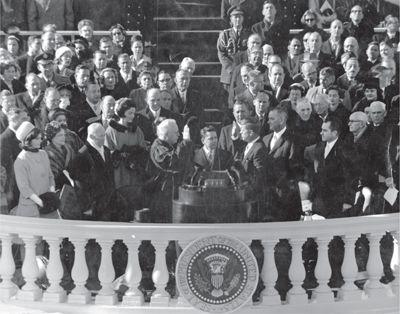
Inauguration
32 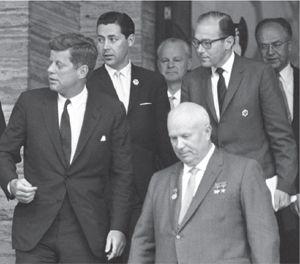
Meeting with Khrushchev