
CHAPTER THIRTEEN
He who learns must suffer, and, even in our sleep, pain
that cannot forget falls drop by drop upon the heart, and in
our own despair, against our will, comes wisdom to us by
the awful grace of God.
—Aeschylus
John F. Kennedy, the youngest man ever elected to the White House, understood how incredibly close the race had been. He also recognized the meaning of his slender margin, a victory that was far from a mandate. Both he and his rival had sought to show the strength and the will with which they would confront the Soviets. Now that he’d triumphed, little, really, had changed. Except that now the task was at hand.
A critical first endeavor involved the reassurance of two important government officials: both J. Edgar Hoover and Allen Dulles—the FBI and CIA directors, respectively—had to be told their jobs were safe. To have done otherwise would have unsettled the country. Therefore, urgent phone calls were placed to each man in the earliest hours of the interregnum. For JFK, retaining Hoover offered the premium of putting a lid on, among other prospects, the troublesome “Inga Binga” material in his files.
President-elect Kennedy put a pair of Republicans in top cabinet posts, naming Douglas Dillon, who’d been Eisenhower’s undersecretary of state, to run the Treasury Department and placing the Ford Motor Company president, Robert McNamara, at Defense. The clubby Dillon, with his old-money connections, appealed to Kennedy the man. McNamara, showing no lack of toughness, made a point, when they discussed the job, of asking Jack whether he’d written Profiles in Courage himself. An air corps lieutenant colonel by the end of World War II, McNamara had a Harvard MBA and at Ford had been one of the famous “Whiz Kids,” a group of ten returning veterans who came in and revitalized the company.
Looking to the liberal faction, which he needed both to acknowledge and include, the president tapped Adlai Stevenson to be his United Nations ambassador, Walter Heller as chief economic advisor, and Arthur Schlesinger as all-around Renaissance man.
Now, as always, concessions needed to be made to the senior Kennedy. It was, after all, the tribute Joe’s money and support deserved. Since his sons’ futures were of the utmost importance to him, posts for both younger Kennedy brothers were part of the bargain: Bobby would be attorney general, Ted would get Jack’s senate seat once he turned the required age of thirty.
Jack laughed with Ben Bradlee at the absurdity of the youngest president ever elected picking his brother, eight years younger than he, as attorney general. When Bradlee asked him how he planned to deliver the news to the press, his probable course of action had a familiar ring. Kennedy said, “I think I’ll open the front door of the Georgetown house some morning around two a.m., look up and down the street, and if there’s no one there, I’ll whisper, ‘It’s Bobby.’ “ There was no getting around the appointment for what it was: sheer, unadulterated nepotism.
“I think he hadn’t really thought about how to run the government until he got elected,” Ken O’Donnell said. “He was a very single-minded person. Politically, each battle he fought one at a time. There were very few things that were clear when he was elected.”
Kennedy’s “spokes of the wheel” approach had been championed by the presidential scholar Richard Neustadt, but such an organizational principle, in fact, followed his natural inclination. Unlike the former army officer Eisenhower, who appointed a strong chief of staff to run his agenda and team, Kennedy refused to have anyone between him and his advisors. Shrewdly, he set up two doors to the Oval Office, one manned by O’Donnell, the other by his secretary, Evelyn Lincoln. This system worked well: cabinet members had to fight their way past O’Donnell, while pals could whiz past Lincoln.
There was little camaraderie among Jack’s chosen men, and several ongoing rivalries. O’Donnell resented the partnership Sorensen assumed with Jack. Ben Bradlee, the Washington sophisticate, failed to see the appeal of Lem or Red. Bobby, meanwhile, resented how much his brother reached out to Torby. As couples, the Bradlees and the Bartletts hardly ever saw each other for the simple reason that as couple-to-couple friends to Jack and Jackie, to invite them at the same time would create a redundancy. Thus, they were asked over on different nights. Together, of course, all of them had a purpose, to keep Jack company, to ensure that he was never alone, never bored, never stuck.
Harris Wofford, Kennedy’s civil rights advisor, described insightfully how he and the others fit in. “The president-elect was a complex political leader in a complex situation. He was not anyone’s man—not Stevenson’s or Bowles’s, and not Mayor Daley’s or John Bailey’s, not the Civil Rights Section’s, and not the Southern senators’; not his father’s and not Bobby’s. He had one foot in the Cold War and one foot in a new world he saw coming; one hand in the old politics he’d begun to master, one in the new politics that his campaign had invoked.”
Kennedy picked Clark Clifford, who’d been President Truman’s counselor, to be his liaison with the outgoing Eisenhower staff. An astute observer of men and power, Clifford recognized early on John Kennedy’s ability to detach himself from himself. You’d see him sitting at meetings, Clifford once told me, and you could almost imagine JFK’s spirit assuming a form of its own and rising up, the better to look down on the group and assess its various members’ motives and agendas. It was the same uncanny detachment Chuck Spalding had seen in Jack on his wedding day.
Not all the people in the U.S. government, even at the top, owe their positions to the president. This remains one of the challenges of being chief executive in the American system. The reality of that limited control over people dawns eventually, if not right away. There’s also the need to lay down clear presidential orders.
Take the time JFK and his aides gathered around a swimming pool in Palm Beach, with dark-suited agents wearing sunglasses crouched protectively around them. JFK told O’Donnell, the White House official he’d personally posted to oversee the Secret Service, to have the agents back off. He wanted them to change to sports shirts and lose the fighting stance. “Nobody’s going to shoot me, so tell them to sit down and relax a bit.”
More than one Kennedy friend commented how happy he seemed in those days, making decisions while enjoying the Florida weather and waiting for Inauguration Day. Feeling buoyed up as he did—so thrilled and excited about his new circumstances, and proud to have pulled off what he had—he determined to stay fit as president. Said Charlie Bartlett: “I remember he told me, ‘From now on I’m really going to take care of myself.’ “ Bartlett also heard him make a different sort of commitment to the future. It had to do with his marriage. “ ‘I’m going to keep the White House white.’ He said it right out there on that terrace.”
Kennedy and Ted Sorensen had been devoting a good deal of that Palm Beach time to writing Jack’s inaugural address. Composed in the tropical air, it was delivered on January 20, 1961, when the Washington temperature hovered in the low twenties and eight inches of snow had fallen that morning.
Given the ongoing challenge of the United States–USSR relationship and its immense significance in the election, that theme would command the heart of the speech. Its focus was on strength—not as a prelude to war, but as an instrument for peace. “Man holds in his mortal hands the power to abolish all forms of human poverty and all forms of human life.”
The Churchillian notion of peace through strength had echoed throughout Jack’s adult life. “We dare not tempt them with weakness. For only when our arms are sufficient beyond doubt can we be certain beyond doubt that they will never be employed.” America would arm not to fight, but to parlay its power into protection. “Finally, to those nations who would make themselves our adversaries, we offer not a pledge but a request: that both sides begin anew the quest for peace, before the dark powers of destruction unleashed by science engulf all humanity in planned or accidental self-destruction.”
Those decisive phrases have not lost their resonance. “Let both sides, for the first time, formulate serious and precise proposals for the inspection and control of arms—and bring the absolute power to destroy other nations under the absolute control of all nations. Let both sides seek to invoke the wonders of science instead of its terrors. Together let us explore the stars, conquer the deserts, eradicate disease, tap the ocean depths, and encourage the arts and commerce.”
The one domestic policy reference would be Kennedy’s commitment to “human rights” at home as well as abroad. At the end came the words that passed into the world’s consciousness: “And so, my fellow Americans, ask not what your country can do for you—ask what you can do for your country.”
To some who’d once been at Choate and paid attention in chapel to the words of Headmaster St. John, a lightbulb flickered. The irony is that Jack Kennedy, the Mucker now grown up, was appropriating the very rallying cry from which he’d felt so alienated as a rebellious student.
The act of asking, in fact, marked the passage of John Kennedy through his public life. Most politicians make promises. They tell people what they will do for them, dangling the prospect of jobs, or government spending, with elections and “pork” irrevocably intertwined. That approach was certainly politics-as-usual for Lyndon Johnson, who always sought ways to find a person’s “button”—that thing he wanted, or feared—that would put him in his power. Kennedy was never like that. From the very start, he called on people to come out, to join, to be active, to be part of something larger than themselves. At the beginning, when Jack was little known, it had been a necessity, but it evolved into a grander vision, one that changed lives exactly as George St. John once had preached.
In Moscow, the Soviet leader, Nikita Khrushchev, had been sounding a different call to arms, in his case a boastful one. The progress of the international Communist cause, he’d told his countrymen on January 6, had “greatly exceeded the boldest and most optimistic predictions and expectations.” Encouraging “wars of liberation” such as the one under way in South Vietnam, he then emphasized the crucial position of Berlin in the struggle being waged against Marxism’s enemies. “The positions of the USA, Britain, and France have proved to be especially vulnerable in West Berlin. These powers . . . cannot fail to realize that sooner or later the occupation regime in that city must be ended. It is necessary to go ahead with bringing the aggressive-minded imperialists to their sense, and compelling them to reckon with the real situation. And would they balk, then we will take resolute measures. We will sign a peace treaty with the German Democratic Republic.”
Once he’d heard those declarations, Jack Kennedy’s sense of purpose—mission, really—was focused on their possible consequences. Did Khrushchev actually intend to sign a treaty with East Germany that would throw the USA, Britain, and France out of West Berlin, where they’d governed as allies since 1945? According to Arthur Schlesinger, Kennedy couldn’t stop reading and re-reading those words. Did they mean war? And would the United States be forced to escalate to nuclear war if the Soviets made good on their threat? Could an American president let the Communists grab West Berlin, the very symbol of Cold War defiance?
This is the specter Jack Kennedy was forced to contemplate in those early days of his presidency: the real chance that he alone would have to choose between nuclear war over Berlin or a historic capitulation to a European aggressor, a second “Munich.” Somehow he was able to greatly enjoy these early weeks after the inauguration. Living, as he did, in compartments, he didn’t let the worry show. He found comfort where he had since youth, in the close company of old friends.
During those early weeks after they’d moved into 1600 Pennsylvania Avenue, the Bartletts came to visit and the First Couple took them on a stroll down the streets surrounding the White House. Escaping through the guard gates was a way of testing his freedom. That night both Jack and Jackie spoke of their commitment to saving the buildings surrounding Lafayette Park, just across Pennsylvania Avenue. The Eisenhower administration had considered leveling the historic townhouses to put up government office buildings. They also mentioned their desire to restore the White House itself. When they found their way up to the ornate Indian Treaty Room in the Old Executive Building, Kennedy practiced using the microphone used by Ike during press conferences. Charlie sat in the back, listening to how the new president sounded from there. The brand-new president was having fun in his discovered world and sharing it with a beloved pal. He wasn’t letting his hidden dread affect the occasion. As Chuck Spalding once told me, even amid crisis, “Jack’s attitude made you feel like you were at a fair or something.”
Lem Billings arrived on Friday and stayed a week. He was the Kennedys’ first houseguest and their most frequent. Soon he’d have his own room, and would show up unannounced and stay as long as he liked. He was never issued a White House pass, but the Secret Service agents all knew him. He joined the couple, too, on weekends at Glen Ora, their retreat in the Virginia horse country. Often, Jackie was the one inviting him. She wanted Jack to have someone to hang out with when she was out riding. The presence of Jack’s old Choate roommate ensured there’d always be company to lighten the mood.
Lem never took for granted Jack’s friendship, cherished it, and was always there for him. “Jack was the closest person to me in the world for thirty years,” he said, and no one doubted it. Still, even he found it difficult to explain Jack’s enduring loyalty. “I’ve often wondered why, you know, all through the years, we continued to be such close friends, because I never kept up on politics and all the things that interested him. What he really wanted to do, on weekends, was to get away from anything that had to do with the White House.”
In fact, escaping the White House even on weeknights appealed greatly to its new occupant. One time he had Red Fay buy tickets ahead of time for Spartacus, allowing them to slip into the nearby movie theater unnoticed once the lights were down. Fay never forgot an incident that occurred a few nights later, walking across Lafayette Park. A fellow standing in the shadows caught the attention of the Secret Service agents, who checked him out by shining their flashlights at him. “What would you do now if that man over there pulled a gun?” Kennedy suddenly asked his buddy from the PT boat days. “What would you do to help your old pal?”
As they walked on, they began talking about assassination, the word itself rather antiquated, given that there’d been none since McKinley. “You know, this really isn’t my job, to worry about my life,” Kennedy said. “That’s the job of the Secret Service. If I worry about that, I’m not going to be able to do my own job. So I have just really removed that from my mind. That’s theirs to take care of. That’s one of the unpleasant parts about the job, but that’s part of the job.”
Fay had moved from California to work at the Navy Department. Once he was on the federal payroll, Jack teased him. “ Listen, Red head, he’d say, I didn’t put you over there to be the brightest man that ever held the job of Undersecretary.” He said that he wanted him there for his honest judgment about what he saw. But, clearly, the president wanted Fay’s company as well. Jack had arranged for another PT buddy, Jim Reed, to be made assistant secretary of the treasury, and for Rip Horton to go to the Army Department. “The presidency is not a good place to make new friends,” Jack said. “I’m going to keep my old friends.”
The Peace Corps—once an idea that seemed, spontaneously, to create itself—was now in the process of becoming a reality. Not sure exactly how the logistics of the visionary but also highly practical project might work, Kennedy put it in the hands of Sargent Shriver. As the founding director, Shriver got it off the ground, with the first volunteers overseas by the end of the year in countries such as Ghana and Tanganyika, Colombia and Ecuador. “The president is counting on you,” he told one early group on the eve of their departure. “It’s up to you to prove that the concepts and ideals of the American Revolution are still alive. Foreigners think we’re fat, dumb, and happy over here. They don’t think we’ve got the stuff to make personal sacrifices for our way of life. You must show them.”
But then, Washington bureaucratic jealousy threatened the enterprise. Shriver sought help from Vice President Johnson, named by JFK to chair the advisory council. “You put the Peace Corps into the Foreign Service,” he told Shriver, “and they’ll put striped pants on your people when all you’ll want them to have is a knapsack and a tool kit and a lot of imagination. And they’ll give you a hundred and one reasons why it won’t work every time you want to do something different. If you want the Peace Corps to work, friends, you’ll keep it away from the folks downtown who want it to be just another box in an organizational chart.”
Like a high priest in cowboy boots, Johnson knew the secrets of life and death in the capital. Thanks to him, the Peace Corps remained independent.
Having first talked about it when she entered the White House, Jackie Kennedy now wanted to start making good on her desire to redecorate the Executive Mansion. To help her, she asked her friend Rachel “Bunny” Mellon, married to the Pittsburgh banking heir and philanthropist Paul Mellon, whose high-patrician style she admired. According to Bunny, “When he became president, Jackie changed—she became just as royal as could be. She said, ‘Will you come now? Jack’s president. Will you come now and help me fix up this house? It’s terrible. And don’t call me “First Lady” ever, because I just work here. This is a job. I’ve got to do it for Jack.’ “
But in addition to her work with Jackie on the public and private rooms, Bunny Mellon made another singular and lasting contribution to the Kennedy-era White House. In this case, it was Jack himself who asked for her expert knowledge. Knowing her to be a celebrated garden designer and horticulturalist, he requested that she renovate the Rose Garden, which he could see from his Oval Office window and called “a mess.”
Established in 1913 by Mrs. Woodrow Wilson, it continues to this day to be the scene of ceremonial events. The layout Bunny Mellon created for JFK, often following his specific instructions, comprises the admired Rose Garden layout still seen today.
On April 12, 1961, the Soviet cosmonaut Yuri Gagarin orbited the earth. It was the first time in human history that man had gone beyond our planet’s atmosphere. Having beaten the United States into space with their first unmanned craft, the satellite Sputnik 1,back in 1957, the Russians once again had surpassed us. That first victory had come on President Eisenhower’s watch, but this one was on Kennedy’s.
But April, the “cruelest month,” held further setbacks, ones that would leave even more serious political scars. On April 17, more than 1,400 anti-Castro Cuban exiles—trained, equipped, transported, and given limited air cover by the CIA—landed on a Cuban beach bordering an inlet now known as the Bay of Pigs on the island’s south side. The disembarking Cubans had been assured by Agency officials they’d have full U.S. military support were they to encounter trouble on landing, but this turned out to be a false promise.
As Kennedy famously quoted at the time, “Victory has a hundred fathers; defeat is an orphan.” The best way to look back with full understanding at the debacle known as the “Bay of Pigs” is to get an idea of how it appeared going forward.
There were several factors contributing to the pressure put on the new president to approve this ostensibly secret plan. Kennedy had himself called for such an action during the campaign, having gotten a tip-off from, if not others, Governor John Patterson of Alabama, who knew his National Guard units were helping the CIA invasion effort. He felt another spur to action. Once he’d taken the oath of office, and had it confirmed that the operation was already well into its planning stages, he understood that to back off and shut down the preparations would paint him as a soft-liner.
Driving him the hardest were his new colleagues. Somehow, the people directing “Operation Zapata,” the invasion’s CIA code name, fully believed their plan could succeed. They were encouraged by the success Allen Dulles, the brother of the late John Foster Dulles, President Eisenhower’s secretary of state, had had in pulling off what was regarded as a similar scheme back in 1954, when a coup d’état had been stage-managed in Guatemala.
Richard Bissell, Dulles’s chief of operations, had slyly arranged, while Kennedy was still a candidate, to meet him at a Georgetown party, and the two Ivy Leaguers had hit it off. Not only was Bissell a persuasive and convincing supporter of Operation Zapata, but so were key Kennedy people, such as Secretary of Defense Robert McNamara and National Security Advisor McGeorge Bundy.
But what really clinched it for those men sitting safely in faraway Washington was the escape hatch many were led to believe was built into the plan: if the exiles found themselves unable to hold a beachhead once they landed, they could then retreat to the Escambray Mountains only eighty miles away, where they’d be able to join up with counterrevolutionary forces hiding out. Unfortunately, it was a very long eighty miles, across nearly impassable swamp—and getting even to that point meant eluding a Castro force vastly larger than the exile group. Obviously—had he known, and he should have known this—instead of signing off on it, Kennedy should have shut Zapata down while it was still possible.
Instead, there on the sands of that Cuban bay, every member of the invading Brigade 2506—mostly middle-class professionals recruited in Miami with little idea how to defend themselves against Fidel’s soldiers—was captured or killed. Quickly, in the aftermath, Kennedy asked for the resignations of both Dulles and Bissell. “In a parliamentary government, I’d have to resign,” JFK told Bissell. “But in this government, I can’t, so you and Allen have to go.”
In the end, even from this distant vantage point, nothing is perfectly clear about that ill-conceived CIA operation except for the fact that, once it was launched, it was bound to fail.
It’s hard to say just why Kennedy went along with his advisors, most of whom seem to have either had their heads in the sand or were otherwise enacting agendas of their own. Yet what does a president have such military and intelligence experts for if not to listen to them? JFK had been in office only three months, and however quick a study he was, he was still learning on the job. He was also used to being entirely his own boss, his own skipper, his own engine of accomplishment—from the Muckers to PT 109 to his extraordinary campaigns. The scope and scale, the sheer bulkiness of the apparatus around him made a difference to his sense of maneuverability. Now he’d signed on, not just to an operation, but to a government. He was surrounded by a government establishment he himself had no hand in forging.
But the contradictions buried in the Bay of Pigs scheme echoed Kennedy’s own. It was the old “two Jacks” problem. He was an idealist pursuing a new foreign policy he hoped would transcend the Cold War. He was also a Cold Warrior who had promised in the recent campaign to back “fighters for freedom” against Fidel Castro. Here he was caught going down the one road while signaling the other.
Just a month earlier, at a White House reception for Latin American diplomats, Kennedy had delivered his “Alliance for Progress” speech. In it he’d vowed to abandon the gunboat diplomacy engaged in by the “Goliath of the North” for generations, as the United States intervened at will in countries such as Cuba. This declaration of Pan-American mutual respect would be tarnished by U.S. efforts to overthrow Castro. Only too aware of the hypocrisy it revealed, Kennedy insisted that the Cuban invasion be carried out in the absence of direct U.S. military action, on the principle of what’s known in dark diplomacy as “plausible deniability.”
To achieve this goal, Kennedy had instructed the CIA’s Bissell, whose baby the operation really was, to see that it was carried out with the minimum of “noise.” For this reason he ordered the landing point shifted from Trinidad, a busy port city, to the desolate Bahía de Cochinos. As a result, the invasion inevitably lost what chance it might have had of triggering a countrywide rebellion, with citizens coming out to join the “liberators.”
Kennedy’s conflict in purpose continued as he sought to reconcile his aggressive Cold Warrior stance, which had seen him denouncing the Truman administration’s “loss” of China, with his newly emerged recognition of postwar nationalism. The incredibly tricky challenge of toppling a despot on foreign soil by supporting an invasion was dealt another blow when Kennedy called off two of the planned air strikes in the midst of the operation. For the anti-Castro force to hold the beachhead, the small Cuban air force needed to be knocked out of action. In the event, it suffered only limited damage.
By the third day, the battle was lost. The mountains with their promise of sanctuary were little more than a mirage, real but impossible to reach. The eyes of the world were watching as Castro rounded up the poorly served and even more poorly supported surviving combatants, who would not return home to Florida for twenty more months, not until the United States bartered for their freedom with more than $50 million worth of medicine and baby food.
In the aftermath, there was certainly enough blame to go around, as JFK ironically suggested. But that mattered little in the face of such headlines as the one that ran in the New York Times on April 21: “CUBA SAYS SOVIETS SCARED OFF U.S.; Asserts Washington Feared ‘Superior’ Russian Arms.”
The question must be asked: What was Kennedy thinking? Why did he sign off on an invasion offering so slender a possibility of success? What about the thought he never seemed even to take into account: What would success actually look like? Could anyone seriously imagine the people of Cuba overthrowing Fidel Castro—or attempting to—upon hearing news of a 1,400-man invasion force landing on a remote beach? And given the strong chance of the mission’s failure, how did he imagine the United States would then appear to the world, both in Latin America and around the globe?
Those questions having been put on the table, there are others equally important. Why didn’t Dulles or Bissell tell JFK he was compromising the invasion by changing the landing area, and that the air strikes—all of them—were essential? Why had they maintained that there would be a widespread Cuban uprising against Castro? Why did they lie in saying the members of Brigade 2506 could escape into the mountains if they failed to secure a beachhead? Bissell, the chief instigator, would later admit to having misled Kennedy into believing that option was a viable one. But why hadn’t General Lyman Lemnitzer, chairman of the Joint Chiefs of Staff, spoken up to warn the president that the invasion plan was a fool’s game? Why had Secretary of State Dean Rusk not expressed his own doubts about the Cuban people’s willingness to embrace a general revolt? Far more important, why hadn’t Kennedy asked the right questions, and made sure to have the solid answers such a risky undertaking demanded? Beyond the human toll, the collateral damage, after all, would be to his administration’s credibility.
To his credit, Kennedy kept disaster from becoming calamity. He decided at the most critical moment to cut his losses, refusing to send in U.S. forces, and that may have been the crucial decision of the entire episode. He took charge—far too late, admittedly—but with executive firmness. He told the military and the intelligence brass that the United States would not openly attack the island of Cuba. He would let those men meet their fate on the beach rather than commit his country to possible direct confrontation with the Soviet Union. Who knew how many Russians were on the island, how many would be killed by a U.S. air attack on Castro’s forces?
The Bay of Pigs cast a long shadow over the Kennedy White House, but the value of the early lessons it provided for Kennedy cannot be underestimated. One of them involved one of his very first presidential acts. “I probably made a mistake in keeping Allen Dulles on,” the president told Arthur Schlesinger just two days later. “It’s not that Dulles is not a man of great ability. He is. But I have never worked with him and therefore I can’t estimate his meaning when he tells me things. We will have to do something about the CIA. I must have someone there with whom I can be in complete and intimate contact—someone from whom I know I will be getting the exact pitch. I made a mistake in putting Bobby in the Justice Department. He is wasted there. Bobby should be in the CIA. It’s a helluva way to learn things, but I have learned one thing from this business—that is, that we will have to deal with the CIA.”
In a statesmanlike gesture, he soon met with Richard Nixon, who hawkishly urged him to “find a proper legal cover and go in.” Nixon’s idea was to use the defense of our naval base at Guantánamo as a possible excuse. Hearing this, Kennedy pointed to the inherent danger in that plan. “There is a good chance that if we move on Cuba, Khrushchev will move on Berlin,” he said. The former vice president, always touched by any sign of respect from Jack, came away ready to rally support for him. “I just saw a crushed man today,” Nixon told his allies after the encounter, asking them to resist taking easy shots at the demoralized president.
President Eisenhower was more hard-nosed, wanting to know why Kennedy had called off the air strikes. When the younger man said it was to conceal the country’s role in the operation, Ike was contemptuous. The very concept was obviously contradictory. Here was the United States offering training, equipment, transportation, and air cover to a military operation in which it intended to deny involvement. “How could you expect the world to believe that we had nothing to do with it?” When Kennedy said he feared how the Russians might retaliate in Berlin, Ike’s response was to tell his successor that the Soviets didn’t react to what we did. Rather, they “follow their own plans.” The general, now a partisan proud of his presidential service, refused to allow that Soviet strength and belligerence had grown toward the end of his watch. The new president had to.
Accustomed to success, Jack took the defeat hard. For the first time, witnesses actually saw him in tears. Yet, recognizing that he’d backed a military effort requiring greater resources than he was ready to commit and greater risks than he, in the end, wanted to take, he accepted the responsibility. “I’m the responsible officer of the government,” JFK assured reporters and the country.
The American people decided they liked the fact that Kennedy, whatever his failings heading into the disastrous mission, had acquitted himself as a true commander in chief at its conclusion. The record shows that he gained his highest job approval rating—scoring 83 percent in a Gallup poll—in the weeks thereafter.
Close friends such as Red Fay could see the toll it had taken. “In the months that followed, no matter how you tried to avoid touching on the subject, by one route or another it seemed to find its way back into the President’s conversation.” Even on vacation in Hyannis Port, it obsessed him, much to the distress of Jackie, who was ready to put the nightmarish scenes on that Cuban beach that haunted her husband behind them.
One of those Cape Cod evenings provided an outpouring Fay never forgot. It was when Jack outlined for him what he believed in: “I will never compromise the principles on which this country is built,” JFK told him, “but we’re not going to plunge into an irresponsible action just because a fanatical fringe in this country puts so-called national pride above national reason.” Then he went on, “Do you think I’m going to carry on my conscience the responsibility for the wanton maiming and killing of children like our children we saw here this evening? Do you think I’m going to cause a nuclear exchange—for what? Because I was forced into doing something that I didn’t think was proper and right? Well, if you or anybody else thinks I am, he’s crazy.”
When his host reached for his crutches, Fay understood he was finished with him for the evening. “He started up the stairs, straining with every step. He stopped me in the middle of the stairs and looked down at me, his face still inflamed. ‘By God, there will be no avoiding responsibility—nor will there be any irresponsibility. When the decisive time for action arrives, action will be taken.’ Turning, he lifted himself painfully up the rest of the stairs and to his room.”
Meeting with the leaders of the Cuban Revolutionary Council, the main exile group, Jack spoke of his own wartime losses, even sharing a photograph of his brother Joe. One of the leaders, who’d lost his son in the invasion attempt, said the exiles had been “taken for a ride.” He suggested Kennedy had been taken for one as well.
With the wounds from the Bay of Pigs still smarting, another Communist threat suddenly loomed on the horizon. It presented the likelihood of a far more dangerous crisis. Premier Nikita Khrushchev, who’d been making dark utterances for several years about changing the balance of power in Berlin—a city that had become such a symbol—demanded a showdown with President Kennedy in Vienna in early June.
Before heading to the summit in Austria, JFK took his first foreign trip, to Ottawa, where he and Jackie were welcomed by Prime Minister John Diefenbaker. Fifty thousand people turned out to watch the Kennedys’ arrival. After addressing jointly both houses of Parliament, Jack took part in a tree-planting ceremony. As he lifted a silver shovel of dirt, he suddenly wrenched his weak back so painfully that he grabbed his forehead in anguish. Upon his return to Washington, he needed his crutches—which he used now only in private, in front of family and friends—to walk from the helicopter landing pad on the South Lawn to the White House.
Jack Kennedy had spent the past decades stoically rising above extreme physical discomfort, and he wasn’t about to change, having now reached the White House. Less than two weeks after their return from Canada, the First Couple flew off to France, where one of the highlights was a luncheon at the Elysée Palace hosted by President Charles de Gaulle. Throughout her stay, beautiful Jackie, with her fluent French and stunning wardrobe, was an unqualified success, both fascinating and delighting the French public. People would remember that her husband joked to the traveling press corps, “I’m the man who accompanied Jacqueline Kennedy to Paris, and I have enjoyed it.” But fewer will know that de Gaulle, an entirely formidable figure, had been captivated enough by her on a trip to Washington the previous year to have commented, “If there were anything I could take back to France with me, it would be Mrs. Kennedy.”
The two leaders got along surprisingly well. During the war, de Gaulle had headed the Free French, symbolizing their country’s resistance to the Nazi occupation. With regard to the American’s coming engagement with Khrushchev in Vienna, de Gaulle was both thoughtful and candid. Urging Kennedy to keep his priorities in perspective, the French president expressed doubts about the ultimate sustainability of the Soviet system. He put little faith in their economic model, and so the Russian tide, he predicted, eventually would recede from Europe. Until that happened, the West, he reminded JFK, must stand firm. The greater threat, he predicted, would come decades later from China.
De Gaulle, like Kennedy, was able to put himself in the other man’s shoes. Yet even as he could see beyond the immediate conflict to three decades down the road, de Gaulle recognized that such foresight little helped the predicament now. His practical advice, when it came to dealing with Khrushchev over the fate of Berlin, was to avoid even the appearance of negotiating. To do so would mean playing the Soviets’ game.
Yet, as Eisenhower had been, de Gaulle was somewhat out of step with the times when it came to assessing the Russian mood. It had been one matter to not take the Soviets seriously when Russia, despite its immense size, seemed to lag behind the West. Now, just sixteen years after the war had ended, leaving devastation and demoralization in its wake, the Soviets were gunning their engines, trying to race ahead of the European powers and the United States. Their numerous gains—from their first-in-space status to their successful backing of “wars of liberation” in Africa, Asia, and Latin America—had left them confident, ready to flaunt their new standing vis-à-vis the West.
Moreover, if the size and power of the Soviet military forces weren’t sufficiently frightening, the fact that the Soviet defense system had come to include a sizable nuclear arsenal surely was. What was bringing President John Kennedy to Vienna with such uncertainty—and foreboding—was Khrushchev’s announced intention to sign a separate treaty between the Soviet Union and East Germany that would have the effect of stranding the city of Berlin 110 miles within the Russian-allied German Democratic Republic. Berlin, split by the Allies into sectors at the end of the war, had become the main escape route for millions fleeing west to escape Communist dictatorship. Ambassador Llewellyn Thompson told the president that the Soviet leader was so personally committed to a solution to the Berlin problem that the chances for either war or an “ignominious” retreat by the West were “close to fifty-fifty.”
Kennedy’s arrival in Vienna resembled a campaign stop of the year before. As they had in Paris, adoring crowds greeted the American First Couple at the airport. Khrushchev—who’d become first secretary of the Russian Communist Party in 1953 after the death of Josef Stalin and consolidated his power, ascending to premier five years later—had taken the train west from Moscow. He arrived to no fanfare. The glamour of Jack and Jackie Kennedy, and their excited reception, undoubtedly stirred resentment.
The meetings were scheduled for alternating sessions in the Soviet and American embassies. On the first day Khrushchev took the role of teacher, lecturing Kennedy on the case for socialist inevitability. Kennedy was no match for his ideological fervor. Both Ken O’Donnell and Dave Powers would write in their joint memoir how the bull-necked Soviet leader paced circles around his slender, youthful listener, “snapping at him like a terrier and shaking his finger.”
That vivid description also paints a picture of Jack Kennedy having to endure the far outer limits of his comfort zone. When Evelyn Lincoln asked the president how the meeting had gone, “Not too well” was his reply.
Khrushchev’s performance was a far cry from an American politician’s usual encounters—except, perhaps, his use of the filibuster. But it seemed to have the effect the Soviet premier desired. Kennedy believed he meant business. Nixon and all the others back home could sound off about the need to call the Soviets’ bluff. Nikita Khrushchev looked and sounded nothing like a bluffer.
The second day turned out to be worse. Khrushchev, having had his ideological warm-up, was now ready for the main event. JFK had come to Vienna hoping to build on what he saw as a recent major diplomatic breakthrough. In April, the United States and the USSR had reached an agreement that each would stop supplying military aid to Laos, a little landlocked kingdom north of Thailand and Cambodia and west of Vietnam. Its significance lay entirely with its central Indochinese location. Kennedy hoped that he and Khrushchev could jointly see the Laos cease-fire as a starting point for broader negotiations.
Unfortunately, Khrushchev himself was there to talk about Berlin, and only Berlin. The Soviet Union, he reiterated, was planning to sign a treaty with East Germany that gave it total authority to control access to West Berlin. What this meant—and Khrushchev made it sharply specific—was that the Americans, the British, and the French would have to end their historic shared occupation of the divided city. The Russians had been edging up to this land grab, then backing away, for several years. This time, however, they seemed ready to proceed.
“The USSR will sign a peace treaty, and the sovereignty of the GDR will be observed,” Khrushchev said in a formal pronouncement. “Any violation of that sovereignty will be regarded by the USSR as an act of open aggression. If the U.S. wants to start a war over Germany, let it do so.”
Kennedy argued, to no avail, for the opposite approach. Instead of heightening Cold War tensions, why not try to lessen them? If Berlin was going to change, why not see it as a model for the future and not as a relic of the past? He tried to interest the Russian in a topic that meant more to him than just about anything else: a treaty over nuclear testing. He tried everything he could think of that might touch the man who was his opponent. He even invoked their shared losses in World War II. For, in the same way Jack mourned his brother Joe, so Khrushchev grieved, still, for his downed fighter-pilot son. But all the efforts the American made to light some spark of commonality between them produced no results.
Desperate, Kennedy requested a third meeting. In the last encounter with Khrushchev, he tried separating the two issues, suggesting that the Soviets might sign a treaty with East Germany while still allowing open access to West Berlin. That way, peace, at least, could be maintained. But the whole idea of the USSR-GDR agreement was to shut down the steady drain of East German workers through the city. Again, Khrushchev dug in his heels.
The new East German government, he said, would have full authority to deny access. Any effort to resist by either America or its allies would be met with the full force of the Red Army, which greatly outnumbered American and allied forces. When Kennedy pushed Khrushchev to acknowledge the right of the United States to continue to have access to West Berlin, Khrushchev held firm. “It is up to the U.S. to decide whether there will be war or peace.”
At this final session Kennedy’s companion made it clear, if it wasn’t already, that his decision was “irrevocable” and “firm.” In the end, all Jack was able to offer in reply to Khrushchev’s threat of war was this grim prediction: “If that’s true, it’s going to be a cold winter.” He left Vienna and returned to Washington, crushed by the experience. The Bay of Pigs had tainted him, he saw, allowing Khrushchev to treat him so contemptuously.
Jack Kennedy now understood he had to find a way to convince Khrushchev he was someone who would fight. But, even before that, he needed to understand exactly why the Soviet leader had talked to him that way, hectoring him. Was Khrushchev, in fact, crazy? He hadn’t thought so, but what else explained why he was talking about war between two countries armed with nuclear weapons? “I never met a man like this,” he told Time’s Hugh Sidey. “I talked about how a nuclear exchange would kill seventy million people in ten minutes, and he just looked at me as if to say, ‘So what?’ My impression was that he just didn’t give a damn if it came to that.”
To Ken O’Donnell he spelled out his own deeper belief, one he’d never share with a reporter, that not even Berlin was worth the possibility now threatened. “It will have to be for much bigger and more important reasons than that. Before I back Khrushchev against the wall and put him to a final test, the freedom of all Western Europe will have to be at stake.” It fell to Lem Billings to record that Jack Kennedy had told him he’d “never come face to face with such evil.”
Jack knew the order of battle for any conflict over Berlin. The United States had 6,500 troops in the city, for a combined American, British, and French force of 12,000. The Soviets had 350,000. Once the first shot was fired, the choice he’d be facing would be Armageddon or Munich. Long his greatest fear, it was now what he saw before him. Worse still, his adversary refused to acknowledge their mutual humanity.
He heard the voices—the chorus was always there—that exhorted him to “stand tough,” the voices that encouraged him to ignore the signals he was getting from Khrushchev in favor of a different party line. “Our position in Europe is worth a nuclear war, because if you are driven from Berlin, you are driven from Germany. And if you are driven from Europe, you are driven from Asia and Africa, and then our time will come next. You have to indicate your willingness to go to the ultimate weapon.” Hadn’t he said that, himself, to a Milwaukee radio interviewer during the campaign?
So, he knew how to talk like a war hawk. But what did it actually mean—words like that, all the threats and gun-cocking—if you’re the first American president to come into office aware of your enemy’s rival nuclear stockpile? It’s one thing to use words such as appeasement and surrender and vital principle with regard to Berlin when someone else is making the decisions.
It was the old “Munich” argument—the one that had so obsessed him that he’d written a book about it—adapted to the nuclear age. The Berlin conflict would endure through much of the summer. As the months went on, Kennedy seemed sapped of initiative. “He’s imprisoned by Berlin,” members of the cabinet told Sidey. “That’s all he thinks about.” On June 21, he would suffer another flare-up of his Addison’s disease, with his temperature spiking to 105 degrees. For several days he was sick in bed, ministered to by Jackie and Lem.
On July 25, Kennedy gave a pivotal speech on the conflict in Europe. “We cannot and will not permit the Communists to drive us out of Berlin, either gradually or by force. . . . We will at all times be ready to talk, if talk will help. But we must also be ready to resist with force, if force is used upon us.” He spoke of West Berlin as a “showcase of liberty, a symbol, an island of freedom in a Communist sea.” But he also made concessions. Suggesting that it might be possible to remove “irritants” from the conflict, he then made a conciliatory statement about Soviet security concerns regarding Germany, the country that cost it 20 million lives in World War II.
Throughout the speech, he made a point of referring to “West” Berlin. The message was that his country did not care what the Soviets and East Germans did in the rest of the city. They had a free hand in that regard. Five days later, Senator William Fulbright, chairman of the Foreign Relations Committee, told a Sunday-morning TV audience that it was in the Russians’ power to shut down the West Berlin escape route if they wished. They could end their problem without war. It was an assessment of American policy, quickly cheered by the East German government, that Kennedy never denied.
On August 3, the Soviets made their long-threatened move on West Berlin. Fortunately for the world, the Soviets and East Germans had found a solution to stop the tide of refugees to the West—a wall. To the man in the White House, it came as a secret relief. “Why would Khrushchev put up a wall if he really intended to seize West Berlin? There wouldn’t be any need of a wall if he planned to occupy the whole city. This is his way out of his predicament. It’s not a very nice solution, but a wall is a hell of a lot better than a war.”
33 
President Kennedy with the Joint Chiefs (L to R): Gen. David M. Shoup, Marine
Corps; Gen. Thomas P. White, Air Force; Gen. Lyman Lemnitzer, chairman;
Kennedy; Adm. Arleigh Burke Navy; Gen. G. H. Decker, Army
34 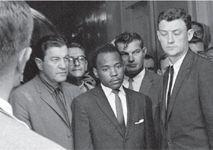
James Meredith with U.S. Marshals after
enrolling in the University of Mississippi,
October 1, 1962
35 
Sargent Shriver, Peace Corps Director