
CHAPTER FOURTEEN
I felt I was walking with destiny and all my past life had been but a preparation for this hour and for this trial.
—Winston Churchill, May 10, 1940
Jack Kennedy’s victories had taught him essential lessons. He recognized the edge a candidate receives when he’s made the earliest start and kept at it. He realized the importance of the vital energy gained by building a trusted team. He discovered the power derived when a politician grasps the nature of the times and wields that understanding.
But failures also offer education. The Bay of Pigs taught him something more critical: When the stakes are the highest and most desperate, there must be both clarity and completion. Know the enemy and your goal, and hold fast to what you’re attempting. Should any oppose your course, fight them with all your resolve.
Throughout the summer of 1961, Jack Kennedy had managed to sustain his hopes for a ban on nuclear arms testing to which the Soviets would agree. At the very heart of his presidency was his mission to keep his country from nuclear war. It would be, he knew, a battle from which no winners could emerge. In 1946, the young journalist John Hersey had published in the New Yorker his account of the survivors of the attack on Hiroshima; no one who’d read it would ever forget it.
We’d agreed, as had the Soviets, to halt nuclear testing in 1958. Yet, in July, a Gallup poll had indicated that public support for the resumption of U.S. nuclear testing stood at two to one. The other side, exhibiting its greater aggression, suddenly showed its hand. August brought Moscow’s shocking announcement of its unilateral decision to resume nuclear testing in the atmosphere. Kennedy’s reaction—“fucked again!”—was deep and personal. Even before this horrifying news hit the headlines, Americans had gotten reports that the milk drunk by Russian children across the country contained detectable traces of radioactivity. Had the Russians treacherously been testing underground all along, even if they’d sworn not to? And was this a clue? And, if so, what were we going to do about it?
Over the next three months the Soviet Union would go on to conduct thirty-one such tests, including the exploding of the largest bomb in history—58 megatons, four thousand times more powerful than the one dropped over Hiroshima in 1945. Despite partisan pressure to respond by resuming U.S. testing, Kennedy resisted. He persisted in believing in the possibility of a comprehensive ban on all forms of nuclear arms testing, atmospheric and underground as well. “Mankind must put an end to war—or war will put an end to mankind.” Yet as the leader of the Free World, he couldn’t allow the Soviets to proceed without a U.S. response. With this in mind, the president instructed Defense Secretary McNamara to begin testing underground.
The United States had tested its first nuclear weapon at the White Sands Proving Ground in New Mexico in July 1945, a month before the U.S. fighters flew off to drop the atomic bombs on Hiroshima and Nagasaki. Those attacks, of course, brought about the Japanese surrender and ended World War II. Seven years later, the United States tested the first hydrogen bomb in the isolated Marshall Islands in the western Pacific in early November 1952. It was one of the last acts of the Truman administration before the election on November 4 ushered in the Eisenhower era.
Truman himself had presided over the dawn of the nuclear era by signing off on the Hiroshima and Nagasaki missions. Other peacetime nuclear explosions—military tests of new, far deadlier weapons—followed on his watch. Then, under President Eisenhower, the number doubled or even tripled. For a dozen years, from 1946 to 1958, the Marshall Islands, a U.S. Trust Territory until 1986, bore the brunt of America’s experimentation. For the Soviets, the testing of their nuclear weapons secretly in their vast territory had begun in 1949. They had selected sites in remote Kazakhstan and later in Novaya Zemlya, a chain of islands in the Arctic Ocean at Russia’s northern edge.
The history of the Cold War is written in the long lists of these many tests. During this period, our allies France and Great Britain were intent on developing their own nuclear arsenals. But distinctions such as “atomic” and “hydrogen,” “nuclear” and “thermonuclear” mean little to the average citizen. Americans accepted the basic contradiction. The United States could keep the Soviets from aggression in Europe by the threat of nuclear retaliation. At the same time, neither side would dare use nuclear weapons, knowing the other would as well.
Even after Kennedy issued the directive for underground nuclear tests, he continued to be pressured by his own experts. They wanted more. In November, the National Security Council delivered a blunt assessment: “If we test only underground and the Soviets tested in the atmosphere, they would surely pass us in nuclear technology.” Still, Kennedy persisted in trying to negotiate. Following a further failure to bring the Soviets around to the American position, he let it be known that the United States was now prepared to begin atmospheric testing again. Though he did nothing beyond indicate American willingness to resume, it was a necessary step in getting to the negotiating table. With it came a new pressure: Prime Minister Harold Macmillan of Britain, considered by JFK a personal as well as an official friend, urged the United States to put off any such activity for six more months.
As 1962 began, Kennedy hadn’t given up on his hope of bringing the Russians around to his idea of a peaceful rivalry, not a nuclear one. What he cared about, above all, was making sure the nuclear genie got put back in the bottle; for him, arriving at a mutual test ban would be the first step. “A journey of a thousand miles begins with one step,” he liked to quote.
Nothing mattered more to him.
In February he and Prime Minister Macmillan jointly wrote a letter to Khrushchev, calling for a “supreme effort” to stop the arms race and avert a nuclear apocalypse. Kennedy, in a phone call with Ben Bradlee not long after sending it, shared his frustration with what he called this “hard-boiled” conflict over nuclear weapons testing between the United States and the USSR, but also the “soft-boiled” one with the British.
Kennedy’s national security team now voted unanimously to resume atmospheric testing. But with the next round of international peace talks scheduled for March in Geneva, he wanted to delay the announcement. It would get in the way, he felt, of offering Khrushchev another chance.
It didn’t matter. Once again, his approaches were refused, his aims thwarted—and, as a result, he saw himself gradually pushed toward brinkmanship. At this point, with the Russians intransigent and any attempts at persuasive diplomacy a failure, Jack felt it was time to present his case to the country. On March 2, speaking on television and radio for forty-five minutes, he made the case for deterrence, explaining the strategic necessity.
He wanted to explain to millions of worried Americans why he’d agreed to resume atmospheric testing. “For all the awesome responsibilities entrusted to this office, none is more somber to contemplate than the special statutory authority to employ nuclear weapons in the defense of our people and freedom.” He needed to test, he said, in order to maintain the country’s deterrent strength. “It is our hope and prayer that these . . . deadly weapons will never be fired.” Red Fay, at the White House for dinner that night, recalled how deeply delivering the speech had affected his friend. “It was about 9:30 when the President finally arrived. Jackie had placed me so that when he came in, I’d be sitting on his left. He was flushed . . . really worn from the whole experience. Everybody sensed that he was very tense. His hands shook. . . . Everybody else, because of his tension, all started to talk among themselves. He directed his conversation to me and said, ‘God, I hope you’ve been enjoying yourself over here, because I’ve been over there in that office, not knowing whether the decision I made . . . ’ “ His voice trailed off, and Fay was left to imagine the agonizing weight of the responsibility that he felt.
Kennedy had dark forebodings. “Ever since the longbow,” he would tell a trusted visitor to the oval office, “when man has developed new weapons and stockpiled them, somebody has come along and used them. I don’t know how we can escape it with nuclear weapons.”
Still Kennedy clung to the fading notion he might be able to shift the two-power rivalry between the United States and the Soviets to peaceful pursuits. He understood that the real contest between the USA and the USSR was over authority in the “Third World.” The rising peoples of Africa, Asia, and Latin America were looking to see who was winning, which system—democracy or Communism—best suited their needs and their hopes.
The ability to conquer space mattered greatly in this quintessential Cold War struggle to be top gun. The way to win was by looking like a winner. Unfortunately, through 1961 the Soviets had held the competitive edge. The launch of Sputnik four years earlier in 1957 had thrown America off stride, and the flight of Yuri Gagarin in April 1961 had done the same again, making the Russians seem invincible by virtue of their superior technology.
But on February 20, 1962, the balance of power, when it came to achievement in space, was restored. On that day, John Glenn became the first American to orbit the earth, circling the globe three times in Friendship 7. A marine among the original seven American astronauts picked by the National Aeronautics and Space Administration in 1959, Glenn met with President Kennedy at the White House both before and after the flight. Even space—especially space—isn’t free of politics, John Glenn well understood. Kennedy knew “we were actually superior to the Soviets and that that’s what we were out to prove.”
Glenn’s triumphant space flight proved the boost NASA needed. What it had lacked before were bragging rights. “I think one reason my flight got so much attention was that we sort of turned the corner in public opinion at that point.” In fact, conquering space offered an unprecedented thrill for the American public. Suddenly it seemed as if all things extraordinary were possible under the young president’s leadership. The dark shadows cast by the unchecked arms race were forgotten for the moment. Yet, however urgent the question of nuclear disarmament was, it was far from the only crisis facing John F. Kennedy.
• • •
In the fall of 1961, Walter Heller, who chaired the president’s Council of Economic Advisers, came to tell him that it was crucial to the economy that steel prices get brought under control. Because the industry’s high prices drove up costs across the board, they had the effect of crippling America’s ability to compete with foreign producers.
Kennedy acted. To keep American steel in the game, Kennedy went in and won an agreement from the United Steelworkers to cut back their wage demands. In March 1962, industry executives and top union officials gathered at the White House and emerged from the meeting having agreed to defer increases. While the president had no right to tell the steel companies how much to charge, the deal was clear: labor would keep down salaries, the executives would hold back on prices. Afterward, JFK called both sidesto thank them for making concessions in the national interest. The union men, when he talked to them, seemed especially pleased to hear the president praising them for their sacrifice.
Then came trouble. Roger Blough, chairman of United States Steel, requested a meeting. From across the cabinet table he handed Kennedy a press release. His company was raising the price of steel 3.5 percent. “Mr. Blough,” JFK said, “what you are doing is in the best interest of your shareholders. My shareholders are every citizen of the United States. I’m going to do everything in the best interest of the shareholders, the people of this country. As the president of the United States, I have quite a bit of influence.”
Blough, Jack realized, had already released the announcement. “You have made a terrible mistake,” he said. “You have double-crossed me.”
To Ken O’Donnell, it was a shocking episode. “These guys felt they were so powerful they could stiff the president of the United States without consequences.” He also saw how livid his boss was. “He was white with anger.” Big steel had betrayed its workers and “made a fool of him.” Discussing it with Ben Bradlee, Jack explained he wasn’t about to take a “cold, deliberate fucking.”
The president’s credibility was now on the line because he’d acted as broker. Labor leaders, he knew, would never trust him again. The steel industry, meanwhile, assumed, “wrongly, he could not or would not do anything.” O’Donnell, who’d watched him at work in Massachusetts, knew what sort of surprise they were in for. “You find out about these guys in these steel companies, where they have been on vacation, who they have been with on vacation,” he instructed.
His instincts told him where the corporate chiefs were vulnerable. “I don’t think U.S. Steel or any other of the major steel companies wants to have Internal Revenue agents checking all the expense accounts of their top executives,” Kennedy told Red Fay, who, before becoming undersecretary of the navy, had himself been a Republican businessman. “Too many hotel bills and nightclub expenses would be hard to get by the weekly wives’ bridge group out at the Country Club.”
The next day, Attorney General Robert Kennedy announced that, under the antitrust laws, a grand jury investigation into the steel industry’s pricing had been ordered. Subpoenas to produce documents were served on U.S. Steel. Defense Secretary Robert McNamara instructed the Pentagon to purchase steel “where possible” from companies that had not raised prices. Later that day, in a press conference, Kennedy addressed the issue: “. . . the American people will find it hard, as I do, to accept a situation in which a tiny handful of steel executives whose pursuit of private power and profit exceeds their sense of public responsibility can show such utter contempt for the interests of 185 million Americans.” By the next night, eight steel companies that had announced price hikes canceled them.
The president’s response to the pullback was to congratulate the steel companies for honoring the public good. “Kennedy’s style of politics: you never paint a guy into a corner,” O’Donnell later observed. “You give the other fellow as much credit as you can. So, he wants a statement thanking the steel companies for realizing their commitment to the United States Government was more important than their commitment to their stockholders.”
But the swords were sheathed only when the mission was accomplished. America’s competitiveness was restored, but revenge had also been extracted. Robert Kennedy later confessed the rough tactics employed. “We looked over all of them as individuals . . . we were going to go for broke . . . their expense accounts and where they’d been and what they were doing. I picked up all their records . . . I told the FBI to interview them all, march into their offices the next day! We weren’t going to go slowly. . . . So, all of them were hit with meetings the next morning by agents. All of them were subpoenaed for their personal records. I agree it was a tough way to operate, but under the circumstances, we couldn’t afford to lose.”
When the action settled, Jack Kennedy didn’t like being left alone. If no one else happened to be around for the evening, he’d ask Dave Powers—now, like Ken O’Donnell, a presidential special assistant—to stay and have supper with him. They’d then spend the evening together until it was time for Dave to escort him to his bedroom. When he was finally ready to sleep, it’d be: “Good night, pal. Will you please put out the light?”
What’s curious—and fascinating—are the fixed orbits JFK assigned to this circle of friends. He always exhibited great fondness for his “Irish mafia” of O’Donnell, O’Brien, and Powers, but they were never part of his social life. With the exception of Powers, who’d join him when nothing else was going on, these men formed an indispensable support team that could be dismissed at sundown. The same went for Ted Sorensen, who’d spent those four years with him in close quarters day after day, flying around the country. They’d become so attuned that Sorensen was practically an alter ego, yet he was never invited for an evening out with his boss.
Novelty and turnover mattered in Jack’s personal world. And, naturally, there were rules. Chuck Spalding liked to say that nobody got as much as forty-eight hours with him. If you bored him, you got less. Anyone ever imagining he was an equal colleague soon knew better. Even social friends might step across invisible boundaries and pay the price. Ben Bradlee was “banished,” to use his word, for several months in 1962 for daring to mention to another reporter how sensitive Kennedy was to critical reporting. Proving Bradlee to be right, Jack gave him a protracted cold shoulder—a kind of grown-up’s “time out”—until eventually the Bradlees were returned to his good graces.
In the White House, he didn’t leap up at dawn like some presidents, but read the newspapers in bed over breakfast. He regularly went for a swim before lunch, took a nap afterward, and then would have another swim before dinner. Kennedy was far from the healthiest president on record, but, clearly, he wanted to come across as that. In photographs, especially, he projected a smiling vitality. When it came to his ongoing medical problems—above all, the intractable back pain—he didn’t complain. Nor did he explain.
As a married man, he’d decided not to forgo his bachelor pleasures. It seems not to have occurred to him. Lem had been right to try to warn Jackie at the wedding. But one of his affairs had an abrupt ending not of his own choosing. In March of 1962, he was visited by J. Edgar Hoover. The FBI, which had kept tabs on him during his Inga Arvad days, had now been chronicling his current relationship with a woman “of interest” to the Bureau. “Information has been developed that Judith E. Campbell, a freelance artist, has associated with prominent underworld figures Sam Giancana of Chicago and John Roselli of Los Angeles. Went on to note the phone calls back and forth between the White House and Campbell.” President Kennedy broke off the liaison with Campbell, who’d been introduced to him by Frank Sinatra, later that day.
His affair with the free-spirited Washington socialite Mary Meyer was very different. This was a relationship of equals. Divorced at the time of their relationship, she’d been married to a top CIA strategist, Cord Meyer, and was the sister of Tony Bradlee. So well did Jack segment his life, he could be good friends with her brother-in-law at the same time he was sleeping with her. He’d regularly see Meyer, who was legendarily attractive and also unpredictable, at Georgetown and White House parties. Sometimes he’d even be the one inviting her to White House functions. “She’d be difficult to live with,” he once noted to pal Ben. But, then, he didn’t have to.
Now that they’d been settled in the White House for more than a year, Jack had grown accustomed to being no longer able to avail himself of the absences necessitated by the campaign trail. His response was to start arranging his time to avoid being alone socially—even alone with Jackie, it seems—for any extended period. He used New York overnights, Palm Beach weekends, campaign trips, and Jackie’s summer-long departures to the Cape for “girling” with pals Chuck, Torby, or George Smathers invited along for company. If they went away together for a weekend, he invariably asked one or more of his pals along. Whether it was the Virginia hunt country, Camp David, Hyannis Port, or Palm Beach, he made a point to start calling around Tuesday to fill up the guest list. His nature seemed to render him unable to look forward to a weekend alone with his wife, or even a dinner, without the addition of outside company.
Rachel “Bunny” Mellon was the close friend who helped Jackie restore the White House, close enough to have Jackie confide in her.
“Jackie knew that he had this . . . feeling. But she sort of said, ‘Well, Jack’s got these girlfriends.’ She never griped about it, she said he could do what he wants.”
Part of it, she believed, was that Jackie had a very “old world” view of men.
“She was a Bouvier and, how can I put it, I think she was strange enough not to be small. It was her fault to marry Jack Kennedy. I mean, she was attracted by him. She was fascinated by him. Regular, decent kind of guys, they would come down the road. She didn’t care who, but she married him. She married him because he was different.”
The presidency offered Jack the chance to act on his old schoolboy’s love of heroes. In August, he invited General Douglas MacArthur to visit. Jack was entranced by the old soldier, respectful even when the eighty-two-year-old wartime general showed what the years and Korea had done to him. He told of his recommendation that his infantrymen each be issued “some kind of cartridge that would clear ten or fifteen yards in front of him.” He was talking about nuclear weapons carried in holsters! “If you could get me this type of atomic cartridge so that every soldier will have that,” he told of his frustrated efforts to win production of this new serviceman’s hardware, “one hundred men could stop a division.” Awestruck at the preposterous idea, Kennedy was true to form. He asked for details. “Let’s say that the cartridge would be fired, let’s say, at some man, or group of men, coming across a field at a hundred and twenty yards. It would hit one man and what? You just explode in a puff?”
It must have occurred to the young president how much war had changed. Here was a revered military hero, a general for the ages, who’d come back to liberate the Philippines and win the war in the Pacific. Here was the genius behind the Inchon Landing in the Korean War, totally unaware of the menace posed by a minor nuclear explosion. Kennedy, the junior officer from World War II come back to lead his country, could not afford such anachronistic thinking, even if it survived among the top military men who now commanded the services.
At the University of Mississippi as that fall semester began, a new student was under extraordinary scrutiny. The air force veteran James Meredith was seeking admission. He would be the first African-American to enroll—and in a rigidly segregated state, it wasn’t going to happen without trouble.
Washington efforts to end discrimination were another issue on the Kennedy administration’s agenda. The main task up to this point, however, had been to encourage government contractors to hire more minorities. But even more radical social change was on the minds of civil rights leaders, and across the South, the educational system at all levels was under assault. Ernest Green and eight other African-American students had made history by integrating Little Rock’s Central High School in 1957. In early May 1961, the first Freedom Riders—seven black, six white—had begun courageously riding buses throughout the South, challenging the rules of segregation.
Now it was Ole Miss’s turn to join the late twentieth century, however unwillingly.
On September 10, the U.S. Supreme Court ruled in favor of Meredith. Supported by the NAACP—the pioneering civil rights organization founded in 1909 by W. E. B. Du Bois, among others—Meredith petitioned the university to admit him. The school continued to refuse, making it increasingly clear that the federal government might need to use force. As the crisis escalated, President Kennedy feared he was heading for a showdown, not just with one school or even one state, but with the entire South.
Here is the recorded conversation between Kennedy and Mississippi governor Ross Barnett:
|
Kennedy: |
Can you maintain this order? |
|
Barnett: |
Well, I don’t know. That’s what I’m worried about. I don’t know whether I can or not. I couldn’t have the other afternoon. |
|
Kennedy: |
You couldn’t have? |
|
Barnett: |
There was such a mob there. It would have been impossible. |
|
Barnett: |
There were men in there with trucks and shotguns and all such as that. Certain people were just enraged. Would you be willing to wait awhile and let the people cool off on the whole thing? It might be . . . two or three weeks, it might cool off a . . . |
|
Kennedy: |
Would you undertake to register him in two weeks? |
|
Barnett: |
You know I can’t undertake to register him myself. |
Governor Barnett continued to be intransigent. His stance put him in a long succession of Southern governors such as Orville Faubus, who’d summoned the Arkansas National Guard to “protect” Central High. “I won’t agree to let that boy get to Ole Miss,” Barnett told Attorney General Kennedy. Jack and Bobby both were hoping they’d get James Meredith into Ole Miss without using federal troops, but Jack was also determined not to be caught unprepared. Aware of the shellacking he’d taken over the Bay of Pigs, what he intended to avoid was trusting anyone to share his agenda when their own was what mattered to them.
Jack was now involved in checking out every detail, scanning the aerial photographs of the university’s campus and ascertaining such details as where military helicopters might land. When two thousand demonstrators, students and nonstudents alike, showed up on September 30 to protest Meredith’s registration, Kennedy, on the phone with Barnett, pressed him either to take charge or defer to the president. The university president was evasive and came across as increasingly unstable.
The problem was whom they could trust to protect Meredith. As the day wore on, the U.S. marshals guarding him were being attacked by the crowd. Governor Barnett, claiming he couldn’t control the Mississippi state troopers—in fact, he’d secretly taken them off duty—refused to guarantee Meredith’s further safety. Kennedy had federalized the Mississippi National Guard but was reluctant to rely on them; he’d also positioned U.S. Army backup in Memphis.
By late that night, the hostilities had increased to a level of violence that saw two men—one a journalist from Agence France-Presse—killed. Military intervention was urgently needed. There was now little option but to summon the waiting troops and pray they arrived in time. Nicholas Katzenbach, the deputy attorney general representing the Justice Department at the campus, confessed to his boss Bobby Kennedy his doubt that the marshals could hold off the rioting protesters until the U.S. soldiers appeared.
If they didn’t manage to arrive in time, Katzenbach worried “neither Meredith nor any of those men have a chance.” Moreover, the reliability of the Mississippi National Guard remained a real question. In Ken O’Donnell’s words, “we knew that most of the National Guard members were students, former students, or else ninety percent in sympathy with the mob.” When the president issued the order to the marshals to protect Meredith at all costs, it was with the knowledge that it might be their last. In Washington, all they could do now was sit and wait. Kennedy and his advisors were on tenterhooks. Some of them feared the next news they’d hear was that Meredith was dead and Katzenbach a prisoner being held by out-of-control students and townie hooligans.
Kennedy was responsible for all the lives that hung in the balance. It was critical that the army not fail him. Yet, here again, as in the Bay of Pigs operation, Kennedy discovered the difference between command and control. Those troops stationed in Memphis, it turned out, had yet to be mustered. When the soldiers finally landed at the Rebels’ football field, it was quickly evident they weren’t mobilizing fast enough. Communicating with them by phone, staying on top of their positions minute by minute, Jack began issuing orders as their commander in chief. As they at last made their way onto the central campus, their presence had an immediate effect. By dawn on October 1, the situation was stabilized. That day, James Meredith became the first black student at the University of Mississippi.
It had been a very long night.
In the aftermath, JFK felt pretty unforgiving toward the military. “They always give you their bullshit about their instant reaction and their split-second timing, but it never works out. No wonder it’s so hard to win a war.” And he had even harsher thoughts about the local officialdom. It was simply incredible to John Kennedy that not a single elected Mississippi authority had stepped in to attempt to restore civil order. The siege of Ole Miss—like his experience as skipper of the foundering PT 109—had forced him to assume a lone command and grab tight his own destiny. What it also had done was give him the satisfaction of enforcing, to the best of his abilities and with all the conviction he had, the law of the land.
To be the American president at this moment in history was to sense the edge of the precipice. Jack Kennedy’s deepest fear was that he might somehow take the step that would send the United States toppling over it. And when he looked out at the world beyond Washington, what he saw was a single place—West Berlin—that, in the flash of an instant, could provide the setting. The balance between the two superpowers was now so precarious that a single stumble there would be all that it took.
The German Democratic Republic, or East Germany, as it was commonly known, was determined to take back full control of its capital, the largest city in Germany. In pursuit of this aim—a land grab completely unacceptable to the Free World—the German Communists had their Russian patron’s full support. In July, Premier Khrushchev had once again thumped his chest, demanding the end of “the occupation regime in the West Berlin.”
The American, British, and French troops billeted there since the end of World War II were to be replaced by a newly organized police force, Khrushchev insisted. This constabulary’s members would be recruited from the three Western powers, as well as from neutral and Warsaw Pact countries. Four years down the road, the new force would be composed entirely of East Germans.
The Soviet leader sent word to Kennedy that he would put off pressing his demands until after the American midterm elections in November. As Khrushchev made clear, this was just a temporary reprieve. Alluding to West Berlin as the “bone in my throat,” he wasn’t about to let it remain there. Rumors of an increased Soviet military presence on the island of Cuba were also disturbing the peace of mind at the Kennedy White House.
Khrushchev, very certain that he had the upper hand and meaning to keep it, had Interior Secretary Stewart Udall, who was visiting Moscow, flown to his Black Sea dacha. There the startled American was entrusted with a warning to pass on to the president. “We will not allow your troops to be in Berlin.” He then added an even more specific threat that he wished relayed. “War over Berlin,” he said, “would mean that within the space of an hour, there would be no Paris and no France.”
Then, having issued this horrifying message, he told Udall that he wanted to meet the president at the United Nations General Assembly meeting in New York in the second half of November. The main topic would be Berlin.
With the Americans continuing, nervously, to monitor Russian activity in Cuba, the Soviet leader once again issued an ultimatum. He sent JFK a letter bluntly informing him that any U.S. attack on Cuba would bring a retaliatory strike at West Berlin. The Russian behavior was so provocative as to be puzzling. Two days later, Kennedy told his close friend David Ormsby-Gore, now British ambassador to the United States, and Secretary of State Dean Rusk that he thought Khrushchev might actually be encouraging him to invade Cuba so he could grab West Berlin. Why else would he be tying the two together?
Suddenly it came, the real threat of war over Berlin. It came in a fight, once again, over Cuba. A bit after eight a.m. on Tuesday, October 16, 1962, McGeorge Bundy carried to Jack Kennedy the news that the latest U-2 spy flight had brought back photographic evidence of Soviet offensive missile sites under construction in western Cuba. Kennedy quickly called his brother, who now hurried to the White House, studying the photos even before the president did.
Though running the Justice Department, Bobby had decided to moonlight in the area of intelligence. He’d done so because of the numerous dissatisfactions with the ill-conceived Bay of Pigs scenario. He was now running the administration’s secret anti-Castro operation himself. Code-named “Operation Mongoose,” this enterprise involved an array of secret plots to topple the Cuban dictator, all doomed to be pathetically unsuccessful.
In the Senate, Kennedy was already under attack from two Republicans—New York’s Kenneth Keating and Indiana’s Homer Capehart—with both insisting on the fierce reality of those now verified Soviet missile installations. “Ken Keating will probably be the next president!” Jack commented as he looked at the three large photographs Bundy had carried to him. The Republicans who had been mounting the attacks may have lacked hard evidence, but at the moment it didn’t matter. They were right.
Squeezed between his soon-to-be-gloating critics on the right and the Soviets, whom he now realized had deceived him, Kennedy was suddenly in an extremely tight spot with little breathing room. The wily Khrushchev had made use of the delay he initiated for the American election to arm his Cuban allies with nuclear weapons—SS-24 Scalpels, medium-range ballistic missiles with a range of a thousand miles—able to reach well into the United States.
The only question on which the CIA had no intelligence at that moment was how rapidly the weapons on that site could be equipped with nuclear warheads. Summoned to the White House, the top cabinet officials and military advisors began to weigh in, making their case for immediate action to destroy the missiles. Such a response, Kennedy was told, would entail either an air strike on the missile sites alone or else a full-scale invasion.
The latter option, General Maxwell Taylor, chairman of the Joint Chiefs of Staff, told him, would mean an involvement of up to 150,000 troops—a hundredfold increase on the ragtag Bay of Pigs invaders. Attacking Cuba was serious military business, and for the Joint Chiefs, what they’d been lobbying for all along. As he listened to his people, one thing was clear: the overall consensus in the room held that the least delay would allow the Soviets the time needed to ready the missiles for use.
Kennedy now assembled an expert panel to decide on what steps to take. The purpose of this group, called ExComm—for Executive Committee—was to keep all intelligence regarding the Soviet missiles at San Cristobal limited to a smaller group than the National Security Council.
“Virtually everyone’s initial choice, at that first October 16 meeting, was a surgical air strike against the nuclear missile sites before they could become operational,” said O’Donnell. “U.S. bombers could swoop in, eliminate the sites, and fly away, leaving the problem swiftly, magically ended. But further questions—JFK always had further questions—proved that solution illusory. First, no cruise missiles or smart bombs existed in those days to assure the precision and success of the strike. The air force acknowledged that it could be certain of eliminating only sixty of the missiles, leaving the others free to fire and destroy us.”
With each question he now asked, Kennedy gained more knowledge. It would be highly risky to send bombers over Cuba unless its surface-to-air missile sites were destroyed, along with its antiaircraft sites, its fighter planes, and its bombers, which might head off to Florida. But an invasion would pit American fighting men against Cubans defending their homeland, a recipe for long casualty lists on both sides, a guarantee of a bitter occupation. It would also mean killing countless numbers of Russians.
Time was of the essence. But so was taking the time—even if it was in short supply—to weigh all the options. Every so often, JFK would leave the room during the deliberations, allowing the others to express themselves more freely. One statement that must have played and replayed in his head was General Taylor’s “It’ll never be one hundred percent, Mr. President.” In other words, an air strike could never be guaranteed to wipe out all the missiles. But Berlin was also central to his thinking. Any attack on Cuba could give Khrushchev his chance. He was only too aware that, back in 1956, when the British, French, and Israelis had gone to war with Egypt, it gave the Soviets the opportunity to crush the Hungarian revolution. If Khrushchev was attempting the same ploy this time, using a U.S. attack on Cuba as a pretext for rolling through West Berlin, Britain and France might well blame the Americans for this mortal breach in the West’s defense.
By Thursday, Bobby was starting to have second thoughts of his own about a raid on Cuba. The issue of America’s moral standing had become part of the debate. After one meeting he passed a note to Sorensen: “I now know how Tojo felt when he was planning Pearl Harbor.” It was a serious consideration. Despite the photographic evidence, there would be many around the world who would regard any military strike against Cuba as aggression, pure and simple. For the United States to attack such a tiny neighbor would wind up in the history books as a classic example of imperialism.
Friday marked the fourth day since Bundy had shown the president the surveillance pictures. Now the stakes were raised even higher, with new aerial photographs revealing more sites in Cuba, ones serving intermediate-range missiles. Such weapons could travel nearly three thousand miles, all the way to New York. The hawks were now screaming for action. The most ferocious was the air force chief of staff, General Curtis LeMay, the former head of the Strategic Air Command, who, during World War II, had led brutal incendiary attacks over Japan.
Kennedy challenged LeMay’s thinking. Might not an American attack on Cuba quickly start a nuclear chain reaction? We attack their ally, they grab for Berlin. Then, confronted by the overwhelming force of the Red Army, the only resort of the United States would be to use tactical atomic weapons right there in the middle of Europe. The next escalation, involving an exchange of each side’s nuclear arsenals, was not, after that, hard to imagine.
This was all unfamiliar language to the cigar-smoking LeMay, who’d entered the air corps in 1929. His interest was simply spelling out the strategic facts. The United States enjoyed a huge advantage in intercontinental missiles. Why weren’t we playing our strength? A naval blockade of Cuba, the only alternative to an attack on the missile sites, would be a sign of weakness. It would be like “appeasement at Munich,” LeMay said. He’d dared—though he may not have entirely realized what he was doing—to imply that Jack Kennedy was his father’s appeasing son.
Yet, to his credit, Kennedy realized to whom he was talking, understood the mind-set of what he was confronting in this frightening moment. LeMay was telling him that the smart move for the United States was to engage in a nuclear test of strength, as if it were an arm wrestle. We lose tens of millions but we end up winning the test of strength, since the Russians will get the worst of whatever planetary horror is inflicted. “You’re talking about the destruction of a country,” Kennedy said simply. That led to the following exchange:
|
LeMay: |
You’re in a pretty bad fix at the present time. |
|
Kennedy: |
What did you say? |
|
LeMay: |
You’re in a pretty bad fix. |
|
Kennedy: |
Well, you’re in there with me. Personally. |
Tapes of the discussions among the Joint Chiefs after their civilian commander left the room show them united against the president. “You pulled the rug right out from under him,” Chief of Staff General David Shoup of the marines applauded LeMay. The military men agreed that anything short of an all-out invasion was “piecemeal.”
Kennedy, fortunately, knew whom he was dealing with. He knew that LeMay and others in the high strategic command leaned toward a “first strike” option, especially in the case of a Soviet move on Berlin. This meant an “obliterating” nuclear attack on all Communist countries, three thousand weapons aimed at a thousand targets. “And we call ourselves human,” Kennedy said after a briefing.
Out campaigning in Chicago, fulfilling his obligation to attend a Democratic fund-raiser for Mayor Richard J. Daley, Jack received a call from Bobby. His brother didn’t mince words. The time had come to make a decision, he said. Flying back to D.C. on Air Force One, Jack warned Pierre Salinger: grab your balls.
A phalanx of powerful men now was allied against him. The Joint Chiefs, McGeorge Bundy, John McCone, Douglas Dillon—all supported an air strike. Here was the Establishment—intelligence, military, and finance—mutually agreeing that the best move was to send in the bombers. And other influential voices were about to join the chorus. On Monday, Senator Richard Russell of Georgia, chairman of the Armed Services Committee, stood by LeMay, urging an air strike followed by an all-out invasion. The time for the showdown with the Soviets had arrived. Yet, still, Kennedy persisted in disagreeing.
Here was a perfect affirmation of the Founding Fathers’ reasoning, which had led them to place ultimate constitutional authority in the hands of the person elected by the American people. As the French statesman Georges Clemenceau more recently had observed, “War is far too important to be left to the generals.” Thus, even after hearing the expert arguments, Kennedy rejected the air-attack option, ordering instead a blockade on all offensive weapons headed to Cuba, a suggestion earlier made by Dean Rusk. He would announce it three days later in a nationally broadcast address.
“This government, as promised, has maintained the closest surveillance of the Soviet military buildup on the island of Cuba,” he told American listeners, the aerial photographs in hand. “Within the past week, unmistakable evidence has established the fact that a series of offensive missile sites is now in preparation on that imprisoned island. The purpose of these bases can be none other than to provide a nuclear strike capability against the Western Hemisphere.”
The missiles had to go, Kennedy declared, decreeing a naval blockade of all ships carrying offensive weapons or missile-firing equipment to Cuba. Any such vessel would be stopped and turned back. “It shall be the policy of this nation to regard any nuclear missile launched from Cuba against any nation in the Western Hemisphere as an attack by the Soviet Union on the United States, requiring a full retaliatory response to the Soviet Union.” He then recited the Cold War canon: “The 1930s taught us a clear lesson: aggressive conduct, if allowed to go unchecked and unchallenged, ultimately leads to war.”
Now began the waiting. During this period he distracted himself, as usual, by having his buddies to dinner at the White House. “I think the pressure of this period made him desire more to have friends around,” recalled Charlie Bartlett. “I think I was over there for dinner three times in the week . . . just small groups, which he would break up about nine thirty and go back to the cables.”
He shared what he could. On one of those nights, Bartlett was climbing into bed around eleven thirty when the phone rang. Kennedy told him, “You’d be interested to know I got a cable from our friend, and he says that those ships are coming through, they’re coming through tomorrow.” To hear such information gave his listener a very clear notion of what kind of pressure Jack was under. Bartlett realized “it was on that kind of a note that he had to go to sleep. But I must say that the president’s coolness and temper were never more evident than they were that week.”
Under the careful supervision of Robert McNamara, the navy enforced the blockade without attacking the Soviet ships, which retreated from the Cuban sea channels. Within the Department of the Navy, however, it was an unpopular decision. That’s because, as Red Fay explained it, his friend was stepping all over what the navy brass saw as the right of a captain to run his own ship. “The President said, ‘Any communication with any skipper of our ship when coming in contact with a Russian ship, I will make the decision as to exactly what he is to say, when he’s to say it, and how he’s to say it.’ “ He was running the operation, but it wasn’t what they wanted to hear.
Nor was the young president’s operation like any they’d known before. He wasn’t fighting a war but acting to prevent one, signaling to the other side the terms on which peace could be maintained.
Two letters arriving from Premier Khrushchev marked the beginning of the conclusion to the crisis. They were sent to the U.S. embassy in Moscow on consecutive days, October 26 and 27. The first letter proposed the removal of missiles and Soviet personnel in exchange for a promise not to invade Cuba. The second asked for the added concession of the removal of Jupiter missiles from Turkey.
The text of the second letter, sent on the following day, was broadcast on Moscow radio at the same time it was delivered to the U.S. embassy.
Kennedy resolved to answer Khrushchev’s first letter, agreeing not to invade Cuba. He then instructed Bobby to tell the Soviet ambassador, Anatoly Dobrynin, in confidence that the Jupiter missiles in Turkey would be withdrawn later. Bobby gave Dobrynin a timetable of one day to accept.
Arriving at the Justice Department, Dobrynin was taken aback by Bobby’s conduct. In the past he’d come to expect the same rough treatment the president’s brother had meted out to Mike DiSalle and other resistant Democrats two years earlier. He had prepared himself to be castigated for the Soviets’ deception. Instead, he came face-to-face with an upset young father trying desperately to prevent a nuclear war. “He didn’t even try to get into fights,” the envoy cabled his superiors in Moscow. The United States would remove the missiles from Turkey, as Khrushchev had requested, within four or five months, Bobby assured him, but couldn’t let it look like a concession. “He persistently returned to one theme: time is of the essence and we shouldn’t miss the chance.”
Still, the entire perilous and exhausting adventure wasn’t going to be over, Bobby told Dobrynin, until the Russian missiles were actually removed from Cuban soil. That was “not an ultimatum, just a statement of fact.” Khrushchev must commit to doing so. It worked. Within the week, Kennedy had won the Soviet leader’s agreement. The crisis had ended. A country that had lived for days with the prospect of nuclear war could now breathe easy.
Though Curtis LeMay would call the decision to not invade Cuba “the greatest defeat in our history,” it was a minority view. “If Kennedy never did another thing,” said the British prime minister, Harold Macmillan, “he assured his place in history by this single act.”
It was later learned that the Soviets had deposited in Cuba a disturbing cache of nuclear weapons in early October, well before the Kennedy administration had the photographic evidence that spurred it into action. There were ninety nuclear warheads in all. Thirty of them possessed sixty-six times the explosive power of the bomb dropped on Hiroshima. There was an equal number of warheads with the firepower of the Hiroshima atomic bomb, plus an assortment of other, smaller ones.
Would Khrushchev have fired them? Here’s what he said afterward in his memoirs: “My thinking went like this: If we installed the missiles secretly, and then the United States discovered the missiles after they were poised and ready to strike, the Americans would think twice before trying to liquidate our installations by military means. I knew that the United States could knock out some of our installations, but not all of them. If a quarter or even a tenth of our missiles survived—even if only one or two big ones were left—we could still hit New York, and there wouldn’t be much of New York left. I don’t mean to say everyone in New York would be killed—not everyone, of course, but an awful lot of people would be wiped out . . . And it was high time that America learned what it feels like to have her own land and her own people threatened.”
But if America had attacked those missile sites, killing the Soviet soldiers and technicians there to deploy them, Khrushchev had in mind another target: West Berlin. “The Americans knew that if Russian blood were shed in Cuba, American blood would surely be shed in Germany.”
The bitter coldness of that statement would have surprised the American president only in tone. It’s precisely what Kennedy had on his mind when everyone else was thinking Cuba. It’s hard to imagine any other president—let alone the youngest one ever elected—resisting the pressures the way Jack Kennedy had managed to. Despite the many buddies he relied upon, despite his brother’s indispensability, despite the curiosity about the world that drove him, the Bay of Pigs had taught him whom he could best rely upon: himself.
Bobby Kennedy offered the sharpest assessment of what his brother had done. “The final lesson of the Cuban missile crisis is the importance of placing ourselves in the other country’s shoes. During the crisis, President Kennedy spent more time trying to determine the effect of a particular course of action on Khrushchev and the Russians than on any other phase of what he was doing. President Kennedy understood that the Soviet Union did not want war.”
It was his detachment that saved us. Another man would have reacted with force to the Soviet treachery. He would have shared in the righteousness of the cause, been stirred to attack by the saber rattling. Jack resisted. He was not moved by the emotion of others around him. He knew his course and stayed to it. Thank God. The boy who had read alone of history’s heroes was now safely one of them. He had done it not by winning a war, but by averting one far more horrible than any leader in the past could have imagined.
36 
President Kennedy in West Berlin
37 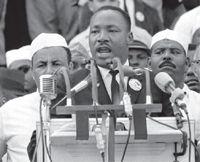
“I have a dream.” Dr. King in Washington, DC,
August 28, 1963
38 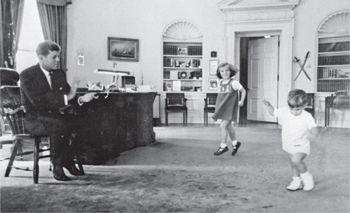
Caroline and John Jr. in the Oval Office