
Joseph Patrick Kennedy 1888–1969
Joseph Patrick Kennedy was born in Boston, Massachusetts on 6 September 1888. He was the eldest child and only surviving son of prominent businessman and politician PJ Kennedy, and his wife, Mary Hickey. Having received his early education at the Catholic Xaverian School, Joe transferred to the prestigious Boston Latin School at the age of thirteen. In 1908, he was accepted to Harvard and graduated in 1912.

Joseph Kennedy
Highly ambitious from an early age, Joe began his career at the Columbia Trust Company, a banking institution which was controlled by his father. The young man’s exceptional business acumen saw him rise quickly up the ranks, and, by the age of twenty-five, he was the country’s youngest-ever bank president.
In October 1914, Joe married his long-time sweetheart, Rose Fitzgerald. The couple would go on to have nine children: four boys and five girls.
During World War One, Joe worked as an assistant manager at a major shipyard, supervising the production of warships and other equipment critical to the war effort. He later branched out into stock market trading, and avoided catastrophe by cashing in his investments before the Wall Street Crash of 1929. Having succeeded in his stated aim of becoming a millionaire by the time he was thirty-five, Kennedy’s later business ventures, which included whiskey importation and movie production, only added to his fortune.
Joe first became involved in politics when he lent his support to Franklin D Roosevelt’s successful presidential campaign in 1932. In exchange for his significant financial donations, Roosevelt appointed Kennedy president of the US Securities and Exchange Commission (SEC), a newly established body tasked with regulating the financial industry. When asked to explain his decision, FDR reportedly claimed that ‘it takes a thief to catch a thief’, a reference to some of Joe’s allegedly illegitimate business dealings.
Kennedy’s tenure at the SEC was followed by a brief stint as Chairman of the Maritime Commission, and then in 1938 he was appointed as the United States Ambassador to Great Britain. However, his opposition to US intervention in World War Two made him unpopular with many senior British politicians, including Churchill. He was forced to resign in December 1940 after he declared in a newspaper interview that ‘democracy is finished in England’.
In 1941, Kennedy, on the advice of doctors, authorized a lobotomy on his third child and eldest daughter, Rosemary. The twenty-three-year-old was believed to suffer from mental retardation and was prone to severe mood swings. It was hoped the procedure would alleviate her symptoms. It did not. Rosemary was left with a permanent mental disability and was institutionalized for the rest of her life. She died in 2005 at the age of eighty-six.
Joe Kennedy never made any secret of the ambitions he held for his family. ‘I got Jack into politics’, he told a reporter in 1957, ‘I was the one. I told him Joe was dead and that it was therefore his responsibility to run for Congress. He didn’t want to do it. He felt he didn’t have the ability and he still feels that way. But I told him he had to do it.’
Joe Kennedy suffered from a stroke on 19 December 1961, which left him partially paralysed and without speech. Further strokes followed, and he eventually died on 18 November 1969, at the age of eighty-one. He nevertheless outlived his sons Jack and Bobby, both of whom were assassinated.
Rose Fitzgerald Kennedy 1890–1995
Born on 22 July 1890, Rose Fitzgerald was the eldest child of John Francis ‘Honey Fitz’ Fitzgerald and Mary Josephine Hannon. Having received her education at Dorchester High School, she graduated in 1906. An accomplished musician, Rose also studied piano at the New England Conservatory. In 1914, at the age of twenty-four, she married the ambitious Joseph Kennedy. Over the course of seventeen years, she would bear a total of nine children, only five of whom would outlive her.
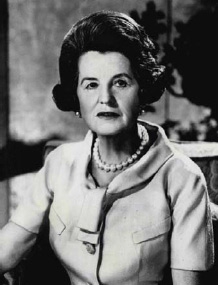
Rose Fitzgerald Kennedy, 1969
A devout Roman Catholic who did not believe in divorce, Rose endured her husband’s many infidelities. In 1951, Pope Pius XII bestowed on her the honorary title of ‘Papal countess’ in acknowledgement of her ‘exemplary motherhood and many charitable works’. As she had once asked, ‘Wasn’t there a book about Michelangelo called The Agony and the Ecstasy? That’s what my life has been.’ Rose Fitzgerald Kennedy died on 22 January 1995, at the age of 104.
Jacqueline Lee Bouvier Kennedy Onassis 1929–1994
Born on 28 July 1929 in Southampton, New York, Jacqueline Lee Bouvier was the eldest of two daughters. Her parents were John ‘Black Jack’ Bouvier, a successful Wall Street stockbroker and Janet Norton Lee. The couple divorced in 1940, when Jacqueline was ten years old.
A bright child, Jacqueline enjoyed reading and did well at school. One of her teachers described her as ‘a darling child, the prettiest little girl, very clever, very artistic, and full of the devil.’ In addition to taking lessons in French and ballet, Jacqueline was also an accomplished equestrienne, and her love of horses would last her a lifetime. Jacqueline’s teenage years were spent at an exclusive boarding school in Connecticut. Graduating in 1947, she continued her education at Vassar College, where she read French, history, art, and literature. Two years later, in 1949, Jacqueline participated in a study abroad programme, which saw her relocating to France to attend the University of Grenoble and the Sorbonne. Returning to the US in 1950, she completed her education at the George Washington University in Washington DC.
She began her career in 1951 as the ‘Inquiring Camera Girl’ for the Washington Times-Herald newspaper. During this time, she was briefly engaged to John Husted, another stockbroker, but she ended the relationship in March 1952. In May of that year, Jacqueline met Senator John Fitzgerald Kennedy at a dinner party. After a ‘spasmodic’ courtship, they became engaged the following year. The wedding took place on 12 September 1953 at St Mary’s Church in Newport, Rhode Island.

Jackie Kennedy
The marriage was fraught with difficulties from the outset, not least of which was Senator Kennedy’s serial infidelity. Jackie’s first pregnancy ended in miscarriage in 1955, and she gave birth to a stillborn daughter in August 1956. Happily, a healthy daughter, Caroline, arrived in November 1957, followed by a son, John Jr, in 1960. A second son, Patrick Bouvier Kennedy, was born on 7 August 1963, but died two days later from a respiratory illness.
Jacqueline, who disliked the shortening of her name to ‘Jackie’, occupied the role of First Lady of the United States from 1961 until her husband’s assassination in late 1963. During this time, she dedicated herself to the restoration of the White House, and with the help of conservation specialists and art experts she succeeded in establishing the White House as the nation’s cultural centre. She enjoyed widespread popularity as First Lady and was regarded as a style icon the world over.

Jackie Kennedy with her husband and children, 1962
On 22 November 1963, as she was travelling alongside her husband in an open-top car through the streets of Dallas, President Kennedy was shot. Accompanying her husband’s body back to Washington DC on board Air Force One, the former First Lady witnessed the swearing in of Lyndon B Johnson as her husband’s successor. Her bloodstained, pink Chanel suit became another defining image of that terrible day.
In 1968, Jacqueline married the Greek shipping tycoon Aristotle Onassis. The pair remained together until Onassis’s death in 1975. In later years, Jacqueline worked as an editor for the publishing houses Viking Press and Doubleday. She died from non-Hodgkin’s lymphoma on 19 May 1994, at the age of sixty-four. She was laid to rest beside President Kennedy in the Arlington National Cemetery in Virginia.
Lyndon B Johnson 1908–1973
Often referred to simply as ‘LBJ’, Lyndon Baines Johnson was born on 27 August 1908 in Stonewall, Texas, where his family owned a small farmstead. He was the eldest child of Sam Ealy Johnson and his wife Rebekah Baines. In 1913, the family moved to Johnson City, which was named after LBJ’s ancestors, who had helped to settle the area. Here, he attended the Johnson City High School, graduating in 1924. In 1927, Johnson enrolled at the Southwest Texas State Teachers College, earning a Bachelor of Science in 1930.

Lyndon B Johnson
Moving to Washington in 1931, Johnson worked as secretary to Congressman Richard Kleberg. By 1934, he had met Claudia ‘Lady Bird’ Alta Taylor, and the pair married in November of that year. The couple went on to have two children, Lynda and Luci.
In 1937, Johnson was elected to the House of Representatives as Congressman for the 10th Congressional District of Texas. After six terms in Congress, he successfully ran for the Senate in 1948 and, in 1953, became the youngest-ever Minority Leader. In 1960, LBJ won the Democratic Party’s vice-presidential nomination and contested the general election alongside the presidential nominee, John Fitzgerald Kennedy.
On 8 November, the Kennedy–Johnson ticket narrowly defeated their rivals. Both men were sworn into office on 20 January 1961. Less than three years later, on 22 November 1963, Johnson became the 36th President of the United States, following Kennedy’s assassination in Dallas. He took his Oath of Office on Air Force One, in the presence of Jackie Kennedy, who was accompanying her husband’s body back to Washington. LBJ was re-elected in the 1964 presidential election.

Taking the Oath of Office on Air Force One, 1963
One of his first acts as President was to establish ‘The President’s Commission on the Assassination of President Kennedy’ (otherwise known as the Warren Commission). During his time in office, Johnson signed into law Kennedy’s Civil Rights Bill. He also introduced major reforms to social services, approving federal funding for education, and establishing the Medicare and Medicaid programmes. However, his decision to reverse Kennedy’s planned withdrawal of troops from Vietnam was criticized in some quarters, and his popularity suffered greatly as opposition to the Vietnam War mounted.
Worried about his failing health and struggling to cope with the internal party tensions caused by the ongoing war in Vietnam, LBJ shocked the nation by announcing in March 1968 that he would not be contesting the presidential election later that year. Upon leaving the White House, LBJ and Lady Bird retired to their ranch in Texas. He died of heart failure four years later, on 22 January 1973. He was sixty-four years old.
Robert Kennedy 1925–1968
Robert Francis ‘Bobby’ Kennedy was born on 20 November 1925, the seventh child of Joe Sr and Rose Kennedy. He was educated at Milton Academy, a preparatory school in Massachusetts. Kennedy was accepted to Harvard in 1946. After graduating with a degree in Government, he continued his studies at the University of Virginia, gaining a law degree in 1951. A year earlier, Bobby had married Ethel Skakel, with whom he would have eleven children.
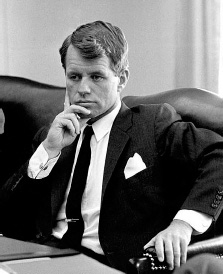
Robert ‘Bobby’ Kennedy, 1964
Kennedy began working at the Department of Justice in 1951, but left a year later to manage his brother’s successful Senate campaign. He later worked for Senator McCarthy on his controversial Subcommittee on Investigations. Controversially, Bobby was appointed Attorney General by President Kennedy in 1961. Following his brother’s assassination, Kennedy launched a successful bid for a seat in the Senate, and four years later, he announced his intention to run for president.
Robert Kennedy was shot on 5 June 1968, at the Ambassador Hotel in California, shortly after winning the Californian Democratic primary. He died the following day and was buried at Arlington National Cemetery in Virginia.
Lee Harvey Oswald 1939–1963
Lee Harvey Oswald was born two months after his father’s death on 18 October 1939 in New Orleans. A troublesome student, Oswald was referred to a psychiatrist in his early teens. He was diagnosed with a ‘personality disorder’, now thought to have been schizophrenia, but did not receive any treatment. In 1956, he joined the US Marines, where he became a skilled marksman. Oswald, however, harboured Communist sympathies, and in 1959 he left the United States for the Soviet Union.

Lee Harvey Oswald, US Marine
In 1961, after a six-week courtship, Oswald married Marina Nikolayevna Prusakova in Minsk. The couple’s first child was born in February 1962. Having been unsuccessful in his bid to gain Soviet citizenship, the family returned to the US in June.
In October 1963, just before the birth of his second daughter, Oswald started work at the Texas Book Depository in Dallas. Six weeks later, he allegedly smuggled his rifle into the building and shot President Kennedy from a sixth-floor window. Forty-five minutes after the assassination, Oswald allegedly shot a policeman before being arrested a little time later while taking refuge in a movie theatre. Oswald was shot in the abdomen by Jack Ruby on 24 November 1963 as authorities were preparing to transfer him to county jail. He died at around 1pm at Parkland Memorial Hospital.
Jack Ruby 1911–1967
Jack Ruby was born Jacob Rubenstein on 25 March 1911, in Chicago, Illinois. The son of Polish émigrés, he was the fifth of eight surviving children. Jack had a difficult childhood, and spent some time in care at foster homes.
In 1943, Ruby was drafted into the United States Air Army Forces and was honourably discharged in 1946, after which time he became involved in the nightclub business. He was also rumoured to have been involved in organized crime.

Jack Ruby
On 24 November 1963, Ruby shot Lee Harvey Oswald in the abdomen as authorities were preparing to transfer Oswald to county jail. The assassination was captured by a number of television cameras and was broadcast live to the nation. On 14 March 1964, Ruby was found guilty of Oswald’s murder and sentenced to death. Ruby appealed both the conviction and the sentence, but died of lung cancer on 3 January 1967, before his appeal came to court.
Nikita Khrushchev 1894–1971
Nikita Sergeyevich Khrushchev was born in April 1894 into a poor mining family near the current Ukrainian–Russian border. As a child, he received little schooling, and worked from a young age to help support the family.
He signed up to the Bolshevik Party in 1918, and fought for the Red Army in the Russian Civil War. By 1929, he had enrolled in the Stalin Industrial Academy, and two years later, he had gained employment within the Communist Party. He advanced quickly and became a member of the Politburo in 1939. He was soon despatched to the Ukraine, where he carried on Stalin’s campaign of political suppression. His actions in support of Stalin’s purges earned him the nickname ‘the butcher of the Ukraine’.
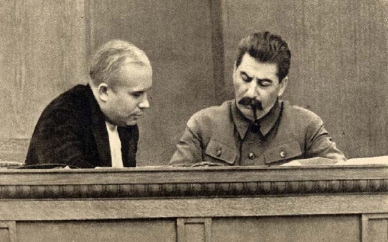
Khrushchev with Joseph Stalin, 1936
Khrushchev became First Secretary of the Communist Party following Stalin’s death in 1953, and Premier of the Soviet Union in 1958. However, his mishandling of relations with the West during the Cold War, including his questionable decision-making during the Cuban Missile Crisis, made him unpopular and he was eventually ousted in 1964. He died on 11 September 1971.